

How Does Chickenpox Progress Stage by Stage? First Spots to Crusted Blisters and Isolation End

Key Takeaways
- Each chickenpox spot passes from flat pink macule to crust in about 24 to 48 hours, while the whole rash typically runs 4 to 7 days because new crops keep appearing.
- The incubation period is 10 to 21 days, which is why siblings often break out two weeks apart and why the first case in a class has usually spread before it is noticed.
- A person is contagious from 1 to 2 days before the first spot until every blister has crusted, and NHS notes that point is usually about 5 days after the spots appear.
- Cloudy fluid in an older blister is the immune system clearing virus, not infection; a hot, spreading, painful spot is the sign that actually suggests bacterial infection.
- Aspirin should not be given to children or teenagers with chickenpox because of Reye's syndrome, and NHS advises avoiding ibuprofen unless a doctor says otherwise.
- Fully crusted scabs are no longer infectious even before they fall off, and picking them off early is the main avoidable cause of pitted scars.
Chickenpox rash usually moves through four visible stages over about 4 to 7 days: flat pink spots, small raised bumps, clear fluid-filled blisters, and finally cloudy blisters that dry into crusts. New crops keep appearing for several days, so all stages coexist. A person is contagious from 1 to 2 days before the first spot until every blister has crusted, which is when isolation typically ends.
It starts with one spot behind an ear, the kind you would ignore on any other Tuesday. By bedtime there are six across the chest, and a preschooler who was bouncing at breakfast is warm, clingy and off her dinner. Somewhere between the bath and the pajamas, a parent says the word out loud: chickenpox.
What follows is a week of counting. Counting spots, counting days, counting the hours until nursery will take her back. Most families have a rough idea that the rash blisters and then scabs, but the details get fuzzy: how many crops, which days are the miserable ones, what a healing blister looks like versus an infected one, and when the door can finally open again.
This explainer walks through the chickenpox stages of rash the way a clinician sees them, spot by spot and day by day, grounded in what CDC, NHS and Mayo Clinic actually publish, so the counting comes with a map.
What are the chickenpox stages of rash, and what is actually happening in the skin?
Chickenpox is caused by the varicella-zoster virus, a member of the herpes virus family that spreads through the air and through fluid from blisters. After it enters through the nose or mouth, it multiplies quietly in lymph nodes and then travels in the bloodstream to the skin. Every spot you see is a small colony of infected skin cells where the immune system has arrived to fight.
Clinicians describe the rash in four stages, and the words are worth learning because they will appear in any letter from a doctor. A macule is a flat, pink, discolored patch you can see but not feel. A papule is a small raised bump. A vesicle is a thin-walled blister filled with clear fluid. A crust, or scab, is the dried remnant once the blister has broken or been reabsorbed.
The signature of chickenpox, and the reason experienced clinicians often recognize it across a room, is that these stages do not happen in neat sequence across the whole body. New spots erupt in waves, or crops, for several days, so a child on day three will have flat pink spots on the legs, fresh blisters on the chest and drying crusts on the face all at once. CDC notes that a typical case produces roughly 250 to 500 itchy lesions in total, most of them on the trunk, face and scalp before spreading outward.
Each individual spot travels from macule to crust in about 24 to 48 hours. The whole rash, from the first spot to the last crust, typically takes 4 to 7 days according to CDC. Understanding those two clocks, the single-spot clock and the whole-body clock, is the key to reading everything that follows.
Chickenpox incubation period: the hidden days before the first spot
The incubation period is the stretch between catching the virus and showing any sign of it. For chickenpox it is long, typically 10 to 21 days according to CDC, with most people breaking out around two weeks after exposure. That long, silent window is why chickenpox travels so efficiently through a classroom: by the time the first child is spotted, the virus has already had a fortnight to spread.

In the last 1 to 2 days before the rash, many people, especially older children and adults, feel generally unwell. This is the prodrome, a word for the early symptoms that precede the main event. Mayo Clinic lists fever, tiredness, loss of appetite and headache in this phase. Young children often skip it entirely and simply appear with spots.
The prodrome matters for one practical reason. CDC states that a person with chickenpox is contagious from about 1 to 2 days before the rash appears. A child who felt off-color at a birthday party on Saturday and broke out on Monday was almost certainly infectious at the party. Parents cannot be blamed for what they could not see, but it explains why exposure letters from schools tend to arrive after the fact.
One more feature of this stage catches families out. Someone who had chickenpox as a child or who received the vaccine may still develop a mild version after exposure. CDC describes this breakthrough disease as usually milder, often with fewer than 50 spots, little or no fever, and a shorter course, yet still contagious. A faint scatter of spots on a vaccinated teenager deserves the same isolation logic as a full-blown case.
Days 1 to 2 of the rash: flat pink spots and small bumps
The first spots almost always appear on the face, scalp or trunk. Mayo Clinic describes them as raised pink or red bumps that break out over several days, and in the earliest hours a spot may be nothing more than a flat pink blotch, easy to mistake for a mosquito bite or a heat rash. Within a few hours the flat macule lifts into a firm little papule, and the itch begins.
Two things distinguish this first crop from ordinary bites even before blisters form. First, location: bites cluster on exposed skin such as ankles and forearms, while chickenpox favors the covered trunk, the hairline and the back of the neck. Second, tempo. Bites arrive all at once; chickenpox keeps arriving. A parent who marks the spots with a pen before bed will usually find that the count has doubled by morning.
Fever, if present, tends to be highest in the first few days of the rash and then eases as crops slow. NHS lists a high temperature, aches and loss of appetite alongside the spots. Toddlers may also develop spots inside the mouth, which show up as small painful ulcers and can turn a normally enthusiastic eater into a reluctant one. Cold, soft foods and plenty of fluids matter more than usual on these days, because a feverish, itchy child who is also refusing drinks is at real risk of dehydration.
Keeping fingernails short from day one is not fussiness. Bacterial infection of scratched spots is the most common complication of chickenpox in children according to CDC, and the groundwork for preventing it is laid in the first 48 hours, when spots are still bumps and the scratching habit has not yet set in.
Days 2 to 4: the dewdrop blister stage, when the itch peaks
Within about a day of appearing, each papule fills with clear fluid and becomes a vesicle, the small tense blister that gives chickenpox its unmistakable look. Textbooks call it a dewdrop on a rose petal: a glistening clear dome sitting on a pink halo of inflamed skin. The wall is thin enough to tear with a fingernail, which is exactly what happens hundreds of times a day if nobody intervenes.
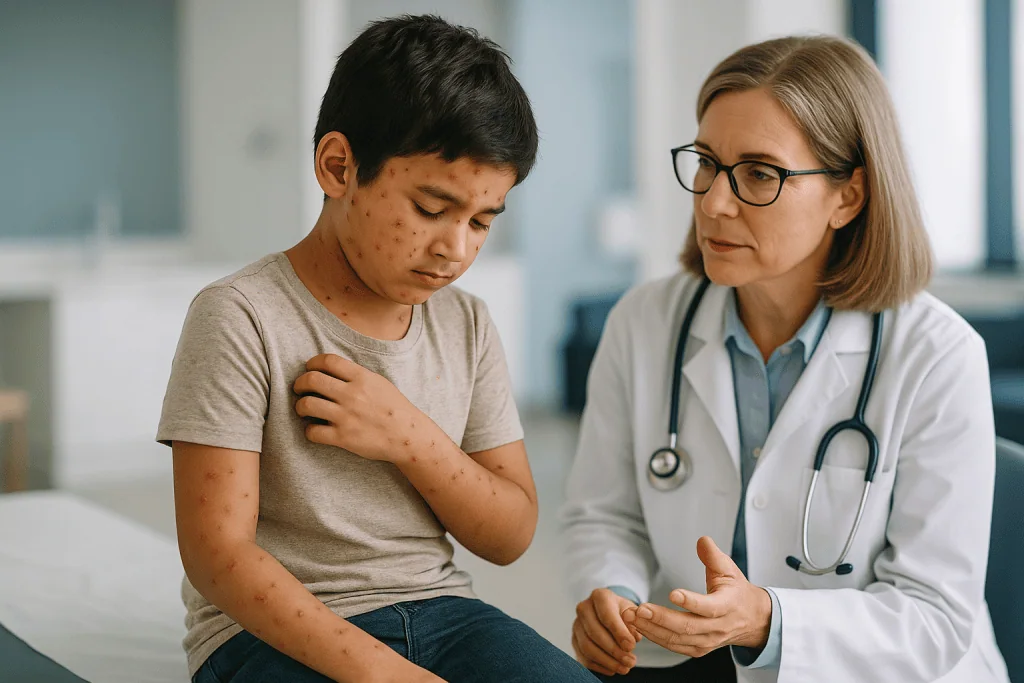
This is the stage most people mean when they ask about the worst of chickenpox. Blisters are appearing in fresh crops, older ones are stretched and itchy, and the fluid inside is loaded with virus. Mayo Clinic notes that the blisters break and leak, and the fluid is one of the two ways the infection spreads to other people. Anything the fluid touches, including bedding and towels, is worth laundering rather than sharing.
Relief at this stage is about the skin surface and the nervous system, not the virus. Lukewarm baths with colloidal oatmeal or baking soda, soothing lotions such as calamine, loose cotton clothing and keeping the room cool are all listed by Mayo Clinic as reasonable comfort measures. Antihistamine medicines are sometimes suggested to help with itch and sleep; whether one is appropriate, and which, is a question for the child’s clinician or pharmacist rather than a decision to make from the medicine cabinet.
Watch the blister count rather than individual blisters. When the number of brand-new clear vesicles each morning starts to fall, the peak has passed. In most cases that turn comes around day 3 to 5, though a small proportion of children, particularly those with eczema, produce heavier and longer crops.
Days 4 to 7: cloudy blisters, crusting and the end of new crops
Around the fourth day, the fluid inside older blisters turns from clear to cloudy or yellowish. This is the immune system at work, not infection, and it is a welcome sign: white blood cells have flooded the blister to clear the virus. The cloudy vesicle then either breaks or slowly shrinks, and a dry crust forms in its place. Mayo Clinic describes this as the final of the three visible phases, with crusts and scabs covering the broken blisters and taking several more days to heal.
New crops usually stop by about day 5, though CDC gives the overall rash a range of 4 to 7 days. The morning when a parent finds no fresh clear blisters anywhere on the body is the practical turning point for the whole illness. Fever has typically gone by now, appetite creeps back, and the child begins to look like a child with scabs rather than a child who is ill.
Crusts should be left alone. Picking them off before the skin beneath has closed raises the chance of both bacterial infection and a pitted scar. Most crusts fall away on their own within 1 to 2 weeks, leaving a flat pink or slightly pale mark that fades over weeks to months. Permanent scarring is uncommon and is nearly always the result of a scratched or infected spot rather than the virus itself.
A few late spots may still be in the blister phase while the rest are crusting. This lag is normal and is the reason guidance about isolation is written around the last blister rather than the first scab.
Chickenpox stages of rash at a glance: a day-by-day table
The table below pulls the timeline together. Ranges are typical figures from CDC and Mayo Clinic, not promises; children with eczema, adults, and people with weakened immunity often run longer and heavier, while vaccinated people who catch breakthrough disease often run shorter and lighter.
| Phase | Typical timing | What you see | Contagious? |
|---|---|---|---|
| Incubation | 10–21 days after exposure | Nothing visible | No, until the last 1–2 days |
| Prodrome | 1–2 days before rash | Fever, tiredness, headache, poor appetite; often absent in young children | Yes |
| Macules and papules | Rash day 1–2 | Flat pink spots lifting into small bumps on face, scalp, trunk | Yes |
| Vesicles | Rash day 2–5 | Clear dewdrop blisters in waves; peak itch; fresh crops each morning | Yes, highest |
| Cloudy blisters and crusting | Rash day 4–7 | Fluid turns cloudy, blisters dry to crusts; new crops stop | Yes until every blister has crusted |
| Healing | 1–2 weeks after crusting | Crusts fall off, pink marks fade | No |
Two lines in this table do most of the work in real family decisions. The incubation line explains why siblings often break out two weeks apart rather than together, and why a household can feel as though it has had chickenpox for a month. The crusting line explains the isolation rule: NHS and CDC both anchor the end of infectiousness to the moment every spot has scabbed, which NHS notes is usually about 5 days after the spots first appeared.
If a spot is clear or cloudy and still soft, it counts as a blister. Only when it is dry, dark and no longer weeping does it move to the safe side of the line.
How can you tell if a rash is chickenpox? What clinicians look for
Parents searching for pictures usually want one answer: is this it? Photographs help, but chickenpox is diagnosed less by any single spot than by a pattern, and the pattern has three parts that clinicians weigh together.
The first is distribution. Chickenpox typically begins centrally, on the trunk, face and scalp, and spreads outward, with fewer lesions on the palms and soles. Spots in the hair and inside the mouth are common and are unusual in most look-alike conditions. The second is the mixture of stages. Finding flat spots, blisters and crusts side by side at the same moment is the classic clue, because bites, hives and drug rashes tend to be at one stage throughout. The third is context: a known exposure 10 to 21 days earlier, a fever that arrived with the spots, and a child who has not completed the varicella vaccine series.
Several conditions borrow parts of this picture. Hand, foot and mouth disease produces blisters, but they favor the palms, soles and mouth rather than the trunk. Impetigo, a bacterial skin infection, forms honey-colored crusts but rarely clear blisters and rarely a fever. Insect bites cluster on exposed skin and do not form crops over days. Shingles, caused by the same virus reactivating later in life, stays within a single band of skin on one side of the body.
When the picture is unclear, or when the person is pregnant, newborn or immunocompromised, a clinician can confirm the diagnosis by swabbing blister fluid for a laboratory test that detects viral genetic material. CDC lists this PCR test as the preferred method. For a well child with a textbook rash, the diagnosis is often made on sight, ideally by phone or video so the child does not sit in a waiting room shedding virus.
What are the worst days of chickenpox?
Ask a room of parents and most will point to rash days 2 to 4. That matches the biology. Fever tends to peak early in the rash, new blisters are still arriving in crops, the earlier ones are stretched and itchy, and sleep collapses for everyone in the house. NHS describes the spots as very itchy and lists a high temperature and aches as typical companions, and those symptoms overlap most heavily in that middle window.
The pattern shifts with age. Young children usually have the mildest course. Teenagers and adults are more likely to have a marked prodrome, higher fever, more lesions and a higher chance of complications, particularly pneumonia, according to CDC. For an adult, the worst days may therefore include the day before the rash, when the person feels genuinely ill without yet knowing why.
The itch deserves its own paragraph, because it is what turns a manageable illness into a wretched one. Itch is worst when the skin is warm, so overheated bedrooms, hot baths and heavy blankets all make nights harder. Cooling the skin, trimming nails, dressing in soft cotton and offering distraction during the peak evenings are low-tech measures with real effect. Cotton gloves or socks on the hands of a toddler at night are an old idea that still works.
Nobody should expect an entirely comfortable week, but a steadily rising temperature after day 3, a child who stops drinking, or a spot that becomes hot, spreading and painful are signs the illness has left the ordinary path. Those belong in the red-flag section later, not on the list of things to wait out.
How long is chickenpox contagious, and when can school or work restart?
Chickenpox spreads two ways. It travels through the air in tiny droplets when an infected person breathes, talks or coughs, and it passes through direct contact with blister fluid. CDC calls it highly contagious: up to 90 percent of susceptible close contacts of an infected person will catch it. That figure explains why a single case in a daycare is treated as an outbreak in waiting.
The contagious window runs from 1 to 2 days before the rash until all lesions have crusted, according to CDC. NHS phrases the same rule for families: stay away from school, nursery or work until every spot has formed a scab, which is usually about 5 days after the spots first appeared. Notice what is not in that rule. Fever gone is not the marker. Feeling well is not the marker. Scabs falling off is not the marker either; a fully crusted rash is no longer infectious even while the crusts remain.
The people most worth protecting during this window are those for whom chickenpox is not a childhood nuisance. CDC identifies pregnant women, newborns, and people with weakened immune systems from illness or treatment as being at highest risk of severe disease. A practical rule for the isolation days is to avoid visiting anyone in those groups, to warn any household member who might be pregnant, and to let the school know so that exposure letters can go out.
Vaccinated people who develop mild breakthrough chickenpox are still contagious and follow the same crusting rule. The virus also survives poorly outside the body, so ordinary laundering of bedding and normal household cleaning are sufficient; no special disinfectant regimen is needed.
What kills the chickenpox virus? What treatment actually does and does not do
The honest answer is that nothing kills varicella-zoster virus in the body. The immune system controls it, clears active infection from the skin within about a week, and then the virus retreats into nerve roots near the spinal cord and stays there for life. Decades later it can reawaken as shingles. CDC estimates that about 1 in 3 people in the United States will develop shingles in their lifetime, which is the long tail of a childhood infection.
Treatment for most healthy children is supportive, meaning it targets comfort rather than the virus. Fever control, fluids, itch relief and skin care are the whole plan. Two safety points are consistent across CDC, Mayo Clinic and NHS. Aspirin should not be given to children or teenagers with chickenpox because of the link with Reye’s syndrome, a rare but serious condition affecting the liver and brain. NHS also advises against using ibuprofen in chickenpox unless a doctor says otherwise, because of a possible association with serious skin infections. Which fever medicine is appropriate, if any, is a decision for the treating clinician or pharmacist.
Antiviral medicines exist, and they do something specific: they block the enzyme the virus uses to copy its genetic material, slowing the production of new virus. They do not remove virus already inside cells, which is why CDC notes they work best when started within 24 hours of the rash appearing and why they are generally reserved for people at higher risk of complications, such as adults, adolescents, pregnant women, newborns and people with weakened immunity. Whether antiviral treatment is warranted is a clinical judgment made case by case.
Prevention is the strongest tool of all. CDC reports that the varicella vaccine series is about 90 percent effective at preventing chickenpox, and that since the vaccination program began, cases and hospitalizations in the United States have fallen dramatically.
Who usually rides chickenpox out at home, and who should be assessed the same day?
Most otherwise healthy children between about one year and puberty have a self-limiting illness that resolves at home without ever being seen in person. That is the reassuring baseline, and it is why many health systems ask families to phone rather than walk in, both to spare the waiting room and because there is usually nothing a clinic visit adds for a well child.
Several groups sit outside that baseline, and for them a same-day conversation with a clinician is the standard advice from CDC and NHS. Babies under about four weeks old have immature immune defenses. Pregnant women face two separate risks: severe pneumonia in the mother, and, depending on the stage of pregnancy, harm to the developing baby. Anyone whose immune system is weakened by illness or by treatments such as chemotherapy, long-term steroid use or medicines for organ transplant can develop widespread, prolonged disease. Teenagers and adults catching chickenpox for the first time have a higher complication rate than young children. People with significant eczema often develop heavier rashes with more risk of skin infection.
The other group who need prompt advice are not the people with chickenpox but the people exposed to it. A pregnant woman, newborn or immunocompromised person who has had close contact with a case should contact their clinician quickly, because there are preventive options, including vaccination or an injection of antibodies, that work only within a short window after exposure. CDC describes these post-exposure measures; timing and eligibility are decided by the clinician.
Everyone else is usually asked to wait, watch and keep in touch. Waiting is not neglect. It reflects the evidence that for the average child the illness is uncomfortable, memorable and safe.
How to tell if chickenpox is getting better: chickenpox scabs falling off and the weeks after
Recovery has a recognizable sequence, and knowing it stops families from mistaking normal healing for a setback. The first sign is arithmetic: fewer new clear blisters each morning until, one day, there are none. Fever usually settles at about the same time. Appetite and energy follow a day or two behind, often before the skin looks any better.
The skin then goes through what can look like a second illness. Cloudy blisters flatten and darken into crusts, and a child on day 6 can look worse in photographs than on day 3, covered in brown scabs rather than neat pink dots. This is progress. Crusts are the finish line for infectiousness, and Mayo Clinic notes they take several more days to heal beneath before falling away.
Over the following 1 to 2 weeks the scabs drop off on their own, usually from the face first because those spots appeared first. Underneath is fresh pink or pale skin that may look slightly indented for a few weeks and then flattens. In darker skin, spots often leave paler or darker marks that take longer to even out. Sun protection on healing skin helps limit lasting discoloration. A shallow pitted scar is possible where a spot was deeply scratched or infected, but it is the exception.
Tiredness can linger for a week or so after the rash, particularly in older children and adults. A cough that appears or worsens after the rash is settling, a spot that swells and reddens while the others fade, or a child who becomes drowsy or unsteady as the skin improves are not part of recovery and warrant a call, as the final section explains.
What people often get wrong about chickenpox
The myth with the most consequences is the chickenpox party, the deliberate exposure of healthy children so they catch it young. It made a kind of sense before a vaccine existed. Today CDC is unambiguous that it is unsafe: there is no way to predict which child will have a mild case and which will develop pneumonia, brain inflammation or a serious skin infection. In the years before the vaccine, CDC records about 4 million cases, 10,500 to 13,000 hospitalizations and 100 to 150 deaths in the United States each year, most in previously healthy children.
The second myth is that once the fever breaks, the child can go back to school. Infectiousness is tied to the blisters, not the temperature, and a bright, playful child with three weeping blisters is still shedding virus.
The third is that chickenpox is a one-time event. It is, in the sense that second cases of chickenpox are uncommon, but the virus never leaves. It waits in nerve roots and can return as shingles decades later, and a person with shingles can pass the virus to someone who has never had chickenpox or the vaccine, giving them chickenpox rather than shingles.
Fourth, the idea that you can catch chickenpox by touching scabs. Once a spot has fully crusted, it is no longer infectious; the risk was in the fluid, not the dry scab.
Finally, the belief that popping blisters speeds healing. It does the opposite, opening the skin to bacteria and raising the odds of scarring. Blisters resolve fastest when left intact, cool and unscratched.
Questions to ask your care team
Most chickenpox care happens by phone, and a short, prepared list turns a rushed call into a useful one. These are the questions that tend to matter, drawn from what clinicians most often find themselves explaining.
- Given this child’s age and health, is this a case you expect to manage at home, and what would change that?
- Which fever medicine, if any, is appropriate for this child, and which should be avoided?
- What can we safely use for the itch, and is there anything about our child’s skin or other medicines that changes the answer?
- Are there spots in the mouth or near the eyes that you would want to look at, and how should we care for them?
- Is anyone in our household in a higher-risk group, and if so, what should they do now?
- Are antiviral medicines relevant for anyone in our family, and by when would that decision need to be made?
- How will we know the rash has fully crusted, and is there anything the school or nursery will want from you?
- Are the other children in the house up to date with varicella vaccination, and is it worth acting on that now?
- What specific changes should prompt us to call back the same day, and what should send us straight to emergency care?
It also helps to have the numbers ready before the call: the date the first spot appeared, the highest temperature recorded, roughly how many new blisters appeared this morning, and how much the child has been drinking. Clinicians make better judgments on a child they cannot see when the description is specific, and parents feel more in control when they are reporting data rather than worry.
When to call your doctor: red-flag signs during chickenpox
Ordinary chickenpox is a week of misery that improves on its own. The signs below are the ones CDC, Mayo Clinic and NHS list as reasons to contact a clinician promptly, because they suggest the illness has moved beyond the skin or that a higher-risk situation exists.
Call the same day if the person with chickenpox is a baby under about four weeks, is pregnant, or has a weakened immune system from illness or treatment. Call if any spot becomes very red, warm, swollen or painful, or if the redness spreads outward; this suggests a bacterial skin infection, the most common complication in children according to CDC. Call if the rash spreads into one or both eyes, or if the skin around the spots is blistering in large sheets.
Seek urgent care for a fever above 102°F (38.9°C) that persists or returns after improving, for a stiff neck, severe headache, unusual drowsiness, confusion or difficulty waking, for a new or worsening cough, chest pain or fast breathing, for vomiting that will not stop, for unsteadiness, tremor or trouble walking, or for signs of dehydration such as very few wet nappies, dry lips or no tears when crying. Mayo Clinic lists dizziness, rapid heartbeat and shortness of breath among the warning signs in adults.
If a pregnant woman, newborn or immunocompromised person has been exposed to chickenpox and has not had it or the vaccine, they should contact their clinician straight away rather than waiting for spots, because preventive options depend on timing. Every one of these judgments, from whether to start an antiviral to whether a hot spot needs an antibiotic, belongs to the treating clinician who can see the patient and knows the history.
Frequently asked questions
What are the worst days of chickenpox?
For most children the hardest stretch is rash days 2 to 4, when fever peaks, new blisters are still arriving in crops and the itch is at its height. Teenagers and adults often feel worst slightly earlier, in the 1 to 2 days of fever and aches before the rash appears. Symptoms generally ease once new blisters stop, usually around day 5.
How can you tell if a rash is chickenpox rather than bites or another virus?
Clinicians look for a pattern rather than a single spot: a rash that starts on the trunk, face or scalp, spots at several stages at once (flat, blistered and crusted side by side), itch, often a fever, and a known exposure 10 to 21 days earlier. A swab of blister fluid can confirm it in uncertain or higher-risk cases.
What kills the chickenpox virus?
Nothing eliminates varicella-zoster virus from the body; the immune system controls it within about a week, and the virus then rests in nerve roots for life. Antiviral medicines slow viral copying and are used mainly for higher-risk people, ideally within 24 hours of the rash. Outside the body the virus is fragile, and normal laundering and cleaning suffice.
How can you tell if chickenpox is getting better?
The clearest sign is that no new clear blisters appear in the morning, followed by the fever settling and appetite returning. The skin often looks worse before it looks better as blisters darken into crusts. Once every spot is dry and crusted, infectiousness has ended, and the scabs fall off over the next 1 to 2 weeks.
How long is chickenpox contagious?
Chickenpox is contagious from 1 to 2 days before the rash appears until every blister has formed a dry crust. CDC and NHS both use the fully crusted rash, not the end of fever, as the marker, and NHS notes this is usually about 5 days after the spots first appeared. Vaccinated people with mild breakthrough cases follow the same rule.
What does chickenpox look like on the first day?
On day one, chickenpox usually appears as a handful of flat pink or red spots on the face, scalp, chest or back that lift into small bumps within hours. They are easy to mistake for bites, but the count typically doubles overnight and the first clear blisters form within about a day. A fever often accompanies the earliest spots.
What is the chickenpox incubation period after exposure?
The incubation period, the gap between catching the virus and the first symptom, is 10 to 21 days according to CDC, with most cases appearing around two weeks after exposure. During the last 1 to 2 days of that window the person is already contagious, which is why chickenpox spreads through households and classrooms before anyone sees a spot.
When do chickenpox scabs fall off, and will they scar?
Crusts usually fall off on their own within 1 to 2 weeks after forming, leaving pink or pale marks that fade over weeks to months. Lasting pitted scars are uncommon and are nearly always the result of a spot that was scratched open or became infected, so keeping nails short and leaving crusts alone is the best protection.
Can a vaccinated child still get chickenpox?
Yes, though it is uncommon and usually mild. CDC describes breakthrough chickenpox in vaccinated people as typically producing fewer than 50 spots, little or no fever, and a shorter illness. These cases are still contagious until every spot has crusted, so the same isolation rule applies. CDC reports the vaccine series is about 90 percent effective at preventing chickenpox.
Can adults catch chickenpox from a child, and is it worse?
An adult who has never had chickenpox or the vaccine can catch it from a child, and CDC notes adults are more likely than young children to have severe disease, including pneumonia. Adults who have had chickenpox are generally protected from a second episode but carry the virus and may later develop shingles, which can in turn pass chickenpox to susceptible people.
References
- CDC: About Chickenpox
- CDC: Clinical Overview of Chickenpox (Varicella) for Healthcare Providers
- NHS: Chickenpox
- MedlinePlus: Chickenpox
This article is for general information only and is not a substitute for professional medical advice. Please consult a qualified doctor about your individual situation.

More from the Blog

Braces, Splints and Seating in Pediatric Physical Therapy: Checking Fit as Your Child Grows
A child braces and splints fit check is a planned review of how an orthosis, splint or seating system sits on a growing body.…

What Happens in a Sensory Integration Therapy Session? Swings, Textures and Guided Play
A sensory integration therapy session is a structured, play-based occupational therapy visit, typically lasting about an hour, in which a trained therapist guides a…

Phototherapy for Newborn Jaundice: What Happens Under the Lights and How Feeding Continues
Phototherapy treats newborn jaundice by shining blue-green light onto the baby's skin. The light changes bilirubin, the yellow pigment that builds up when an…

Living With Febrile Seizures: Household Planning, Caregiver Briefings and Calm Fever Routines
Parents cope best with febrile seizures by preparing before the next fever: a one-page plan every caregiver can follow, a calm first-aid routine (time…

When Can a Child Bathe, Play and Return to School After Pediatric Surgery? Recovery Milestones
Most children can shower or bathe once the surgical team says the wound may get wet, often within one to two days of a…

Why Are Repeat Echocardiograms Scheduled After Kawasaki Disease and What Do They Track?
Repeat echocardiograms after Kawasaki disease track the coronary arteries, the vessels that supply the heart muscle, because inflammation can stretch them into aneurysms during…