

Hair Transplant
Hospital-based FUE, DHI and Afro hair transplants in Istanbul, natural results, transparent package costs and medical aftercare.
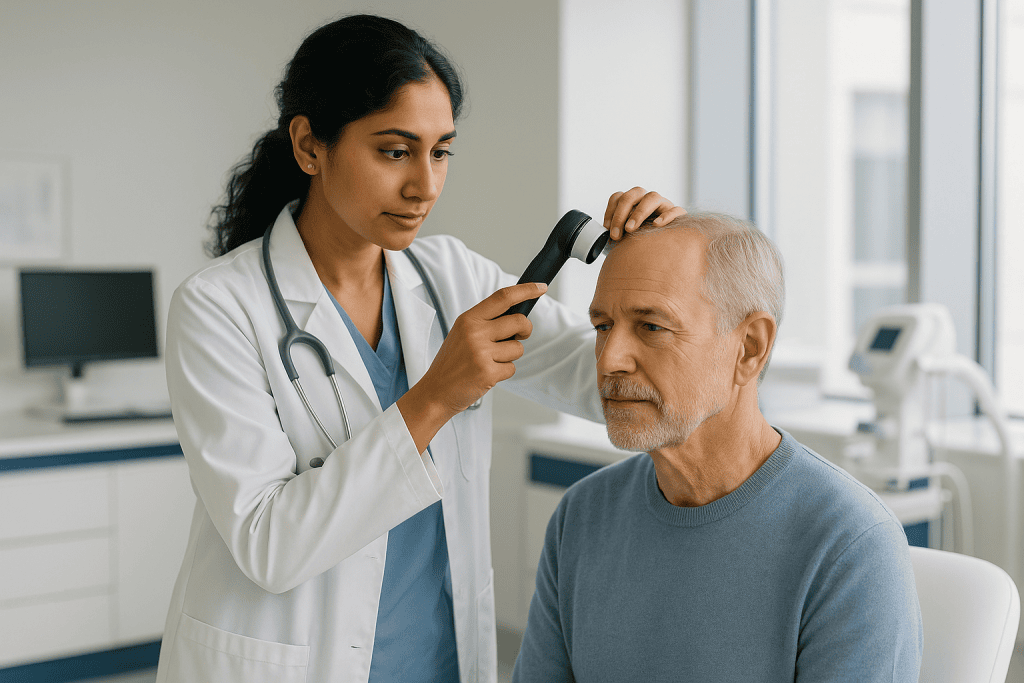
FUE, Sapphire FUE or DHI?
Three modern techniques, one goal: natural, permanent density. Which one fits depends on your pattern, your donor area and your priorities.
FUE
The modern standard: follicles extracted one by one, no linear scar, scales to large sessions.
- Best forMost patterns of loss
- ShavingUsually full shave
- StrengthLarge-session coverage
Sapphire FUE
FUE with sapphire-blade channels: finer incisions, denser placement, smooth healing at the hairline.
- Best forMaximum hairline density
- ShavingUsually full shave
- StrengthFine, dense channels
DHI
Implanter-pen placement with the finest control of angle and direction, ideal for detail and unshaven work.
- Best forHairline detail, women
- ShavingUnshaven possible
- StrengthAngle & direction control
Afro and curly hair? Both FUE and DHI are adapted to curved follicles by our experienced teams. Ask which technique fits your case →
Which stage is your hair loss?
Clinicians grade male pattern loss from 1 to 7. Your stage shapes the plan: the zones, the graft numbers and the honest expectations.
Most good transplant candidates sit between stages 3 and 6. Read the full guide to your stage ↓ or get it graded free from your photos →
The same procedure, around the world
Indicative FUE package market ranges from our cost data: the difference is economics, not standards.
Indicative market package ranges, never a quote: your price depends on your plan and graft count. Your personalised quote is free and carries no obligation.
Hospital-based care vs a storefront clinic
Prices in Turkey range widely because what stands behind them ranges widely. Whoever you choose, check what stands behind the price.
A hospital-based transplant at Acibadem
The standards of a JCI-accredited hospital group, applied to hair restoration.
- ✓Medical assessment before any commitment, cause, donor capacity and general health
- ✓A named, accountable doctor responsible for your case
- ✓Sterile hospital operating standards, audited internationally
- ✓Anesthesia expertise and full hospital backup behind the room
- ✓Written package, written aftercare and structured remote follow-up
Booking anywhere else? Ask these first
Five questions any serious provider answers in writing, including us.
- ?Who is the named doctor on my case, and which steps do they perform?
- ?Where exactly is the procedure performed, and how is it licensed?
- ?How was my graft number decided, before or after my donor area was examined?
- ?What exactly does the price include, and what costs extra on the day?
- ?How does follow-up work after I fly home, and what is the revision policy?
From landing in Istanbul to your full result
- Day 1Arrival, examination & hairline design
- Day 2The procedure: 6–8 calm hours
- Day 3Check, first wash & fly home
- Weeks 2–8Shedding phase, completely normal
- Months 3–9New growth appears and thickens
- Month 12Your full result, permanent hair
Everything in your package
Everything you want to know, answered below
Jump straight to the part of the guide you came for.
Quick answer
A hair transplant unit evaluates and treats hair loss by moving healthy hair follicles from donor areas to thinning or bald areas to restore natural-looking hair growth. At Acibadem in Turkey, care typically includes specialist assessment, treatment planning, modern transplantation techniques, and follow-up support tailored to the patient’s scalp condition and hair pattern.
Turkey is the hair transplant capital of the world, and Istanbul is its heart. Every year, hundreds of thousands of people fly here to restore their hair, drawn by surgeons who plan more hairlines in a month than many clinics abroad see in a year, and by package costs 55–75% below what the same procedure commands in the US, UK or Germany. At Acıbadem International, a hair transplant is something more specific: a medical procedure performed to hospital standards, inside one of Türkiye’s largest hospital groups, with FUE, DHI and Sapphire FUE techniques, dedicated experience in Afro-textured and curly hair, honest package pricing and real medical follow-up after you fly home.
Why the world comes to Turkey for hair transplants
The reasons are practical. First, experience: Turkish teams perform an enormous volume of hair restoration procedures, and in surgery, volume builds skill, hairline design, graft handling and density planning are crafts refined by repetition. A surgeon who plans hundreds of hairlines a year has seen your pattern of loss, your hair type and your donor situation many times before; that pattern recognition is not something a certificate can substitute for. Second, cost: wages, clinic overheads and currency dynamics make an identical procedure genuinely cheaper to deliver in Türkiye, so a result that would cost €10,000–€15,000 in Western Europe or the US is available here for a fraction of that, without cutting corners when you choose the right provider. Third, the infrastructure that has grown around it: direct flights from most of Europe, the Gulf and beyond, English-speaking coordinators, e-visas that take minutes to obtain for most nationalities, and all-inclusive packages that turn a medical trip into a planned three-day visit.
There is also a quieter reason patients mention after the fact: normalcy. In Istanbul, flying in for a hair transplant is unremarkable, and for a procedure that many patients prefer to keep private, being one of thousands is strangely comfortable.
That popularity has a flip side: quality in Turkey ranges from world-class hospital departments to high-volume storefronts where you may never actually meet a doctor. The single most important decision you will make is not FUE versus DHI: it is who performs your procedure and where.
Hospital-based hair transplant: the Acıbadem difference
At Acıbadem International, hair transplantation is performed in a hospital environment rather than a walk-up clinic. That changes several things that matter:
Your suitability is assessed medically, including the cause of your hair loss, your donor-area capacity and your general health, before anyone talks to you about graft numbers. The procedure takes place in sterile, fully equipped facilities with medical supervision, anesthesia expertise and the full resources of a hospital behind the room, which is exactly where a 6–8 hour medical procedure belongs. And you remain a patient afterwards, not a completed sale: aftercare instructions, medication guidance and follow-up are part of the treatment, with your coordinator reachable long after you land home.
The difference shows most clearly in the cases that are not routine. A patient with diabetes, a heart condition or blood-thinning medication needs pre-operative evaluation and, occasionally, coordination with other specialists, trivial inside a hospital group, impossible in a storefront. A patient whose “pattern loss” turns out to be a medical condition needs a dermatologist, not an implanter pen. And in the rare event that anything unexpected happens during a long procedure, the difference between a hospital and a rented floor with a sign is not subtle. Acıbadem’s group includes 7 JCI-accredited hospitals, operates to the same internationally audited standards across every department, and has treated international patients from more than 90 countries in over 20 languages.
How to choose where to have your hair transplant in Turkey: an honest checklist
Searching for the “best hair transplant in Turkey” returns thousands of providers making identical claims, so here is the checklist we would give a family member, even if they never became our patient. Ask these questions of any provider, including us:
Who actually performs the procedure? Ask for the name of the doctor responsible for your case, their background, and which parts of the procedure they personally perform or directly supervise. If you cannot get a doctor’s name before paying a deposit, that tells you everything. Where does it take place? A hospital or licensed surgical facility with sterile standards and medical backup, or a converted office floor? Ask to see the facility’s accreditation. How was your graft number decided? A number quoted from one photo, at first contact, before anyone examined your donor area, is a sales figure, not a plan. What happens if something is not right? Ask how follow-up works after you fly home, who you contact, and what the provider’s revision policy is. What exactly does the price include? Get the package contents in writing, assessment, the procedure, medications, aftercare, transfers, and check what is an “extra” on the day. Are the reviews and photos real? Look for consistent, dated patient stories over years, not a wall of stock-perfect results.
No serious provider is offended by these questions; the ones who deflect them have answered them anyway.
FUE, DHI and Sapphire FUE: the techniques explained
FUE (Follicular Unit Extraction) is the workhorse of modern hair restoration. Individual follicular units are extracted from the donor area at the back and sides of your head with a micro-punch, then implanted one by one into recipient channels opened in the thinning area. There is no linear scar, healing is fast, and the technique scales well to larger sessions, which is why FUE is the standard choice for most patterns of male hair loss.
Sapphire FUE refines the implantation stage: recipient channels are opened with blades made of sapphire crystal rather than steel. The finer, V-shaped incisions allow denser channel placement and are associated with smoother healing of the recipient area, often preferred when maximum density at the hairline is the goal.
DHI (Direct Hair Implantation) loads each extracted graft into a spring-loaded implanter pen that opens the channel and places the follicle in a single motion. DHI gives the surgeon very fine control over the angle, direction and depth of every graft, valuable for hairline detail work, for placing grafts between existing hairs without shaving the whole recipient area, and for smaller, precision sessions.
You may also see FUT (the “strip” method) mentioned in older articles: a strip of donor scalp removed and dissected into grafts, leaving a linear scar. It still has narrow indications, but for international patients seeking scar-free healing and short downtime, FUE-family techniques have effectively replaced it, and they are what Acıbadem’s hair restoration teams use.
Which is right for you depends on your pattern of loss, the density you need, whether an unshaven approach matters to you, and your hair characteristics.
Unshaven and no-shave options: keeping it discreet
“Will I have to shave my head?” is one of the most common questions we receive, especially from women, from men with longer styles, and from anyone who would rather colleagues never knew. The honest answer: a full shave remains the standard for large FUE sessions, because it gives the team the cleanest access for extraction and implantation, and it grows back quickly. But it is not the only way. In partial-shave approaches, only the donor strip at the back is trimmed and the hair above covers it immediately. In unshaven DHI, suitable smaller cases can be treated with neither the donor nor the recipient area visibly shaved, grafts are trimmed individually. These approaches take longer per graft and suit smaller sessions best, so whether they fit your case is an assessment question. Where discretion is a priority it changes the plan, and it is far better designed in than asked for on the day.
The Norwood scale: which stage is your hair loss?
Clinicians grade male pattern hair loss on the Norwood scale, from stage 1 to stage 7, and knowing roughly where you sit makes every conversation about grafts, techniques and cost more concrete. Stages 1–2 describe a mature hairline with early temple recession; surgery is rarely the first answer here, and stabilising the loss matters more. Stage 3deepening temple recession, sometimes with early crown thinning (3 vertex), is where transplantation typically starts to make sense. Stages 4–5 show a receding front and an expanding crown with a thinning bridge between them; these are the classic transplant candidates, needing a session planned across zones. Stage 6 sees the bridge lost and front-to-crown merged into one bald area, and stage 7 leaves only the horseshoe of permanent hair at the sides and back. Advanced stages can still achieve transforming results, but they demand the most honest planning: the donor area is finite, so coverage is prioritised where it frames the face, and expectations are set against what your donor bank can actually supply.
Two useful cautions. First, the scale describes pattern, not cause, diffuse loss, patchy loss and scarring conditions live outside it and need diagnosis before any surgical conversation. Second, your stage today is not your stage forever: a 28-year-old at stage 3 with a strong family history of stage 6 needs a plan that anticipates the future, not just a fix for the present. Both are exactly what a medical assessment is for.
Afro hair transplant: curly and textured hair needs a specialist
Afro-textured hair is the most technically demanding hair type to transplant, and the area where experience separates providers most sharply. The visible curl continues under the skin: the follicle itself is curved, so a standard straight micro-punch sized for European or Asian hair can transect and destroy the root it is trying to extract. Transplanting textured hair well requires larger, carefully chosen punch sizes, adjusted extraction angles that follow the curl, unhurried graft handling and an implantation plan that respects the natural growth direction of curly hair.
Done by a team with real Afro hair experience, the same curl becomes an advantage: each curly hair covers more scalp than a straight one, so strong visual density is achievable with fewer grafts. Acıbadem’s teams plan Afro and curly hair cases, for both men and women, with this physiology in mind from the first assessment, including curl-pattern evaluation, a conservative test-based approach to extraction where appropriate, and hairline designs that suit African, Afro-Caribbean and mixed-heritage features rather than defaulting to one template.
Two situations deserve particular mention. Traction alopeciahair loss along the hairline and temples from years of tight braids, weaves or locs, is one of the most common reasons Black women seek restoration, and it responds well to transplantation once the traction has stopped and the loss is stable. And tightly coiled 4B–4C hair, the type most often turned away elsewhere, is precisely where punch selection and extraction technique matter most; being declined by a clinic without Afro experience says nothing about whether an experienced team can treat you.
So if you have been told your hair type is “not suitable” for FUE, it is worth a second look: in experienced hands, modern FUE and DHI absolutely can be used on Afro-type hair: the technique is simply adapted to the follicle, not forced onto it.
Hair transplants for women
Female hair loss is usually diffuse rather than patterned, which makes the medical assessment even more important: thyroid, iron and hormonal causes need to be considered before surgery is discussed at all. Where a transplant is appropriate: a stable, localized pattern with a healthy donor area, a widened parting, traction loss at the hairline or temples, or restoration after scarring, techniques such as DHI allow grafts to be placed between existing hairs without shaving the head.
Women also seek these procedures for reasons that have nothing to do with pattern loss: lowering a naturally high hairline, rebuilding temples after years of tight styling, restoring hair along a facelift or surgical scar, and rebuilding overplucked eyebrows. Each of these is a design-led, precision procedure, smaller than a typical male session, but far less forgiving of a millimetre’s error in angle or direction, which is why implanter-pen control and unhurried planning matter so much. The starting point is always the same: a proper evaluation, not a price list.
Female hair loss: grading, workup and realistic goals
Male loss recedes along a known map. Female loss usually thins outward from the part while the front hairline stays put, which changes the grading, the tests and the answer about surgery.
Ludwig and Savin: how it is graded
The Ludwig scale has three grades, all describing the part widening as density drops across the top while the frontal hairline holds. The Savin scale adds finer density steps and the frontal-accentuated variant, where thinning spreads forward into a triangle behind the hairline. Two findings matter more than the grade: whether the hairline is intact, and what the back and sides look like under magnification.
The workup that comes before any surgical conversation
Diffuse thinning has drivers surgery cannot touch. They are checked first, with blood tests and an examination rather than a photograph:
- Ferritiniron stores can drive shedding while a routine blood count still reads normal.
- Thyroid functionboth an underactive and an overactive thyroid shed hair.
- Androgen-related tests, where there are other signs: irregular periods, acne, new facial hair.
- Vitamin D, and a review of your medicines and the past year, childbirth, surgery, severe illness, rapid weight loss.
- Trichoscopya magnified camera on the scalp. Painless, a few minutes, and it shows whether hairs are miniaturising and whether the follicular openings survive.
When a cause is found it is treated first. Shedding after childbirth, illness or iron depletion often recovers on its own, and transplanting into it spends donor hair on a problem that was resolving. Your doctor reads the results against your history.
When it is not pattern loss
Some presentations belong with a dermatologist rather than a surgeon: round bald patches appearing over weeks; a scalp that burns, stings or itches persistently; scaling or pustules; skin gone smooth and shiny where the pores are no longer visible. Those suggest an inflammatory or scarring process, and scarring types destroy follicles permanently.
Why some women are told no
The most common reason is diffuse thinning that involves the donor area too. A transplant moves hair; it does not create more. If the back and sides are miniaturising, grafts taken from there thin later and the result unwinds. Offered instead: treatment of the driver, care for the hair you have, re-examination once things are stable.
What surgery realistically changes
The gains are specific rather than global: a narrowed part; density along the part line where the scalp shows most; a lowered hairline; temples rebuilt after traction, once the pulling has stopped and the loss is stable; hair along a facelift scar; eyebrows. It does not thicken hair thinning everywhere, and it does not slow the process causing it.
The unshaven route, in practice
Few women accept a shaved head, and for most female cases they do not have to. In unshaven DHI the donor hairs are trimmed inside a hidden band that the surrounding hair covers immediately, or graft by graft; the recipient area is not shaved, and grafts go between the hairs already there. It is slower per graft, so it suits small and mid-sized plans, which is why session size is discussed alongside technique.
Beard, eyebrow and hairline-only procedures
The same techniques restore more than the scalp. A beard transplant fills patchy or absent facial hair with grafts matched to beard direction and texture, from cheek gaps and goatee thinness to a full beard build for men with little natural growth. Eyebrow transplantation rebuilds shape lost to overplucking, scarring or thinning, placing individual hairs at the almost-flat angle natural brows demand. Smaller hairline-only or crown-only scalp sessions refine a specific zone rather than the whole head. In selected cases, beard or body hair can even supplement a limited scalp donor area: a decision for the examination room, not the brochure.
For patients travelling specifically for these procedures, the Turkey guides go into graft counts, design and recovery in more detail: beard transplant in Turkey, eyebrow transplant in Turkey and, for the scalp technique most often asked about alongside them, sapphire FUE in Turkey.
Crown, temples and hairline: why zones need different strategies
Not all scalp is equal. The hairline and frontal zone frame your face, carry most of the visual impact, and reward density and fine detail, which is why good plans spend donor grafts generously here. The temples are subtle but transformative: softening a harsh recession restores proportion to the whole face. The crown is the donor bank’s biggest consumer: it is a spiral, not a line, needs grafts placed in a whorl pattern, visually swallows density, and, because loss there often continues, is the zone where over-committing early can leave nothing for later. A crown-heavy plan in a young patient with progressing loss is a red flag; an honest team will sometimes advise treating the front now and the crown later, or not at all yet. If a provider’s plan treats every zone identically, it is not really a plan.
How much does a hair transplant cost in Turkey?
The answer, as of 2026: most reputable all-inclusive hair transplant packages in Türkiye fall in an indicative market range of roughly $2,400–$5,400 for FUE and $2,800–$6,000 for DHIfigures our own cost calculator uses as market ranges, never as quotes. The same procedures are commonly priced at $8,000–$25,000 in the US and £5,000–£15,000 in the UK, which is why patients routinely save 55–75% by treating in Türkiye: the difference reflects the economics of delivering care here, not a difference in what happens in the operating room when you choose a hospital-grade provider.
What actually moves the price: the technique (DHI and Sapphire FUE sit above standard FUE), the number of grafts your plan requires, the seniority and size of the team working on your case, and what the package includes. Most Turkish providers price per package rather than per graft, which international patients generally prefer: the number you agree is the number you pay. When you compare offers, compare like with like: a “cheaper” quote that excludes medications, aftercare, transfers or the post-operative wash is not cheaper; it is unfinished.
A hair transplant is a medical procedure with a permanent, visible result. Choose the provider you trust, then discuss the price, not the reverse.
Your own number depends on your case, and a personalised quote follows the assessment rather than preceding it. The calculator and savings tool give you realistic market context in your own currency.
Turkey vs the UK, US and Germany: what the difference really buys
Put the same FUE package side by side and the arithmetic is stark: an indicative $2,400–$5,400 in Türkiye against roughly $5,300–$11,900 in Germany, $6,200–$14,000 in the UK and $8,600–$19,400 in the United States: the ranges our savings tool works from. For many patients the Turkish package, flights and hotel combined cost less than the procedure alone at home. But the comparison that matters is not only financial. In much of Western Europe and North America, hair restoration is a low-volume sideline: a clinic may perform a few sessions a week. In Istanbul it is a high-volume specialty, and in a hospital group it is a high-volume specialty with medical governance on top. What you give up by flying home two days after surgery is the convenience of a local follow-up visit; what replaces it is structured remote follow-up with photos and direct contact with your coordinator.
What an all-inclusive package includes
A well-built Turkish hair transplant package removes every practical obstacle between you and the procedure. At Acıbadem, your plan covers the medical side end to end, assessment, the procedure itself with the technique agreed in your plan, medications and the aftercare kit, the first wash and post-operative check, and written aftercare guidance, while your international patient coordinator arranges the practical side: scheduling, airport transfers, help with accommodation near the hospital and interpreter support in more than 20 languages. You see what is included in writing before you book anything, and there are no surprise extras on the day.
What a package does not include, ours or anyone’s, is also worth knowing before you compare: your flights and hotel room (we help arrange the hotel; you keep control of the booking), personal expenses, and any treatment for conditions discovered at assessment that need addressing first. If a provider’s offer is vague about any of this, ask for it in writing; the good ones already have it in writing.
Hair transplant in Turkey for American patients
Patients in the United States usually arrive at this page through one question, the Turkey hair transplant cost, and the honest answer is that the ranges under How much does a hair transplant cost in Turkey? and the side-by-side under Turkey vs the UK, US and Germany already apply to an American patient without adjustment. What differs for a patient flying from the United States is the shape of the comparison, the length of the journey and what a package can and cannot include, which is what this section covers.
Turkey hair transplant cost for Americans: how to read the comparison
A quote from a clinic in the United States is usually surgery-only and often expressed per graft; a Turkish package is priced as one figure and normally covers the procedure, medications, the aftercare kit, the first wash and the post-operative check, with transfers arranged for you. The like-for-like comparison is therefore the whole trip, the package, the round-trip flight and the hotel nights, against the surgery-only figure at home, not one headline number against another. Ask any provider, including us, for a dated written quote that states the graft range the price covers and what happens if the surgeon finds that more grafts are needed on the day; a quote that is vague on either point is not comparable with one that is precise. The hair transplant cost guide works through the arithmetic line by line, and the cost calculator turns a graft estimate into an indicative range.
Flights from the United States and the shape of the trip
Istanbul has non-stop flights from New York, Boston, Washington, Chicago, Miami, Houston, Dallas, Los Angeles and San Francisco, typically ten to thirteen hours in the air, and Türkiye runs seven to eight hours ahead of Eastern time. That is why most American patients plan the visit described under Your three days in Istanbul as a four-to-five-day trip: a day to arrive and rest before the consultation, the procedure day, the wash and check the day after, and a last day before the flight so that the return journey does not start within hours of leaving the hospital. Entry rules for United States passport holders have changed more than once in recent years; check the current requirement on the official Turkish government e-Visa site when you book rather than relying on an older article.
Turkey hair transplant package with flight: what to ask before you book
Some advertised packages say “with flight”. Read what that means in writing: flights are rarely part of a medical package, and when they are, the fare class, the departure city and the change conditions decide whether the inclusion is worth anything. The questions that matter more than the flight are the ones under How to choose where to have your hair transplant in Turkeywho performs and supervises the procedure, which hospital it takes place in, and how follow-up works once you are back in the United States, which is described under Follow-up and revision after you fly home. At Acıbadem the medical side is set out in your written plan before you book, your coordinator arranges transfers and helps with accommodation near the hospital, and follow-up after you fly home is structured around photographs and direct contact rather than a return visit.
How many grafts do I need?
A “graft” is a follicular unit of one to four hairs, and graft count is the currency of hair transplant marketing, which is exactly why it deserves scepticism. As orientation only: refining a hairline is commonly discussed in the region of several hundred to around 1,500 grafts; frontal restoration with temple work often lands between roughly 1,500 and 3,000; and advanced patterns combining front and crown can call for 3,000–4,500 or more, sometimes across more than one session. Those bands are context, not quotes: the number that matters is the one produced by examining your donor area and your pattern under magnification.
The right question is not “how many grafts for how much money?” but “what does my pattern of loss need, and what can my donor area safely supply?” Your donor region is a finite bank: a lifetime supply commonly discussed in the low thousands of safely harvestable grafts, not an infinite meadow. Taking too much, too densely, trades tomorrow’s options for today’s session and can visibly thin the donor zone itself. Be equally wary of the opposite trick: a headline price attached to a graft number too small to achieve the coverage you were shown in the “after” photos. Good planning matches the available donor supply to the zones that frame your face first, and, where loss is likely to progress, keeps a strategy, and donor reserve, for the years ahead.
Norwood stage, graft band and zone plan: how they join up
The scale describes the pattern; graft counts describe the workload. Here is the join between them, orientation only. Donor supply, not stage, sets the ceiling: two men at the same stage need different plans if one has coarse, densely packed donor hair and the other has fine, sparse hair.
| Stage | Zones usually in play | Indicative graft band | One session or staged? |
|---|---|---|---|
| Norwood 1–2 | Mature hairline, temple corners. | Usually none yet. | Surgery is rarely the first answer; diagnosis and stabilising come first. |
| Norwood 3, 3 vertex | Temples and frontal edge, sometimes early crown. | Several hundred to around 1,500 for hairline and temple work; more once the crown is included. | Usually one session. The crown is the decision to think hard about here. |
| Norwood 4 | Frontal zone and temples, thinning bridge behind. | Roughly 1,500–3,000. | Commonly one session, planned so the bridge is not left stranded. |
| Norwood 5 | Front, mid-scalp, leading edge of the crown. | Roughly 3,000–4,500. | One large session or two, depending on what the donor can safely give. |
| Norwood 6–7 | Front and crown merged; only the horseshoe remains. | 4,500 or more if donor supply allows, frequently it does not. | Staged, often deliberately front-only. Framing the face beats thin cover everywhere. |
Use the bands to sanity-check a quote, not to place an order. A number offered before anyone has examined your donor area under magnification is a price.
Your donor area: what sets the ceiling on everything else
Graft counts, staging, candidacy and cost are all rationed by one thing: how much hair the back and sides of your head can safely give up. A photograph cannot settle it.
What is measured, and how
The donor zone is examined under magnification, trichoscopy, a lens held against the scalp. It takes minutes, it does not hurt, and it shows what a photo cannot:
- Donor densityhow many follicular units sit in each square centimetre.
- Hair calibrecoarse hair covers more scalp per graft, so equal density is not equal coverage.
- Groupingwhether your units carry one, two, three or four hairs. Hairs per graft fill a zone; graft count alone does not.
- Scalp laxityhow the tissue moves, which affects extraction and healing.
- Miniaturisation inside the donor itselffine, shortening hairs among the normal ones, a warning that the donor is less permanent than it looks.
A graft number quoted from a phone photo has skipped all five.
What “safe donor area” means
The horseshoe around the back and sides, the occipital and temporal zones, is genetically resistant to pattern loss. Follicles moved from inside it keep that resistance in their new position, which is the whole mechanism behind a permanent result. Hair taken from outside it carries the pattern with it and can thin years later. The border is not visible, so in a young man with a strong family history it is predicted conservatively.
A lifetime figure, not a session figure
The donor is an account that takes no deposits. A follicle is moved once, and the site it came from does not refill. So your ceiling is not how many for this operation: it is how many for every operation you will ever have, including one you have not thought about yet. Advanced patterns are staged across sessions months apart for that reason.
When the donor cannot cover the pattern
Sometimes the bald area needs more than the donor can give. Four responses are honest, and they are decided with you rather than for you.
- Prioritise the frame. Spend the supply on the hairline and front; leave the crown, which swallows density, for later or not at all.
- Stage it. Plan across years, so growth from the first session can be read before more is committed.
- Supplement. Beard or body hair can extend a limited scalp supply in selected cases. It behaves differently and is used deliberately, not as filler.
- Decline. Some patterns cannot be served well by surgery. A provider who accepts everyone is not assessing anyone.
Over-harvesting, and why it does not heal
Taking too many grafts, packing extractions too closely or reaching outside the safe zone leaves a donor area that is thin, patchy or moth-eaten. Scarring can be softened and gaps camouflaged, but the density removed does not come back. Harvest density is capped for that reason: extraction is spread across the whole zone, with hair left standing between the sites. That cap is why a careful plan sometimes offers fewer grafts than a cheaper quote does.
Hairline design: the decision you wear every day
Density fills a photograph; the hairline makes the face. A well-designed hairline is slightly irregular, nature abhors a ruler, sits at a height that suits both your features and your age, opens at the temples in a way that matches your facial structure, and uses single-hair grafts at the leading edge with density building behind. It is designed with you sitting up, drawn and redrawn with your input, and photographed for consent before a single channel is opened. It also respects time: the hairline that flatters a 25-year-old can look borrowed at 50, which is why experienced surgeons design for the decades ahead and politely resist requests to rebuild a teenage hairline on a progressing pattern. When you review any provider’s results, look past the density shot: follow the hairline’s edge, the temple angles and the direction of growth. Detail there is the signature of a team that plans, and it is the part of your result that everyone you ever meet will look at without knowing why.
The procedure, step by step
On the day, a hair transplant is long but calm. After final design and consent, the donor area is prepared and numbed with local anesthesia: the only genuinely uncomfortable moments are the first small injections, after which the scalp is numb. Extraction of grafts takes the first hours: you lie comfortably, often listening to music or dozing, while follicular units are removed one by one and immediately counted, sorted by hair count and kept in a chilled holding solution that protects them outside the body. After a break, you will eat lunch, the recipient area is prepared: channels opened to the planned pattern with the technique agreed for your case, each at a specific angle and depth. Implantation, channel by channel, graft by graft, following the planned angles and density map, fills the rest of the session. Most cases take six to eight hours with breaks, and you walk out the same day with a bandaged donor area, an aftercare kit and written instructions. You will be back for a check and the first professional wash before you fly.
Anesthesia and comfort across a six-to-eight-hour day
The numbing
The scalp is numbed locally, in stages: small injections around the donor zone before extraction, then the recipient zone before channels are opened. Those first injections are the genuinely uncomfortable part: a sting and a sense of pressure, seconds each. The area stays numb from there, and the team tops the block up before it wears off. Fine needles, cooling, vibration and pressure devices are all in use to blunt those first seconds.
Sedation, and what it changes
A mild sedative is offered to some patients, for anxiety, or for people who cannot comfortably stay still for hours. It is a medical decision taken at the pre-operative assessment against your health and your medications. Expect to be drowsy, to need someone with you afterwards, and not to drive.
The day from your side of it
You lie face down while grafts are extracted, then sit reclined while they are placed. Position is the tiring part, not pain. Breaks are built in, lunch happens, and the bathroom is available whenever you ask.
That night and the next two days
Expect tightness, like a hat one size too small, soreness in the donor area when you turn your head, and a numb patch across the top that can last weeks. You sleep on your back with your head elevated. Forehead swelling often appears around the second day and drains toward the eyes. The medication in your kit is prescribed for these days, take it as written and add nothing of your own.
Pain that is not part of this
Discomfort that eases day by day is expected. A fever of 38°C (100.4°F) or higher, redness spreading outward from the donor or recipient area, pus, pain that worsens after the second day instead of easing, or swelling that closes an eye are different. Difficulty breathing, swelling of the lips, tongue or throat, a widespread rash or faintness after any medication is a medical emergency. A few small inflamed spots around individual grafts are a different thing again.
Recovery, shedding and when you will see the result
Plan around three days in Istanbul, flying home from day three onward, and about a week before you look meeting-ready. The first days bring mild swelling and small crusts at the graft sites; these settle over the first one to two weeks with the washing routine you are taught. Then comes the phase nobody warns you about: between weeks two and eight, most of the transplanted hairs shed. This “shock loss” is a normal part of the cycle: the follicles remain in place and enter a resting phase. New growth appears from around months three to four, thickens visibly through months six to nine, and the mature result is judged at twelve months, sometimes later for crown work and curly hair. Transplanted follicles are taken from the zone genetically resistant to pattern loss, which is why the result is considered permanent, though your team may also discuss protecting the non-transplanted hair around it.
Aftercare: the first two weeks, day by day
The fortnight after surgery decides how smoothly your grafts settle, and it is far easier than patients fear, provided you follow the written plan in your kit rather than internet folklore. In broad strokes, and always deferring to the specific instructions your team gives you:
Days 1–3: the grafts are at their most delicate. Sleep on your back with your head elevated on the travel pillow from your kit, keep hands, pillows and shower jets away from the recipient area, skip alcohol while on your medications, and expect some forehead swelling around day two: it migrates down and fades. Your first wash is done for you at the hospital before you fly, and you are taught the technique. Days 4–10: daily gentle washing with the provided foam and lotion softens the crusts, which lift progressively; most patients look unremarkable in a loose cap by the end of the first week and meeting-ready without one at around day ten. Desk work from about a week is realistic; light walking is fine from the start. Days 10–14: the last crusts clear, numbness and occasional itching begin to fade, and normal (gentle) hair washing resumes. What waits longer: the gym, heavy lifting and anything that makes you sweat hard, typically a few weeks; swimming pools, saunas and direct sunbathing, typically around a month; and smoking, which works against healing and is best avoided as long as you can manage. Every one of these timings comes printed in your aftercare plan.
Recovery at a glance
The skimmable version, for the night you want one answer and not a paragraph. Your own written plan wins wherever they differ.
| When | What you see | What you do |
|---|---|---|
| Days 1–3 | Crusts forming, sore donor area, forehead swelling peaking around day two. | Sleep on your back, head raised. No pressure, no jets, nothing pulled over the head. |
| Days 4–10 | Crusts lifting daily; redness fading. | Wash exactly as taught. Desk work from around a week; light walking from the start. |
| Days 10–14 | Last crusts gone; itching and patchy numbness easing. | Normal gentle washing resumes. |
| Weeks 2–8 | The transplanted hairs shed. Expected, not failure. | Sweat-heavy training and heavy lifting wait weeks; pools, saunas and direct sun around a month. |
| Months 3–4 | First growth, fine, uneven, arriving at different speeds. | Photographs for review, in your pre-operative views. |
| Months 6–9 | Thickening and coarsening; the pattern becomes readable. | Photographs again. Do not compare week to week. |
| Month 12 | The mature result; later for crown work and curly hair. | Judge it now. Revision questions belong at this point, not earlier. |
What is not part of recovery
Swelling, crusting and soreness in the first days are ordinary. These are not:
- Fever of 38°C (100.4°F) or higher, or shivering and feeling generally unwell.
- Redness or warmth spreading beyond the treated areas, or red streaks running from them.
- Pus or foul-smelling discharge, or swelling that is hot, hard and getting bigger.
- Pain increasing rather than settling after the second day.
- Swelling that closes an eye.
- Bleeding that does not stop after ten minutes of firm, continuous pressure.
- Swelling of the face or throat with difficulty breathing or swallowing, a spreading rash, or feeling faint.
What the donor area looks like afterwards
FUE leaves no linear scar. It does leave scars: one small round mark for every punch, scattered across the donor horseshoe. “Scar-free” is a marketing word, and the real version is the one that lets you plan a haircut.
What FUE scarring physically is
Each extraction takes a follicular unit and a tiny disc of skin with it. The punches used in modern FUE are under a millimetre across, and each site heals as a small round mark, usually paler than the surrounding skin. Nothing grows from it again: it is covered by the hair left standing around it.
At everyday lengths, and at a buzz
From a scissor cut down to a number three or four guard, the hair falls over the sites and there is nothing to notice. Shorter is where it depends. At a grade one, or shaved, the scalp is on display, and how the marks read depends on punch size, how densely the harvest was spread, how your skin heals, and the contrast between a pale mark and your own skin tone: they show more on deeper skin tones. Hair that is kept very short is a planning fact settled before the plan is written: it changes punch size and harvest density, and it can change the graft number offered.
The healing you will actually watch
For the first days the donor strip is shaved, with tiny scabs at each site; these lift with the washing routine you are taught. The zone stays pink for weeks, longer on fair skin, and looks blotchier than it ends up. As the surrounding hair grows back, it blends.
The line between scarring and thinning
FUT, the older strip method, concentrates the same trade into one linear scar across the back: hidden under moderate length, but it rules out a shaved head. FUE distributes it instead. What neither method hides is over-harvesting. If too much is taken from one region, what shows is not marks: it is a visibly thinner patch of donor. That is a planning failure rather than a scar, and unlike the redness it does not fade.
Risks and side effects: the honest list
A hair transplant under local anesthesia is a low-risk procedure, but “low-risk” is not “no-risk”, and you should distrust any provider who will not discuss what can go wrong. Common and temporary: swelling of the forehead for a few days, crusting, itching as healing progresses, reduced sensation in the scalp that can take weeks to months to fully return, and the shock-loss shedding described above, startling, but expected. Uncommon but real: folliculitis (inflamed follicles that may need attention), infection, rare in sterile conditions and the reason those conditions are non-negotiable, prolonged redness in fair skin, and small cysts at graft sites. The complications that actually ruin outcomes are usually not medical but planning failures: an over-harvested donor area that looks moth-eaten, a hairline placed too low or too straight, grafts angled against natural growth, and density promised beyond what the donor could supply. Those are precisely the risks that assessment, planning and an experienced surgical team exist to prevent, and they are far harder to fix than to avoid.
Repair transplants: fixing a bad hair transplant
A growing share of consultations we receive begins with the same sentence: “I had a transplant somewhere else, and…” Sometimes the density never arrived; sometimes the hairline was placed low, straight or harsh; sometimes grafts grow at odd angles, or the donor area was over-harvested and shows. If this is you, two things are worth hearing. First, you are not out of options: repair work, camouflaging a poor hairline with refined single-hair grafts, redistributing density, extracting and re-placing badly angled grafts, using beard or body hair where scalp donor is depleted, is an established discipline, and hospital-grade teams see these cases regularly. Second, repair is less forgiving than first surgery: donor reserves are already spent in part, scar tissue changes the ground, and the plan must be more conservative and more staged. Timing matters too: a result should generally be judged at twelve months before declaring it failed, and repair surgery needs the scalp fully settled. Month eight is not the end of the story, and waiting is sometimes the honest answer rather than more surgery.
Protecting your result: medication, PRP and the hair you still have
A transplant relocates permanent hair; it does not switch off the process thinning the hair around it. That is why the best long-term results usually pair surgery with a strategy for the native hair, and why that conversation belongs in your assessment, not in an aftercare leaflet. Prescription medication for pattern loss exists and is widely used; whether it suits you is a medical decision with real trade-offs, made with a doctor who knows your history, never something to start on your own or buy online because a forum recommended it. Supportive treatments such as PRP (platelet-rich plasma, prepared from your own blood) are offered in many programmes as a complement to surgery and native-hair care; evidence for such adjuncts continues to evolve, so an honest team will present them as support, never as a substitute for sound surgical planning. What you should take from this section is not a prescription: it is a question to ask at consultation: “What is the plan for the hair I still have?” A provider with no answer is planning a photograph, not a decade.
Medication for the hair you still have
A transplant moves hair that was never going to fall out. It does nothing for the hair around it, which is still on its own trajectory. Two medications are the mainstream answer, and not naming them only sends you to an internet pharmacy.
The two mainstream options
Topical minoxidil is applied to the scalp and acts on the hair growth cycle. It is sold without prescription in many countries.
Oral 5-alpha-reductase inhibitorsthe class most people have read about under the name finasteride, reduce the hormone that miniaturises follicles in a pattern-loss scalp. In most countries these are prescription-only, and that restriction is the point: the decision needs a doctor who knows your medical history, not a checkout page.
What they do, and what they do not
Both hold ground and thicken hair that is still there. Neither regrows a bald zone, and neither replaces grafts where the follicles are gone. The effect lasts as long as the treatment does: stop, and the process resumes.
Side effects are a real conversation, had with the doctor who prescribes rather than settled on a forum. Two points belong in it as standard. A 5-alpha-reductase inhibitor alters PSA blood-test results, so any doctor checking your prostate needs to know you take one. And it must not be taken or handled by women who are pregnant or who may become pregnant. Do not start, stop or change any medication on your own: the doctor who prescribed it decides, with the team planning your surgery.
Why timing matters around surgery
The hairs most at risk after a transplant are your own thinning ones, sitting between the new grafts. They can shed temporarily alongside the transplanted hair, and they keep miniaturising whether or not you have surgery. That is why the medication question is settled before the operation, not during recovery. Whatever you take goes into your pre-operative file.
The transplanted hair needs none of it
Grafts from the resistant donor zone do not depend on medication to survive. Medication is for the rest of your scalp. Anyone who says the transplant itself collapses without a lifelong prescription is describing the wrong thing.
PRP: what it is and where it fits
What a session involves
PRP is platelet-rich plasma. Blood is drawn from your arm as it would be for a routine test, spun in a centrifuge to concentrate the platelet fraction, and injected across the thinning areas of the scalp. It is an appointment, not a hospital day. The injections sting, and the scalp can feel tender and look pink for the rest of the day. A course is usually a set of sessions weeks apart with maintenance later, spaced according to your plan.
What it can and cannot be asked to do
PRP supports native hair that is thinning, and in some plans supports healing of the recipient area after surgery. It does not grow hair in a bald zone, and it is not a substitute for grafts. Evidence for adjunct treatments in hair loss is still developing and response varies, so PRP should be offered as optional support of uncertain size, never as a reason to accept fewer grafts than your plan needs. Ask whether it sits inside your package price or is charged separately, and get that answer in writing.
Are you a good candidate?
The best candidates have stable or predictably patterned loss, a healthy donor area, realistic expectations and, often overlooked, a diagnosis. Not all hair loss is androgenetic: patchy loss, scarring conditions and medical causes need treatment, not transplantation, and a very young patient with rapidly evolving loss may be better served by stabilising first.
Age deserves its own word, because we are asked daily. There is no single “right age”, but there are patterns: in your early twenties, loss is usually still declaring itself, and the priority is diagnosis and stabilisation, rushing to rebuild a juvenile hairline on a progressing pattern is how repair cases are made. From the late twenties through the fifties is the broad heartland of good candidacy. Beyond that, health matters more than birthdays: we regularly treat patients in their sixties whose assessment is excellent. Diabetes, heart conditions, blood thinners and smoking do not automatically rule you out, but they belong in the assessment, which is exactly why we assess before we schedule. Our candidacy tool takes two minutes and gives a structured read on where a case sits, though only an examination settles it. A transplant that should not have happened is the only truly bad transplant.
Your three days in Istanbul
A typical plan: you land on day one and are met at the airport; your consultation, examination and final hairline design happen the same day or the next morning. Day two is the procedure. Day three brings the post-operative check and first wash, after which most patients fly home. Your coordinator handles transfers and scheduling throughout, help with accommodation near the hospital is part of the service, and many patients fold the visit into a longer stay in one of the world’s great cities: the procedure does not confine you to a room.
The practicalities are lighter than most patients expect. Your coordinator corresponds with you in your language before you ever book a flight, sharing your assessment, your written plan and your schedule so the only surprises in Istanbul are the good kind. Bring loose button-front shirts (nothing pulled over the head for the first days), your regular medications with their prescriptions, and swimwear expectations postponed by a month.
Follow-up and revision after you fly home
A result takes a year to arrive and you will spend nearly all of it somewhere else, so follow-up is remote by design. How it runs belongs in your written plan before you book, ours and anyone else’s.
Who you contact
Your international patient coordinator stays your route in, in your language and in writing so there is a record. Keep three documents to hand: your plan, your graft count and operative note, and your aftercare instructions. A question asked in month seven is answered faster when the team can see what was done.
The rhythm, and the photos
Check-ins follow the biology, not the calendar: the first fortnight, the shedding phase, first growth around months three to four, thickening through six to nine, the mature result at twelve months. Photographs are asked for in the same views taken before surgery, front, top, crown, donor, daylight, dry hair, same distance. Two shots in different light invent differences that are not there. The medical team reads them.
Month four is not month twelve
A worry at month four is usually about pace, and there is no result yet to judge. That is not the same as nothing being done: an inflamed patch, a donor area that looks wrong, a zone still bare while its neighbours have started are clinical questions, handled when raised rather than filed until the anniversary. Month twelve is a different conversation, assessed against your pre-operative photographs and, where it warrants it, a re-examination in person.
Touch-ups and revision
Whether a touch-up is appropriate depends on three things: how much donor reserve remains, why the density fell short, and whether the scalp has settled. Density over-promised against a limited donor bank cannot be fixed by taking more from that bank. Terms differ between providers and between cases, ask for yours in writing before you book, not after.
Why patients choose Acıbadem for hair restoration
Individual results vary from person to person, and no responsible provider will promise you a specific outcome, what we promise is the process that gives your result the best chance: honest candidacy assessment, careful planning, hospital-grade execution and follow-up that does not end at the airport.
Frequently Asked Questions
How much is a hair transplant in Turkey?
Indicative all-inclusive market ranges are roughly $2,400–$5,400 for FUE and $2,800–$6,000 for DHI, depending on graft count, technique and team, typically 55–75% below US, UK or German prices. A personalised quote follows the assessment, and our cost calculator shows realistic ranges in your own currency.
How much does a 3,000-graft hair transplant cost in Turkey?
Because most reputable Turkish providers price per package rather than per graft, a session in the 3,000-graft region generally sits in the upper half of the indicative $2,400–$5,400 FUE market range, with DHI above that. Treat any exact figure quoted before your donor area has been examined as marketing, not planning: your written quote should follow your assessment.
Why are hair transplants cheaper in Turkey?
Lower operating costs, favourable currency dynamics and intense competition among a very high number of providers, not lower medical standards when you choose a hospital-grade team. The same economics are why so many countries’ patients fly here for dental work and surgery, too.
Why do so many people go to Turkey for hair transplants?
Volume of experience, cost savings of 55–75%, and an infrastructure built around international patients: direct flights, coordinators, all-inclusive packages and short three-day treatment plans.
Is it safe to have a hair transplant in Turkey?
It is as safe as the provider you choose. In a hospital setting with medical assessment, sterile operating conditions and physician oversight, a hair transplant is a low-risk procedure with local anesthesia. The risks in Turkey concentrate at the bottom of the market, where medical steps are stripped out to hit a price, which is why choosing hospital-based care matters more than choosing a technique.
How do I avoid a bad clinic in Turkey?
Ask five questions in writing before paying anything: who is the named doctor on my case, where exactly is the procedure performed, how was my graft number decided, what does the package include, and how does follow-up work after I fly home.
Can FUE be used on Afro-type hair?
Yes, with adapted technique. Because Afro-textured follicles curve beneath the skin, extraction needs larger, carefully selected punches and adjusted angles in experienced hands. Teams without that experience transect grafts; teams with it achieve excellent results, often with fewer grafts thanks to the coverage curly hair provides.
Do you perform African American and Black hair transplants?
Yes. Acıbadem’s teams plan Afro, African American and mixed-texture cases, for men and women, with punch size and extraction angle chosen for the curl of the follicle.
FUE or DHI, which is better?
Neither is universally better. FUE (and Sapphire FUE) excels at larger sessions and maximum-density work; DHI offers the finest control of angle and direction, suits unshaven approaches and precision zones like the hairline. The right choice depends on your pattern, density needs and hair type: it is a planning decision made at assessment, not a menu item.
How many grafts will I need?
It depends on your pattern of loss, the density you want and what your donor area can safely supply, anywhere from a few hundred grafts for a hairline refinement to several thousand for advanced loss. Be wary of graft numbers quoted from a photo alone at booking time; your count should come from a proper donor and recipient assessment.
Do I need to shave my head?
For large FUE sessions a full shave remains standard: it heals and grows out quickly. But partial-shave and unshaven DHI approaches exist for suitable smaller cases, keeping the procedure invisible to colleagues. Where discretion matters it is designed into the plan rather than improvised on the day.
What is the best age for a hair transplant?
There is no single number. In the early twenties the priority is usually diagnosis and stabilising the loss, transplanting a still-evolving pattern too early creates tomorrow’s repair cases. The late twenties through the fifties is the broad heartland of good candidacy, and healthy patients in their sixties are regularly treated. The assessment, not the birthday, decides.
How long do I need to stay in Turkey?
Around three days: arrival and assessment, the procedure day, then the post-operative check and first wash before flying home from day three onward. Your coordinator builds the exact schedule with you.
Does a hair transplant hurt?
The procedure is done under local anesthesia: the brief sting of the first numbing injections is the most uncomfortable part for most patients. Afterwards, expect tightness and mild soreness for a few days, managed with the medication in your aftercare kit.
When will I see my results?
Expect the transplanted hairs to shed between weeks two and eight: that is normal. New growth starts around months three to four, thickens through months six to nine, and the final result is assessed at twelve months (sometimes longer for crown areas and curly hair).
What is shock loss, did my transplant fail?
No. Shedding of the transplanted hairs between roughly weeks two and eight is an expected part of the follicle’s cycle: the roots remain in place and enter a resting phase before regrowing. A transplant is never judged in month two: the twelve-month photo is the honest one.
Can a hair transplant fail?
Genuine graft failure is uncommon in experienced, sterile hands. What patients call “failure” is usually one of three things: normal shock loss judged too early, density that was over-promised against a limited donor supply, or planning errors: a harsh hairline, wrong angles, an over-harvested donor. All three are prevented by assessment and experienced planning, which is exactly what you should be selecting for.
When can I fly home and go back to work?
Flying home from day three is standard. Desk work is realistic about a week after the procedure, once initial swelling and crusting have settled; strenuous exercise, swimming and direct sun need longer: your aftercare guide covers the exact timeline.
When can I wear a hat after a hair transplant?
A loose, clean cap that does not touch the grafts is generally fine from about a week, and many patients travel home in one earlier following their team’s guidance. Tight or fitted hats wait longer. Your written aftercare plan gives the exact timing for your case.
When can I go back to the gym?
Light walking is fine immediately. Sweat-heavy training, heavy lifting and contact sports typically wait a few weeks, and swimming pools and saunas around a month, sweat, pressure and chlorinated water are all unkind to fresh grafts. Your aftercare plan gives you the exact clearances.
When can I smoke and drink alcohol again?
Alcohol pauses while you are on your post-operative medications and in the first healing days. Smoking constricts the small blood vessels your grafts depend on, pausing it before and after surgery, the longer the better, is one of the cheapest things you can do for your result. Your team will give you specific guidance.
Is a hair transplant permanent?
Transplanted follicles come from the donor zone that is genetically resistant to pattern hair loss, so they are considered permanent. Hair that was never transplanted can continue to thin, which is why good planning accounts for future loss and your team may discuss protecting your existing hair.
Will people be able to tell I had a hair transplant?
In the first week, yes, crusting and redness are visible, which is why many patients plan a quiet week or a loose cap. From around day ten most people pass unremarked, and once the result matures the only tell of a well-planned transplant is that there is nothing to tell: a natural, irregular hairline growing in the right direction.
Can women have hair transplants?
Yes, with an extra emphasis on diagnosis first, since female hair loss is often diffuse or medically driven. For suitable patterns, techniques such as DHI can place grafts between existing hairs without shaving the head.
Can you fix a bad hair transplant from another clinic?
Often, yes. Repair work, refining a harsh hairline, redistributing density, correcting angles, supplementing a depleted donor area with beard or body hair, is an established discipline, though it is more constrained than first surgery and sometimes needs staging. What is realistically fixable depends on the donor reserve left, the scar tissue present and whether the scalp has fully settled.
Can I have a second hair transplant later?
Yes, if your donor area still has safe capacity, which is exactly why responsible first surgery does not exhaust it. Advanced patterns are sometimes planned across two sessions deliberately, spaced many months apart so the first result can be read before the second is placed.
Do you use beard or body hair as donor?
In selected cases, yes, beard hair in particular can supplement a limited scalp donor supply, most often in repair work or advanced loss. It behaves differently from scalp hair, so where and how it is used is a planning decision made at examination, never a default.
What is included in the package?
At Acıbadem: medical assessment, the procedure with the technique agreed in your plan, medications and aftercare kit, the first wash and post-operative check, written aftercare guidance, airport transfers, help with accommodation and multilingual coordination, confirmed in writing before you book, with no surprise extras.
Do I need a visa to come to Turkey for a hair transplant?
Citizens of many countries enter Türkiye visa-free or with an e-visa obtained online in minutes; requirements depend on your nationality, and your coordinator will point you to the official source for your passport during planning. Istanbul is reached by direct flights from most of Europe, the UK and the Gulf, with one-stop connections worldwide.
How do I get started?
The first step is an assessment rather than a price: photographs of the hair from the front, top, crown and donor area, the history behind the loss, and an examination of the donor area under magnification. Candidacy, the recommended technique and a personalised, transparent quote all follow from that assessment, which is free of charge and carries no obligation.
Conditions We Treat
One condition listed
All conditions A–ZHair transplant cost in Turkeyledger-based guide ranges, or browse the full Turkey Medical Price Index.
Medically reviewed by the Acıbadem International Medical Board September 26, 2026
See our medical review board →
Update history
- PublishedJune 7, 2026
- Medical review approvedSeptember 26, 2026
- Last content updateSeptember 25, 2026
References5
- Hair loss nhs.uk
- Consumer Advocacy ishrs.org
- Hair Transplantation and Restoration plasticsurgery.org
- Thinning hair and hair loss: Could it be female pattern hair loss? aad.org
- Hairstyles that pull can lead to hair loss aad.org
Add us as a Preferred Source to see more of our trusted health content across Google Search, AI Overviews and Discover.
Treatments in Hair Transplant
Specialists in this Unit
Available at these Hospitals



What patients say about this unit
★★★★★From 2,400+ verified patient reviews“As a woman researching a hair transplant I mostly found clinics geared to men. Here the workup started with finding the cause of my hair loss before agreeing to operate, bloodwork first, surgery second. That order gave me confidence.”
“I compared clinics in three countries before booking my DHI hair transplant here. The difference was the physician-led planning and the sterile operating environment. The crusts cleared on schedule and the follow-up photos are reviewed regularly.”
“As someone with type 4 curls I was told elsewhere that an afro hair transplant was too risky. Here the assessment was thorough and the plan realistic. Healing took patience, as they said it would, and the density is coming in evenly.”
“I chose a hospital for my FUE hair transplant instead of a storefront clinic and it showed at every step, anesthesia was handled by a dedicated team and my hairline was designed with me, not for me. Very glad I made the trip.”
Comparison guides for this specialty
Speak with our medical team
Share your case and our international patient team will guide you to the right specialist, free of charge.