Face Lift: Benefits, Risks, and Recovery — A Complete Guide

A face lift treats visible facial aging by lifting deeper tissues and removing or redistributing excess skin. It is most helpful for sagging in the cheeks, jawline, and neck rather than fine wrinkles or skin texture.
Key Takeaways
- A face lift treats visible facial aging by lifting deeper tissues and removing or redistributing excess skin.
- It is most helpful for sagging in the cheeks, jawline, and neck rather than fine wrinkles or skin texture.
- Recovery usually happens in stages, with swelling and bruising improving over several weeks.
- Choosing a qualified plastic surgeon and following aftercare instructions helps reduce risks.
- A face lift may be combined with other procedures when this matches a person’s goals and anatomy.
A face lift is a cosmetic surgery that lifts and repositions facial tissues to reduce sagging and create a more rested, defined appearance. It can improve jowls, deep folds, and loose skin, but results, recovery, and risks vary from person to person.
Overview: What a Face Lift Does
A face lift, also called rhytidectomy, is a surgical procedure designed to reduce visible signs of aging in the lower face and sometimes the midface and neck. It works by lifting and repositioning facial tissues, tightening underlying support layers, and removing or adjusting excess skin. The goal is not to change a person’s identity, but to restore a firmer, smoother, and more refreshed facial contour.
For many people, the main concerns are sagging cheeks, jowls along the jawline, deep folds around the mouth, and loose skin in the neck. A face lift can improve these changes more effectively than creams, injectables, or non-surgical treatments when tissue descent is significant. It does not stop aging, but it can reset some of its visible effects.
Results depend on skin quality, bone structure, age-related changes, general health, and the specific technique used. Some patients have a full face lift, while others may be candidates for a limited or mini-lift. A surgeon may also discuss combining surgery with procedures such as a neck lift or eyelid surgery when aging changes affect several areas of the face.
Who May Be a Good Candidate

A good candidate for a face lift is someone bothered by facial sagging, jowls, deep creases, or looseness in the lower face and neck, and who wants a surgical option for longer-lasting improvement. Most candidates still have some skin elasticity and are in generally good physical health. It is also important to have realistic expectations about what surgery can and cannot achieve.
A face lift is often best suited to people whose main concern is structural sagging rather than very fine lines, sun damage, or uneven pigmentation. Surface skin issues may need separate treatment. Patients who smoke, have uncontrolled high blood pressure, bleeding problems, or certain medical conditions may need additional evaluation before surgery.
Emotional readiness matters too. A face lift should be a personal choice rather than a response to outside pressure. During consultation, the surgeon reviews goals, examines facial anatomy, and discusses whether a full face lift, mid-face lift, or another approach is more appropriate. In some cases, concern about facial changes may overlap with skin conditions or healing problems that also need attention.
How the Procedure Works: Step by Step
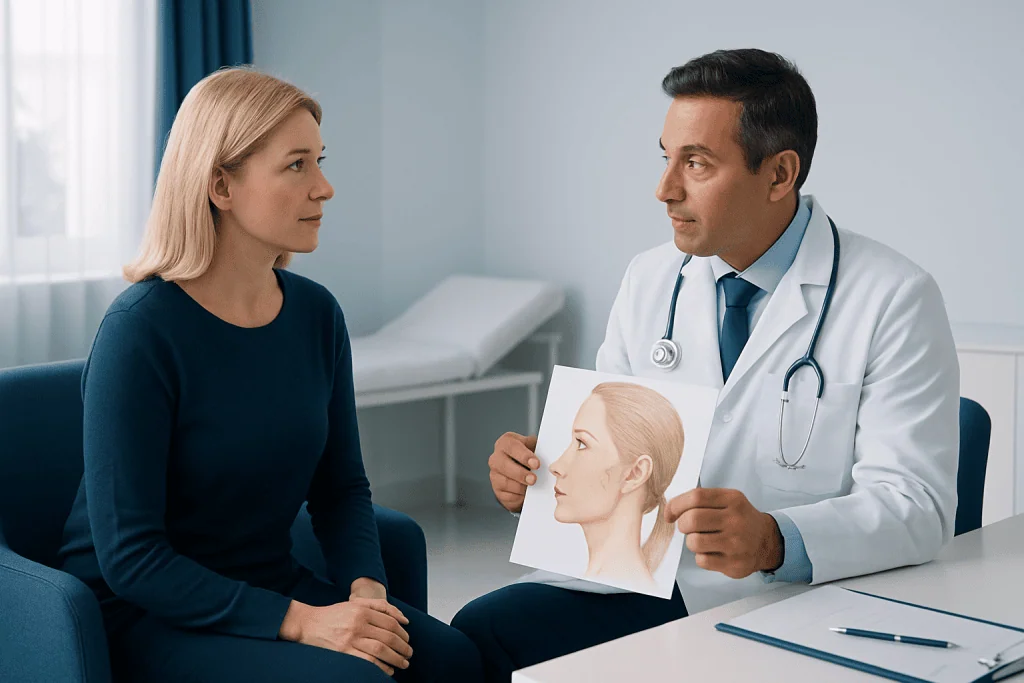
Face lift surgery is usually performed under general anesthesia or, in selected cases, sedation with local anesthesia. The exact approach depends on the treatment plan. Incisions are commonly placed around the hairline and ears so scars can be as discreet as possible. If the neck is also being treated, an additional small incision under the chin may be used.
After the incisions are made, the surgeon lifts the skin and works on the deeper facial support layer, often called the SMAS. Repositioning this deeper tissue is a key part of modern face lift surgery because it supports a more natural contour and may help results last longer. Excess skin is then trimmed, and the remaining skin is redraped without excessive tension before the incisions are closed.
Depending on the person’s anatomy and goals, the operation may focus on the lower face alone or include the cheeks and neck. Some people combine a face lift with procedures such as rhinoplasty or skin resurfacing to address multiple features in a balanced way. Surgery time varies, and most patients go home the same day or after a short monitored stay, depending on the extent of the procedure and the care plan.
Benefits and Expected Results
The main benefit of a face lift is improved contour in areas where aging has caused tissue descent. This may include a better-defined jawline, reduced jowling, smoother folds around the mouth, and a firmer neck profile. Many patients say they look less tired or stern after surgery, even though their facial expression remains their own.
Compared with non-surgical treatments, a face lift can offer more substantial correction of sagging and a longer-lasting result. It may be especially helpful when fillers or skin-tightening treatments are no longer enough to address loose skin and deeper structural changes. Results are not permanent, but they generally age with the person over time.
It is also important to understand the limits of surgery. A face lift does not erase every wrinkle, improve all skin texture changes, or fully correct sun damage. It may not address volume loss in the temples or under-eye area without additional treatment. For some people, age-related neck fullness is partly due to fat distribution or anatomy, and this may lead the surgeon to discuss related concerns such as double chin as part of an overall facial assessment.
Risks, Side Effects, and Possible Complications
Like any operation, a face lift has potential risks. Common short-term effects include swelling, bruising, tightness, numbness, and mild discomfort during early healing. These are expected to improve gradually. Visible scars are part of surgery, but they are usually placed carefully and often fade with time.
Less common but important complications include bleeding under the skin (hematoma), infection, delayed wound healing, skin loss, asymmetry, fluid collection, nerve injury, and reactions related to anesthesia. Temporary weakness of facial movement can happen, and permanent nerve injury is uncommon but possible. Hair loss around incision sites may also occur in some patients.
Risk is influenced by factors such as smoking, uncontrolled medical conditions, certain medications, and poor wound healing history. A surgeon helps reduce these risks through careful planning, preoperative assessment, and clear instructions before and after surgery. Patients should report any past problems with scarring, bleeding, or facial surgery so the care team can plan safely.
Recovery Timeline and Self-Care
Recovery from a face lift happens gradually. In the first few days, swelling, bruising, tightness, and a feeling of facial heaviness are common. Dressings or drains may be used for a short period. Resting with the head elevated and following wound-care instructions can help reduce swelling and support healing.
Many people feel more comfortable being seen in public after about two to three weeks, although the timeline varies. Bruising often fades before all swelling has resolved. Numbness, firmness, or mild asymmetry can improve more slowly over weeks to months as tissues settle. Final results are usually clearer after swelling has significantly decreased.
Aftercare often includes avoiding smoking, strenuous exercise, bending, and activities that raise blood pressure too much in the early period. Medications should only be taken as advised by the surgical team, especially those that may affect bleeding. Patients should protect healing skin from sun exposure and attend follow-up visits so recovery can be monitored properly.
- Keep the head elevated while resting.
- Follow instructions for cleansing incisions and changing dressings.
- Avoid smoking and nicotine products during healing.
- Do not resume strenuous exercise until the surgeon says it is safe.
- Contact the care team promptly if swelling suddenly worsens or one side becomes much more painful.
How Doctors Evaluate and Plan Treatment
Planning a face lift begins with a detailed consultation. The surgeon reviews medical history, current medications, allergies, smoking status, and any previous facial procedures. A physical examination looks at skin quality, facial volume, muscle tone, the position of the cheeks and jawline, and the neck. Photographs are often taken for planning and comparison.
This evaluation is important because different aging patterns need different strategies. Some patients mainly need lifting of deeper tissues, while others also have prominent neck bands, excess fat under the chin, or hollow areas that may benefit from a combined approach. In selected cases, additional assessment may be needed if there is a history of poor healing, easy bruising, or chronic medical illness.
The surgeon also discusses goals and limitations in practical terms. This includes expected scarring, likely recovery time, and whether surgery is the best option at all. If facial fullness, skin changes, or laxity are being considered in a broader cosmetic plan, related concerns such as skin aging may also be addressed to help match the treatment to the person’s needs.
When to Seek Medical Care
Anyone considering a face lift should seek care from a qualified plastic surgeon for a proper assessment rather than relying only on photos or online advice. Medical evaluation is especially important for people with heart disease, high blood pressure, diabetes, bleeding disorders, or a smoking history, because these factors can affect surgical safety and healing.
After surgery, patients should contact their doctor promptly if they develop rapidly increasing swelling, severe one-sided pain, fever, significant bleeding, shortness of breath, chest pain, or drainage that seems unusual. These symptoms do not always mean a serious complication, but they should be checked without delay.
Patients should also seek medical advice if recovery feels stalled, if scars become increasingly red or painful, or if facial movement changes unexpectedly. Near the end of the treatment journey, some international patients may choose care in centers with coordinated surgical and aftercare services. Acibadem International’s multidisciplinary specialists and JCI-accredited hospitals diagnose and treat patients seeking procedures such as face lift surgery with individualized planning and follow-up.
Frequently asked questions
What is the difference between a face lift and non-surgical facial rejuvenation?
A face lift is surgery that repositions deeper facial tissues and removes or redrapes excess skin. Non-surgical options such as fillers, neuromodulators, or energy-based treatments may help with volume loss, wrinkles, or mild laxity, but they do not produce the same degree of lifting for significant sagging.
How long does face lift recovery usually take?
Early recovery often takes a few weeks, and many people feel more comfortable socially after two to three weeks. However, some swelling, numbness, and tissue settling can continue for several weeks or months before the final result becomes clearer.
Will a face lift leave visible scars?
Scars are expected with any surgical face lift, but they are usually placed around the hairline and ears to be less noticeable. Over time, many scars soften and fade, though the exact appearance depends on healing, skin type, and aftercare.
At what age do people usually consider a face lift?
There is no single right age for a face lift. Surgeons usually focus more on facial anatomy, skin quality, and the degree of sagging than on a specific age number.
How long do face lift results last?
Results are long-lasting, but not permanent. Aging continues after surgery, yet many people continue to look younger than they would have without treatment for years afterward.
Can a face lift fix wrinkles around the eyes or mouth completely?
A face lift can improve some folds and sagging, especially in the lower face, but it does not remove every wrinkle. Fine lines, sun damage, and texture changes may need different treatments depending on the person’s goals.
References
- American Society of Plastic Surgeons
- American Academy of Facial Plastic and Reconstructive Surgery
- NHS
- MedlinePlus
- U.S. Food and Drug Administration
This article is for general information only and is not a substitute for professional medical advice. Please consult a qualified doctor about your individual situation.
Explore treatments in Turkey — costs, top hospitals & a free quote
JCI-accredited · board-certified surgeons · reply within 24h
Check your numbers in seconds
BMI, calories, due date, blood pressure and 30+ more clinical calculators — free, instant, doctor-reviewed ranges.

More from the Health Library



Related Specialists

Assoc. Prof. Dr. Mahmut Subaşı
Thoracic Surgery
Prof. Dr. Mert Şentürk
Anesthesiology
Prof. Dr. Burak Tander
Pediatric Surgery
Büşra Zeybek
Physical Medicine & Rehabilitation