Treatment for Arthritis in Feet: How It Works, Results and What to Expect

Foot arthritis may affect the toes, midfoot, hindfoot, ankle, or several joints at once. Treatment usually starts with measures that reduce joint stress and support comfortable movement.
Key Takeaways
- Foot arthritis may affect the toes, midfoot, hindfoot, ankle, or several joints at once.
- Treatment usually starts with measures that reduce joint stress and support comfortable movement.
- Imaging and a clinical examination help identify the involved joints and guide treatment decisions.
- Injections may offer temporary symptom relief for selected people but do not reverse joint damage.
- Surgery is usually reserved for persistent pain, deformity, or loss of function after conservative treatment.
- New severe pain, redness, warmth, fever, or inability to bear weight needs prompt medical assessment.
Treatment for arthritis in feet is tailored to the affected joint, arthritis type, pain severity, and impact on walking. Many people improve with supportive footwear, activity adjustments, rehabilitation, medicines, or injections; surgery may be considered when symptoms remain limiting despite nonsurgical care.
Overview: How Treatment for Arthritis in Feet Works
Treatment for arthritis in feet aims to relieve pain, preserve mobility, reduce stress on damaged joints, and help a person continue daily activities safely. The most appropriate plan depends on which joints are affected, whether arthritis is caused by wear and tear, an inflammatory condition, prior injury, or another problem, and how much symptoms interfere with walking and footwear.
Foot arthritis can involve the big-toe joint, smaller toe joints, midfoot joints, hindfoot joints, or the ankle. Symptoms may develop gradually, but they can also worsen after an injury or during flares of inflammatory arthritis. A clinician may recommend a combination of footwear changes, exercise and rehabilitation, medicines, injections, and—when other options no longer provide enough relief—an operation.
There is not one treatment that suits every person. A stepwise approach is common: lower-risk, nonsurgical options are usually tried first, then reviewed based on pain, function, imaging findings, and personal goals. Treatment may also involve orthopedics, rheumatology, physiotherapy, pain management, and podiatry or foot-and-ankle care.
Recognizing Arthritis in the Foot and Ankle
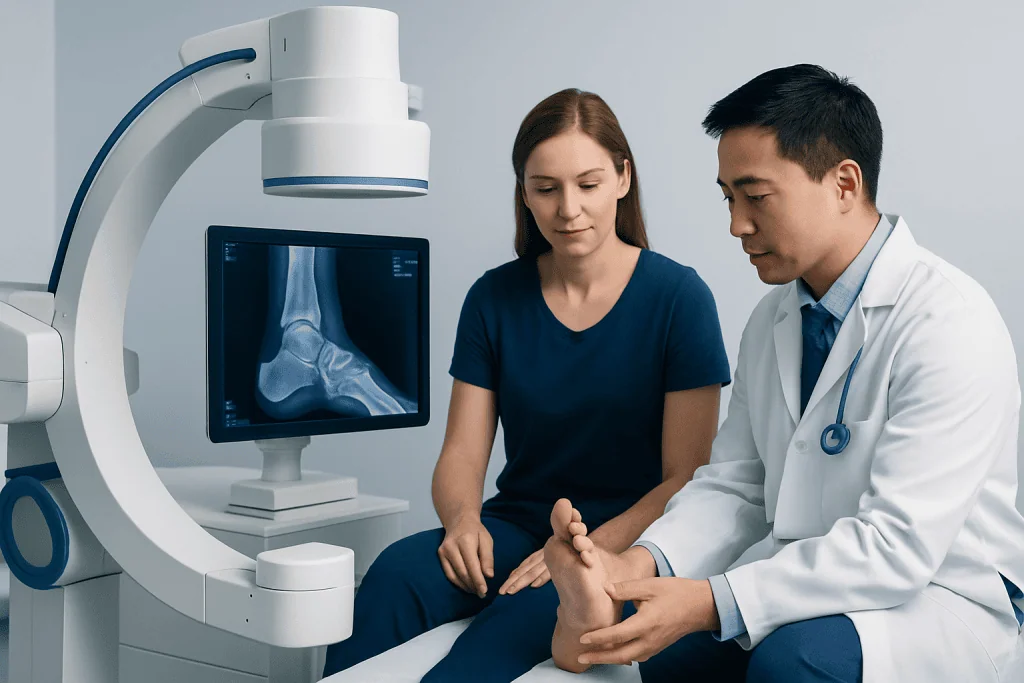
Arthritis causes inflammation and/or structural changes within a joint. In the feet, this may lead to aching or sharp pain during standing and walking, stiffness after rest, swelling, reduced range of motion, tenderness, or difficulty fitting into usual shoes. A painful bump at the big toe, altered foot shape, or pain over the top or inside of the midfoot may also occur depending on the joint involved.
Pain that increases with weight-bearing and settles with rest can occur with osteoarthritis, the most common form. However, symptoms alone cannot establish the cause. Inflammatory arthritis, gout, infection, tendon problems, stress fractures, nerve conditions, and circulation problems can produce overlapping symptoms and may require different treatment.
A person should avoid assuming that persistent foot pain is simply a normal part of aging. Early assessment can clarify the diagnosis and may help address gait changes, footwear difficulties, and activity limitations before they become more disruptive.
Causes, Risk Factors, and Candidacy for Treatment

Osteoarthritis can develop over time as cartilage and other joint structures change. Previous fractures, dislocations, ligament injuries, repeated high-impact loading, and poorly aligned joints can increase the likelihood of post-traumatic arthritis. Inflammatory conditions such as rheumatoid arthritis or psoriatic arthritis may affect multiple foot joints and require treatment of the underlying immune-mediated disease alongside local foot care.
Risk factors vary by arthritis type and may include older age, family history, prior foot or ankle injury, repetitive occupational or sporting strain, excess body weight, certain foot shapes, and inflammatory disease. Gout can cause sudden, intensely painful attacks, often in the big-toe joint, while infection in a joint is uncommon but requires urgent care.
Most people with symptomatic arthritis in the feet are candidates for some form of conservative treatment. Surgery is generally considered for people with clearly localized, structurally significant arthritis whose pain and loss of function persist despite appropriately tried nonsurgical measures. Suitability also depends on overall health, circulation, bone quality, smoking status, skin condition, diabetes control where relevant, and ability to follow recovery instructions.
People who have inflammatory arthritis may benefit from coordinated care with a rheumatologist. Controlling systemic inflammation can reduce flares and protect joints elsewhere, while local treatment can address mechanical pain, deformity, or footwear problems in the feet.
Assessment and Choosing a Personalized Plan
A clinician will ask about pain location, timing, past injuries, medical conditions, medicines, footwear, work demands, and activity goals. The examination may include observation of walking, assessment of joint movement and alignment, testing for tenderness and swelling, and evaluation of circulation, sensation, skin health, and tendon function.
Weight-bearing X-rays are often useful because they show joint-space narrowing, bone spurs, alignment changes, and signs of old injury while the foot is under load. Ultrasound, CT, or MRI may be used when the diagnosis remains uncertain, when more detail is needed for surgical planning, or when soft-tissue injury, stress injury, or inflammation is suspected. Blood tests may be appropriate if inflammatory arthritis, gout, or infection is a concern.
The treatment plan should be based on function rather than X-ray findings alone. Some people have visible arthritis on imaging with limited symptoms, while others have significant pain despite modest imaging changes. Meaningful goals may include walking farther, returning to work, wearing shoes more comfortably, sleeping without pain, or participating in selected exercise.
Nonsurgical Treatment Options
Supportive footwear is often a central part of treatment for arthritis in feet. A shoe with a roomy toe box, stable sole, cushioning, and an appropriate rocker shape may reduce painful joint motion during walking. Custom or prefabricated orthotics, stiff inserts, braces, or walking boots may be recommended for specific joints and should be selected with professional advice to avoid transferring pressure elsewhere.
Physiotherapy can help improve strength, balance, flexibility, and walking mechanics while protecting painful joints. Exercises are individualized; forcing a severely painful joint through movement is not usually helpful. Lower-impact activities such as cycling, swimming, or water exercise may maintain general fitness with less repetitive loading than running or jumping.
Medicines may include topical anti-inflammatory products or oral pain-relieving and anti-inflammatory medicines when they are safe for the individual. These medicines can have side effects and interactions, particularly for people with kidney disease, stomach ulcers, heart disease, high blood pressure, or those taking blood-thinning medicines. A doctor or pharmacist can advise on safe choices.
For selected patients, an image-guided corticosteroid injection may reduce pain and inflammation for a limited period. It may be used to confirm which joint is generating pain or to support participation in rehabilitation. The response varies, and repeated injections are not suitable for everyone. If arthritis is due to an inflammatory condition, disease-modifying treatment prescribed by a rheumatologist may be needed to manage the underlying cause.
Surgery: Procedure Steps, Benefits, and Risks
Surgery may be discussed when pain remains substantial despite nonsurgical care, joint damage or deformity causes major difficulty with walking or shoes, and the likely benefits fit the person’s goals. The main procedures include joint-preserving operations in selected cases, removal of painful bone spurs, joint fusion (arthrodesis), and, less commonly in particular joints, joint replacement. The operation depends on the location and pattern of arthritis.
Before surgery, the team reviews imaging, medical history, medicines, anesthesia needs, smoking status, circulation, and home support. On the day of surgery, anesthesia may be general, regional, or a combination. The surgeon makes an incision, addresses damaged joint surfaces or deformity, and may use screws, plates, or other fixation if fusion is performed. Dressings, a splint, boot, or cast may be applied afterward.
A fusion removes painful movement at the diseased joint by allowing the bones to heal together in a planned position. It can provide reliable pain relief for an appropriately selected painful joint, although it permanently reduces movement there. Nearby joints may compensate, and some people notice changes in walking. Joint replacement can preserve some motion in carefully selected situations, but it is not appropriate for every foot or ankle joint.
Potential benefits include less pain, improved stability, easier shoe wear, and better walking tolerance. Risks include infection, bleeding, blood clots, nerve irritation, wound-healing problems, persistent pain, stiffness, hardware irritation, failure of a fusion to heal, and the need for further treatment. A surgeon can explain the risks that are most relevant to the planned procedure. When surgery is appropriate, orthopedic assessment and treatment can help determine the safest and most suitable approach.
Recovery Timeline and Self-Care After Treatment
Recovery depends greatly on the treated joint and procedure. After an injection, a person may be advised to rest the area briefly and monitor for unusual pain, swelling, fever, or redness. Improvements may occur over days, though the amount and duration of relief vary. Rehabilitation and footwear strategies remain important even if pain improves.
After foot or ankle surgery, elevation, wound care, prescribed pain control, and protection of the operated area are important in the early phase. Some procedures require a period of no weight-bearing or limited weight-bearing with crutches, a walker, scooter, cast, or boot. Follow-up visits and X-rays are used to check wound healing, alignment, and bone healing when a fusion has been performed.
Return to driving, work, exercise, and regular shoes varies widely. It may take weeks to months to progress through protected walking, strengthening, and return to more demanding activities. Swelling can last longer than expected, especially later in the day. Following the surgeon’s and rehabilitation team’s instructions closely supports recovery and reduces avoidable complications.
Self-care can also include pacing activities, avoiding shoes that compress painful areas, maintaining a healthy body weight where appropriate, and treating related conditions such as diabetes or inflammatory arthritis. Acibadem International’s multidisciplinary specialists at JCI-accredited hospitals assess and treat foot and ankle arthritis for international patients when coordinated care is needed.
When to Seek Medical Care
A person should arrange medical assessment for foot pain, stiffness, or swelling that lasts more than a short period, repeatedly returns, affects walking, disrupts sleep, or makes usual footwear difficult to wear. Evaluation is also appropriate after a significant foot or ankle injury, particularly if pain persists after the initial swelling improves.
Prompt medical care is important for a hot, red, markedly swollen joint; fever or feeling unwell with joint pain; a sudden inability to bear weight; an open wound; new numbness; or a pale, blue, or cold foot. These signs can have causes other than arthritis and should not be managed with home treatment alone.
People with diabetes, reduced circulation, immune suppression, or known inflammatory arthritis should contact a clinician early for new foot changes. Regular foot checks and timely treatment of skin breaks can help prevent complications.
Frequently asked questions
What is the best treatment for arthritis in feet?
The best treatment for arthritis in feet depends on the affected joint, the cause of arthritis, and how much symptoms limit daily life. Supportive shoes, orthotics, physiotherapy, activity changes, and appropriately chosen medicines are common first options. Injections or surgery may be considered when these measures do not provide enough relief.
Can arthritis in the feet be cured?
Most forms of arthritis cannot be fully reversed, but symptoms and function can often be improved. Treatment aims to reduce pain, support walking, limit strain on damaged joints, and address the underlying cause when possible. Inflammatory arthritis may also need long-term medical treatment to control inflammation.
Does walking make foot arthritis worse?
Walking does not necessarily worsen arthritis, and regular movement can support strength and overall health. However, pain that consistently increases during or after walking may mean that footwear, walking distance, pace, or treatment needs adjustment. A clinician or physiotherapist can recommend joint-friendly activity levels.
How long does it take to recover from foot arthritis surgery?
Recovery varies by procedure, joint, and individual health. Protected weight-bearing may be needed for several weeks after some operations, while swelling and rehabilitation can continue for months. The surgical team provides a personalized timeline based on healing and follow-up imaging.
Are steroid injections safe for foot arthritis?
Corticosteroid injections can be useful for selected people, particularly for short-term symptom relief or to identify a painful joint. They are not suitable for every person or every joint, and their effect is temporary. A clinician will consider infection risk, diabetes, skin condition, other medicines, and the number and timing of past injections.
When is foot arthritis surgery necessary?
Surgery is not automatically necessary when arthritis appears on an X-ray. It may be considered when ongoing pain, stiffness, instability, or deformity substantially affects daily life despite a well-planned course of nonsurgical treatment. The decision should account for expected benefits, risks, recovery demands, and the person’s own goals.
References
- American College of Foot and Ankle Surgeons
- American Academy of Orthopaedic Surgeons
- National Institute of Arthritis and Musculoskeletal and Skin Diseases
- Arthritis Foundation
- National Health Service
This article is for general information only and is not a substitute for professional medical advice. Please consult a qualified doctor about your individual situation.
Arthritis in Turkey — costs, top hospitals & a free quote
JCI-accredited · board-certified surgeons · reply within 24h

Orthopedics & Spine
Care for bones, joints and the musculoskeletal system, including joint replacement, sports injuries and trauma.
125 specialists in this unitMore from the Health Library



Related Specialists

Dyt. Ayşe Mürüvvet Alanyalı
Nutrition and Diet
Dr. Ayşe Cennet Sarimehmetoğlu
Cardiology
Dr. Ramiz Ahmadov
Neurosurgery
Dr. Nurcan Göğebakan
Otorhinolaryngology