

Radiation Dosimetry: How It Works, Results and What to Expect

Radiation dosimetry is a core part of safe, individualized radiation therapy planning. A medical dosimetrist works with radiation oncologists and medical physicists to create and check treatment plans.
Key Takeaways
- Radiation dosimetry is a core part of safe, individualized radiation therapy planning.
- A medical dosimetrist works with radiation oncologists and medical physicists to create and check treatment plans.
- Patients do not usually feel the planning calculations or radiation dose verification processes.
- A dosimetry report is mainly a technical clinical document, and the radiation oncology team should explain what its findings mean for an individual.
- Radiation therapy side effects depend on the treatment area, dose, technique and a person’s overall health.
Radiation dosimetry is the process of calculating, planning and verifying the dose of radiation used in treatment. It helps the radiation oncology team target a tumor as precisely as possible while limiting exposure to surrounding healthy tissues.
Radiation Dosimetry Overview
Radiation dosimetry is the science and clinical process of measuring, calculating and checking radiation dose. In cancer care, it is used to design a radiation therapy plan that delivers a prescribed dose to a tumor or treatment area while reducing dose to nearby organs and healthy tissues.
It is not usually a separate treatment appointment that a patient can feel. Instead, radiation dosimetry takes place behind the scenes after imaging and before treatment begins, with additional safety checks during the treatment course. The work is performed by a radiation oncology team that commonly includes a radiation oncologist, medical dosimetrist, medical physicist and radiation therapists.
Modern planning systems use imaging scans, contouring tools and sophisticated calculations to create a three-dimensional dose distribution. Techniques such as external beam radiation therapy, intensity-modulated radiation therapy and image-guided radiation therapy rely on accurate dosimetry to support precise treatment delivery.
How Radiation Dosimetry Works
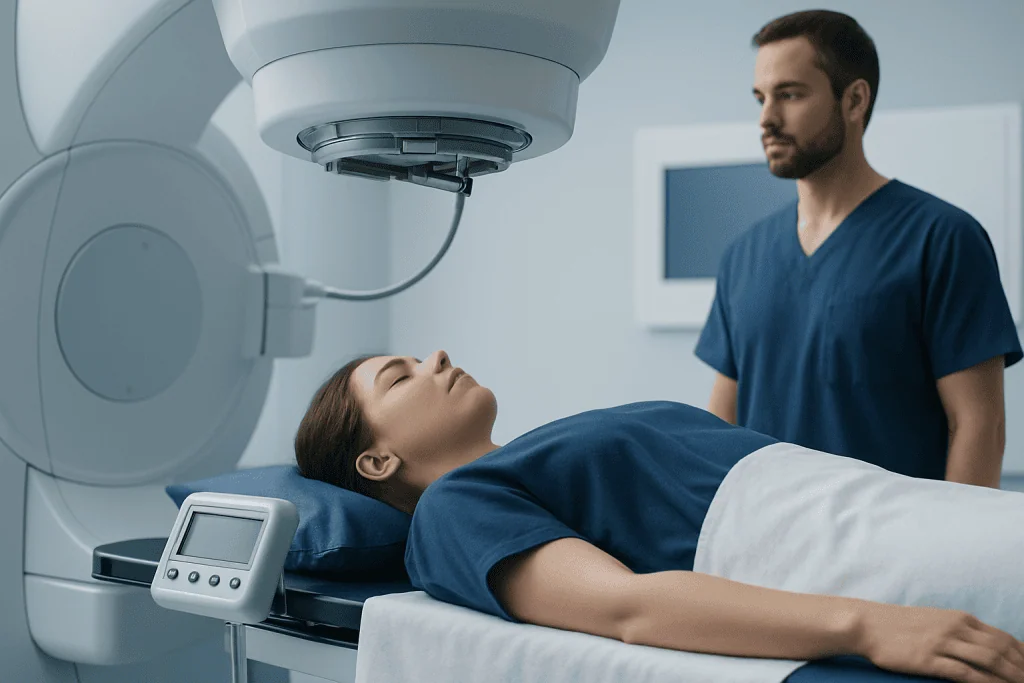
Radiation dosimetry begins with a treatment prescription from the radiation oncologist. The prescription identifies the treatment target, the total planned dose, the number of treatment sessions and important normal tissues that need protection. The team uses this information together with imaging, often a CT simulation scan and sometimes MRI or PET images, to build a detailed treatment plan.
The radiation oncologist outlines the tumor, surgical bed or other target volume and identifies nearby organs at risk. A medical dosimetrist then uses specialized computer software to test beam angles, radiation energies, field shapes and intensity patterns. The goal is to achieve adequate target coverage while following accepted dose limits for healthy structures whenever possible.
A medical physicist independently reviews the plan and performs quality assurance checks before treatment. For some complex plans, the team may use measurements in a phantom or other verification device to confirm that the treatment machine can accurately deliver the calculated dose. Imaging before or during sessions may also help confirm positioning.
Dosimetry is not limited to cancer treatment planning. It can also involve monitoring occupational radiation exposure, checking equipment performance and supporting radiation safety. In radiation oncology, however, its central purpose is to make each treatment plan accurate, reproducible and appropriately tailored to the individual.
Who May Need Radiation Dosimetry and What to Expect

Anyone receiving radiation therapy needs dosimetry as part of standard treatment planning. This may include people treated for breast, prostate, lung, head and neck, gynecologic, brain, skin and other cancers, as well as selected noncancerous conditions. The exact planning approach depends on the diagnosis, tumor location, prior treatment, surgery, medical history and the aim of care.
The patient-facing process commonly starts with a consultation and a simulation appointment. During simulation, the team positions the person in the same way they will lie or sit for treatment. A custom mask, cushion, body mold or other immobilization device may be made to help keep the body comfortably still and reproducibly positioned.
After simulation, the planning and quality-assurance process may take several days or longer, depending on complexity and clinical urgency. The patient is generally not exposed to therapeutic radiation while the computerized plan is being created. Once reviews are complete, the radiation therapy course begins according to the agreed schedule.
Radiation therapy is often part of coordinated cancer care alongside surgery, systemic therapy or follow-up imaging. The most appropriate approach should be discussed with the treating oncology team, who can explain the purpose of treatment and how it fits within the overall care plan.
Step-by-Step: From Simulation to Dose Delivery
1. Consultation and prescription: The radiation oncologist reviews the diagnosis, imaging, pathology and treatment goals. They discuss potential benefits, alternatives and likely side effects, then create a radiation prescription if treatment is appropriate.
2. Simulation and imaging: A planning scan is taken in the treatment position. Small skin marks or tattoos may be used in some cases to support consistent alignment. Contrast material may occasionally be recommended to improve visualization of certain structures, depending on the treatment area and imaging needs.
3. Contouring and plan design: The physician outlines targets and normal organs on the planning images. The dosimetrist creates possible plans and adjusts technical parameters to meet the prescription and protect critical structures. The team may compare more than one plan before selecting the most suitable option.
4. Review, verification and treatment: The radiation oncologist and medical physicist review the final plan. Quality assurance is completed before the first session. During treatment, radiation therapists position the patient, perform required imaging checks and deliver the plan. The treatment machine does not make a person radioactive after standard external beam therapy.
Benefits, Risks and Recovery Timeline
The main benefit of radiation dosimetry is better control over where radiation dose is delivered. Careful planning can help the team provide the intended treatment dose to the target while limiting unnecessary exposure to nearby tissues. This is particularly important when tumors are close to sensitive organs such as the spinal cord, eyes, heart, bowel, bladder or salivary glands.
Dosimetry itself does not cause physical side effects. Side effects arise from radiation treatment and vary considerably by the body area treated, total dose, number of sessions, treatment technique and whether other therapies are given. Common short-term effects may include tiredness and skin changes in the treatment area, while other effects are specific to the region receiving radiation.
There is generally no recovery period after treatment planning or routine dosimetry checks. During radiation therapy, most people return home after each session and continue many usual activities as their energy allows. Symptoms can build gradually during treatment and may continue for a period after it ends, so regular communication with the care team is important.
Long-term risks are discussed before treatment because they depend on the site and plan. The radiation oncology team uses dose constraints, imaging and quality assurance to reduce risk, but no treatment can eliminate all possible side effects. Follow-up appointments help assess recovery, treatment response and any late effects that may need support.
How to Read a Radiation Dosimetry Report
A radiation dosimetry report is a technical summary of the planned or delivered radiation dose. It may include the prescribed dose, number of fractions or sessions, target volume names, dose-volume histogram information, beam details and doses received by nearby organs. The report is designed primarily for trained professionals and should be interpreted in the context of the complete treatment plan.
Important terms may include target coverage, which describes how well the intended area receives the prescribed dose, and organs at risk, which refers to normal structures near the treatment target. A dose-volume histogram, often called a DVH, is a graph used to evaluate how much of a target or organ receives a particular dose. It is useful for plan comparison but is not, by itself, a prediction of an individual outcome.
Numbers in a report can be confusing without context. A higher dose to a target may be intentional, while an acceptable dose to a nearby organ depends on the organ, treatment purpose, prior therapies and clinical guidelines. Patients should ask their radiation oncologist which findings matter most for their plan, what side effects are most relevant and what monitoring will be provided.
Is Dosimetry a Lot of Math?
Dosimetry uses a substantial amount of mathematics, physics and computer-based modeling. Medical dosimetrists need to understand radiation behavior, anatomy, treatment machines and dose calculations. Modern treatment planning software performs many complex calculations, but skilled professionals are still needed to make sound planning decisions, evaluate results and recognize potential problems.
For patients, it is not necessary to understand every calculation in order to take part in treatment decisions. A helpful discussion focuses on practical questions: what area is being treated, what the treatment is intended to achieve, how long treatment will take, which organs are being protected and what side effects are most likely.
For people considering dosimetry as a profession, comfort with quantitative reasoning is valuable. Education requirements vary by country and employer, but training typically combines anatomy, radiation physics, treatment planning and supervised clinical experience.
Is Dosimetrist a Hard Job?
Medical dosimetry can be a demanding role because it combines technical expertise with clinical responsibility. A dosimetrist must work accurately, understand complex anatomy and radiation physics, use specialized planning software and collaborate closely with physicians, physicists and therapists. Attention to detail is essential because small planning differences can matter clinically.
The work can also be rewarding for people who enjoy science, problem-solving and contributing directly to patient care. Workload and complexity vary by treatment center, available technology and the types of cancers treated. Ongoing education is important because radiation therapy techniques and planning tools continue to evolve.
A dosimetrist does not make treatment decisions alone. Radiation plans are reviewed within a multidisciplinary quality and safety process, with physician oversight and physics checks before treatment delivery.
Frequently asked questions
What is radiation dosimetry?
Radiation dosimetry is the calculation, measurement and verification of radiation dose. In radiation therapy, it helps the care team create a plan that treats the intended target while reducing dose to nearby healthy tissues.
How long does radiation dosimetry take?
Planning time varies based on the complexity of the treatment, the type of cancer and the urgency of care. It commonly takes several days after the simulation scan because the plan must be designed, reviewed and checked before treatment starts.
How to read a radiation dosimetry report?
A dosimetry report should be reviewed with the radiation oncologist because it contains technical terms and measurements. Key items may include the prescribed dose, target coverage, organ dose limits and dose-volume histograms, but their significance depends on the individual treatment plan.
Is dosimetry a lot of math?
Yes. Medical dosimetry involves physics, geometry, dose calculation and computer modeling. Planning software assists with calculations, but trained professionals must evaluate the plan carefully and apply clinical judgment.
Is dosimetrist a hard job?
It can be challenging because it requires detailed technical knowledge, careful problem-solving and a high level of accuracy. It is also a collaborative role, with plans reviewed by radiation oncologists and medical physicists as part of a broader safety process.
What is the highest salary for a dosimetrist?
Salary varies widely by country, region, certification, experience, workplace and local demand. Reliable salary information is best obtained from current national labor statistics, professional organizations and local job listings rather than a single universal figure.
When should someone seek medical care during radiation therapy?
A person should contact their radiation oncology team promptly for new, severe or worsening symptoms, including significant pain, fever, trouble breathing, difficulty swallowing, uncontrolled vomiting, confusion, weakness or troublesome skin reactions. For severe symptoms or a medical emergency, urgent local emergency care is appropriate.
References
- American Society for Radiation Oncology
- American Association of Physicists in Medicine
- National Cancer Institute
- International Atomic Energy Agency
- American Association of Medical Dosimetrists
This article is for general information only and is not a substitute for professional medical advice. Please consult a qualified doctor about your individual situation.
Oncology care in Turkey — second opinion and treatment plan
JCI-accredited · board-certified surgeons · reply within 24h

More from the Health Library



Related Specialists

Dr. Yasemin Ballıca Özen
Gynecology & Obstetrics
Prof. Dr. Turgay Çelikel
Pulmonology
Prof. Dr. Moşe Benhabib
Gynecology & Obstetrics
Assoc. Prof. Dr. Şule Göncü Ayhan
Gynecology & Obstetrics