Throat Cancer Screening: How It Works, Results and What to Expect

There is no standard population-wide screening test for throat cancer in people without symptoms. Persistent hoarseness, swallowing difficulty, a neck lump or a mouth/throat sore need medical assessment.
Key Takeaways
- There is no standard population-wide screening test for throat cancer in people without symptoms.
- Persistent hoarseness, swallowing difficulty, a neck lump or a mouth/throat sore need medical assessment.
- An ear, nose and throat specialist may use a flexible camera examination, imaging and sometimes a biopsy to clarify findings.
- A suspicious result does not confirm cancer; biopsy is usually needed for diagnosis.
- Avoiding tobacco, limiting alcohol and receiving recommended HPV vaccination can help reduce risk.
Throat cancer screening is not a single routine test for everyone. It usually involves a clinical assessment and focused tests when a person has persistent symptoms, important risk factors, or an abnormal finding in the mouth, throat or neck.
Throat Cancer Screening: What It Means
Throat cancer screening refers to checking for possible cancers affecting the pharynx (throat), larynx (voice box), tonsils, or nearby tissues before they cause advanced symptoms. For most people, there is no recommended routine screening test comparable to mammography for breast cancer or colonoscopy for colorectal cancer. Instead, assessment is targeted to people with concerning symptoms, visible changes, or a higher likelihood of disease.
A clinician typically begins with questions about symptoms and medical history, followed by an examination of the mouth, throat and neck. If anything needs closer evaluation, an ear, nose and throat (ENT) specialist may perform laryngoscopy, order imaging, or take a tissue sample. These steps help distinguish cancer from common non-cancerous conditions such as infection, reflux or voice strain.
“Throat cancer” is a broad term. It can include cancers of the oropharynx, hypopharynx and larynx. Some are linked to tobacco and alcohol exposure, while many cancers of the tonsil and base of tongue are associated with human papillomavirus (HPV). Early assessment of persistent changes is valuable because treatment planning depends on the exact location, type and extent of the condition.
Who May Need Assessment Rather Than Routine Screening?
People without symptoms do not usually need a throat cancer test as part of a general health check. However, a doctor may recommend a prompt assessment when symptoms persist beyond about two to three weeks, particularly when there is no clear explanation or when symptoms are worsening. This is not because cancer is the most likely cause, but because persistent symptoms deserve a careful evaluation.
Factors that may increase the need for attention include current or previous tobacco use, regular heavy alcohol use, a history of head and neck cancer, prior radiation to the head or neck, and certain occupational exposures. HPV-related throat cancers can occur in people without traditional tobacco-related risks, so new ongoing symptoms should not be dismissed based on age or lifestyle alone.
- Persistent hoarseness or a noticeable voice change
- A neck lump that does not settle
- Pain or difficulty when swallowing
- One-sided throat or ear pain without an ear infection
- A sore, red or white patch in the mouth or throat that does not heal
- Unexplained weight loss, coughing blood, or breathing difficulty
A dental professional may notice changes in the mouth during a routine examination, while a primary care clinician can arrange referral to ENT when deeper throat structures need inspection. People with ongoing symptoms can also learn more about related warning signs through throat cancer information.
How Throat Cancer Screening and Testing Work

The process starts with a clinical review. The clinician asks when symptoms began, whether they are changing, and whether there is a history of smoking, alcohol use, reflux, HPV-related disease, previous cancer or relevant family history. They examine the lips, gums, tongue, tonsils, roof and floor of the mouth, as well as the neck for enlarged lymph nodes or other lumps.
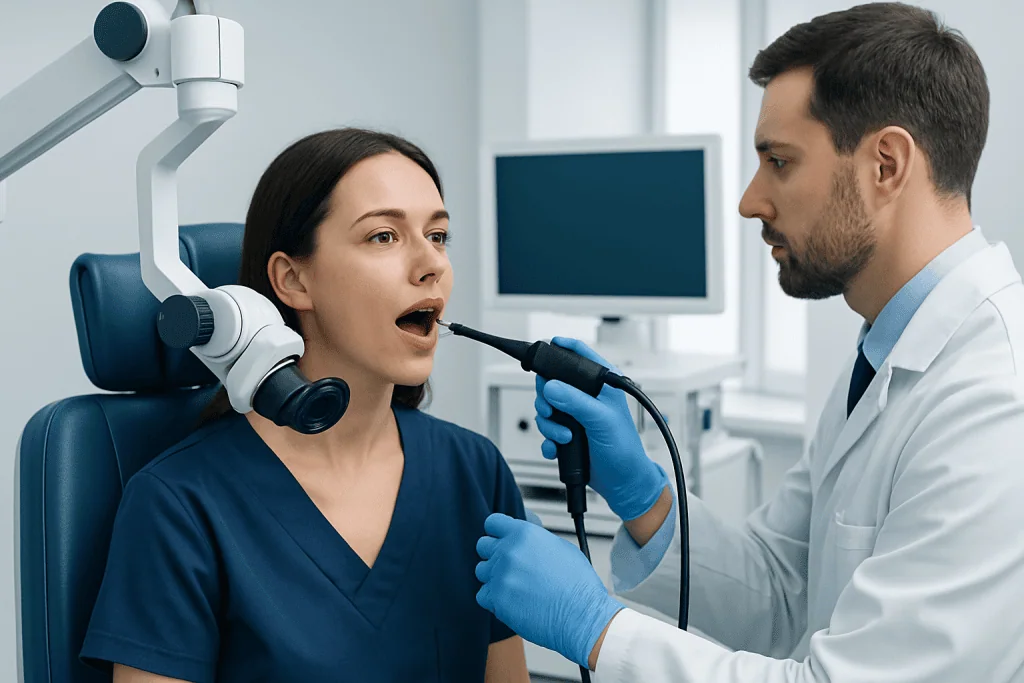
If a closer view is required, the clinician may use a small mirror or a flexible nasendoscope. This thin, soft tube with a light and camera passes gently through a nostril after numbing spray may be used. It allows the specialist to see the nasal passages, back of the throat, voice box and vocal cords while the person breathes and may speak or swallow. The examination is usually brief and is commonly performed in an outpatient clinic.
Imaging is not used as a stand-alone general screening method. A CT scan, MRI scan, ultrasound or PET-CT may be requested when an examination finds an abnormal area or neck lump, or after cancer has been diagnosed to understand its extent. If an abnormality looks suspicious, a biopsy is the only way to confirm whether cancer cells are present.
Biopsy methods vary according to the site. A clinician may use a fine needle to sample a neck lump, take a small tissue sample in clinic, or arrange a procedure under anesthesia to examine an area and collect tissue safely. The tissue is assessed by a pathologist, who can identify the cancer type and may test for markers such as HPV-related changes when appropriate.
What Happens During the Procedure and Afterward?
For a standard office assessment, people can usually eat and drink normally beforehand unless the clinic gives different instructions. It is useful to bring a list of symptoms, medications and previous test results. The clinician will explain each step, and the person can ask to pause if the flexible camera examination feels uncomfortable.
A flexible laryngoscopy generally takes only a few minutes. Numbing spray can leave the nose or throat feeling unusual temporarily, and some people experience mild watering of the eyes, coughing or a brief gagging sensation. These effects usually settle soon after the test. If numbing medication is used, the clinic may advise waiting until normal swallowing sensation returns before eating or drinking.
After imaging, recovery is usually immediate. Contrast material is sometimes used for CT or MRI scanning; patients should inform the team about kidney disease, previous contrast reactions, pregnancy or possible pregnancy, and relevant medicines. After a biopsy, mild soreness, a small amount of bleeding or temporary voice and swallowing discomfort may occur depending on the site and technique.
Results are not always available on the same day. The specialist may discuss examination findings immediately, while imaging and biopsy reports often require further review. A normal camera examination can be reassuring, but the clinician may still recommend follow-up if symptoms continue or if another cause needs treatment.
Understanding Results, Benefits and Possible Risks
A result may be normal, may identify a benign explanation, or may show an area that needs further testing. Common non-cancerous findings include inflammation from viral illness, allergies, acid reflux, vocal cord nodules, benign cysts, tonsil stones and enlarged lymph nodes related to infection. An abnormal result should be interpreted in context and does not by itself mean that cancer is present.
The main benefit of targeted assessment is timely clarification of persistent symptoms and earlier diagnosis when cancer is present. Earlier-stage cancers may have more treatment options and can sometimes be treated with less extensive therapy. Testing can also identify treatable non-cancer causes, such as reflux-related irritation or infection.
Risks from an office examination and flexible laryngoscopy are generally low. Temporary discomfort, nosebleed or gagging can occur. Imaging may involve radiation exposure in the case of CT and, rarely, contrast reactions. Biopsies have a small risk of bleeding, infection, pain or anesthesia-related effects, which the treating team will discuss before the procedure.
If cancer is confirmed, care is planned by specialists in ENT surgery, medical oncology, radiation oncology, pathology, radiology, speech and swallowing therapy, dentistry and nutrition as needed. Management may involve head and neck cancer treatment, including surgery, radiation therapy, systemic treatment, or a combination tailored to the diagnosis.
Common Questions About Possible Throat Cancer
What is the biggest indicator of throat cancer? There is no single symptom that proves throat cancer. A persistent neck lump, ongoing hoarseness, difficulty swallowing, one-sided throat pain, or a mouth or throat lesion that does not heal are among the findings that warrant assessment. The most important feature is persistence, particularly when a symptom lasts more than two to three weeks or progressively worsens.
What is the three finger test for throat cancer? The “three finger test” is not a validated medical screening test for throat cancer. It is sometimes described online as feeling the neck or throat with fingers, but self-examination cannot reliably assess the deeper throat, vocal cords or many lymph nodes. A new neck lump or swelling should be examined by a qualified clinician rather than judged by a self-test.
Is throat cancer 100% curable? No cancer can be described as 100% curable. Outlook depends on the exact site, stage, cell type, HPV status for some oropharyngeal cancers, overall health and response to treatment. Many throat cancers are treatable, and outcomes are often better when disease is found at an earlier stage; an oncology team can explain an individual prognosis after complete evaluation.
What is commonly mistaken for throat cancer? Throat cancer symptoms can overlap with common conditions including colds, tonsillitis, allergies, reflux, postnasal drip, vocal strain, benign vocal cord growths and dental problems. Most sore throats and voice changes are not caused by cancer. Still, a symptom that does not settle, recurs repeatedly, or is associated with a neck lump should be checked.
Reducing Risk and When to Seek Medical Care
Not all throat cancers can be prevented, but several steps can reduce risk. Avoiding tobacco in all forms and avoiding exposure to secondhand smoke are important. Limiting alcohol, maintaining good oral health, using sun protection for the lips, and discussing HPV vaccination with a qualified healthcare professional can also be helpful preventive measures.
Medical care should be sought promptly for trouble breathing, coughing blood, inability to swallow fluids, rapidly increasing neck swelling, or severe worsening pain. A non-urgent but timely appointment is appropriate for persistent hoarseness, throat pain, swallowing changes, a neck lump, unexplained weight loss, or a mouth sore that has not healed within two to three weeks.
People should avoid trying to diagnose throat cancer through internet symptom checklists or neck self-tests. A primary care clinician, dentist or ENT specialist can decide whether observation, treatment for a likely benign condition, flexible laryngoscopy, imaging or biopsy is appropriate. Acibadem International’s multidisciplinary specialists and JCI-accredited hospitals evaluate and treat head and neck conditions for international patients when specialist care is needed.
Frequently asked questions
Is there a routine throat cancer screening test?
No routine screening test is recommended for the general population without symptoms. Throat cancer assessment is usually targeted to people with persistent symptoms, abnormal findings in the mouth or neck, or significant risk factors. A clinician can decide which tests, if any, are appropriate.
Can a dentist detect throat cancer?
A dentist may notice suspicious sores, color changes, lumps or other abnormalities in the mouth during an examination. However, some throat areas are not easily visible during a dental check. An ENT referral may be needed for a detailed throat and voice box examination.
Does a normal laryngoscopy rule out throat cancer?
A normal laryngoscopy is reassuring because it allows direct viewing of important throat and voice box structures. However, the clinician considers the entire picture, including symptoms, neck examination and any imaging or biopsy findings. Further follow-up may be advised if symptoms persist.
How long does it take to get biopsy results for suspected throat cancer?
Timing varies by hospital, the type of sample and whether additional laboratory tests are needed. The treating team will explain when and how results will be shared. If cancer is identified, further tests may be arranged to guide treatment planning.
Can acid reflux cause symptoms similar to throat cancer?
Yes. Acid reflux can contribute to chronic throat clearing, hoarseness, cough, a lump sensation and throat irritation. These symptoms are common and often have non-cancer causes, but persistent or progressive symptoms still merit a medical assessment.
What should someone do if they find a lump in the neck?
A neck lump that lasts more than two to three weeks, grows, feels firm, or occurs with throat, voice or swallowing symptoms should be evaluated by a clinician. Many neck lumps are linked to infections or other benign causes, but examination is important to identify the cause. Urgent assessment is needed if swelling rapidly enlarges or affects breathing or swallowing.
References
- World Health Organization
- American Cancer Society
- National Cancer Institute
- Centers for Disease Control and Prevention
- National Health Service
This article is for general information only and is not a substitute for professional medical advice. Please consult a qualified doctor about your individual situation.
Persistent digestive symptoms? Get evaluated in Turkey
JCI-accredited · board-certified surgeons · reply within 24h
Add us as a Preferred Source to see more of our trusted health content across Google Search, AI Overviews and Discover.

More from the Health Library



Related Specialists

Dr. Selim Tansal
Cardiovascular Surgery
Dr. Onur Özdenoğlu
Gynecology & Obstetrics
Dr. Ersin Adem Hadzhiyusein
Inpatient Clinic Physicians Clinical Service
Dr. Yeşfa Şebnem Özbay
Pediatrics