

Leukemia Bruises: What It Means, What to Expect and When to See a Specialist
Key Takeaways
- Leukemia bruising is a platelet problem made visible: the marrow makes too few of the roughly 150,000 to 450,000 platelets per microliter a healthy adult circulates, so vessels leak with little or no injury.
- Location and number matter more than color; bruises on the back, chest, abdomen or face, or several fresh ones at once, are the pattern that warrants a blood test, while shin and forearm marks are almost always ordinary.
- Petechiae, pinpoint red or purple dots that do not fade when pressed with a glass, are a stronger signal of a genuinely low platelet count than bruises themselves.
- Bruising rarely travels alone in leukemia; fatigue, pallor, unexplained fevers, recurrent infections and night sweats developing over a few weeks are the companions that change the conversation.
- A complete blood count from a single tube of blood is the test that separates leukemia from far more common causes such as aging skin, blood-thinning medicines, vitamin deficiencies and immune platelet disorders.
- No food or supplement fights leukemia, but a varied diet, strict food safety during low white-cell periods and disclosing every herbal product to your team genuinely support treatment.
Leukemia bruises happen because the marrow makes too few platelets, the cell fragments that plug small leaks in blood vessels. They tend to appear without a clear knock, in unusual places such as the back, chest or face, alongside pinpoint red or purple dots called petechiae, and often with fatigue, fevers or frequent infections. Most unexplained bruising is not leukemia, but a simple blood count can settle the question quickly.
A father getting his toddler ready for the bath notices three purple marks on her back, spots no playground fall should reach. A retiree pushing sixty-five finds a plum-colored patch above her wrist and cannot remember hitting anything. Both do what most of us do: press the mark, frown, and type a worried question into a phone.
Bruises are ordinary. Almost everyone collects a few every month, and the overwhelming majority mean nothing beyond a bumped shin or thinning skin. Yet bruising is also one of the classic early signals of leukemia, which is why the topic ranks high in search results and even higher in late-night anxiety.
This article sorts the two apart honestly. It explains the mechanism that turns a blood cancer into skin discoloration, what the marks actually look like, which companion symptoms change the picture, and exactly when a bruise has earned a trip to the doctor for a blood test.
Why does leukemia cause bruising in the first place?
Every bruise starts the same way: a tiny blood vessel tears, blood leaks into the surrounding tissue, and the skin above it darkens. What stops that leak is a platelet plug. Platelets are cell fragments produced in the bone marrow, and a healthy adult circulates roughly 150,000 to 450,000 of them in every microliter of blood, according to MedlinePlus. When you knock your knee, they rush to the damaged wall, stick together and seal it before much blood escapes.
Leukemia interferes with this supply line at the source. The disease is a cancer of blood-forming cells, and abnormal white cells multiply in the marrow until they crowd out the cells that would have matured into platelets and red cells. Fewer platelets means a slower, weaker seal. A bump that once produced no mark now leaves a visible bruise, and a vessel that tears on its own, as small vessels sometimes do, may leak enough to show through the skin without any injury at all.
The medical term for a low platelet count is thrombocytopenia, and Cleveland Clinic notes that bleeding risk climbs as the count falls, with spontaneous bleeding becoming a real concern at very low levels. This is the single most useful idea in the whole topic: leukemia bruising is not a skin problem. It is a platelet problem that happens to be visible on the skin. Keep that in mind and the rest of the clues fall into place.
What do leukemia bruises actually look like?
There is no bruise so distinctive that a glance confirms leukemia, and any article claiming otherwise is selling certainty it does not have. What clinicians describe instead is a pattern.
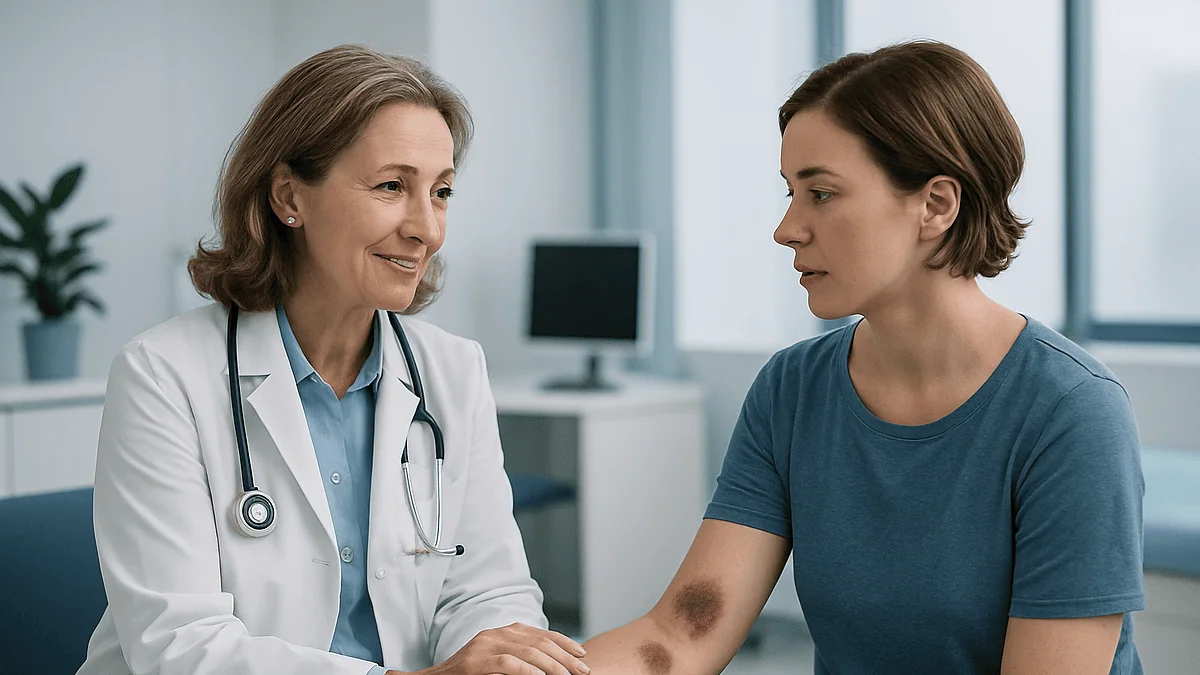
The marks frequently appear where no accidental knock is likely: the trunk, the back, the buttocks, the upper arms, the face. Shins and forearms bruise in everyone; a torso does not. They are often larger than the trigger would justify, or there is no remembered trigger at all. They may be numerous, several fresh ones at once in different colors, rather than a single mark working its way from purple to yellow.
Two companions matter more than the bruise itself. The first is petechiae, pinpoint red, purple or brown dots that look like a fine rash, do not fade when pressed, and cluster on the lower legs, ankles or anywhere skin has been squeezed by a waistband or a sock. Mayo Clinic lists these tiny spots among the recognized symptoms of leukemia. The second is bleeding elsewhere: gums that ooze when brushed, nosebleeds that take a long time to stop, unusually heavy periods, or a small cut that keeps weeping.
Color, by contrast, tells you very little. A leukemia bruise goes through the same red, purple, green and yellow stages as any other, because the biochemistry of breaking down leaked blood does not change. Do not study shades. Count marks, note locations, and watch for dots.
Normal bruise vs leukemia bruise: the key differences
Side by side, the contrast is mostly about context rather than appearance. Use the table as a rough guide, not a diagnostic tool.
| Feature | Ordinary bruise | Pattern that warrants a blood test |
|---|---|---|
| Cause | A remembered bump or fall | No clear injury, or trivial contact |
| Location | Shins, knees, forearms, elbows | Back, chest, abdomen, face, upper arms |
| Number | One or two at a time | Several fresh marks appearing together |
| Size | Matches the impact | Larger than the impact explains |
| Healing | Fades over roughly two weeks (MedlinePlus) | New ones keep arriving before old ones fade |
| Companions | None | Petechiae, bleeding gums, nosebleeds, fatigue, fever |
Notice that the right-hand column does not say leukemia. It says blood test. Several conditions produce the same picture, including immune platelet disorders, liver disease, vitamin deficiencies and certain medicines, and a complete blood count is the step that separates them.
One more honest note: some people, particularly older adults and those with fair or sun-damaged skin, bruise on the forearms and backs of the hands with almost no provocation. Mayo Clinic describes this as a common, harmless consequence of thinning skin and fragile vessels. It lives firmly in the left column, even though it can look alarming.
How do I know if my bruising is leukemia?
You cannot know from the skin alone, and neither can a physician. That is not a dodge; it is the reason blood tests exist.
What you can do is weigh probability sensibly. Leukemia is uncommon relative to the sheer volume of bruising humans experience. Most people typing this question have an isolated mark or two on an arm or leg, no other symptoms, and a perfectly normal platelet count waiting to be found. Anxiety, understandably, does not do statistics.
Ask yourself four questions. Have you been bruising more easily than a few months ago, or is this a longstanding trait? Are the marks turning up in places you never bang? Have you noticed the pinpoint dots, bleeding gums or nosebleeds that suggest a genuinely low platelet count? Do you feel unwell in other ways: persistently tired, running low fevers, catching infections that linger, losing weight without trying, waking drenched in sweat?
A single yes is worth a conversation with your doctor. Two or more, especially the last, is worth a prompt appointment. The NHS advises seeing a GP if you have possible symptoms of acute leukemia, noting that they are usually caused by something else but should be checked. The test that answers the question is a complete blood count, which measures platelets, red cells and white cells from a single tube of blood. In most laboratories it is routine, fast and inexpensive. Worry is heavier to carry than a needle.
What are the early warning signs of leukemia besides bruising?
Bruising rarely arrives alone, and the company it keeps is what turns a curiosity into a clinical concern. Leukemia disrupts three cell lines at once, so its early symptoms cluster into three families.
When red cells fall, anemia follows: fatigue out of proportion to activity, pale skin or pale inner eyelids, breathlessness climbing a flight of stairs that used to be easy, a racing heartbeat at rest. When healthy white cells fall, infections take hold: fevers without an obvious source, a cold that becomes a chest infection, mouth ulcers that will not heal. When platelets fall, you see the bleeding family: bruises, petechiae, gum and nose bleeding.
Mayo Clinic adds a fourth group tied to the abnormal cells themselves. They can gather in the spleen and liver, producing a sense of fullness or discomfort under the left ribs. They can enlarge lymph nodes in the neck, armpit or groin. They can drive drenching night sweats, unintended weight loss and bone or joint aches, particularly in children who suddenly refuse to walk or complain of leg pain at night.
The pace varies. The NHS describes acute myeloid leukemia symptoms as usually developing over a few weeks and worsening, while chronic forms may cause few symptoms for years and are often picked up on a routine blood test. That is why the combination matters more than any single item. Bruising plus fatigue plus fever over a few weeks is a different conversation from bruising alone.
Petechiae: the tiny red dots people mistake for a rash
If bruises are the headline, petechiae are the fine print that experienced clinicians read first. They are pinpoint spots, often no bigger than the tip of a pen, colored red, purple or reddish brown, and they appear when capillaries leak minute amounts of blood into the skin.
Three features set them apart from an ordinary rash. They do not itch. They lie flat rather than raised. And they do not blanch: press a clear glass against them and the dots stay visible, whereas most rashes fade under pressure because their redness comes from dilated vessels rather than escaped blood. This glass test is a useful home observation, not a diagnosis, but it does help decide how quickly to make a call.
Petechiae favor gravity and pressure. They gather around the ankles and lower legs, under bra straps and waistbands, and anywhere a child has been picked up firmly. A cluster appearing after a violent coughing fit or vomiting is usually mechanical and harmless. A spreading crop with no such story, or one accompanied by fever or fatigue, is a reason to seek same-day advice.
Why do they matter so much in leukemia? Because they typically signal a platelet count that has fallen well below the normal floor of 150,000 per microliter described by MedlinePlus, low enough that vessels are leaking without any injury. Cleveland Clinic lists petechiae among the hallmark signs of thrombocytopenia. Bruises can come from many things. Widespread petechiae almost always mean the blood itself deserves a look.
Bleeding gums, nosebleeds and heavy periods: the bruise's close relatives
Skin is simply the most visible place to notice a low platelet count. The same failure of clotting shows up in every tissue that bleeds easily, and these signs often precede the bruises people eventually search for.
Gums are a frequent early site. Brushing produces pink foam most days; flossing leaves a streak that lingers; a dental cleaning bleeds longer than the hygienist expects. In some acute leukemias the gums themselves can look swollen and boggy as abnormal cells infiltrate the tissue, a sign dentists are trained to notice.
Nosebleeds change character. Everyone gets one in dry winter air, but a nosebleed that takes a long time to stop, recurs several times a week, or starts without any picking or trauma suggests the plug is not forming properly. Menstrual bleeding may become heavier, longer or clottier than a person’s own baseline, and because heavy periods have many common causes, this clue is easily dismissed for months.
Less obvious sites include blood in urine, dark or tarry stools, tiny blood spots in the whites of the eyes, and cuts that ooze long after they should have sealed. Cleveland Clinic lists these alongside bruising and petechiae as manifestations of thrombocytopenia. None is specific to leukemia. Together, and especially alongside fatigue or fever, they describe a body that is running short of platelets, and that is a finding no one should sit on for long.
What else causes easy bruising? Common explanations first
Before leukemia enters the conversation, several far more common culprits deserve their turn, and a good clinician will work through them in roughly this order.
Age and sunlight lead the list. Mayo Clinic explains that skin thins with age, losing some of the fatty cushion that protects vessels, while years of sun exposure weaken the collagen around them. The result is the flat, dark, painless patches on forearms and hands seen in many people over sixty, medically trivial though cosmetically annoying.
Medicines come next. Blood-thinning drugs, prescribed to prevent clots, work by design to slow the platelet plug or the clotting cascade, so bruising is an expected trade-off rather than a warning. Some anti-inflammatory tablets and steroid medicines, including long-term skin creams and inhalers, have similar effects on platelets or skin thickness. Certain herbal supplements, notably those marketed for circulation or memory, also interfere with clotting; the NIH Office of Dietary Supplements documents interactions for several. Never stop a prescribed medicine because of bruising; raise it with the prescriber instead.
Then there are nutritional and organ causes. Vitamin C deficiency weakens vessel walls, vitamin K deficiency impairs clotting factors, and liver disease reduces production of those same factors. Inherited bleeding disorders can surface in adulthood. Immune thrombocytopenia, where the body destroys its own platelets, produces a picture that is nearly identical to leukemia on the skin and is far more common. All of these are reasons the blood test, not the bruise, gets the final word.
Bruising in children: when is it worth a check?
Children are bruise factories. A toddler learning to walk collects marks on shins, knees, forehead and elbows in a steady stream, and a school-age child returns from recess looking like a small boxer. Pediatricians expect this and are reassured by it, because bony, forward-facing surfaces are exactly where accidental bruises belong.
What changes the calculation is location, company and mood. Bruises on the back, buttocks, chest, abdomen, ears or neck are unusual from ordinary play, and any clinician will want to understand them, both for medical causes and for the child’s safety. A sudden crop of petechiae, especially with a fever, is a same-day matter because it can also signal serious infection. Nosebleeds that recur or last a long time, and gums that bleed with gentle brushing, point to platelets rather than play.
The mood clue is underrated. Acute lymphoblastic leukemia, the most common childhood leukemia, tends to arrive over weeks rather than months, and the NHS lists bruising alongside pallor, tiredness, breathlessness, repeated infections, bone and joint pain and a swollen abdomen among its symptoms. A previously energetic child who becomes pale, clingy, limps or refuses to walk, or seems exhausted after minimal activity has changed in a way parents usually sense before they can name.
Trust that sense. A complete blood count in a child is a quick procedure, and pediatric teams would far rather run one reassuring test than miss an unwell child because a parent worried about overreacting.
What happens at the doctor's visit if bruising is the concern?
The appointment is usually less dramatic than the anticipation. Expect a conversation first: when the bruising began, whether it is new for you, what medicines and supplements you take, whether anyone in the family bleeds easily, and whether you have felt tired, feverish or unwell. Then a careful look at the skin, the gums, the lymph nodes in the neck, armpits and groin, and a gentle press under the ribs to check the spleen and liver.
The decisive step is the complete blood count. A single tube of blood goes through an automated analyzer that counts red cells, white cells and platelets and measures hemoglobin within minutes. MedlinePlus explains that platelet tests are used precisely to investigate unexplained bruising and bleeding. If numbers are unusual, a laboratory scientist or hematologist examines a blood smear under the microscope, looking at the size, shape and maturity of the cells, because leukemia often reveals itself as immature cells that should not be circulating.
Only if those results point toward the marrow does the next stage follow. Mayo Clinic describes a bone marrow biopsy, usually from the back of the hip, where a small sample is taken under local anesthetic and analyzed with techniques such as flow cytometry and genetic testing that identify the exact type and subtype of any abnormal cells. Most people investigating bruising never reach this step.
Timelines depend on findings. A normal count usually ends the workup. An abnormal one typically triggers a rapid referral, often within days, because acute leukemias move quickly and early specialist assessment matters.
What to expect if bruising does lead to a leukemia diagnosis
For the minority whose blood count is abnormal, the following weeks are structured and fast. Understanding the shape of them removes some of the fear.
Leukemia is not one disease. Mayo Clinic groups it by speed, acute or chronic, and by the cell line involved, lymphoid or myeloid, giving four main types with many subtypes beneath. Acute forms involve immature cells that multiply rapidly and generally require treatment soon after diagnosis. Chronic forms involve more mature cells, progress slowly, and in some cases are monitored for months or years before any treatment begins. The specialist will explain which type you have and why that determines the plan.
Treatment approaches include medicines that kill or slow dividing cells, targeted drugs that block specific molecular signals the abnormal cells depend on, immune-based therapies, and in selected cases replacement of the marrow with donor stem cells. Each has its own timeline and side-effect profile, and choosing among them belongs to you and your treating team, informed by the subtype, your age, your general health and your priorities.
Bruising itself often gets worse before it gets better. Many treatments temporarily suppress the marrow further, so platelets can fall lower in the early weeks; teams monitor counts closely and may give platelet transfusions when levels drop into the range where spontaneous bleeding becomes a risk. As healthy marrow recovers, bruising and petechiae typically recede, and many patients describe that fading as the first visible sign that things are turning. Outcomes vary widely by type, and honest conversations with your specialist about your specific situation are worth more than any general statistic.
Are there foods that help fight leukemia?
People ask this constantly, and the honest answer disappoints anyone hoping for a shopping list. No food, juice, spice or supplement has been shown to shrink leukemia cells or replace treatment. Claims that a particular berry, root or alkaline diet fights blood cancer are not supported by mainstream evidence, and they can do harm when they delay care or interact with medicines.
What diet can do is support the body carrying the disease and its treatment. Adequate protein helps maintain muscle and repair tissue during periods of fatigue and reduced appetite. Iron, folate and vitamin B12 are building blocks for red cells, though supplementing them makes sense only if a deficiency is confirmed, since leukemia-related anemia is a production problem rather than a raw-material shortage. Vitamin C supports the connective tissue around blood vessels and vitamin K supports clotting factors, both relevant to bruising, and both easily obtained from a varied diet of fruit, vegetables and leafy greens.
Food safety deserves as much attention as nutrition. When treatment lowers white cells, the risk from bacteria in undercooked meat, unpasteurized dairy, raw sprouts or unwashed produce rises. Many cancer centers offer dietitian guidance on which foods to avoid during low-count periods.
Supplements need particular caution. Some herbal products thin the blood, some interfere with drug metabolism in the liver, and the NIH Office of Dietary Supplements maintains fact sheets describing these interactions. Tell your team about everything you take, including teas and powders. Eat well, eat safely, and let the treatment do the fighting.
When should you see a doctor about bruising?
This is the section to bookmark. Bruising deserves a routine appointment when it is new or clearly increasing compared with your own history, when marks appear in places you do not bump, when several fresh bruises show up at once, or when you are also more tired than usual, running unexplained fevers or picking up infections that linger. The NHS advises seeing a GP for any possible leukemia symptoms, adding that most turn out to have another cause but still warrant a check.
Seek same-day care for the following red flags: a spreading rash of pinpoint red or purple dots that does not fade under pressure, especially with a fever, a stiff neck or a child who seems unusually drowsy; a nosebleed that will not stop after a sustained period of firm pressure; blood in urine, black or tarry stools, or vomiting blood; bleeding gums that ooze continuously; a severe headache, confusion or vision change following a fall in someone who bruises easily; or a large, rapidly expanding bruise after minimal trauma. Cleveland Clinic notes that very low platelet counts can lead to spontaneous bleeding, including internal bleeding, which is why these signs are treated urgently.
Bring a short list to the appointment: when the bruising started, every medicine and supplement you take, any family history of bleeding, and the other symptoms you have noticed. A photograph of the marks with a date helps, since bruises fade before appointments arrive. The visit that most often follows this list ends with a normal blood count and genuine relief. The rare one that does not begins the process early, which is precisely the point.
Living with easy bruising during leukemia treatment
For those already in treatment, bruising becomes a daily companion rather than a warning, and small practical habits reduce both the marks and the risk behind them. None of these replace the monitoring your team provides; they simply make low-platelet weeks easier.
Protect the mouth. A soft-bristled toothbrush and gentle technique reduce gum bleeding, and many teams advise against flossing or dental work when counts are low. Ask before scheduling a cleaning.
Shave with an electric razor rather than a blade, blow your nose gently, and keep nasal passages moist in dry weather, since cracked lining is the usual starting point for nosebleeds.
Choose activity thoughtfully. Walking, stretching and light resistance work are generally encouraged for energy and mood, while contact sports, heavy lifting with straining and activities with fall risk are usually paused during low-count periods. Your team will tell you which thresholds apply to you.
Check labels. Several common over-the-counter pain relievers and many herbal supplements impair platelet function; ask which are safe rather than assuming.
Keep a simple log. Note new bruises, petechiae, nosebleeds or gum bleeding with dates. Trends between appointments help your team decide when a transfusion or a change in plan is warranted, and patients who track symptoms often feel more in control of a process that can otherwise feel like it is happening to them.
Finally, know your urgent contacts and use them. Treatment teams expect calls about bleeding and would always rather hear about a concern early than manage a complication late.
Frequently asked questions
How do I know if my bruising is leukemia?
You cannot tell from the skin alone; only a blood test can answer that. Bruising that is new for you, appears in places you do not bump such as the back or trunk, comes in several fresh marks at once, or arrives with pinpoint red dots, bleeding gums, fatigue or fevers is worth a prompt appointment. Most unexplained bruising turns out to have a benign cause, and a complete blood count usually settles the question the same day.
What do leukemia bruises look like?
They look like ordinary bruises, moving through the same purple, green and yellow stages, which is why appearance alone is unreliable. What differs is the pattern: marks without a remembered injury, in unusual locations, larger than any bump explains, and often accompanied by petechiae, tiny non-blanching red or purple dots on the legs or under tight clothing. Bleeding gums and prolonged nosebleeds commonly appear alongside them.
What are the early warning signs of leukemia?
Early signs cluster into three groups tied to falling blood cells: fatigue, pallor and breathlessness from low red cells; fevers and lingering infections from low healthy white cells; and bruising, petechiae, gum and nose bleeding from low platelets. Night sweats, unintended weight loss, bone pain, swollen lymph nodes and fullness under the left ribs may also occur. In acute forms these typically develop over a few weeks; chronic forms may cause no symptoms for years.
What are the best foods to eat to help fight leukemia?
No food has been shown to fight leukemia or replace treatment, and claims about specific fruits, spices or diets are not supported by mainstream evidence. Diet can support the body through treatment: adequate protein, plenty of fruit and vegetables, and careful food safety when white cells are low. Tell your team about any supplements, since several herbal products thin the blood or interact with medicines. A cancer dietitian can tailor advice to your counts.
What are the key differences between a normal bruise and a leukemia bruise?
Normal bruises follow a known bump, sit on bony areas like shins and forearms, appear one or two at a time and fade over roughly two weeks. Bruises that warrant a blood test appear without injury, favor the trunk, face or upper arms, arrive several at once, keep appearing before old ones fade, and come with petechiae, bleeding gums, nosebleeds, fatigue or fever. The distinction is context, not color.
Can unexplained bruising be a sign of leukemia?
Yes, unexplained bruising is a recognized symptom of leukemia because the disease lowers platelet production, but it is far more often caused by aging skin, sun damage, blood-thinning or anti-inflammatory medicines, vitamin deficiencies, liver problems or immune platelet disorders. The word unexplained is the key: bruising that is new, increasing and unaccompanied by injury deserves a complete blood count regardless of which cause is ultimately found.
What are petechiae and why do they matter?
Petechiae are pinpoint red, purple or brown spots caused by tiny capillaries leaking blood into the skin. Unlike most rashes they are flat, do not itch and do not fade when pressed with a clear glass. They usually indicate a platelet count that has fallen well below normal, which is why clinicians treat a spreading crop, especially with fever or fatigue, as a same-day concern rather than something to watch.
Where on the body do leukemia bruises usually appear?
They tend to appear where accidental knocks are unlikely: the back, chest, abdomen, buttocks, upper arms and face. Petechiae favor the lower legs and ankles and areas squeezed by waistbands or straps. Bruises confined to shins, knees, forearms and elbows are the normal geography of daily life and, on their own, rarely point toward a blood problem.
What test shows whether bruising is caused by low platelets?
A complete blood count, drawn from a single tube of blood and analyzed within minutes, measures platelets along with red and white cells and hemoglobin. If the platelet count is low or other values are unusual, a blood smear is examined under the microscope, and only if those findings point toward the marrow does a bone marrow biopsy follow. Most people investigating bruising have a normal count and need nothing further.
When should I go to the emergency department for bruising?
Go urgently for a spreading rash of non-blanching dots with fever, stiff neck or drowsiness; a nosebleed that will not stop after sustained pressure; blood in urine, black stools or vomited blood; continuous gum bleeding; a severe headache, confusion or vision change after a fall; or a large bruise expanding rapidly after minor trauma. Very low platelet counts can cause internal bleeding, so these signs are treated as emergencies.
References
- Thrombocytopenia – Cleveland Clinic
- Platelet Tests – MedlinePlus
- Acute myeloid leukaemia: Symptoms – NHS
- Bruises – MedlinePlus
This article is for general information only and is not a substitute for professional medical advice. Please consult a qualified doctor about your individual situation.

More from the Blog

Allogeneic Car T Cell Therapy: What It Means, What to Expect and When to See a Specialist
Allogeneic CAR T cell therapy uses immune T cells from a healthy donor, rather than the patient's own, that are engineered in advance to…

Car T Cell Therapy Cost: What the Price Covers, What Moves It and the UK, US and Türkiye Ranges
CAR T-cell therapy is among the most expensive treatments in modern medicine because each dose is manufactured from one patient's own cells and delivered…
Proton Therapy Cost: What the Price Covers, What Moves It and the UK, US and Türkiye Ranges
Proton therapy cost is driven mainly by the equipment behind it, the number of treatment sessions in your course and the country where you…

Bone Marrow Transplant Recovery: A Week-By-Week Timeline and What Speeds It Up
Bone marrow transplant recovery unfolds in stages: roughly two to four weeks in the hospital while the new stem cells engraft, a 100-day window…

Bone Marrow Transplant Risks for the Donor: What It Means, What to Expect and When to See a Specialist
Donating bone marrow or blood stem cells is considered low risk for healthy adults. Most donors experience temporary effects such as back or hip…
Cancer Treatment Cost: What the Price Covers, What Moves It and the UK, US and Türkiye Ranges
Cancer treatment cost has no single figure. The price is built from diagnosis, staging scans, surgery, radiotherapy sessions, drug therapy cycles, hospital days and…