

Top 10 Proton Therapy Centers: What It Means, What to Expect and When to See a Specialist
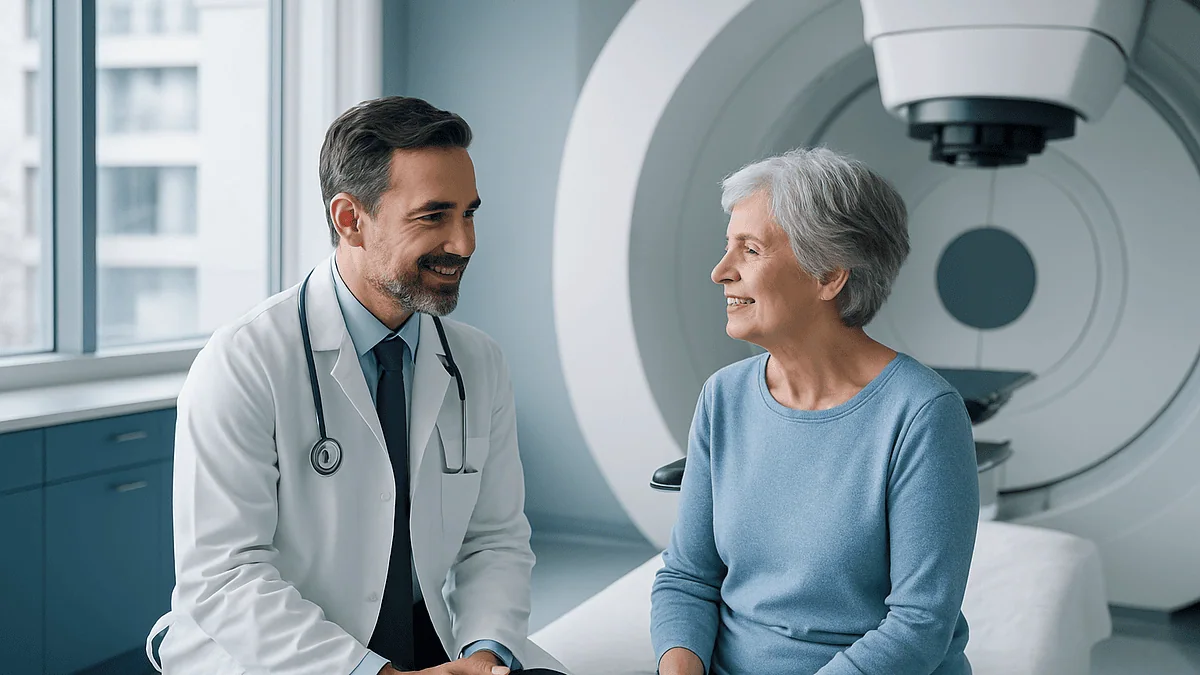
Key Takeaways
- Proton beams release most of their energy at a set depth (the Bragg peak) and then stop, which is why tissue behind a tumor receives far less dose than with X-ray radiation.
- Tumor control with protons is broadly similar to photons at the same dose; the hoped-for advantage is fewer side effects, and randomized trials in common adult cancers are still testing whether that advantage is real.
- The strongest evidence-based indications are childhood cancers and tumors near critical structures such as the skull base, eye, spine and brainstem.
- A typical session lasts 15 to 30 minutes, with the beam itself on for about a minute, delivered five days a week over several weeks.
- A center that offers both protons and photons and can show you comparative dose plans has less incentive to recommend the more expensive option unnecessarily.
- Skin dose from protons can be higher than with some photon techniques, so skin reactions are not automatically milder even when internal organs are better spared.
No neutral medical source publishes a ranked list of the top 10 proton therapy centers, because rankings are marketing, not evidence. A high-quality center is recognizable by clear markers: accreditation, pencil-beam scanning, image guidance, a pediatric program, active clinical trials and honest counseling about when standard radiation works just as well. Proton therapy is a precise form of radiation, not a separate cure.
A father in a hospital waiting room types four words into his phone: best proton therapy center. Forty results appear, half of them advertisements, most of them written by the centers themselves. His daughter is eight, and somewhere in the alphabet soup of gantries and gray units he is trying to find a single thing he can trust.
That search happens thousands of times a day. It also exposes an uncomfortable truth about medical technology: the question people ask (“which center is number one?”) is not the question the evidence can answer. Radiation oncology does not keep a leaderboard. What it does keep is a set of standards, trial results and quality markers that separate genuinely excellent programs from expensive rooms with a good website.
This guide is built for that father. It explains what a proton beam actually does inside tissue, how a course of treatment unfolds, what the outcome data honestly show and, most usefully, how to recognize a top-tier center without anyone naming one for you.
Why an honest "top 10 proton therapy centers" list has no names on it
Most articles carrying this headline are directories. They list institutions, often in the order those institutions paid to appear, and they rarely disclose it. A hospital magazine cannot ethically do the same, and a careful reader should be suspicious of anyone who does.
The deeper problem is that no independent body ranks proton centers on patient outcomes. Radiation oncology quality is measured differently: by accreditation of the physics program, by participation in registries and trials, by peer review of treatment plans and by the training of the team. Those measures produce a standard, not a scoreboard. Two centers meeting the standard are, for a given patient, functionally equivalent. A third that meets the standard and happens to be closer to home is usually the better choice, because treatment runs five days a week for several weeks (Mayo Clinic).
So this article replaces ten names with ten markers. Each one is something you can verify by asking, reading a consent form or checking a trial registry. Taken together they describe what “top” genuinely means in this field, and they travel with you whether you live in Ohio, Manchester or Osaka.
What proton therapy actually is, and why the Bragg peak matters
Standard radiation therapy uses X-rays, also called photons. A photon beam deposits energy as it enters the body, peaks near the surface, then keeps going: it exits through healthy tissue on the far side of the tumor. Clinicians shape and rotate the beams so the tumor gets the highest combined dose, but some exit dose is unavoidable.
Protons behave differently. They are charged particles with mass, accelerated to roughly 60 percent of the speed of light by a cyclotron or synchrotron. As they slow down inside tissue they release most of their energy in a sharp burst at a depth that physicists can set with millimeter precision, then stop. That burst is the Bragg peak. Beyond it, the dose falls essentially to zero (National Cancer Institute).
Picture the difference as two ways of watering one plant in a crowded flower bed. Photons are a garden hose: the target gets wet, and so does everything behind it. Protons are a watering can with a very long spout that stops pouring the moment the roots are reached.
Two consequences follow. First, tissues behind the tumor, such as the heart behind a left breast or the brainstem behind a skull-base tumor, receive far less radiation. Second, the cancer-killing effect on the tumor itself is broadly similar to photons at an equivalent dose. Proton therapy is a more precise way of delivering radiation, not a stronger or fundamentally different treatment. That distinction sits under almost every question that follows.
Who is the leader in proton therapy?
People ask this expecting a name. The evidence-based answer is that leadership in proton therapy is distributed, and it looks different depending on what you measure.
If leadership means volume, the largest centers treat several thousand patients a year across multiple treatment rooms. Volume matters because rare tumors, particularly in children, are managed more safely by teams who see them often. If it means research, the leaders are the programs enrolling patients in randomized trials comparing protons with photons, because those trials are the only way to convert a physical advantage into proven clinical benefit. If it means technology, the frontier is pencil-beam scanning with intensity modulation, in-room imaging and adaptive planning that adjusts to a shrinking tumor mid-course.
Several countries also lead in different ways. In England, proton beam therapy is a nationally commissioned service with referral criteria set centrally, so access is decided by clinical indication rather than by postcode or ability to pay (NHS England). Other health systems have taken a market approach, producing many more centers but also more variation in who gets treated and why.
The practical lesson: stop searching for a leader and start checking whether a specific program meets the standards in the next section. A center with modest publicity that runs a robust pediatric anesthesia program and publishes its outcomes is doing more for patients than a famous one that neither enrolls in trials nor tells you when standard radiation would serve you equally well.
The ten markers that define a top proton therapy center
These are the features a specialist would look for on behalf of a family member. None requires insider knowledge; each can be confirmed with a phone call or a consultation.
| Marker | Why it matters | How to check |
|---|---|---|
| 1. Accredited radiation oncology program | Independent review of physics, safety and staffing | Ask which body accredits the department |
| 2. Pencil-beam scanning | Paints dose layer by layer, sparing more normal tissue than older passive scattering | Ask which delivery technique is used |
| 3. Daily image guidance | Confirms the target has not shifted before each session | Ask about in-room CT or X-ray imaging |
| 4. Adaptive re-planning | Adjusts to anatomy changes during a multi-week course | Ask how often plans are re-evaluated |
| 5. Multidisciplinary tumor board | Surgeons, medical and radiation oncologists agree the plan together | Ask whether your case will be reviewed at a board |
| 6. Pediatric program with anesthesia | Young children need sedation and specialized support | Relevant if the patient is a child |
| 7. Active clinical trials | Signals scientific rigor and offers access to comparative studies | Search a public trial registry for the center |
| 8. Both protons and photons on site | Reduces incentive to recommend protons when not needed | Ask whether standard radiation is also offered |
| 9. Transparent counseling | Explains when evidence for protons is strong, uncertain or absent | Listen for honest uncertainty in the consult |
| 10. Survivorship and late-effects follow-up | Radiation effects can emerge years later | Ask about long-term follow-up clinics |
Marker eight deserves emphasis. A center that can only deliver protons has a financial reason to recommend protons. One that offers both and still suggests protons for your case is giving you information, not a sales pitch.
Which cancers is proton therapy used for, and where the evidence is strongest
Proton therapy is used across many tumor types, but the strength of the case varies enormously, and a good center will tell you which category you fall into.
The strongest rationale is in children. Growing tissue is exquisitely sensitive to radiation, and the late effects of dose to a developing brain, spine or heart can include learning difficulties, hormone deficiencies, growth problems and second cancers decades later. Reducing the volume of normal tissue irradiated is a direct way to reduce those risks, which is why childhood tumors are a priority indication in national programs (NHS England).
The case is also strong for tumors wrapped around critical structures: chordomas and chondrosarcomas at the base of the skull, tumors of the eye, certain spinal and paraspinal tumors, and some head and neck cancers where salivary glands, the optic nerves or the brainstem sit millimeters from the target (Mayo Clinic).
For common adult cancers the picture is more nuanced. In prostate, breast, lung, esophageal and liver cancers, protons clearly deliver less dose to nearby organs on the planning scan. Whether that translates into measurably fewer serious side effects or better survival is exactly what ongoing randomized trials are designed to answer, and several are still recruiting. A center that says “the physics favors protons for you, but the clinical trials have not yet proven a benefit” is being accurate, not evasive.
Left-sided breast cancer is a good example of honest uncertainty. Protons reduce heart dose on paper; modern photon techniques with breath-hold also reduce it substantially. Which approach a given patient needs depends on her anatomy, not on which machine is newer.
What is the success rate of proton therapy?
This is the most searched question about proton therapy and the one most often answered misleadingly. A single “success rate” does not exist, and any center quoting one without context should prompt skepticism.
Here is why. Radiation success is measured by tumor control and survival for a specific cancer, at a specific stage, in a specific patient group, over a specific number of years. A low-grade tumor in a healthy child and an advanced lung cancer in an older adult may both receive proton therapy and have utterly different outcomes, none of which reflect on the beam itself. Proton therapy is a delivery method. The biology of the cancer decides most of the result.
What the comparative evidence does show is this: where protons and photons deliver the same tumor dose, tumor control rates are broadly similar. The hoped-for advantage of protons lies in fewer side effects from lower doses to healthy tissue, not in killing more cancer. Randomized trials in several adult cancers are testing whether that advantage is real and meaningful; results so far are mixed, with some showing fewer acute effects and others finding no significant difference (National Cancer Institute).
A better question to ask a specialist is: “For my diagnosis and stage, what is the expected control rate with radiation, and would protons change my side-effect risk in a way that matters to me?” That question has an answer. The generic one does not.
One more caution. Centers sometimes publish outcome figures from their own patients. These are useful but not comparable across institutions, because each center treats a different mix of cancers and stages. A higher number may simply mean a center accepts fewer high-risk patients.
What happens at a first proton therapy consultation
The first visit is longer than most medical appointments, often an hour or more, and it is largely conversation and review rather than machines. A radiation oncologist examines the imaging, pathology and prior treatment history, then explains whether radiation is appropriate at all and, if so, whether protons offer an advantage over photons for this particular tumor and body.
Expect to hear the phrase “comparative plan.” At well-run centers the physics team often generates both a proton plan and a photon plan for the same patient and lays them side by side, showing the dose to the heart, lungs, bowel or brain under each. If the difference is small, a thoughtful clinician will say so and may recommend conventional treatment, which is usually more accessible and less expensive (Johns Hopkins Medicine).
If protons are chosen, the next step is simulation. You lie on a CT scanner in the exact position you will hold for every treatment. Technicians make a custom immobilization device, a molded cushion, a thermoplastic mask for the head and neck, or a body frame, so the position is reproducible to within a few millimeters. Small skin marks or tiny tattoos may be placed as alignment references. Children who cannot lie still are assessed for daily anesthesia, which is one reason a dedicated pediatric team is a quality marker.
Between simulation and the first treatment there is a gap of roughly one to two weeks (NHS). Physicists and dosimetrists use that time to build and verify the plan, running quality checks on the machine before a person is ever placed in front of it.
What to expect during a proton therapy session
Patients often describe the first session as anticlimactic, and that is a good sign. Proton therapy is painless and silent; you feel nothing when the beam is on.
You arrive, change into a gown if the treatment area requires it, and are positioned by radiation therapists using the device made at simulation. Lasers and in-room imaging confirm alignment. In many centers the couch is robotic and adjusts in six directions until the images match the plan. The staff then leave the room and watch by camera and intercom. The beam itself is on for only a minute or so, but the whole appointment, including positioning and imaging, typically lasts 15 to 30 minutes (Mayo Clinic).
The room can look intimidating. A proton gantry is a rotating structure three stories tall, though most of it is hidden behind walls; you see only a nozzle that swings around you. Some centers use fixed beams and rotate the patient instead. Neither design is inherently superior; what matters is the planning behind it.
A few practical realities help. Treatment is outpatient, so you go home the same day. Most people continue working or attending school, at least in the early weeks. You are not radioactive afterward; protons do not linger in the body, so hugging children or sharing a bed is entirely safe. And because the beam is delivered from a room-sized machine fed by an accelerator the size of a house, appointment times are precise: a delay in one room can ripple through the day, which is why centers ask patients to arrive early.
How long does a course of proton therapy take?
The rhythm of proton therapy is a working week: treatment Monday through Friday, weekends off, repeated for several weeks (Mayo Clinic). The total number of sessions, called fractions, is set by the tumor type and the dose the oncologist prescribes, and it can range from a single treatment for some small targets to six or seven weeks for others.
Why not deliver everything in one visit? Splitting radiation into daily fractions exploits a biological asymmetry: healthy cells repair radiation damage between sessions more efficiently than most cancer cells do. Over weeks, that gap accumulates in the patient’s favor. Newer schedules with fewer, larger fractions, known as hypofractionation, are increasingly used where evidence supports them, and protons are being studied in this setting as well (National Cancer Institute).
The multi-week structure has a consequence that outranks any technology comparison: geography. If the nearest proton center is 300 miles away, a six-week course means relocating, finding housing, missing work and separating a family. Some programs offer lodging support; many do not. When the physical dose advantage of protons is marginal for your case, a specialist may reasonably conclude that high-quality photon therapy near home, delivered on schedule and without disruption, is the better overall plan. Missing sessions or spreading them out weakens the biological effect, so a course completed on time with photons can outperform a proton course interrupted by travel and exhaustion.
Ask during consultation how many fractions are planned, whether a shorter schedule is appropriate for your diagnosis and what happens if a day is missed. Those three answers tell you more about the coming weeks than any brochure.
Side effects of proton therapy: what is realistic
Proton therapy causes fewer side effects than photon therapy in some settings, but it is not side-effect free, and centers that imply otherwise are overselling. The tumor receives a full radiation dose, and tissue on the entry path still receives some.
Effects fall into two groups. Acute effects develop during treatment and in the weeks after, in the region being treated. Skin in the beam path may redden, darken or peel, somewhat like a sunburn. Fatigue is common across all radiation types and tends to build through the course before easing over a few weeks after the last session. Head and neck treatment can cause mouth soreness and taste changes; abdominal treatment can cause nausea or loose stools; pelvic treatment can irritate the bladder or bowel (NHS).
Because protons stop at the target, the exit-dose effects that accompany photons, such as irritation of tissue on the far side of the tumor, are often reduced. That is the mechanism behind the hope for lower rates of heart disease after breast or lung treatment and fewer cognitive effects after brain treatment in children.
One physics subtlety deserves mention. Skin dose can actually be higher with protons than with some photon techniques, because a proton beam enters at closer to full intensity. Skin reactions are therefore not automatically milder.
Late effects appear months or years afterward and depend on which organs received dose: hormone changes, tissue stiffening, fertility effects or, rarely, second cancers. A center’s long-term follow-up program, the tenth marker in the table above, exists precisely to catch these early. Ask what your follow-up schedule will look like at year one, year five and beyond.
How much does one session of proton therapy cost?
Ask three centers and you may get three answers, and none will be the number you eventually pay. Proton therapy is, as a rule, more expensive than photon therapy, mainly because the accelerator and shielded building cost far more to construct and staff. Published health-economic comparisons consistently find higher per-course costs for protons, though the size of the gap varies widely with country, payer and number of fractions, which is why no single figure can honestly be quoted here.
Several factors shape the bill:
- Number of fractions. Charges accrue per session, so a five-fraction course costs a fraction of a 35-fraction course.
- Health system. In publicly funded systems such as the NHS, eligible patients pay nothing at the point of care; access is governed by clinical criteria, not price (NHS England). In insurance-based systems, coverage depends on the plan and the diagnosis.
- Indication. Insurers are more likely to approve protons for children and for tumors near critical structures, where evidence is strongest, and to require justification or trial enrollment for common adult cancers.
- Indirect costs. Travel, lodging for several weeks, lost income and childcare can rival the treatment charges themselves.
Two practical steps help. First, ask the center’s financial counselor for a written estimate for your specific plan and whether prior authorization has been obtained before your first session, not after. Denials sometimes arrive mid-course. Second, ask the oncologist directly whether photon therapy would be clinically equivalent for you. If the answer is yes, choosing the less expensive option is not settling; it is good medicine.
Which countries offer proton beam therapy?
Two decades ago proton therapy was confined to a handful of physics laboratories. Today more than 100 centers operate worldwide, with dozens more under construction, and the map keeps filling in.
The United States has the largest number of centers, concentrated in major metropolitan areas and academic medical hubs. Japan was an early adopter and has an extensive network, with particle therapy including carbon ions woven into national cancer care. Germany, the Netherlands, Switzerland, Italy, France, Sweden, Denmark, the Czech Republic and Spain all operate centers. The United Kingdom’s National Health Service runs two publicly funded high-energy centers in England, and previously sent eligible patients abroad for treatment under a national program (NHS England). China, South Korea, Taiwan, India, Russia, Australia and several Middle Eastern countries have built or are building facilities.
Availability, however, is not the same as access. Within a country, proton centers cluster in wealthy urban regions; a family in a rural area may face the same relocation problem as one crossing a border. Medical tourism marketing has grown up around this gap, promising rapid access abroad. Some of it is legitimate; some is not. Standards are not uniform across countries, and a patient who travels loses the continuity of a local team for follow-up and side-effect management.
If you are considering treatment abroad, apply the same ten markers you would at home. Ask about accreditation, delivery technique, image guidance and trial participation. Then ask who will manage a complication two months after you return. A center that answers all of those clearly is worth the journey; one that answers with a price list is not.
Questions to ask a proton center before you commit
A consultation is an interview in both directions. These questions are ordered roughly by how much their answers should influence your decision.
- “Would you recommend protons for me if I could only get photon therapy near home?” The reply reveals how large the clinician believes the real advantage to be.
- “Can I see the comparative plans?” Dose maps for protons and photons side by side turn an abstract claim into something you can look at, with the doses to your own heart, bowel or brainstem labeled.
- “Is there a clinical trial I qualify for?” Trial enrollment often improves access to protons for adult cancers and contributes to the evidence future patients will rely on.
- “What delivery technique will be used?” Pencil-beam scanning is the modern standard; passive scattering still exists at some older facilities.
- “How will you check my position and anatomy each day, and will the plan be adapted if I lose weight or the tumor shrinks?”
- “How many patients with my diagnosis does this team treat each year?” Experience with rare tumors matters more than total volume.
- “Who manages side effects, and who do I call at night?” A named nurse or on-call line is the mark of a program that expects to look after you, not just irradiate you.
- “What does follow-up look like at one, five and ten years?”
- “What will this cost me, in writing, and has authorization been confirmed?”
Notice that none of these asks the center to rank itself. Good programs welcome the list; they have been asked before and have answers ready. Hesitation, vagueness or a pivot to how advanced the machine is tells you something too. Precision in radiation is a property of the whole team, and a team confident in its process is not threatened by a patient who wants to understand it (Johns Hopkins Medicine).
When to see a specialist, and red flags during treatment
Proton therapy is not something you shop for directly; it is one option within a cancer treatment plan. The right moment to raise it is when radiation of any kind has been recommended, particularly for a child, a tumor near the brain, spine, eye or heart, or a cancer close to an area that has been irradiated before. Ask your oncology team whether a referral to a radiation oncologist with proton experience makes sense for your case. A second opinion in radiation oncology is routine and no clinician should take offense (MedlinePlus).
Once treatment begins, most side effects are expected and manageable by the treating team. A smaller set of symptoms should prompt same-day contact with your radiation oncology nurse or, if the center is closed, urgent medical care:
- Fever or shaking chills, which can signal infection, especially if you are also receiving chemotherapy
- Skin in the treatment area that breaks open, weeps, bleeds or shows spreading redness and warmth
- Difficulty swallowing that stops you drinking fluids, or any trouble breathing
- Vomiting or diarrhea that does not settle within a day, or signs of dehydration such as dizziness and very dark urine
- New headache with drowsiness, confusion, seizure, weakness, numbness or vision change after brain or spine treatment
- Chest pain, a racing heartbeat or sudden swelling in one leg
- Bleeding from the bladder or bowel, or an inability to pass urine
Months or years after treatment, new symptoms in the treated region, unexplained fatigue, or changes in growth, periods or hormone-related health in someone treated as a child all warrant a return to the follow-up clinic rather than watchful waiting. Late effects are usually most manageable when identified early (NHS). The best centers make that return easy; if yours does not, your primary care clinician can make the referral.
Frequently asked questions
Who is the leader in proton therapy?
There is no single leader; leadership is spread across programs that combine high patient volume, pencil-beam scanning, daily image guidance, pediatric anesthesia support and active randomized trials. Some countries lead through nationally organized access, others through the sheer number of centers. Rather than searching for a famous name, check whether a specific program meets these quality markers and whether it will tell you honestly when standard radiation would serve you equally well.
What is the success rate of proton therapy?
Proton therapy has no single success rate, because it is a way of delivering radiation rather than a distinct treatment; outcomes depend on the cancer type, stage and the patient. At equal doses, tumor control is broadly similar to photon radiation. The intended benefit is fewer side effects from lower dose to healthy tissue, which trials are still measuring in adult cancers. Ask your specialist about expected outcomes for your specific diagnosis instead.
How much does one session of proton therapy cost?
Costs vary so widely by country, payer, diagnosis and number of sessions that no single reliable figure exists. Proton therapy generally costs more than photon therapy because of the accelerator and shielded facility. In publicly funded systems eligible patients pay nothing at the point of care; in insurance-based systems coverage depends on the plan and the indication. Request a written estimate and confirmed authorization before starting treatment.
Which countries offer proton beam therapy?
More than 100 centers operate worldwide. The United States has the most, followed by Japan and a growing network across Europe including Germany, the Netherlands, Switzerland, Italy, France, the Nordic countries and the United Kingdom, where NHS England runs publicly funded centers. China, South Korea, Taiwan, India, Australia and several Middle Eastern countries also have facilities. Availability within a country is uneven, so travel is often required even at home.
Is proton therapy better than regular radiation?
It is more precise, not more powerful. Protons deposit less radiation in tissue beyond the tumor, which is a clear physical advantage. Whether that translates into meaningfully fewer side effects depends on the tumor location and the patient; the benefit is well accepted for children and tumors near critical structures, and still being tested in trials for common adult cancers. For many patients, modern photon therapy is clinically equivalent.
Does proton therapy hurt?
No. The treatment itself is painless and silent; you feel nothing while the beam is on, and the beam runs for only about a minute per session. The longer part of each visit is positioning and imaging. Side effects such as skin redness, fatigue or soreness in the treated area can build over the weeks of a course, but these come from the cumulative dose, not from the session as it happens.
How long does a proton therapy course last?
Most courses run five days a week for several weeks, though the total number of sessions ranges from a single treatment for some small targets to six or seven weeks for others. Each appointment typically takes 15 to 30 minutes including setup. The schedule is set by tumor type and prescribed dose; shorter hypofractionated schedules are used where evidence supports them. Completing the course on time matters more than the technology chosen.
Am I radioactive after proton therapy?
No. Proton therapy is external-beam radiation; the beam passes through and stops, and nothing radioactive remains in your body afterward. You can be around children, pregnant people and pets immediately and safely. This differs from some internal radiation treatments involving implanted or swallowed radioactive sources, which carry temporary precautions. If you are unsure which type you are receiving, ask your treatment team.
Is proton therapy safe for children?
Children are the group with the strongest rationale for proton therapy, because growing tissue is highly sensitive to radiation and lower dose to the developing brain, spine and organs may reduce late effects such as learning, growth and hormone problems. It is still radiation and carries risks, so it is used only when radiation is needed. Young children often require daily anesthesia, which is why a dedicated pediatric team is essential.
How do I find a good proton therapy center?
Ask your oncologist for a referral to a radiation oncologist with proton experience, then evaluate the center against verifiable markers: accreditation, pencil-beam scanning, daily imaging, a multidisciplinary tumor board, active clinical trials and availability of photon therapy on site. Ask to see comparative dose plans for your own case. A program that explains honestly when protons are not needed is showing you its quality more reliably than any ranking.
References
This article is for general information only and is not a substitute for professional medical advice. Please consult a qualified doctor about your individual situation.

More from the Blog
Allogeneic Car T Cell Therapy: What It Means, What to Expect and When to See a Specialist
Allogeneic CAR T cell therapy uses immune T cells from a healthy donor, rather than the patient's own, that are engineered in advance to…

Car T Cell Therapy Cost: What the Price Covers, What Moves It and the UK, US and Türkiye Ranges
CAR T-cell therapy is among the most expensive treatments in modern medicine because each dose is manufactured from one patient's own cells and delivered…
Proton Therapy Cost: What the Price Covers, What Moves It and the UK, US and Türkiye Ranges
Proton therapy cost is driven mainly by the equipment behind it, the number of treatment sessions in your course and the country where you…
Bone Marrow Transplant Recovery: A Week-By-Week Timeline and What Speeds It Up
Bone marrow transplant recovery unfolds in stages: roughly two to four weeks in the hospital while the new stem cells engraft, a 100-day window…
Bone Marrow Transplant Risks for the Donor: What It Means, What to Expect and When to See a Specialist
Donating bone marrow or blood stem cells is considered low risk for healthy adults. Most donors experience temporary effects such as back or hip…
Cancer Treatment Cost: What the Price Covers, What Moves It and the UK, US and Türkiye Ranges
Cancer treatment cost has no single figure. The price is built from diagnosis, staging scans, surgery, radiotherapy sessions, drug therapy cycles, hospital days and…