

Can Dimple Creation Surgery Be Reversed? What Happens When a Dimple Is Too Deep or Uneven

Key Takeaways
- A created dimple is held by a stitch and a plug of scar tissue, which is why it can usually be released from inside the mouth without any external incision.
- Natural dimples come from a split in the zygomaticus major muscle attaching to the skin, so they move with a smile and vanish at rest; surgical dimples are often static in early healing because scar does not relax like muscle.
- Scar tissue keeps remodeling for 12 to 18 months according to the Cleveland Clinic, and up to two years according to the NHS, so a dimple's depth should be judged over months rather than weeks.
- Filling a too-deep dimple from the outside without first releasing the tether tends to pad the rim and sharpen the indentation, because the problem is a pull rather than a shortage of tissue.
- The tissue core removed at the first operation does not regenerate, so dimpleplasty reversal can flatten the cheek but cannot promise an exact return to the original face.
- No registry or systematic review ranks dimpleplasty for regret, so any claim that it is the most regretted cosmetic surgery rests on polls and opinion rather than medical evidence.
Yes, a surgically created dimple can usually be released, because the dimple is held by a stitch and the small scar that forms around it. A dimpleplasty reversal typically involves freeing that scar from inside the cheek, sometimes with fat grafting to smooth a dent. Full flattening is not guaranteed, timing matters, and the decision about whether and when to revise sits with the treating surgical team.
Three weeks after her procedure, a reader wrote to us with a photograph taken at a friend’s wedding. The left dimple was exactly what she had pictured. The right one looked like a thumbprint pressed into clay, visible even when her face was completely still. Her question was short: is this permanent?
It is one of the most common messages we receive about dimpleplasty, the operation that creates a cheek dimple with a stitch placed from inside the mouth. People ask whether a dimple that is too deep can be softened, whether an uneven pair can be matched, and whether dimpleplasty reversal is even a real thing or just a phrase that appears in search results.
The honest answer is more nuanced than either the glossy clinic pages or the horror-story forums suggest. A created dimple is held by something that can be undone, but the face does not always return to exactly where it started. Here is what the anatomy, the healing biology and the available evidence actually say.
What a natural dimple actually is, and why surgery has to imitate it
A natural cheek dimple is not a hole and not extra skin. It is a tether. In most people the zygomaticus major, the muscle that pulls the corner of the mouth up and out when you smile, runs as a single band from the cheekbone to the mouth. In people with dimples, that muscle commonly splits into two slips, and a few fibers from the lower slip attach directly to the underside of the skin. Pull the muscle, pull the skin inward, and a dimple appears exactly where the attachment sits. Relax the muscle and the dimple vanishes.
That last point is the anatomical reason this topic matters. A genuine dimple is dynamic: it shows with expression and disappears at rest. The surgical version has to build a skin-to-muscle connection that was never there, and it does so with a suture and scar tissue rather than with living muscle fibers. Scar does not relax the way muscle does. In the early weeks, therefore, a created dimple is often present even when the face is still, a feature surgeons describe as a static dimple.
Two more structures live in the same neighborhood and shape every conversation about revision. The buccal branches of the facial nerve, the nerve that moves the muscles of expression, cross the cheek roughly in line with the corner of the mouth. The parotid duct, the tube that drains saliva from the large salivary gland in front of the ear, opens inside the cheek opposite the upper second molar. Any operation in this area, whether creation or dimpleplasty reversal, has to respect both.
Understanding dimples as tethers rather than hollows also explains why a too-deep result cannot simply be filled from the outside like a pothole. The problem is a pull, not a shortage of tissue, and the fix usually starts with releasing that pull.
How dimple creation surgery works: what actually happens in the chair
Most dimpleplasty techniques follow the same logic, even when the details differ between surgeons. The patient smiles, the surgeon marks the spot on the skin, and local anesthetic numbs the cheek. The operation is then performed from inside the mouth, so there is no external cut.
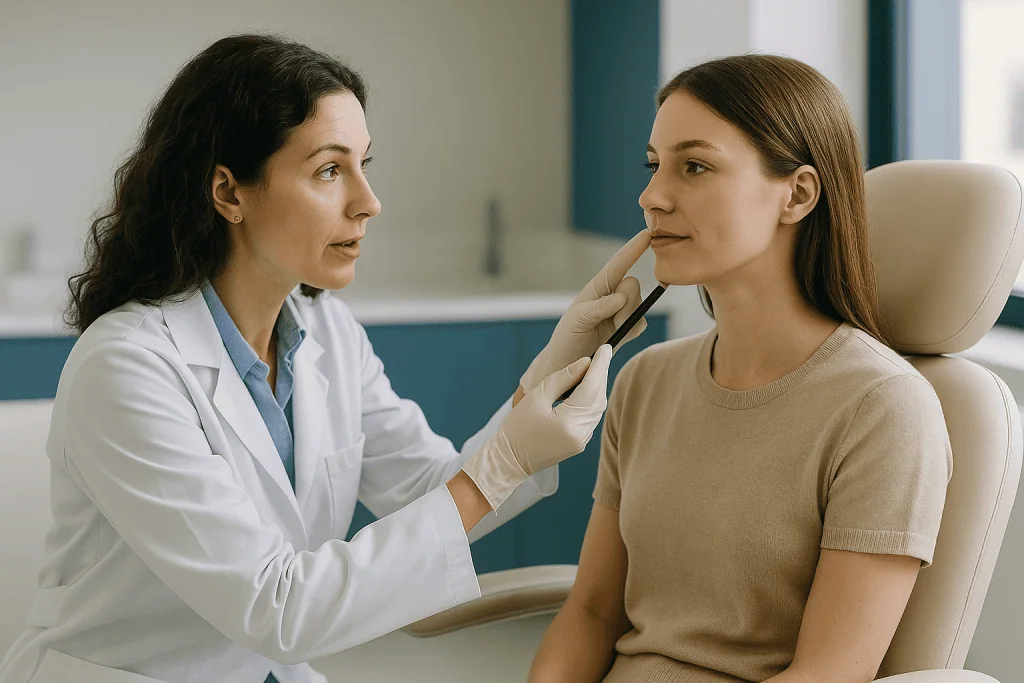
Through a small opening in the lining of the cheek, the surgeon removes a tiny core of soft tissue and sometimes a sliver of the buccinator, the flat cheek muscle that keeps food between your teeth when you chew. That removal creates a small void beneath the chosen spot. A dissolvable stitch is then passed through the underside of the skin and through the muscle layer and tied, pulling the skin inward and anchoring it. Over the following weeks, the body fills the void with scar, which eventually takes over the job of holding the dimple once the stitch dissolves.
Everything about the final result depends on three variables set in those few minutes. The amount of tissue removed influences depth. The tightness of the knot influences how far the skin is drawn in. The exact placement of the suture determines whether the dimple sits at a point that moves naturally with the smile or in a spot that looks pinned on.
The procedure is typically completed in under an hour and performed as an outpatient under local anesthetic, which is part of its appeal and part of its risk. Short and simple operations are easy to underestimate. The scar that forms afterwards cannot be measured in the chair, and it is scar behavior, not surgical skill alone, that decides whether a dimple ends up natural, overdone or absent six months later. That unpredictability is the single most important fact for anyone weighing this operation or its reversal.
Can you reverse a dimpleplasty? The honest answer on dimpleplasty reversal
In principle, yes. Because a created dimple is held by a suture and a small plug of scar tissue, a surgeon can go back through the inside of the cheek, cut the stitch if it has not yet dissolved, and release the band of scar that connects skin to muscle. Once that connection is divided, the skin is free to sit flat again. This release is what most surgeons mean by dimpleplasty reversal.
In practice, three things complicate the picture. First, scar is not inert. Once released, the area heals again, and a second round of scarring can partially re-tether the skin, leaving a shallower dimple rather than none at all. Second, the core of tissue removed during the original operation does not grow back. If a generous amount was taken, a soft hollow or flattened patch can remain at rest even after the pull is released, and that is where fat grafting, the transfer of a small amount of a person’s own fat to fill a contour, may be discussed. Third, timing shapes the result: a very fresh dimple with an intact stitch is technically simpler to release than a mature scar that has had a year to consolidate.
There are no large trials or registries on dimpleplasty, let alone on its reversal. The published literature consists of small case series and technique descriptions. That means nobody can quote you a reliable rate of complete reversal, and anyone who does is guessing. What can be said with confidence is that release is anatomically feasible, that the outcome ranges from near-complete flattening to a softer residual dimple, and that the result depends on how much tissue was removed and how the individual scars.
The decision about whether a reversal is appropriate, and whether to release, revise or simply wait, belongs to the surgeon who can examine the cheek directly.
Why a created dimple ends up too deep, and whether it settles on its own
A dimple that looks like a crater in the first month is often not a mistake. Surgeons deliberately create a result that is deeper and more static than the intended final appearance, because they expect it to soften. Two processes drive that softening. Swelling in the cheek exaggerates the contrast between the pinned spot and the puffy tissue around it, and as swelling resolves the dimple appears shallower. Then the scar itself matures: collagen is remodeled and the tether loosens slightly as the stitch dissolves and the body’s own fibers take over.

Scar remodeling is slow. The NHS notes that scars continue to change and fade for up to two years, and the Cleveland Clinic describes scar maturation as taking roughly 12 to 18 months. The internal scar holding a dimple follows the same biology, which is why most surgeons ask patients to judge a dimple’s depth only after several months rather than several weeks.
Some dimples, however, do stay too deep. The usual reasons are a knot tied too tightly, a larger-than-intended core of tissue removed, a suture that caught the skin at a steeper angle than planned, or an individual tendency toward dense scarring. People who form thick or raised scars elsewhere on the body may be more likely to hold a firm tether in the cheek. A dimple that remains sharply visible at rest beyond the point where swelling has clearly resolved, and that has not changed over consecutive months, is unlikely to flatten further without intervention.
This is the first fork in the road. A deep dimple that is still softening deserves patience. A deep dimple that has stopped changing is the typical candidate for a release. Distinguishing the two is a clinical judgment, usually made by comparing photographs taken at rest and smiling across a span of months.
Uneven dimples after dimpleplasty: why one side behaves differently
No face is symmetrical, and no two cheeks heal identically. Asymmetry after dimple creation is therefore less an aberration than a near-certainty in degree; the question is whether the difference is noticeable. Several mechanisms can push an uneven result past the threshold of what a person can live with.
Placement is the most obvious. Even a few millimeters of difference in where each suture is anchored can make one dimple sit higher, lower or closer to the mouth. Because a dimple is judged by how it moves during a smile, and most people smile slightly asymmetrically to begin with, a placement that looks balanced on a still face may look lopsided in motion.
Depth is the second. If one knot was tied a touch tighter or one tissue core was slightly larger, that side will hold a deeper, more static dimple. Healing is the third, and the least controllable: one side may swell more, scar more densely or, conversely, lose its tether as the stitch dissolves. Partial or complete loss of a dimple on one side, with a persistent dimple on the other, is a recognized pattern in the small case series that exist.
Correcting asymmetry does not always mean touching the side that looks wrong. If one dimple is too deep, releasing or loosening it may be preferable to deepening the other. If one has faded, re-creating it with a fresh suture may be the simpler route. If both are present but mismatched in position, release of one and re-creation at a new point can be discussed, accepting that each additional operation adds scar.
The pragmatic question a surgeon will ask is which side most closely resembles the goal, and whether the other side can be brought toward it with the least additional surgery. That framing, rather than a reflex to fix the side that bothers you most, usually produces the more natural outcome.
Dimpleplasty reversal and revision options compared
Several distinct procedures are grouped together under the words reversal and revision. They are not interchangeable, and each addresses a different problem. The table below summarizes what each involves and what it can realistically address, as described in technique papers and general wound-healing guidance. None of these carries a quotable success rate from the allowed evidence base, and all are performed from inside the mouth under local anesthetic in most descriptions.
| Approach | What it involves | Problem it addresses | Main limitation |
|---|---|---|---|
| Watchful waiting | Photographs at rest and smiling, reviewed over months as swelling and scar settle | Dimple that is deeper or more static than expected in early healing | Requires patience; a dimple that has stopped changing will not flatten further |
| Suture release | Dividing the stitch and the scar band between skin and muscle through the original mucosal site | Dimple that is too deep, too static or in the wrong position | Re-scarring may leave a shallower residual dimple; removed tissue does not return |
| Loosening or re-anchoring | Releasing the original tether and placing a new suture with less tension or at a different point | Mismatched depth or position between sides | Adds a second scar; final depth still depends on individual healing |
| Fat grafting | Transferring a small volume of the person’s own fat to fill a hollow left after release | Persistent dent or flattened patch at rest | Grafted fat is partly reabsorbed, so a single session may not be final |
| Re-creation after fading | A fresh suture on the side that has lost its dimple | Asymmetry from one dimple disappearing | Same unpredictability as the original operation |
Two points deserve emphasis. Fat grafting without release rarely makes sense, because the dimple is a pull rather than a deficit, and filling over an intact tether simply pads the rim. And every item in the table beyond waiting is a further operation in a small zone that already contains scar, the parotid duct and branches of the facial nerve. The treating team weighs that cumulative risk against the visible problem, and reasonable surgeons may advise against revising a mild asymmetry at all.
Who is usually offered a revision, and who is asked to wait
Surgeons who perform dimple release tend to apply a short list of practical criteria rather than a formal protocol, because no guideline body has issued one for this procedure. The common threads are consistent with general cosmetic surgery guidance from the NHS and Mayo Clinic: realistic expectations, a stable problem, and a clear understanding of what further surgery can and cannot do.
People usually considered for release or revision share certain features. The dimple has stopped changing across consecutive months rather than weeks, so swelling and early scar remodeling can be reasonably excluded as the cause. The concern is specific and demonstrable: a dimple visible at rest in photographs, a measurable difference in position between sides, or a dimple that has faded on one side only. The mouth lining has healed fully and there is no active infection or inflammation at the original site. General health permits a minor procedure under local anesthetic.
People commonly asked to wait fall into a different pattern. Anyone within the early healing window is usually told that judging depth before the scar has matured leads to unnecessary surgery. Someone who has formed thick or raised scars after previous skin injuries may be counseled that additional cutting in the cheek could worsen rather than improve the contour. Active smokers are frequently asked to stop beforehand, because smoking impairs wound healing. Someone whose distress is out of proportion to a change that others cannot see may be referred for a conversation about body image before any further operation, a step the NHS cosmetic procedures guidance explicitly encourages.
There is also a group for whom the right answer is no further surgery at all. A mild asymmetry that is only visible in certain lighting or at certain angles may be better left alone, since every normal face carries some asymmetry and every additional operation adds scar and risk. This is a decision made together with the treating team, with the person’s own priorities at the center.
What are the downsides of dimpleplasty that rarely make the brochure?
Marketing for dimple creation emphasizes that it is quick, needs no external incision and is done awake. All true. The downsides tend to be underplayed, and they are precisely the things that lead people to search for reversal later.
Unpredictability is the central one. The result depends on how an individual’s scar tissue behaves, which no surgeon can know in advance. Dimples can end up deeper than planned, shallower than planned, static when a dynamic one was wanted, or absent altogether once the stitch dissolves. Partial fading over months, with one side disappearing while the other persists, is described in the small published series.
Position errors are harder to correct than depth errors. A dimple that sits too close to the mouth or too high on the cheekbone can look pinned on during a smile, and moving it requires release plus re-creation at a new site.
Then there are the risks shared with any operation inside the mouth. Infection is possible because the mouth is not sterile; MedlinePlus lists increasing redness, swelling, warmth, pus and fever as signs of a surgical wound infection. Bleeding and bruising occur. Injury to the parotid duct can cause saliva to pool under the cheek lining or leak into the wound. Injury to a buccal branch of the facial nerve can weaken part of the smile, usually temporarily but occasionally longer. A hollow or flattened patch can persist if too much tissue was removed. Scarring inside the cheek can leave a firm lump the tongue can feel for months.
Finally, there is the downside of the reversal itself: it is more surgery in the same small zone, with the same list of risks, and it cannot promise a return to the original face. The Mayo Clinic’s guidance on cosmetic surgery puts the general principle plainly: results are not guaranteed, and revision may not deliver what the first operation failed to.
Dimpleplasty recovery time, and how recovery from a reversal compares
Recovery from dimple creation and from its release follow similar arcs, because both are small procedures through the cheek lining that heal by scar. The differences are mostly about expectations: after creation you are waiting for a dimple to soften, and after a release you are waiting to see how flat the cheek will settle.
In the first few days, swelling and tenderness inside the cheek are expected, and the dimple or release site may feel firm. The small mucosal wound inside the mouth closes within days, and the mouth’s rich blood supply generally heals these wounds without external scarring. Surgeons commonly advise soft foods, gentle rinsing as instructed, and avoiding anything that stretches the cheek vigorously while the lining knits.
Over the following weeks, swelling recedes and a created dimple usually becomes less static. A released dimple usually softens as the divided tether heals, though a shallow residual indentation may linger while new scar forms. The firm internal lump that the tongue can feel typically softens as the scar remodels.
The long tail is measured in months. Scar tissue continues to remodel for 12 to 18 months according to the Cleveland Clinic, and the NHS notes that scars can keep changing for up to two years. For a created dimple, this is the period during which depth can still decrease and, in some people, the dimple can fade or vanish. For a release, it is the period during which the cheek either settles flat or retains a soft impression. Judging either outcome before this process is well advanced risks a hasty second operation.
Timelines beyond these general wound-healing ranges are not supported by the allowed evidence base, and individual experience varies. The surgical team will set review appointments and will be the ones to say when a result can be considered settled.
Dimple surgery gone wrong versus normal healing: telling the difference
Many searches for dimple surgery gone wrong describe a result that is simply early. A deep, static dimple at two weeks, a firm lump inside the cheek, a feeling of tightness when smiling: these are expected features of the healing phase rather than complications. A genuine complication is a different thing, and knowing the difference saves both anxiety and unnecessary surgery.
Normal healing has a direction. Swelling decreases week on week. The dimple becomes less visible at rest. The internal firmness softens. Discomfort fades. If each of these is moving the right way, even slowly, the process is working as expected.
A complication breaks that direction or adds something new. Redness, warmth and swelling that worsen after the first few days rather than improve point toward infection, as does pus from the inside of the cheek, a bad taste, or fever. A sudden soft swelling of the cheek, especially during eating, can indicate saliva collecting after injury to the parotid duct. Weakness of the smile on the operated side, difficulty whistling or puffing the cheek, or drooping at the mouth corner suggests the buccal branch of the facial nerve has been bruised or injured; many such weaknesses recover, but they need assessment. Skin that becomes dusky or breaks down over the dimple is rare and needs urgent review. Bleeding that soaks through gauze or does not settle with gentle pressure also warrants a call.
Then there is the category that is neither normal healing nor an acute complication: the aesthetic result that has settled and is not what was wanted. A dimple that has stopped changing but remains too deep, sits in the wrong place or has vanished is a stable outcome, and it falls under revision rather than emergency care. Photographs taken at regular intervals, in the same light, at rest and smiling, are the most useful tool for showing the surgeon which category a result belongs to.
Is dimpleplasty the most regretted cosmetic surgery? What the evidence shows
The question appears constantly in search data, and the honest answer is that nobody knows, because the data to answer it do not exist. There is no national registry of cosmetic procedure regret, no systematic review ranking operations by dissatisfaction, and the dimpleplasty literature is limited to small case series written by the surgeons who perform it. Lists that name a most regretted procedure are compiled from online polls, social media posts or the impressions of individual practitioners. None meet the standard of mainstream medical evidence, and they should not be quoted as fact.
What can be said is more useful than a ranking. Regret after any cosmetic procedure tends to cluster around a few predictable factors identified in general guidance from the NHS and Mayo Clinic: expectations that the operation could not meet, a decision made quickly or under social pressure, a result that cannot be easily reversed, and limited counseling about risks beforehand.
Dimpleplasty has features that could push it in either direction. Its small scale and reversibility in principle argue for lower regret than operations that remove or reshape bone. Its unpredictability, the fact that it depends on scar behavior nobody can forecast, and the visibility of the result in every conversation argue the other way. The procedure is also heavily promoted on social platforms, which is a known driver of impulsive decisions. The NHS cosmetic procedures guidance recommends a cooling-off period between consultation and surgery for precisely this reason.
So the right question is not whether dimpleplasty is the most regretted operation, but whether the particular person considering it, or considering its reversal, has a clear and stable reason, understands that scar not skill decides the final depth, and has been told plainly that a return to the original face is not guaranteed. Those three conditions matter more than any league table.
What people often get wrong about reversing or fixing a dimple
Misunderstandings about dimple creation tend to follow the same few patterns, and each one leads to either unnecessary worry or unnecessary surgery.
The first is treating an early result as a final one. A dimple that looks carved in at ten days is behaving as expected. Swelling exaggerates it and the scar has not begun to remodel. Booking a release at that stage replaces an evolving result with a second scar before anyone knows what the first would have become.
The second is the reverse: assuming a dimple will always fade. Some do, and some vanish completely. Others hold firm for years. Individual scar behavior decides, and nobody can tell in advance which group a person falls into, which is why both the procedure and the plan for revision should assume the result may be lasting.
The third is the pothole fallacy, the idea that a too-deep dimple can be filled from the outside. Injecting any filling material over an intact tether pads the rim and often makes the indentation look sharper. The pull has to be released first; filling, if needed at all, comes afterwards.
The fourth is believing that reversal means restoration. Release frees the skin, but the tissue core removed at the first operation does not regenerate, and new scar forms where the old one was divided. The realistic goal is a cheek that looks unoperated to a casual observer, not an identical copy of the pre-surgery face.
The fifth is assuming more surgery is always the answer to asymmetry. Every face is asymmetric. A difference visible only in certain light, at certain angles, may be better accepted than chased with repeated operations, each of which adds scar in a small space shared with the parotid duct and facial nerve branches.
The sixth is trusting a quoted success percentage. For this procedure, in the allowed evidence base, no such figure exists.
Questions to ask your care team before a dimpleplasty reversal
A good consultation about revising or releasing a dimple should feel like a shared assessment rather than a sales conversation. The NHS and Mayo Clinic both advise asking about the surgeon’s training, how often they perform the specific procedure, and what happens if the result is not as hoped. For dimple release, the following questions put those principles to work.
- Has my dimple stopped changing, or is it still settling? What in the photographs tells you that?
- Is the problem depth, position, a static dimple at rest, or a lost dimple on one side? Which of those can a release realistically fix?
- How much tissue was removed at the first operation, and does that affect whether a hollow may remain after release?
- Would you release only, release and re-anchor, or release and later consider fat grafting? Why that order?
- What is the chance that the dimple partially re-forms as the release site scars, and what would we do then?
- Where exactly is the parotid duct opening and the buccal nerve branch in relation to the site, and how will you protect them?
- How will I know the difference between normal healing and a complication in the first two weeks?
- How many months should pass before we judge the result of the release, and will you photograph it at each visit?
- If I decide to do nothing, what do you expect this dimple to look like in a year?
- Would you advise against operating on this at all, and if so, why?
The last two questions are the most revealing. A surgeon who can describe the no-surgery pathway in detail, and who is willing to say that a mild asymmetry does not warrant another operation, is demonstrating the judgment that matters more than any technique. Writing the answers down and reviewing them after a cooling-off period, as general cosmetic surgery guidance recommends, turns a quick decision into a considered one.
When to call your doctor after dimple surgery or a reversal
Most people heal from dimple creation and from its release with nothing more than expected swelling and tenderness. A small number develop problems that need prompt attention, and because the wound is inside the mouth, the warning signs can be easy to dismiss as ordinary soreness. Contact the surgical team the same day if any of the following appear.
- Redness, swelling or warmth of the cheek that worsens after the first few days rather than improving, which MedlinePlus lists among the signs of a surgical wound infection.
- Pus or cloudy discharge from inside the cheek, a persistent foul taste, or fever and chills.
- Bleeding from the mouth that soaks gauze or does not settle with gentle pressure.
- A sudden soft or fluctuating swelling of the cheek, particularly one that enlarges when you eat, which can indicate saliva collecting after injury to the parotid duct.
- New weakness of the smile on the operated side, difficulty puffing out the cheek or whistling, or drooping at the corner of the mouth.
- Numbness of the cheek or lip that is spreading rather than settling.
- Skin over the dimple that turns dusky, blisters or breaks down.
- Pain that escalates rather than eases, or pain that is out of proportion to what the team told you to expect.
- Difficulty opening the mouth that is getting worse rather than better.
Seek emergency care immediately for rapidly spreading facial swelling, swelling that affects breathing or swallowing, high fever with confusion, or bleeding that cannot be controlled. These are rare after a procedure of this size, but they are emergencies when they occur.
For concerns that are aesthetic rather than medical, such as a dimple that seems too deep or uneven, the right response is a scheduled review rather than an urgent call, ideally with photographs taken in consistent light at rest and smiling. Whether the result needs time, release, revision or nothing at all is a decision for the treating team, made with you and based on examination.
Frequently asked questions
Can you reverse a dimpleplasty completely?
Often it can be released, but complete reversal is not guaranteed. A surgeon divides the stitch and scar band holding the skin to the muscle through the inside of the cheek, which frees the skin to sit flatter. Because new scar forms where the old one was cut and the removed tissue does not grow back, some people retain a shallow impression. The treating surgeon can judge what is realistic after examining the cheek.
How long does it take to recover from dimpleplasty?
The small wound inside the cheek typically closes within days, and swelling and tenderness ease over the following weeks. The dimple itself usually becomes less static as swelling resolves, but the internal scar keeps remodeling for 12 to 18 months according to the Cleveland Clinic, so the final depth is not known early. Your surgical team will schedule reviews and tell you when the result can be considered settled.
What is the typical dimpleplasty recovery time before a revision can be considered?
There is no fixed interval in the medical literature, and surgeons generally wait until the dimple has stopped changing across consecutive months. Because scar tissue matures over 12 to 18 months, operating earlier risks releasing a dimple that would have softened on its own. Photographs taken in the same light, at rest and smiling, help the surgeon decide whether the result is stable enough to revise.
What are the downsides of dimpleplasty?
The main downside is unpredictability: the final depth depends on how an individual scars, so dimples can end up too deep, too shallow, static at rest, or fade entirely on one side. Other risks include infection inside the mouth, bleeding, injury to the parotid duct or a branch of the facial nerve, a persistent hollow, and an internal lump the tongue can feel. Any revision adds further surgery in the same small area.
Why is my new dimple so deep and visible when I am not smiling?
In the early weeks this is usually expected rather than a complication. Surgeons often create a deeper, static dimple on purpose because swelling and scar remodeling typically soften it over time. If the dimple is still sharply visible at rest after swelling has clearly resolved and has not changed over consecutive months, it may have settled too deep, and a release can be discussed with your surgical team.
What happens when dimple surgery goes wrong?
Genuine complications include worsening redness, pus or fever suggesting infection, a soft cheek swelling from saliva after parotid duct injury, or weakness of the smile from bruising of a facial nerve branch. These need prompt assessment. A result that is stable but too deep, uneven or faded is not an emergency; it is addressed through planned revision such as release, re-anchoring or fat grafting, decided with the treating team.
Can uneven dimples after surgery be fixed?
Usually something can be done, though the approach depends on the cause. If one dimple is too deep, releasing or loosening it may be preferable to deepening the other. If one has faded, a fresh suture may re-create it. If positions differ, release and re-creation at a new point can be discussed. Each option adds scar, and mild asymmetry visible only in certain light may be better accepted.
Can filler fix a dimple that is too deep?
Not on its own. A created dimple is a tether pulling skin inward, not a shortage of tissue, so injecting material over an intact stitch tends to pad the surrounding area and can make the indentation look sharper. Surgeons generally release the tether first and only then consider filling any remaining hollow, often with the person’s own fat. Whether that step is needed is a decision for the treating team.
Is dimpleplasty the most regretted cosmetic surgery?
There is no reliable evidence either way. No registry or systematic review ranks cosmetic procedures by regret, and dimpleplasty studies are small case series. Lists naming a most regretted operation come from online polls or individual impressions. General guidance from the NHS and Mayo Clinic links regret to unrealistic expectations and rushed decisions, which is why a cooling-off period before any cosmetic surgery is recommended.
Will a surgically created dimple disappear on its own over time?
Some do, some do not. Because the dimple is held by scar rather than muscle, its depth can decrease as the scar remodels over 12 to 18 months, and in some people it fades or vanishes entirely, occasionally on one side only. Others hold firm for years. Individual scar behavior decides, and no one can predict in advance which will happen, so plans should assume the result may be lasting.
References
- NHS: Cosmetic procedures
- NHS: Scars
- Cleveland Clinic: Scars
- MedlinePlus: Surgical wound infection, treatment
This article is for general information only and is not a substitute for professional medical advice. Please consult a qualified doctor about your individual situation.

More from the Blog

How a Neck Lift Is Performed: Platysmaplasty, Liposuction and the Incision Behind the Ear
A neck lift is usually done under general anesthesia or local anesthesia with sedation. The surgeon makes small incisions, typically behind the ears and…

How Long Does Cheek Augmentation Last? Implants, Fat Transfer and Fillers Over Time
Cheek augmentation lasts anywhere from months to decades depending on the method. Hyaluronic acid fillers are temporary, typically wearing off over roughly 6 to…

How Lip Lift Surgery Is Done: The Bullhorn Incision Under the Nose Explained Step by Step
A bullhorn lip lift is a short outpatient operation that removes a small, curved strip of skin from directly beneath the nose so the…
Nasal Endoscopy, Old Surgical Records and Photos: How a Revision Rhinoplasty Plan Is Built
A revision rhinoplasty consultation is built from three sources of evidence: the operative report and records from the first surgery, dated photographs showing how…

Brow Lift Results: What a Natural Lift Looks Like and Why Surgeons Avoid the Surprised Look
Natural brow lift results reposition a heavy or low brow closer to the bony rim above the eye, opening the upper eyelid without changing…

Compression Garments and Activity Limits After Cosmetic Surgery: The First Weeks Explained
A compression garment after cosmetic surgery is a snug, elastic wrap or suit worn over the treated area to limit swelling, support healing tissue…