

Does Laser Dentistry Still Need Numbing? Anesthesia and Comfort by Procedure
Key Takeaways
- Erbium lasers remove tooth structure by flashing water inside enamel and dentin to steam, with less vibration and heat than a drill, which is why shallow cavities are sometimes treated without an injection.
- Deep cavities, cracked teeth and inflamed gum pockets still usually need a local anesthetic injection regardless of the instrument, because the nerve is already sensitized.
- In periodontitis care the laser is an adjunct to scaling and root planing, not a replacement, and the numbing is driven by the mechanical cleaning.
- A pale or white film on a laser-treated gum site in the first days is coagulated tissue and part of normal healing, not a sign of infection.
- Eye protection matched to the laser's wavelength is mandatory for everyone in the room, including children and parents.
- Agreeing a stop signal before starting without anesthesia is the single most practical safeguard; numbing can be added at any point, and the NHS notes it takes effect within minutes.
Laser dentistry often reduces, but does not eliminate, the need for numbing. Small, shallow cavities and minor gum procedures treated with erbium or diode lasers can sometimes be done with only a topical gel or no anesthesia, while deeper fillings, root planing and most surgery still call for a local anesthetic injection. Your dentist decides case by case, and you can ask for numbing at any point.
The appointment card says “laser filling, upper left molar,” and the first thing you check is whether there will be a needle. You are not alone. Most people who ask about laser dentistry numbing are not asking about photons or wavelengths; they want to know whether the procedure will hurt and whether they will leave with a lip that feels like a wet sponge for the rest of the afternoon.
The honest answer sits between the two extremes you may have read online. Dental lasers are not a magic wand that switches off sensation, and they are not a gimmick either. They cut, vaporize and seal tissue in a way that is physically different from a spinning drill or a steel blade, and that difference changes how much the nerve inside a tooth or gum is provoked.
This explainer walks through what actually happens, which procedures commonly go ahead with little or no anesthesia, which ones almost always need it, and how to have a clear conversation with your dental team before anyone picks up a handpiece.
What does laser dentistry numbing actually mean?
Start with the words, because they get tangled. A dental laser is a device that produces a single, concentrated wavelength of light that is absorbed by a specific target in the mouth: water, the mineral in enamel, or pigment in gum tissue. When that light is absorbed, the target heats and either vaporizes or is cut away in tiny bursts. Numbing, in dental terms, means a local anesthetic, a medicine injected or applied near a nerve so that it temporarily stops sending pain signals to the brain. The NHS describes local anesthesia as numbing a small area while you stay fully awake.
So the question “does laser dentistry still need numbing?” is really two questions stacked on top of each other. First, does the laser itself provoke the nerve less than a drill or scalpel would? Second, is the reduction large enough that a particular patient, for a particular procedure, can skip the injection without discomfort?
The answer to the first is usually yes, for reasons covered in the next section. The answer to the second depends on how deep the work goes, how inflamed the tissue already is, and how that individual person experiences sensation. A shallow cavity in a calm tooth is a different proposition from a cracked molar that has been aching for a week.
One more distinction matters. “No injection” does not always mean “no anesthesia.” Many laser appointments use a topical anesthetic gel on the gum surface, which numbs the outer layer of tissue without a needle. For some soft-tissue procedures that gel is enough. For others it is a courtesy before the injection goes in. When you ask your dentist about numbing, it helps to ask specifically: injection, gel, or neither?
Why can a dental laser reduce the need for an injection?
Think about what a conventional drill does to a tooth. A rotating bur grinds through enamel and dentin, the softer layer underneath that contains thousands of microscopic fluid-filled tubules leading toward the pulp, where the nerve lives. The bur produces heat, vibration and pressure at the same time. Fluid in those tubules shifts, and the nerve interprets that movement as pain. This is the same mechanism that makes a sensitive tooth twinge when cold water hits it.
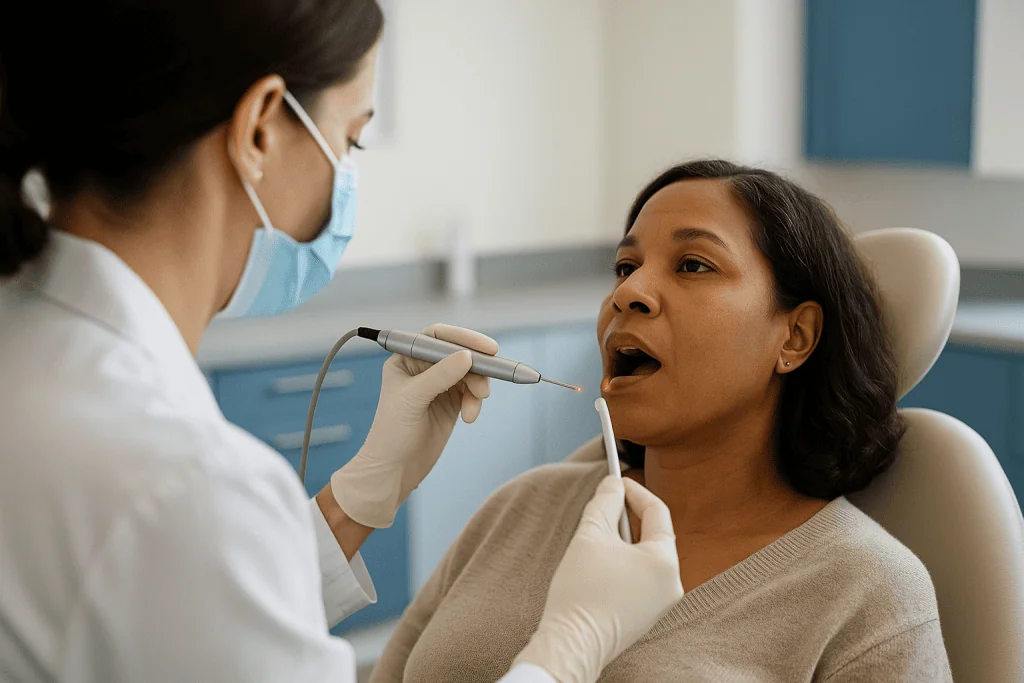
Erbium-family lasers, the type most often used on tooth structure, work by a different route. Their light is strongly absorbed by water. Each pulse flashes the water inside enamel and dentin to steam, and that micro-explosion lifts away a tiny amount of tooth. A water spray cools the surface between pulses. There is no spinning contact, far less vibration and, when used correctly, less heat transferred toward the pulp. Less tubule disturbance means less nerve stimulation.
Some researchers also propose that the repeated light pulses have a mild dampening effect on nerve firing, sometimes described as laser analgesia. The evidence for this is mixed and the mechanism is not fully settled, so it should be treated as a possible contributor rather than an established fact.
Soft-tissue lasers, usually diode or carbon dioxide devices, cut gum by absorbing into pigment or water and sealing small blood vessels and nerve endings as they go. That sealing effect is why laser gum procedures often bleed less and why patients may report less sting during the cut than with a blade.
None of this abolishes sensation. The pulp still has a nerve, and that nerve still responds if the work gets close enough to it. Reduced stimulation is the realistic promise; zero stimulation is not.
Laser cavity filling without anesthesia: what the evidence shows
This is the scenario that generates the most hope and the most disappointment. The published literature, searchable through PubMed, includes clinical trials in which a meaningful share of patients had small to moderate cavities prepared with an erbium laser and reported no need for a local anesthetic injection. Those same studies also show that a share of patients did request numbing, and that the proportion varies widely from one trial to another depending on cavity depth, tooth type, patient age and how pain was measured.
Three patterns recur across the research:
- Shallow decay confined to enamel or outer dentin is the most likely to be treated comfortably without injection.
- Deeper decay, especially where the pulp is already irritated, behaves much more like conventional drilling in terms of sensation, and injection rates climb.
- Laser preparation is generally slower than drilling for larger cavities, which is one reason many dentists reserve it for smaller lesions.
What the evidence does not support is any blanket statement that laser fillings are painless. Mayo Clinic’s overview of cavities notes that treatment choice depends on how far decay has progressed, and that principle applies directly here: the deeper the lesion, the less the choice of instrument changes what the nerve feels.
A practical way to interpret this: if your dentist suggests trying a laser filling without an injection, it is reasonable to agree on a signal, usually a raised hand, so that numbing can be added the moment anything beyond a cool tapping sensation appears. Starting without an injection is a trial, not a commitment. Most clinicians who offer this approach keep the anesthetic drawn up and ready.
Laser gum treatment pain: soft-tissue procedures explained
Gum work is where laser dentistry numbing questions get more varied, because “gum treatment” covers everything from reshaping a few millimeters of tissue to treating established periodontitis, the chronic infection that destroys the bone and ligament supporting teeth, described in detail by the National Institute of Dental and Craniofacial Research.
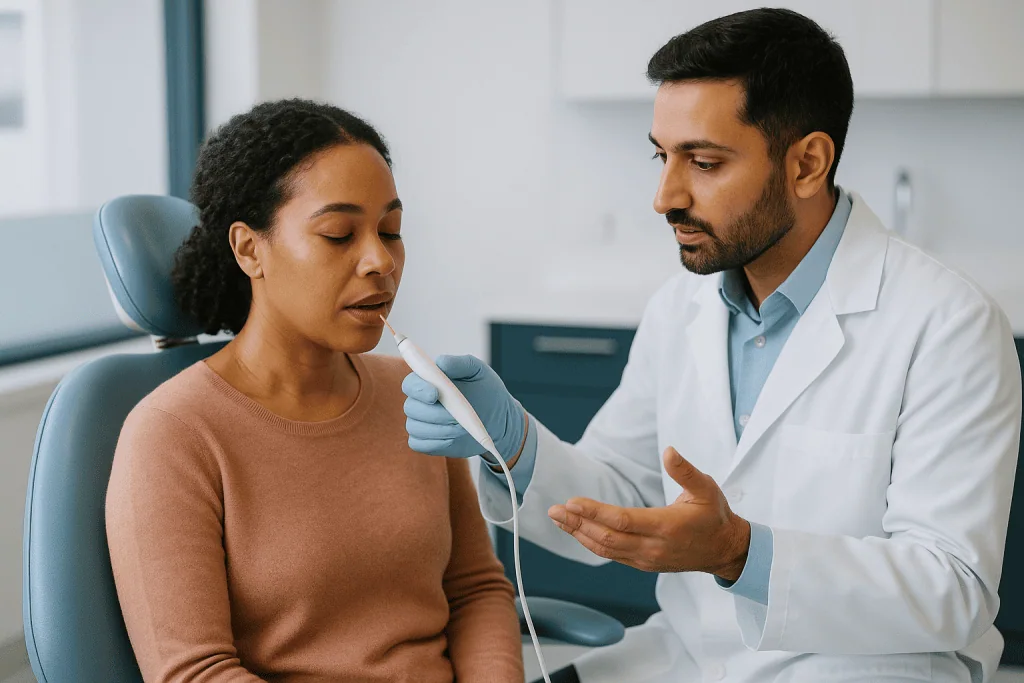
Minor contouring, such as trimming excess gum over a partly erupted tooth or releasing a tight band of tissue under the tongue or lip (a frenectomy), is often done with a topical gel alone or a very small injection. Diode lasers seal the tiny vessels they cut, so bleeding is limited and the field stays clear, which tends to shorten the procedure.
Deep cleaning is different. Scaling and root planing, the removal of hardened plaque from below the gumline and smoothing of root surfaces, reaches into pockets that are inflamed and tender. Mayo Clinic lists local anesthetic as a standard part of this treatment. Some practices add a laser to disinfect the pocket lining after scaling; the laser is an adjunct there, not a replacement, and the numbing is driven by the scaling, not by the light.
Surgical procedures such as crown lengthening, where gum and sometimes bone are removed to expose more tooth, or periodontal pocket surgery, almost always use full local anesthesia whether or not a laser is involved. The laser may change how the tissue is cut and how it heals, but it does not change the depth of the work.
Inflamed tissue is also more acidic, and local anesthetics work less reliably in acidic environments. That is one reason a swollen, infected gum may need more thorough numbing than a healthy one, laser or no laser. If your gums bleed easily or feel sore before the appointment, expect anesthesia to be recommended.
Laser dentistry numbing by procedure: a quick comparison table
Patterns are easier to see side by side. The table below summarizes what is commonly reported in clinical practice and the published literature. It is a guide to the conversation, not a prediction for your mouth; your dentist’s judgment on the day takes precedence.
| Procedure | Laser type usually used | Numbing commonly needed? | Why |
|---|---|---|---|
| Small, shallow cavity | Erbium | Sometimes none, or topical gel; injection on request | Little heat or vibration reaches the pulp |
| Deep cavity near the nerve | Erbium | Usually a local anesthetic injection | Pulp is close and often already irritated |
| Gum contouring, frenectomy | Diode or CO2 | Topical gel or a small injection | Surface tissue, vessels sealed as cut |
| Scaling and root planing with laser adjunct | Diode or Nd:YAG | Usually a local anesthetic injection | Deep, inflamed pockets; numbing driven by scaling |
| Crown lengthening, pocket surgery | Erbium, diode or CO2 | Full local anesthesia | Depth of work, bone may be involved |
| Mouth ulcer or cold sore treatment | Diode, low-level | Often none | Non-cutting, low energy |
| Tooth sensitivity treatment | Diode or Nd:YAG | Often none | Low energy applied to exposed dentin |
| Light-activated whitening | Various light sources | None (not a cutting procedure) | Light warms gel; sensitivity afterward is common |
Two rows deserve a note. Light-assisted whitening is marketed under the laser umbrella, but the light plays a supporting role to the bleaching gel and the evidence that it adds much benefit is limited. Low-level laser use for ulcers and sensitivity is promising in small studies but has not reached the status of a standard-of-care recommendation in major guidelines. Both are listed so you know where they sit, not as endorsements.
Who is usually a good candidate, and who is asked to wait?
Suitability for laser treatment, and for attempting it without an injection, depends more on the problem than on the person.
People who tend to do well with minimal numbing include those with small cavities caught early at a check-up, those needing minor gum reshaping, and those with a strong needle aversion who would otherwise avoid care altogether. For that last group, the chance of a shallow filling without an injection can be the difference between treating decay now and treating an abscess later.
People who are usually advised that anesthesia will still be part of the plan include anyone with a deep cavity, a tooth that has been spontaneously aching, a cracked tooth, or active periodontal infection. The nerve in those situations is already sensitized, and asking it to tolerate any instrument without numbing is unrealistic.
Some situations lead a dentist to recommend a different approach entirely or to postpone laser work:
- Decay underneath an existing metal or ceramic restoration, because erbium lasers do not cut those materials efficiently and conventional instruments are needed to remove them first.
- Large cavities where laser preparation would be slow enough to outweigh any comfort benefit.
- Teeth that need a crown, where bulk shaping is faster with rotary instruments.
- Acute infection with swelling, which the NHS and NIDCR both describe as needing drainage or antimicrobial management before definitive treatment.
Medical history matters too. Certain photosensitizing medicines, pacemakers in older models, and some conditions affecting healing may change the plan. Those are decisions for the treating team, who weigh the specific device, the specific site and your overall health. Children are discussed separately below, because their needs are distinct.
Is laser dentistry painless? What patients actually feel
Painless is a word to retire from this conversation. Low-discomfort, or more comfortable than the alternative, is closer to what the evidence supports.
During laser cavity preparation without anesthesia, people most often describe a rapid tapping or popping sensation, a sound like a small firecracker string, and a cool spray of water. Some report brief sharp twinges when the laser reaches deeper dentin. Those twinges are the nerve’s way of reporting that the work is getting closer, and they are the usual trigger for adding numbing. There is no benefit in gritting your teeth through it.
During soft-tissue laser work with only topical gel, the typical report is warmth and a faint smell, with occasional stinging in thinner tissue. Pressure sensations persist even when pain is fully controlled, because local anesthetics block pain fibers more completely than pressure fibers. Many people mistake pressure for pain at first, and a calm explanation beforehand helps.
After the procedure, a laser-treated tooth may be sensitive to cold for a time, much as a conventionally filled tooth can be. Laser-treated gum tissue often feels less raw than a scalpel wound in the first day, which patients frequently remark on, though controlled comparisons show variable results rather than a consistent large advantage.
Individual pain thresholds differ widely, and anxiety amplifies sensation. If you know you are an anxious dental patient, say so. Options such as nitrous oxide, an inhaled gas that reduces anxiety and dulls discomfort while you stay awake, exist in many practices and are decided case by case by the clinician. The most reliable predictor of a comfortable laser appointment is not the laser; it is a plan agreed before the chair is reclined.
Laser dentistry for kids: comfort, preparation and what to expect
Parents raise laser dentistry numbing questions more than any other group, and for understandable reasons. A child who has a frightening first injection may carry that fear for decades. The prospect of a small cavity treated with a water spray and a tapping sound instead of a needle and a drill is appealing.
The research in children mirrors the adult picture, with a few differences. Primary (baby) teeth have thinner enamel and larger pulps relative to their size, so decay reaches sensitive dentin sooner. Trials in pediatric dentistry report that many children tolerate erbium laser preparation of small cavities without injection, and that the absence of drill vibration and noise reduces distress. They also report that some children still need anesthesia, and that behavior, not just tooth anatomy, determines whether the appointment succeeds.
Preparation that helps, regardless of instrument:
- Use neutral language. “The dentist will clean the tooth with a light and a water spray” is accurate and calm.
- Avoid the words “hurt” and “needle” at home; let the dental team introduce vocabulary they are trained to use.
- Ask whether a short “show and tell” visit is possible before treatment, so the sounds and protective glasses are familiar.
- Agree on a stop signal the child controls, exactly as adults are offered.
Children, like adults, need laser-protective eyewear, and keeping a young child still with glasses on is part of what the team assesses. For soft-tissue procedures such as releasing a tongue-tie, topical gel is often used, and the decision about additional anesthesia or any form of sedation rests entirely with the pediatric dental clinician based on the child’s age and the procedure. No medicine choices or amounts belong in a parent’s planning; what belongs there is the conversation, the preparation, and a calm presence in the room.
What happens on the day of a laser dental procedure?
The room looks much like any treatment room, with one addition: everyone wears tinted protective glasses, including you. Laser light can damage the retina, and eye protection matched to the device’s wavelength is a non-negotiable part of safe practice.
Your dentist will confirm the plan, including the numbing approach. If a topical gel is used, it is applied to dried gum with a cotton swab and left for a short period to take effect. If an injection is planned, the gel usually goes on first to reduce the sting. The NHS notes that local anesthetic injections generally start working within minutes, so there is a brief pause before cutting begins.
For tooth work, you will hear a rhythmic popping sound and feel the water spray; a suction tip removes the water. The dentist may pause to check progress with a probe or an explorer, and may switch to a hand instrument or, for restorations, a slow handpiece to finish. The filling itself is placed in the usual way. Laser-prepared surfaces are sometimes left with a rougher texture that bonding materials adhere to well, which is one of the practical reasons erbium lasers are used for small composite fillings.
For gum work, you may notice a faint smell as tissue vaporizes; the suction manages this. Bleeding is usually minimal. Stitches are needed less often than with scalpel surgery for small procedures, though larger surgeries may still require them.
At the end you will receive written aftercare. If no injection was given, you can eat as soon as you are ready. If you were numbed, the NHS advises waiting until sensation returns before eating, because biting a numb cheek or tongue is a common and avoidable injury.
What do the following days usually look like?
Recovery after laser treatment follows the same biology as recovery after conventional treatment; the wound is smaller or cleaner in some cases, but it is still a wound.
After a filling, with or without anesthesia, the treated tooth may react to cold or sweet foods for a while. This reflects a pulp that was disturbed and is settling. Mayo Clinic’s guidance on cavities describes sensitivity after fillings as common and generally temporary. If you received a local anesthetic, the NHS states that numbness typically wears off over a few hours; until then, soft foods on the opposite side and no hot drinks reduce the risk of an unnoticed burn or bite.
After soft-tissue laser work, the surface often forms a pale or whitish layer within a day. This is coagulated protein, a normal part of laser wound healing, and it is frequently mistaken for infection. It should not be scrubbed or picked at. Mild soreness is expected and usually improves day by day rather than worsening. Gentle brushing around the site, warm saltwater rinses if your dentist suggests them, and avoiding very spicy or crunchy food for the first days are the usual instructions.
After scaling and root planing with a laser adjunct, gums may feel tender and teeth may feel temporarily more sensitive as inflamed tissue shrinks and exposes root surfaces. NIDCR notes that gum tissue tightens around the teeth as healing progresses, which is the intended outcome.
Your dentist will give a review date appropriate to the procedure. The direction of travel matters more than the calendar: discomfort that is steadily easing is reassuring, while discomfort that plateaus and then climbs is the pattern that warrants a call, covered in the final section.
Risks and alternatives: a neutral look at both sides
Lasers are regulated medical devices with a long record in dentistry, and when used by trained clinicians their risk profile is comparable to conventional instruments. That said, the risks are not zero, and they are worth knowing before you decline numbing or choose a laser option.
Thermal injury to the pulp can occur if an erbium laser is used without adequate water cooling or with settings too high for the remaining tooth thickness. This is a technique issue rather than an inherent flaw, and it is one reason the dentist’s training with the specific device matters more than the device itself. Soft-tissue lasers can cause unintended tissue charring or delayed healing if energy is concentrated in one spot. Eye injury is a risk to everyone in the room without correct eyewear, which is why protection is mandatory.
Working without anesthesia carries its own risk: a sharp, unexpected pain can cause a patient to jerk, and a sudden movement during any dental procedure is hazardous. The agreed stop signal and the clinician’s willingness to pause and numb are the safeguards.
Alternatives are not inferior; they are different tools:
- Conventional rotary preparation with local anesthesia remains the standard against which laser methods are measured, and it is faster for larger cavities.
- Air abrasion, a fine powder stream, removes shallow decay with little vibration and is another needle-free option for small lesions in some practices.
- Chemomechanical caries removal uses a gel to soften decayed dentin so it can be scooped away, also often without injection.
- Scalpel surgery for gum procedures, with sutures, has decades of outcome data behind it.
No major guideline body currently recommends lasers as the preferred method for routine fillings or gum treatment. They are an accepted option. Which option fits you is a judgment for the treating team, informed by the lesion, the device and your preferences.
What people often get wrong about laser dentistry numbing
Misconceptions cluster around this topic, partly because marketing language outruns the evidence. Here are the ones dental teams hear most, with the correction.
“Laser means no needle, full stop.” Not so. Lasers lower the odds of needing an injection for shallow work. Deep fillings, root planing and surgery still call for anesthesia in the great majority of cases, laser or not.
“If I feel anything, the laser is being used wrongly.” Some sensation is expected. Tapping, cold spray and pressure are normal. Sharp pain is the signal to add numbing, not evidence of error.
“Laser fillings last longer.” The evidence on restoration longevity shows laser-prepared and drill-prepared fillings performing similarly in most comparisons. Longevity depends mainly on the material, the bond and your home care.
“Laser gum treatment replaces deep cleaning.” In periodontitis, the laser is an adjunct to scaling and root planing. Removing the hardened deposits mechanically remains the core of treatment according to NIDCR and Mayo Clinic guidance.
“Laser whitening is a laser procedure.” The bleaching agent does the work; the light assists at most. Post-whitening sensitivity is about the gel, not the light.
“The white patch after gum laser treatment is infection.” It is usually coagulated tissue, a normal feature of laser wound healing. Infection shows up as spreading redness, swelling, pus or fever, not as a thin pale film.
“Numbing from a dental injection is dangerous.” Local anesthetics used in dentistry have an excellent safety record, as the NHS and MedlinePlus both describe. Serious reactions are rare. Avoiding needed treatment because of needle fear carries far greater risk than the needle does.
Getting these straight before the appointment makes the conversation with your dentist shorter and the decisions clearer.
Questions to ask your care team before a laser procedure
A good laser appointment starts with a short conversation, and the right questions turn a vague “it should be comfortable” into a concrete plan. Bring these along, in whatever order feels natural.
- What type of laser will you use for my procedure, and what is it designed to do: cut tooth, cut gum, or disinfect?
- Based on how deep this cavity is, or how inflamed this gum is, what is your honest expectation about whether I will need an injection?
- If we start without an injection, what is the signal I give, and will you stop immediately and numb the area?
- Will a topical gel be used first? How long does it need to work?
- Are there parts of this procedure where you will switch to conventional instruments, and will the numbing plan change at that point?
- How long should I expect sensitivity afterward, and what pattern would make you want to see me sooner?
- What will the treated area look like tomorrow? Is a pale or white film expected?
- Do any of my medicines or health conditions change the plan or the aftercare?
- For a child: how will you explain the procedure to them, and may I stay in the room?
- If I am very anxious, what comfort options does this practice offer, and who decides which is appropriate?
Write the answers down or ask for them in the written aftercare sheet. Patients who leave with a clear picture of what sensation is normal and what is not are far less likely to spend the evening worrying, and far more likely to call promptly about the one symptom that genuinely needs attention. Your dental team would rather answer ten questions in the chair than one worried message at midnight.
When to call your doctor or dentist after laser treatment
Most laser dental procedures heal uneventfully, and most post-treatment sensitivity fades. A small number of symptoms signal that the pulp, the gum or the surrounding tissue needs to be reassessed. Do not wait for a scheduled review if you notice any of the following.
Call your dentist promptly, the same day if possible, for:
- Toothache that wakes you at night or throbs on its own without a trigger such as cold.
- Pain that was easing and then begins to climb again, especially after a few days of improvement.
- Lingering pain lasting well after a cold or hot stimulus has been removed, rather than a brief twinge.
- Swelling of the gum, cheek or face, or a bad taste suggesting pus.
- Bleeding from a laser-treated gum site that does not stop with firm pressure from a clean gauze.
- Numbness or altered sensation that has not returned well beyond the few hours the NHS describes as typical for local anesthetic, which may indicate nerve irritation and should be assessed.
- A filling that feels high or catches when you bite, which can cause pulp irritation if left.
Seek urgent medical care, through an emergency department or emergency dental service, for:
- Rapidly spreading facial swelling, particularly if it affects the eye, the floor of the mouth or the neck.
- Difficulty swallowing, difficulty breathing, or inability to open the mouth normally.
- Fever with facial swelling, which the NHS lists among signs of a dental abscess needing prompt treatment.
- Any signs of an allergic reaction after a local anesthetic, such as hives, wheezing or swelling of the lips or tongue.
Fear of being a nuisance stops many people from calling about symptoms that turn out to matter. Dental teams expect these calls. The decision about what to do next, whether that is reassurance, a review, a change in the restoration or further treatment of the tooth or gum, sits with the clinician who knows your case. Your part is simply to report what you feel, when it started and whether it is getting better or worse.
Frequently asked questions
Is laser dentistry painless?
No procedure that touches living tooth or gum is truly painless, but laser treatment of shallow cavities and minor gum work is often described as low-discomfort, with tapping, cool spray and pressure rather than sharp pain. Deeper work still typically requires local anesthetic. Individual pain thresholds vary widely, so the realistic expectation is reduced sensation, with numbing available at any point if sharp pain appears.
Can I have a laser cavity filling without anesthesia?
Sometimes. Clinical studies indexed on PubMed show that a proportion of patients with small, shallow cavities tolerate erbium laser preparation without an injection, while others request numbing, especially when decay is deeper or the tooth is already sensitive. Your dentist assesses the depth of the lesion and can start without injection on the understanding that anesthetic will be added immediately if needed.
How much does laser gum treatment hurt compared with scalpel surgery?
For small procedures such as contouring or releasing a frenum, many patients report less bleeding and less soreness afterward with a laser, and topical gel alone is sometimes sufficient. Controlled comparisons show variable rather than dramatic differences. Larger gum surgery and deep cleaning of inflamed pockets still use full local anesthesia whether or not a laser is involved, because the depth of the work determines the sensation.
Is laser dentistry for kids safe without numbing?
Pediatric studies report that many children tolerate erbium laser preparation of small cavities without an injection and find the absence of drill noise and vibration less distressing. Some children still need anesthesia, and behavior as much as tooth anatomy decides the outcome. Protective eyewear is required, and all decisions about numbing or any form of sedation rest with the pediatric dental clinician.
What does a dental laser feel like on a tooth?
Most people describe a rapid popping or tapping sensation accompanied by a crackling sound and a cool water spray. Brief sharp twinges can occur as the laser reaches deeper dentin, and those twinges are the usual cue to add local anesthetic. Pressure sensations continue even when pain is fully blocked, because anesthetics suppress pain fibers more completely than pressure fibers.
Why do I still need an injection for a deep laser filling?
The nerve inside a tooth sits in the pulp, and when decay approaches it the tissue is often already inflamed and hypersensitive. A laser reduces heat and vibration compared with a drill, but it cannot prevent the nerve from responding to work carried out close to it. Numbing in that situation protects you from sudden pain and protects the procedure from sudden movement.
Does the laser itself numb the tooth?
Not in the way an anesthetic does. Some researchers propose that repeated laser pulses mildly dampen nerve firing, an effect sometimes called laser analgesia, but the evidence is mixed and the mechanism is not established. The more reliable explanation for reduced discomfort is simply that erbium lasers disturb the fluid-filled tubules in dentin far less than a rotating bur does.
How long does numbness last after a laser dental procedure with local anesthetic?
The laser does not change how long the anesthetic lasts. The NHS describes dental local anesthetic as taking effect within minutes and wearing off over a few hours. During that window, avoid hot drinks and chewing on the numb side to prevent accidental burns or cheek bites. Numbness persisting well beyond that range should be reported to your dentist.
Is the white patch on my gum after laser treatment an infection?
Usually not. A pale or whitish film forming over a laser-treated gum site within a day is coagulated protein, a normal feature of laser wound healing, and it should be left alone rather than scrubbed. Infection presents differently: spreading redness, increasing swelling, pus, a bad taste or fever. Those signs warrant a prompt call to your dentist.
Can laser treatment replace deep cleaning for gum disease?
No. In periodontitis, mechanical removal of hardened deposits from below the gumline through scaling and root planing remains the core of treatment, as described by NIDCR and Mayo Clinic. Lasers may be used afterward to disinfect the pocket lining, but they are an adjunct. Because the scaling itself reaches inflamed tissue, local anesthetic is routinely used.
References
- NHS: Local anaesthesia
- NIH National Institute of Dental and Craniofacial Research: Periodontal (Gum) Disease
- MedlinePlus: Anesthesia
- NIH PubMed: clinical studies on laser cavity preparation and local anesthesia
This article is for general information only and is not a substitute for professional medical advice. Please consult a qualified doctor about your individual situation.

More from the Blog

Recovering From Laser Dentistry: Gum Tenderness, Hot Foods and the First Day
After laser gum treatment, mild tenderness, slight swelling and sensitivity to temperature are common for the first day or two, and gums usually settle…

When Is an Impacted Tooth Monitored, Exposed or Removed? How Dentists Decide
An impacted tooth is usually monitored when it is free of pain and disease and sits where it is unlikely to harm neighboring teeth.…
Metal Braces vs Clear Aligners: Bite Control, Compliance and Daily Upkeep Compared
Metal braces and clear aligners both straighten teeth with gentle, sustained pressure, and for mild to moderate crowding they reach broadly similar results. Fixed…

Oral and Maxillofacial Surgery for International Patients: Stay Length and Follow-Up
Oral surgery abroad follow up is the planned series of checks after a procedure, and it starts before you travel home. Surgeons usually ask…

What Halitosis Treatment Involves: Cleaning, Gum Care, Tongue Care and Referral When Needed
A halitosis treatment plan usually starts at the dentist: a professional cleaning, treatment of any gum disease, daily tongue cleaning and practical steps to…
How an Impacted Canine Is Surgically Exposed and Guided Into Place
Impacted canine exposure surgery is a short oral surgery in which a surgeon lifts or removes the gum (and sometimes a thin layer of…