

Free Testosterone Levels: Why Total Testosterone Can Mislead and What the Ratio Means

Key Takeaways
- Only about 1 to 3 percent of circulating testosterone is free; roughly 40 to 60 percent is locked to SHBG and the rest rides loosely on albumin.
- Free testosterone falls about 2 percent per year after midlife, roughly twice the rate of total, because SHBG rises with age.
- Obesity and diabetes lower SHBG and can make total testosterone look deficient while free testosterone is normal; liver disease and thyroid overactivity do the reverse.
- Equilibrium dialysis and validated calculations are the reliable free testosterone methods; direct analog immunoassays, common on consumer kits, are not recommended by the Endocrine Society.
- One ng/dL equals 10 pg/mL, so a free value of 4.2 ng/dL is the same blood as 42 pg/mL; unit mismatches cause most online panic.
- TRAVERSE (2023, 5,246 men) found no excess major cardiac events with testosterone gel but more atrial fibrillation, pulmonary embolism and acute kidney injury, in men selected by total, not free, testosterone.
Free testosterone is the small fraction, roughly 1 to 3 percent, of testosterone that is not bound to blood proteins and can act on tissues. Total testosterone can mislead when sex hormone-binding globulin is unusually high or low, so guidelines suggest checking free testosterone in borderline cases. Results depend on the lab method and units, and interpretation belongs with a clinician who knows your symptoms.
A 46-year-old refreshes his patient portal at 7 a.m. and sees two lines he cannot reconcile. Total testosterone: normal. Free testosterone: flagged low. Which one is lying? Neither, as it turns out, and that puzzle is exactly why free testosterone levels have become one of the most searched hormone questions of the year.
As of September 2026, the surge has three engines. Social media clips insisting that “total testosterone is useless, only free matters” have racked up tens of millions of views. At-home finger-prick hormone kits now land on doorsteps with a number but no interpretation. And the 2023 TRAVERSE cardiovascular safety trial, the largest of its kind, reopened a serious conversation about who actually has testosterone deficiency in the first place.
What follows is the version a careful endocrinologist would give you across a desk: how the hormone travels, why one number can hide another, what the ratio means, and where the evidence is firm, thin, or simply absent.
What are free testosterone levels, and why is total testosterone not the whole story?
Picture testosterone molecules on a crowded train. Most passengers are strapped into seats; a few stand in the aisle, free to step off at any station. Free testosterone levels describe those standing passengers: the hormone that is unbound and biologically available to enter cells in muscle, bone, brain and the testes.
Total testosterone counts everyone on the train, seated and standing. For most healthy men the two numbers rise and fall together, and total testosterone, measured properly in the morning, remains the first test guidelines recommend. The trouble begins when the number of seats changes. The main “seat” is sex hormone-binding globulin, or SHBG, a liver-made protein that grips testosterone so tightly the hormone cannot act while attached. When SHBG climbs, total testosterone can look reassuring while the free fraction quietly shrinks. When SHBG falls, a low-looking total may conceal a perfectly adequate free level.
Here is the number that explains the confusion: only about 1 to 3 percent of circulating testosterone is free. A total reading is therefore a measurement of mostly stored hormone, with the active sliver inferred rather than seen. That is why the Endocrine Society’s 2018 guideline advises measuring free testosterone, by a reliable method, whenever total is borderline or SHBG is likely to be abnormal.
The viral framing gets one thing right and one thing wrong. Right: free testosterone can reveal what total hides. Wrong: it does not replace total, and a free result from an unreliable assay can mislead far more than a careful total ever would. The two numbers are partners. Read apart, each can fool you; read together, with SHBG and your symptoms, they tell a coherent story.
How testosterone travels in blood: SHBG, albumin and the free fraction
Blood carries testosterone in three states, and the proportions matter more than most lab reports admit.
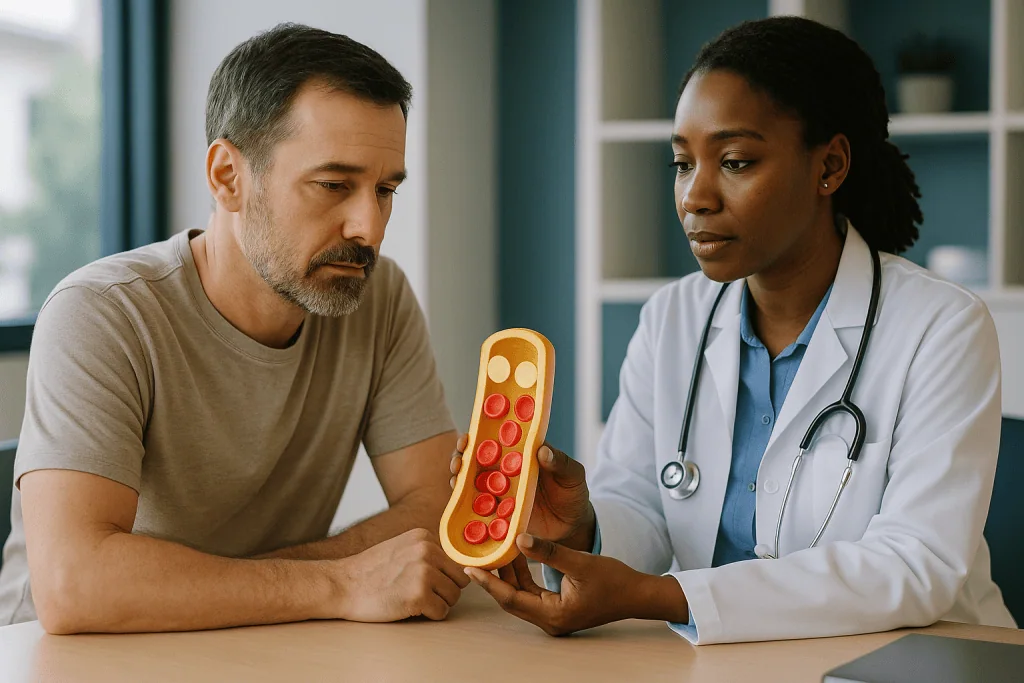
Roughly 40 to 60 percent is bound to SHBG. This bond is strong, and SHBG-bound testosterone is generally considered unavailable to tissues. Another 35 to 55 percent rides on albumin, the most abundant blood protein. Albumin holds testosterone loosely, more like a handshake than a seat belt, so this portion can detach and act within the time it takes blood to pass through a capillary bed. The remaining 1 to 3 percent is truly free.
Clinicians fold the albumin-bound and free portions together under one term: bioavailable testosterone. Think of it as the hormone that can actually do work. Free testosterone alone is the narrower measure, and the two terms are sometimes used interchangeably in casual conversation, which adds to the confusion.
SHBG itself is a moving target. It rises with age, which is one reason free testosterone declines faster than total in men past 40. It rises with an overactive thyroid, liver disease, HIV infection, and certain anticonvulsant medicines. It falls with obesity, insulin resistance and type 2 diabetes, an underactive thyroid, kidney protein loss, and glucocorticoid use. Each of these shifts changes total testosterone without necessarily changing how much hormone reaches your cells.
Two practical consequences follow. First, any lab report that shows total testosterone but not SHBG is giving you half the picture when something in that list applies to you. Second, a borderline total in a man with obesity should be read differently from the same number in a lean man with liver disease, because SHBG is probably pulling in opposite directions. The hormone did not change; the number of seats on the train did.
What changed recently
Three dated developments shape how free testosterone levels are read today, and none of them is a miracle breakthrough.
In 2017, researchers pooled four large cohorts from the United States and Europe and published harmonized reference ranges for total testosterone in healthy non-obese men aged 19 to 39: roughly 264 to 916 ng/dL. Many laboratories have since adopted this lower limit, which is why some men who were “low” on an older scale became “normal” overnight, and why free testosterone became a more interesting tiebreaker.
In 2018, the Endocrine Society issued its clinical practice guideline on testosterone therapy in men with hypogonadism. It set out the diagnostic sequence most US clinicians now follow: unequivocal symptoms, two separate morning total testosterone measurements on an accurate assay, and free testosterone by equilibrium dialysis or a validated calculation when total is near the cutoff or SHBG is likely altered. The guideline explicitly discouraged direct analog free testosterone immunoassays, which remain common on direct-to-consumer panels.
In June 2023, the New England Journal of Medicine published TRAVERSE, a randomized placebo-controlled trial of 5,246 men aged 45 to 80 with low testosterone, symptoms, and existing or elevated cardiovascular risk. Over a mean follow-up of about 33 months, major adverse cardiac events were not more frequent with testosterone gel than placebo (7.0 versus 7.3 percent). The trial also recorded more atrial fibrillation, pulmonary embolism and acute kidney injury in the testosterone group, so it reassured on one count and raised new questions on others.
Why does a treatment trial matter to a measurement question? Because TRAVERSE enrolled men on the basis of total testosterone below 300 ng/dL. Its results apply to that definition of deficiency, not to anyone whose only abnormal number is a free testosterone from a finger-prick kit.
Why total testosterone can mislead: five common scenarios
Most of the time total testosterone is honest. In these situations it is not, and each one is common enough that your clinician will have seen it this month.

The man with obesity. Excess abdominal fat and insulin resistance suppress SHBG, so total testosterone drops even when free testosterone is near normal. A man with a body mass index above 35 can show a total of 250 ng/dL and a free level inside the reference range. Treating that total as deficiency, without checking free, would be a mistake the guidelines specifically warn against.
The older man. SHBG rises about 1 percent a year after midlife. A 70-year-old can keep a total of 450 ng/dL while his free testosterone has fallen into the lowest decile for his age. His total looks fine; his symptoms may not be.
The man with liver disease, an overactive thyroid, or on certain anticonvulsants. All raise SHBG. Total climbs, sometimes above normal, while the free fraction stays flat or sinks.
The afternoon sample. Testosterone peaks between about 7 and 10 a.m. and can run 20 to 30 percent lower by late afternoon in younger men. A 3 p.m. draw can turn a normal man into a “low” one on paper. The fix is simple: repeat it, early, on another day.
The acutely ill or sleep-deprived man. Infections, surgery, intensive training and a few nights of short sleep all depress testosterone temporarily. One study of healthy young men found a week of 5-hour nights cut daytime testosterone by 10 to 15 percent. Guidelines say do not diagnose deficiency during acute illness.
Notice the pattern. In four of five cases the fix is not a different hormone but a second question: what is SHBG doing, and when was the blood drawn?
What does the free testosterone ratio mean?
Lab reports express the relationship between free and total testosterone in two ways, and reading the wrong one as the other is a frequent source of alarm.
The first is percent free testosterone: free divided by total, multiplied by 100. In healthy adult men it typically lands between about 1.5 and 3 percent. A low percentage usually means SHBG is high; a high percentage usually means SHBG is low. The percentage by itself does not tell you whether you have enough hormone. A man with a total of 900 ng/dL and 1.2 percent free still has more free testosterone than a man with 300 ng/dL and 2.5 percent free.
The second is the free androgen index, or FAI: total testosterone divided by SHBG, usually multiplied by 100, with both in the same molar units. The FAI is a rough estimate of androgen activity that was designed for women, where SHBG dominates binding. In men, where albumin carries a large share, the FAI performs poorly and the Endocrine Society does not recommend it for diagnosing male hypogonadism. If a men’s health panel reports FAI without a calculated free testosterone, that is a limitation worth raising with your clinician.
The more useful “ratio” is really a calculation rather than a quotient. The Vermeulen equation and similar formulas take total testosterone, SHBG and albumin and estimate free testosterone from known binding strengths. This calculated free testosterone tracks equilibrium dialysis closely in validation studies and is what most reference laboratories mean when they print “free testosterone, calculated.”
So when someone asks what the ratio means, the honest answer is: it tells you how your binding proteins are behaving, which explains why total and free may disagree. It does not, on its own, diagnose anything.
How a free testosterone test is done, and why the method changes the answer
Four methods carry the same label on a results page, and they are not equal. The table below is the single most useful thing to check before you worry about a number.
| Method | What it measures | Accuracy | Where you see it |
|---|---|---|---|
| Total testosterone (LC-MS/MS) | All bound plus free hormone | High; reference standard for total | Reference labs, guideline-based care |
| Free testosterone by equilibrium dialysis | Free fraction physically separated | High; reference standard for free | Specialist labs; slower and costlier to run |
| Calculated free testosterone (Vermeulen or similar) | Estimate from total, SHBG and albumin | Good; validated against dialysis | Most hospital and reference labs |
| Direct analog free testosterone immunoassay | Antibody-based direct estimate | Poor; underestimates and tracks SHBG | Many consumer and some clinic panels |
| Bioavailable testosterone | Free plus albumin-bound | Good when calculated or by precipitation | Some reference labs |
Equilibrium dialysis is the gold standard: serum sits on one side of a membrane that only free hormone can cross, and the crossing fraction is measured. It is labor-intensive, so most laboratories use a validated calculation instead, which works well as long as SHBG and albumin are measured on the same sample.
The direct analog immunoassay is the problem child. Its values run several-fold lower than dialysis, they move with SHBG rather than independently of it, and guideline authors have called for them to be abandoned. A “low free testosterone” from one of these kits, with a normal total, often means nothing more than the method’s bias.
Before a result is interpreted, ask three questions: Was it drawn between 7 and 10 a.m.? Was it fasting, since a meal can lower testosterone transiently? And which method printed the free value? If the report cannot answer the third, the number cannot carry a diagnosis.
Free testosterone levels by age: what the ranges actually show
Age tables are the most clicked pages on this topic and the least trustworthy, because every laboratory sets its own intervals and units. Still, the direction of travel is well documented.
Total testosterone in men falls about 1 percent per year from the late 30s onward, on average. Free testosterone falls roughly twice as fast, around 2 percent per year, because SHBG rises in parallel. Population data from the Massachusetts Male Aging Study and the European Male Ageing Study support both figures, with wide scatter between individuals. Plenty of men in their 60s keep free testosterone in the range of men in their 30s; plenty do not.
Units are where readers get hurt. Free testosterone may be reported in picograms per milliliter (pg/mL), nanograms per deciliter (ng/dL), or picomoles per liter (pmol/L). One ng/dL equals 10 pg/mL; one pg/mL equals about 3.47 pmol/L. A value of 42 pg/mL is the same as 4.2 ng/dL and roughly 146 pmol/L. Compare a number against the wrong unit and you will be either terrified or falsely reassured.
For calculated or dialysis free testosterone in adult men, lower reference limits quoted by US laboratories commonly sit somewhere in the 35 to 70 pg/mL region, with cutoffs around 50 to 65 pg/mL frequently cited in guideline discussions. Some laboratories publish age-stratified intervals; others use one adult range. Neither approach is wrong, but they produce different flags for the same blood.
The guideline position is deliberately unglamorous: the reference range printed on your own report, from the laboratory that ran the sample, is the one that applies. An online age chart, however polished, cannot know which method or population your laboratory used. Use it to understand the trend, never to grade your result.
Total vs free testosterone: which is more important?
The question assumes a contest. There is none; they answer different questions, in a fixed order.
Total testosterone comes first because it is the most reproducible, best standardized measurement available, and because every major randomized trial of testosterone therapy, including TRAVERSE and the 2016 Testosterone Trials, enrolled men on the basis of low total values. The evidence on benefits and harms is therefore anchored to total. If your morning total is clearly low on two separate days and you have symptoms, free testosterone adds little to the diagnosis.
Free testosterone matters most in the gray zone. The Endocrine Society defines the situations: total testosterone near the lower limit of normal, or any condition that pushes SHBG out of its usual range, which in practice means obesity, diabetes, thyroid disease, liver disease, older age and certain medicines. In those men, a reliable free level can either confirm that a borderline total reflects true deficiency or show that it is a binding-protein artifact.
Free testosterone matters least when it comes from a poor assay. A low direct-analog value in a man with a normal total and no symptoms should prompt a better test, not a prescription.
Where the honest uncertainty lies: no large randomized trial has selected men by low free testosterone alone and shown that treating them improves outcomes. Observational studies link low free testosterone to anemia, lower bone density, frailty and mortality in older men, but association is not causation, and those studies cannot separate the hormone from the illnesses that lower it.
So which is more important? Total for deciding whether deficiency is likely and whether trial evidence applies to you; free for explaining a result that does not fit. A clinician who orders both, with SHBG, in the morning, on two days, is practicing exactly as the guidelines describe.
Low free testosterone symptoms: what happens if your free testosterone is low?
A low free testosterone number, by itself, does nothing. What matters is whether the tissues that depend on the hormone are showing it, and whether the number is real.
When free testosterone is genuinely and persistently low, the symptoms guideline authors regard as most specific are sexual: reduced desire, fewer spontaneous erections, and erectile difficulty. Less specific but common complaints include low energy, low mood, poorer concentration, reduced muscle strength, increased body fat, and hot flashes in more severe cases. Over years, the measurable consequences include lower bone mineral density, mild anemia, and loss of lean mass.
The difficulty is that every item on that list has other causes: depression, sleep apnea, thyroid disease, diabetes, medication side effects, and ordinary overwork. This is why the Endocrine Society requires both unequivocal symptoms and repeatedly low morning values before applying the label hypogonadism, and why it discourages routine screening of men without symptoms.
If a low free value is confirmed, the next step is not treatment but explanation. Two measurements, luteinizing hormone and follicle-stimulating hormone, tell the clinician whether the testes are failing (primary hypogonadism, with high LH) or whether the pituitary signal is weak (secondary hypogonadism, with low or inappropriately normal LH). Secondary causes include obesity, opioid use, pituitary tumors, iron overload and high prolactin, several of which are reversible. Prolactin, iron studies and sometimes pituitary imaging follow from there.
Observational cohorts tie low free testosterone in older men to higher mortality and frailty, but randomized evidence that raising it changes those outcomes does not exist. What the evidence does support is that identifying the cause changes care: untreated sleep apnea, an unrecognized pituitary problem, or a reversible medication effect are findings worth the workup, whatever happens to the hormone number afterward.
What does it mean if my free testosterone level is high?
High free testosterone is far less searched than low, but it deserves a clear answer because the causes range from trivial to important.
The most common explanation in men is low SHBG. Obesity, insulin resistance and type 2 diabetes reduce SHBG, which lifts the free percentage even when total testosterone is average or below. In that case the “high” value is a signal about metabolism, not about excess hormone, and the clinician’s attention turns to glucose and weight rather than the testes.
The second explanation is exogenous testosterone or anabolic steroids. Men using prescribed testosterone, or non-prescribed products, can show free values above the reference range. Supraphysiologic levels drive a thickening of the blood (raised hematocrit), suppress sperm production, and can shrink the testes; these are listed adverse effects in every guideline. A man on testosterone therapy with an unexpectedly high free level needs his prescriber to review the regimen, not an internet forum.
Rare explanations include androgen-producing tumors of the testis or adrenal gland and inherited enzyme disorders, which usually come with other signs and a very high total as well. Laboratory interference can produce a spurious high on immunoassays, which is one more argument for repeating any surprising result on a reference method.
In women, the question has a different center of gravity. Modestly raised free testosterone is a frequent finding in polycystic ovary syndrome and is one of the diagnostic criteria clinicians consider alongside cycle irregularity and ovarian ultrasound. Markedly raised levels prompt a search for adrenal or ovarian causes.
Across all of these, the pattern repeats: the free number is interesting mostly for what it reveals about SHBG, medicines, or an underlying condition. On its own, it is a prompt for questions, never a diagnosis.
What the evidence actually says about free testosterone levels
Grading the evidence is the only honest way through a topic this crowded with confident voices. Here is where the strength sits.
Strong, from physiology and laboratory validation: free testosterone is about 1 to 3 percent of total; SHBG binds tightly and albumin loosely; equilibrium dialysis is the reference method; calculated free testosterone agrees well with it; direct analog immunoassays do not. These findings have been replicated across laboratories for three decades.
Moderate, from large observational cohorts: free testosterone declines with age faster than total; low free levels associate with anemia, osteoporosis, frailty and sexual symptoms in older men; obesity lowers SHBG and total while sparing free. The European Male Ageing Study, with more than 3,000 men, is the anchor here. These studies describe relationships; they cannot prove the hormone causes the outcomes.
Strong but narrow, from randomized trials: in men selected by low total testosterone, treatment modestly improves sexual function (Testosterone Trials, 790 men over 65, 2016) and, in TRAVERSE, did not raise major cardiac events over about three years while increasing atrial fibrillation, pulmonary embolism and acute kidney injury. Neither trial selected men by free testosterone, so neither answers whether treating isolated low free values helps.
Weak or absent: evidence that any specific free testosterone cutoff predicts response to therapy; evidence that supplements marketed to “raise free T” change clinical outcomes; evidence supporting the free androgen index in men; evidence for finger-prick consumer assays as a diagnostic tool.
Expert opinion, clearly labeled as such in the guidelines: the recommendation to measure free testosterone when total is borderline or SHBG is altered, and the choice of morning, fasting, repeated sampling. Sensible, widely adopted, and not tested in a randomized trial because no one has designed one.
An opinion grounded in all of that: the measurement questions are largely settled, the treatment questions are partly settled, and the viral promise that a single free testosterone number unlocks energy or longevity is not supported at any evidence grade.
Common myths about free testosterone levels
Each of these circulates widely enough that clinicians hear them weekly. The corrections are short because the evidence is clear.
“Total testosterone is useless; only free matters.” Total is the standardized, trial-validated starting point. Free is the tiebreaker for borderline totals and abnormal SHBG. Guidelines ask for both in the right order, not one instead of the other.
“A free testosterone from a home kit is as good as a hospital lab.” Most consumer panels use direct analog immunoassays, which guideline authors describe as unreliable. A surprising home result is a reason to repeat on a calculated or dialysis method, not a diagnosis.
“Any free value under the range means I need testosterone.” Diagnosis requires symptoms plus two confirmed low morning values, after excluding acute illness and reversible causes. A single flagged number meets none of those conditions.
“Supplements can raise free testosterone meaningfully.” Small trials of zinc or vitamin D show benefit only in men who were deficient in those nutrients. Products promoted as SHBG blockers or “free T boosters” lack randomized evidence for clinical outcomes, and the NIH Office of Dietary Supplements notes that supplement claims are not reviewed for effectiveness before sale.
“High SHBG is a disease.” SHBG rises normally with age and with several conditions. It is a signal to interpret total testosterone carefully, not a target for treatment.
“Free testosterone explains fatigue.” Fatigue is among the least specific symptoms in medicine. Sleep apnea, depression, thyroid disease and anemia are more common explanations, and a low free value does not exclude them.
“The ratio tells you how you feel.” Percent free and the free androgen index describe binding, not symptoms. Two men with identical ratios can have very different free levels and very different lives.
Myth-busting is not the same as dismissal. Free testosterone is a genuinely useful measurement; it simply works only inside the framework the guidelines built around it.
Can lifestyle change free testosterone levels?
Yes, within limits that the evidence defines more modestly than the marketing does.
Weight loss is the best-supported lever. In men with obesity, losing 5 to 10 percent of body weight through diet and exercise raises total testosterone modestly in randomized and observational studies, partly by restoring SHBG and partly by reducing the conversion of testosterone to estrogen in fat tissue. Larger weight loss after bariatric surgery produces larger rises. The effect on free testosterone is smaller than on total, precisely because SHBG rises as the weight comes off.
Sleep is the second lever, and the fastest. Restricting healthy young men to five hours a night for a week lowered daytime testosterone by 10 to 15 percent in a controlled study; the effect reversed with recovery sleep. Untreated obstructive sleep apnea is associated with lower testosterone, and treating it is worthwhile for many reasons beyond hormones.
Resistance training raises testosterone acutely for an hour or so after a session. Whether it shifts resting levels over months is less certain; studies disagree, and the long-term effect appears small. Training remains valuable for muscle, bone and mood regardless of what the hormone does.
Alcohol in excess lowers testosterone and raises SHBG. Opioid medicines suppress the pituitary signal and are a frequent, under-recognized cause of secondary hypogonadism; any change to a prescribed medicine belongs to the prescriber.
What does not have evidence: timed cold exposure, specific “testosterone diets,” and most supplements, as discussed above.
The realistic promise is this. For a man whose free testosterone is borderline because of excess weight or poor sleep, correcting those may move the number back into range and, more importantly, improves the outcomes that matter on their own merits. For a man with a pituitary or testicular cause, lifestyle will not substitute for diagnosis.
When to see a doctor about free testosterone levels
A hormone number is a reason to talk, not a reason to act alone. These are the situations where that conversation should happen soon rather than eventually.
Book an appointment if you have persistent sexual symptoms (reduced desire, fewer morning erections, erectile difficulty) lasting more than a few months, especially alongside fatigue, low mood, reduced strength or hot flashes. Bring any results you already hold, with the laboratory name, units and method visible, so your clinician can judge whether they are reliable or need repeating.
Seek prompt evaluation for red-flag features that point beyond ordinary low testosterone: new headaches with vision changes, which can signal a pituitary problem; breast tenderness or enlarged male breast tissue (gynecomastia); a testicular lump or swelling; a sudden drop in libido with milky nipple discharge, which suggests high prolactin; unexplained bone fracture from a minor fall; or infertility.
Seek urgent care if you are using testosterone, prescribed or otherwise, and develop chest pain, sudden shortness of breath, a swollen painful calf, a very red face with headaches and dizziness (possible raised hematocrit), or a racing irregular heartbeat. TRAVERSE recorded excess atrial fibrillation and pulmonary embolism with treatment, and those are emergencies whatever the cause.
Talk to your prescriber, never a forum, before changing or stopping any medicine, including testosterone, opioids, anticonvulsants or thyroid treatment, even if you believe it is affecting your levels. Stopping testosterone abruptly can produce weeks of worsened symptoms while the pituitary recovers.
What to expect: repeat morning fasting bloods on a reference method, SHBG, LH and FSH, prolactin, a blood count, and a conversation about sleep, weight, mood and medicines. Whether treatment is appropriate, in what form, and with what monitoring, is a decision that belongs to the treating clinician, made with you, on the basis of confirmed results and your own goals.
Frequently asked questions
Is 4.2 free testosterone good?
It depends entirely on the unit and method printed beside it. If the unit is ng/dL, 4.2 equals 42 pg/mL, which sits near or just below the lower limit many US laboratories use for calculated free testosterone in adult men. If the unit is pg/mL, 4.2 would be far below any adult male range and most likely reflects a direct analog assay or a reporting error. Compare it only with the range on your own report and discuss it with your clinician.
Which is more important, total testosterone or free testosterone?
Total testosterone comes first because it is standardized and every major treatment trial used it to define deficiency. Free testosterone becomes the more informative number when total is borderline or when SHBG is likely abnormal, as in obesity, diabetes, thyroid or liver disease, and older age. Guidelines recommend measuring both, with SHBG, in the morning on two separate days rather than choosing one.
What happens if your free testosterone is low?
A confirmed low free testosterone with symptoms can be associated with reduced sexual desire, erectile difficulty, fatigue, low mood, reduced muscle strength and, over years, lower bone density and mild anemia. A single low value, however, often reflects an unreliable assay, an afternoon draw, acute illness or poor sleep. The next step is confirmation on a reference method plus LH, FSH and prolactin to find the cause.
What does it mean if my free testosterone level is high?
In men the commonest cause is low SHBG from obesity or insulin resistance, which raises the free fraction without any excess hormone. The next most common is use of prescribed or non-prescribed testosterone or anabolic steroids. Rarely, androgen-producing tumors or assay interference are responsible. In women, modest elevations are frequent in polycystic ovary syndrome. Any high result should be repeated on a reliable method and reviewed by a clinician.
Does a free testosterone test need to be done in the morning and fasting?
Yes. Testosterone peaks between about 7 and 10 a.m. and can run 20 to 30 percent lower by late afternoon, and a meal can lower it transiently. Guidelines advise a morning fasting sample, repeated on a second day before any diagnosis, and not during acute illness. Ask that SHBG and albumin be measured on the same sample so free testosterone can be calculated accurately.
What is the difference between free, bioavailable and total testosterone?
Total counts all testosterone in blood. Free is the 1 to 3 percent not attached to any protein. Bioavailable adds the albumin-bound portion, which detaches easily, to the free fraction, so it represents roughly 35 to 55 percent of total and approximates the hormone available to tissues. Laboratories may report any combination, and the reference range differs for each.
Does high SHBG mean I have low testosterone?
Not necessarily. High SHBG lowers the free percentage but can coexist with a perfectly adequate absolute free testosterone, especially when total is high. SHBG rises normally with age and with thyroid overactivity, liver disease and some medicines. It is a signal to interpret total testosterone cautiously and to measure free testosterone directly or by calculation, not a diagnosis in itself.
What is the free androgen index and does it apply to men?
The free androgen index is total testosterone divided by SHBG, multiplied by 100, with both in the same units. It was developed for women, in whom SHBG dominates binding, and performs poorly in men because albumin carries a large share of the hormone. The Endocrine Society does not recommend it for diagnosing male hypogonadism; a calculated free testosterone is preferred.
Are at-home free testosterone test kits accurate?
Most consumer kits use direct analog immunoassays for free testosterone, which guideline authors describe as unreliable because the results run low and track SHBG rather than true free hormone. Finger-prick total testosterone is also sensitive to collection timing and technique. Treat a surprising home result as a prompt for a morning laboratory test on a reference method, not as a diagnosis.
Can free testosterone levels change if I lose weight or sleep better?
Modestly, yes. Losing 5 to 10 percent of body weight raises total testosterone in men with obesity, mainly by restoring SHBG; the rise in free testosterone is smaller. Recovery from sleep restriction can reverse a 10 to 15 percent fall seen in controlled studies, and treating sleep apnea is associated with better levels. These changes are worthwhile on their own merits and do not replace evaluation for other causes.
References
This article is for general information only and is not a substitute for professional medical advice. Please consult a qualified doctor about your individual situation.

More from the Blog

Male Fertility Supplements: CoQ10, Zinc, Folate and What the Evidence Actually Supports
Male fertility supplements have mixed evidence. Small randomized trials suggest coenzyme Q10 and some antioxidant blends can modestly improve sperm concentration and motility, but…

Is Testosterone a Steroid? The Difference Between Hormone Therapy and Anabolic Abuse
Yes. Testosterone is a steroid by chemistry: a hormone built on the four-ring molecular skeleton that every steroid shares, and one the body makes…

How to Increase Testosterone Naturally: The Sleep, Training and Diet Levers With Evidence
Testosterone responds modestly to lifestyle. The strongest evidence supports losing excess body fat, sleeping seven to nine hours, resistance training several times a week,…

Ashwagandha and Testosterone: What the Trials Show and Who Should Be Cautious
Several small randomized trials in men who were overweight, infertile, or starting resistance training found that standardized ashwagandha root extract raised testosterone modestly, about…

High Testosterone in Men: Causes, Signs and When It Signals a Problem
High testosterone in men means a blood level above the laboratory reference range, which for total testosterone in adults is roughly 300 to 1,000…

Fadogia Agrestis: The Viral Testosterone Herb: Animal Data, Toxicity Concerns and What Is Missing
Fadogia agrestis is a West African shrub marketed as a natural testosterone booster. The only evidence that it raises testosterone comes from two small…