

Home Safety Planning After a Dementia Diagnosis: A Practical Guide for Caregivers

Key Takeaways
- Fire, falls, and medicines cause the most serious early harm at home, so secure the stove, clear the floors, and lock away medicines before anything else.
- The National Institute on Aging recommends keeping the water heater at or below 120°F (about 49°C) because a person with dementia may not pull away from hot water in time.
- Depth-perception changes mean a dark mat on a dark floor can look like a hole, which is why contrast and plain surfaces matter more than any gadget.
- Door alerts, hidden keys, and a predictable evening routine reduce wandering with less distress than locks, which should be a last resort and never used with the person home alone.
- A new confusion that arrives over hours or days is more likely to be delirium from infection, dehydration, or a medicine than a step in the dementia itself, and it needs a same-day call.
- A written care plan that records medicines, routines, triggers, legal documents, and a backup caregiver is the single document that lets someone else keep the person safe at 2 a.m.
After a dementia diagnosis, caregivers should plan home safety in stages: first reduce fall and fire hazards, secure medicines and sharp tools, add night lighting and clear walkways, then address wandering with door alerts and an identification plan, and review driving and finances with the care team. Reassess every few months, because needs change as the condition progresses.
The kettle had boiled dry twice that month. Nothing dramatic, no flames, just a scorched base and a smell that lingered in the hallway. Her daughter noticed it on a Sunday visit, the same week the neurologist used the word dementia for the first time. That evening she walked through her mother’s house with new eyes, counting the throw rugs, the stair with no rail, the bathroom with the bath mat that slid.
That walk-through is where dementia home safety for caregivers really begins: not with a shopping list of gadgets, but with a quieter question. What in this house asks the brain to remember, judge, or react quickly, and what can be changed so it asks less?
This guide is written for that first month and the months after it. It separates what the evidence supports from what sounds sensible but rarely helps, and it keeps every decision where it belongs, with the person living with dementia, the family, and the treating team.
Why dementia home safety matters for caregivers from the first week
Dementia is an umbrella term for a decline in memory, thinking, and reasoning severe enough to interfere with daily life; Alzheimer’s disease is its most common cause. The World Health Organization estimates that more than 55 million people live with dementia worldwide, with nearly 10 million new cases each year, so the situation that feels isolating at the kitchen table is, in fact, one of the most common caregiving journeys on earth.
Most people who receive the diagnosis are living at home at the time, and most want to stay there. The home is also where the early risks concentrate: a hob left on, a confusing medicine cabinet, a dark landing at 3 a.m. The National Institute on Aging lists these as the leading preventable hazards precisely because they are ordinary.
There is an opinion running through this guide, and it is worth stating plainly. The most valuable safety work is done early, while the person can still take part in decisions about their own home. A rail chosen together in month one is accepted; the same rail installed by surprise in year three can feel like an intrusion. Early planning is not about assuming the worst. It is about using the clearest window to build a house that will keep working as the condition changes.
Safety planning also protects the caregiver. Fewer midnight searches for a wandering spouse, fewer trips to the emergency department after a fall, and fewer arguments about the car translate into sleep, patience, and the capacity to keep going. The evidence base for home modification is modest in size but consistent in direction: a simplified, well-lit, uncluttered environment reduces both accidents and distress.
How dementia changes the way a person reads a room
To plan well, it helps to understand what the condition actually does to perception. Dementia does not only erase memories. It alters executive function, the brain’s ability to plan, sequence steps, and judge risk. Turning off a stove is a sequence: notice, decide, locate the knob, turn it the right way, confirm. Lose one link and the pan keeps heating.

Visual processing changes too. Many people with Alzheimer’s disease have trouble with depth perception and contrast. A dark bath mat on a dark floor can look like a hole. A glossy white floor can look wet. A patterned carpet can appear to move. These are not hallucinations; they are the brain receiving a normal image and misinterpreting it. The NHS and the National Institute on Aging both recommend plain, contrasting surfaces for exactly this reason.
Then there is time. Internal clocks drift, so the person may wake at 2 a.m. convinced it is morning and head for the front door. Late-afternoon restlessness, often called sundowning, is a recognized pattern in which confusion and agitation rise as daylight fades.
Finally, the condition narrows the ability to learn new routines. A brand-new lock, a different route to the bathroom, or a rearranged kitchen can be harder to absorb than it would have been a year earlier. This is why the best changes are the ones that make the existing environment more forgiving, rather than the ones that ask the person to adapt. Keep what is familiar; remove what is dangerous; make the safe path the obvious one.
Who needs a full safety plan now, and who can usually wait
Not every diagnosis calls for the same response on the same day. Clinicians generally stage dementia as mild, moderate, or severe, and the home safety priorities shift with each stage.
A person with mild dementia who lives with a partner, still cooks safely with supervision, and has had no falls or wandering episodes usually needs a light-touch plan: a hazard walk-through, secured medicines, good lighting, and an honest conversation about driving and money. Sweeping changes at this stage can undermine confidence without adding safety.
The picture changes quickly when any of the following apply: the person lives alone, has already left a stove or tap running, has fallen in the past year, has got lost on a familiar route, has a second condition that affects balance or vision, or has a history of misusing medicines by accident. In these situations the plan should be comprehensive and should be built within weeks, not months.
Caregivers are often asked to wait on one thing: locks and restrictions. Guideline-level advice from the National Institute on Aging is to use the least restrictive measure that solves the actual problem. A door chime is less restrictive than a keyed lock; a keyed lock is less restrictive than a locked room. Escalate only when the earlier step has failed, and never lock a person in a home without another adult present, because of fire risk.
The other group asked to wait is the caregiver who wants to fix everything at once. Prioritize fire, falls, and medicines first. Everything else can follow in the next review.
Dementia proofing your home: room-by-room priorities
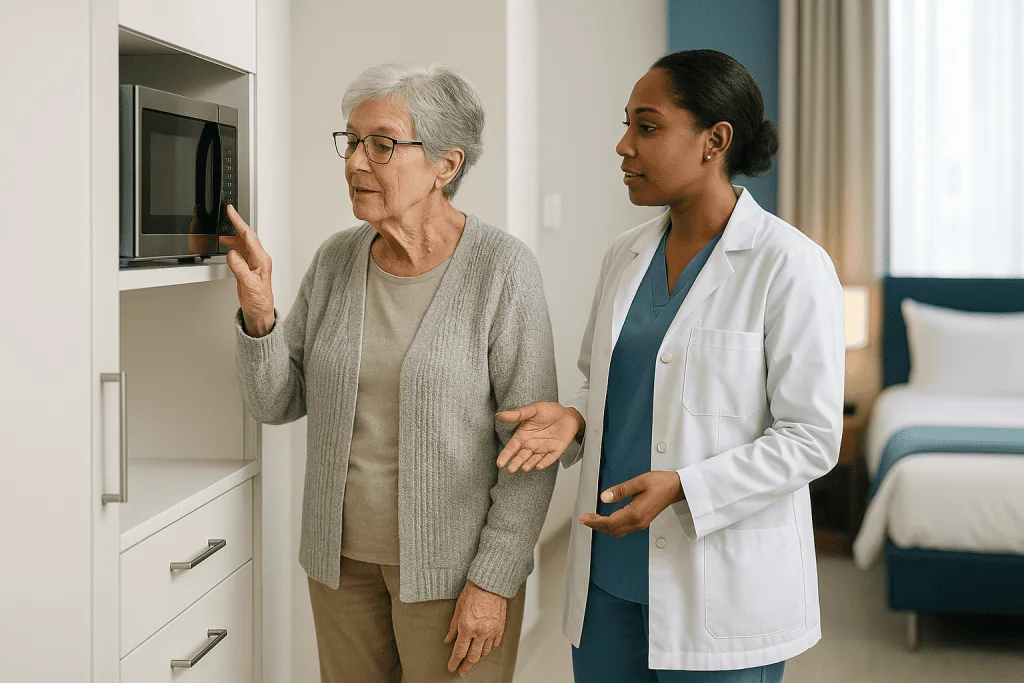
The phrase dementia proofing your home is popular in searches, though no home can be made fully proof against a progressive condition. What you can do is rank hazards by how likely they are to cause harm and how easily they are fixed. The table below summarizes the priorities that recur across MedlinePlus, NHS, and National Institute on Aging guidance.
| Area | Highest-priority change | Why it matters |
|---|---|---|
| Kitchen | Stove safety controls, knives and cleaning chemicals stored out of sight | Unattended heat is the leading fire risk; chemicals can be mistaken for food or drink |
| Bathroom | Grab bars, non-slip mat, water heater set to a safe temperature | Wet surfaces and scald injuries cluster here |
| Stairs and hallways | Rails on both sides, contrast strips on step edges, motion-sensor night lights | Depth perception loss makes stairs the most common fall site |
| Bedroom | Clear path to the bathroom, bed at a height that allows feet to rest flat | Night-time rising is when most wandering begins |
| Entrances | Door alerts, discreet secondary lock placed high or low, exit disguised with a curtain | Reduces unnoticed exits without a confrontation |
| Whole house | Remove loose rugs, tape cords, lock away medicines, firearms, and car keys | Low cost, high impact, recommended by every major guideline |
Two principles run under all of it. Contrast and simplicity: a toilet seat in a color that stands out from the floor is easier to find than a white one on white tile. Visibility over memory: glass-fronted cupboards or labeled doors with a picture of the contents reduce the need to remember where things live.
Walk the house at night as well as by day. Shadows, glare from a streetlamp, and the glow of a standby light can all look different to a brain that is struggling to interpret what it sees.
Wandering prevention for dementia, the front door, and driving
Wandering is the word used when a person with dementia walks or drives away from a safe place without a clear plan or the ability to find the way back. The National Institute on Aging notes it is common, can happen at any stage, and is often triggered by a need the person cannot express: searching for a toilet, for a long-dead parent, or for the job they left thirty years ago.
Prevention works on three layers. The first is meeting the need. Regular toilet reminders, a structured daily walk, and a calm late-afternoon routine remove many of the reasons to leave. The second is the environment. Door chimes or pressure mats alert the household; a curtain over the door or a plain-colored door that matches the wall reduces the visual cue; moving coats, keys, and shoes out of sight removes the prompt to go out. The third is a plan for the day it happens anyway: a recent photo, a written description, a list of former homes and favorite places, and neighbors who know to call. Identification worn on the body, such as a bracelet, helps strangers help.
Driving deserves a frank conversation early. Dementia affects reaction time and judgment before the person notices any change. The National Institute on Aging advises families to watch for new dents, getting lost on familiar routes, and near-misses, and to raise the subject with the care team, who may recommend a formal driving assessment. In most places a clinician can advise on retiring from driving, and the decision is far easier to accept when it is framed as medical advice rather than a family verdict. Keys should then be stored out of sight, and alternative transport arranged before the car goes, so the loss of independence is not total.
Kitchen, fire, and medicine safety
Fire and medicines are the two hazards most likely to cause serious harm quickly, so they come first in any dementia home safety plan for caregivers.
Start with heat. Automatic shut-off devices for stoves, which cut power after a set period with no motion nearby, are widely recommended; removing stove knobs when the kitchen is not in use is a simpler alternative. Induction hobs reduce burn risk because the surface itself stays cooler. Check smoke and carbon monoxide alarms monthly, and consider interlinked alarms so an alert in the kitchen sounds in the bedroom. The National Institute on Aging suggests setting the water heater no higher than 120°F (about 49°C) to prevent scalds, since a person with dementia may not react quickly to hot water.
Move on to the cupboards. Cleaning products, dishwasher tablets, and alcohol should be locked away or stored out of sight. Small appliances with exposed heating elements can be unplugged when not in use. If the person still enjoys cooking, and many do, keep the activity but change the task: washing vegetables, stirring cold mixtures, or setting the table preserves purpose without the heat.
Medicines need a system rather than a lecture. The common error is not refusal but repetition, taking a morning dose twice because the first was forgotten. Locked storage with a single daily supply set out by a caregiver, or a pharmacist-prepared blister pack, reduces this. Bring every bottle, including supplements and over-the-counter products, to the care team for a review, because some medicines worsen confusion or balance. Any change to what is taken, and when, belongs to the prescribing clinician, not to the household.
Falls, lighting, and the bathroom
Falls are the injury that most often ends a person’s time at home, and dementia raises the risk through slower reactions, impaired depth perception, and the side effects of some medicines. The good news is that fall prevention is mostly practical.
Lighting comes first. Night lights along the route from bed to bathroom, ideally motion-activated, remove the fumble for a switch. Daytime lighting should be even, without pools of shadow, and glare from bare bulbs or shiny floors should be reduced with shades and matte finishes. Open the curtains early; daylight helps reset the body clock and may ease late-day restlessness.
Then floors. Remove loose rugs or fix them with non-slip backing, tape down cords, and keep walkways a shoulder-width clear. Avoid bold patterns and sudden changes in flooring color, which can be misread as steps. Mark the edge of each stair with a strip in a contrasting color, and fit rails on both sides.
The bathroom concentrates every risk: water, hard surfaces, undressing, and urgency. Grab bars by the toilet and in the shower, a shower seat, a hand-held shower head, and a non-slip mat are standard recommendations in NHS and MedlinePlus guidance. Remove the lock from the inside of the bathroom door, or fit one that can be opened from outside. A raised toilet seat in a contrasting color helps with both finding it and rising from it.
Footwear matters more than people expect. Backless slippers and socks on wood floors are frequent culprits; closed, flat shoes with a grip sole are safer. Ask the care team about a vision and hearing check, and about a physiotherapy or occupational therapy referral. An occupational therapist, a professional who assesses how a person manages daily tasks at home, can spot hazards a family walks past every day.
What the first weeks and months after diagnosis usually look like
The diagnosis rarely changes the house overnight, but it changes how the house is seen. Caregivers often describe the first fortnight as a mix of relief, because something finally has a name, and vertigo, because the future has shifted.
A realistic sequence, drawn from the structure of MedlinePlus and National Institute on Aging guidance, looks like this. In the first week, do the hazard walk-through and fix the fast, cheap things: rugs, cords, night lights, locked medicines. In the first month, hold the harder conversations, about driving, money, and who holds a spare key, while the person can take a full part. Arrange a medication review and ask about an occupational therapy assessment. By three months, most households have a written care plan, a wandering plan, and a routine that includes daily movement and a predictable evening.
Progression varies enormously by cause and by person. Dementia caused by Alzheimer’s disease tends to advance gradually over years; vascular dementia, caused by reduced blood flow to the brain, often changes in steps after small strokes; dementia with Lewy bodies brings fluctuations and visual misperceptions early. The treating team can describe the likely pattern for the specific diagnosis, which is far more useful than any general timeline.
What stays constant is the need to review. A plan written for someone who still cooks is out of date once they no longer recognize a hot hob. Set a reminder to reassess every three to six months, or sooner after any fall, illness, hospital stay, or change in behavior, since each of these can mark a shift in what the home needs to do.
What should be included in a dementia care plan
A care plan is a written document that sets out who the person is, what they need, who provides it, and what to do when things change. It is the backbone of dementia home safety, because it turns a dozen informal arrangements into something another person could pick up and follow at 2 a.m.
Guideline-level sources, including the NHS and MedlinePlus, converge on the same core contents. A practical dementia care plan checklist usually covers:
- Diagnosis, stage, and the name of the treating clinician, with contact details.
- A current list of all medicines, who manages them, and where they are stored.
- Other health conditions, allergies, and recent hospital admissions.
- Daily routine: usual waking time, meals, toileting pattern, favorite activities, and known triggers for distress.
- Safety measures in place, such as stove controls, door alerts, and grab bars, with a date for the next review.
- A wandering plan: recent photo, description, former addresses, places they may head for, and who to call.
- Legal and financial arrangements: whether a power of attorney (a legal document naming someone to make decisions if the person cannot) and an advance directive (a record of treatment wishes) exist, and where they are kept.
- The caregiver’s own backup: who steps in if the main caregiver is ill, and when respite care has been arranged.
Keep one copy on the fridge or by the phone and one with the clinician. Share it with any paid carers and with the family members who visit least, since they are the ones most likely to miss a change. The person with dementia should contribute wherever possible; a plan that records the music they love and the nickname they answer to is a plan that works on a hard day.
Home safety devices and technology: what the evidence actually shows
Caregivers are offered an ever-growing menu of sensors, trackers, and smart devices, and it is fair to ask which ones have evidence behind them. The honest answer is that research on technology for dementia at home is mostly small and short, and that the strongest support is for the simplest tools.
Well-supported, low-technology measures include motion-sensor night lights, stove shut-off timers, door and window chimes, bed and chair pressure alarms, and visible clocks that show the day and whether it is morning or evening. These address specific, common risks and need no learning on the part of the person with dementia.
Location devices, such as GPS trackers worn in a watch or pendant, can shorten the time it takes to find someone who has wandered. They are reasonable to consider when wandering has already happened or is judged likely. Their limits are practical: they must be worn, charged, and carried, and they do nothing to prevent the exit itself. Video monitoring raises privacy and dignity questions that families should discuss openly with the person while they can still weigh in.
Medication reminder devices range from a simple timed box to automated dispensers. They help with the problem of forgetting, but they do not solve the problem of not recognizing the device or its alarm, which is why supervision still matters in later stages.
Two cautions. First, no device should replace human checking; technology adds a layer, it does not remove one. Second, be skeptical of any product that promises to slow or stop the condition. There is no evidence that any home device alters the course of dementia, and that claim is a reliable sign of marketing rather than medicine.
What people often get wrong about dementia home safety
Some of the most common mistakes come from good intentions, which is why they persist. Correcting them early saves both effort and distress.
The first is the big clear-out. Families sometimes strip a home of ornaments, photographs, and familiar clutter in the name of safety. Hazards should go; memories should stay. A home that no longer looks like home increases confusion and agitation, and the NHS specifically advises keeping familiar objects in view.
The second is assuming that a person who seems fine in conversation is safe with a stove. Social skills often survive long after planning and judgment have slipped, and a pleasant chat is not a safety assessment. Watch what happens, not what is said.
Third, locking doors as a first step. Restrictions escalate frustration and can be dangerous in a fire. Start with alerts and distraction, and keep locks for when nothing else has worked, always with another adult in the house.
Fourth, treating a sudden change as just the dementia. A rapid new confusion, over hours or days, is more likely to be delirium, an acute state of confusion caused by infection, dehydration, pain, or a medicine, and it is a reason to call the clinician, not to adjust the house.
Fifth, believing that nothing can be done once the diagnosis is made. Dementia cannot currently be reversed, but many of its daily risks can be managed, and the right environment measurably reduces falls, burns, and wandering.
And sixth, forgetting the caregiver. A plan that depends on one exhausted person is a plan with a single point of failure. Build in respite from the start.
Where caregivers find support, including Alzheimer's caregiver support groups
The question caregivers type most often, after the practical ones, is simply where to turn. The answer has several layers, and the best plans use more than one.
Start with the treating team. Memory clinics, neurologists, and primary care practices can refer to occupational therapy, social work, and community dementia services, and they can advise on respite options in your area. Ask directly; referrals are frequently available but rarely offered unprompted.
National health bodies publish free, evidence-based caregiving guides. The National Institute on Aging in the United States and the NHS in the United Kingdom both maintain detailed pages on home safety, wandering, driving, and caregiver wellbeing, and MedlinePlus offers a plain-language summary of dementia home care. These are reliable starting points precisely because they do not sell anything.
Support groups, whether in person or online, give something the guidance pages cannot: other people in the same week of the same journey. Groups for spousal caregivers, in particular, address the grief of losing a partner who is still present, a strain that friends without the experience may not understand. Many are run by nonprofit dementia organizations, by local councils or area agencies on aging, or by hospital social work departments. Online forums allow participation at 3 a.m. after a hard night. Look for groups that are moderated, that do not promote products, and that respect privacy.
Counseling for the caregiver, through primary care or an employee assistance program where available, is not a sign of failure. Caregiver depression and burnout are well documented and are themselves a safety risk, because a depleted caregiver misses things. Protecting the caregiver is protecting the person with dementia.
Questions to ask your care team about home safety
Appointments are short and the questions that matter most tend to surface on the drive home. Writing them down beforehand, and bringing a second person to listen, makes the visit far more useful. These are the questions that caregivers most often wish they had asked earlier.
- What type of dementia has been diagnosed, and what pattern of change is typical for it?
- Which of the current medicines could affect balance, alertness, or confusion, and is a review worthwhile?
- Is an occupational therapy home assessment available, and how is it arranged?
- Should driving stop now, or is a formal driving assessment appropriate?
- Is it still safe for this person to be home alone, and for how long at a time?
- What signs should prompt an urgent call rather than a routine appointment?
- Are there community dementia services, day programs, or respite options you can refer us to?
- Is now the right time to discuss power of attorney and advance care planning, and who can help with that?
- How often should we come back to review the home safety plan?
- What support is available for the caregiver specifically?
Take notes, and ask for a written summary if one is offered. Many clinics are willing to put the key safety advice, including the recommendation on driving, in a letter, which can make it easier for the person with dementia to accept a change that comes from a doctor rather than from family.
Finally, ask who to contact between appointments. Knowing that there is a nurse line, a memory clinic coordinator, or a named social worker turns a frightening middle-of-the-night question into a phone call, and that reassurance is itself part of a safe home.
When to call your doctor
Most changes in dementia are gradual and belong in a routine review. Some are not, and recognizing the difference is one of the most important safety skills a caregiver can learn.
Call the care team the same day, or seek urgent care, if you notice any of the following:
- Sudden confusion, drowsiness, or agitation that develops over hours or a few days, which may signal delirium from infection, dehydration, pain, or a medicine reaction.
- A fall, especially with a blow to the head, new pain, or difficulty standing afterward, even if the person seems fine.
- Signs of a stroke: sudden weakness or drooping on one side, slurred speech, or loss of vision, which need emergency services immediately.
- Refusing food or fluids for more than a day, or signs of dehydration such as very dark urine or a dry mouth.
- A possible overdose or missed-dose pattern involving any medicine, or ingestion of a non-food substance.
- Burns, cuts, or any injury the person cannot explain.
- New hallucinations, severe distress, or aggression that puts the person or others at risk.
- Wandering that leads to the person being lost; call emergency services first, then the care team.
Call for a routine appointment, within days to weeks, when you see a steadier decline: more frequent near-misses in the kitchen, getting lost on familiar routes, new incontinence, weight loss, disturbed sleep, or any change that makes the current safety plan feel stretched. Bring the care plan with you.
One more trigger belongs on the list: the caregiver. If you are not sleeping, are becoming short-tempered, or feel you cannot keep going, tell the care team. Caregiver strain is a medical issue with real solutions, and raising it early is a decision that protects everyone in the house.
Frequently asked questions
What are the first home safety changes to make after a dementia diagnosis?
Start with the hazards that cause the most harm fastest: stove safety controls, locked medicines and chemicals, loose rugs and cords removed, night lights along the route to the bathroom, and grab bars in the bath. These fixes are inexpensive, do not require the person to learn anything new, and appear in every major guideline. Harder conversations about driving and money can follow in the first month.
What does dementia proofing your home actually mean?
It means reducing the number of tasks that depend on memory, judgment, or quick reaction, rather than making the house hazard-free, which is impossible. Practically, that is good lighting, plain contrasting surfaces, clear walkways, visible labels, secured heat sources and medicines, and alerts on exits. Familiar objects and photographs should stay, because a home that stops looking like home increases confusion.
What should be included in a dementia care plan?
A care plan should list the diagnosis and clinicians, every medicine and who manages it, other health conditions, the daily routine and known triggers, safety measures in place, a wandering plan with a recent photo, legal documents such as power of attorney, and a backup caregiver. Keep a copy by the phone and another with the treating team, and update it after any fall, illness, or change in behavior.
How can caregivers prevent wandering in dementia?
Wandering prevention works best in layers. Meet the underlying need with regular toilet breaks, daily exercise, and a calm evening routine; reduce cues by moving keys, coats, and shoes out of sight and using a plain door or curtain; add chimes or pressure mats to alert the household; and prepare for the day it happens anyway with identification, a photo, and neighbors who know to call.
Can a person with early dementia be left home alone?
Sometimes, for limited periods, depending on the stage and the specific risks. The treating team, ideally with an occupational therapy assessment, can judge whether the person recognizes danger, can use a phone, and has not had fires, falls, or wandering episodes. The answer usually changes over time, so revisit it at every review rather than assuming last year’s answer still holds.
Where can I find support for someone with Alzheimer's disease?
Begin with the treating clinician, who can refer to community dementia services, occupational therapy, social work, and respite care. National health bodies such as the NHS and the National Institute on Aging publish free caregiving guides. Nonprofit dementia organizations, local councils or area agencies on aging, and hospital social work departments run support groups, including some specifically for spouses.
Are there online Alzheimer's caregiver support groups for spouses?
Yes. Many nonprofit dementia organizations and health services host moderated online forums and video groups, and several run sessions specifically for spousal caregivers, where the grief of losing a partner who is still present is understood without explanation. Choose groups that are moderated, protect privacy, and do not promote products, and ask your care team or local dementia service for trusted options.
How can I prevent Alzheimer's disease?
There is no proven way to prevent Alzheimer’s disease, but the World Health Organization identifies factors linked to lower dementia risk across a lifetime: regular physical activity, not smoking, controlling blood pressure, diabetes, and cholesterol, managing hearing loss, staying socially and mentally active, and limiting alcohol. These reduce risk at a population level; they do not guarantee an individual outcome.
Do home safety devices and GPS trackers help with dementia?
Simple devices such as motion-sensor lights, stove timers, and door chimes have the most practical support because they address specific risks without needing the person to learn anything. GPS trackers can shorten the time to find someone who has wandered but only if worn and charged, and they do not prevent the exit. No device slows the condition itself; treat any such claim as marketing.
How often should a dementia home safety plan be reviewed?
A review every three to six months is a reasonable routine, with an immediate reassessment after any fall, hospital stay, illness, new medicine, or change in behavior, since each can mark a shift in what the home needs to do. Needs change at different speeds depending on the type of dementia, so ask the treating team how often they would like to revisit the plan with you.
References
- MedlinePlus: Dementia – home care
- NHS: Dementia and the home environment
- World Health Organization: Dementia fact sheet
- Cleveland Clinic: Dementia
This article is for general information only and is not a substitute for professional medical advice. Please consult a qualified doctor about your individual situation.

More from the Blog

Headache at the Back of the Head: Tension, Neck and Occipital Nerve Causes and Warning Signs
Most headaches at the back of the head come from tension-type headache or strained muscles and joints in the upper neck, and they ease…

CIDP Recovery: Milestones in Strength, Balance and Walking Over the First Months
Recovery from CIDP usually unfolds over months, not days. Many people notice the first gains in strength within a few weeks of starting immune…

Movement Disorders Treatment: How Tremor, Dystonia and Parkinsonism Are Managed Differently
Movement disorders are treated according to the circuit that is misfiring, not the symptom alone. Essential tremor is usually managed with beta blockers or…

Headache with Neck Pain or Stiffness: Common Causes, Meningitis Warning Signs and When It Is Urgent
Headache with neck stiffness is most often caused by tense neck muscles, prolonged poor posture, a tension-type headache or a headache that starts in…
Caregiver Guidance in Alzheimer’s Disease: Sleep, Fall Prevention and Daily Structure
Alzheimer's caregiver guidance centers on three practical levers: protect sleep with daylight, movement and a calm evening routine; prevent falls by simplifying the home…
How Are Sleep and Mood Changes Managed in Dementia Care Without Losing Daily Routine?
Sleep and mood changes in dementia are usually managed by keeping the day predictable first: consistent wake and bed times, morning daylight, regular meals,…