

How Does the Chest Settle After Gynaecomastia Treatment? Results Over the First Months

Key Takeaways
- Gynaecomastia means enlarged breast gland, not just chest fat, and gland does not shrink with exercise or over-the-counter products.
- Swelling and bruising peak in the first days after surgery and the chest can briefly look fuller than before the operation.
- A compression garment is typically worn for a few weeks after surgery to limit swelling and help the skin settle onto the new contour.
- Gynaecomastia treatment results are usually assessed at several months, because scar tissue softens and skin retracts long after the headline shape appears.
- Pubertal gynaecomastia usually resolves without treatment within six months to two years, which is why teenagers are often asked to wait.
- Removed gland does not regrow, but remaining tissue can be stimulated by unaddressed hormonal causes, and chest fat can return with weight gain.
After gynaecomastia treatment, the chest settles in stages rather than all at once. Swelling and bruising are most noticeable in the first one to two weeks, a compression garment is usually worn for several weeks, and the contour keeps refining for months as fluid clears and skin tightens. Most surgeons ask patients to judge the result no earlier than several months after the procedure, at a review with the treating team.
The first look in the mirror rarely matches the mental picture. A day or two after surgery, the chest is wrapped in a snug garment, the skin underneath is puffy and mottled, and the flatness that was the whole point of the operation is nowhere to be seen. People in this position often send a worried message to the clinic, or quietly search their phone at two in the morning.
That anxiety is understandable, and it is mostly a mismatch between expectations and biology. Tissue that has been cut, suctioned and stitched does not simply fall into its final shape. It swells, bruises, drains, scars and then, slowly, contracts. Gynaecomastia treatment results unfold over months, and the early weeks are a poor preview of the eventual picture.
This explainer walks through what is happening beneath the skin at each stage, which changes are expected, which ones deserve a phone call, and what the evidence says about how the chest finally settles.
What actually happens during gynaecomastia treatment?
Gynaecomastia is enlargement of breast gland tissue in men or boys, usually driven by a shift in the balance between estrogen and testosterone (Mayo Clinic). The word is often applied loosely to any fullness on the male chest, but clinically it means true gland, not just fat. Fat alone on the chest is called pseudogynaecomastia, and the distinction matters because gland and fat respond differently to every form of treatment.
Treatment sits on a spectrum. At one end is observation: many cases, particularly in puberty, shrink on their own (Mayo Clinic). In the middle sits medication, most often a class called selective estrogen receptor modulators, which block estrogen’s action at the breast; these are not approved specifically for gynaecomastia and are used at the prescribing clinician’s discretion (Mayo Clinic). At the far end is surgery.
Surgery itself usually combines two techniques. Liposuction, which is the removal of fat through a thin tube inserted via small cuts, deals with the soft, fatty component. Excision, meaning direct surgical removal, deals with the firm gland that suction cannot break up, and is done through a short incision typically placed at the edge of the areola (Mayo Clinic). When the skin has been stretched for years, some surgeons also remove excess skin, which produces longer scars.
Understanding this is the key to understanding recovery. Liposuction disturbs a wide area of fat under the skin, which is why swelling spreads across the whole chest. Excision leaves a cavity where the gland sat, which is why fluid can pool there. The final result depends on how that disturbed tissue heals and how well the skin shrinks back over the new, flatter surface.
Why the chest looks worse before it looks better: the first week
Injury of any kind triggers inflammation, and surgery is a controlled injury. Within hours, small blood vessels leak fluid into the tissue, white blood cells arrive to clear debris, and the area becomes warm, tender and swollen. On the chest this is very visible, because the skin over the pectoral muscle is thin and there is little room for fluid to hide.
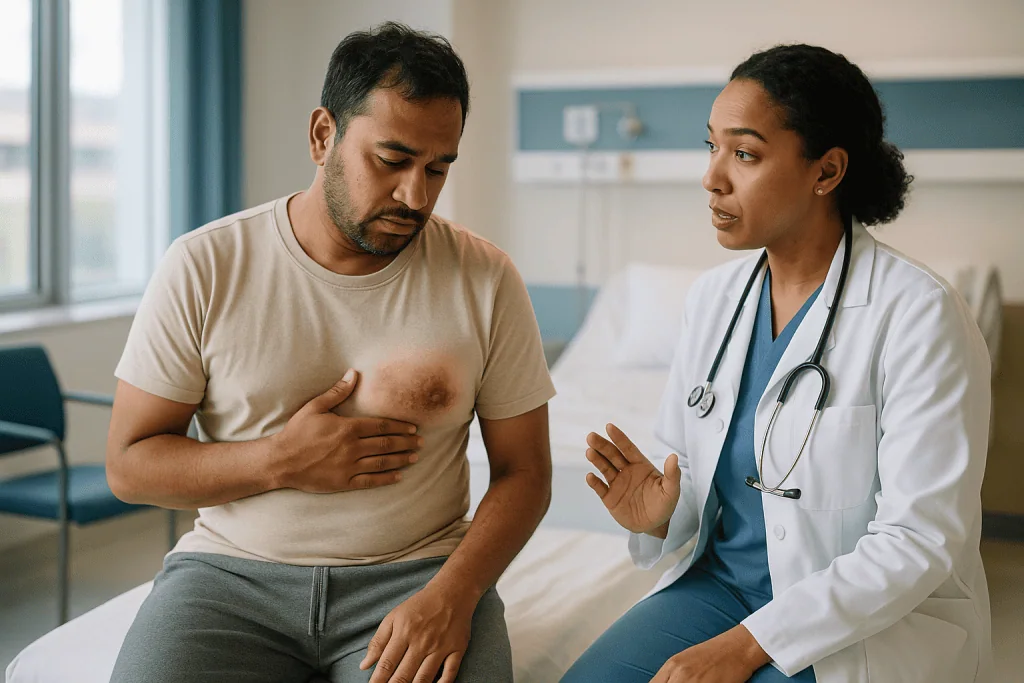
Bruising follows a predictable color sequence as blood pigment breaks down: purple-red first, then greenish, then yellow before fading. With liposuction, bruising can appear well away from the incisions, sometimes tracking down toward the abdomen with gravity. This spreading looks alarming but simply reflects where fluid has drifted under the skin.
Some surgeons place thin drains, small tubes that carry fluid out of the wound, for a day or two; others rely on compression alone. Either way, a firm garment is typically worn around the clock in this early phase to limit swelling and help the skin adhere to the new contour (Cleveland Clinic).
Pain is usually described as soreness or tightness rather than sharp pain, and the treating team will have discussed pain relief before discharge. This article does not cover medicines or doses; any question about them belongs with the prescribing clinician.
What the chest looks like at day three is almost irrelevant to the eventual outcome. It may appear lumpy, uneven or even fuller than before. That is inflammation, not the result. Most people find it easier to avoid close mirror inspections in the first week and to trust the review appointments instead.
Weeks two to six: swelling, the garment and gynecomastia surgery recovery time
By the second week, bruising is fading and the sharpest tenderness has usually eased. Swelling, however, behaves differently. It peaks in the first several days and then drains slowly through the lymphatic system, a network of vessels that returns tissue fluid to the bloodstream. Surgery disrupts some of those vessels, so drainage is sluggish for a while.
This is the stage when a compression garment earns its keep. Steady pressure reduces the space available for fluid, encourages the skin to settle against the underlying tissue, and lessens the risk of a seroma, which is a pocket of clear fluid collecting under the skin. Cleveland Clinic notes that garments are typically worn for a few weeks after surgery, though the exact schedule is set by the surgeon and varies with the technique used.
Activity returns gradually. Light walking is encouraged from the first days because it helps circulation and reduces clot risk. Desk work is often possible within a week or so; upper-body exercise, heavy lifting and anything that bounces or stretches the chest are usually held back for several weeks so that healing tissue is not pulled apart (Cleveland Clinic). Timelines differ from person to person and should come from the treating team rather than from an article.
Around this time people commonly notice firmness or ridges under the skin. Healing tissue produces collagen, and early collagen is disorganized and stiff. This firmness softens as the scar tissue matures. Gentle massage is sometimes suggested to speed that process, but only once the surgeon confirms the incisions are secure.
Numbness across the nipple and lower chest is expected. Small sensory nerves are stretched or cut during surgery and regrow slowly, a process measured in months rather than weeks.
Gynaecomastia treatment results at three months: what usually shows
Three months is often the first point at which the chest begins to resemble the eventual result. Most of the swelling has drained, the garment has usually been retired, and the skin has started to shrink onto the flatter surface beneath. Many people describe this as the moment they finally feel comfortable in a fitted shirt.
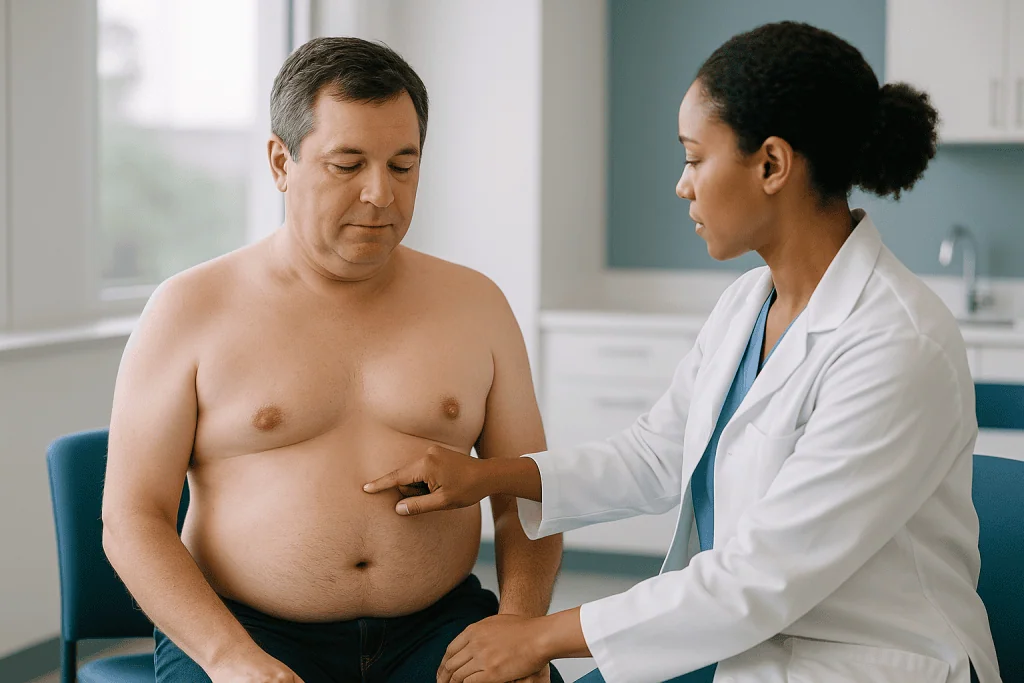
It is still not the finished picture. Residual firmness, particularly around the areola where gland was excised, can persist. Slight asymmetry between the two sides is common at this stage, because each side swells and drains at its own pace. Skin may look a little loose or crinkled where it has not yet fully retracted, especially in older patients or where the breast was large before surgery.
The three-month review is usually when the surgeon assesses whether healing is on track. They look at incision maturity, check for any fluid collection, and compare the two sides. If a small area of gland or fat remains, this is typically noted but not acted on, because tissue that still looks prominent at three months may flatten considerably with more time.
Photographs help here. Comparing the three-month chest to the pre-operative photos in the clinic record tends to reveal a change that daily mirror checks have hidden. The reverse is also true: comparing it to an idealized image online, of a body that may never have had gynaecomastia, invites disappointment.
The honest summary at this stage is that the shape is emerging but the surface is still refining. Gynaecomastia treatment results are usually judged at six months or later, not at three.
Six months and beyond: when the final shape settles
Scar tissue matures over a long arc. In the first weeks it is red, raised and stiff. Over the following months, the body remodels that tissue: disorganized collagen is replaced by orderly fibers, excess blood vessels recede, and the scar flattens and pales. Cleveland Clinic and MedlinePlus both describe this remodeling as continuing for many months after surgery, which is why surgeons are reluctant to make a final judgment early.
Skin retraction follows a similar timetable. Skin is elastic, but elasticity depends on age, genetics, how long it was stretched and how much it was stretched. Younger skin that carried a modest amount of gland usually snaps back well. Skin that has been stretched for years, or after significant weight loss, may leave some laxity even when all the excess tissue has been removed.
Sensation is also still returning. Tingling, occasional shooting sensations or patches that feel oddly sensitive are typical signs that nerves are reconnecting. A fully numb nipple at six months does not necessarily mean permanent loss, but it should be mentioned at review.
This is also the stage when the treating team may discuss whether a minor revision is worth considering, for instance if a distinct firm nodule remains or if one side sits noticeably differently. Most surgeons prefer to wait until at least this point, and often longer, so that they are operating on settled tissue rather than tissue that would have improved on its own.
A useful mental model: the operation removes the tissue, but the body finishes the job. The final contour is the surgeon’s work plus months of the patient’s own healing.
Does gynecomastia go away without surgery? Medication and watchful waiting
Often, yes, at least in adolescence. Mayo Clinic notes that gynaecomastia appearing during puberty usually resolves without treatment within six months to two years, as hormone levels stabilize. For this reason, teenagers are frequently advised to wait and be reviewed rather than to seek treatment straight away.
In adults the picture is different. Once breast gland has been present for a long time, it tends to become fibrous, meaning the soft, active gland is gradually replaced by dense scar-like tissue that no longer responds to hormonal signals. Mayo Clinic notes that medication tends to be most useful in the early, active phase, and is less likely to help long-standing gynaecomastia.
When medication is used, it usually belongs to the class of selective estrogen receptor modulators. These drugs occupy estrogen receptors in breast tissue, dampening the growth signal that estrogen provides. They are prescribed off-label for this purpose, meaning outside their approved indication, and only a clinician can weigh whether that is appropriate for an individual (Mayo Clinic). If they do help, the effect appears over weeks to months as tissue shrinks; they do not remove fibrous tissue and they do not affect fat.
Addressing an underlying cause can also allow the chest to settle on its own. Cleveland Clinic lists a range of contributors, including certain prescribed medicines, alcohol, some recreational substances, liver or kidney disease, thyroid disorders and hormone-producing tumors. Where a cause is found and can be corrected, the gland may regress. Anyone who suspects a prescribed medicine is involved should raise it with the prescriber rather than stopping it independently.
Fatty tissue on the chest, by contrast, responds to overall weight loss rather than to any of these approaches.
Who is usually offered treatment, and who is asked to wait
Surgery is generally considered when the enlargement has persisted, causes physical discomfort or significant distress, and is unlikely to improve on its own (Mayo Clinic). Before any procedure, the treating team wants to know why the gland grew in the first place. That usually means a clinical examination, questions about medicines and substances, and blood tests to check hormone, liver, kidney and thyroid function (MedlinePlus). Imaging is sometimes used to distinguish gland from fat or to assess an unusual lump.
Several groups are typically asked to wait:
- Adolescents whose gynaecomastia is recent, because the majority of pubertal cases settle without intervention (Mayo Clinic).
- People whose enlargement is linked to a reversible cause, such as a medicine that can be changed by the prescriber or a treatable hormone disorder, since the chest may shrink once the cause is addressed.
- People in the middle of significant weight change, because operating on a chest that is still changing shape makes the final contour unpredictable.
- People who smoke or use nicotine, who are often asked to stop for a period around surgery because nicotine narrows blood vessels and impairs wound healing.
- People with uncontrolled medical conditions that raise anesthetic or bleeding risk, until those are stabilized.
Surgeons also look at expectations. Someone hoping for a specific chest seen on a screen, rather than a flatter version of their own chest, may be encouraged to reflect further. The decision to operate, and the timing, rests with the treating team, who weigh the likely benefit against the risks of anesthesia, bleeding, infection, contour irregularity and scarring (Cleveland Clinic).
Any new, hard, one-sided lump, especially with nipple discharge or skin change, is investigated first, because although breast cancer in men is uncommon, it must be excluded before cosmetic treatment (Mayo Clinic).
Recovery timeline at a glance
Every recovery is individual, and the treating team’s instructions override any general table. That said, people find it useful to see the typical sequence laid out. The stages below summarize what Cleveland Clinic, Mayo Clinic and MedlinePlus describe about healing after gynaecomastia surgery; they are ranges, not promises.
| Stage | What is usually happening | What it often looks or feels like |
|---|---|---|
| First days | Inflammation peaks; garment worn continuously; drains, if used, are removed | Swollen, bruised, tight; chest may look fuller than before |
| Weeks 1–2 | Bruising fades; soreness eases; light walking encouraged | Puffy, numb patches, lumpy under the skin |
| Weeks 2–6 | Swelling drains slowly; scar tissue forms and feels firm; garment often still worn | Shape starting to appear; firmness and ridges common |
| Around 3 months | Most swelling gone; skin retracting; exercise usually resumed with clearance | Recognizable result; minor asymmetry and residual firmness |
| 6–12 months | Scars mature and pale; sensation returns; contour stabilizes | Settled shape; revision discussed only if needed |
Two patterns are worth pointing out. First, the visible improvement is front-loaded: the biggest change happens between week one and month three. Second, the subtle improvement is back-loaded: scar quality, skin smoothness and sensation continue to refine long after the headline shape has arrived. People who understand both curves tend to be more patient with the process.
The table deliberately omits fixed dates for returning to work or sport. Those depend on the extent of surgery, the individual’s job and the surgeon’s protocol, and they should be agreed at the pre-operative consultation.
Gynecomastia scars after surgery, nipple sensation and skin: the slow movers
Three aspects of healing lag behind the rest, and they cause the most late-stage worry.
Scars come first. When surgery is limited to liposuction, incisions are tiny and usually sit in the fold of the armpit or at the lower edge of the chest. When gland is excised, the incision typically follows the border of the areola, where the change in skin color helps disguise it. Skin-reduction techniques leave longer scars around the areola or across the chest. All scars pass through a red, raised phase before flattening and fading, and this maturation takes many months (MedlinePlus). Sun protection during the first year helps prevent scars from darkening permanently. Some people, particularly those with darker skin or a family history, are prone to thickened scars, and this should be discussed before surgery.
Nipple sensation is second. The nerves supplying the nipple run through the very tissue that is removed or suctioned, so altered sensation is expected. Numbness, tingling or hypersensitivity usually improve gradually as nerve fibers regrow, but full recovery is slow and some permanent change is possible (Cleveland Clinic). Rarely, the nipple can also look slightly indented if too much tissue is removed beneath it; surgeons deliberately leave a thin cushion of tissue to avoid this.
Skin is third. Redundant skin tightens over months, helped by compression and by the natural contraction of healing tissue. Where the skin was heavily stretched, some looseness may remain even after everything else has settled. This is a limitation of the skin’s elasticity rather than a failure of the surgery, and it is one reason surgeons examine skin quality carefully during planning.
What influences how the chest settles
Several factors, some within a person’s control and some not, shape the final outcome.
Weight stability is probably the most important modifiable factor. Liposuction removes fat cells from the chest, but the cells that remain can still enlarge. Significant weight gain after surgery can restore chest fullness, while significant weight loss can leave skin that was tight at the time of surgery looking loose. A stable weight in the months before and after treatment gives the surgeon a stable target and gives the skin the best chance to retract cleanly.
Hormonal balance matters because true gland responds to estrogen. If the underlying cause has not been addressed, whether that is a medicine, a substance, or an untreated medical condition, any residual gland can continue to be stimulated (Cleveland Clinic). This is why investigation precedes surgery rather than following it.
Nicotine impairs wound healing by constricting blood vessels and reducing oxygen delivery to tissue, raising the risk of delayed healing and poorer scars. Alcohol is separately listed among contributors to gynaecomastia itself (Mayo Clinic). Anabolic steroids and some supplements marketed for muscle gain are also recognized causes, and continuing them after surgery can undo the result.
Following the compression schedule, protecting incisions from sun, and easing back into exercise on the surgeon’s timetable all influence swelling, seroma risk and scar quality. Age and genetics set the ceiling for skin retraction and scar behavior, and no amount of diligence changes those.
None of this means outcomes are entirely predictable. Two people with similar chests and identical surgery can heal differently. The treating team’s job is to stack the controllable factors in the patient’s favor and to explain honestly where the uncontrollable ones may lead.
Can gynecomastia come back after treatment?
Gland tissue that has been surgically removed does not grow back. What can happen is that tissue left behind, or the cause that produced the gland in the first place, leads to renewed fullness. Understanding this distinction is the key to answering the question honestly.
Surgeons intentionally leave a thin layer of tissue beneath the areola to protect blood supply and avoid a sunken nipple. If the hormonal driver persists, that small remnant can be stimulated. Cleveland Clinic lists ongoing contributors that include certain prescribed medicines, alcohol, anabolic steroids and some recreational substances, as well as medical conditions affecting the liver, kidneys or thyroid. Where these continue unaddressed, some regrowth is possible.
Fat is the more common culprit. Liposuction reduces the number of fat cells in the chest but does not eliminate them, and remaining cells expand with weight gain. A chest that was flat at six months can soften again with a substantial rise in weight. This is not a return of gynaecomastia in the strict sense but can look and feel similar.
Medication, where it has been used, works only while it is taken and only on active gland; stopping it under the clinician’s guidance can allow some regrowth if the underlying imbalance remains (Mayo Clinic). In adolescents, the natural tendency is toward resolution, not recurrence, once puberty completes.
Anyone noticing new firmness, growth, tenderness or a distinct lump after treatment should have it assessed rather than assumed to be recurrence. New changes may reflect scar tissue, a late seroma, hormonal change or, uncommonly, something that needs separate investigation. The assessment, and any decision about further treatment, sits with the treating team.
What people often get wrong
Myths about gynaecomastia recovery circulate widely, and several of them lead people to worry unnecessarily or to make poor decisions.
“If it isn’t flat by two weeks, the surgery failed.” Two weeks is the peak of firmness and residual swelling for many people. Judging a result then is like judging a painting before the primer has dried. Surgeons generally assess outcome at several months, not weeks (Cleveland Clinic).
“Chest exercises will fix gynaecomastia.” Building the pectoral muscle can improve overall chest shape, but true gland tissue does not shrink with exercise, and a larger muscle beneath it can sometimes make gland more prominent. Exercise and weight management help the fatty component and general health; they do not remove gland (Mayo Clinic).
“Creams and supplements dissolve breast tissue.” No topical product or over-the-counter supplement has been shown in mainstream evidence to remove gland. Products marketed this way should be treated with skepticism, and some supplements are themselves suspected contributors to gynaecomastia.
“Hard lumps under the skin mean tissue was left behind.” Early firmness is usually immature scar tissue or organizing fluid, which softens over months. Persistent, well-defined nodules are assessed later, once healing has settled.
“Compression is optional once the pain stops.” Pain fades well before swelling and skin retraction are complete. The garment is doing its most useful work during the weeks when the chest already feels fine.
“Teenagers should be operated on quickly to avoid distress.” Most pubertal gynaecomastia resolves on its own within six months to two years (Mayo Clinic). Early surgery removes tissue that would likely have disappeared, and exposes a young person to risks they may not have needed to take.
Questions to ask your care team before and after treatment
A good consultation is a conversation, not a briefing. Writing questions down beforehand helps, because appointments are short and nerves make people forget. The following are worth raising with the treating team; the answers should be specific to the individual rather than general.
- Have the possible causes of my gynaecomastia been investigated, and is anything reversible without surgery?
- Is my enlargement mostly gland, mostly fat, or a mixture, and how does that change the technique you would use?
- Will the operation involve liposuction, excision, skin removal, or a combination, and where exactly will the incisions be?
- What is your usual compression schedule, and how will I know when to stop wearing the garment?
- When can I expect to walk, drive, return to work, and resume upper-body exercise, and what signs would tell me I am doing too much?
- What degree of swelling, asymmetry and firmness do you consider normal at two weeks, six weeks and three months?
- What changes in nipple sensation should I expect, and how long might they last?
- How will my skin quality affect the result, and is there a chance of residual looseness?
- What are the risks of bleeding, seroma, infection and contour irregularity in your experience, and how are they managed if they occur?
- At what point would you consider the result final, and how do you approach a revision if one is needed?
- Are there any of my current medicines, supplements or habits that could affect healing or cause regrowth?
- Who do I contact, and how quickly, if something worries me after hours?
After surgery, the questions shift: is this level of swelling expected, is this firmness normal, when is my next review? Keeping a brief daily note of symptoms and photographs taken in the same light and position makes those follow-up conversations far more useful for both patient and surgeon.
When to call your doctor
Most of what happens after gynaecomastia treatment is uncomfortable but expected. A small number of signs are not, and they warrant contacting the treating team promptly rather than waiting for the next scheduled review. If the team cannot be reached, emergency services or an urgent care setting are the right next step.
Call urgently if any of the following occur:
- Rapid, one-sided swelling or a chest that suddenly feels tense and much larger on one side, which can indicate bleeding under the skin (a hematoma).
- Fever, chills, or spreading redness, warmth and increasing pain around an incision, which may signal infection.
- Pus, cloudy or foul-smelling discharge, or an incision that opens.
- Skin over the nipple or chest turning dusky, dark or very pale, which may indicate compromised blood supply.
- A soft, fluctuant swelling that keeps enlarging, suggesting a seroma that may need drainage.
- Pain that escalates rather than easing, or pain not controlled in the way the team told you to expect.
Call emergency services immediately for chest pain, shortness of breath, coughing up blood, or a swollen, painful calf, because blood clots in the leg or lung are a recognized risk after any operation and need immediate care (Cleveland Clinic, MedlinePlus).
Outside the surgical setting, anyone with gynaecomastia should seek medical review for a new hard or fixed lump, nipple discharge, skin dimpling, or enlargement confined to one breast, since these need assessment to exclude other causes including breast cancer, which although uncommon in men does occur (Mayo Clinic).
None of these signs means something has certainly gone wrong. They mean a clinician should look. Making that call early is almost always simpler than dealing with the consequences of waiting, and every decision about what to do next belongs with the treating team.
Frequently asked questions
How long does gynecomastia surgery recovery time usually take?
Recovery happens in stages: soreness and bruising ease over the first one to two weeks, swelling drains over several weeks while a compression garment is worn, and the contour continues refining for months. Cleveland Clinic describes light activity resuming within days and strenuous exercise being held back for several weeks. Exact timing depends on the technique and the surgeon’s protocol, so the treating team’s instructions should guide each step.
When will I see my final gynaecomastia treatment results?
Most surgeons consider the result settled at around six months to a year, once swelling has cleared, skin has retracted and scars have matured. The overall shape is often recognizable by about three months, but firmness, minor asymmetry and scar redness can persist beyond that. Judging the outcome earlier tends to cause unnecessary worry, because the tissue is still actively remodeling.
Does gynecomastia go away on its own?
Often, in adolescence. Mayo Clinic notes that pubertal gynaecomastia usually resolves without treatment within six months to two years. In adults, long-standing gland tends to become fibrous and is less likely to shrink spontaneously, though correcting an underlying cause such as a contributing medicine or hormone disorder can lead to improvement. Fatty chest tissue responds to weight loss rather than time.
Why is my chest still hard and lumpy weeks after surgery?
Firmness in the early weeks is usually immature scar tissue and organizing fluid rather than tissue left behind. Healing produces stiff, disorganized collagen that softens as it remodels over months. Surgeons commonly reassess persistent nodules only after healing has settled. A soft swelling that keeps growing, or a hard area with redness and warmth, should be checked sooner by the treating team.
Will gynecomastia scars after surgery be visible?
Scars depend on technique. Liposuction alone leaves tiny marks near the armpit or chest fold, gland excision usually leaves a short incision along the areola border where color change disguises it, and skin-reduction surgery leaves longer scars. All scars are red and raised early and fade over many months. Sun protection during the first year and, for some people, scar treatments discussed with the surgeon help the final appearance.
Can gynecomastia come back after surgery?
Gland that has been removed does not regrow. Renewed fullness usually comes from either remaining fat cells enlarging with weight gain or a small tissue remnant being stimulated by an ongoing hormonal cause, such as certain medicines, anabolic steroids or untreated medical conditions listed by Cleveland Clinic. New firmness, growth or a distinct lump after treatment should be assessed rather than assumed to be recurrence.
Do medications work for gynaecomastia, and how long do they take?
Some clinicians prescribe selective estrogen receptor modulators, which block estrogen’s effect on breast tissue; Mayo Clinic notes they are used off-label and tend to help mainly in the early, active phase. Any effect appears gradually over weeks to months and does not remove fibrous tissue or fat. Whether medication is appropriate, and for how long, is a decision for the prescribing clinician.
Is numbness in the nipple after gynecomastia surgery permanent?
Usually not, though some change can persist. Sensory nerves to the nipple pass through the tissue that is removed or suctioned, so numbness, tingling or hypersensitivity are expected afterwards. Nerves regrow slowly, and sensation typically improves over months. Cleveland Clinic lists permanent sensory change among possible risks, so a fully numb nipple at six months is worth raising at review.
When can I exercise or lift weights after gynecomastia treatment?
Gentle walking is usually encouraged from the first days to aid circulation and reduce clot risk. Upper-body training, heavy lifting and high-impact activity are typically held back for several weeks so healing tissue is not stressed and swelling is not prolonged (Cleveland Clinic). The precise timetable varies with the extent of surgery and should be confirmed with the treating team before resuming each type of activity.
Why do surgeons ask teenagers to wait before treating gynaecomastia?
Because most pubertal gynaecomastia settles on its own. Mayo Clinic notes resolution usually occurs within six months to two years as hormone levels stabilize. Operating early removes tissue that would likely have disappeared and exposes a young person to surgical risks unnecessarily. Waiting with periodic review lets the treating team identify the minority whose enlargement persists and who may benefit from treatment later.
References
This article is for general information only and is not a substitute for professional medical advice. Please consult a qualified doctor about your individual situation.

More from the Blog
Combined Procedures in Breast Aesthetics: When a Lift and Implants Happen in One Operation
A combined breast lift and augmentation, also called augmentation mastopexy, reshapes and raises sagging breast tissue while placing an implant for volume, all under…

Reading a Breast Aesthetics Surgical Plan: Measurements, Options and Questions to Raise
A breast aesthetics surgical plan usually lists your chest and breast measurements, the surgeon's proposed technique, and the alternatives that were considered. Reading it…

Preparing for Breast Augmentation: Imaging, Medication Review and the Final Sizing Visit
Preparing for breast augmentation usually involves three steps spread over several weeks: a baseline breast imaging review if you are of screening age or…

How Long Do Breast Implants Last? Lifespan, Monitoring and When Replacement Is Discussed
Breast implants are not lifetime devices, but they do not expire on a fixed schedule. Many last 10 to 20 years or more, and…

How DIEP Flap Breast Reconstruction Works: Abdominal Tissue, Microsurgery and Operating Time
DIEP flap breast reconstruction rebuilds a breast using skin and fat from the lower abdomen while leaving the abdominal muscle in place. Surgeons trace…

When Is Gynaecomastia Treatment Considered? Watchful Waiting, Causes Checked and Surgery
Gynecomastia treatment is usually considered only after three things have happened: a doctor has confirmed the swelling is glandular breast tissue rather than fat,…