

Hyperbaric Oxygen Therapy With Diabetes: Why Blood Sugar Is Checked Around Each Session

Key Takeaways
- Clinical hyperbaric oxygen therapy pressurizes the chamber to roughly two to three times normal atmospheric pressure, and a session typically lasts about two hours including pressurization and depressurization.
- Breathing pure oxygen under pressure can lower blood glucose, which is why programs check readings before and after each session and may postpone a treatment if the reading falls outside their safe range.
- A Cochrane systematic review found that adding hyperbaric oxygen to standard care increased diabetic foot ulcer healing at six weeks but showed no significant difference at one year, with overall evidence graded as low quality.
- Hyperbaric oxygen is an adjunct to, never a replacement for, offloading, debridement, infection control and adequate blood supply.
- Temporary worsening of nearsightedness during a course is recognized and usually resolves after treatment, so a glasses prescription should not be changed until some weeks later.
- Most glucose-monitoring and insulin-delivery devices contain batteries and may not be allowed inside the chamber because of fire risk, so monitoring arrangements should be agreed before the first session.
Hyperbaric oxygen therapy is sometimes added to standard wound care for a diabetic foot ulcer that has not healed with offloading, debridement and good circulation. Breathing pure oxygen under pressure can lower blood glucose during a session, so programs typically measure it before and after each treatment to reduce the risk of hypoglycemia. The wound team decides whether and when it is appropriate.
The first thing a new patient usually notices is not the chamber. It is the finger prick. Before anyone talks about pressure gauges or oxygen hoods, a nurse checks a blood sugar reading, writes it down, and asks what you ate for breakfast. For someone who has lived with diabetes for twenty years, that can feel oddly familiar, and a little puzzling. You came for your foot. Why does everyone keep asking about your glucose?
The answer sits at the heart of how hyperbaric oxygen therapy for a diabetic foot ulcer works. The same physiology that pushes extra oxygen into a stubborn wound also nudges blood sugar downward in many people, sometimes by more than they expect. Checking glucose on both sides of a session is not a formality; it is how the team keeps a two-hour treatment safe.
This explainer walks through what actually happens inside the chamber, what the evidence does and does not show about healing, who is usually offered the therapy, and what the weeks around it tend to look like.
What hyperbaric oxygen therapy for a diabetic foot ulcer actually involves
Hyperbaric oxygen therapy, often shortened to HBOT, means breathing pure oxygen inside a sealed chamber where the air pressure is raised above normal. Mayo Clinic describes pressures of roughly two to three times what we live in at sea level. At that pressure the lungs take in far more oxygen than they could on an ordinary day, and that oxygen dissolves directly into the plasma, the liquid part of blood, rather than riding only on red blood cells.
Why would that matter for a foot? A diabetic foot ulcer is an open sore, usually on the sole or a toe, that forms because long-standing high glucose damages both the nerves that signal pain and the small vessels that deliver blood. MedlinePlus notes that this combination lets minor injuries go unnoticed and heal slowly. Tissue starved of oxygen struggles to fight infection, build new capillaries or lay down collagen.
The chamber itself is less dramatic than its reputation. Most centers use either a clear single-person tube where you lie on a padded bed, or a larger room where several patients sit in chairs and breathe through a hood or mask. Mayo Clinic lists a typical session as lasting about two hours. Ears feel the pressure change the way they do on an aircraft, and staff coach you to equalize by swallowing or yawning.
Throughout, the oxygen is the medicine. There is no injection, no drug added to the air, and no sedation. The goal is simple to state: saturate the tissue around the ulcer with enough oxygen, repeatedly, to support the body’s own repair machinery while the rest of the wound-care plan continues outside the chamber.
Why is blood sugar checked before and after every session?
Because the chamber can move it. Cleveland Clinic lists lowered blood sugar among the recognized effects of hyperbaric treatment, and clinical programs that treat people with diabetes build their routine around that observation. A reading before the session tells the team whether it is safe to pressurize; a reading afterward tells them whether the two hours inside produced a meaningful drop.
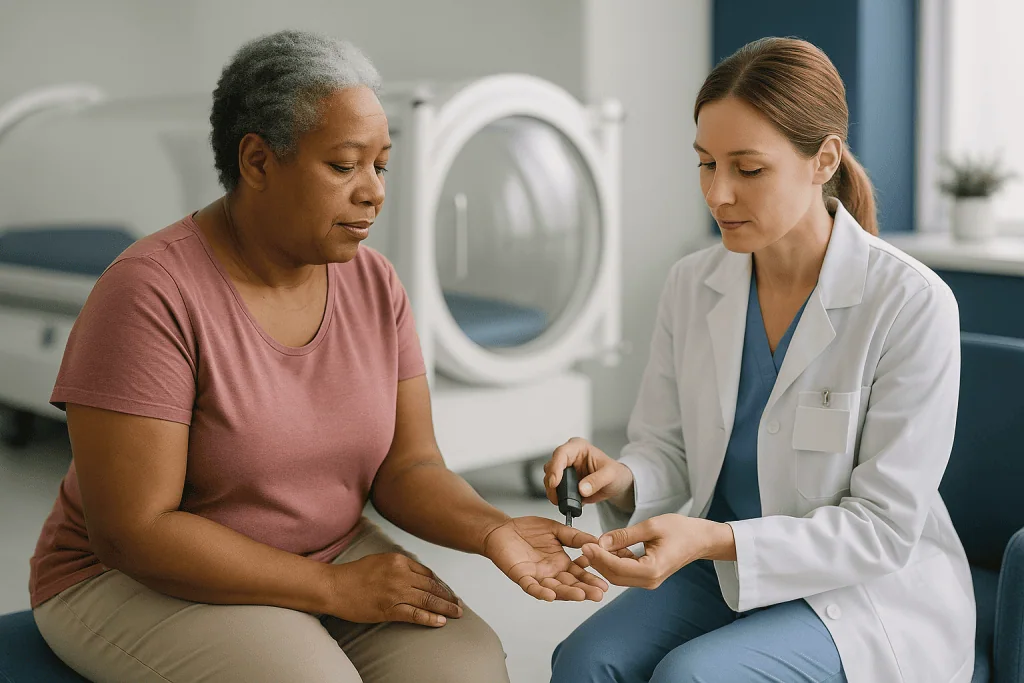
The concern is hypoglycemia, the medical term for blood glucose that falls low enough to affect how the brain and body function. Inside a pressurized chamber this is a particular problem for three practical reasons. The door cannot simply be opened; decompression takes time. Early symptoms such as sweating or mild confusion are harder to notice when you are lying still with a hood on. And a person who becomes confused in a single-occupancy chamber cannot easily signal for help.
So the pre-session check functions as a go or no-go gate. Each program sets its own threshold, decided by its medical director, below which the session is delayed until the patient has eaten and been rechecked. A reading that is very high may also prompt a pause, since the wound team wants to understand what is driving it before adding another variable.
The post-session reading has a different job. It builds a personal pattern. After three or four treatments, the nurse can often predict roughly how far a given patient’s glucose tends to fall and plan snacks or timing accordingly. That record also goes back to the clinician who manages the diabetes, because a consistent downward swing during a course of daily sessions is useful information for them.
None of this means the chamber is dangerous for people with diabetes. It means the therapy is delivered with a safety net sized to the physiology.
Why does hyperbaric oxygen lower blood glucose?
The honest answer is that researchers have observed the effect more reliably than they have explained it. Several mechanisms are proposed, and they probably overlap.
The first is improved insulin sensitivity. When tissues receive abundant oxygen, muscle and fat cells appear to respond more readily to the insulin already circulating, pulling glucose out of the bloodstream faster than usual. For someone taking insulin or a medicine that stimulates insulin release, that enhanced response can tip a normal reading into a low one.
The second is metabolic demand. Lying in a chamber looks restful, but the body is doing work: managing pressure changes, maintaining temperature, and in some patients coping with mild anxiety about the enclosed space. Cells that are suddenly oxygen-rich may also burn glucose more efficiently.
The third is timing. Sessions are often scheduled in the morning, and a patient who skipped breakfast to get to the appointment arrives with a lower baseline than they realize. A two-hour treatment on top of that gap can be enough on its own.
What this means in practice is that the glucose drop is not a side effect in the sense of something going wrong. It is the expected consequence of putting more oxygen into a body that is already being treated for diabetes. The wound-care nurse is not worried that something unusual is happening; they are planning for something ordinary.
It also explains why the pattern varies so much from person to person. Someone whose diabetes is managed with diet alone may barely notice a change. Someone on injected insulin may see a larger swing. Neither is a problem as long as it is measured, which is the whole point of the finger prick.
Can a hyperbaric chamber help people with diabetes, and who is usually asked to wait?
A hyperbaric chamber for diabetics is not a treatment for diabetes itself. It does not change the underlying condition, and it is not offered to improve blood sugar control. Its role is narrower: supporting the healing of specific wounds in people whose diabetes has made healing difficult.
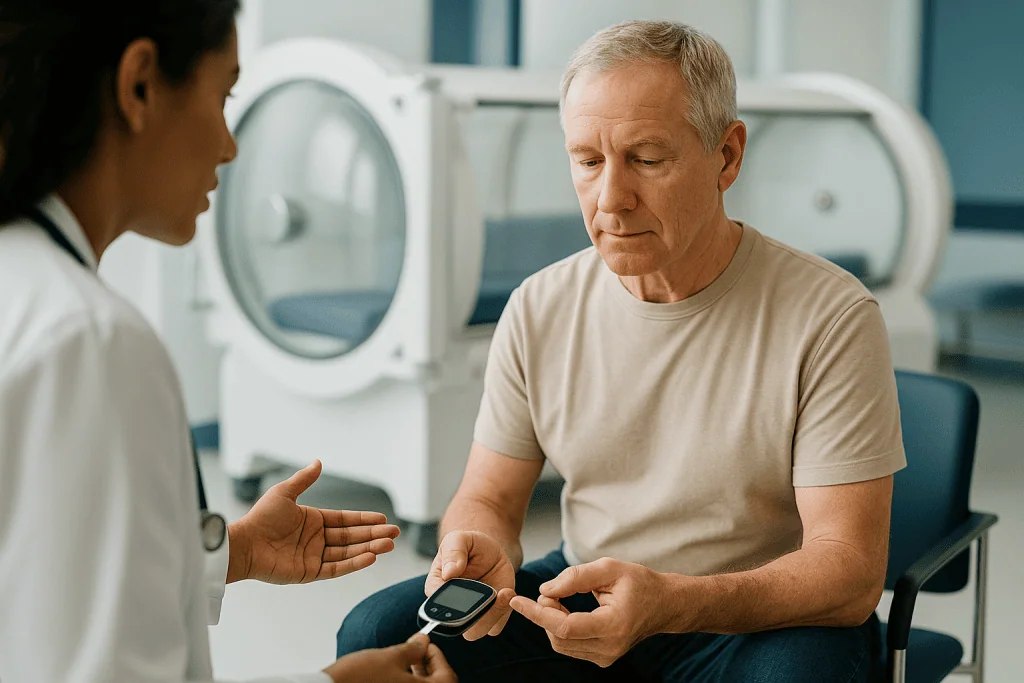
The candidates most often considered are those with a foot ulcer that is deep, has not responded to several weeks of standard care, and shows signs of reaching tendon or bone. Cleveland Clinic and Mayo Clinic both list diabetic wounds among the conditions for which hyperbaric therapy is used. Before referral, the wound team usually confirms that blood supply to the foot is adequate, because oxygen under pressure cannot reach tissue that has no circulation to carry it. People with severe arterial blockage may be sent to a vascular specialist first.
Some patients are asked to wait or are advised against the chamber entirely. Mayo Clinic notes that an untreated collapsed lung is a reason not to proceed, since pressure changes could worsen it. Active ear or sinus infections, recent ear surgery, certain lung conditions, uncontrolled seizures and some chemotherapy drugs are also commonly reviewed before a decision. A high fever on the day of treatment usually means postponing.
Diabetes-specific pauses are mostly about the glucose check described earlier. A reading outside the program’s safe range delays that day’s session rather than canceling the course. Claustrophobia is handled case by case; many people manage well in a clear chamber with a window and a staff member in view.
The decision about whether the therapy is appropriate, and when to start, belongs to the treating wound-care physician together with the clinician managing the diabetes. This article describes the typical framework, not a verdict for any individual.
Does hyperbaric oxygen therapy help a diabetic foot ulcer heal? What the evidence shows
Here the magazine-friendly answer and the scientific answer part ways, and readers deserve the scientific one.
The most rigorous summary comes from a Cochrane systematic review of hyperbaric oxygen for chronic wounds, which pooled randomized trials in people with diabetic foot ulcers. The reviewers found that adding hyperbaric treatment to standard care increased the proportion of ulcers healed at six weeks compared with standard care alone. That short-term benefit is real and consistent across the included studies.
The longer-term picture is less clear. At one year, the same review found no significant difference in healing between the groups. For major amputation, the outcome patients care about most, the trials were too small and too varied for the reviewers to draw a confident conclusion. They graded the overall evidence as low quality, citing small study sizes and inconsistent methods.
What does that mean for someone with a wound today? Three things. First, hyperbaric oxygen is an adjunct, a word clinicians use for a treatment added alongside the main plan, never a replacement for it. Second, it appears to speed early healing in selected wounds, which can matter when infection is threatening deeper tissue. Third, no one can promise a particular result, and a program that does so is overstating what the data support.
Mayo Clinic frames the therapy similarly: used for diabetic wounds that are not healing, as part of a broader approach. The Cochrane findings are the reason most guidelines recommend it selectively rather than for every ulcer, and why a wound team will often try the fundamentals for a period before suggesting the chamber.
What is the best treatment for a foot ulcer? Where the chamber fits in standard care
People search for the single best treatment, and the frustrating truth is that there is no single one. Diabetic foot ulcers heal when several things happen at once, and hyperbaric oxygen sits near the end of that list, not the beginning.
The foundation is offloading, which means taking weight and friction off the wound. A sore on the ball of the foot cannot close if it is pressed into a shoe with every step. Teams use special boots, casts or footwear to redistribute pressure. MedlinePlus emphasizes that protecting the foot from further injury is central to healing.
Next is debridement, the removal of dead or infected tissue so that healthy tissue can grow. This is done by a clinician, often at each visit, and is one of the clearest predictors of progress.
Infection control follows. A wound that has reached bone needs imaging and, frequently, antibiotics chosen by the treating team. Cleaning and dressing choices support a moist, protected environment.
Circulation is assessed early. If arteries in the leg are narrowed, no amount of oxygen in the chamber will reach the toe, and a vascular procedure may be needed before anything else can work.
Finally, glucose management. Persistently high blood sugar impairs white blood cells and new vessel growth. The clinician managing the diabetes is part of the wound team whether or not they ever see the chamber.
Hyperbaric oxygen is layered on top of all of this for wounds that are still not responding. Think of it as reinforcement for a plan that is already in place, not a shortcut around it. That ordering is what the evidence supports, and it is also why the chamber is rarely the first thing a newly diagnosed patient is offered.
How many HBOT sessions for wound healing, and how long is each one?
Readers often ask how many hours a day oxygen therapy takes. For hyperbaric treatment the answer is typically one session per day, and Mayo Clinic describes each as lasting about two hours including the time to pressurize and depressurize. The actual period at full pressure is somewhat shorter, broken up by brief intervals of breathing ordinary air to reduce the risk of oxygen toxicity, a condition in which very high oxygen exposure irritates the lungs or nervous system.
The number of sessions depends on the condition being treated. Cleveland Clinic notes that some problems respond after a few treatments while chronic wounds commonly require a course spread across several weeks. Mayo Clinic gives a range that, for non-healing wounds, often runs into dozens of sessions. Programs usually schedule them on consecutive weekdays, which means a patient may spend six to eight weeks attending daily.
That commitment is one reason the therapy is reserved for selected wounds. Daily attendance affects work, transport and caregivers. It also multiplies the number of glucose checks, since each session carries its own pre and post reading.
Progress is reviewed as the course goes on. Most wound programs photograph and measure the ulcer at regular intervals, and the team may stop early if the wound closes or, conversely, if there is no change after a defined block of treatments. The Cochrane review’s finding of benefit at six weeks aligns loosely with how long many courses run, though no trial has pinned down an ideal number.
What patients should take from this is that the schedule is a typical range tied to how wound programs operate, not a fixed prescription. The treating physician sets the number, adjusts it to the wound’s response, and can extend or shorten it without that meaning anything has gone wrong.
A typical session day for someone with diabetes
The rhythm of a treatment day becomes routine quickly, but the first few can feel like a lot of steps. The table below summarizes what commonly happens and why, drawn from how hyperbaric programs described by Mayo Clinic and Cleveland Clinic are organized. Specifics vary by center.
| Stage | What usually happens | Why it matters with diabetes |
|---|---|---|
| Arrival | Brief questions about meals, symptoms, fever, ear comfort | Skipped meals are the commonest cause of a low reading later |
| Pre-session check | Fingerstick glucose, vital signs, foot and dressing inspection | Confirms the reading is within the program’s safe range before the door closes |
| Preparation | Change into cotton gown; remove lighters, electronics, petroleum-based products | Fire safety in an oxygen-rich space applies to everyone |
| Pressurization | Gradual increase over several minutes; ear equalizing coached | Patients with nerve damage may be less aware of ear pressure; staff watch closely |
| Treatment | Roughly two hours total, with short air breaks | Staff observe for sweating, restlessness or confusion that could signal a drop |
| Post-session check | Repeat glucose, ear and chest comfort, dressing check | Builds the personal pattern used to plan future sessions |
| Departure | Snack if needed; next appointment confirmed | Ensures the reading is stable before driving or walking out |
Two details are worth emphasizing. Eating a normal meal before attending is the single most useful thing a patient can do to keep the day smooth; the program will advise on timing. And the dressing inspection matters because a foot that cannot feel pain may have changed overnight without the patient knowing. The session is as much a daily wound check as it is a dose of oxygen.
What is the downside? Hyperbaric oxygen therapy side effects and risks
Hyperbaric oxygen therapy side effects are mostly mild and related to pressure, but a few are serious enough that every program screens for them.
The most common complaint is ear discomfort. Mayo Clinic lists middle ear injury, including fluid or a ruptured eardrum, among the risks when pressure is not equalized. Sinus pain follows the same logic. Staff coach swallowing techniques, and people who cannot clear their ears may be referred for a small procedure to vent the eardrum before continuing.
Temporary changes in vision come next. Cleveland Clinic notes that nearsightedness can worsen during a course and typically improves after treatment ends. Patients are usually told not to change a glasses prescription until some weeks after finishing.
Lower blood sugar, the subject of this article, is listed by Cleveland Clinic as a recognized effect and is managed through the checks already described.
Rarer but more serious risks include lung collapse from trapped air, seizures from oxygen toxicity, and fire. Mayo Clinic flags all three. Seizures are uncommon and are the reason sessions include air breaks; fire risk is why lighters, battery devices and certain skin products are banned inside.
Fatigue after a session is common and usually passes within a few hours. Some patients describe feeling lightheaded during depressurization.
What should a person with diabetes weigh against this? The inconvenience of daily attendance over several weeks, the physical demands of transport with an ulcerated foot, and the uncertainty in long-term evidence. None of these is a reason to refuse the therapy, but they are the honest counterweight to its benefits, and a good wound team will discuss them openly rather than minimize them.
Insulin, diabetes medicines and the chamber: what changes and what does not
Readers on insulin or glucose-lowering tablets reasonably want to know whether their medicine schedule changes during a course of hyperbaric treatment. The answer is that any adjustment is made by the prescribing clinician, never by the wound program on its own and never by the patient. What this section can explain is the mechanism behind the conversation.
Insulin lowers blood glucose by moving sugar from the bloodstream into cells. Some oral medicines stimulate the pancreas to release more insulin; others improve how cells respond to it or reduce how much glucose the liver produces. If the chamber independently improves insulin sensitivity, as the earlier section described, a patient on an insulin-releasing medicine may experience additive lowering during a session.
That is why wound programs typically send glucose records to the diabetes clinician after the first week. A consistent pattern of post-session drops gives that clinician the information to decide whether anything about timing or regimen should change for the duration of the course. Equally, the pattern may show no meaningful shift, in which case nothing changes.
Meal timing is the lever most patients control. Eating a normal breakfast before a morning session, rather than fasting, raises the starting point and reduces the chance of a low two hours later. Programs commonly ask patients to bring a quick-acting carbohydrate snack and glucose tablets in their bag for after the session.
Continuous glucose monitors deserve a note. Many devices contain batteries and cannot go into the chamber because of fire risk, so some patients remove a sensor before each session. Others use devices the program has approved. Ask the team in advance so that monitoring is not interrupted unexpectedly.
The thread running through all of this is coordination. The chamber adds a variable; the people who manage your diabetes need to know about it.
What the following days and weeks usually look like
The first week is mostly adaptation. Ears learn the pressure rhythm, the schedule settles, and the glucose pattern emerges. Mild tiredness after sessions is common and tends to lessen as the body adjusts. The wound itself rarely changes visibly in the first few treatments; healing is cumulative rather than immediate.
By the second and third weeks, many wound programs begin to see measurable change in responsive ulcers: a smaller surface area, pinker tissue at the base, less drainage. This aligns with the six-week healing window in which the Cochrane review found benefit. Dressings may be changed less often, and the offloading boot continues throughout.
Vision changes, if they occur, usually appear in this middle stretch. Cleveland Clinic describes the nearsightedness as temporary, and patients are advised to wait before updating glasses.
Toward the end of a course the team reassesses. Some wounds close before the planned number of sessions and treatment stops. Others improve but remain open, and the physician may extend the course or decide that further sessions are unlikely to add benefit. Either decision is clinical, based on measurement, not on how the patient feels about the chamber.
After the last session, glucose checks return to whatever routine the diabetes clinician set, though it is worth noting that a pattern of lower readings may take a few days to fade. Foot care does not end. MedlinePlus is explicit that daily foot inspection, proper footwear and regular clinical checks remain the backbone of preventing a new ulcer, and the Cochrane review’s finding of no significant difference at one year is a reminder that the chamber does not protect against recurrence.
Follow-up with the wound team usually continues on a tapering schedule until the skin has fully matured, which can take weeks after visible closure.
What people often get wrong about hyperbaric oxygen and diabetes
Myths cluster around this therapy because it looks futuristic and because wound healing is slow enough to invite wishful thinking. A few corrections, each grounded in what the evidence actually shows.
The chamber treats diabetes. It does not. The temporary glucose lowering is an effect to be managed, not a therapeutic goal, and no major guideline lists hyperbaric oxygen as a treatment for diabetes itself.
Hyperbaric oxygen replaces wound care. The opposite is true. The Cochrane review studied it only as an addition to standard care, and every trial kept offloading, debridement and infection control in place. Skipping the basics to rely on the chamber is the surest way to waste a course.
More sessions are always better. Oxygen toxicity is dose-related, which is why sessions include air breaks and why the physician sets a defined course. Extending treatment indefinitely has not been shown to improve outcomes and carries its own risks.
The glucose check means something is wrong. It means the program is doing its job. A low reading before a session simply delays that day; it is not a sign that the therapy is harming the patient.
Soft-sided home chambers do the same thing. Mayo Clinic describes clinical hyperbaric therapy as pressurized to two to three times normal with pure oxygen. Low-pressure devices sold for wellness purposes do not reach these conditions and have not been studied for diabetic ulcers. Using one is not a substitute for a supervised course.
Healing will be permanent. The one-year data show no significant difference, and ulcers recur when the causes, nerve damage and poor circulation, remain. The chamber buys time and tissue; it does not change the foot’s underlying vulnerability.
Questions to ask your care team before starting
A good conversation before the first session saves confusion later. These questions are phrased so that the answers will be specific to you rather than general.
- Has blood flow to my foot been assessed, and is it adequate for oxygen to reach the wound?
- What standard wound care will continue alongside the sessions, and who is responsible for each part?
- How many sessions are you planning, and what would make you stop early or extend the course?
- What is the program’s threshold for a safe pre-session glucose reading, and what happens if mine is outside it?
- Will my glucose results be shared with the clinician who manages my diabetes, and how often?
- Should I eat before each session, and when?
- Can I wear my continuous glucose monitor or insulin pump inside the chamber, and if not, how will monitoring be handled?
- Which of my current medicines or conditions have you reviewed for chamber safety?
- How will you measure whether the wound is responding, and how often will you tell me?
- What should I do if my ears will not clear?
- Who do I call between sessions if the foot looks different or I feel unwell?
Bring a written list of your medicines, including over-the-counter products and supplements, since some are reviewed for interaction with high oxygen exposure. Bring your most recent glucose log too; a week of readings gives the team a baseline before the chamber adds its own effect.
Finally, ask who will coordinate. Hyperbaric treatment for a diabetic wound involves at least two clinical teams, and patients do best when one named person is the point of contact.
When to call your doctor
Most courses of hyperbaric oxygen pass without incident, but a few signs should prompt a same-day call to the wound team or diabetes clinician, and some warrant emergency care.
Call urgently, or seek emergency help, for symptoms of a severe low blood sugar: confusion, difficulty speaking, unusual drowsiness, seizure or loss of consciousness. MedlinePlus describes shakiness, sweating, rapid heartbeat and hunger as earlier warning signs that should be treated promptly with fast-acting carbohydrate according to your existing plan, and reported to the team.
Seek emergency care for sudden chest pain or shortness of breath after a session, which could indicate air trapped in the lung, or for any seizure.
Contact the wound team the same day if the foot shows new redness spreading up the leg, increasing swelling, a foul smell, fresh drainage, a dark or black area of skin, or a fever and chills. Mayo Clinic and MedlinePlus both note that infection in a diabetic foot can advance quickly because pain signals are blunted, so changes that would be minor elsewhere deserve prompt attention here.
Call about ear or sinus pain that persists after a session, bleeding from the ear, or a sudden change in hearing. Report vision changes so they can be documented, even though they are usually temporary.
Let the diabetes clinician know about any pattern of readings outside your usual range, high or low, that lasts more than a day or two.
None of these signs means the therapy must stop. They mean the people managing your care need to know, and the decision about what happens next belongs to them.
Frequently asked questions
Can hyperbaric chamber therapy help people with diabetes?
It can support healing of selected diabetic foot ulcers, but it does not treat diabetes itself. Mayo Clinic and Cleveland Clinic list non-healing diabetic wounds among the conditions for which hyperbaric oxygen is used, always alongside standard wound care. Whether an individual is a suitable candidate depends on wound depth, blood supply to the foot, and other health conditions reviewed by the treating team.
What is the best treatment for a diabetic foot ulcer?
There is no single best treatment; healing depends on several measures working together. Offloading pressure from the wound, removing dead tissue, controlling infection, ensuring adequate circulation and managing blood glucose form the foundation described by MedlinePlus. Hyperbaric oxygen is considered for wounds that have not responded to those fundamentals, as an addition rather than a substitute.
How many hours a day is hyperbaric oxygen therapy?
Usually one session a day lasting about two hours, according to Mayo Clinic, including the time taken to pressurize and depressurize the chamber. The period at full pressure is somewhat shorter and includes brief air breaks to reduce the risk of oxygen toxicity. Sessions are typically scheduled on consecutive weekdays over several weeks.
How many HBOT sessions for wound healing are typical?
Chronic wounds commonly require a course spread across several weeks, with Mayo Clinic noting that non-healing wounds may need dozens of sessions. The exact number is set by the treating physician and adjusted according to how the wound responds. Programs measure the ulcer regularly and may stop early if it closes or if there is no change after a defined block.
What is the downside of hyperbaric oxygen therapy?
The most common problems are ear and sinus discomfort from pressure changes, temporary worsening of nearsightedness, fatigue and lowered blood sugar. Rare but serious risks listed by Mayo Clinic include lung collapse, seizures from oxygen toxicity and fire. For people with diabetes, the daily commitment over several weeks and uncertainty in long-term evidence are practical downsides worth discussing.
Why does blood sugar drop in a hyperbaric chamber?
High oxygen exposure appears to improve how cells respond to insulin, so glucose leaves the bloodstream faster than usual. Added metabolic demand during the session and skipped meals beforehand can deepen the effect. Cleveland Clinic lists lowered blood sugar as a recognized effect, which is why programs check readings on both sides of each treatment.
Should I eat before a hyperbaric session if I have diabetes?
Most programs ask patients with diabetes to eat a normal meal before attending rather than fasting, because a low starting point increases the chance of hypoglycemia during the session. Follow the specific instructions from your wound team and diabetes clinician, and bring a fast-acting carbohydrate snack for afterward. Any change to medicine timing is decided by your prescriber.
Does HBOT help diabetic wounds heal faster?
The evidence suggests a short-term benefit. A Cochrane systematic review found more ulcers healed at six weeks when hyperbaric oxygen was added to standard care, but no significant difference at one year and inconclusive data on amputation. The reviewers graded the evidence as low quality, so clinicians use the therapy selectively rather than for every wound.
Can I wear my insulin pump or glucose sensor in the chamber?
Often not, because battery-powered devices pose a fire risk in an oxygen-rich environment and may malfunction under pressure. Policies differ between programs, and some devices have been assessed for chamber use. Ask the team before your first session so that monitoring and insulin delivery can be arranged safely, and discuss any temporary change with your diabetes clinician.
What happens if my blood sugar is too low or too high before a session?
The session is usually delayed rather than canceled. A low reading is typically addressed by eating and rechecking; a very high reading may prompt the team to look for a cause, such as infection, before proceeding. Each program sets its own thresholds, and the pattern of readings is shared with the clinician who manages your diabetes.
References
- Cleveland Clinic: Hyperbaric Oxygen Therapy
- MedlinePlus: Hyperbaric oxygen therapy
- MedlinePlus: Diabetic Foot
- MedlinePlus: Hypoglycemia
This article is for general information only and is not a substitute for professional medical advice. Please consult a qualified doctor about your individual situation.

More from the Blog

Preparing for Hyperbaric Oxygen Therapy: Ear Checks, Blood Sugar and What Stays Outside
To prepare for hyperbaric oxygen therapy, expect a pre-treatment assessment that includes an ear exam, a review of your medicines and lung history, and,…

Why Hyperbaric Oxygen Therapy Is Given as a Course: How Sessions Are Planned and Reviewed
How many HBOT sessions are needed depends on the condition being treated, not on a fixed package. Emergencies such as carbon monoxide poisoning may…

Inside a Hyperbaric Oxygen Therapy Session: Pressurization, Ear Equalizing and Chamber Time
During hyperbaric oxygen therapy you lie or sit in a sealed chamber while the air pressure is raised to roughly two to three times…

How to Use Crutches Properly: Stairs, Sitting and Not Falling
To use crutches safely, set the tops two finger-widths below your armpits and carry your weight through your hands, never your armpits. Move both…

Scar Tissue Massage: When It Helps, How It Is Done, and When to Leave Scars Alone
Scar tissue massage can help soften, flatten, and desensitize a healing scar once the wound has fully closed and a clinician has cleared you,…

Who Is Referred for Clinical Nutrition Therapy? Diabetes, Kidney Disease and Surgery Recovery
Medical nutrition therapy is usually recommended for people whose eating pattern directly affects a diagnosed condition: most often type 1 or type 2 diabetes,…