

Oral Minoxidil: Why Dermatologists Now Prescribe the Blood-Pressure Pill for Hair
Key Takeaways
- Oral minoxidil was approved in 1979 for severe high blood pressure, and every prescription for hair loss remains off-label in the United States, the United Kingdom and the European Union.
- A 2024 randomized trial in 90 men found no statistically significant difference in hair-count gains between the tablet and topical minoxidil after 24 weeks.
- In a multicenter review of 1,404 patients, unwanted facial or body hair affected about 15 percent, while fluid retention and fast heartbeat each affected under 2 percent.
- Minoxidil is a prodrug activated by a scalp enzyme that varies between people; the tablet is activated mainly in the liver, which may explain why some topical non-responders improve on it.
- Weight gain on oral minoxidil is retained salt and water triggered by the body's response to lower blood pressure, and rapid gain is a label-listed reason to call the prescriber.
- Loniten carries a boxed warning for fluid around the heart and worsening angina, so a baseline blood pressure, pulse and heart history belong before the first tablet, not after.
Oral minoxidil is a prescription tablet approved to treat severe high blood pressure that dermatologists increasingly prescribe off-label, in amounts far below the blood-pressure range, for pattern hair loss. Small randomized trials and large observational studies suggest it works about as well as topical minoxidil and is easier to use consistently. Side effects include unwanted body hair, dizziness, fluid retention and a faster heartbeat, so it requires medical supervision.
For years the ritual was the same: twice a day, part the hair, squeeze the dropper, wait for the scalp to dry, try not to touch the pillow. Then, in August 2022, a widely shared newspaper story revealed that many dermatologists had quietly stopped pushing the foam and started writing prescriptions for oral minoxidil, a tablet first approved in 1979 for dangerously high blood pressure.
The story traveled fast. A randomized trial published in JAMA Dermatology in 2024 then gave the trend a scientific spine by comparing the pill head-to-head with the topical, and short videos promising “a pill that fixes thinning hair” have kept the topic on the first page of search ever since. As of mid-2025, oral minoxidil sits among the most searched hair-loss treatments in the United States.
What the videos skip is the part a clinician cannot: this is an off-label use of a blood-pressure medicine, with real cardiovascular effects, a firm list of people who should avoid it and a side-effect profile worth understanding before the first appointment, not after.
What changed recently: why is oral minoxidil trending now?
Minoxidil has lived three lives. The first began in the late 1960s as a powerful pill for severe high blood pressure; the US Food and Drug Administration approved it in 1979 under the brand name Loniten. The second life started almost at once, when patients on the tablets began sprouting hair on their foreheads, arms and cheeks. Researchers rubbed the drug onto balding scalps, and by 1988 a topical solution (Rogaine) was approved for men, followed by a women’s version in 1991 and over-the-counter sales in 1996.
The third life is the one filling search results today. From roughly 2015, dermatologists in Australia and Spain began publishing case series showing that very small amounts of the tablet, far below the blood-pressure range, thickened hair in women and men who could not tolerate the topical. In 2021 a multicenter study pooled records from 1,404 patients and reported that the most common problem was unwanted facial or body hair, while serious cardiovascular events were rare. That paper gave prescribers a safety benchmark they had lacked.
Public interest jumped in August 2022 after a national newspaper described the practice, and it rose again in 2024 when a randomized clinical trial in JAMA Dermatology compared oral and topical minoxidil directly in 90 men with pattern baldness. The trial found no statistically significant difference in hair-count gains at 24 weeks.
One thing has not changed. As the MedlinePlus drug entry still states, the tablets are approved to treat high blood pressure. No regulator in the United States, the United Kingdom or the European Union has approved oral minoxidil for hair loss, which is why every prescription for that purpose remains off-label, a term unpacked in a later section.
Can minoxidil pills be used to treat hair loss?
Yes, under a prescription, and the practice is now common enough that many dermatology clinics consider it a routine option rather than an experiment. The condition with the most evidence is androgenetic alopecia, the inherited pattern thinning that shows up as a receding hairline and crown in men and as a widening part in women. Clinicians also use the tablets as an add-on in telogen effluvium (diffuse shedding after illness, surgery or stress), in some forms of alopecia areata (patchy autoimmune hair loss) alongside immune-directed treatment, and to support regrowth after chemotherapy.

Who tends to be offered the pill? Usually someone for whom the topical has failed on practical grounds. The liquid contains propylene glycol, which irritates many scalps and leaves hair greasy; the foam is gentler but still has to reach skin through a full head of hair twice daily. Surveys repeatedly show that a large share of people stop topical minoxidil within a year, not because it stops working but because the routine is tedious. A tablet swallowed with breakfast removes that barrier entirely.
Mainstream guidance has not yet caught up with the clinics. The NHS hair-loss page and the Mayo Clinic treatment overview both list topical minoxidil, and for men finasteride, as the established medicines for pattern hair loss. The tablet is absent from those pages not because it has been judged ineffective but because the formal evidence base is younger and smaller.
So the honest answer has two halves. Minoxidil pills can treat hair loss, and for many people they do so conveniently. Whether they are right for a particular scalp, heart and medical history is a decision only the prescribing clinician can make after an examination.
How does oral minoxidil work on hair follicles?
Minoxidil is a vasodilator, a drug that widens blood vessels, and it does so by opening potassium channels in the smooth muscle of small arteries. That is why it lowers blood pressure. The hair effect is more surprising, and still not fully explained.
Each follicle cycles through a growth phase (anagen, lasting two to six years), a brief regression phase and a resting phase (telogen) before the hair sheds. In pattern hair loss, hormones gradually shorten anagen and shrink follicles, a process called miniaturization, until they produce only fine, colorless fuzz. Laboratory and biopsy studies show minoxidil lengthens anagen, pushes resting follicles back into growth earlier, and enlarges miniaturized follicles so they produce thicker shafts. Improved blood flow, growth-factor signaling and the same potassium-channel effect have all been proposed as the mechanism.
Here is the detail that matters for the oral-versus-topical debate. Minoxidil is a prodrug, meaning it is inactive until the body converts it. The conversion depends on an enzyme called sulfotransferase. When you apply the liquid, that conversion has to happen in the scalp itself, and scalp enzyme activity varies widely from person to person. Studies suggest only a portion of users have enough enzyme to activate the topical fully, which helps explain why some people see dramatic results and others see nothing.
Swallowed minoxidil is activated largely in the liver and then reaches follicles through the bloodstream, bypassing the scalp enzyme lottery. That is the leading theory for why some topical non-responders improve on the tablet. It is a plausible, mechanistically supported idea, but it comes from small laboratory studies rather than large trials, so it should be read as a strong hypothesis rather than a settled fact.
Why is oral minoxidil off-label, and what does that mean for you?
“Off-label” means a licensed clinician is prescribing an approved medicine for a purpose, population or amount that the regulator has not formally reviewed. It is legal, extremely common, and in some specialties it is the norm; a large fraction of pediatric and dermatology prescriptions fall into this category. What it does not mean is that the use has been checked for safety and effectiveness by the FDA the way the blood-pressure indication was.

Why has nobody sought approval for hair? Mostly economics and timing. Minoxidil’s patent expired decades ago, so no company has a commercial reason to fund the large, multi-year trials a new indication requires. The tablets on the market exist only in strengths designed for hypertension, which means prescribers must adapt a blood-pressure product to a cosmetic goal using their own judgment. That is exactly the kind of adaptation a layperson should never attempt alone.
Off-label status also shapes the conversation you should expect. A careful prescriber will explain that the evidence is promising but incomplete, go through heart and blood-pressure history, confirm you are not pregnant or planning pregnancy, and set out a monitoring plan. If that conversation does not happen, ask for it.
A word on compounded versions. Some clinics arrange capsules made by compounding pharmacies in strengths not sold commercially. Compounded medicines are legal when prescribed, but they are not FDA-approved products; their consistency and purity are not reviewed the way manufactured tablets are, and they are never appropriate for self-directed use. The same applies with more force to minoxidil tablets sold without prescription on the internet, whose contents cannot be verified. Any decision to use the medicine, and in what form, belongs with the clinician who has examined you.
What the evidence actually says about oral minoxidil for hair loss
Grading the research honestly means separating three tiers of evidence.
Randomized controlled trials, the strongest design, are few and small. The 2024 JAMA Dermatology trial enrolled 90 men with pattern hair loss and randomly assigned them to the tablet or the topical for 24 weeks. Both groups gained hair; the difference between them was not statistically significant on the crown, with a non-significant trend favoring the tablet at the front. A 2020 trial in 52 women reached a similar conclusion over the same period. These are single-center studies lasting six months, so they tell us about short-term equivalence with topical minoxidil, not about long-term safety or how the pill compares with finasteride or spironolactone.
Observational data form the bulk of the literature. The 2021 multicenter review of 1,404 patients, several retrospective series of several hundred people each, and systematic reviews published in 2022 and 2023 consistently report improvement in most users and a predictable side-effect pattern. Observational studies cannot prove cause and effect, and they tend to under-report mild problems, but their consistency across countries is reassuring.
Expert opinion fills the remaining gaps: how much to prescribe, how long to continue, how often to check blood pressure. None of that has been tested in trials.
The balanced verdict: moderate-quality evidence that oral minoxidil is roughly as effective as topical minoxidil over six months; low-to-moderate evidence on safety beyond a year or two; and no evidence that it reverses scarring forms of hair loss, where follicles are destroyed. Anyone promising guaranteed regrowth is quoting the videos, not the journals.
Low dose oral minoxidil vs topical minoxidil: side-by-side
The phrase “low dose oral minoxidil” appears throughout the dermatology literature to distinguish hair-loss prescribing from the much larger amounts used for hypertension. The table summarizes how the two forms differ on the points people actually weigh.
| Feature | Topical minoxidil (solution or foam) | Low dose oral minoxidil (tablet) |
|---|---|---|
| Regulatory status for hair loss | FDA-approved, available over the counter | Off-label; approved only for high blood pressure |
| How it is activated | By an enzyme in the scalp, which varies between people | Mainly in the liver, then delivered through the blood |
| Daily routine | Applied to dry scalp, usually twice daily | Swallowed as prescribed |
| Most common side effects | Scalp itching, flaking, greasy hair, early shedding | Unwanted facial or body hair, early shedding, lightheadedness, ankle swelling |
| Heart and blood-pressure effects | Minimal; small amount absorbed | Possible; requires screening and monitoring |
| Strength of efficacy evidence | Many large randomized trials over decades | Two small randomized trials plus large observational series |
| Use in pregnancy | Not recommended | Not recommended |
Two points stand out. First, the topical has a far deeper evidence base, which is why guidelines still name it first. Second, the tablet’s main advantage is not superior power but reliability: it reaches every follicle at a consistent level regardless of scalp enzymes, hairstyle or how tired you are at bedtime. For someone who has genuinely used the foam for a year without benefit, or who cannot tolerate it, that reliability is a real clinical argument. For someone who has never tried the topical, most dermatologists would still start there.
Oral minoxidil for women: why dermatologists reach for it
Much of the early research on the tablet came from clinics treating women, and that is no accident. Female pattern hair loss, which affects an estimated 40 percent of women by age 50, rarely produces a bald patch; instead the part widens and the ponytail thins, which makes applying liquid precisely to the affected area difficult. Many women also report that the solution flattens styled hair and drips onto the forehead, where it can trigger exactly the fine facial hair they most want to avoid.
The oral route sidesteps the application problem but not the facial-hair one. Hypertrichosis, the medical term for excess hair growing where it is not wanted, is the single most common side effect in women, showing up on the upper lip, temples, forearms and sideburn area in roughly one in six or seven users in the large series. It is reversible when the medicine is stopped and some women manage it with routine hair removal, but it should be discussed before the first prescription, not discovered in the mirror.
Pregnancy is the firm line. Minoxidil crosses the placenta, has caused abnormalities in animal studies, and passes into breast milk, so it is not prescribed to anyone who is pregnant, trying to conceive or breastfeeding. Reliable contraception is part of the conversation for women of childbearing age.
Women are also more likely to be offered the tablet in combination. Dermatologists frequently pair it with spironolactone, a medicine that blunts the hormonal signal driving pattern loss, because the two act on different parts of the problem. Both lower blood pressure, however, so combining them increases the chance of lightheadedness when standing. Whether that pairing makes sense is a judgment for the prescriber, informed by blood pressure, kidney function and the rest of the medical history.
What are the most common oral minoxidil side effects?
The clearest picture comes from the 2021 review of 1,404 patients treated in hair clinics across several countries. Its numbers are worth knowing because they are so different from the warnings printed on a blood-pressure label.
- Unwanted hair growth on the face or body: about 15 percent, by far the most frequent complaint.
- Lightheadedness, especially on standing: about 1.7 percent.
- Fluid retention, usually puffy ankles or feet: about 1.3 percent.
- Fast or pounding heartbeat: just under 1 percent.
- Headache, puffiness around the eyes and sleep disturbance: each well under 1 percent.
Only 1.7 percent of patients stopped the medicine because of side effects. Those figures are reassuring but come with the usual caveats of observational data: the clinics were experienced, patients were screened before starting, and mild symptoms often go unreported.
Two experiences deserve separate mention because they frighten people unnecessarily. The first is shedding. In the first two to eight weeks, many users lose more hair than usual as resting follicles are pushed into a new growth cycle and release the old shafts. It feels like the opposite of what you paid for, but it generally signals the medicine is active and settles within a few weeks. The second is the slow timeline: visible change takes three to six months, and the fullest effect closer to a year.
Rarer but more serious effects, including fluid around the heart and marked drops in blood pressure, are covered in the heart section below. The practical message is that the tablet’s common side effects are cosmetic and mild, its serious ones are uncommon but real, and the difference between the two is exactly why the prescribing clinician checks your heart history first.
Why does oral minoxidil cause weight gain?
Short answer: it is water, not fat. Understanding why explains a good deal about how this drug behaves in the body.
When minoxidil widens the arteries and pressure falls, the body reads the drop as a threat and fights back. The kidneys activate the renin-angiotensin-aldosterone system, a hormonal chain whose job is to hold on to sodium and water, and the nervous system releases adrenaline-type signals that speed the heart. The result is that fluid accumulates in the tissues, most noticeably in the ankles, feet and sometimes the face and fingers. On a bathroom scale that fluid shows up as weight, often a couple of pounds, occasionally more, and it can appear within days rather than the weeks a change in body fat would take.
At the amounts used for hypertension this effect is so strong that the Loniten label expects the medicine to be given together with a diuretic, a water tablet, to counteract it. At the far smaller amounts used for hair, the large series found fluid retention in only around 1 to 2 percent of patients, but it does still occur, and people who already retain fluid easily, eat a high-salt diet or take other medicines that cause swelling notice it more.
How to tell the difference at home: fluid weight arrives fast, rises through the day, leaves a dimple when you press a swollen shin for a few seconds, and often improves overnight. Fat gain does none of those things. Appetite is not a recognized effect of minoxidil.
Rapid weight gain is also one of the warning signs MedlinePlus lists as a reason to call the prescriber, because at the extreme it can signal fluid building up around the heart or lungs. Gaining several pounds in a few days, swelling that climbs above the ankle, or breathlessness when lying flat should prompt a same-day call rather than a smaller breakfast.
Does oral minoxidil affect your heart and blood pressure?
It does, by design. Any medicine that opens blood vessels will lower pressure and nudge the heart to beat faster to compensate. The question is how much that matters at the amounts dermatologists use, and the honest answer is: usually little, occasionally a lot, and nobody can tell which group you belong to without checking.
Start with the label, because it describes the drug at full strength. Loniten carries a boxed warning, the FDA’s strongest, for pericardial effusion, a build-up of fluid in the sac surrounding the heart that can progress to tamponade, where the fluid compresses the heart and stops it filling. The label also warns that minoxidil can worsen angina (chest pain from narrowed coronary arteries) and cause rapid heart rate, which is why the hypertension regimen routinely includes a beta-blocker to slow the pulse and a diuretic to shed fluid.
Now the hair-clinic data. In the 1,404-patient review, measurable drops in blood pressure were small on average, fast heart rate affected under 1 percent, and no cases of pericardial effusion were recorded. Since then a handful of case reports have described effusions in people taking low amounts for hair, typically those with other risk factors. These reports do not establish how often it happens, but they confirm it is not impossible.
Sensible monitoring follows from that uncertainty. Most prescribers record blood pressure and pulse before starting, repeat them at follow-up visits, ask about swelling and breathlessness, and request an electrocardiogram or cardiology opinion when there is any history of heart disease, rhythm problems or fainting. Home blood-pressure readings are a useful addition if your clinician asks for them.
Evidence grade: label warnings rest on decades of hypertension experience; the low-amount safety data are observational and short-term. Both deserve respect.
Who should not take oral minoxidil?
The exclusion list is short but non-negotiable, and it is the main reason a tablet for hair should never be borrowed, shared or bought online.
Pheochromocytoma, a rare adrenal gland tumor that releases surges of adrenaline, is an absolute contraindication listed on the label, because minoxidil can stimulate that release and provoke a dangerous blood-pressure crisis. Pregnancy, planned pregnancy and breastfeeding are likewise off the table, for the reasons described in the women’s section.
Beyond those, prescribers weigh relative risks. People with heart failure, a recent heart attack, angina, significant heart-rhythm disorders or a history of pericardial disease face a higher chance of the serious cardiac effects, and many dermatologists will decline to prescribe without a cardiologist’s agreement. Anyone whose resting blood pressure already runs low, who faints easily or who has had falls is more likely to be troubled by dizziness. Advanced kidney disease changes how the drug is cleared and how readily fluid accumulates, and dialysis patients need specialist input.
Interactions matter too. Taking the tablet alongside other blood-pressure medicines, water tablets, nitrates for angina, or erectile-dysfunction drugs that also widen vessels can compound the pressure drop. Alcohol has a similar additive effect in the first hours after a dose. None of these combinations is automatically forbidden, but each needs to be known to the prescriber.
Older adults deserve a specific mention. Age brings stiffer arteries, slower reflexes and more medicines, all of which raise the stakes of a sudden drop in pressure on standing. Hair loss in later life can still be treated, but the balance between a cosmetic benefit and a fall risk shifts, and that balance is a conversation to have openly with the clinician rather than a reason to stay silent about symptoms.
Do you take minoxidil with food, and what should the first months look like?
Food is the least complicated part. The MedlinePlus entry describes minoxidil as a tablet taken by mouth and does not tie it to meals; absorption is not meaningfully changed by eating. Some people prefer to take it with a meal to avoid a queasy stomach, and some prescribers suggest an evening dose so that any lightheadedness happens while you are sitting on the sofa rather than standing on a train platform. Follow the instruction on your own prescription, keep the timing consistent, and if you miss a dose do not take two to catch up.
Expect the calendar to run roughly like this. Weeks two to eight often bring the shedding described earlier, which is unnerving but expected. By month three, hair that was going to respond usually begins to look denser at the part or crown, often noticed first by a partner or hairdresser rather than by you. Months six to twelve are where photographs taken under the same light show the real difference. Dermatologists typically ask for standardized photos at baseline and at follow-up for exactly this reason: day-to-day inspection in the bathroom mirror is a poor judge.
Minoxidil manages pattern hair loss rather than ending it. Follicles respond while the drug is present and gradually return to their previous trajectory when it is withdrawn, so stopping usually leads to loss of the regained hair over three to six months. That is true of the topical as well; the tablet simply makes the long haul easier to sustain.
Stopping or changing the amount is a decision to make with the prescriber, not alone. Abruptly discontinuing has no dangerous rebound, but the clinician may want to review why it is being stopped and what, if anything, replaces it.
Common myths about oral minoxidil, corrected
Viral claims about this medicine tend to err in both directions, inflating the benefits and dismissing the risks. A few deserve a direct answer.
“It is just Rogaine in a pill, so it must be as safe.” The molecule is the same; the exposure is not. Topical minoxidil leaves only a small amount reaching the bloodstream, which is why it is sold without prescription. The tablet delivers the drug to every blood vessel in the body, which is why it carries a boxed cardiac warning and requires a prescriber.
“It regrows hair anywhere, permanently.” It thickens follicles that are miniaturized but alive. Where follicles have been destroyed by scarring conditions or long-standing complete baldness, there is nothing left to enlarge. And the effect lasts only while treatment continues.
“If the topical did nothing, the pill is the only option.” Non-response to the foam is one reason dermatologists consider the tablet, but finasteride for men, spironolactone for some women, and low-level light devices are also established or emerging options, and a clinician may recommend one of those first.
“The weight gain is fat.” It is retained salt and water, arrives in days and is a signal to call the prescriber if it is rapid or accompanied by swelling.
“You can split up leftover blood-pressure tablets yourself.” Adapting a hypertension product for hair is precisely the step that requires medical training, a heart check and a monitoring plan. Doing it alone is how people end up in emergency departments with fainting episodes or racing hearts.
“If hair falls out in the first month, it has failed.” Early shedding is the expected sign of follicles cycling into growth and typically settles within weeks.
When to see a doctor about oral minoxidil or hair loss
Two kinds of appointment matter here: the one before you ever take the tablet, and the urgent one if something goes wrong while you are on it.
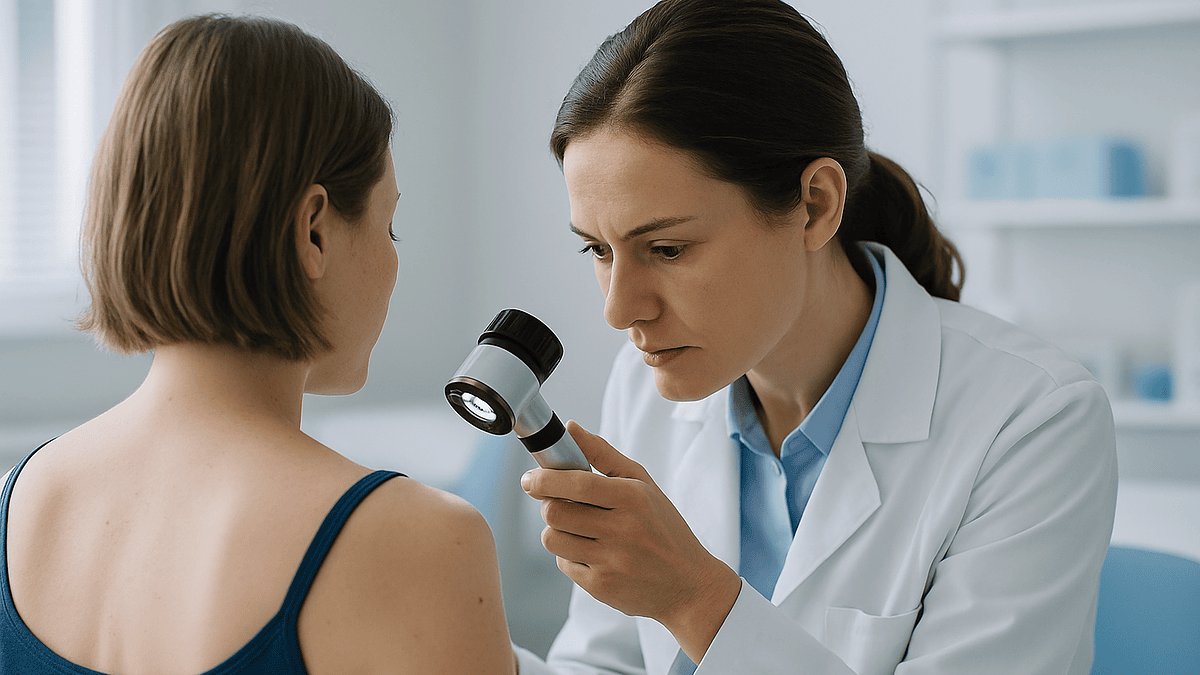
See a clinician first because not all thinning is pattern hair loss. Sudden shedding can follow illness, childbirth, crash dieting, iron deficiency or thyroid disease; round bald patches suggest alopecia areata; scalp redness, scaling or pain can point to scarring conditions that need entirely different treatment and that minoxidil will not help. Women with new facial hair, acne or irregular periods alongside thinning should be assessed for hormonal causes before any hair medicine is chosen. A dermatologist will usually examine the scalp with magnification, may order blood tests, and only then discuss whether the tablet, the topical or something else fits.
While taking oral minoxidil, seek same-day medical advice, or emergency care if severe, for any of the following:
- Chest pain, pressure or tightness, especially on exertion.
- Fainting, near-fainting or dizziness that does not pass on sitting down.
- A racing, pounding or irregular heartbeat.
- Shortness of breath, particularly when lying flat or waking you at night.
- Rapid weight gain over a few days, or swelling of the ankles, legs, face or abdomen.
- A new, persistent headache with visual changes.
- Any signs of an allergic reaction such as rash, facial swelling or difficulty breathing.
Less urgent but still worth a message to the prescriber: facial hair growth that troubles you, sleep disturbance, dizziness on standing, or shedding that continues beyond two months. Never stop, restart or adjust the medicine on your own; those decisions belong to the clinician who prescribed it, who can weigh the benefit to your hair against everything else in your medical picture.
Frequently asked questions
Can minoxidil pills be used to treat hair loss?
Yes, under prescription and off-label. Dermatologists use oral minoxidil mainly for pattern hair loss in men and women, and sometimes as an add-on in diffuse shedding or alopecia areata. Two small randomized trials and large observational series suggest it works about as well as the topical over six months. Because the tablet affects blood pressure and heart rate, it requires screening and monitoring by the prescribing clinician.
What are the potential side effects of taking Loniten (minoxidil tablets)?
At the amounts used for hair, the most common effect is unwanted facial or body hair, followed by early shedding, lightheadedness, ankle swelling and a faster heartbeat. At blood-pressure strength the Loniten label carries a boxed warning for fluid around the heart, worsening chest pain and marked fluid retention. Chest pain, fainting, breathlessness or rapid weight gain are reasons to contact a doctor the same day.
Why does oral minoxidil cause weight gain?
The gain is fluid, not fat. When minoxidil widens blood vessels and pressure falls, the kidneys respond by holding on to sodium and water, which pools in the ankles, feet and sometimes the face. It can appear within days. In hair-loss series it affects only about one to two percent of users, but rapid gain or spreading swelling should be reported to the prescriber promptly.
Do you take minoxidil with food?
Food makes little difference to how the tablet is absorbed, and the MedlinePlus entry does not tie it to meals. Some people take it with a meal to avoid stomach upset, and some prescribers suggest an evening dose so any dizziness occurs at rest. Follow the timing on your own prescription, keep it consistent, and never take an extra tablet to make up a missed one.
Is low dose oral minoxidil safe long term?
The evidence is reassuring but incomplete. Observational studies covering more than a thousand patients report few serious events and a discontinuation rate under two percent, yet most follow-up lasts a year or two and no large long-term randomized trial exists. Rare case reports of fluid around the heart have appeared. Ongoing monitoring of blood pressure, pulse and swelling is the accepted way to manage that uncertainty.
Is oral minoxidil for women different from use in men?
The medicine is the same, but the context differs. Women more often struggle to apply the topical to a widening part, so the tablet is appealing, yet they are also more troubled by facial hair growth, which affects roughly one in six or seven users. Pregnancy, planned pregnancy and breastfeeding rule it out entirely. Dermatologists sometimes combine it with spironolactone, which adds to the blood-pressure-lowering effect.
How long does oral minoxidil take to work?
Expect a slow start. Many people shed more hair between weeks two and eight as resting follicles cycle into growth. Early thickening is usually noticed around month three, and photographs taken under the same lighting show the clearest difference between six and twelve months. Results last only while treatment continues; stopping typically leads to gradual loss of the regained hair over three to six months.
What happens if you stop taking oral minoxidil?
There is no dangerous rebound, but the benefit fades. Follicles that thickened under treatment gradually return to their previous trajectory, and most people notice the regained density disappearing over three to six months. Any decision to stop, pause or switch to the topical should be discussed with the prescribing clinician, who can plan the transition and check that nothing else, such as a new medical problem, is driving the hair loss.
Can you take oral minoxidil with blood pressure medication?
Sometimes, but only with the prescriber’s knowledge, because the effects add together. Combining minoxidil with other blood-pressure tablets, water tablets, nitrates or erectile-dysfunction medicines can cause larger drops in pressure, dizziness and fainting. People already treated for hypertension or heart disease are often referred for a cardiology opinion first. Never start the tablet without telling the clinician every medicine you take, including supplements.
Is oral minoxidil better than topical minoxidil?
Not clearly. The available randomized trials found the two roughly equivalent for hair growth over six months. The tablet’s advantages are convenience and consistent delivery regardless of scalp enzyme activity; its disadvantages are body-wide side effects and off-label status. Topical minoxidil has decades of large trials behind it and remains the first choice in mainstream guidance. Which is right for you depends on your heart health, tolerance and history.
References
This article is for general information only and is not a substitute for professional medical advice. Please consult a qualified doctor about your individual situation.

More from the Blog

Scalp Psoriasis vs Dandruff: How to Tell Them Apart and Treat Each
Scalp psoriasis is an immune-driven condition that produces thick, sharply bordered, silvery plaques that often extend past the hairline, while dandruff is a mild,…
What Causes Hair Loss? The 10 Medical Reasons and How Doctors Tell Them Apart
Hair loss has about ten common medical causes: pattern (androgenetic) hair loss, telogen effluvium after stress or illness, autoimmune alopecia areata, thyroid disease, iron…

Dutasteride for Hair Loss: How It Differs From Finasteride and What Trials Show
Dutasteride is a prescription medicine approved in the United States for enlarged prostate, not for hair loss, though it is approved for male pattern…

Exosomes for Hair Loss: Promising, Unproven, and What That Means for You
Exosome therapy for hair loss is experimental. Early laboratory and animal studies suggest exosomes, microscopic particles that carry signals between cells, might stimulate hair…

Does Microneedling Help Hair Growth? A Careful Reading of the Trials
Small randomized trials suggest microneedling can improve regrowth in androgenetic (pattern) hair loss, mostly when combined with a proven topical hair-growth medication; evidence for…
Derma Rolling for Hair: What Needling Can Add, and Its Limits
Derma rolling can modestly support hair regrowth in pattern hair loss, mainly when paired with a clinician-recommended topical treatment; small randomized trials show greater…