

Orthodontic Warning Signs: Broken Wires, Loose Brackets and Pain That Is Not Normal
Key Takeaways
- Expected soreness after an adjustment affects several teeth, peaks within the first day or two and fades over a few days; pain concentrated in one tooth that worsens over time does not fit that pattern.
- A loose bracket is usually painless but means that tooth has stopped being treated, which is why it should be reported within days rather than left until a routine visit roughly 6 to 8 weeks away.
- Cover a protruding wire with orthodontic wax and call the practice; cutting it at home risks swallowing or inhaling fragments and can leave back teeth without guiding force.
- Bleeding gums during braces are caused by plaque rather than the appliance, and NIH guidance notes early gingivitis is reversible with thorough daily cleaning.
- Chalky white spots around brackets are early enamel demineralization that can often be arrested if reported early, before it becomes a cavity.
- Facial swelling, fever, difficulty swallowing or breathing, or a component that triggers coughing after being inhaled are emergency signs that need same-day medical care, not a message to the orthodontic office.
Orthodontic problems to report include a broken or protruding archwire, a bracket or band that has come loose, a cracked or lost aligner, swelling or bleeding gums that persist despite cleaning, and pain that is severe, one-sided, throbbing or lasts beyond the few days of expected soreness after an adjustment. Contact your orthodontic team promptly; facial swelling, fever or trouble swallowing need same-day medical care.
Maya noticed it at breakfast: a thin metal end poking the inside of her cheek every time she chewed. Her next appointment was five weeks away, the orthodontic office was closed for the weekend, and the internet offered two confident answers, one telling her to bend it back with a pencil and the other telling her nothing short of an emergency visit would do. Neither helped her decide what to actually do before Monday.
Braces and aligners are slow, deliberate instruments. They work over 18 months to 2 years in many cases, and across that stretch something will almost certainly bend, snap, rub or ache. Most of it is minor. Some of it is not. Knowing the orthodontic problems to report, and how urgently, is the single most useful skill a patient or parent can carry through treatment.
This explainer sorts the ordinary from the worrying, using the same thresholds orthodontic and dental guidance use, so the decision you make at the breakfast table is an informed one rather than a guess.
How braces and aligners actually move teeth, and why some soreness is expected
A tooth is not cemented into the jaw. It sits in a socket lined by a thin cushion of fibers called the periodontal ligament. When a brace or aligner presses gently and continuously on the crown, that ligament is squeezed on one side and stretched on the other. Bone cells respond: on the squeezed side, bone is slowly dissolved; on the stretched side, new bone is laid down. The tooth drifts a fraction of a millimeter at a time into its new position, and the socket rebuilds around it.
That remodeling is why mild aching is normal after a wire change or a new aligner tray. The ligament is inflamed on purpose. NHS guidance describes teeth feeling sore for a few days after braces are fitted or adjusted, with the discomfort easing as the tissues settle. The ache tends to be dull, spread across several teeth, and worst when biting into something firm.
A fixed brace has three main parts. Brackets are the small squares bonded to each tooth. The archwire is the thin wire running through them, and it carries most of the force. Ligatures are the tiny elastic or wire ties that hold the archwire into each bracket. Clear aligners replace all of that with a series of removable plastic trays, each one shaped slightly differently from the last so that the teeth are nudged along in stages.
Understanding this mechanism tells you something practical. Because force is applied to the whole arch, a problem usually feels like a problem: one tooth that throbs on its own, a bracket that spins freely, a wire that has lost its anchor at the back. Those are not part of the design. The design is quiet, continuous, and spread out. When something feels sharp, sudden or lopsided, the system has changed, and that is the signal worth reporting.
What are the most common orthodontic problems during treatment?
Ask any orthodontic team what fills their unscheduled appointment slots and the list is remarkably consistent. Wires that have slid sideways or snapped, brackets that have debonded after a hard bite, ligatures that have pinged off, cheeks and lips rubbed raw by a new appliance, and aligners that have cracked or gone missing. Alongside these mechanical issues sit the biological ones: gums that bleed when brushed, white chalky marks appearing around brackets, and occasionally a tooth that becomes tender in a way that does not match the rest of the mouth.

The table below groups the common problems by what they usually mean and how quickly they are typically addressed. Urgency categories follow the general approach used in dental and orthodontic guidance: most appliance breakages are not emergencies, but they should not be ignored for weeks either, because an unanchored wire or a dead bracket means that part of the arch has quietly stopped moving, or is moving in the wrong direction.
| Problem | What it usually means | Typical urgency |
|---|---|---|
| Wire poking cheek | Teeth have moved and the wire now extends past the last bracket | Call within days; cover it meanwhile |
| Loose or spinning bracket | Bond has failed; tooth is no longer being guided | Call within days |
| Snapped archwire | Force on part of the arch is lost or redirected | Call within days |
| Lost ligature | Wire may slip from one bracket | Mention at next visit unless wire moves |
| Cracked or lost aligner | Tray no longer fits or is unavailable | Call the same or next working day |
| Bleeding gums | Plaque-related gum inflammation (gingivitis) | Improve cleaning; report if it persists |
| Severe one-tooth pain, swelling, fever | Possible infection or injury, not routine soreness | Same-day care |
None of these entries require you to diagnose yourself. They are prompts for a conversation with the team managing your treatment.
Broken braces wire: what to do before your appointment
A wire end that scratches the cheek is the most frequent orthodontic complaint and, fortunately, one of the least serious. It usually happens for a good reason: the teeth have moved, the arch has shortened slightly, and the wire that fitted neatly weeks ago now extends past the last bracket. In other cases the wire has slipped sideways through the brackets, leaving one end long and the other short, or it has fractured outright after biting something hard.
The first task is comfort. Orthodontic relief wax, the small strips provided at the start of treatment, can be dried onto the sharp end to cover it. If none is at hand, a small piece of sugar-free gum pressed over the tip works in the same way. Rinsing with warm salt water can soothe a cheek that has already been grazed. These are temporary measures, not fixes.
The second task is deciding how far to intervene. Dental first-aid guidance consistently warns against cutting a wire at home. Clipped fragments are easy to swallow or inhale, and a shortened wire may leave teeth at the back without any guiding force at all. Gently pushing a slipped wire back toward the center using a clean cotton swab is low risk; attempting to bend a wire with household tools is not, because it can distort the force across the whole arch.
The third task is to report it, ideally by phone or the practice’s messaging system, with a description of which side, how long the exposed end is, and whether a bracket or ligature came off at the same time. Most practices will book a short visit to trim or replace the wire. A wire that is merely annoying can wait a few days with wax in place. A wire that has embedded itself in the cheek and cannot be freed, or one attached to a fractured appliance after a blow to the face, belongs in the urgent category described later.
Loose bracket on braces: why it matters more than it feels
A loose bracket often announces itself quietly. It may slide along the wire when touched with the tongue, spin in place, or sit slightly rotated compared with its neighbors. It rarely hurts, which is exactly why patients are tempted to leave it until the next scheduled visit. The problem is that a bracket is the only point of contact between the wire and that tooth. Once the bond fails, the tooth is no longer being moved. If the brace is also using elastics or springs attached to that bracket, the forces intended for one tooth may now be shifting several others in an unplanned way.
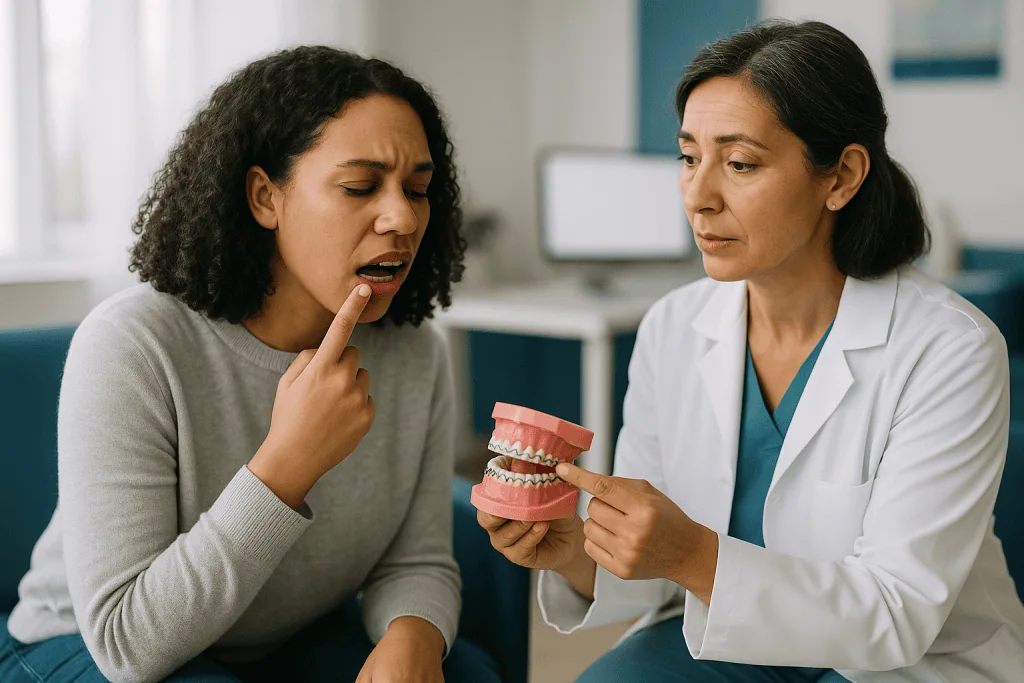
Brackets debond for predictable reasons. Biting into hard or sticky foods is the classic culprit, which is why orthodontic teams give the same dietary advice at every fitting. Brackets placed on teeth with weaker enamel or on partly erupted back teeth can fail more readily. Occasionally the bracket at the very end of a wire takes an unusual load and lifts off.
What to do is straightforward. If the bracket is still threaded on the wire, leave it there; wax can hold it against the tooth and stop it rubbing. If it has come off entirely, keep it in a small bag and bring it to the appointment. Do not try to glue it back; dental adhesives are specialized materials applied to carefully prepared enamel, and household glue can damage both the tooth and the surrounding gum.
Report it within a few days rather than weeks. NHS guidance places routine adjustment visits around every 6 to 8 weeks, which is a long time for one tooth to drift unsupervised. A single detached bracket is not an emergency, but it is one of the clearest orthodontic problems to report promptly because the cost of delay is paid in extra treatment time, not in pain.
Braces pain not normal: telling routine soreness from a warning sign
Expected orthodontic discomfort has a recognizable shape. It begins within hours of a wire change or a new aligner, peaks over the first day or two, and fades over a few days as the periodontal ligament settles, a pattern described in NHS and MedlinePlus patient guidance. It affects a group of teeth rather than one. It feels like pressure or a dull ache, and it is worse when chewing firm food. Lips and cheeks may also feel tender while the skin inside the mouth toughens up in the first couple of weeks after fitting.
Pain that does not fit this shape deserves attention. Several features shift it from ordinary to reportable:
- It is concentrated in a single tooth and that tooth feels different from its neighbors, especially when tapped.
- It is throbbing, keeps you awake, or wakes you.
- It appears days or weeks after an adjustment rather than straight after one.
- It is accompanied by swelling of the gum, cheek or face, a bad taste, or a tooth that looks darker than the others.
- It is sharp and triggered by cold, lasting well after the cold stimulus is removed.
These patterns can point toward conditions that have nothing to do with the brace itself, such as decay beneath a band, a cracked tooth, or an infection of the tooth pulp. Mayo Clinic guidance on tooth abscess lists persistent throbbing pain, sensitivity to temperature and pressure, facial swelling and fever among the features that warrant prompt dental assessment, and swelling with fever or difficulty breathing or swallowing as reasons to seek emergency care.
A separate category is jaw pain. Some muscle tiredness is common as the bite changes, but clicking, locking or pain in front of the ear that limits opening should be mentioned to the orthodontic team, who may adjust the plan or involve a dental colleague. Over-the-counter pain relief may be suggested for ordinary soreness; which product, if any, and how to use it is a question for your orthodontist or pharmacist, not something to settle by searching online.
Clear aligner problems to report: cracks, lost trays and teeth that stop tracking
Removable aligners trade the wire-and-bracket emergencies for a different set. The most common is simply losing a tray. Aligners wrapped in a napkin at a restaurant table account for a surprising share of calls to orthodontic offices. The second is a crack, usually at the edge of a tray or around one of the small tooth-colored attachments bonded to the teeth to give the plastic something to grip. The third is subtler: the tray stops fitting. There is a visible gap between the plastic and the biting edge of one or more teeth, meaning those teeth are no longer following the planned movement. Clinicians call this a loss of tracking.
Each of these should be reported, and the right response varies. A lost tray may mean moving back to the previous aligner, or forward to the next, depending on where you are in that stage; this is a decision for the orthodontist, because jumping ahead too early can leave teeth lagging the plan. A hairline crack that does not affect fit is often tolerated until the next tray. A tray split in two is not usable. Teeth that have stopped tracking may need more time in the current aligner, a technique the team will explain, or a new scan and revised set of trays.
Attachments that fall off are the aligner equivalent of a loose bracket. The tray may still fit, but that tooth has lost the handle the plan relied on. Keep the tray, note which tooth, and call.
Two further aligner problems are worth mentioning. Persistent soreness or ulceration where a tray edge meets the gum suggests the edge needs smoothing, something the team can do quickly. And a tray that sits in the mouth for far fewer hours than instructed is, in effect, a treatment that has paused. Being honest about wear time at check-ups is more useful than apologizing for it, because the plan can be adjusted around reality.
Gum swelling, white spots and bad breath: the hygiene problems to report
Fixed appliances are plaque traps. Food collects around brackets and under wires, and the bacterial film that forms there irritates the gum margin within days if it is not removed. The earliest sign is gum that bleeds when brushed or looks puffy and shiny along the edge. This is gingivitis, the mild and reversible form of gum disease. NIH guidance notes that gingivitis can be reversed with thorough daily brushing and flossing, and that left unaddressed it can progress to periodontitis, where the supporting bone is affected.
Two features make gum problems during orthodontics worth reporting rather than quietly tolerating. First, inflamed gum tissue can swell over the brackets, making cleaning harder and setting up a cycle. Second, moving teeth through inflamed tissue is less predictable, and in advanced gum disease the orthodontist may need to pause treatment entirely. Bleeding that persists after two weeks of careful cleaning with the brushes and floss threaders you were shown, or gum that is swelling rather than settling, is a conversation to have with the team.
White spots are the second hygiene signal. A chalky, matte patch on the enamel around a bracket is early demineralization: acid produced by plaque bacteria has begun to dissolve minerals from the enamel surface. At this stage the damage can often be arrested with better cleaning and fluoride, which is why spotting it early matters. Left alone it can become a cavity. These marks are more visible on photos than in the mirror, so ask the team to show you at appointments.
Bad breath that does not clear with brushing, a persistently unpleasant taste, or pus at the gum line all point to an area that is not being cleaned or that has become infected, and belong on the same list of orthodontic problems to report. None of these are reasons for embarrassment. Cleaning around a fixed brace is genuinely difficult, and teams expect to coach patients through it more than once.
Who orthodontic treatment is usually for, and who is usually asked to wait
Orthodontic treatment addresses malocclusion, the general term for teeth and jaws that do not meet as they should. MedlinePlus describes the spectrum: crowding, spacing, teeth that stick out, bites where the upper teeth sit too far forward or the lower teeth sit ahead of the upper, open bites where front teeth do not meet, and crossbites where the arches are misaligned side to side. Treatment is considered when the misalignment affects function, such as chewing or speech, makes cleaning difficult, puts teeth at risk of wear or injury, or causes significant concern about appearance.
Children are commonly assessed once the adult front teeth and first molars have come through, with many starting treatment in early adolescence, when most adult teeth are present and jaw growth can still be guided. Adults can be treated at any age if the teeth and gums are healthy; the biology of tooth movement does not switch off, although it tends to be slower and jaw growth can no longer be used.
Some people are asked to wait, and the reasons are protective rather than dismissive. Active decay must be treated first, because bonding brackets over untreated cavities is unsafe. Active gum disease must be stabilized, since moving teeth in inflamed bone risks further bone loss. Children whose adult teeth are not yet far enough along may be reviewed again later rather than treated twice. People with certain medical conditions or on medicines that affect bone turnover may need discussion between the orthodontist and their physician before starting.
For children and teenagers, the problems to report are the same as for adults, with two additions. A growing child who complains of a very loose brace or one that no longer feels like it fits may have had a tooth shed under a band or bracket. And a child who repeatedly removes a removable appliance, or has lost it, is effectively not in treatment, which the team needs to know so the plan can be rethought rather than drift.
What the first days and weeks after a fitting or adjustment usually look like
The pattern after a new fixed brace is well described in patient guidance from the NHS and MedlinePlus, and it helps to know it in advance. The first few hours are mostly odd rather than painful: the appliance feels enormous, speech is slightly altered, and the tongue keeps exploring. Soreness in the teeth builds over the first day as the ligaments respond to force, peaks somewhere in the first two days, and fades over the next few. Soft foods are easier during this window. Cheeks and lips often develop small sore patches where they meet brackets, and these usually toughen within a week or two; wax over the offending bracket helps meanwhile.
After routine adjustments, the same cycle repeats in a milder form. Teeth ache for a few days, then settle. Each new aligner tray behaves similarly, which is why many people are advised to switch trays at night so the tightest hours pass during sleep.
Across the weeks between visits, expect a few predictable events. Ligatures sometimes fade or come off. The wire gradually extends past the back bracket as teeth align. Teeth may feel slightly mobile when pressed with a finger; a small degree of looseness is a normal part of moving teeth through bone, as the ligament widens to allow movement. Noticeable mobility of one tooth, or a tooth that visibly tips, is not.
What should not happen is pain that intensifies rather than fades after the first few days, a sore patch that becomes an enlarging ulcer, or any swelling. NHS guidance frames the adjustment interval at roughly 6 to 8 weeks and overall treatment at around 18 months to 2 years, though both depend on the individual plan. Those figures are a map, not a schedule, and the treating team will tell you where you are on it. Writing down anything that felt wrong between visits, with dates relative to your last appointment, makes the next check-up far more productive.
What people often get wrong about orthodontic problems
Several durable myths circulate about braces, and each can lead to a wrong decision at the wrong moment.
“If it does not hurt, it is not a problem.” A loose bracket or a snapped back section of wire is often painless, yet it means part of the arch has stopped being treated. The absence of pain is not reassurance here; the loss of function is the issue.
“Pain means the brace is working harder.” Research into tooth movement does not support the idea that more pain equals faster progress. Modern wires are designed to deliver light, continuous force, and the aim is to move teeth within the range where bone remodels healthily. Severe pain is a reason to call, not a badge of effort.
“A protruding wire can be cut with nail clippers.” Dental guidance discourages this because cut fragments can be swallowed or inhaled and because a shortened wire may abandon the back teeth. Covering the end and calling is the safer path.
“Bleeding gums are caused by the brace.” The brace makes cleaning harder, but the bleeding comes from plaque. NIH guidance on gum disease is clear that early gingivitis is reversible with thorough cleaning; the appliance is the obstacle, not the cause.
“Missing a few weeks does not matter.” Teeth do not pause when appointments are missed. A brace with a broken component can continue moving teeth, sometimes in an unplanned direction, for as long as it sits in the mouth.
“Any dentist can sort out a brace problem.” A general dentist can assess pain, infection or injury and can offer first aid for a sharp wire, but adjusting the appliance itself is best left to the orthodontist managing the plan, who knows what each component is intended to do.
“Once the brace comes off, the job is finished.” Teeth tend to drift back toward their old positions. Retainers, the appliances worn after active treatment, are the part people most often abandon, and a retainer that cracks or no longer fits is itself one of the orthodontic problems to report.
Signs that communication with your orthodontist is not working, and what to do if you are unhappy
People searching for signs of a poor orthodontist are usually asking a more practical question: how do I know whether my concerns are being taken seriously? Good orthodontic care has recognizable features that are independent of any particular practice or clinician. A written treatment plan was discussed and agreed before starting, including the expected duration and the retainer phase. Progress is reviewed at visits, with photographs or scans compared over time. Questions about pain or breakages are answered without dismissal, and there is a clear route for reporting problems between appointments. Changes to the plan are explained, with reasons.
Warning signs on the communication side include repeated appointments where nothing is checked beyond a quick glance, an inability to get a clear answer about how far along treatment is, breakages that go unrepaired visit after visit, or a plan that extends well past the original estimate with no explanation. None of these prove poor care; busy clinics have bad days. Patterns are what matter.
Orthodontic malpractice is a legal concept rather than a clinical one. In general terms it refers to care that falls below the standard a competent orthodontist would provide and that causes harm, such as moving teeth through untreated gum disease or failing to act on obvious signs of root damage. Whether any particular situation meets that definition is a question for the professional regulator in your country and, where relevant, independent legal advice, not for a magazine article.
If you are unhappy, a sensible sequence is to raise concerns directly and specifically, in writing if the conversation feels difficult, with dates and examples. Ask for a copy of your records, including the original plan and any scans or photographs; you are entitled to them. If the response does not resolve things, a second opinion from another orthodontist, to whom you bring those records, is a reasonable and common step. Formal complaints go through the practice’s complaints procedure and then to the relevant dental regulator. The aim throughout is to get treatment back on track; the decision about how to proceed rests with you and whichever team you choose to continue with.
Orthodontic emergency signs that need same-day attention
Genuine orthodontic emergencies are rare. Most breakages fall into the “call within days” category. A handful of situations do not, either because the appliance is causing harm or because the problem is not really about the appliance at all.
Trauma is the clearest example. A fall, a sports collision or a blow to the face while wearing a fixed brace can drive brackets into the lip, fracture the wire, and loosen or displace teeth. Any tooth that has been knocked out of position, a lip that is bleeding heavily or has a wire embedded in it, or a jaw that will not close properly needs urgent dental or medical assessment, with the orthodontist informed afterward so the appliance can be reassessed.
Infection is the second. A tooth under a brace can develop an abscess just as any other tooth can. Mayo Clinic guidance lists facial swelling, fever and difficulty breathing or swallowing as signs requiring emergency care, and describes severe, persistent throbbing pain with swelling as reasons to see a dentist promptly rather than wait.
Inhalation or swallowing of a component is the third. Swallowed small pieces usually pass without trouble, but a piece that triggers coughing, wheezing, chest discomfort or a feeling that something is caught in the airway requires immediate medical attention, because inhaled fragments can lodge in the lungs.
Allergic reactions are uncommon but real. Some people react to the nickel in certain wires or to the latex in some elastics. Itching, redness or swelling of the lips and gums that begins soon after a new component is fitted should be reported the same day so materials can be changed.
Finally, a removable appliance or retainer that has cracked and now has a sharp edge or a loose wire can lacerate the tongue or be inhaled during sleep. Take it out and call. The common thread in every emergency is that the mouth has changed suddenly and significantly; slow, dull, symmetrical soreness is almost never in this category.
Questions to ask your care team
Most problems during treatment are easier to handle when the ground rules were set at the start. These questions help, whether you are about to begin or are midway through and realizing you never asked.
- How do I contact the practice between appointments if something breaks, and what happens outside opening hours?
- Which problems do you want to hear about the same day, and which can wait until my next visit?
- What should I do if a wire pokes my cheek or a bracket comes loose before I can be seen?
- How many days of soreness is typical after my adjustments, and what pattern of pain would you want to know about?
- If I lose or crack an aligner, should I go back to the previous tray or forward to the next, and for how long?
- How will I know whether my teeth are tracking to the plan, and can you show me at each visit?
- What cleaning tools do you recommend for my particular appliance, and can you demonstrate them in my mouth?
- What early signs of gum inflammation or enamel white spots should I look for at home?
- Roughly where are we in the original treatment estimate, and has anything changed that estimate?
- What will the retainer phase involve, and what counts as a retainer problem to report?
Two further questions are worth asking if you have a medical condition or take regular medicines. Does anything in my medical history affect how my teeth move or how my gums respond? And is there anything my physician should know about my orthodontic treatment? Some medicines that affect bone turnover or gum tissue can influence orthodontic planning, and a brief exchange between your orthodontist and prescribing clinician can prevent surprises. Never adjust any medicine on your own account because of orthodontic treatment; that conversation belongs with the prescriber.
Write the answers down. A one-page summary of who to call, what to do with wax, and which signs matter is more useful at a weekend breakfast table than any search result.
When to call your doctor
Orthodontic problems divide into three tiers of urgency, and knowing which tier you are in is most of the decision.
Call your orthodontic team within a few days for a wire that pokes or has slipped, a bracket or band that is loose or has come off, a snapped wire, a lost ligature that has allowed the wire to move, a cracked or lost aligner, an attachment that has fallen off, or a retainer that no longer fits. Cover sharp ends with wax, keep any detached pieces, and avoid hard or sticky foods until seen.
Call your orthodontist or dentist the same or next working day for pain in a single tooth that is different from the rest, soreness that intensifies after the first few days rather than fading, gum swelling or bleeding that persists despite two weeks of careful cleaning, a bad taste or pus at the gum line, new white spots on the enamel, a tooth that has become noticeably mobile or has changed color, or an itchy, swollen reaction to a new component.
Seek same-day urgent or emergency care, through an emergency dental service, urgent care or emergency department as appropriate, for any of these red-flag signs:
- Swelling of the face, jaw or neck, particularly if spreading or accompanied by fever.
- Difficulty breathing or swallowing, or a feeling that something is lodged in the throat or airway after a component came loose.
- Severe, throbbing tooth pain that is not controlled by the measures your team advised and is keeping you from sleep.
- A blow to the face that has displaced teeth, fractured the appliance into the lip or cheek, or left the jaw unable to close.
- A wire or sharp fragment embedded in the cheek, lip or tongue that cannot be freed.
- Heavy bleeding from the mouth that does not stop with gentle pressure.
Mayo Clinic guidance on dental infection specifically flags fever with facial swelling, and any trouble breathing or swallowing, as emergency signs. When in doubt, call; orthodontic and dental teams would rather hear about a false alarm than see a problem that has been left to grow. Every decision about what happens next, including any change to your plan, belongs with the team treating you.
Frequently asked questions
What are the most common orthodontic problems during braces?
The most frequent problems are a wire that pokes the cheek because teeth have moved, a bracket that has debonded after a hard bite, a ligature that has come off, cheeks and lips rubbed sore by a new appliance, and, for aligner wearers, a cracked or lost tray. Gum bleeding from plaque around brackets and early white spots on enamel are the common biological problems. Most are not emergencies but should be reported within days.
Broken braces wire: what to do if I cannot see my orthodontist for weeks?
Cover the sharp end with orthodontic wax or a small piece of sugar-free gum, rinse with warm salt water if the cheek is grazed, and call the practice to describe the problem; most will arrange a short repair visit. Avoid cutting the wire yourself, since fragments can be swallowed or inhaled and a shortened wire may leave back teeth untreated. A wire embedded in the cheek that cannot be freed needs urgent care.
Is a loose bracket on braces an emergency?
No, a single loose bracket is rarely an emergency, but it should be reported within a few days. The bracket is the only link between the wire and that tooth, so once it detaches the tooth stops moving as planned, and any elastics attached to it may shift other teeth unexpectedly. Leave it on the wire if it is still threaded, cover it with wax, and keep any piece that falls off to bring to your appointment.
How can I tell if braces pain is not normal?
Normal soreness spreads across several teeth, starts soon after an adjustment, peaks within a day or two and eases over a few days. Pain that is concentrated in one tooth, throbbing, waking you at night, appearing weeks after an adjustment, or accompanied by swelling, fever, a bad taste or a darkened tooth is not typical and should be assessed by your orthodontist or dentist promptly.
What are the orthodontic emergency signs I should never wait on?
Seek same-day urgent care for swelling of the face or neck, fever with dental pain, difficulty breathing or swallowing, coughing or wheezing after a component came loose, a blow to the face that has displaced teeth or driven the appliance into the lip, a wire embedded in soft tissue that cannot be freed, or bleeding that does not stop with gentle pressure. Mayo Clinic guidance lists facial swelling with fever and any breathing difficulty as emergency signs.
What are the signs that an orthodontist might not be providing good care?
Look for patterns rather than single bad days: no written plan discussed at the start, visits where progress is never checked or shown, breakages left unrepaired across several appointments, unclear answers about how far along treatment is, or a plan extending well beyond the original estimate with no explanation. Good care includes a clear route for reporting problems between visits and explanations whenever the plan changes.
What is orthodontic malpractice?
Orthodontic malpractice is a legal term for care that falls below the standard a competent orthodontist would provide and that results in harm, such as moving teeth through untreated gum disease or ignoring clear signs of root damage. Whether a specific situation meets that definition is decided by professional regulators and, where relevant, legal advisers, not by patients or articles. The first steps are usually raising concerns in writing and requesting your records.
What should I do if I am unhappy with my orthodontist?
Raise specific concerns directly, in writing if needed, with dates and examples, and ask for a copy of your records including the original plan and any scans. If the response does not resolve matters, a second opinion from another orthodontist who reviews those records is a reasonable step. Formal complaints go through the practice’s procedure and then the relevant dental regulator. The goal is to get treatment back on track.
Why are my gums bleeding with braces, and should I report it?
Bleeding gums during orthodontic treatment are almost always caused by plaque collecting around brackets and wires, which inflames the gum margin; this early stage is called gingivitis. NIH guidance notes it is reversible with thorough daily brushing and flossing. Improve cleaning with the brushes and threaders you were shown, and report bleeding that persists after about two weeks, or any gum that is swelling rather than settling.
How long does soreness last after braces are adjusted?
NHS and MedlinePlus patient guidance describe teeth feeling sore for a few days after braces are fitted or adjusted, with the discomfort easing as the tissues around the teeth settle. The same pattern tends to follow each new aligner tray. Soreness that intensifies rather than fades after the first few days, or that concentrates in one tooth, falls outside this pattern and should be reported to your orthodontic team.
References
- NHS: Orthodontics
- MedlinePlus: Malocclusion of teeth
- NIH National Institute of Dental and Craniofacial Research: Gum disease
This article is for general information only and is not a substitute for professional medical advice. Please consult a qualified doctor about your individual situation.

More from the Blog

Who Needs a Space Maintainer? When an Early Lost Baby Tooth Calls for One
A space maintainer is usually considered when a child loses a baby tooth well before the permanent tooth beneath it is ready to come…

What MRI and CT Reveal About TMJ: The Disc, Arthritis and Joint Damage
MRI is the preferred way to see the soft tissues of the temporomandibular joint, especially whether the cartilage disc sits on top of the…

What Porcelain Veneers Can Change and What Still Depends on Your Gums: Realistic Results
Porcelain veneers are thin ceramic shells bonded to the front of teeth. They can reliably change color, small chips, minor spacing and the shape…
How a Dentist Bonds Dental Crystals (Tooth Gems) Without Drilling the Enamel
A dentist bonds a tooth gem the same way tooth-colored fillings are bonded: the enamel is cleaned, briefly etched with a mild acid gel…

Can Gum Disease Kill You? The Links to Heart and Whole-Body Health
Gum disease itself rarely kills, but advanced periodontitis is associated with higher rates of heart attack, stroke, and poorly controlled diabetes, and in rare…

After Halitosis Treatment: Hydration, Tongue Cleaning and the Daily Routine Dentists Recommend
After halitosis treatment, dentists usually recommend a simple halitosis daily routine: brush twice a day for two minutes with fluoride toothpaste, clean between the…