

Shaving and Folliculitis: Razor Habits Your Dermatologist Will Ask You to Change
Key Takeaways
- Multi-blade cartridges cut hair below the skin surface, which is the exact setup for a curly hair to re-enter the skin as a razor bump.
- Soft, pus-filled bumps that appear within a day or two of shaving usually mean bacterial folliculitis; firm bumps with a visible hair loop that appear days later usually mean ingrown hairs.
- Mayo Clinic notes mild folliculitis often heals in a few days with warm compresses and gentle cleansing, while ingrown hairs typically need weeks of no shaving to grow free.
- Shaving with the grain in a single light pass on well-lubricated skin reduces follicle damage more than any change of brand or product.
- Hot tub folliculitis from Pseudomonas bacteria shows up about one to two days after exposure and is worst where a swimsuit trapped water against the skin.
- Bumps that keep spreading or fail to improve after a week or two of self-care, or any hot, hard, painful lump, are reasons Mayo Clinic gives to see a clinician.
Shaving with folliculitis is usually discouraged until the inflamed follicles settle, because each pass of the blade reopens irritated skin and can carry bacteria to neighboring follicles. Most clinicians suggest pausing for a few days, using warm compresses and gentle cleansing, then resuming with a clean single blade or electric razor, shaving with the grain and never dry. Bumps that spread, hurt or persist warrant a medical review.
The mirror does not lie at six-forty on a weekday morning. Three angry bumps along the jawline, one with a white head, a fourth coming up on the neck where the collar rubs. There is a meeting at nine. The razor is right there. Whether to pick it up is the whole question.
Shaving with folliculitis is one of the most ordinary dilemmas dermatologists field, and one of the least dramatic: nobody is frightened by a few red spots, so people shave straight through them and wonder why the spots keep coming back. The condition is easy to name and slightly harder to understand, because two different problems hide under the same word.
What follows is the explanation your clinician would give if the appointment ran twenty minutes instead of eight: what a blade actually does to a follicle, why direction matters more than brand, and which habits are worth changing for good.
What actually happens when a razor passes over a hair follicle
A hair follicle is the small tube in the skin that a single hair grows from. Folliculitis is inflammation of that tube, most often because bacteria that normally live harmlessly on the surface, usually Staphylococcus aureus, have slipped inside. A razor is the most efficient tool ever invented for helping them do exactly that.
Picture the blade at skin level. A modern multi-blade cartridge does something clever and slightly unkind: the first blade lifts the hair, the following blades cut it fractionally below the surface. The result is the closeness people pay for and, in the same stroke, a hair tip parked beneath the skin. Every pass also lifts microscopic flakes of the outer layer along with the hair, leaving pinpoint openings no wider than a follicle mouth. Bacteria from the blade, the fingers or the surrounding skin need nothing more.
Two things then happen, and they are worth separating. In true bacterial folliculitis, the follicle becomes a tiny abscess: a red ring around a hair with a white or yellow head. In what dermatologists call pseudofolliculitis barbae, the problem is mechanical rather than microbial. A curly hair cut below the surface curls back and re-enters the skin as it grows, and the body treats its own hair as a splinter. That bump is a foreign-body reaction, not an infection, although it can become infected later.
Mayo Clinic lists shaving among the most common triggers for both patterns, alongside tight clothing, heat and moisture. The mechanism explains why the usual advice is not about products at all. It is about how close the blade gets, which direction it travels, and how often you ask a recovering follicle to survive another pass.
Razor bumps vs folliculitis: are they the same thing?
People use the two names interchangeably, and half the time the mix-up does no harm. The distinction matters when the standard bump routine fails.

Folliculitis after shaving is usually infectious. It tends to show up within a day or two as scattered pustules, small blisters filled with pus, each centered on a hair. The surrounding skin is pink, itchy or sore, and the spots can appear anywhere a razor has been, including the scalp, legs and armpits. Mayo Clinic describes the early lesions as clusters of small bumps or pimples around hair follicles that may break open and crust.
Razor bumps, the everyday term for pseudofolliculitis barbae, behave differently. They arrive a few days after shaving rather than hours, cluster where hair is coarsest and curliest (the beard, the neck, the bikini line) and often feel firm rather than soft. Look closely and you may see the loop of a hair trapped under a thin roof of skin. Mayo Clinic notes that ingrown hair is most common in people with tightly curled hair who shave, and that repeated episodes can leave darker patches, called post-inflammatory hyperpigmentation, or raised scars.
Why does the difference change the plan? Infectious folliculitis responds to reducing bacteria and letting the follicle drain. Pseudofolliculitis responds to changing the geometry of the cut so the hair tip stays above the surface. Antibacterial washes do little for a mechanical problem; a longer trimmer setting does little for a bacterial one. Many people have both at once, which is why a clinician will look at several bumps, not one, before suggesting which lever to pull first.
A rough rule of thumb: soft, pus-filled and fast suggests infection; firm, hair-trapping and slow suggests ingrowth.
Should I stop shaving with folliculitis?
Yes, usually, and usually only for a short while. Nobody is asking you to grow a beard for life or abandon your legs to nature. The point of a pause is simple: a follicle that is already inflamed needs a few days without being scraped, and every shave during that window is a fresh set of micro-openings for bacteria to exploit.
How long is a few days? Mayo Clinic says mild folliculitis often heals without scarring in a few days with basic self-care, and advises avoiding shaving in the affected area during that time. For pseudofolliculitis barbae the timeline stretches, because trapped hairs need to grow out and release themselves; Mayo Clinic recommends stopping shaving, tweezing or waxing until the skin improves, which can take weeks rather than days.
For many people the real barrier is social or professional. A patient in a customer-facing job with a clean-shaven dress code faces a genuinely awkward week. Two compromises come up in clinic again and again. The first is trimming rather than shaving: an electric trimmer or clipper with a guard cuts the hair a millimeter or more above the skin, short enough to look tidy and long enough that the tip cannot dig back in. The second is shaving around, not through, the active spots, leaving an island of unshaved skin to heal.
What clinicians ask you not to do is shave over pustules to hide them. Opening a pus-filled bump with a blade spreads its contents across the skin and onto the razor, seeding new follicles. Stopping the razor, briefly and deliberately, is treatment, not surrender.
Who is usually asked to pause the razor, and who can keep going
Not everyone with a bump gets the same instruction. Dermatologists sort people roughly into three groups.
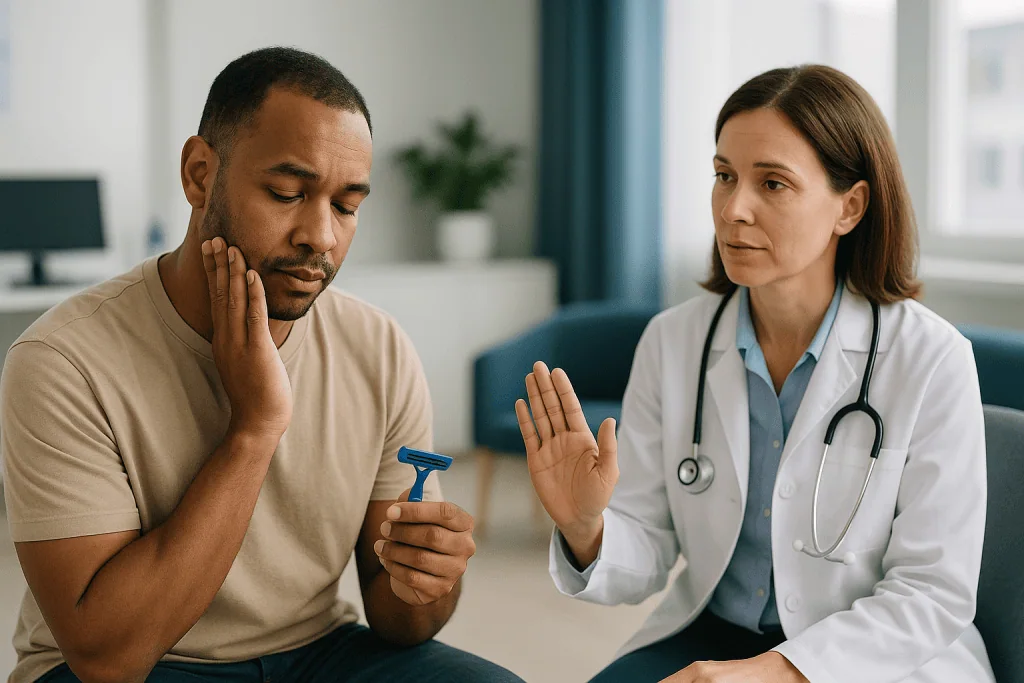
The first can usually keep shaving, with adjustments: someone with a couple of isolated pustules after a rushed shave, no fever, no spreading redness, skin that otherwise looks calm. Changing technique, and skipping the affected patch for a few days, is often enough.
The second group is asked to stop for a defined period. This includes anyone with widespread pustules, anyone whose spots return in the same place every cycle, and anyone with clear signs of ingrowth: firm bumps with visible looped hairs. Mayo Clinic’s advice for ingrown hairs is blunt about it. Let the hair grow until the bumps clear.
The third group is asked to wait and be seen before shaving again. Cleveland Clinic lists several factors that make folliculitis more likely to become deep or stubborn, including diabetes, a weakened immune system from illness or medicines, obesity, and long courses of antibiotics or steroid creams. Someone in this group with a hot, tender, expanding bump may be developing a boil, a deeper infection of the follicle and surrounding tissue, which no razor habit will fix. People with a history of keloids, thick raised scars that grow beyond the original wound, are also usually asked to hold off, because each inflamed follicle is a potential scar.
Teenagers just starting to shave belong in a category of their own. Their skin is not more fragile, but their technique is often hurried and their razors are often borrowed. A supervised first few months, with a fresh blade and no sharing, prevents a good deal of adolescent folliculitis.
Where you fall on this spectrum is a judgment for the person examining your skin, not for an article.
Is folliculitis a hygiene issue? What really drives it
Mostly no, and the assumption causes real harm. People who believe their bumps mean they are unclean tend to scrub harder, wash more often and reach for stronger soaps. Each of those weakens the skin barrier and makes the follicles angrier.
Staphylococcus aureus lives on the skin or in the nose of many healthy people without causing trouble. Folliculitis happens when the follicle is breached, not when the skin is dirty. A freshly showered person who shaves against the grain with a week-old blade is at higher risk than someone who skipped the shower but shaves gently with the grain.
A few genuinely hygiene-adjacent factors do matter, and they concern the razor and the environment rather than the person:
- Razors left wet in a shower caddy grow bacteria between uses. Rinse, shake dry and store somewhere dry.
- Shared razors transfer skin flora and occasionally more serious infections. A blade should have one owner.
- Tight, sweaty clothing after shaving traps heat and moisture against open follicles. Cleveland Clinic names occlusive clothing and heavy sweating among common triggers.
The environment can also supply the microbe. Mayo Clinic describes hot tub folliculitis, caused by Pseudomonas bacteria in poorly maintained warm water, which produces an itchy, bumpy rash about one to two days after exposure, often worst where a swimsuit held water against the skin. Yeast on the chest and back, and heavy oils or pomades that plug follicles, are other non-shaving causes a clinician considers when the pattern does not fit the razor. The NHS similarly notes that folliculitis frequently clears without any treatment once the trigger is removed.
So if a relative or a well-meaning barber suggests you simply need to wash more, you have permission to disagree politely.
Shaving with folliculitis: the razor habits your dermatologist changes first
When the skin has settled and you are ready to shave again, the goal shifts from closeness to kindness. Mayo Clinic’s prevention guidance for folliculitis and ingrown hairs reads almost like a list of everything a hurried morning gets wrong. Here is what dermatologists usually change, roughly in order of impact.
- Direction. Shave with the grain, in the direction the hair grows. Against-the-grain strokes give a closer cut precisely because they pull the hair up and slice it below the surface, which is the setup for ingrowth.
- Preparation. Wash with warm water and a mild cleanser first, then use a washcloth in gentle circles to lift hairs lying flat or beginning to curl in. Apply a generous layer of shaving gel or cream; never shave dry.
- The blade. Use a clean, sharp blade every time, or an electric razor. A dull blade drags and needs more passes; more passes mean more micro-openings.
- Pressure and passes. One light pass per area. Going back over the same patch to chase stubble is where most of the damage happens.
- Closeness. Mayo Clinic specifically suggests avoiding a very close shave by using an electric razor or a guarded blade. A shadow of stubble is protective.
- Aftercare. Rinse with warm water, pat dry and apply a plain moisturizer. Skip alcohol-heavy aftershaves on inflamed skin.
- Frequency. Shave less often if you can. Every other day gives follicles a recovery window that daily shaving never allows.
None of this is glamorous, and none of it requires buying anything special. The single habit that most often turns recurrent folliculitis around is the least exciting one: one pass, with the grain, on well-lubricated skin. People who have fought bumps for years are frequently startled by how much a slower shave changes.
Which hair-removal method suits irritated skin? A side-by-side look
There is no perfect method for folliculitis-prone skin, only trade-offs. The table summarizes how common options behave for someone who gets bumps, drawing on Mayo Clinic’s prevention guidance for folliculitis and ingrown hair.
| Method | How close it cuts | Risk for bump-prone skin | Notes |
|---|---|---|---|
| Multi-blade cartridge | Below the surface | Higher | Lift-and-cut design favors ingrowth; best avoided during flares |
| Single-blade or safety razor | At the surface | Moderate | Fewer blades, fewer passes if technique is good |
| Electric foil or rotary razor | Slightly above the surface | Lower | Mayo Clinic suggests this for people with recurring bumps |
| Trimmer or clipper with guard | A millimeter or more above | Lowest | Hair cannot re-enter skin; stubbled rather than clean-shaven look |
| Depilatory cream | At or just below the surface | Variable | Chemically dissolves hair; can irritate; patch-test first, never on broken skin |
| Waxing or tweezing | Removes from the root | Higher for ingrowth | Regrowing tip may curl under; Mayo Clinic advises pausing during flares |
| Laser hair reduction | Reduces regrowth over time | Lower long term | Mayo Clinic lists it as an option to discuss; several sessions; clinician assessment essential, especially for deeper skin tones |
Two points deserve emphasis. First, the safest options during a flare are the ones that leave a little hair behind, a cosmetic compromise many people resist until they understand why it works. Second, laser hair reduction is neither quick nor risk-free; it changes the hair rather than the skin, and the choice of device and settings for pigmented skin belongs with a trained clinician. It is a question to raise, not a decision to make from a table.
What does pubic folliculitis after shaving look like, and why the groin flares so easily
The groin is the region people most often ask about and least often show anyone, so it is worth being plain. Pubic folliculitis after shaving looks like the same condition anywhere else: small red or skin-colored bumps, some with a white head, each sitting where a hair emerges. On darker skin the redness may read as deeper brown or purple. Ingrown-type bumps here are often firm and can leave dark marks along the bikini line for months after they settle.
Why does this area flare so readily? Three factors stack. The hair is coarse and curly, the classic setup for re-entry. The skin folds and sits under underwear all day, so heat, sweat and friction are constant; Cleveland Clinic names tight clothing and sweating as triggers. And most people shave the groin by feel, in a shower, against the grain, with a razor that has already done the legs.
People also worry, reasonably, about what else the bumps could be. Folliculitis bumps are centered on hairs and appear in a shaved zone within days of shaving. Genital herpes produces clustered blisters not tied to hair follicles that often tingle or sting before they appear; genital warts are flesh-colored, persistent and not pus-filled. The overlap is real enough that new genital bumps in someone who is sexually active deserve a clinical look rather than a guess, particularly when they do not match the shaving pattern.
Practical adjustments follow the same logic as the face, with extras: trim instead of shave during a flare, shave downward with the grain, keep a dedicated razor for the groin, and change out of damp workout clothes promptly. Loose cotton underwear for a few days after shaving reduces the friction that keeps follicles inflamed.
What helps folliculitis after shaving in the first 48 hours
The first two days after a bad shave decide whether a few bumps stay a few bumps. The measures that help are undramatic, which is exactly why people skip them in favor of something that stings.
Warm compresses come first. Mayo Clinic advises applying a warm, moist washcloth to the area several times a day. Warmth increases blood flow, eases the ache and encourages pustules to drain on their own. Use a clean cloth each time, and do not share it.
Gentle cleansing comes second. Wash once or twice a day with warm water and a mild soap, then pat, not rub, the skin dry. Mayo Clinic also lists over-the-counter antibacterial washes and soothing lotions among self-care options; the aim is to reduce surface bacteria without stripping the skin. Harsh scrubs, loofahs and alcohol-based toners push irritation the wrong way.
Third, leave the bumps alone. Squeezing a pustule drives bacteria deeper and across the skin. Picking at an ingrown hair with fingernails or an unsterilized pin adds a second infection to the first. If a hair is clearly visible in a loop just under the surface, Mayo Clinic describes gently lifting the loose end out with a sterile needle or tweezers, without plucking it, so the tip sits above the skin. Anything deeper is a job for the clinic.
Fourth, protect the area. Loose clothing, no shaving, no hot tubs, no heavy oils or creams that seal follicles shut. A fragrance-free moisturizer is fine once the skin has stopped weeping.
If the bumps itch, a cool compress between warm ones can help. If they are painful, tender and growing rather than settling by the second or third day, that is the moment to stop managing at home and make a call.
What the next days and weeks usually look like
Most people want a calendar. Skin does not keep one, but typical patterns exist, and knowing them stops a normal recovery from feeling like a failure.
Days one to three. Superficial bacterial folliculitis often peaks early. Pustules may open and crust; itching settles as inflammation falls. Mayo Clinic notes that mild folliculitis often heals in a few days with self-care and without scarring. The skin may look worse before it looks better as crusts form.
Days four to ten. Redness fades to pink, then to a flat mark. Anyone whose spots are still enlarging, still producing pus or spreading to new areas has left the mild category; Mayo Clinic recommends seeing a clinician if symptoms do not improve after a week or two of self-care.
Weeks two to six. This is the pseudofolliculitis timeline. Trapped hairs need to grow long enough to lift free, and the firm bumps soften and flatten as they do. Mayo Clinic’s guidance for ingrown hairs is to stop shaving, tweezing or waxing until the skin improves, and to expect weeks rather than days.
Weeks to months. Post-inflammatory hyperpigmentation, the darker mark left where inflammation was, is the slowest part of recovery, especially on deeper skin tones. It is not scarring and it generally fades, but the fading is measured in months, and each new flare resets the clock in that spot. Sun protection on exposed areas helps marks fade rather than deepen.
Resuming shaving is reasonable once the skin is smooth to the touch, with no pustules and no tenderness. Restart with the gentler technique, not the old one; follicles have a long memory for how they were last treated.
When medicines enter the picture: what they do and how long they take
When technique changes and self-care are not enough, a clinician may add medicines. None replaces changing how you shave, and the choice among them depends on what the skin shows, sometimes helped by a swab of a pustule.
Topical antibiotics, applied to the skin, reduce the bacterial load in and around follicles. They are commonly used for localized bacterial folliculitis; Mayo Clinic lists them among first-line treatments and notes that oral antibiotics are generally reserved for severe or recurrent infection.
Benzoyl peroxide washes, familiar from acne care, kill surface bacteria and are sometimes suggested to reduce recurrence in people who must keep shaving. They can bleach fabric and dry the skin.
Topical retinoids, derived from vitamin A, are used mainly for pseudofolliculitis barbae. They thin the plug of dead cells over the follicle and help hairs exit rather than curl under. They take weeks to show an effect and increase sun sensitivity.
Mild topical steroids may be prescribed briefly to calm the inflammatory reaction around an ingrown hair. Long-term or unsupervised use thins the skin and can itself trigger folliculitis, one reason Cleveland Clinic lists prolonged steroid cream use among risk factors.
Antifungal creams or tablets are used when the cause turns out to be yeast rather than bacteria, most often on the chest, back and shoulders.
For hair that keeps ingrowing despite everything, laser hair reduction, which damages the follicle so it produces finer, sparser hair, is an option some clinicians raise; Mayo Clinic mentions it for recurrent cases.
Whichever route a prescriber suggests, starting, stopping or switching should follow their instructions, and a medicine that seems to make the skin worse should be reported rather than quietly abandoned.
What people often get wrong about shaving and folliculitis
A few beliefs survive because they sound plausible. Each deserves a direct correction.
‘Against the grain is fine if my razor is sharp enough.’ A sharp blade makes a cleaner cut, but direction determines whether the hair tip ends up below the surface. Sharpness does not change geometry.
‘More blades, closer shave, healthier skin.’ Closeness and skin health pull in opposite directions for anyone prone to bumps. Mayo Clinic advises avoiding very close shaves in exactly this group.
‘Hot water opens the pores.’ Warm water softens hair and is useful. Very hot water strips the skin barrier and leaves follicles more vulnerable, not less.
‘Alcohol aftershave disinfects the skin.’ It stings, which feels like it is doing something. On freshly shaved skin it dries and irritates, and any antibacterial effect is fleeting.
‘Folliculitis means I am unhygienic.’ Covered above, but worth repeating: it is a breach of the follicle, not a failure of washing.
‘If I keep shaving, the skin will toughen up.’ Repeatedly inflamed follicles do not adapt. They scar and darken. Mayo Clinic lists permanent scarring and dark spots among complications of recurrent folliculitis.
‘Plucking the ingrown hair fixes it.’ Plucking removes the hair but leaves the follicle open and the next hair to grow through the same distorted channel. Lifting the tip free without pulling it out is the technique Mayo Clinic describes.
‘It is only cosmetic.’ Superficial folliculitis usually is. Deep folliculitis and boils can spread and, rarely, seed a bloodstream infection, especially in people with diabetes or weakened immunity. That is why the red flags in the final section matter.
Questions to ask your care team
A short appointment goes further with prepared questions. These are the ones that tend to change what happens next.
- Does this look like bacterial folliculitis, ingrown hairs, or both? The answer decides whether the plan targets bacteria, cutting technique, or each in turn.
- Would a swab help? Recurrent pustules sometimes involve resistant bacteria, and knowing what is growing shapes treatment.
- How long should I stop shaving, and what does ready-to-restart skin look like? Ask for a description, not just a number of days.
- Is trimming acceptable in the meantime, and to what length?
- Which razor type suits me, and should I change how often I shave?
- Could anything I put on my skin be contributing? Heavy oils, pomades and occlusive creams plug follicles, and some products used for other skin conditions can make bumps worse.
- Do any of my other conditions or medicines raise my risk? Diabetes, immune-suppressing treatment and long courses of antibiotics or steroid creams all matter.
- If a medicine is prescribed, how will I know it is working, and how long should I give it before we reassess?
- Are the dark marks likely to fade, and is there anything that would make them worse?
- Is laser hair reduction a reasonable option for my skin type, and what would it involve?
- What signs should bring me back sooner than my follow-up?
Bring your razor if you can. Clinicians who see the blade, the cartridge age and the direction of stubble regrowth often spot the problem in seconds. A photograph of the skin at its worst is also useful, because bumps have a habit of calming down the morning of an appointment, and a picture keeps the conversation honest.
When to call your doctor
Superficial folliculitis is a nuisance. A few patterns are not, and they deserve a call rather than another compress.
Contact your doctor promptly if any of the following applies:
- A bump is growing, hot, hard and increasingly painful, or several bumps are merging into one tender lump. This suggests a boil or carbuncle, a deeper infection that may need drainage and prescription treatment.
- Redness is spreading outward from the bumps, especially with streaking, warmth or swelling of the surrounding skin.
- You have a fever, chills or feel generally unwell alongside the skin changes.
- The bumps have not improved after a week or two of self-care, or keep returning in the same place, both of which Mayo Clinic gives as reasons to be seen.
- The rash is widespread, involves the scalp with hair loss, or appeared after a hot tub or pool.
- You have diabetes, a weakened immune system, or take medicines that suppress immunity, and you develop any infected-looking bumps. Complications are more likely in this group.
- Genital bumps do not match a shaving pattern, tingled before appearing, or come with discharge or pain on urination.
- You notice thickened raised tissue, rapidly darkening skin or other signs of scarring.
Seek urgent care if a swollen area is expanding over hours, if you develop a high fever with a very painful lump, or if you feel faint, confused or short of breath with a skin infection. These are rare but serious signs that infection has moved beyond the follicle.
Everything in this article is general guidance. The person examining your skin, who knows your history and can see the bumps, decides what your plan should be. If their advice differs from anything written here, follow theirs.
Frequently asked questions
Should I stop shaving if I have folliculitis?
Usually yes, for a short period, until the inflamed follicles have settled and the skin feels smooth again. Mayo Clinic advises avoiding shaving over affected areas while mild folliculitis heals, typically a few days. If you cannot go unshaven, trimming with a guarded clipper leaves hair above the skin so the tip cannot re-enter, and shaving around rather than over active bumps limits spread.
What does pubic folliculitis look like?
Pubic folliculitis appears as small red or skin-colored bumps, some with a white or yellow head, each centered on a hair in a recently shaved area. On darker skin the color may be brown or purple. Bumps that are not tied to hair follicles, that tingled before appearing, or that come with discharge deserve a clinical check because other conditions can look similar.
Is folliculitis a hygiene issue?
No. Folliculitis happens when the follicle is breached and bacteria that normally live on the skin get inside, not because skin is dirty. Over-washing and scrubbing weaken the barrier and make bumps worse. What does matter is the razor: a shared blade, a dull blade, or one stored wet raises risk far more than how often you shower.
What helps folliculitis after shaving?
Warm, moist compresses several times a day, gentle washing with a mild cleanser, and leaving the bumps unsqueezed are the core of self-care Mayo Clinic describes. Wear loose clothing, skip hot tubs and heavy creams, and pause shaving until the skin is calm. If bumps enlarge, hurt or spread rather than settle over a few days, see a clinician.
Razor bumps vs folliculitis: how can I tell which I have?
Look at timing and texture. Folliculitis tends to appear within a day or two of shaving as soft, pus-filled spots that can occur anywhere. Razor bumps, or pseudofolliculitis barbae, show up a few days later, feel firm, cluster where hair is coarse and curly, and often show a trapped hair loop under the skin. Many people have both, and a clinician can tell them apart quickly.
How long after folliculitis can I shave again?
There is no fixed number of days, but a useful marker is skin that is smooth to the touch with no pustules and no tenderness. Mayo Clinic notes mild folliculitis often heals in a few days, whereas ingrown hairs need weeks to grow free. When you restart, use a clean sharp blade or electric razor, shave with the grain and take a single light pass.
Can I use an electric razor with folliculitis?
An electric razor is generally the gentler choice for people prone to folliculitis, and Mayo Clinic suggests it as a way to avoid shaving too closely. It cuts slightly above the skin surface, so hair tips are less likely to re-enter. Wait until active pustules have cleared before shaving over the area, and clean the head between uses.
Does shaving spread folliculitis?
It can. Passing a blade over an open pustule carries bacteria onto the razor and across neighboring skin, where fresh micro-openings from the same stroke let them enter new follicles. This is why clinicians ask people not to shave over active bumps, to use a clean blade each time, and never to share razors.
Should I shave over folliculitis to make it less visible?
No. Shaving over bumps opens them, spreads their contents and usually makes the area redder and more visible within a day. If appearance matters for work, trimming with a guarded clipper keeps things tidy without cutting below the surface, and shaving around the affected patch leaves the inflamed follicles to heal.
Can shaving cream or aftershave cause folliculitis?
The products themselves rarely cause infection, but they can worsen the conditions for it. Shaving without any lubricant increases friction and skin damage, while alcohol-heavy aftershaves dry and irritate freshly shaved skin. Heavy oils or pomades can plug follicles. A generous layer of gel or cream before shaving and a plain fragrance-free moisturizer afterward are what most dermatologists suggest.
References
This article is for general information only and is not a substitute for professional medical advice. Please consult a qualified doctor about your individual situation.

More from the Blog

How Doctors Choose Between Antibiotic Cream and Tablets for Impetigo: Extent, Spread and Fever
Doctors usually treat impetigo with an antiseptic or antibiotic cream when the infection is small, confined to one area and the person is otherwise…
Styling Products, Oils and Dandruff Treatment: What Your Dermatologist Will Ask You to Change
Dandruff is driven by a scalp yeast called Malassezia, excess oil and individual skin sensitivity, so a dermatologist usually asks you to stop applying…
Basal Cell Carcinoma: Does It Spread, Is It Dangerous, and What Does It Look Like?
Basal cell carcinoma almost never spreads to distant organs; metastasis is considered extremely rare by major medical sources. Its real danger is local. Left…
Does Allergy Testing Help With Eczema? When Dermatologists Recommend It and What It Can Show
Allergy testing does not diagnose eczema, and it helps only in specific situations. Dermatologists usually suggest it when eczema stays severe despite good skin…

Can You Swim With Molluscum Contagiosum? Sports, Shared Towels and Ways to Limit Spread
In most cases, yes. Public health guidance does not require people with molluscum contagiosum to stay out of swimming pools, because the virus has…
Repairing the Skin Barrier After Contact Dermatitis: Moisturizers, Gloves and Gentle Cleansing
Repairing the skin barrier after contact dermatitis rests on three habits: removing or avoiding the trigger, applying a plain fragrance-free emollient generously and often,…