

The Post-Workout Meal: The Anabolic Window, Revisited

Key Takeaways
- Muscle stays more responsive to protein for roughly 24 hours after resistance training, so the real anabolic window is measured in hours, not minutes.
- A 2018 meta-analysis of 49 trials found total daily protein, plateauing near 1.6 grams per kilogram, predicted muscle gain better than when the protein was eaten.
- A 2017 randomized trial found protein taken immediately before versus immediately after lifting produced similar strength and muscle gains over ten weeks.
- Timing matters most after fasted training and when the next hard session is within about 8 hours, when early carbohydrate speeds glycogen refilling.
- Adults over about 60 show anabolic resistance and need closer to 35–40 grams of protein per sitting to match the response of a younger adult's 20 grams.
- Alcohol after training reduced the muscle protein synthesis response by roughly a quarter to a third in controlled studies, even when protein was eaten alongside.
A post workout meal still matters, but the strict 30-minute anabolic window does not hold up in randomized trials. Evidence suggests eating 20–40 grams of protein plus carbohydrate within a few hours of training, with total daily protein and overall calories mattering more than the clock. Timing becomes tighter mainly if you trained fasted or train again within about 8 hours.
Watch the end of any gym session and you will see it: shaker bottles rattling before the last plate is racked, someone chugging a protein drink in the parking lot as if the muscle they just worked might evaporate on the drive home. That ritual is back in the spotlight. As of September 2026, short videos insisting you have “30 minutes or you wasted the workout” are circulating again, right alongside an equally loud fasted-training crowd that says the post workout meal barely matters at all.
Both camps are quoting science, and both are quoting it selectively. The research on nutrient timing has matured a great deal since the window idea took hold in the 1990s, and the honest answer sits somewhere less dramatic than either headline.
So this is the anabolic window, revisited: what the trials actually measured, where the old advice still earns its place, and what to put on your plate when the gym bag hits the floor.
What changed recently: the dates behind the anabolic window debate
The anabolic window is the idea that there is a short period after exercise, often quoted as 30 to 60 minutes, when muscle is unusually primed to absorb nutrients and build new tissue. It came out of lab studies in the 1990s and early 2000s that measured how quickly muscle took up amino acids after a lift. Those studies were real, but they mostly looked at a single session, often in people who had trained without eating beforehand.
The first serious reappraisal arrived in 2013, when a review in the Journal of the International Society of Sports Nutrition pulled the timing literature together and concluded that the window, if it exists, is far wider than the gym folklore claimed. In 2017 the same research group published a randomized trial comparing protein eaten immediately before training with protein eaten immediately after; after ten weeks the two groups gained strength and muscle to a similar degree. That same year the International Society of Sports Nutrition updated its position stand on nutrient timing, and in 2018 a large meta-analysis in the British Journal of Sports Medicine found that total daily protein, not the timing of individual servings, was the main dietary driver of muscle gain during resistance training.
None of that is brand new, which is exactly the point. What is new in 2026 is the volume of social content reviving the 30-minute rule, usually attached to a product, while the peer-reviewed picture has been stable and reassuring for the better part of a decade. The post workout meal has not been debunked; the stopwatch has.
What is the anabolic window, in plain terms?
Two processes run in your muscle all day. Muscle protein synthesis is the building of new muscle protein, and muscle protein breakdown is the dismantling of old protein. Your net muscle balance is simply one minus the other. Resistance exercise raises both, and eating protein tips the balance toward building. The anabolic window theory says that the building response is dramatically stronger if protein arrives while the muscle is still “switched on” by the workout.
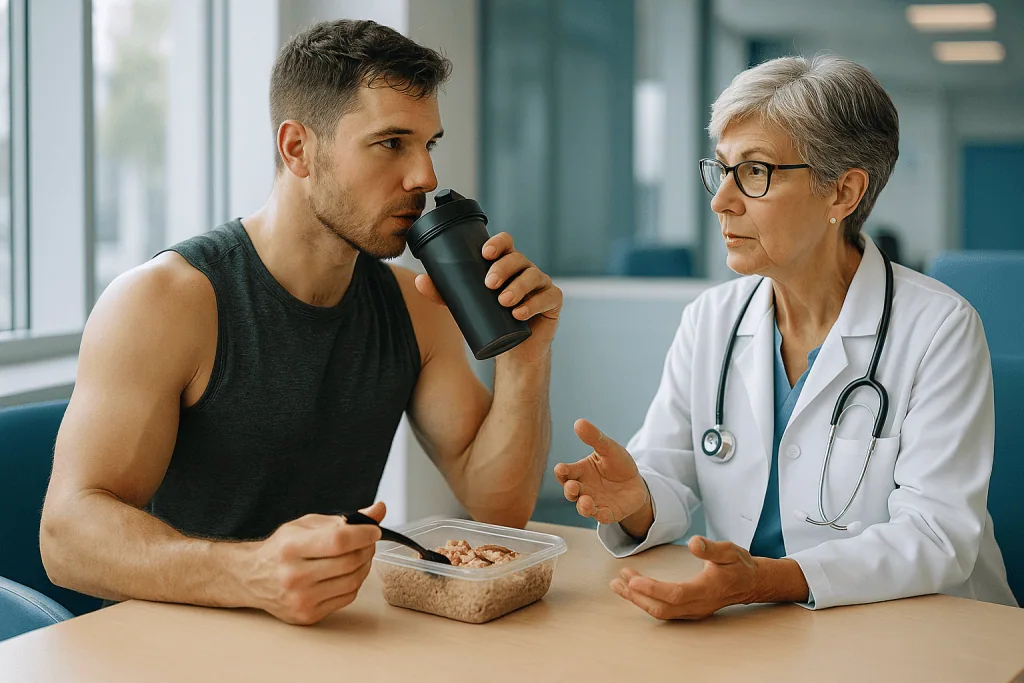
Here is what the measurement studies show. After a hard session, the sensitivity of muscle to protein does rise, and it stays elevated for at least 24 hours, with the sharpest response in the first several hours. That is a window, but it is a garage door, not a mail slot. The classic lab experiments that produced the 30-minute figure typically compared a shake taken right after training with a shake delayed by three hours in people who had not eaten for 12 hours. In that design, the delayed group was running on empty, so of course the early feeding looked better.
Swap in a realistic scenario, a person who ate a meal containing protein two or three hours before training, and the amino acids from that meal are still circulating when the workout ends. The body does not know the session is over; it only knows what is in the bloodstream. For most people, that pre-workout meal already covers the first stretch of the so-called window.
Glycogen, the stored form of carbohydrate in muscle and liver, follows a similar pattern. Refilling it is fastest in the first hour or two, but given 24 hours and enough carbohydrate in the diet, it refills regardless.
What the evidence actually says, graded by strength
Grading matters here because the strongest-sounding claims rest on the weakest designs.
Strong evidence (meta-analyses of randomized trials): Total daily protein intake improves gains in lean mass and strength from resistance training, with benefits plateauing around 1.6 grams per kilogram of body weight per day in the 2018 British Journal of Sports Medicine analysis of 49 trials. Timing of protein relative to the workout did not independently change outcomes once total intake was accounted for.
Moderate evidence (individual randomized trials, weeks to months long): Eating protein immediately before versus immediately after lifting produces similar muscle and strength changes over 8–12 weeks in trained adults. A handful of older trials in untrained or older participants found an advantage for immediate feeding, but they were small and often did not match total protein between groups.
Mechanistic evidence (acute lab studies measuring hours, not outcomes): Muscle protein synthesis is elevated for roughly 24 hours after training and responds to protein throughout that period. Glycogen resynthesis is fastest early. These findings explain why timing helps at the margins without proving it changes your physique.
Expert opinion and position stands: Sports nutrition bodies recommend a protein feeding every 3–4 hours across the day and a post workout meal “soon” after training, chiefly as a practical anchor rather than a biological emergency.
Read together, the hierarchy is clear. Eat enough protein across the day, spread it out, and have a reasonable meal in the few hours after training. If you do those three things, the data cannot distinguish a 20-minute shake from a 90-minute sit-down dinner.
Does timing matter more if you train fasted?
Yes, and this is the one place where the old advice keeps real weight. A fasted session, meaning training after an overnight fast with nothing but water or black coffee, means there are no dietary amino acids in circulation during or immediately after the workout. Muscle breakdown rises during exercise, and without incoming protein the net balance stays negative until you eat.

Early-morning lifters, people who run before breakfast, and anyone practicing time-restricted eating fall into this group. For them, the gap since the last protein feeding may already be 10–14 hours by the time the session ends, and the recommendation to eat protein reasonably promptly after training is sensible. Think within an hour or so, not an anxious sprint.
Does fasted training itself harm muscle gain? The trial evidence is thin and mixed. Small studies in resistance-trained adults show similar gains fasted or fed as long as total protein over the day is matched. For endurance work, fasted sessions shift fuel use toward fat during the run but have not been shown to change body composition more than fed sessions when calories are equal. If you prefer training on an empty stomach, the evidence does not forbid it; it simply nudges your protein after workout toward the front of your day.
One practical caution from mainstream guidance: fasted high-intensity exercise raises the chance of lightheadedness, especially in people with blood-sugar conditions or those taking glucose-lowering medicines. Anyone in that situation should discuss meal timing around exercise with their clinician rather than copying a routine from a fitness feed.
How much protein after a workout actually helps?
Dose-response studies, which give different amounts of protein and measure the synthesis response, point to roughly 20–25 grams of high-quality protein maximizing the response in younger adults after a typical lifting session, with around 40 grams performing slightly better after whole-body workouts and in larger or older individuals. Beyond that, extra protein in a single sitting is mostly oxidized for energy rather than built into muscle, though it still counts toward your daily total.
Leucine is the amino acid that acts as the main trigger for muscle protein synthesis, and most of these effective servings contain roughly 2–3 grams of it. Animal proteins such as dairy, eggs, poultry, fish and meat reach that threshold in smaller portions; plant proteins can get there too, but usually need a larger serving or a combination, for example lentils with grains or a soy-based meal.
In everyday food, 25 grams of protein looks like one of these:
- A cup of plain Greek yogurt plus a small handful of nuts
- Three eggs, or two eggs with a slice of cheese
- A palm-sized portion of chicken, salmon or lean beef
- A cup of cooked lentils with a cup of cooked quinoa
- A cup of cottage cheese or a glass of milk with a peanut-butter sandwich
The more useful question is not “how much after?” but “how much across the day, and in how many servings?” The practical consensus is 0.3–0.4 grams per kilogram per meal, three or four times daily. A 70-kilogram person lands around 25 grams per meal and 110–120 grams per day during a training block. Hit that pattern and the post workout meal is just one of the servings, not a separate assignment.
What is the best post workout meal? Food choices compared
The best post workout meal does two jobs: it delivers a leucine-rich protein serving, and it supplies carbohydrate to begin restoring glycogen, scaled to how hard and how long you trained. A 30-minute strength session uses modest glycogen; a 90-minute interval run or long ride uses a great deal. Fat is not the enemy in this meal, though a very high-fat meal digests slowly, which only matters if you train again the same day.
| Option | Approx. protein | Carbohydrate | Best suited to |
|---|---|---|---|
| Greek yogurt with berries and granola | 20–25 g | Moderate | Short strength or class workouts |
| Chicken, rice and vegetables | 30–40 g | High | Long or whole-body sessions, main meal timing |
| Eggs on whole-grain toast with fruit | 20–25 g | Moderate | Morning fasted training |
| Chocolate milk (large glass) | 12–16 g | High | Endurance sessions, low appetite, quick option |
| Tofu stir-fry with noodles | 20–25 g | High | Plant-based diets, evening training |
| Whey shake with a banana | 25 g | Moderate | Two-a-days, travel, no access to a kitchen |
Notice that nothing in the table is exotic. The ingredient lists on viral “recovery” products rarely beat a plate of ordinary food, and whole meals bring fiber, potassium, and fluid that powders do not. Chocolate milk earns its spot for a reason: trials in endurance athletes found it refueled glycogen and supported subsequent performance about as well as commercial recovery drinks, largely because its carbohydrate-to-protein ratio happens to sit in the useful range.
Pick the row that matches the session you did and the meal you were going to eat anyway. For most people that is lunch or dinner, slightly adjusted, not a sixth feeding.
What should you avoid after a workout?
Fewer things than the internet suggests, but a few habits do work against recovery.
The first is skipping protein entirely in favor of a carbohydrate-only snack or a sugary sports drink. Carbohydrate alone refills glycogen but does little for muscle repair, and after a lift the protein is the piece doing the heavy lifting. Pairing them is the fix; swapping one for the other is not.
The second is alcohol. Controlled studies in trained men found that drinking enough to feel it after a session reduced the muscle protein synthesis response by roughly a quarter to a third, even when protein was eaten alongside. A single drink with dinner is a different matter from post-match rounds, but the dose-response is real, and alcohol also interferes with sleep, which is when much of the repair happens.
Third, very large, very high-fat meals eaten minutes after intense exercise are more likely to sit uncomfortably, because blood flow is still shifted toward muscle and away from the gut. This is about comfort, not muscle loss; waiting 20–30 minutes until you feel settled costs you nothing biologically.
Fourth, under-eating. The most common post workout mistake in the data is not a late meal but a missing one: people who train to manage weight sometimes treat the session as a reason to eat less, which leaves total protein and calories short and blunts the adaptation they trained for.
What you do not need to avoid: fruit, dairy, caffeine in normal amounts, or fat in sensible portions. None of these “shut the window.” The window closes slowly on its own, and ordinary food keeps it open longer, not shorter.
What to do immediately after the gym, in order
If the clock is less tyrannical than advertised, what should the first half hour look like? A reasonable sequence, drawn from mainstream fitness and hydration guidance, goes like this.
Start with fluid. Sweat losses during a 60-minute session commonly run between half a liter and two liters depending on heat and intensity. Drinking water over the next hour or two, with food that contains sodium, restores volume better than gulping a liter in one go. Weighing yourself before and after a hard session a few times teaches you your own loss; each kilogram down is about a liter to replace.
Then let your body settle. A few minutes of easy walking or gentle movement brings heart rate down gradually and reduces the lightheaded feeling some people get from stopping abruptly. Static stretching has weaker evidence for preventing soreness than many assume, but it is harmless if you enjoy it.
Eat when it fits. If your next meal is within an hour or two, that is your post workout meal. If it is further away, or you trained fasted, a smaller protein-and-carbohydrate snack bridges the gap. The shake in the parking lot is optional, not obligatory.
Shower, change, and give some thought to sleep. Seven to nine hours of sleep is the recovery intervention with the broadest evidence behind it, and it is the one most often sacrificed by people obsessing over the 30-minute rule.
Finally, note how the session felt. Persistent, unusual fatigue, pain that is sharp rather than achy, or dizziness that lingers are not recovery-nutrition problems and belong in the “when to see a doctor” conversation below.
Should I eat after the gym if I am not hungry?
Appetite often drops for an hour or so after hard exercise, particularly after high-intensity intervals or training in the heat. The mechanism is partly hormonal: ghrelin, the hormone that signals hunger, tends to fall during and shortly after vigorous exercise, while appetite-suppressing hormones rise. This is normal, temporary and not a sign that your body does not need fuel.
Whether to override it depends on context. If you ate a normal meal within the previous three or four hours and your next meal is within the next couple, there is no evidence that forcing food down improves anything. Wait until hunger returns and eat a protein-containing meal then.
If you trained fasted, trained for more than about 90 minutes, or have another session coming the same day, the calculus changes. In those cases an easy-to-tolerate option, something liquid or soft, delivers protein and carbohydrate without demanding appetite: a glass of milk, a yogurt drink, a smoothie with fruit and Greek yogurt. Cold, fluid-based choices tend to go down most easily when appetite is low.
People trying to lose weight sometimes see low post-exercise appetite as an opportunity. The trade-off is worth knowing. Chronic under-fueling around training tends to reduce the amount of muscle retained during weight loss, and preserving muscle is one of the main reasons to train while losing fat in the first place. A moderate protein-rich meal when hunger returns supports that goal better than skipping.
If appetite loss after exercise is persistent, severe, or accompanied by nausea, that pattern deserves medical attention rather than a nutrition tweak.
When the window really is narrow: two-a-days and endurance work
There is a population for whom early refueling is not a myth at all: anyone who must perform again soon. Glycogen resynthesis, the process of rebuilding stored carbohydrate in muscle, runs fastest in the first two hours after exercise, and if the next session is 6–8 hours away, that head start determines how much fuel is in the tank when you line up again.
Sports nutrition guidance for this scenario is specific. Carbohydrate at roughly 1–1.2 grams per kilogram of body weight per hour for the first four hours, started as soon as practical after finishing, restores glycogen most effectively. Adding protein in a ratio of about one part protein to three or four parts carbohydrate helps when carbohydrate intake is below that target, and it covers the muscle-repair side in the same meal. For a 70-kilogram athlete that is in the range of 70–85 grams of carbohydrate per hour, which is why endurance athletes reach for rice, bread, potatoes, juice and flavored milk rather than a chicken salad.
Tournament players, swimmers with morning and evening practices, and people doing a long run in the morning before a strength session in the afternoon all fall into this group. So do manual workers who exercise before a physically demanding shift.
If your next hard effort is 24 hours away, none of this urgency applies. Glycogen will be fully restored by then on a normal carbohydrate-containing diet, and the research shows no additional benefit from front-loading. The window is narrow only when the schedule is.
Does age change the post workout meal?
It does, and this is one of the more useful updates since the original window research. Older muscle shows what researchers call anabolic resistance: a blunted muscle-building response to the same amount of protein that works well in younger adults. Dose-response studies suggest that adults over roughly 60 need closer to 35–40 grams of high-quality protein in a sitting to reach the response that 20 grams produces in a 25-year-old.
Exercise partly reverses this. Resistance training restores some of the sensitivity, which is one reason strength work is recommended at every age and why combining it with adequate protein matters more, not less, as the decades add up. Observational data in older adults link higher protein intake with slower loss of muscle and function, and small randomized trials in people over 65 show that protein taken around training sessions adds modestly to the gains from training alone.
The practical adjustments are simple. Older adults benefit from making sure each main meal, including the one after training, contains a full protein serving rather than concentrating protein at dinner. Dairy and eggs are convenient because they are leucine-rich in small volumes, which helps when appetite is lower. Protein distribution across the day, with breakfast often the meal most in need of a boost, matters at least as much as the post-exercise serving.
Anyone with kidney disease, or who has been told to limit protein for a medical reason, should treat these general targets as a conversation starter with their clinician or a registered dietitian, not a plan to adopt on their own.
Common myths about protein after workout, corrected
“If you miss the 30-minute window, the workout was wasted.” No trial has ever shown that. Muscle remains responsive to protein for about a day after training, and the 2017 randomized comparison of pre- versus post-workout protein found equivalent results after ten weeks.
“Your body can only absorb 20–30 grams of protein at once.” Absorption is not the limit; the gut takes up essentially all the protein you eat. What plateaus is the acute muscle-building response to a single serving. Larger meals still contribute to daily totals, reduce breakdown, and support other tissues.
“Liquid protein is better because it is faster.” Whey is absorbed quickly, which is convenient but not superior over a day. Slower proteins such as casein and whole foods produce a longer, flatter rise in amino acids that is equally effective for gains when totals match.
“Carbohydrates after lifting are only for endurance athletes.” Carbohydrate does not add much to the muscle protein synthesis response when protein is adequate, but it refills glycogen and supports training quality the next day. Lifters doing high-volume sessions use more glycogen than they assume.
“Fasted cardio burns more fat, so skip the post workout meal to keep burning.” Fasted sessions shift fuel use during the run, but 24-hour fat balance depends on total calories, and delaying food afterward has not been shown to improve body composition in trials.
“You need a special recovery product.” Ordinary food covers every documented requirement. Products may be convenient; convenience is their honest selling point, not superior physiology.
Supplements around training: whey, creatine, BCAAs and the evidence
The supplement aisle sits right next to the anabolic window myth, so it is worth separating what has evidence from what has marketing. The NIH Office of Dietary Supplements reviews this literature and its conclusions are measured.
Whey protein powder is simply a concentrated dairy protein. Randomized trials show it supports muscle gain during resistance training to the same degree as an equivalent amount of protein from food. It is a convenient way to reach a protein target, not a performance enhancer in its own right.
Creatine monohydrate has the strongest evidence of any sports supplement for increasing strength and lean mass during resistance training, across dozens of randomized trials. Timing relative to the workout appears to matter little; consistent daily intake is what saturates muscle stores. It is generally considered safe for healthy adults, though people with kidney conditions should ask their clinician first.
Branched-chain amino acids, or BCAAs, are three of the essential amino acids sold on their own. The evidence that they add anything when total protein intake is adequate is weak; a complete protein already contains them in effective amounts.
Products marketed as “research peptides” or growth-hormone “secretagogues” for recovery are not approved medicines, are sold outside regulated channels, and are not for self-use. Their safety and effectiveness for recovery have not been established in human trials.
Supplements in the United States are not reviewed for effectiveness before sale, and contamination of sports products with undeclared substances is documented. Third-party testing certifications reduce that risk. None of this replaces a conversation with a clinician or dietitian, particularly for anyone taking prescription medicines or managing a chronic condition.
When to see a doctor about post-workout symptoms or nutrition
Most of what follows exercise is ordinary: tiredness, mild soreness peaking a day or two later, a thirst that a good meal and a few glasses of water fix. A smaller set of signs are not recovery-nutrition problems and warrant prompt medical attention.
- Dark, cola-colored urine with severe muscle pain and weakness after an unusually intense session, which can signal rhabdomyolysis, a breakdown of muscle tissue that can injure the kidneys. This is an emergency.
- Chest pain, pressure or pain spreading to the arm or jaw during or after exercise, fainting, or an irregular heartbeat that does not settle. Call emergency services.
- Dizziness, confusion or persistent nausea after exercising in the heat, which may indicate heat illness or dangerously low sodium from drinking very large volumes of plain water.
- Unexplained weight loss, persistent fatigue that worsens over weeks despite rest, or performance that keeps declining, which can reflect under-fueling, thyroid or iron problems, or overtraining.
- Loss of menstrual periods in people who train hard, or repeated stress fractures, both associated with low energy availability.
Certain groups should discuss exercise nutrition with their clinician before experimenting with timing or fasted training: anyone with diabetes or taking glucose-lowering medicines, people with kidney or liver disease, those with a history of disordered eating, people who are pregnant, and anyone on medicines that affect heart rate or blood pressure.
If you are considering supplements, including creatine or high-dose protein, mention them at your next appointment. Decisions about how training and eating interact with your medicines, conditions or lab results belong with the clinician who knows your history, not with a post workout meal guide, however evidence-based it tries to be.
Frequently asked questions
What is the best food to eat after a workout?
A meal that pairs 20–40 grams of high-quality protein with carbohydrate scaled to the session, such as Greek yogurt with fruit and granola, eggs on whole-grain toast, chicken with rice and vegetables, or a tofu stir-fry with noodles. Ordinary meals cover every documented requirement; specialized recovery products offer convenience rather than better physiology.
How soon after a workout should I eat protein?
Within a few hours is well supported; within 30 minutes is not required. If you ate a protein-containing meal 2–3 hours before training, those amino acids are still available afterward. If you trained fasted, aim to eat within about an hour. Total daily protein and spreading it across three or four meals matter more than the exact gap.
Is protein after workout more important than carbohydrate?
For muscle repair after strength training, protein is the key piece, and carbohydrate adds little to that specific response when protein is adequate. For refilling glycogen after long or repeated sessions, carbohydrate takes the lead. Most people do best eating both together as part of a normal meal.
What should I avoid after a workout?
Skipping protein in favor of carbohydrate-only snacks, drinking alcohol in quantity, eating very heavy, high-fat meals before your stomach has settled, and under-eating because you trained. Fruit, dairy, moderate caffeine and sensible fat do not need to be avoided and do not shorten the anabolic window.
Should I eat after the gym if I am not hungry?
Not necessarily right away. Appetite often dips for an hour after hard exercise because hunger hormones temporarily fall. If you ate recently and your next meal is within a couple of hours, wait and eat a protein-rich meal then. If you trained fasted or train again the same day, a liquid or soft option such as milk, a smoothie or a yogurt drink is easier to tolerate.
Is a protein shake necessary after lifting?
No. Whey shakes are a convenient protein source, and trials show they support muscle gain about as well as the same amount of protein from food. If a shake helps you reach your daily target, it is a reasonable tool. If you can eat a meal within a few hours, the shake offers no additional advantage.
What should I do immediately after the gym?
Drink water steadily over the next hour or two, walk for a few minutes to let your heart rate settle, then eat your next normal meal when it fits, including protein and carbohydrate. If that meal is far off or you trained fasted, have a smaller snack. Prioritize sleep that night; it is the recovery tool with the broadest evidence.
Does the anabolic window matter for fat loss?
Not in the way the myth suggests. Trials show 24-hour fat balance depends on total calories, not whether you delay eating after exercise. During weight loss, eating adequate protein around training helps preserve muscle, which is one of the main reasons to train while losing fat. Skipping the post workout meal to extend fat burning has no outcome evidence behind it.
Is the post workout meal different for older adults?
Yes. Muscle over roughly age 60 responds less strongly to a given protein amount, a pattern called anabolic resistance. Older adults generally benefit from a larger protein serving, around 35–40 grams, at main meals including the one after training, and from spreading protein across the day. Anyone advised to limit protein for medical reasons should check with their clinician first.
Do BCAAs or creatine need to be taken right after training?
Creatine works by saturating muscle stores through consistent daily use, so timing around the workout matters little. BCAAs add little when total protein intake is adequate, because complete proteins already contain them. The NIH Office of Dietary Supplements summarizes this evidence, and anyone with kidney disease or on prescription medicines should ask a clinician before starting either.
This article is for general information only and is not a substitute for professional medical advice. Please consult a qualified doctor about your individual situation.

More from the Blog

Static Stretching: When It Helps, When It Hurts Performance and How Long to Hold
Static stretching, holding a muscle at mild tension without moving, reliably improves flexibility when each stretch is held for 15–30 seconds, repeated two to…

Bodyweight Exercises: The No-Equipment Program That Covers Everything
Bodyweight exercises can build strength, muscle, and endurance without any equipment, provided you train each major movement pattern, squat, hinge, lunge, push, pull, and…

Best Exercises for the Lymphatic System: Movement as Your Second Heart
The best exercises for the lymphatic system are rhythmic, whole-body movements: brisk walking, swimming or water walking, cycling, gentle rebounding, and slowly progressive strength…

Jump Rope: The Cardio, Bone and Coordination Benefits, and the Joint Question
Jump rope is a vigorous whole-body cardio exercise that raises heart rate within a minute, loads bone through hundreds of small landings, and trains…

Hip Thrusts: Why the Glute Exercise Matters for Knees, Backs and Running
A hip thrust is a strength exercise in which you rest your upper back on a bench and drive your hips upward against a…

Compression Boots: What Pneumatic Recovery Devices Do, and What Trials Show
Compression boots are inflatable leg sleeves that squeeze the limbs in a rhythmic pattern, a technique called intermittent pneumatic compression. Small randomized trials in…