

The Strongest Muscle in the Body: It Depends How You Measure

Key Takeaways
- The masseter jaw muscle typically closes the molars with 150–200 pounds of force, and one record measurement registered roughly 975 pounds for two seconds, leverage, not bulk, is its secret.
- The tongue is actually eight separate muscles forming a boneless 'muscular hydrostat,' and it has never topped any scientific strength measurement: its real distinction is tirelessness.
- The heart beats about 100,000 times and pumps roughly 2,000 gallons of blood every day, resting only in the fraction-of-a-second pause between beats.
- The stapedius in the middle ear, only a millimeter or two long, is the smallest skeletal muscle, and it protects your hearing by damping loud sounds.
- Skeletal muscle everywhere produces a similar force per unit of cross-section (roughly 16–30 newtons per square centimeter), so the 'strongest' muscles win on size, fiber type, and leverage rather than better tissue.
- Adults who skip resistance activity lose roughly 3–5% of muscle mass per decade after age 30, which is why the CDC and American Heart Association recommend strengthening activity at least twice a week.
Quick Answer
No single muscle is the strongest in the body; it depends on what you measure. The masseter (jaw muscle) generates the greatest raw force on an object, the gluteus maximus is the largest and most powerful mover, the soleus produces the most sustained pull, and the heart works longest, beating roughly 100,000 times a day. The tongue, despite the popular myth, holds none of these titles.
It starts, as these things often do, at a family dinner table. A ten-year-old looks up from her plate and asks which muscle is the strongest. Dad says the tongue: he read it somewhere. Grandma votes for the heart, because it never quits. An uncle who lifts weights flexes and points at his thigh.
Here’s the fun part: none of them is entirely wrong, and none is entirely right. Strength is not one thing. A muscle can be strong the way a vise is strong, the way a sprinter is strong, or the way a marathoner is strong, and the human body has a different champion for each event.
So instead of crowning one winner, let’s run the whole competition. The results are stranger, and more useful, than the trivia answer you were expecting.
Why ‘Strongest Muscle’ Is a Trick Question
Ask an exercise physiologist to name the strongest muscle and the first thing you’ll get is a counter-question: strongest at what? Muscle performance can be scored at least five different ways, and each scoreboard has a different name at the top.
- Absolute forcehow hard a muscle can press or pull on an object outside the body.
- Force relative to sizeoutput per square inch of muscle tissue, the pound-for-pound contest.
- Powerforce multiplied by speed, which is what launches you up a flight of stairs.
- Sustained forcethe steady, unglamorous pull that keeps you upright all day.
- Lifetime workloadtotal work performed over the decades, without a single day off.
There’s a further complication: muscles never work alone. Your jaw closes because the masseter, temporalis, and pterygoid muscles fire together; your leg extends because four quadriceps muscles share the load. Isolating one muscle’s contribution in a living person is genuinely hard, which is why researchers rely on indirect measures, bite-force gauges, dynamometers, electrical activity readings, and calculations based on a muscle’s cross-sectional area.
That’s the honest frame for everything that follows. The question isn’t unanswerable: it just has several correct answers, and knowing which is which tells you something real about how your body works.
The Masseter: Champion of Raw Bite Force
If the contest is pure force applied to an object, the winner sits in your cheek. The masseter, the thick, rectangular muscle you can feel bulge when you clench your teeth, closes the jaw, and it does so with startling efficiency.

Working together with the other jaw muscles, the masseter can typically bring the molars together with somewhere in the range of 150 to 200 pounds of force. One famous record measurement registered a bite of roughly 975 pounds sustained for about two seconds, more than the weight of a grand piano, delivered through two back teeth.
The secret isn’t sheer bulk. Gram for gram, the masseter isn’t unusually mighty tissue. Its advantage is leverage. The muscle sits very close to the jaw joint and attaches to a short, rigid lever, the mandible, so nearly all of its contraction converts into crushing force at the teeth. Compare that with your biceps, which has to move a long forearm through a wide arc; much of its effort is spent on speed and range rather than raw pressure.
Evolution had good reason to invest here. Chewing is survival-level work, repeated thousands of times a day across a lifetime of meals. The trade-off shows up in modern life, too: people who chronically clench or grind their teeth can develop jaw pain, headaches, and worn enamel, precisely because this muscle is so effective at what it does.
Is the Tongue Really the Strongest Muscle in the Body?
Let’s retire this one respectfully: no. The tongue is not the strongest muscle in the body by any measurement scientists actually use. It doesn’t produce the most force, the most power, or the most force per unit of size.
It isn’t even a single muscle. The tongue is a bundle of eight musclesfour intrinsic ones that change its shape and four extrinsic ones that anchor and move it. Anatomists classify it as a muscular hydrostat, the same engineering category as an octopus arm or an elephant’s trunk: a structure with no bones that maintains its volume while endlessly reshaping itself.
So where did the myth come from? Most likely from the tongue’s genuinely impressive traittirelessness. It repositions with every word you speak, sweeps your mouth between bites, and drives the roughly 500 to 700 swallows a typical person performs each day. It works while you eat, talk, and even sleep, and it almost never feels fatigued the way your legs do after a long hike. Somewhere along the line, “remarkably tireless” got compressed into “strongest,” and the shorthand stuck.
The tongue’s real distinction is versatility. Few structures in the body can lengthen, shorten, curl, flatten, and stiffen on demand, dozens of times a minute, for ninety years. That’s a genuine marvel: it’s just not the one the trivia card claims.
The Gluteus Maximus: Biggest Muscle, Built for Power
By sheer size, nothing else comes close. The gluteus maximus, the main muscle of your buttock, is the largest muscle in the human body by volume, and its job description explains why: it is your primary engine for hip extension, the movement that drives you out of a chair, up a staircase, up a hill, and into a sprint.
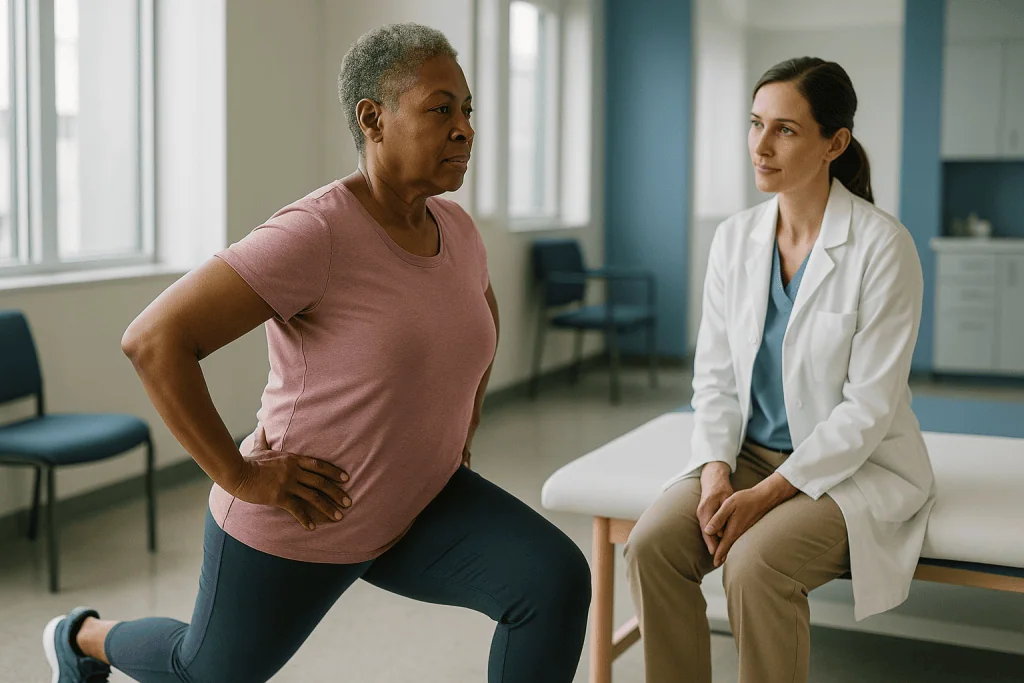
Anthropologists point out that a powerful gluteus maximus is one of the anatomical signatures of upright, two-legged humans. Chimpanzees, our closest relatives, have comparatively modest glutes, and they can’t run upright the way we can. Every time you rise from sitting, this muscle straightens roughly your entire body weight against gravity, a lift it performs, unthanked, dozens of times a day.
Modern life has a complicated relationship with this champion. Hours of sitting keep the gluteus maximus slack and lengthened, and physical therapists commonly observe that people compensate with their lower backs and hamstrings during lifting and climbing: a pattern associated with strain and discomfort. The fix is refreshingly low-tech: movements that extend the hip under load. Climbing stairs, walking uphill, squatting to pick things up properly, and standing up from a chair without using your hands all recruit it directly.
If “strongest” means the muscle that moves the most mass through space in daily life, the gluteus maximus has an excellent claim to the crown.
Which Muscle Is the Most Powerful? Quadriceps vs. Soleus
Power is a specific thing in physiology: force multiplied by velocity. It’s not just how hard a muscle pulls, but how fast it pulls while loaded. On that scoreboard, the front of your thigh dominates.
The quadriceps femorisreally four muscles sharing one tendon, straightens the knee, and it’s the group doing the explosive work when you jump, sprint, or kick. Because the quadriceps are both large and fast, they generate more external power than any other muscle group in the body. Watch a person leap onto a curb to dodge a puddle: that’s the quadriceps and glutes converting stored effort into motion in a fraction of a second.
But there’s a quieter contender one story down. The soleus, a broad, flat muscle beneath your more visible calf, may exert the greatest sustained force of any muscle. Its job is anti-gravity duty: every moment you stand, the soleus pulls steadily to keep your body from tipping forward at the ankles. It’s built almost entirely from slow-twitch, fatigue-resistant fibers: the marathoner’s fiber type, which is why you can stand in line for an hour without your calves screaming.
Here the definition problem shows its teeth. The quadriceps win on peak output; the soleus wins on relentless, hour-after-hour force. Both are “most powerful”, in different events. If you’ve ever wondered why walking feels effortless while a single set of jump squats leaves you gasping, you’ve felt the difference between these two kinds of strength.
What Muscle Never Stops? The Heart’s 100,000-Beat Workday
Every other muscle in this article gets breaks. Your masseter rests between meals; your quadriceps clock out when you sit. The heart’s shift never ends.
A typical adult heart beats about 100,000 times a dayover 35 million times a year, and in the neighborhood of 2.5 billion beats across a long life. Each day it pumps roughly 2,000 gallons of blood through a vascular network that, laid end to end, would stretch tens of thousands of miles. It began this work before you were born and will not pause once.
How does any muscle sustain that? Cardiac muscle is a distinct tissue type, different from the skeletal muscle in your arms and legs. Its cells are extraordinarily dense with mitochondria, the structures that produce energy, and they’re wired together so electrical signals sweep through the whole chamber in a coordinated wave. The heart even generates its own rhythm through specialized pacemaker cells; it doesn’t wait for instructions from the brain the way your biceps does.
Its rest is hidden in plain sight. Between every beat comes diastole, the relaxation phase when the chambers refill: a micro-break repeated 100,000 times a day. That built-in rhythm of work and recovery, plus a rich dedicated blood supply through the coronary arteries, is what makes lifelong labor possible.
If “strongest” means total work performed over a lifetime, this contest isn’t close. The heart wins by decades.
The Uterus: Pound for Pound, the Strongest Contraction
One contender enters this competition only occasionally, but when it does, nothing matches it for force relative to its own weight: the uterus during labor.
Outside of pregnancy, the uterus weighs about as much as a small apple. Over nine months it transforms, growing many times heavier and expanding from roughly the size of a fist to a vessel that fills much of the abdomen. Its muscular wall, the myometrium, is smooth muscle, the involuntary type, and by the end of pregnancy it has become one of the most formidable contractile structures in human biology.
During active labor, coordinated waves of contraction squeeze the entire organ, generating internal pressures strong enough to move a full-term baby through the birth canal, work measured in hours, sometimes the better part of a day. Obstetric monitors routinely record these pressure waves, and clinicians describe labor contractions as among the most powerful sustained muscular events the body produces. Pound for pound, no skeletal muscle performs comparable work.
What makes this especially remarkable is the choreography. Unlike a bicep curl, no one consciously commands a contraction. Hormonal signals and the muscle’s own electrical coupling coordinate millions of cells to squeeze from the top of the uterus downward, in rhythm, again and again.
It’s a reminder that the body’s strength league includes muscles that never show up at the gym, and that some of the most powerful work humans do is involuntary.
The Busiest Muscles You Never Think About: Your Eyes
Strength contests reward force, but there’s a category for sheer activity, and there, the tiny muscles around your eyes put everything else to shame.
Six extraocular muscles control each eyeball, steering it up, down, side to side, and in subtle rotations. They are among the fastest-reacting muscles in the body, and they are almost never idle. As you read this sentence, your eyes are performing rapid jumps called saccadesseveral per second, landing precisely on each word. Researchers estimate the eyes make tens of thousands of distinct movements every day, and the work continues even in sleep, during the aptly named rapid-eye-movement (REM) stage.
What’s striking is the engineering trade-off. These muscles are dramatically overpowered for their load: they’re many times stronger than they’d need to be simply to rotate the small, light eyeball. The surplus buys them something more valuable than forceprecision and speed. Tracking a tennis ball, reading small print, locking onto a face across a room: these demand instant, exact corrections, and the extraocular muscles deliver them thousands of times an hour without conscious effort.
They also cooperate with the orbicularis oculi, the muscle that blinks your eyelids roughly 15 to 20 times per minute, over 14,000 blinks in a waking day, each one resurfacing the eye with tear film.
Strong? Not by the pound. Busy beyond comparison? Absolutely.
Which Is the Weakest Muscle in the Human Body?
Fair is fair, if we’re crowning champions, we should name the smallest competitor too. Deep inside your middle ear sits the stapedius, widely cited as the smallest skeletal muscle in the body. It’s barely longer than a millimeter or two, about the size of a grain of rice’s tip, and in terms of absolute force, it’s about as weak as muscle gets.
Don’t pity it. The stapedius has one of the most elegant jobs in human anatomy. It attaches to the stapes, the tiniest bone in your body, which transmits sound vibrations to the inner ear. When a loud noise arrives, the stapedius contracts reflexively, a response called the acoustic reflex, stiffening the chain of ear bones and damping the vibration before it can hammer the delicate inner ear. It is, in effect, a built-in volume limiter.
When the stapedius is paralyzed, which can happen with certain nerve conditions, people often develop hyperacusis, a distressing sensitivity in which ordinary sounds feel painfully loud. A muscle you could balance on a pencil eraser turns out to be part of what makes a noisy world tolerable.
One honest caveat: “weakest” suffers from the same definition problem as “strongest.” The stapedius wins (or loses) on absolute force because it’s the smallest. Relative to its size and the precision of its task, it’s doing exactly what it should. In the body, small almost never means unimportant.
How Do Scientists Actually Measure Muscle Strength?
Since you can’t unbolt a muscle from a living person and hook it to a scale, researchers measure strength indirectly, and the methods explain why this whole debate exists.
- Dynamometry. Devices measure the force a joint action produces: grip strength gauges, bite-force transducers, leg-press instruments. These capture what muscle groups do together, not single muscles.
- Cross-sectional area. Imaging can measure a muscle’s thickness. Skeletal muscle produces a fairly consistent force per unit of cross-section, studies generally place it around 16 to 30 newtons per square centimeter, so a bigger cross-section predicts a stronger muscle. This is the basis for the pound-for-pound comparisons.
- Electromyography (EMG). Electrodes record a muscle’s electrical activity, revealing how hard it’s working during a task, though not its absolute force.
- Biomechanical modeling. Researchers combine anatomy, leverage, and joint angles to estimate what individual muscles contribute: this is how we know the masseter’s short lever multiplies its effect.
Notice what emerges from that force-per-area figure: muscle tissue is roughly equally strong everywhere in the body. Your jaw muscle and your thigh muscle are built from essentially the same contractile machinery. What separates the champions isn’t better tissue: it’s architecture: size, fiber arrangement, fiber type, and above all leverage. The masseter wins on mechanics, the quadriceps on mass and speed, the soleus on fiber type, the heart on energy supply. Strength, it turns out, is mostly engineering.
Strongest Muscle Contenders at a Glance
Here’s the full medal podium, every category, every champion, and the reason each one wins its event.
| Title | Winner | Why it wins |
|---|---|---|
| Greatest raw force on an object | Masseter (jaw) | Short lever close to the joint converts contraction into crushing bite force |
| Largest and most powerful mover | Gluteus maximus | Biggest muscle by volume; drives hip extension for standing, climbing, sprinting |
| Greatest peak power | Quadriceps group | Large, fast muscles that combine force with speed in jumps and sprints |
| Greatest sustained pull | Soleus (calf) | Fatigue-resistant slow-twitch fibers hold you upright against gravity all day |
| Greatest lifetime workload | Heart | Roughly 100,000 beats and about 2,000 gallons pumped daily, without a day off |
| Strongest relative to weight | Uterus (in labor) | Coordinated smooth-muscle contractions powerful enough to deliver a baby |
| Most tireless and flexible | Tongue (8 muscles) | Boneless muscular hydrostat that reshapes constantly for speech and swallowing |
| Smallest and weakest by force | Stapedius (middle ear) | Millimeter-scale muscle that protects hearing by damping loud sounds |
If you’re keeping score for trivia night, the safest single answer to “which muscle is strongest?” is the masseter: that’s the one most reference sources name when the question means raw force. But now you can do something better than recite the answer: you can explain why the question needs one.
Skeletal, Cardiac, Smooth: Why Muscle Type Changes the Contest
Part of the reason this debate never resolves cleanly is that “muscle” covers three fundamentally different tissues, and comparing them is a bit like ranking a crane, a metronome, and a python.
Skeletal muscle is the kind you can see and command, roughly 600 named muscles anchored to bone, from the gluteus maximus down to the stapedius. It’s voluntary, fast to respond, and quick to fatigue relative to the other types. Every gym exercise, every step, every chewed bite runs on skeletal muscle.
Cardiac muscle exists in exactly one place: the heart. It’s involuntary, self-pacing, and metabolically built for endurance, with cells packed with energy-producing mitochondria and linked so tightly that contraction sweeps through them as one coordinated squeeze. You cannot consciously tense it, and, crucially, it essentially cannot rest longer than the pause between beats.
Smooth muscle lines your blood vessels, airways, digestive tract, bladder, and uterus. It contracts slowly, holds tension efficiently, and works entirely without your awareness. It’s moving food through your intestines and adjusting your blood pressure right now. The uterus’s astonishing performance in labor is smooth muscle at full coordination.
Each type is optimized for a different physics problem: bursts of directed force, perpetual rhythm, or slow relentless squeeze. Asking which is “strongest” across types isn’t just hard: it’s a category error. Within its own event, each tissue is close to the theoretical limit of what muscle can do. That’s the real headline: your body doesn’t have one strongest muscle. It has the right muscle everywhere.
Why the Answer Actually Matters for Your Health
Here’s my honest opinion after weighing all the evidence: the most important muscle fact in this article isn’t about the masseter or the heart. It’s thiswhichever muscles you have, you’re gradually losing them, and you can do something about it.
Starting around age 30, adults who don’t do resistance activity lose roughly 3 to 5 percent of their muscle mass per decade, a process called sarcopenia that accelerates later in life. That loss isn’t cosmetic. Muscle strength predicts practical things: whether you can rise from a chair without hands at 80, catch yourself in a stumble, carry groceries up stairs. Grip strength, a simple, five-second measurement, has repeatedly been associated in large cohort studies with overall health and longevity, not because hand muscles are magic, but because grip reflects total-body muscle status.
The prescription in mainstream guidelines is modest and consistent. The CDC and the American Heart Association both recommend muscle-strengthening activity on at least two days a week, covering all major muscle groups, alongside about 150 minutes of moderate aerobic activity. “Strengthening” doesn’t require a gym membership: bodyweight squats, stair climbing, carrying loads, resistance bands, and digging in a garden all qualify.
And the lifetime-workload champion benefits too. Regular activity strengthens the heart’s pumping efficiency and is one of the best-supported habits in all of preventive medicine. The strongest muscle in your body, practically speaking, is the one you keep training.
When Should You See a Doctor About Muscle Weakness or Pain?
Most muscle soreness is benign: the ache after yard work or a new exercise routine typically peaks within a day or two and fades on its own. But some patterns deserve prompt medical attention, and a few are emergencies.
Call emergency services immediately if weakness comes on suddenly, especially on one side of the body: a drooping face, an arm that won’t lift, slurred speech, or sudden trouble walking. These are classic warning signs of stroke, where minutes genuinely matter.
Make a timely appointment with a clinician if you notice:
- Weakness that is progressive, tasks like climbing stairs, rising from a chair, or opening jars becoming steadily harder over weeks or months
- Muscle weakness accompanied by numbness, tingling, or unexplained weight loss
- Severe muscle pain along with dark, tea-colored urine, particularly after intense exertion: a possible sign of muscle breakdown that needs urgent evaluation
- New difficulty swallowing, chewing, or speaking, or a jaw that clicks, locks, or aches persistently (chronic clenching and temporomandibular joint problems are common and treatable concerns)
- Muscle cramps or weakness that began after starting a new medication, worth a conversation with your prescriber rather than stopping on your own
One more quiet flag: falls. If you or an older family member has fallen more than once in a year, or feels unsteady standing up, that’s worth raising at the next visit. Declining leg strength is common, measurable, and, with guided exercise, often substantially improvable. Weakness that changes your daily life is never something to simply accept as aging.
Frequently asked questions
Is the tongue the strongest muscle in our body?
No. The tongue isn’t the strongest muscle by any measure scientists use, force, power, or strength relative to size. It isn’t even one muscle, but a group of eight working as a flexible, boneless unit. The myth likely arose because the tongue is remarkably tireless, working through hundreds of daily swallows plus constant speech without fatiguing. Its true distinction is endurance and flexibility, not strength.
Which is the weakest muscle in the human body?
The stapedius, located in the middle ear, is generally cited as the smallest and weakest skeletal muscle in terms of absolute force: it’s only about a millimeter or two long. Despite its size, it has a vital job: contracting reflexively during loud sounds to stiffen the ear’s tiny bones and protect the inner ear. When it fails, ordinary sounds can become painfully loud, a condition called hyperacusis.
What muscle never stops working?
The heart. Cardiac muscle contracts roughly 100,000 times a day, around 2.5 billion beats over a long lifetime, pumping about 2,000 gallons of blood daily. It generates its own electrical rhythm through pacemaker cells and rests only during the brief relaxation phase between beats. No skeletal muscle comes close to that lifetime workload, which is why many experts call the heart the hardest-working muscle in the body.
Which muscle is the most powerful?
It depends on the definition of power. For peak power, force delivered at speed, the quadriceps group at the front of the thigh leads, driving jumps and sprints. For sheer moving strength in daily life, the gluteus maximus, the body’s largest muscle, dominates. And for sustained force, the soleus in the calf holds you upright against gravity for hours without tiring. Each wins a different event.
What is the largest muscle in the human body?
The gluteus maximus, the main muscle of the buttock, is the largest muscle by volume. It powers hip extension, the movement behind standing up, climbing stairs, walking uphill, and sprinting. Its size is a hallmark of upright human anatomy; species that don’t walk on two legs have far smaller glutes. Long hours of sitting can leave it underused, which is one reason strength guidelines emphasize hip and leg exercises.
What is the smallest muscle in the human body?
The stapedius in the middle ear is generally considered the smallest skeletal muscle, at roughly one to two millimeters in length. It attaches to the stapes, also the body’s smallest bone, and contracts automatically in response to loud noise, damping vibrations before they reach the delicate inner ear. It essentially functions as a built-in volume limiter, and its size is matched to a task that demands precision rather than force.
Do muscles get weaker with age?
Yes, without training they do. Adults typically lose about 3 to 5 percent of muscle mass per decade after age 30, a process called sarcopenia that speeds up in later decades. The encouraging evidence: resistance activity slows and partially reverses this loss at any age, and studies show meaningful strength gains even in people in their 80s and 90s. Guidelines recommend muscle-strengthening activity for all major muscle groups at least two days a week.
Is the heart a muscle or an organ?
Both. The heart is an organ whose walls are built almost entirely of cardiac muscle, a specialized tissue found nowhere else in the body. Unlike skeletal muscle, cardiac muscle is involuntary, sets its own rhythm through pacemaker cells, and is densely packed with energy-producing mitochondria that allow it to work continuously for a lifetime. Regular aerobic activity strengthens its pumping efficiency, which is a core reason exercise guidelines exist.
How many muscles are in the human body?
Most anatomy references count roughly 600 named skeletal muscles, though the exact number varies because experts disagree on how to count muscles with multiple parts, and some people have small anatomical variations. That figure covers only voluntary skeletal muscle: it excludes the cardiac muscle of the heart and the smooth muscle lining blood vessels, airways, the digestive tract, and other organs, which together add enormously to the body’s total muscular tissue.
Why do people say the masseter is the strongest muscle?
Because when ‘strongest’ means the greatest raw force exerted on an object, the masseter wins, and it’s the answer most reference sources give. Working with the other jaw muscles, it typically closes the molars with 150 to 200 pounds of force, and a record bite measurement reached roughly 975 pounds briefly. Its advantage is mechanical: it sits close to the jaw joint on a short, rigid lever, so nearly all its contraction becomes crushing force at the teeth.
References
- Cleveland Clinic: Heart: Anatomy and Function
- MedlinePlus: Muscle Disorders
- CDC: Physical Activity Guidelines for Adults
This article is for general information only and is not a substitute for professional medical advice. Please consult a qualified doctor about your individual situation.

More from the Blog

Does Coffee Stunt Your Growth? A Century-Old Myth, Measured
No, coffee does not stunt growth. Adult height is determined mostly by genetics, along with childhood nutrition, sleep, and overall health, and no credible…

How Much Blood Is in the Human Body? Liters, Pints and Donations
The average adult carries about 4.5 to 5.7 liters of blood, roughly 9 to 12 pints, or 1.2 to 1.5 gallons, equal to about…

Microplastics in the Body: What Has Been Found in Blood and Tissue, and What Reduces Exposure
Microplastics in the body are real: small studies have detected plastic fragments in human blood, placenta, lung tissue and artery plaque. What that means…

Chickenpox in Adults: Why It Is More Serious, Symptoms and When to Seek Care
Yes, adults can get chickenpox if they have never had the infection or been vaccinated, and the illness tends to be more severe than…

Creatine and Hair Loss: The Single Study Behind the Myth, and What Newer Data Show
Current evidence does not show that creatine causes hair loss. The worry traces to a single 2009 study of 20 rugby players in which…

How Long Antibiotics Take to Work (and When to Call Back)
Antibiotics begin acting on bacteria within hours of the first dose, but most people do not notice improvement for two to three days, according…