

What Happens at a Fluoride Application Visit: Varnish, Gel or Foam in the Dental Chair

Key Takeaways
- Fluoride varnish sets on contact with saliva and clings to enamel for hours, which is why most teams ask you not to brush until the next morning.
- A Cochrane review of 22 trials linked regular varnish to roughly 43 percent fewer decayed surfaces in permanent teeth and 37 percent in baby teeth, with moderate-quality evidence.
- Varnish is favored over gel or foam trays for young children mainly because far less of it is swallowed.
- Dental fluorosis reflects total fluoride intake while teeth are forming, up to about age eight, and is driven chiefly by swallowed toothpaste rather than professional application.
- The NHS describes twice-yearly varnish for children from age three as the usual rhythm, with more frequent application a clinical decision for higher risk.
- Adults with dry mouth from medicines, receding gums, or braces are among the groups who commonly benefit, even though adult trial data are thinner than pediatric data.
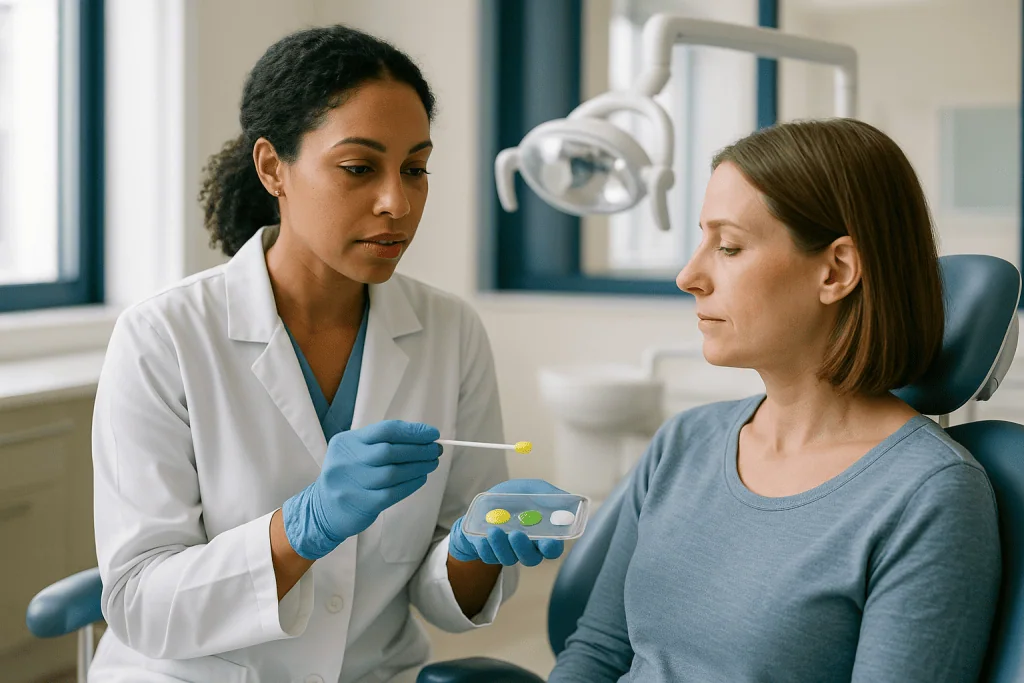
A fluoride varnish procedure is a quick, painless step in a routine dental visit. The dentist or hygienist dries the teeth, paints on a sticky, high-concentration fluoride varnish with a small brush, and it sets on contact with saliva. Gel or foam versions sit in a tray for a few minutes instead. The whole application usually takes only a few minutes, and no numbing or drilling is involved.
The hygienist has finished polishing, the water sprayer is off, and then she reaches for a tiny sealed packet the size of a ketchup sachet. “Just a little fluoride,” she says. Your child, sensing a change of routine, grips the armrests. You find yourself wondering the same thing many parents do in that moment: what exactly is in that packet, and why does it need to go on teeth that already get brushed twice a day?
That is the everyday scene behind the fluoride varnish procedure. It is one of the most ordinary things that happens in a dental chair, and one of the least explained. Most people receive it without ever hearing what it does to enamel, how it differs from the foam trays some of us remember from childhood, or why the aftercare instructions are so specific.
This explainer walks through the visit from start to finish, weighs what the evidence really shows, and gives you the questions worth asking before anyone opens that packet.
What is a fluoride varnish procedure, in plain language?
Fluoride varnish is a sticky, resin-based coating that carries a concentrated dose of fluoride, the mineral that helps enamel resist acid. A dental professional paints a thin layer onto the tooth surfaces, where it hardens almost immediately on contact with saliva and clings for hours while fluoride seeps into the outer enamel. Because it stays put rather than sloshing around the mouth, very little is swallowed, which is the main reason it has become the preferred professional fluoride method for young children, according to the NHS.
The word “varnish” throws people. It sounds like something for a wooden floor, and in a loose sense that is the idea: a protective film that stays where you put it. The difference is that this film is temporary and biologically active. Over the hours it clings to the teeth, it acts as a slow-release reservoir, letting fluoride do its work long after you have left the building.
Nothing about the procedure is invasive. There is no needle, no drill, no numbing, and no removal step. The teeth are not scraped or etched beforehand. In most practices the varnish is applied at the very end of a check-up or cleaning, taking a couple of minutes for a full mouth, and the patient walks out able to talk and drink normally.
The experience for the patient is mostly sensory: a slightly odd taste, a feeling that the teeth are coated or fuzzy, and sometimes a faint yellowish tint until the varnish wears off. Understanding those sensations in advance is half the battle, particularly with children. The rest of this article explains why the enamel needs the help, how the steps unfold, and where the honest limits of the treatment lie.
Why teeth need fluoride at all: the acid-and-mineral tug of war
Enamel is the hardest substance in the human body, but it is not inert. Every time you eat or drink something with sugar or starch, bacteria living in dental plaque digest it and release acid. That acid pulls calcium and phosphate out of the enamel surface, a process called demineralization. Between meals, saliva neutralizes the acid and pushes minerals back in, which is remineralization. A cavity is what happens when the losses outpace the repairs for long enough that the surface collapses, as the Mayo Clinic describes in its overview of tooth decay.

Fluoride tips that balance in three ways. First, when fluoride is present as minerals return to the enamel, they form a slightly different crystal, fluorapatite, which dissolves at a lower pH than ordinary enamel. In plain terms, the repaired surface is tougher than the original. Second, fluoride speeds up the remineralization itself. Third, at the concentrations found on the tooth surface after professional application, it interferes with the enzymes bacteria use to make acid.
None of this is a one-off effect. The protection is strongest when low levels of fluoride are around often, which is why daily toothpaste and, where available, fluoridated water do most of the heavy lifting. The CDC estimates that community water fluoridation reduces cavities by roughly a quarter in both children and adults. Professional varnish adds a concentrated top-up for people whose everyday exposure is not enough to hold the line.
Think of enamel as a seawall. Daily fluoride is routine maintenance. A varnish visit is the crew arriving with extra material before storm season, especially useful for the weak spots where the wall is already showing hairline cracks. It cannot rebuild a section that has already fallen; that is what fillings are for.
What are the steps involved in applying fluoride varnish?
The fluoride varnish procedure follows a short, predictable sequence. Knowing it in advance helps adults relax and gives parents a script to narrate for a nervous child.
- Check and consent. The clinician confirms there are no contraindications, asks about allergies, and explains what will happen. Some varnishes contain a resin derived from tree sap, so a history of related allergies is worth mentioning here.
- Cleaning, if scheduled. Varnish works on plaque-covered teeth, but many practices apply it after a polish so the enamel is as clean as possible.
- Drying. A small gauze square or cotton roll wipes saliva off a section of teeth. Air is sometimes used too. This step matters because varnish grips best on a dry surface.
- Painting. Using a tiny disposable brush, the clinician dabs a thin layer onto all tooth surfaces, paying extra attention to grooves, edges near the gum line, and any early white spots. The packet holds only a small amount, and the whole mouth takes a couple of minutes.
- Setting. The moment saliva touches the varnish, it firms into a film. There is no light, no rinse, and nothing to hold in the mouth.
- Instructions. The team explains what to eat, when to brush, and what the teeth may look and feel like for the rest of the day.
Children are often positioned lying back on a parent’s lap, knee to knee with the clinician, so the head is steady and the mouth is easy to see. The child does not need to keep still for long, and crying does not spoil the result; saliva only helps the varnish set.
The entire application is faster than most people expect. Patients frequently report that the explanation took longer than the treatment.
Varnish, gel or foam: how the three fluoride treatments compare
Professional fluoride comes in three main forms. All deliver a concentrated dose to the tooth surface, but they differ in how they are applied, how much is swallowed, and who they suit.
| Feature | Varnish | Gel | Foam |
|---|---|---|---|
| How it is applied | Painted on with a brush | Placed in a soft tray held over the teeth | Placed in a tray, lighter and airier than gel |
| Time in the mouth | Sets in seconds; stays on teeth for hours | Tray worn for a few minutes | Tray worn for a few minutes |
| Swallowing risk | Low, because it clings to enamel | Higher; patient must be able to spit reliably | Higher; same spitting requirement |
| Typical age group | All ages, including toddlers | Older children and adults | Older children and adults |
| Aftercare | Avoid brushing and hard or hot foods for the rest of the day, as directed | Avoid eating or drinking briefly, as directed | Avoid eating or drinking briefly, as directed |
| Appearance | May tint teeth yellowish until brushed off | No visible residue | No visible residue |
The trend in recent guidance has been toward varnish across the board. The NHS describes it as suitable for both baby and adult teeth, and the NIH Office of Dietary Supplements lists it among the standard professionally applied fluoride products. Trays of gel or foam remain in use, particularly for adults and teenagers who can sit with a tray, spit thoroughly, and tolerate the taste. Some patients with a strong gag reflex prefer varnish because nothing bulky sits in the mouth.
Which form you receive is a clinical judgment. It depends on your age, your cavity risk, how many teeth are being treated, and what the practice stocks. There is no evidence that patients need to choose between them themselves, and it is reasonable to simply ask why one was selected for you.
Who is fluoride varnish usually for, and who is asked to wait?
Fluoride varnish is offered most consistently to children. The NHS recommends it for children from age three at routine check-ups, typically twice a year, and notes it can be used for younger children on the dentist’s advice. The logic is straightforward: baby teeth have thinner enamel, small children cannot spit reliably, and the years when adult teeth are erupting are the years when their surfaces are most vulnerable.
Beyond age, the deciding factor is risk. People who commonly benefit include:
- Anyone who has had cavities in the last few years, since past decay is the strongest predictor of future decay.
- Children with early white-spot lesions, the chalky patches that signal enamel losing minerals before a hole forms.
- People wearing braces, where brackets trap plaque and make brushing harder.
- Adults with dry mouth from medicines, radiotherapy to the head and neck, or conditions such as Sjögren’s syndrome, because less saliva means less natural repair.
- Older adults with receding gums, exposing root surfaces that are softer than enamel and decay faster.
- Anyone whose diet, disability, or circumstances make consistent brushing difficult.
Who is usually asked to wait? Very few people are firmly excluded. A known allergy to colophony, the pine-resin base in many varnishes, is the main reason to choose a different product or skip it. Clinicians also typically postpone application when there are open mouth ulcers, ulcerative gingivitis, or active bleeding, simply because the varnish is unpleasant on raw tissue. A child who is unwell on the day may be rebooked.
Low-risk adults with healthy teeth, fluoridated water, and good brushing habits may be told that varnish adds little for them. That is not a refusal of care; it is the evidence being applied honestly. The decision always rests with the dental team, who can see the mouth in front of them.
How long should fluoride varnish stay on teeth?
This is the question people most often type into a search bar after leaving the practice, usually because the instructions were delivered while they were paying and fastening a coat. The short answer is: as long as your dental team tells you, which in most practices means avoiding brushing until the next morning.
The reasoning comes back to how varnish works. Unlike gel or foam, which deliver their fluoride in the few minutes the tray is in place, varnish is designed to be a slow-release reservoir. Every hour it clings to enamel is another hour of fluoride migrating into the surface and being held in the plaque and saliva around the teeth. Brushing it off early cuts that window short. The varnish is not permanent; chewing and normal saliva flow wear it away over the following day, and brushing removes whatever remains.
Typical instructions cover four things:
- Skip brushing and flossing for the rest of the day, resuming the next morning.
- Choose soft foods and avoid very hot drinks, crunchy snacks, and sticky sweets that could peel the film off.
- Do not be alarmed by a yellowish tint or a rough, coated feeling; both disappear once the varnish is brushed away.
- Avoid other fluoride products such as mouth rinse on the day of application, unless told otherwise.
Patients sometimes ask whether leaving it on longer would help more. There is no evidence for that, and the film naturally wears off anyway. Equally, if a child eats a crunchy snack an hour later, the visit is not wasted; a good portion of the fluoride uptake happens early. Just return to the usual routine and mention it at the next appointment.
If your team gave a specific timeframe that differs from the general pattern above, follow theirs. They know which product was used and why.
What the rest of the day and the following weeks usually look like
The first few hours are the only part of the timeline that requires any attention. The teeth feel slightly waxy. Some people notice a mild, slightly bitter or medicinal taste that fades as saliva does its work. Children may run their tongue over their front teeth and announce that they feel “weird”; this is normal and passes. Lunch is usually soft: yogurt, pasta, soup that is not piping hot. By bedtime most people have forgotten the varnish is there.
The next morning, brushing removes any remaining film along with the yellow tint. The teeth look and feel exactly as before. There is no residue to worry about, no follow-up visit for removal, and no restriction on activity, sport, or school.
What happens beneath the surface is quieter and slower. Over the following weeks, the fluoride that entered the outer enamel continues to make the surface more resistant to acid and, in areas of early demineralization, supports the return of calcium and phosphate. This is why a white spot noted at one visit may look less chalky at the next. It is also why the benefit is cumulative: a single application helps, but the systematic review evidence discussed later in this article is built on repeated applications over months and years.
The NHS describes twice-yearly application as the usual rhythm for children at routine check-ups. People at higher risk may be seen more often; that is a clinical decision, not a fixed schedule. Between visits, the ordinary tools matter more than the varnish: brushing twice daily with a fluoride toothpaste, limiting the frequency of sugary snacks and drinks, and drinking water.
In short, the timeline has an active afternoon, an uneventful night, and then months of invisible work. Nothing about it should interfere with daily life, and there is no recovery in the conventional sense.
Is fluoride varnish at the dentist worth it? What the evidence actually shows
The honest answer depends on who is asking. For children and teenagers, particularly those at elevated cavity risk, the evidence is reasonably solid. A Cochrane systematic review of 22 trials found that regularly applied fluoride varnish was associated with about a 43 percent reduction in decayed, missing, or filled tooth surfaces in permanent teeth, and about 37 percent in baby teeth, compared with placebo or no treatment. The authors rated the quality of that evidence as moderate, meaning further research could shift the numbers somewhat but is unlikely to overturn the direction of the finding.
Two caveats are worth spelling out. Those percentages are relative reductions averaged across populations; a child with very low risk starts from such a small baseline that a 43 percent reduction may amount to a fraction of a tooth surface. The trials also varied in how often varnish was applied and in what other fluoride the children were already getting, so the benefit in any one mouth is uncertain.
For adults, the trial evidence is thinner. Most professional bodies extend the recommendation to adults at elevated risk on the basis of shared biology, the strength of the pediatric data, and the very low risk of harm, rather than on large adult trials. That is a reasonable position, but it should be described as such.
Where does that leave the “worth it” question? Varnish is not a substitute for daily fluoride toothpaste, a low-sugar diet, or fluoridated water, each of which does more over a lifetime. It is a low-risk, quick addition that has its best-documented payoff in children and in anyone whose enamel is already under strain. If your dental team recommends it, the evidence supports saying yes. If they say you do not need it, the evidence supports that too.
What are the downsides of fluoride varnish? Side effects explained honestly
Fluoride varnish side effects are mostly minor and short-lived, but they deserve a plain account rather than a wave of the hand.
The most common complaints are cosmetic and sensory. Many varnishes leave the teeth looking dull or yellowish for the rest of the day, which can surprise a teenager before a social event. The taste is described as sweet, medicinal, or faintly bitter depending on the product, and the coated sensation bothers some people more than others. All of this resolves once the varnish is brushed off.
Nausea or a brief upset stomach can occur if a meaningful amount of fluoride is swallowed. This is more of a concern with tray-applied gel or foam than with varnish, which is one reason varnish is favored for small children. The amounts in a single varnish application are small, and serious toxicity from a routine professional application is not something reported in the mainstream literature.
Allergic reactions are rare but real. The resin base in many products is colophony, related to pine rosin, and people with a documented allergy to it, or to certain adhesive plasters, should tell the team before application. Swelling, hives, or wheezing after any dental product is a reason to seek urgent care, as covered in the final section.
The longer-term question people raise is dental fluorosis, the faint white streaking or, rarely, brown mottling that can occur when developing teeth receive too much fluoride overall. MedlinePlus and the CDC both note that fluorosis is a risk only while teeth are still forming under the gums, roughly up to age eight, and that it reflects total intake from all sources, especially swallowed toothpaste. Twice-yearly professional varnish, applied by a clinician in controlled amounts, is not considered a significant contributor.
Finally, an honest downside: varnish can create a false sense of security. It protects; it does not license skipping brushing or sipping sugary drinks all day.
Fluoride treatment for kids: preparing a child for the visit
For most children, the varnish itself is the easy part. The hard part is the unknown. A few minutes of preparation at home changes the experience more than anything the clinician can do in the room.
Start with honest, simple language. “The dentist is going to paint your teeth with a special vitamin coat that makes them strong” is accurate enough and avoids words like “medicine” or “treatment” that can carry baggage. Mention that it tastes a bit different and might feel sticky. Children cope far better with an odd sensation they were told about than with a surprise.
Practice the position. Toddlers are often treated lying back with their head in the clinician’s lap and their legs across a parent’s, which keeps the mouth visible and the child steady. A quick game at home of lying back and opening wide, with a parent counting teeth, turns the unfamiliar into a routine.
On the day, a light meal beforehand helps, since eating afterward will be softer and later than usual. Bring a favorite cup with water. Skip the brushing lecture in the waiting room; the goal is a calm child, not a perfectly clean mouth, and varnish works on plaque-covered teeth anyway.
Afterward, follow the team’s advice on food and brushing, and expect a discussion about the tint. Framing it as “your teeth are wearing their protective coat until tomorrow” turns a complaint into a badge.
Comfort after the visit is rarely an issue. There is no soreness, no numbness, and no wound. If a child is genuinely distressed, it is almost always about the position or the taste rather than any pain, and it passes quickly. Praise, a sticker, and a soft snack close the loop. The next visit, in the NHS’s typical twice-yearly rhythm, is usually easier still.
Fluoride treatment for adults: do grown-up teeth still benefit?
Adults often assume fluoride is something they aged out of, like booster seats. The biology says otherwise. Enamel does not stop dissolving in acid at eighteen, and several things that arrive with adulthood make teeth more vulnerable, not less.
Dry mouth is the big one. Hundreds of common medicines, including many for blood pressure, depression, allergies, and bladder control, reduce saliva flow as a side effect. Saliva is the body’s own remineralizing fluid; less of it means acid lingers longer and repair happens more slowly. Radiotherapy to the head and neck and autoimmune conditions such as Sjögren’s syndrome have the same effect, often more severely. The Mayo Clinic lists dry mouth among the key risk factors for cavities at any age.
Receding gums are another. As gums pull back, they expose the root surface, which is covered in cementum and dentin rather than enamel. These tissues are softer and begin to demineralize at a milder acidity, so root cavities are a distinct problem in older adults. Fluoride varnish painted along the gum line is one of the standard responses.
Braces, partial dentures, and crowns all create ledges where plaque hides. Frequent snacking, acid reflux, and sipping sports drinks through a long workday add acid load. Any of these can move a previously low-risk adult into a category where professional fluoride makes sense.
The evidence base for adults is smaller than for children, as noted earlier, so the recommendation rests partly on shared mechanism and the treatment’s very low risk. That is a reasonable basis, and it is how most guideline bodies frame it. The question to ask is not “am I too old for this” but “what is my risk right now.” Your dental team can answer that from your history, your saliva, and what they see on the X-rays.
What people often get wrong about fluoride varnish
A handful of misunderstandings surface repeatedly in the chair. Correcting them makes the procedure easier to accept and, more importantly, easier to use well.
“Varnish fixes cavities.” It does not. Fluoride can help reverse the earliest stage of decay, when enamel has lost minerals but has not yet broken down into a hole. Once a cavity has formed, the tissue is gone and a filling or other restoration is needed. Varnish protects what remains; it does not rebuild.
“If my child gets varnish, brushing matters less.” The opposite is closer to the truth. Daily low-level fluoride from toothpaste is the foundation, and the trials behind varnish were run in children who were also brushing. Varnish is a supplement to the routine, not a replacement.
“Varnish is only for kids.” As the previous section explained, adults with dry mouth, receding gums, braces, or a recent cavity history are among those who commonly receive it.
“The yellow color means something went wrong.” Many products are tinted so the clinician can see coverage. The color brushes off the next day.
“Professional fluoride causes fluorosis.” Fluorosis reflects total fluoride intake during the years teeth are forming, and the main culprit historically has been young children swallowing toothpaste. The CDC and MedlinePlus both point to age-appropriate toothpaste amounts and supervision as the lever that matters. Controlled professional application twice a year is not the driver.
“Foam and gel are stronger because they take longer.” Time in the tray reflects how those products deliver fluoride, not superior potency. Varnish delivers over hours by clinging to the teeth.
“It hurts.” There is no needle, drill, or pressure. The only discomfort most people describe is taste and texture.
Alternatives to fluoride varnish, and what happens if you decline
Declining varnish is a legitimate choice, and no dental team should treat it as anything else. It helps to know what the alternatives are and what the trade-off looks like.
The most powerful alternative is already in your bathroom. Brushing twice a day with a fluoride toothpaste, spitting rather than rinsing so a little fluoride stays on the teeth, and supervising children so they use an age-appropriate amount are the interventions with the broadest evidence base. The NHS describes this as the core of children’s dental care, with varnish layered on top.
Community water fluoridation, where it exists, provides constant low-level exposure. The CDC’s estimate of roughly a quarter fewer cavities in fluoridated communities applies to children and adults alike. If your water is not fluoridated, or you drink mostly bottled or filtered water, mention it; it changes the risk calculation.
Diet is the lever people underestimate. It is the frequency of sugar exposure, not just the amount, that drives decay, because each exposure triggers an acid attack that lasts well beyond the last swallow. Fewer snacking episodes and water between meals do more than any single professional treatment.
Dental sealants are a different kind of protection. A thin plastic coating is bonded into the deep grooves of molars, physically blocking plaque from the areas where most childhood cavities begin. Sealants and varnish are not competitors; many children receive both.
Prescription-strength fluoride toothpaste is another professional option for adults and older children at high risk, used at home under a dentist’s direction. Whether it suits you is a decision for the prescribing clinician.
If you decline varnish, nothing dramatic happens. Your risk simply stays where the rest of your habits put it, and the team will keep monitoring. If early decay appears later, varnish can be revisited then.
Questions to ask your care team before the varnish goes on
The application takes two minutes; the conversation around it can take less if you arrive with the right questions. These are the ones that tend to change decisions or ease worries.
- Why are you recommending fluoride varnish for me or my child specifically? The answer should mention risk factors: past cavities, white spots, dry mouth, braces, diet, or water supply. “We do it for everyone” is a policy, not a reason.
- Which form are you using, and why that one? Varnish, gel, and foam each have a place. Understanding the choice helps you follow the matching aftercare.
- Does this product contain colophony or any other resin I should know about? Essential if you or your child has reacted to pine rosin, adhesive plasters, or a previous dental product.
- Exactly how long should we wait to eat, and when should we brush again? Ask for the specific instruction for this product rather than relying on a general rule.
- How often do you expect to repeat this, and what would change that plan? Twice a year is a common rhythm for children, but higher risk can mean more, and lower risk can mean less.
- What are the early signs that the varnish is doing its job, or not? A good answer involves white spots, X-ray findings, and how the plan adjusts if new decay appears.
- Is our water fluoridated, and does that affect what you recommend? If the team does not know, it is worth finding out yourself.
- Are there other preventive steps, such as sealants or a different toothpaste, that would help more?
- If we decline today, what do you suggest instead, and when would you want to revisit it?
Write the answers down or ask for them in the visit summary. The details that matter most, especially aftercare timing, are the easiest to forget on the way to the car.
When to call your doctor or dentist after a fluoride varnish visit
Serious problems after fluoride varnish are rare, and most people need no follow-up at all. Even so, a few situations warrant a prompt call, and knowing them in advance removes the guesswork.
Seek urgent medical care immediately if, within minutes to a few hours of the application, there is swelling of the lips, tongue, face, or throat, difficulty breathing or swallowing, widespread hives, or a feeling of faintness. These are signs of a possible allergic reaction, most often to the resin base, and they need emergency assessment rather than a wait-and-see approach.
Call your dentist or doctor the same day if a child vomits repeatedly after the visit, becomes unusually drowsy or floppy, complains of persistent stomach pain, or if you have reason to believe a large amount of fluoride product was swallowed, for example if a child got hold of a packet or tray. The amounts used in a routine varnish application make this very unlikely, but poison-control or medical advice is the right response to any genuine concern about ingestion.
Contact your dental team, without urgency, if a rash or soreness inside the mouth develops in the following days, if gums around the treated teeth become red or painful, or if the yellow tint does not brush off after two or three cleanings. Also let them know if the aftercare instructions were not followed, so they can decide whether anything needs adjusting.
Separately from the varnish itself, some symptoms should always prompt a dental appointment regardless of recent treatment: a toothache that wakes you or a child at night, a visible hole or dark spot, sensitivity to sweet foods that lingers, or facial swelling near a tooth. Varnish prevents; it does not treat an established problem, and the sooner decay is seen, the smaller the repair.
Every decision about repeating, changing, or stopping fluoride treatment belongs with the team who examined your mouth.
Frequently asked questions
How long should fluoride varnish stay on teeth?
Leave it on for as long as your dental team advises, which in most practices means not brushing until the following morning. Varnish is designed as a slow-release reservoir, so every hour it stays on the enamel extends the fluoride uptake. Soft foods and lukewarm drinks help it stay put. If a child eats something crunchy early, the visit is not wasted; simply resume the usual routine and mention it next time.
What are the downsides of fluoride varnish?
The common downsides are cosmetic and temporary: a yellowish tint, a coated feeling, and an odd taste until it is brushed off. Mild nausea can occur if fluoride is swallowed, though this is more associated with tray-applied gel or foam. Rare allergic reactions to the resin base are possible in people sensitive to pine rosin. Fluorosis is not linked to controlled professional application; it reflects total intake during tooth formation.
What are the steps involved in applying fluoride varnish?
The clinician confirms consent and allergies, often cleans the teeth, dries a section with gauze, and paints a thin layer of varnish onto all surfaces with a small brush. It sets within seconds when saliva touches it, so there is no rinsing, light, or removal step. The team then explains what to eat and when to brush. A full mouth typically takes a couple of minutes.
Is fluoride varnish at the dentist worth it?
For children and anyone at elevated cavity risk, the evidence supports it: a Cochrane systematic review found regular varnish associated with meaningful reductions in decay, rated as moderate-quality evidence. For low-risk adults with good brushing habits and fluoridated water, the added benefit may be small, and a dentist may reasonably say it is not needed. It supplements daily toothpaste and a low-sugar diet rather than replacing them.
How long does fluoride varnish last on the teeth and in its effect?
The visible film wears off within about a day through chewing and saliva, and brushing removes the rest. The protective effect lasts far longer, because fluoride that entered the outer enamel continues to make it more acid-resistant over the following weeks and months. That is why guidance such as the NHS’s describes repeating application at routine check-ups, typically twice a year for children, rather than treating it as a one-off.
Does fluoride varnish hurt?
No. There is no needle, drill, pressure, or numbing involved. The only sensations most people report are a slightly medicinal taste and a sticky or fuzzy feeling on the teeth for the rest of the day. Young children sometimes dislike lying back or having a brush in their mouth, but the discomfort is about the unfamiliar position rather than pain, and it ends the moment the application finishes.
Can my child eat after a fluoride varnish treatment?
Yes, but softer and later is the usual advice. Most teams recommend waiting a short while, then choosing soft foods and avoiding very hot drinks, crunchy snacks, and sticky sweets for the rest of the day so the film is not peeled off early. Water is fine. Follow the specific timing your team gives, since products vary slightly in their instructions.
What is the difference between fluoride varnish and fluoride gel or foam?
Varnish is painted on and sets into a film that stays on the teeth for hours, while gel and foam sit in a tray for a few minutes and are then spat out. Varnish involves far less swallowing, which makes it the preferred option for young children, people with a strong gag reflex, and anyone who cannot spit reliably. All three deliver concentrated fluoride to the enamel surface.
Can fluoride varnish cause fluorosis?
Routine professional varnish is not considered a meaningful cause. Dental fluorosis, the faint white streaking on enamel, arises from total fluoride intake during the years teeth are forming beneath the gums, up to roughly age eight, and the main historical source has been young children swallowing toothpaste. Controlled, twice-yearly application by a clinician contributes very little to that total, according to CDC and MedlinePlus information.
Do adults need fluoride treatment at the dentist?
Some do, depending on risk rather than age. Adults with dry mouth from medicines or medical conditions, receding gums that expose softer root surfaces, braces, or a recent history of cavities are commonly offered varnish. Adults at low risk may be told it adds little. The trial evidence for adults is smaller than for children, so the recommendation rests on shared biology and low risk; your dental team decides based on your mouth.
References
- NHS: Taking care of children's teeth
- CDC: About Community Water Fluoridation
- MedlinePlus: Fluoride in diet
This article is for general information only and is not a substitute for professional medical advice. Please consult a qualified doctor about your individual situation.

More from the Blog

Which Tooth Decay Treatment Fits the Damage? Filling, Inlay, Crown or Root Canal
The right tooth decay treatment depends on how much healthy tooth is left, not on how much the cavity hurts. Small to moderate cavities…

After Oral and Maxillofacial Surgery: Expected Bleeding vs Signs That Need a Call
After oral or maxillofacial surgery, light oozing that tints saliva pink for the first day is expected, and swelling usually peaks around day two…
Realistic Results in Aesthetic Dentistry: What Shade, Shape and Symmetry Can Change
Cosmetic dentistry realistically changes three things: shade (whitening lightens natural enamel, not fillings or crowns, and fades over months to a few years), shape…
Porcelain Veneers Myths: Ruined Teeth, Fake Looks and Other Claims Explained Honestly
Most porcelain veneers myths do not hold up. Veneers do not rot the tooth underneath, but conventional veneers do require removing a thin layer…

Can You Eat After a Root Canal? From the Temporary Filling to the Day the Crown Is Fitted
Yes, you can eat after a root canal, but most dentists ask you to wait until the local anesthetic has fully worn off, usually…
Which Restorative Dental Treatment Fits the Damage? Filling, Crown, Root Canal or Implant
The right choice among a filling, crown, root canal or implant depends mostly on how much healthy tooth remains and whether the nerve inside…