

What Happens During a CoolSculpting Session: Applicators, Cooling Time and the Massage After
Key Takeaways
- Cryolipolysis, the procedure behind the CoolSculpting brand name, cools pinchable fat so the cells die gradually by apoptosis and are cleared by the immune and lymphatic systems over weeks to months.
- A single cooling cycle runs about 35 to 60 minutes depending on the device, with intense cold for the first five to ten minutes followed by numbness for the rest.
- Published studies measured a 10 to 25 percent reduction in the thickness of the treated fat layer after one session, with visible change typically at two to four months.
- The two-minute massage immediately after the applicator comes off is uncomfortable but has small-study evidence of increasing fat reduction, which is why clinicians do it.
- Paradoxical adipose hyperplasia, a rare firm enlargement of treated fat appearing two to five months later, was first estimated at about 1 in 20,000 cycles and usually needs surgery to correct.
- Fat cells removed do not regrow, but the remaining cells can enlarge with weight gain, so the result lasts only as long as weight stays reasonably stable.
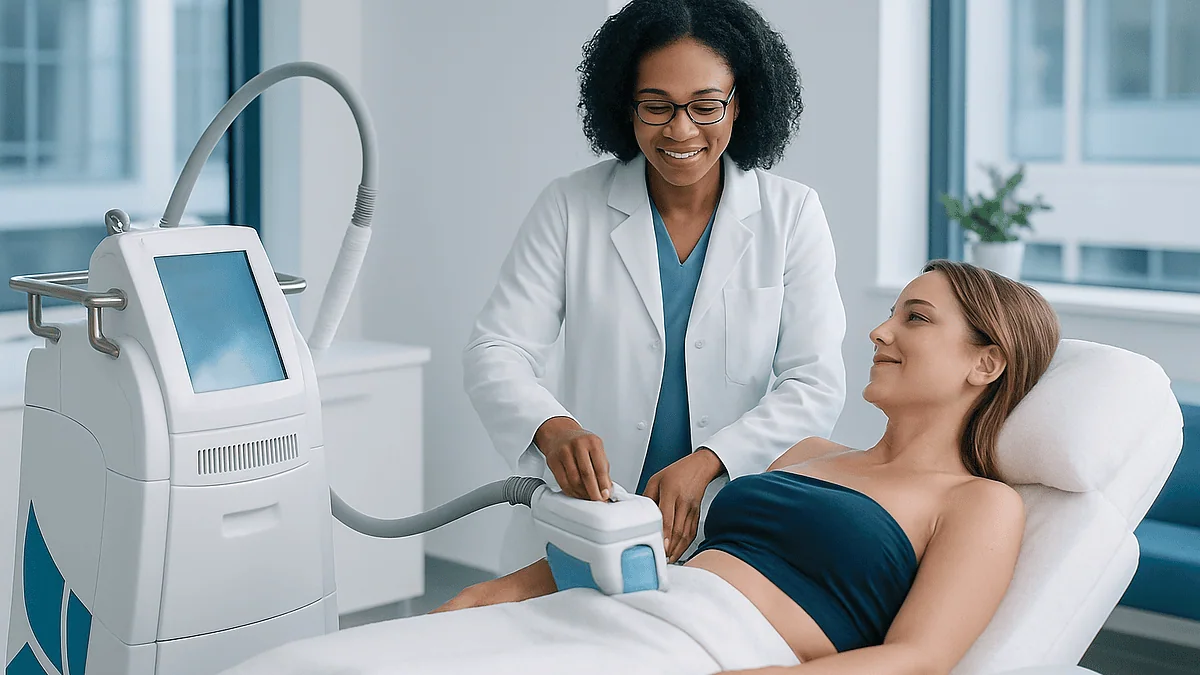
During a CoolSculpting session, a clinician marks the treatment area, places a protective gel pad on the skin, and attaches a cooling applicator that gently draws tissue in or rests flat against it. Controlled cooling runs for roughly 35 to 60 minutes per area. The applicator is then removed and the numb, firm tissue is massaged for about two minutes. Patients usually go home the same day.
You have read the website, booked the appointment, and now you are sitting on a treatment couch in a paper gown wondering one practical thing: what exactly is about to happen to you? Not the marketing version. The real sequence, from the first pen mark on your skin to the strange, taffy-like feel of the tissue when the applicator comes off.
Knowing what happens during CoolSculpting matters more than it might seem. People who understand the pulling sensation, the deep cold, the brief ache of the massage afterward and the weeks of numbness that can follow tend to describe the experience as odd rather than frightening. Those who walk in blind often describe the same session as alarming.
This explainer walks through one session in order, grounds every number in published evidence, and is honest about what is still uncertain, including a rare complication that deserves plain language rather than a footnote.
What happens during CoolSculpting, step by step
CoolSculpting is the brand name most people use for a procedure called cryolipolysis, which simply means breaking down fat cells with controlled cold. Several devices exist; the sequence of a session is broadly similar across them, and the research cited here concerns cryolipolysis in general rather than any one product.
A typical appointment follows a predictable arc. First comes a short assessment: the clinician looks at the area, checks it can be grasped as a soft, pinchable fold, and confirms nothing in your history rules you out. Next the skin is marked with a template and a clear gel pad is laid down to protect it from frostbite-type injury. Then the applicator goes on. Most applicators use gentle vacuum to pull the fold of tissue between two cooling plates; some flat models rest against areas that cannot be pinched. Cooling then runs for a set cycle, usually between 35 and 60 minutes depending on the device and applicator, according to a systematic review of cryolipolysis studies published in Plastic and Reconstructive Surgery.
When the cycle ends, the applicator is removed and the treated tissue is firm and cold, often compared to a stick of butter from the fridge. The clinician massages it for around two minutes. The redness and swelling that follow are expected. You dress and leave; there is no anesthesia to wake up from and no incision to protect.
Nothing visible changes that day. The fat cells that have been injured by cold are cleared by the body gradually, which is why the earliest changes in treated fat are usually described two to four months later, not two to four days.
How does fat freezing actually work inside the body?
The idea behind cryolipolysis rests on an observation that dermatologists made decades ago: fat cells are more vulnerable to cold than the skin, nerves and muscle around them. Case reports described children who developed temporary dimples in their cheeks after sucking on ice pops, a phenomenon called popsicle panniculitis. Fat had been injured; skin had not.
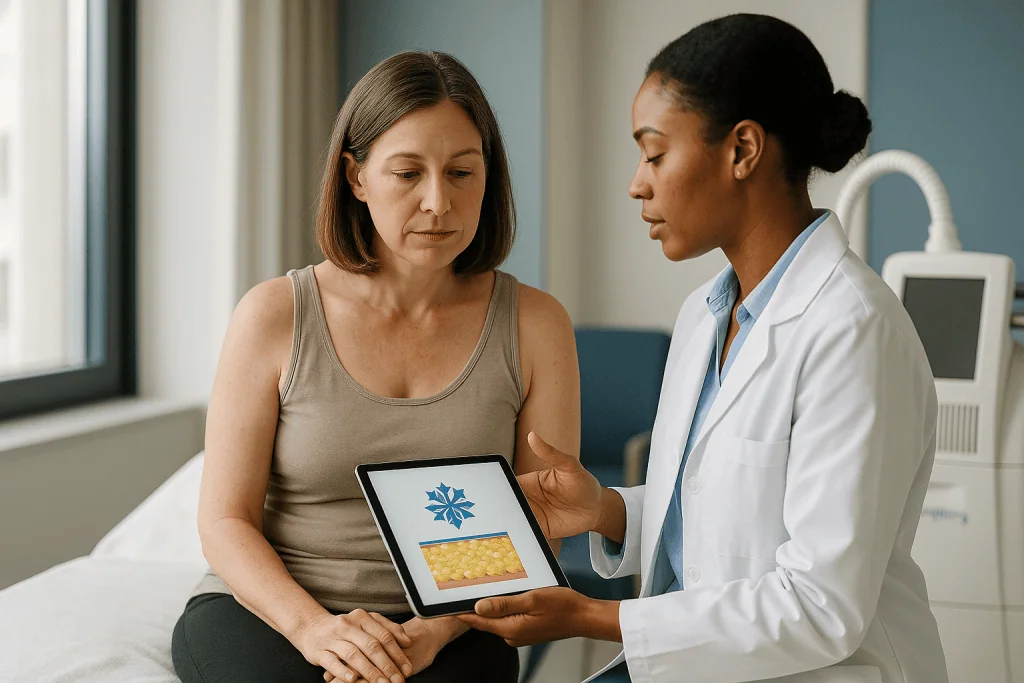
Modern devices exploit that difference deliberately. When fat tissue is held at a low but non-freezing temperature for long enough, the fat cells begin a slow, programmed death called apoptosis. Apoptosis is the body’s orderly way of dismantling a cell without rupturing it, which is important, because a ruptured fat cell spills its contents and provokes a more aggressive inflammatory response. With apoptosis, inflammatory cells arrive over the following days and weeks, engulf the damaged fat cells and carry the lipid away through the lymphatic system, where it is processed like dietary fat.
Studies in the systematic review mentioned above measured the thickness of the fat layer before and after a single treatment using ultrasound. Reductions ranged from roughly 10 to 25 percent of the treated layer’s thickness. That figure explains both the appeal and the limits of the method: it thins a specific pocket of fat, and it does so modestly. It does not change body weight in any meaningful way, and it does not affect visceral fat, the deeper fat that surrounds the organs and carries most of the metabolic risk.
One more mechanism point matters for the rest of this article. Because the cold also stuns the small sensory nerves in the skin, numbness and altered sensation are common afterward and typically fade over weeks as the nerves recover. That is an expected effect of the mechanism, not a sign of injury.
Before the applicator goes on: assessment, marking and the gel pad
The quietest part of the session is often the most consequential. A clinician who takes several minutes to pinch, photograph and mark the area is doing the work that determines whether the result looks even or lumpy.
The pinch test comes first. Cryolipolysis treats subcutaneous fat, the layer that sits between skin and muscle and can be gathered in your fingers. If the fullness in an area comes mostly from deeper fat behind the abdominal wall, no applicator can reach it. A good assessment also checks skin quality, because very loose skin may look looser once the fat beneath it shrinks, and notes any hernia, scar or tenderness in the field.
Marking follows, usually with a plastic template matched to the applicator size. The template lines up with the fold so the vacuum draws in the intended tissue and nothing else. Photographs taken at this stage are your baseline; honest follow-up comparisons depend on matching lighting and posture later.
Then comes the gel pad, a cool, slightly wet sheet laid over the marked skin. Its job is protection. Without it, the skin surface could be cooled too far and develop a cold injury similar to frostbite. If a clinician skips the pad or it slips during setup, that is worth speaking up about immediately.
Expect a few practical questions at this point too: whether you have eaten, whether you are warm enough, whether you need the restroom before a long cycle. These details are not fussiness. Sitting still for most of an hour while part of you is numb and immobilized goes far more smoothly when nothing else is nagging at you.
Choosing the applicator and what the suction feels like
Applicators come in a family of shapes, and the match between applicator and anatomy is where technique shows. Curved vacuum cups suit the lower abdomen and flanks. Smaller cups are built for the area under the chin or the fat between the bra line and the arm. Flat, non-suction plates are used on surfaces that will not form a fold, such as the outer thigh in some people.
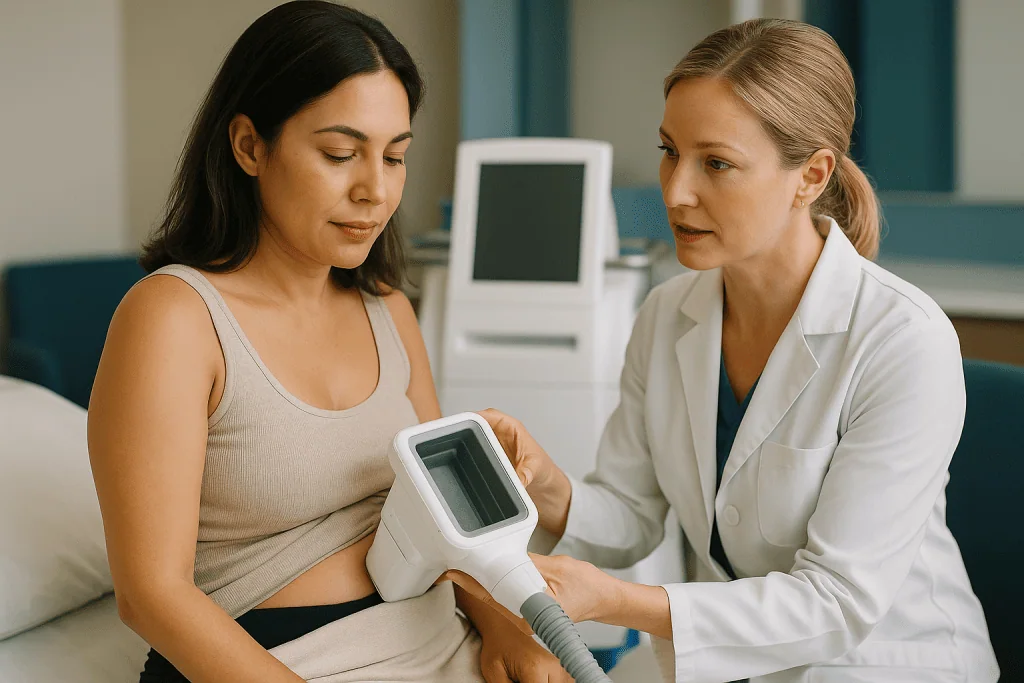
When a vacuum applicator is placed, the first sensation is a firm, steady pull as the tissue is drawn up into the cup. People describe it as intense pressure, a strong pinch, or the feeling of a very determined hug on one small spot. It is uncomfortable rather than sharp, and it usually eases within a few minutes once the skin and the sensory nerves begin to chill.
Then the cold arrives. For the first five to ten minutes the area feels intensely cold, sometimes with a pulling ache that spreads a little beyond the cup. After that, numbness takes over and most people stop noticing the applicator at all. In the systematic review of cryolipolysis trials, discomfort during treatment was reported as mild to moderate and temporary, with no study requiring pain medication during the cycle itself.
Two things are worth asking during placement. One is whether the cup has a full, even seal; a partial seal can cool unevenly or lose vacuum midway. The other is how the clinician plans to treat a wide area such as the abdomen: with overlapping placements, a larger applicator, or a second cycle. Fat does not shrink neatly to the edge of a cup, so the plan for edges and overlap is a legitimate part of what happens during CoolSculpting and a reasonable thing to understand before the cold begins.
Does CoolSculpting hurt? The cooling phase minute by minute
The honest answer is that it is uncomfortable at the start and dull in the middle. Here is how the cooling phase typically unfolds once the applicator is sealed.
Minutes one to five: the vacuum sensation dominates. Pressure, tugging, a feeling that the skin is being held tightly. Breathing slowly through this stretch helps more than people expect.
Minutes five to ten: deep cold. This is the window most people name when asked what the worst part was. It can sting, ache or burn in a cold way, and the ache can radiate a little. Then it fades, not because the device has warmed but because the nerves have gone quiet.
Minutes ten to the end of the cycle: numbness. Most people read, scroll, nap or talk. Cycles vary by device and applicator, with 35 to 60 minutes the range reported across published studies. If a second area is being treated at the same time with a second applicator, the two sensations do not usually add up to something worse; they are simply two numb spots.
Toward the end: a mild thaw ache can begin as the cycle finishes, and some people feel a cramping or pulling sensation when the vacuum releases.
Pain that escalates during the cycle rather than fading, or any burning that feels like the skin itself is hurting, is not typical and should be reported to the clinician right away so the seal and skin can be checked. Everything else described here falls within the expected, published experience of the procedure.
The massage after: why those two minutes matter
When the applicator comes off, the treated tissue stands up in a firm, cold, slightly waxy mound shaped exactly like the inside of the cup. It looks strange. It feels stranger. Then the clinician begins to knead it, and for a minute or two the numbness gives way to a sharp, tingling, pins-and-needles ache as blood flow and sensation return. Many people say this is the single most unpleasant moment of the session. It passes quickly.
The massage is not just about flattening the mound for comfort. In the research literature it is treated as part of the mechanism. One small controlled study included in the systematic review treated both flanks of the same participants and massaged only one side; the massaged side showed a larger reduction in fat layer thickness at two months. The proposed explanation is that mechanical disruption of the chilled fat cells adds to the cold injury and increases the number of cells cleared later. Because the trial was small, the finding is best described as supportive rather than settled.
Expect the massage to be vigorous: a mix of kneading and circular pressure, usually around two minutes, sometimes with a mechanical massage device in place of hands. The area will be red, swollen and tender afterward, and bruising can appear over the following day.
Once the massage is done, there is nothing left to the session except dressing and going home. Loose clothing is kinder to a tender, swollen area than anything tight at the waistband, and a short walk to the car is perfectly fine. This is also the moment to confirm the plan for follow-up photographs and to be clear about what sensations in the coming days are expected and which should prompt a call.
How long does a session take, and what does the timeline look like?
The whole appointment usually runs longer than the cooling itself. Assessment, marking, applicator placement and massage add time at both ends, and treating several areas can mean multiple cycles in sequence or in parallel. The table below sets out typical ranges for a single area, drawn from the published studies in the systematic review and from mainstream clinical summaries. Treat them as ranges, not promises; your care team will give you figures for your own plan.
| Stage | Typical duration or timing | What you are likely to notice |
|---|---|---|
| Assessment and marking | 10–20 minutes | Pinch test, photographs, template lines on skin |
| Gel pad and applicator placement | 5–10 minutes | Cold wet pad, then strong vacuum pull |
| Cooling cycle, one applicator | 35–60 minutes | Intense cold for 5–10 minutes, then numbness |
| Post-treatment massage | About 2 minutes | Sharp tingling as sensation returns |
| Redness, swelling, bruising | Days to about 2 weeks | Area looks and feels bruised |
| Numbness or altered sensation | Up to several weeks | Tingling, dullness, occasional itching |
| Earliest visible change in fat layer | Around 2 months | Subtle softening of the fold |
| Fuller change measured in studies | 2–4 months | Clothing may fit differently in that area |
Two points deserve emphasis. A single area treated once showed a 10 to 25 percent reduction in fat layer thickness in the published studies, so clinicians often discuss whether a second cycle on the same area, spaced a few months apart, makes sense. And the slow timeline is biology, not a flaw: the body clears damaged fat cells at its own pace, and no amount of extra massage, wrapping or supplements speeds it up.
Who is cryolipolysis usually for, and who is usually asked to wait?
The procedure was designed for a narrow job: thinning a discrete, pinchable pocket of fat in someone who is already near a weight they are comfortable with. Clinicians describe the typical candidate as having stable weight, realistic expectations about a modest change, and a specific area that has not responded to the ordinary levers of diet and activity. It is not a weight-loss treatment, and mainstream medical sources including Mayo Clinic are explicit that it does not treat obesity or improve metabolic health.
Some people are asked to wait or steered toward other options altogether. Three uncommon cold-related conditions are generally considered absolute reasons not to proceed: cryoglobulinemia, in which abnormal proteins in the blood clump when cooled; cold agglutinin disease, in which cold triggers red cells to stick together; and paroxysmal cold hemoglobinuria, a rare condition in which cold causes red cells to break down. Each turns a controlled chill into a genuine medical risk.
Others are typically deferred rather than excluded: anyone pregnant or breastfeeding, anyone with a hernia or open wound in the treatment field, people with reduced sensation or poor circulation in the area, and those with active skin conditions where the applicator would sit. Raynaud phenomenon and a history of cold urticaria, a hives reaction to cold, call for a careful discussion.
Candidacy also includes expectations. Someone hoping to lose a dress or trouser size, to tighten loose skin, or to see a result before an event next month is likely to be disappointed, and a thoughtful clinician will say so. Where the goal is larger-volume fat removal in one procedure, liposuction remains the surgical alternative, with its own recovery, anesthesia and risk profile described in plain terms by MedlinePlus. Which path, if any, fits you is a decision for you and your treating team.
What the following days and weeks usually look like
The first evening, the treated area is typically red, puffy and tender, with the faint outline of the applicator still visible. Many people describe a dull, bruised feeling, as if they had been firmly poked for an hour, which is roughly what happened. Bruising can darken over the first two or three days, especially where vacuum applicators were used.
Numbness is the sensation that surprises people most. The skin can feel dull, tingly, oddly cool, or itchy, and these altered sensations commonly persist for several weeks before settling. The systematic review reported that sensory changes were temporary in the studies it examined, with recovery over a period of weeks.
A smaller group experiences something less comfortable. Beginning several days after treatment, often around day three, some people develop a deep, nerve-like pain in the treated area: stabbing, shooting, or an intense itch that disturbs sleep. This delayed-onset pain is well documented in published case series, is more often reported after abdominal treatment, and tends to resolve on its own over one to several weeks. If it happens to you, it is not a sign that the treatment has gone wrong, but it is a reason to call your care team so they can assess it and discuss comfort measures. Any medication decisions belong with the prescribing clinician.
By the end of week two, most of the visible swelling and bruising has usually faded. From about week six or eight, people sometimes notice the first subtle softening of the treated fold, and the changes measured in studies accumulate toward the two- to four-month mark. The follow-up appointment, with photographs matched to the originals, is where the honest comparison happens. Phone-camera selfies in different light are a poor substitute and a frequent source of confusion.
CoolSculpting side effects and risks, including the one everyone asks about
The common side effects are the ones already described: redness, swelling, bruising, tenderness, numbness and tingling. In the published literature these are expected and self-limiting. Less common effects include temporary skin firmness or a feeling of fullness in the area, mild dizziness or lightheadedness during the session, and the delayed nerve-type pain discussed above.
The rare complication that deserves plain language is paradoxical adipose hyperplasia, usually shortened to PAH. Paradoxical adipose hyperplasia is a reaction in which the treated fat, instead of shrinking, gradually enlarges and hardens into a firm, well-defined mass that often matches the shape of the applicator. It typically appears two to five months after treatment and does not go away on its own. The first published series, in JAMA Dermatology, estimated the rate at about 0.0051 percent, or roughly 1 in 20,000 treatment cycles. Later reports from individual centers have suggested the true frequency may be considerably higher, and the question is not fully settled. The reasons are not fully understood, though it has been reported more often in men and with certain older applicator designs.
Why does PAH matter so much given its rarity? Because the usual remedy is surgical: liposuction or, occasionally, more extensive surgery to remove the enlarged tissue, which turns a non-surgical procedure into a surgical one. Anyone considering cryolipolysis should hear about PAH before, not after, the applicator goes on.
Skin injury is the other serious risk. Frostbite-type damage, blistering and later changes in skin color have been reported when the protective gel pad was omitted or the skin was cooled too far. Proper technique makes this uncommon, which is why the pad and the seal are worth watching for.
Cryolipolysis does not treat loose skin, cellulite or visceral fat, and no published evidence shows a benefit for general health.
What can't you do after CoolSculpting?
Fewer things than people fear, and a short list worth taking seriously. Because there is no incision and no anesthesia, most people return to ordinary activity the same day, and Mayo Clinic’s summary notes that no formal recovery period is usually needed. The restrictions are about comfort, accurate judgment of results and not interfering with healing tissue.
In the first few days, the treated area is best left alone. Avoid deep tissue massage, aggressive scrubbing or any device that applies heat or vibration directly to the area; the tissue is bruised and the nerves are stunned, and extra stimulation adds discomfort without adding benefit. Tight waistbands, underwires or shapewear over the spot can be genuinely painful on a swollen area, so looser clothing for a week or so is a practical kindness rather than a rule.
Heat is a frequent question. There is no evidence that saunas, hot baths or sunbathing undo the treatment, but numb skin cannot warn you that it is overheating, so hot water bottles, heating pads and strong sun on the treated area are sensible to avoid until sensation has fully returned.
Strenuous exercise is not prohibited. If it is comfortable, it is fine. If the area aches with movement, give it a day or two.
Two things are worth not doing for a different reason. Do not weigh yourself expecting change; the scale is not how this works. And do not judge the result in the first six weeks. Swelling can briefly make the area look fuller, and the body has barely begun clearing the treated fat.
If you take any prescribed medication, including blood thinners, continue exactly as your prescriber directs; nothing about this procedure is a reason to adjust it on your own, and any question belongs with the clinician who prescribes it.
How long does CoolSculpting last?
The answer has two halves, and the second is the one people forget. Fat cells that have gone through apoptosis and been cleared by the body do not come back; adults do not readily make new fat cells in a treated area. In that narrow sense, the reduction in the number of fat cells is durable, and follow-up studies in the systematic review found that the measured thinning persisted over the months they tracked.
The other half is that the fat cells that remain, in the treated area and everywhere else, can still enlarge. Each fat cell is essentially a storage sac that fills or empties depending on energy balance. Gain weight and the remaining cells swell, which can reduce or erase the visible difference, sometimes in a slightly uneven pattern because the treated area has fewer cells to share the load. Lose weight and the difference tends to become more apparent.
So the practical answer is that the result lasts as long as your weight stays reasonably stable. The procedure itself does nothing to protect against future weight change; it has no effect on appetite, metabolism or the hormones that regulate them, and it should not be confused with weight-loss medication or surgery.
Long-term follow-up data beyond a few years are limited, and no published guideline sets out how often, if ever, the area might need retreatment. People who notice the fullness returning are usually looking at weight change rather than fat cells regenerating. That distinction is worth raising with your care team before you decide anything, because the sensible response to each is different.
What people often get wrong about fat freezing
It freezes the fat solid. It does not. The tissue is cooled to a low but controlled temperature that injures fat cells over time while sparing skin and muscle. Ice crystals in the skin would be a complication, which is exactly what the gel pad is there to prevent.
The fat comes out through the skin or in the urine the next day. Damaged fat cells are broken down by immune cells and their contents travel through the lymphatic system, then are metabolized like fat from a meal, over weeks to months. Nothing dramatic leaves the body.
It is a weight-loss treatment. Studies measured changes in the thickness of a specific fat layer, not meaningful changes in body weight. Mayo Clinic’s summary is blunt that it does not treat obesity.
Numbness afterward means nerve damage. Temporary numbness and tingling are expected consequences of cooling the sensory nerves in the skin, and published studies describe them resolving over weeks.
Results show in a week. Any apparent change in the first couple of weeks is swelling, not fat loss. The documented window for visible change is about two to four months.
It tightens skin or treats cellulite. It does neither. Loose skin can look looser once the fat beneath it shrinks.
It is risk-free because it is non-surgical. Common side effects are mild, but paradoxical adipose hyperplasia, though rare, usually requires surgery to correct, and improper technique can cause cold injury to skin.
Massage, wraps or supplements afterward speed up the result. The post-treatment massage performed immediately by the clinician has some supporting evidence. Nothing bought afterward has shown a benefit in published studies.
One session finishes the job. A single cycle produced a 10 to 25 percent reduction in layer thickness in the studies reviewed; whether to repeat is a judgment for the treating team.
Questions to ask your care team before the applicator goes on
A good consultation answers most of these unprompted. If it does not, asking them is reasonable, and the quality of the answers tells you a great deal.
- Is my fullness in this area pinchable subcutaneous fat, or is it mostly deeper fat that this method cannot reach?
- Which applicator do you plan to use here, how many cycles, and how will you handle the edges and any overlap?
- What is the gel pad for, and how will you confirm the applicator has a full seal before cooling starts?
- What does the published evidence say about the size of change I can realistically expect, and what would count as a disappointing result?
- How many people have you treated who developed paradoxical adipose hyperplasia, what is your protocol for recognizing it, and who manages it if it happens?
- Do I have any condition in my history, such as a cold-sensitive blood disorder, Raynaud phenomenon or a hernia, that should rule this out or delay it?
- What sensations in the first two weeks are expected, and which ones should make me call you the same day?
- If I develop delayed nerve-type pain, how is it usually assessed and managed here?
- When and how will follow-up photographs be taken so the comparison with today’s images is fair?
- What are my alternatives, including doing nothing or waiting, and what are the trade-offs of each?
One question is worth asking yourself rather than the clinic: why this area, and why now? Cryolipolysis delivers a modest, slow, localized change. People who want exactly that tend to feel it was worth the hour on the couch. People who hoped for something transformative tend not to, regardless of how well the session was performed. The decision to proceed, defer or choose a different route always sits with you and the clinician responsible for your care.
When to call your doctor
Most of what follows a session is predictable and fades on its own. A few signs are not part of the expected course and warrant a same-day call to the clinic that treated you, or to your own doctor if the clinic cannot be reached.
Call promptly if the treated skin blisters, turns white, grey or very dark, develops an open area, or feels painful in the skin itself rather than deep underneath; these can indicate a cold injury that needs assessment. Spreading redness that is hot to the touch, pus, fever or chills suggest infection, which is uncommon after a non-invasive procedure but still possible. Severe or escalating pain, especially pain that is not controlled by ordinary comfort measures or that interferes with sleep for more than a few nights, should be assessed rather than endured; delayed nerve-type pain is recognized and usually settles, but your team should know it is happening.
Months later, a different kind of vigilance applies. If the treated area becomes noticeably firmer, larger or more defined than before, particularly if it takes on the shape of the applicator, contact your clinic. That pattern is how paradoxical adipose hyperplasia presents, typically two to five months after treatment, and early recognition helps planning even though it is not an emergency.
Seek urgent care, by calling emergency services, for anything that would be an emergency regardless of the procedure: chest pain, difficulty breathing, fainting, sudden severe abdominal pain, or a swollen, painful calf. These are not known effects of cryolipolysis, but a recent treatment should never delay care for symptoms that need it.
When in doubt, call. Clinics expect questions in the first weeks, and your treating team is the right place for every decision about what happens next.
Frequently asked questions
How does CoolSculpting feel during the session?
It feels like strong suction followed by deep cold, then numbness. The first few minutes bring firm pulling pressure from the vacuum applicator, then five to ten minutes of intense cold that can ache or sting. After that the area goes numb and most people read or rest. The sharpest moment is usually the two-minute massage afterward, when sensation returns with tingling and pins and needles.
Does CoolSculpting hurt afterward?
Mild to moderate soreness is common for several days, similar to a deep bruise, along with swelling, redness and numbness. A smaller number of people develop a delayed nerve-type pain beginning around the third day, described as stabbing or intensely itchy, that typically resolves over one to several weeks. Pain that escalates sharply or affects the skin surface itself should be reported to your care team the same day.
How long does CoolSculpting last?
The fat cells cleared after treatment do not come back, so the reduction in cell number is durable. The remaining fat cells, however, can enlarge with weight gain, which can shrink or erase the visible difference. In practice the result lasts as long as weight stays reasonably stable. Long-term data beyond a few years are limited, and the procedure does nothing to prevent future weight change.
What are the risks associated with CoolSculpting?
Common effects are redness, swelling, bruising, tenderness and temporary numbness lasting up to several weeks. Less common are delayed nerve-type pain and, if technique is poor, cold injury to the skin. The rare but important complication is paradoxical adipose hyperplasia, in which treated fat enlarges and hardens months later and usually requires surgery to correct. People with cold-sensitive blood disorders should not have the procedure.
What can't you do after CoolSculpting?
Very little is forbidden. For the first week or so, avoid deep massage, heat pads, hot water bottles and strong sun on the numb area, since you cannot feel it overheating, and skip tight clothing over the tender spot. Exercise is fine if it is comfortable. Keep taking any prescribed medication exactly as directed, and do not judge the result or weigh yourself expecting change in the first six weeks.
What are common CoolSculpting side effects in the first two weeks?
Expect the treated area to look red, swollen and often bruised for several days, with the outline of the applicator sometimes visible at first. Numbness, tingling, dull sensation or itching commonly persist for several weeks as the stunned skin nerves recover. Some people notice temporary firmness or a feeling of fullness. These effects were reported as temporary and self-limiting across the published studies of cryolipolysis.
How long is a CoolSculpting session for one area?
The cooling cycle for one applicator typically runs 35 to 60 minutes depending on the device, but the whole appointment is longer. Assessment, photographs and marking take roughly 10 to 20 minutes, placing the gel pad and applicator another 5 to 10, and the massage afterward about 2 minutes. Treating several areas can mean multiple cycles run in sequence or at the same time with more than one applicator.
When do you see results from fat freezing?
Not for several weeks. Any change in the first fortnight is swelling, which can briefly make the area look fuller. The earliest subtle softening of the treated fold is usually noticed around two months, and the changes measured in published studies accumulate toward the two- to four-month mark. That slow pace reflects how long the body takes to clear damaged fat cells and cannot be hurried.
Who should not have cryolipolysis?
People with cryoglobulinemia, cold agglutinin disease or paroxysmal cold hemoglobinuria, three uncommon conditions in which cold affects the blood, are generally advised against it. Treatment is usually deferred during pregnancy and breastfeeding, over a hernia, open wound or active skin condition, and where sensation or circulation in the area is reduced. Raynaud phenomenon and cold urticaria require careful discussion with the treating team.
Is CoolSculpting a weight-loss treatment?
No. It thins a specific, pinchable pocket of fat by roughly 10 to 25 percent of its thickness in published studies, which does not translate into meaningful change on the scale. It has no effect on appetite, metabolism, visceral fat around the organs or overall health, and mainstream medical sources are clear that it does not treat obesity. Larger-volume fat removal falls to surgical options such as liposuction.
References
This article is for general information only and is not a substitute for professional medical advice. Please consult a qualified doctor about your individual situation.

More from the Blog
What Pectoral Augmentation Results Look Like Over Time: Realistic Expectations for Men
Pectoral augmentation results change for months after surgery. In the first week the chest usually looks swollen, high and tight; over 6 to 12…

What Are the Risks of Aesthetic Genital Surgery? Infection, Wound Healing and Sensation
Aesthetic genital surgery carries the general risks of any operation, including bleeding, infection and reactions to anesthesia, plus risks specific to this area: wound…
How Arm Liposuction Is Performed: Incision Points, Cannula Passes and Time Under Anesthesia
Arm liposuction removes fat from the upper arm through two or three small skin openings, usually near the elbow crease and the back fold…

Laser Liposuction Recovery: Compression Garment Days, Walking Early and Returning to Work
Laser liposuction recovery typically involves wearing a compression garment for several weeks, walking gently from the first day to lower clot risk, and returning…

How BBL and Lipofilling Is Performed: Liposuction, Fat Purification and Careful Transfer
A BBL lipofilling procedure reshapes the buttocks with a person's own fat in three stages. Liposuction removes fat from areas such as the abdomen,…

Mommy Makeover vs Staged Surgeries: Is One Combined Operation the Safer Choice for You?
Neither path is automatically safer. A mommy makeover combines abdominal and breast procedures under one anesthetic, which means a single recovery but a longer…