

When Would You Be Asked to Leave the Birthing Pool? Water Birth Safety Checks Explained

Key Takeaways
- NHS guidance keeps birthing pool water at or below 37.5°C because overheating raises both the mother's and the baby's heart rate and can mimic fetal distress.
- A Cochrane review of 15 trials with 3,663 women found water immersion in the first stage of labor reduced the use of epidural-type pain relief without increasing cesarean births, serious tears or neonatal unit admissions.
- Thick meconium in the water is one of the few findings that almost always ends a water labor, because the baby may need continuous monitoring and a pediatric team at birth.
- An epidural and injected opioid pain relief cannot be used in the pool; choosing either is among the most common and least worrying reasons for leaving the water.
- Getting into the pool before labor is established can space out contractions in some people, but the effect is individual and usually reverses once you stand and move on land.
- After the birth, NHS advice is to wait until postnatal bleeding has finished before swimming, which for most people coincides with the postnatal check at around 6 to 8 weeks.
You would usually be asked to leave the birthing pool during labor if a safety check changes the picture: your temperature or the water temperature rises above the recommended limit, the baby's heartbeat becomes irregular, meconium or heavier bleeding appears in the water, labor slows, or you choose pain relief such as an epidural or an opioid injection that cannot safely be used in water. Midwives also ask you out to examine you, and you can leave whenever you wish.
The pool is already filling when she arrives, steam curling off the surface, and the first thing she asks is not whether she can get in. It is whether, once she is in, someone will make her get out. She has read the forum threads. She has heard about a friend who labored happily in water for hours and then spent the last forty minutes on dry land, bewildered about why.
The honest answer is that leaving the birthing pool during labor is a planned possibility, not a failure. Water immersion is offered on the understanding that a set of checks continues the whole time you are in it, and that some findings mean the safest place to be is beside the pool rather than inside it.
This explainer walks through what those checks are, what a midwife is actually looking for every few minutes, and which findings tend to end a water labor. It also tackles the questions that cluster around the subject: whether swimming can start labor, whether anyone still shaves you, and when you can get back into a pool once the baby has arrived.
How a birthing pool works during labor, in plain terms
A birthing pool is a deep tub, wider and deeper than a domestic bath, filled with warm water so that a laboring person can sit, kneel or float with the water covering the abdomen. The depth matters. Buoyancy takes a large share of body weight off the pelvis and spine, which is why many people describe water as making it easier to change position between contractions.
The physiology behind the comfort is simple. Warm water relaxes skeletal muscle and may ease the perception of pain. Hydrostatic pressure (the gentle, even squeeze of water on the body) is thought to shift fluid back into circulation and dampen the stress response. NHS guidance on pain relief in labour describes water as something that can help you relax and may make contractions feel less painful; it does not describe water as a treatment for anything.
In practice, a midwife checks the water temperature with a thermometer and adjusts it to what feels comfortable to you, keeping it at or below 37.5°C, according to NHS guidance. Your own temperature, pulse and the baby’s heartbeat are checked at regular intervals using a waterproof hand-held Doppler, a small ultrasound device held against the abdomen.
Some people use the pool only for the first stage of labor, when the cervix is opening, and leave to give birth. Others stay in and the baby is born under water, brought gently to the surface within seconds. The second is what most people mean by water birth; the first is often called water immersion for labor. Both involve the same checks, and both carry the same possibility that you will be asked to step out.
Who is usually offered the pool, and who is usually asked to wait
Water immersion is generally offered to people with a straightforward, single, head-down pregnancy at term who are in established labor and have no condition that calls for continuous electronic monitoring. That is the group studied in the trials summarized by the Cochrane review on immersion in water during labour and birth, and it is the group most national guidance has in mind.
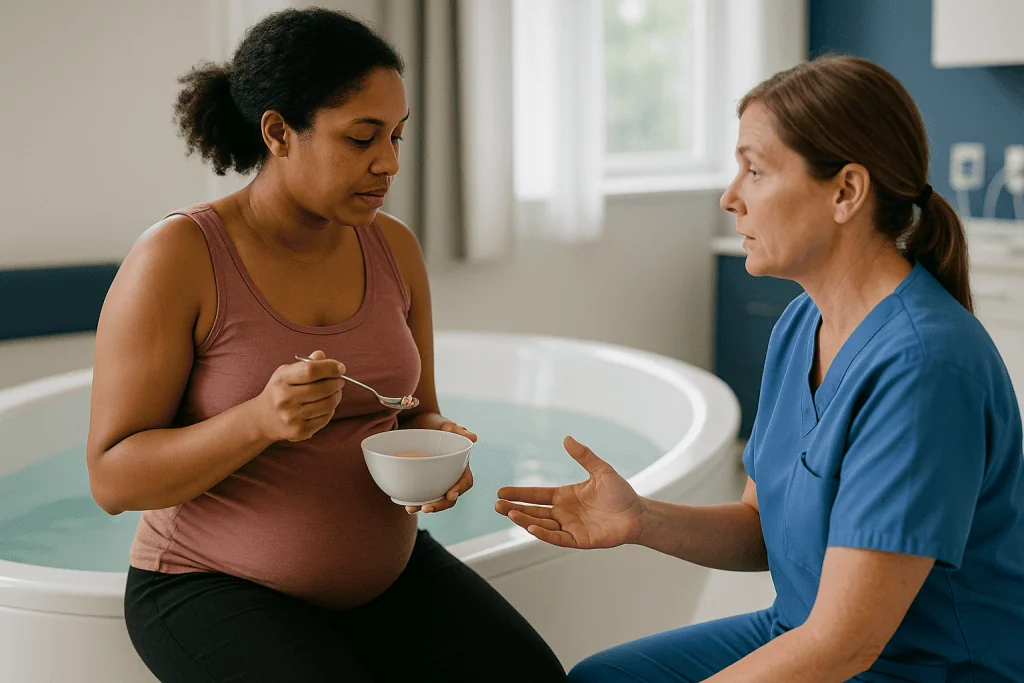
Being asked to wait, or being advised that the pool is not suitable, is not a judgment about you. It reflects whether the extra observation that water makes harder is needed. Situations where care teams commonly advise against the pool include:
- A pregnancy before 37 completed weeks, when the baby may need closer observation at birth.
- Twins or a baby lying breech (bottom first) or transverse (sideways).
- A raised maternal temperature or signs of infection before labor begins.
- Conditions that require continuous electronic fetal monitoring, such as some cases of high blood pressure, diabetes needing medication or a previous cesarean birth, depending on local policy.
- Significant bleeding in pregnancy, or thick meconium (the baby’s first stool) already seen in the waters.
- Recent use of an opioid pain-relief injection, because drowsiness in water is a drowning risk.
Several of these are relative rather than absolute. A person who has had a previous cesarean, for example, may be offered water immersion with wireless waterproof monitoring in some units and not in others. The deciding factor is whether your particular team can keep the level of observation they consider safe while you are in the water. If you are told the pool is not advised, it is reasonable to ask which specific concern lies behind that, and whether anything would change the picture.
When would you be asked to leave the birthing pool during labor? The main reasons
Leaving the birthing pool during labor usually happens for one of a short list of reasons, and most of them are about information rather than emergency. The pool is a wonderful place to be when all is well. It is a poor place from which to gather more detail, so when a check raises a question, the first step is often simply to move you where answering it is easier.
The reasons that come up most often in national guidance and in the evidence base are these:
- Your temperature rises. A maternal fever is a sign that may indicate infection, and warm water can mask it or add to it.
- The water is too warm and cannot be brought back within the recommended range quickly.
- The baby’s heartbeat changes in a way that needs continuous electronic monitoring to interpret.
- Meconium appears in the water, particularly if it is thick, because the baby may need observation at birth.
- Bleeding heavier than the normal show is seen.
- Labor slows or stalls and the team wants to examine you, encourage mobility on land, or consider other options.
- You feel faint, drowsy or unwell, or your pulse or blood pressure change.
- You want pain relief that cannot be used in water, such as an epidural or an opioid injection.
- The team is concerned about the baby’s position or shoulders at the point of birth and wants room to help.
- You want to get out. Preference is a complete reason on its own.
None of these is a verdict on how the birth is going. In many cases a person steps out, is examined, cools down, has the baby monitored for a stretch, and is invited back in. In others, the move out of the water is the start of a different plan. Either way, the decision rests with the midwife or obstetrician looking after you, and the reasoning should be explained to you at the time.
Water birth safety checks at a glance
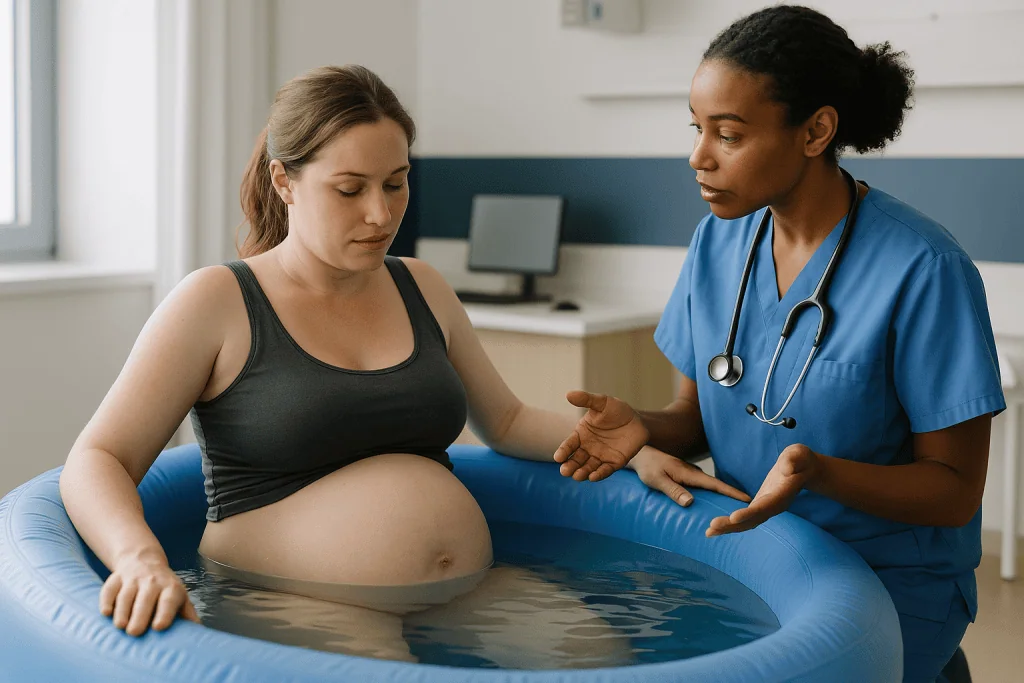
A labor in water is a labor with a running list of observations. The table below summarizes what is checked, why it matters, and the kind of finding that usually prompts a conversation about leaving. The exact intervals vary between units and between the first stage (cervix opening) and second stage (pushing); checks become more frequent as birth approaches.
| What is checked | Why it matters in water | Finding that usually prompts a change of plan |
|---|---|---|
| Water temperature | Overheating raises maternal and fetal temperature and heart rate | Above 37.5°C (NHS guidance) and not quickly correctable |
| Your temperature | Fever may signal infection; warm water can hide it | A rise above your normal range, especially with a fast pulse |
| Your pulse and blood pressure | Faintness in deep water is a safety issue | Dizziness, a racing pulse, or blood pressure outside expected limits |
| Baby’s heartbeat (Doppler) | Intermittent listening is the standard for low-risk labor (WHO) | A pattern that needs continuous electronic monitoring to interpret |
| Color of the water | Meconium or bleeding are easier to miss in moving water | Thick meconium or bleeding beyond a normal show |
| Progress of labor | Water sometimes slows contractions if entered early | Contractions spacing out or no change over an agreed period |
| Hydration and fluid intake | Warm water increases sweating and fluid loss | Signs of dehydration or very little urine |
| Your comfort and wishes | Consent is continuous | You ask to leave, or ask for pain relief not used in water |
Two things stand out. First, most of the triggers are about observation, not catastrophe. Second, the person in the pool is a participant in these checks rather than a subject of them. You can ask what the water temperature is, what the baby’s heart rate was, and what would change the plan. Good practice is for the midwife to tell you anyway.
Your temperature, the water temperature and the baby's heartbeat
Three numbers do most of the work in keeping a water labor safe, and they are linked. If the water is too warm, your core temperature rises. If your core temperature rises, the baby’s heart rate tends to rise with it. A fast fetal heart rate caused by maternal overheating can look like distress, and separating the two is one reason why water temperature is checked so often.
The water is kept at a level that feels comfortable to you and no higher than 37.5°C, per NHS guidance on pain relief in labour. That ceiling is close to normal body temperature for a reason. Unlike a hot bath at home, where you can step out the moment you feel flushed, a laboring person is distracted, working hard, and may not notice overheating until it is marked. Sweating is less effective when most of the body is submerged.
Your own temperature and pulse are checked at intervals alongside the water. A rising temperature matters for a second reason beyond comfort: it can be a sign of infection in the uterus, which is more likely if the waters have been broken for a long time. If your temperature climbs, the usual response is to get out, cool down and be reassessed. Some people return to the pool once their temperature settles; others do not, depending on what else is found.
The baby’s heartbeat is listened to with a waterproof hand-held Doppler, placed against your abdomen just below the waterline or with you leaning forward. The WHO intrapartum care recommendations support intermittent auscultation (listening at intervals) as the standard for healthy women in labor, rather than routine continuous electronic monitoring. If a pattern emerges that needs the continuous trace to interpret, that is a reason to leave the water, because conventional belt monitors cannot be used in it.
Meconium, bleeding and what midwives watch for in the water
Meconium is the baby’s first stool: thick, dark green and sticky. Many babies pass it after birth, but some pass it in the womb, where it mixes with the amniotic fluid. Thin, lightly stained fluid is common, especially in pregnancies past the due date, and is often not a cause for concern. Thick, fresh meconium is different. It can signal that the baby has been stressed, and a baby who breathes meconium into the lungs at birth may need observation or support from a pediatric team.
In a pool, meconium is harder to see. The water is moving, the lighting is often low, and dark flecks disperse. That is why a midwife will look at the water color after your waters break and may ask you to stand so that fluid can be seen on a pad. If thick meconium is found, most units advise leaving the pool so that the baby’s heartbeat can be monitored continuously and a pediatric team can be present at birth.
Bleeding follows a similar logic. A small amount of blood-stained mucus, the show, is a normal part of labor and does not require leaving the water. Fresh, heavier bleeding needs to be assessed on land, where the amount can be judged and the cause investigated. Water dilutes blood and makes volume impossible to estimate accurately.
Midwives also watch for a less obvious sign: the baby’s position. If progress is slow despite strong contractions, or if the head is descending at an angle, the team may want you out to examine you and to help you adopt positions that are easier to support on land. At the moment of birth, if there is any concern about the baby’s shoulders being delayed, you would be asked to stand or step out quickly so that recognized maneuvers can be used. This is practiced in advance and happens rarely.
When to get in the birth pool: can getting in too early slow labor?
Timing is the question behind many unexpected exits from the pool. Several of the top-ranking articles on this subject argue that getting in too early can slow labor, and there is a physiological basis for that caution, though the evidence is softer than the headlines suggest.
The concern is that deep relaxation early in labor, before contractions are strong and regular, can reduce the frequency of contractions. The body eases, oxytocin (the hormone that drives contractions) is not yet in full flow, and the pattern can space out. Most units therefore suggest entering the water once labor is established, meaning regular, strong contractions with the cervix opening steadily. The NHS describes established labor as the point when contractions are regular and the cervix has opened to around 4 cm, though midwives assess the whole picture rather than a single number.
Here is the honest part. The Cochrane review of 15 trials involving 3,663 women found no clear evidence that water immersion in the first stage lengthened labor or increased the need for medicines to strengthen contractions. So the slowing effect, where it occurs, appears to be individual rather than universal, and it is reversible: standing up, walking and leaving the water tend to pick the pattern back up.
This is why leaving the pool because labor has slowed is often temporary. A midwife may suggest an hour on land, upright and mobile, with the pool kept warm for your return. If contractions re-establish, back in you go. If they do not, that opens a different conversation about options, which the team will explain. Early in labor, a shower or a warm bath at home can offer some of the same comfort without the same effect on timing, and many people save the pool for the stretch when they most want it.
Pain relief choices that mean leaving the water
Some forms of pain relief go with the pool and some do not, and choosing one of the second kind is one of the most common and least alarming reasons for leaving the birthing pool during labor.
Compatible with water: breathing techniques, massage from a partner at the poolside, a TENS machine before you get in (it must be removed before entering water, since it is electrical), and inhaled nitrous oxide and oxygen, often called gas and air, which the NHS lists as usable in the pool because it is breathed through a mouthpiece and clears from the body within minutes of stopping.
Not compatible with water: an epidural, and injected opioid analgesics. An epidural delivers local anesthetic through a fine tube into the space around the spinal nerves in the lower back. It numbs the lower body, requires continuous monitoring of blood pressure and the baby’s heartbeat, and makes standing unsafe, so it cannot be combined with a deep pool. Injected opioid pain relief works on the brain’s pain pathways and causes drowsiness; a drowsy person in deep water is at risk, so units wait until the effects have clearly worn off before allowing pool use. How long that is depends on the medicine and the individual, and your midwife will tell you the local policy.
The Cochrane review found that women who used water immersion in the first stage were somewhat less likely to go on to use regional analgesia such as an epidural, which fits the idea that water itself helps many people cope. It does not mean water replaces an epidural for everyone, and wanting one after hours in the pool is not giving up. It is a choice, and the anesthetic team will want you out of the water, dried and positioned before they begin. Nothing about this reflects on how the labor is going.
Leaving the birthing pool during labor: what it actually looks like
People picture a sudden, dramatic haul out of the water. The reality, in the great majority of cases, is slower and more ordinary. A midwife explains what she has noticed, says what she would like to check, and asks you to step out between contractions. Warm towels appear. A birthing ball or a mat is already beside the pool. The water is often left in, because a return is a real possibility.
Getting out of a deep pool while in labor takes a little coordination. Steps are built into most pools; your partner or midwife supports you under the arms; you sit on the edge first if that is easier. Many people feel heavier and more aware of the contractions once the buoyancy is gone, and it helps to know that in advance. The feeling settles within a few minutes as you find a position on land.
What happens next depends entirely on why you were asked out. If it was to listen to the baby for longer, you may spend a stretch on a monitor and then be told all is well. If it was your temperature, you will be cooled and rechecked. If it was slow progress, you may be examined and encouraged to walk. If you asked for an epidural, the anesthetist is called. If meconium or bleeding was the reason, the team moves toward a plan that keeps the baby monitored continuously for the rest of labor.
In a true emergency, which is rare, the move is quicker and the explanation shorter, and that is appropriate. Labor units rehearse getting someone out of a pool fast. Whatever the pace, you are entitled to be told why, to have your questions answered, and to have a partner with you. The decision to leave, and whether to return, sits with the clinical team, but the conversation should include you.
Water birth risks: what the evidence actually shows
Headlines have swung between water birth being as safe as birth on land and water birth being reckless. The evidence is calmer than either.
The Cochrane systematic review on immersion in water during labour and birth drew on 15 randomized trials with 3,663 women. For immersion during the first stage of labor, it found a reduction in the use of regional analgesia, and no clear difference in rates of cesarean birth, serious perineal tears, admission of babies to a neonatal unit, low Apgar scores or infection in babies. The authors rated much of this evidence as low to moderate quality, meaning further research could change the estimates. That is a meaningful finding for comfort, and a reassuring one for safety, within the low-risk population studied.
For birth under water, the second stage, the trial evidence was thinner and the review could draw fewer conclusions. Observational studies have not shown a consistent increase in harm to babies when births occur in well-run units with clear eligibility criteria, but observational data cannot settle the question in the way trials can. This is one of those areas where the honest statement is that water birth appears to be no riskier than land birth for healthy people at term in supervised settings, and that the certainty is moderate rather than high.
Specific rare events are described in the literature and are the reason certain checks exist: the umbilical cord tearing if a baby is lifted too quickly from the water, water inhalation if a baby is brought up and then re-submerged, and infection if pools are not cleaned to a strict protocol. Each has a corresponding rule: bring the baby up slowly and only once, keep the face out of the water after surfacing, and follow the cleaning schedule. These rules are part of why leaving the pool promptly when asked matters.
What people often get wrong about water birth
Some misunderstandings follow this subject around, and a few of them cause real worry. Here are the ones worth correcting.
Babies will drown if born under water. A healthy term baby does not take a breath until exposed to air and a change in temperature and pressure; the trigger to breathe comes at the surface. The Cochrane review found no clear increase in neonatal problems with water immersion in the trials it examined. The safeguards are that the baby is brought to the surface promptly and not re-submerged, and that any baby showing signs of stress before birth is born on land.
Being asked to leave means something has gone wrong. As the earlier sections show, the commonest reasons are temperature, a wish for different pain relief, slow progress and the need for a longer listen to the baby. Many people return to the water afterward.
Water birth prevents tearing. The evidence does not support a clear protective effect. The Cochrane review found no significant difference in serious perineal tears between water and land for first-stage immersion.
Swimming can send you into labor. There is no evidence that swimming starts labor. The NHS lists swimming as one of the safest forms of exercise in pregnancy because the water supports your weight. If contractions begin while you are swimming, the timing is coincidence, not cause.
You will be shaved before getting in the pool. Routine shaving of pubic hair before birth is no longer standard practice. The WHO intrapartum care recommendations advise against routine perineal or pubic shaving, because it offers no benefit and may increase skin irritation. It is not required for a water birth.
Home water birth and hospital water birth carry the same checks. The checks are the same in principle, but the response to a concerning finding differs because of distance from an obstetric unit. That is a conversation to have with your care team before you decide where to give birth, not something to settle by reading heated comment threads.
Can you go in a pool after childbirth? Swimming after giving birth and the six-week question
Once the baby has arrived, the pool question reverses. Now people want to know when they can get back into water, and what the famous six weeks is really about.
In the first days after birth, the body is in open-wound mode. The site where the placenta was attached inside the uterus is raw and heals over weeks, producing lochia, the vaginal bleeding and discharge that follows birth. The cervix, which opened for the birth, closes gradually. Any perineal tear or cesarean wound is knitting together. Each of these is a route by which bacteria in pool, sea or bath water could cause infection.
NHS advice on keeping fit after a baby is to wait until postnatal bleeding has stopped before swimming, and to delay high-impact exercise until after the postnatal check, which usually takes place at around 6 to 8 weeks. The six-week figure is therefore not a switch that flips on a particular morning. It is a rough marker of the time by which, for most people, lochia has finished, the cervix has closed and perineal or abdominal wounds have healed enough to tolerate immersion and exertion.
What happens if you do not wait? The main risks are infection of the uterus or of a healing wound, and heavier bleeding if exertion comes too soon. Neither is inevitable, but both are avoidable with a little patience. A quick warm shower or a shallow bath at home is generally fine once any stitches are comfortable; a public pool, a hot tub or open water is the thing to postpone.
The following weeks tend to look like this: bleeding that is bright at first and fades to brown then cream over several weeks, pelvic floor exercises from the first days, gentle walking as soon as you feel able, and a postnatal check where you can ask directly about swimming and about anything that does not feel right. If bleeding returns heavily, smells offensive or comes with fever, that is a reason to seek care rather than wait for the appointment.
Questions to ask your care team
The best time to learn how your unit handles leaving the pool is before you are in it. These questions are specific enough to get specific answers, and the answers will tell you a great deal about how water birth is run where you plan to give birth.
- What are the eligibility criteria for using the pool here, and do I currently meet them?
- At what point in labor do you usually suggest getting in, and how do you assess that?
- How often will you check the water temperature, my temperature and the baby’s heartbeat while I am in the pool?
- Do you have waterproof wireless monitoring, and in what circumstances would I need the continuous monitor instead?
- Which specific findings would lead you to ask me to leave the pool, and could I return afterward?
- Which forms of pain relief can I use in the water, and how long after an opioid injection would I need to wait before getting in?
- If I want to give birth in the water rather than just labor in it, what has to be true for that to go ahead?
- How many midwives will be present at the moment of birth, and what is the plan if the baby’s shoulders are delayed?
- How is the third stage, the delivery of the placenta, managed after a water birth here?
- If I am planning a home water birth, what is the plan and the expected transfer time if a concern arises?
Write the answers into your birth preferences so that whoever is on shift knows what you have already discussed. One more question is worth asking of yourself: how will you feel if the pool turns out to be for part of labor rather than all of it? People who hold the water as one tool among several tend to find an unexpected exit far easier to take than those who have built the whole picture around it. That is not a reason to lower your hopes, only to widen them.
When to call your doctor
During labor itself you are already with professionals, and the checks described above are their job. The red flags that matter most are the ones that arise before you arrive, after you go home, or in a home birth.
Before or during early labor, call your maternity unit urgently if:
- Your waters break and the fluid is green, brown or blood-stained, which may indicate meconium or bleeding.
- You have fresh vaginal bleeding heavier than a blood-stained show.
- You develop a fever, shivering or feel generally unwell.
- The baby’s movements have reduced or changed from the usual pattern.
- You have a severe headache, visual disturbance, or sudden swelling of the face and hands.
- You feel faint, breathless or have chest pain.
After the birth, seek care the same day if:
- Bleeding becomes heavy enough to soak a pad in an hour, or you pass clots larger than a plum.
- Lochia smells offensive, or you have a fever, abdominal tenderness or flu-like symptoms, which can signal infection of the uterus or of a wound.
- A perineal or cesarean wound becomes red, swollen, hot or oozes.
- You have pain, swelling or warmth in one calf, or breathlessness and chest pain, which can be signs of a blood clot.
- You feel persistently low, anxious or unable to cope, or have thoughts of harming yourself or the baby.
Call emergency services for sudden severe bleeding, collapse, seizure, or chest pain with breathlessness. For anything that feels wrong and does not fit a list, phone your midwife or maternity unit; that is what the number is for. Whether you labor in water or on land, every decision about monitoring, pain relief and the place of birth belongs with the team caring for you, informed by what you want and by what the checks reveal on the day.
Frequently asked questions
Can you have an epidural in a birth pool?
No. An epidural numbs the lower body and requires continuous monitoring of blood pressure and the baby’s heartbeat, which cannot be done safely in deep water. If you decide you want an epidural after laboring in the pool, you will be helped out, dried and positioned on a bed before the anesthetist begins. Many people use the pool for part of labor and an epidural for the rest; one does not cancel out the other.
Can swimming send you into labor?
There is no evidence that swimming triggers labor. The NHS lists swimming among the safest forms of exercise in pregnancy because water supports your weight and reduces strain on joints. Labor begins through hormonal changes that gentle exercise does not override. If contractions start while you are swimming, it is coincidence. Once you are in labor, staying out of public pools and heading to your planned place of birth is sensible.
Do they shave pubic hair during labor?
Routine shaving is no longer standard practice and is not required for a water birth. The WHO intrapartum care recommendations advise against routine perineal or pubic shaving because it provides no benefit and may cause skin irritation. If a cesarean becomes necessary, a small area at the incision line may be clipped rather than shaved. You are not expected to remove hair beforehand.
Why would a midwife ask me to get out of the pool if everything feels fine?
Usually because a check needs a better view than the water allows. Common reasons include your temperature rising, the water running too warm, a change in the baby’s heartbeat that needs a longer listen, meconium or bleeding in the water, or contractions slowing. Feeling fine is reassuring but does not replace these observations. In many cases you will be invited back into the pool once the question has been answered.
When should you get in the birth pool during labor?
Most units suggest entering once labor is established, meaning strong, regular contractions and a cervix that is opening steadily. Getting in earlier can relax you so deeply that contractions space out in some people, though the Cochrane review found no overall lengthening of labor with water immersion. Your midwife will assess the whole picture rather than relying on a single measurement, and a shower or bath at home can offer comfort beforehand.
Can you go in a pool after childbirth?
Not straight away. NHS advice is to wait until postnatal bleeding, called lochia, has stopped before swimming, because the healing uterus, cervix and any wounds are vulnerable to infection from pool, sea or hot-tub water. For most people this coincides with the postnatal check at around 6 to 8 weeks. A warm shower or shallow bath at home is generally fine much sooner once stitches are comfortable.
What happens if you don't wait 6 weeks after birth?
The six-week figure is a guide rather than a rule. The main risks of returning to swimming, strenuous exercise or sex before healing is complete are infection of the uterus or a wound while lochia continues, and heavier bleeding if exertion comes too soon. Not everyone who acts earlier has a problem, but these complications are avoidable. If bleeding has stopped and wounds feel healed, your midwife or doctor can advise on your individual timing.
Is water birth safe for the baby?
For healthy people at term with a single head-down baby, the evidence is reassuring but not certain. The Cochrane review of 15 trials found no clear difference in neonatal unit admissions, low Apgar scores or infection between water immersion and land labor, while rating much of the evidence as low to moderate quality. Rare risks described in the literature, such as cord tearing or water inhalation, are the reason for strict rules about how the baby is lifted out.
What are the main water birth risks for the mother?
The trials summarized by Cochrane did not show an increase in serious perineal tears, cesarean birth or maternal infection with first-stage water immersion. Practical risks include overheating, dehydration and feeling faint in deep water, which is why temperature, pulse and fluid intake are checked. Blood loss is harder to estimate in water, so heavier bleeding is assessed on land. Eligibility criteria exist to keep people with higher-risk pregnancies where closer monitoring is possible.
Can I get back into the birthing pool after being asked to leave?
Often, yes. If you left because your temperature rose, the water was too warm, or the baby needed a longer listen and all was found to be well, many units allow a return once the concern has settled. If you left because of thick meconium, significant bleeding, a heartbeat pattern needing continuous monitoring or an epidural, a return is usually not possible. The decision rests with the midwife or obstetrician caring for you.
References
- NHS: Pain relief in labour (including water and birth pools)
- WHO recommendations: Intrapartum care for a positive childbirth experience
- NHS: Keeping fit and healthy with a baby
- NHS: Exercise in pregnancy
This article is for general information only and is not a substitute for professional medical advice. Please consult a qualified doctor about your individual situation.

More from the Blog

Which Conditions May Be Treated With Fetal Surgery? Spina Bifida, TTTS and Diaphragmatic Hernia
Fetal surgery is most established for three conditions: open spina bifida (myelomeningocele), where the spinal defect is closed before birth; twin-to-twin transfusion syndrome, where…

Cesarean Incision Care: What Normal Healing Looks Like and Which Changes Need a Call
A healing cesarean incision is usually pink or slightly red at the edges, mildly tender, and gradually flatter and paler over about six weeks.…

When Can You Drive, Climb Stairs and Carry Your Baby After a Cesarean Delivery?
Most people are asked not to drive after a cesarean until they can twist, look over a shoulder and brake hard without pain, are…

What Happens in the Operating Room During a Cesarean Delivery: Spinal Block to First Cuddle
During a C-section, a spinal or epidural block numbs you from the chest down while you stay awake. The surgeon makes a low horizontal…

Fasting and Timing for Gestational Diabetes Screening: How to Prepare for the Glucose Test
Preparation depends on which glucose test you are having. The one-hour screening test usually needs no fasting; you eat normally, drink the glucose solution…

Who Needs Closer Pregnancy Monitoring? Twins, Diabetes, Blood Pressure and Other Reasons
Closer pregnancy monitoring is usually offered when a pregnancy carries a higher chance of complications for the mother, the baby, or both. Common reasons…