Signs of Recovery From Jaundice in Newborns: An Evidence-Based Patient Guide

Jaundice often improves as a newborn feeds well and the liver becomes better able to remove bilirubin. Skin colour alone cannot confirm recovery; bilirubin testing and clinical assessment may be needed.
Key Takeaways
- Jaundice often improves as a newborn feeds well and the liver becomes better able to remove bilirubin.
- Skin colour alone cannot confirm recovery; bilirubin testing and clinical assessment may be needed.
- Yellowing typically fades from the legs and body before it disappears from the face and eyes.
- Frequent, effective feeding supports hydration and bilirubin removal through urine and stools.
- Sunlight is not a safe or reliable treatment for newborn jaundice; medically supervised phototherapy is used when treatment is needed.
- Urgent medical assessment is needed for poor feeding, unusual sleepiness, high-pitched crying, fever, or rapidly deepening yellow colour.
Signs of recovery from jaundice in newborns usually include yellow colour fading from the face and body, effective feeding, regular wet and dirty nappies, and bilirubin levels that stabilise or fall when checked. Because jaundice can sometimes worsen quickly, parents should follow their baby's individual follow-up plan and contact a clinician promptly if the baby is difficult to wake, feeding poorly, or becoming more yellow.
Overview: what recovery from newborn jaundice looks like
Jaundice is the yellow colouring of a baby’s skin and the whites of the eyes caused by bilirubin, a yellow pigment made when red blood cells are broken down. Many newborns develop mild jaundice in the first days after birth because their livers are still maturing and they have a naturally high turnover of red blood cells. In many cases, it is temporary and resolves with time and effective feeding.
The most reassuring signs of recovery from jaundice in newborns are that the yellow colour is becoming lighter rather than spreading or deepening, the baby is feeding actively, and wet nappies and stools are becoming regular. If blood testing is being used, recovery is shown by a bilirubin level that is below the treatment threshold and is stable or falling. A healthcare professional should interpret results according to the baby’s age in hours, gestational age, overall health, and other risk factors.
Parents should not rely only on appearance, particularly in different skin tones or under artificial lighting. Newborns who have been assessed for jaundice may need repeat examinations or bilirubin measurements even if they seem well, because bilirubin can rise after an initial check.
How to know if a newborn is recovering from jaundice?
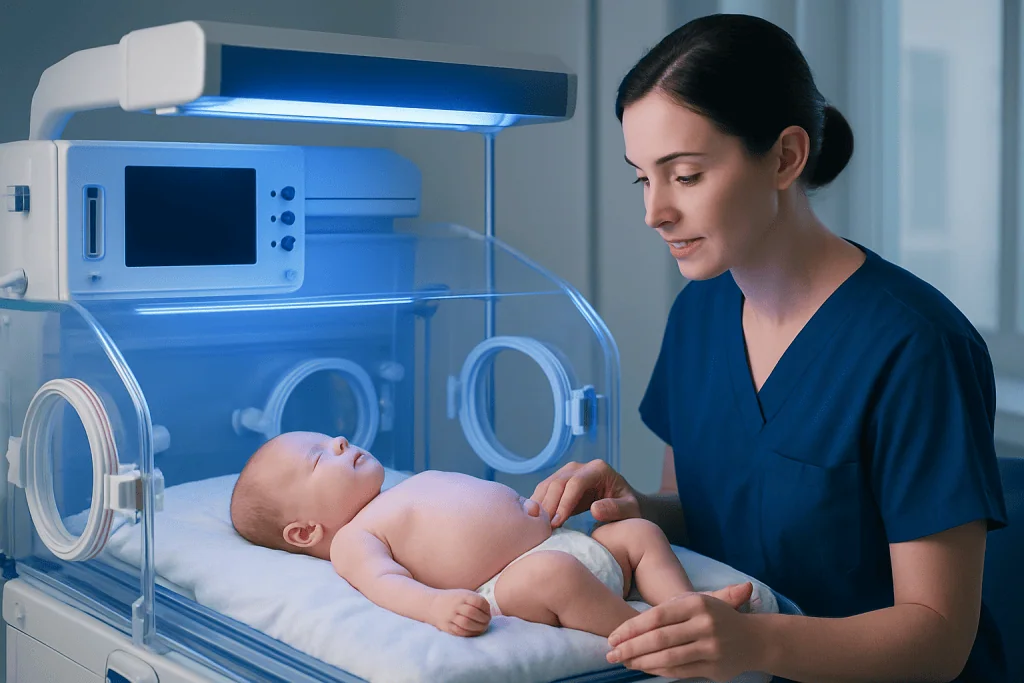
Recovery is usually gradual. Yellowing commonly clears in the reverse of the pattern in which it appeared: it may disappear from the legs, feet, hands, and trunk before fading from the face and eyes. The change can be subtle, so it may be easier to notice over a day or two rather than from one feed to the next.
A recovering baby generally wakes for feeds or can be woken without great difficulty, sucks and swallows effectively, and seems reasonably alert during feeds. As milk intake increases, stool colour normally changes from dark meconium to greener and then mustard-yellow stools in breastfed babies. Regular urine output and stools help the body remove bilirubin.
Clinical follow-up is important because visible improvement does not always match the bilirubin level. A clinician may use a skin bilirubin screening device or a blood test to confirm whether bilirubin is falling or whether treatment or closer monitoring is required. Parents should attend every scheduled newborn review, including checks after discharge.
- Yellow colour is lighter and no longer extending down the body.
- Feeding is becoming more effective and frequent.
- The baby has appropriate wet nappies and stools for their age.
- The baby is not increasingly sleepy, limp, or hard to wake.
- Follow-up bilirubin measurements are stable or decreasing when tests are advised.
Does newborn jaundice go away on its own?

Physiological jaundice, the common form in otherwise healthy full-term babies, often goes away on its own as feeding becomes established and the liver matures. It often becomes noticeable after the first 24 hours of life, may peak during the first several days, and then improves over the following one to two weeks. The timing can be longer in babies born early and in some breastfed babies.
However, not every case should simply be watched at home. Jaundice that begins in the first 24 hours, rises quickly, lasts longer than expected, or occurs with illness may be linked to a condition that needs assessment. Examples include blood group incompatibility, bruising from delivery, infection, red blood cell disorders, thyroid conditions, or problems affecting bile flow or the liver.
Breastfeeding should usually continue, with support to improve attachment and milk transfer if needed. A paediatric clinician or lactation professional can assess whether the baby is receiving enough milk. Formula supplementation is not automatically needed and should be discussed with the baby’s healthcare team when intake or weight gain is a concern.
Why jaundice changes: causes and factors that affect recovery
Bilirubin is produced as old red blood cells are processed. Before birth, the placenta helps remove bilirubin; after birth, the baby’s liver must process it and the bowel must eliminate it. Newborn livers are less efficient at this task initially, and bilirubin may also be reabsorbed from the intestines if feeding is limited or stool passage is delayed.
Some babies need closer observation because their risk of higher bilirubin levels is greater. This includes babies born before 38 weeks, babies with a sibling who previously required jaundice treatment, those with significant bruising or a scalp swelling after birth, and babies who are not feeding effectively. Blood group differences between parent and baby can sometimes lead to faster red blood cell breakdown.
Prolonged jaundice may have different causes from early newborn jaundice. Pale or chalky stools, dark urine that stains a nappy, or jaundice persisting beyond the period advised by a clinician should be assessed. These signs can indicate that bilirubin is not being excreted normally and should not be attributed to ordinary newborn jaundice without medical review.
Assessment and treatment: monitoring and phototherapy
Healthcare professionals assess jaundice by examining the baby, asking about feeding and nappy output, reviewing birth and family history, and measuring bilirubin when appropriate. The result is considered alongside the baby’s exact age, whether they were born early, and any medical risk factors. Additional blood tests may be recommended if there is concern about a cause other than typical physiological jaundice.
When bilirubin is above a treatment threshold, the usual first-line treatment is phototherapy. During this treatment, the baby is placed under a special medical blue light or may use a fibre-optic light blanket. The light changes bilirubin in the skin into forms that the body can remove more easily through urine and stool. This is different from ordinary household lighting or exposure to the sun.
Phototherapy is generally effective and is monitored by trained staff. The baby may wear eye protection depending on the equipment used, and the clinical team continues to support feeds and monitor temperature, hydration, weight, and bilirubin levels. The duration varies according to the bilirubin level, its cause, and how the baby responds. Treatment is stopped when testing indicates it is safe, and some babies need a follow-up level to check for rebound.
In uncommon severe cases, more intensive treatment may be necessary, such as intravenous immune globulin for certain immune-related causes or an exchange transfusion. These decisions are made urgently by neonatal specialists when bilirubin reaches levels associated with risk of harm. Medically supervised phototherapy is a standard, evidence-based option for babies who meet treatment criteria.
Can sunlight help with newborn jaundice?
Sunlight should not be used to treat newborn jaundice. Although sunlight contains wavelengths that can affect bilirubin, it is not controlled, cannot provide a predictable dose, and may expose a newborn to overheating, dehydration, sunburn, or harmful ultraviolet radiation. Placing a baby by a window is also not a reliable alternative, as glass blocks some wavelengths and the light exposure remains difficult to control.
If jaundice needs treatment, hospital or clinic phototherapy is designed to deliver a measured wavelength of light while the baby’s temperature, feeding, and bilirubin are monitored. Parents should not delay medical assessment or substitute home sunlight exposure for recommended care.
At home, the safest supportive steps are to follow the feeding plan provided by the baby’s healthcare team, offer feeds frequently, observe alertness and nappy output, and attend advised bilirubin checks. Parents should ask a clinician before giving water, glucose water, herbal products, or other remedies, as these are not recommended treatments for newborn jaundice.
What are the signs that jaundice is getting worse in a newborn?
Jaundice may be worsening when yellowing becomes more intense or moves from the face and chest toward the abdomen, legs, feet, or palms and soles. However, colour changes alone are not enough to judge severity. Parents should contact the baby’s healthcare team on the same day if they think the yellow colour is increasing or if the baby has missed a planned review.
Urgent medical assessment is needed if a baby is very sleepy or difficult to wake for feeds, refuses feeds or feeds much less than usual, has fewer wet nappies, appears floppy or unusually stiff, has a high-pitched cry, develops fever, or seems unwell. These symptoms do not always mean bilirubin is dangerously high, but they require prompt assessment because newborns can become unwell quickly.
Parents should also seek prompt advice for jaundice in the first 24 hours after birth, jaundice that is still present beyond the timeframe discussed with their clinician, very pale stools, or dark urine. If there is immediate concern that a newborn is seriously unwell, emergency services should be contacted rather than waiting for a routine appointment.
Follow-up, home care and support for families
Home care focuses on feeding and observation rather than trying to treat jaundice independently. Newborns should usually feed frequently, and parents may benefit from practical breastfeeding support if feeds are painful, brief, infrequent, or the baby is not swallowing well. The baby’s clinician can advise what nappy output, weight change, and feeding pattern are appropriate for that baby’s age.
Before leaving hospital or a birth centre, parents should know when the baby’s next clinical review will occur and who to contact if concerns arise. Follow-up is especially important for babies discharged early, those born prematurely, and babies with jaundice near a treatment level. Bringing feeding records, nappy counts, and questions to the appointment can help the clinical team assess progress.
Acibadem International’s multidisciplinary paediatric and neonatal specialists in JCI-accredited hospitals diagnose and treat newborn jaundice for international patients, including assessment, bilirubin monitoring, feeding support, and phototherapy when indicated. Families should always seek individual advice from a qualified paediatric clinician, as newborn jaundice care is tailored to each baby’s age, health, and test results.
Frequently asked questions
How quickly should jaundice improve in a newborn?
In common physiological jaundice, the yellow colour often peaks during the first several days and then gradually improves over the next one to two weeks. The exact timeline varies, especially for premature babies and babies with feeding difficulties. A clinician should assess jaundice that begins early, becomes more noticeable, or persists longer than expected.
Is it normal for a baby's eyes to stay yellow after the skin improves?
The whites of the eyes may appear yellow for a little longer than the skin in some babies. However, appearance alone cannot confirm that bilirubin is safe or falling. Parents should follow the follow-up plan and ask the healthcare team if yellowing seems unchanged or more pronounced.
Should a newborn with jaundice be woken for feeds?
Newborns with jaundice may be sleepy, and regular effective feeding is important for hydration and bilirubin elimination. A baby's clinician can give personalised guidance on feeding frequency and whether the baby should be woken. A baby who cannot be woken adequately or will not feed needs prompt medical assessment.
Can breastfeeding cause jaundice in newborns?
Breastfed babies can develop jaundice, especially if milk intake is low in the first days of life or if breastfeeding jaundice occurs later in an otherwise thriving baby. Breastfeeding usually should continue, with help to optimise feeding if necessary. A clinician can determine whether low intake, another cause, or treatment is involved.
What bilirubin level is dangerous in a newborn?
There is no single bilirubin number that is dangerous for every baby. Clinicians interpret bilirubin according to the baby's age in hours, gestational age, health status, and risk factors. This is why timely testing and professional interpretation are important.
Can newborn jaundice come back after phototherapy?
Bilirubin can rise again after phototherapy is stopped, particularly when there is an underlying cause of increased bilirubin production or when treatment began early. Some babies therefore have a repeat bilirubin measurement after treatment. Parents should continue observing feeding and alertness and attend any planned follow-up checks.
References
- American Academy of Pediatrics
- National Institute for Health and Care Excellence
- Centers for Disease Control and Prevention
- World Health Organization
- HealthyChildren.org, American Academy of Pediatrics
This article is for general information only and is not a substitute for professional medical advice. Please consult a qualified doctor about your individual situation.
Explore treatments in Turkey — costs, top hospitals & a free quote
JCI-accredited · board-certified surgeons · reply within 24h

More from the Health Library



Related Specialists
Dr. Mehmet Noyan Zenger
Radiology
Dr. Nesrin Yılmaz Baıramov
Physical Medicine and Rehabilitation
Dr. Erdem Kaplan
Emergency Service
Mert Vural
Physical Medicine & Rehabilitation