Dental Bridge vs Implant: Key Differences and How Doctors Tell Them Apart
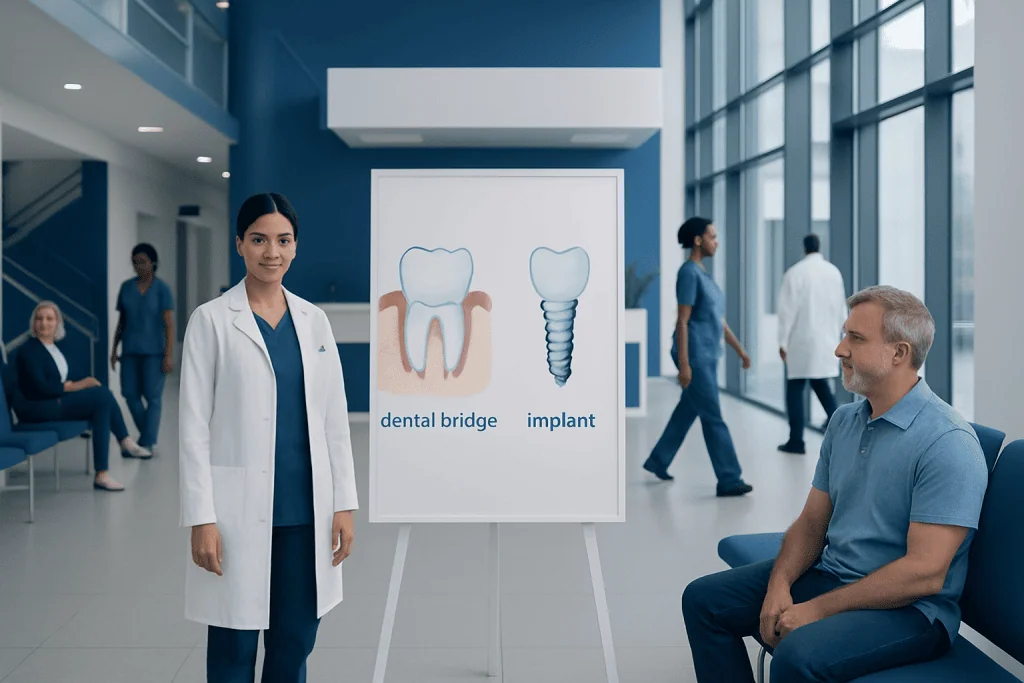
A dental bridge replaces a missing tooth by attaching to neighboring teeth or implants, while a dental implant replaces the tooth root and supports a crown. Doctors distinguish a bridge from an implant through an oral exam, dental history, and imaging such as X-rays or 3D scans.
Key Takeaways
- A dental bridge replaces a missing tooth by attaching to neighboring teeth or implants, while a dental implant replaces the tooth root and supports a crown.
- Doctors distinguish a bridge from an implant through an oral exam, dental history, and imaging such as X-rays or 3D scans.
- Bridges may be suitable when adjacent teeth already need crowns, while implants may help preserve jawbone and avoid altering nearby healthy teeth.
- The best option depends on bone support, gum health, oral hygiene, smoking status, bite forces, and overall medical history.
- Pain, swelling, looseness, gum bleeding, or trouble chewing should be assessed by a dentist or oral surgeon.
Medically reviewed by the Acıbadem International Medical Board — July 24, 2026
Dental bridge vs implant is mainly a question of support: a bridge is held by nearby teeth, while an implant is fixed in the jawbone. Dentists usually tell them apart through the appearance of the replacement tooth, the health of neighboring teeth and gums, and dental imaging.
Overview: Dental Bridge vs Implant at a Glance
Dental bridge vs implant can be answered simply: a bridge spans the gap left by a missing tooth, while an implant replaces the missing tooth root and supports a crown above it. Both can restore appearance and chewing function, but they are built differently and place forces on different structures in the mouth.
Because they may look similar from above the gumline, many people are unsure which one they have or which one may suit them better. A clinician usually sorts this out by looking at how the tooth replacement is supported, examining the neighboring teeth and gums, and reviewing dental X-rays. This article starts with a side-by-side comparison, then explains how doctors tell them apart, and finally outlines what to do in each situation.
| Feature | Dental bridge | Dental implant |
|---|---|---|
| Main support | Nearby natural teeth or implants | Titanium or similar post in the jawbone |
| Replaces tooth root? | No | Yes |
| Effect on nearby teeth | May require shaping adjacent teeth for crowns | Usually does not involve neighboring teeth |
| Bone preservation | Does not directly stimulate bone at the missing root | Helps maintain bone where the root was lost |
| Treatment timeline | Often shorter | Often longer due to healing and integration |
| Cleaning | Needs special cleaning under the pontic | Needs careful gumline cleaning around the implant crown |
| Common use | When adjacent teeth need crowns or implant surgery is unsuitable | When enough bone and gum support are present |
Neither option is universally better. The right choice depends on oral health, anatomy, personal preferences, and the condition of nearby teeth. In some cases, a person may already have one type of restoration and only need help identifying it or managing a problem with it.
How a Clinician Tells a Bridge from an Implant
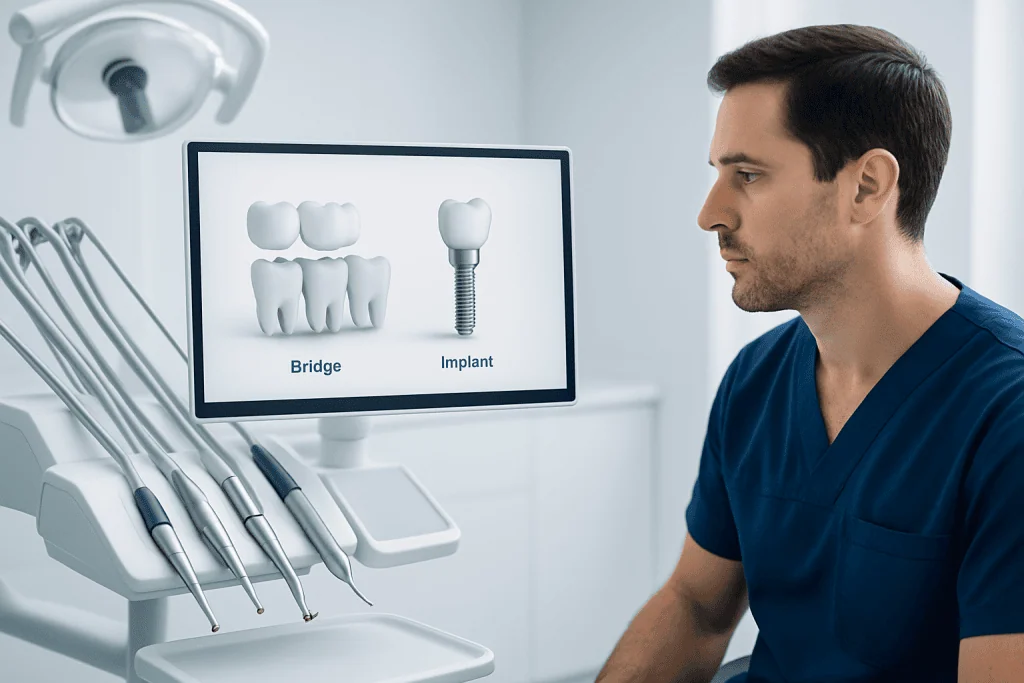
Doctors and dentists first look at the replacement tooth itself and the teeth next to it. With a traditional bridge, the neighboring teeth often have crowns attached to the false tooth in the middle, creating a connected unit. With an implant crown, the replacement may appear to emerge more independently from the gum, without being fused to crowns on the adjacent teeth.
A gentle clinical exam can reveal important clues. A dentist checks whether the replacement tooth moves as one piece with nearby crowned teeth, whether there is a pontic resting over the gum, and how the floss passes around or under the restoration. The shape of the gumline, bite marks, wear patterns, and the texture of the restoration may also suggest whether the support is tooth-based or implant-based.
Imaging usually provides the clearest answer. Standard dental X-rays often show the metal implant fixture within the jawbone, whereas a bridge shows crowns on adjacent teeth with no artificial root in the empty space. If the view is unclear or treatment planning is needed, the dentist may use 3D imaging such as cone beam computed tomography to assess bone levels, root shape, and implant position.
Dental history matters too. If a person remembers having surgery, stitches, or a healing period before receiving the final tooth, an implant is more likely. If the treatment involved preparing neighboring teeth for crowns and placing a connected replacement relatively quickly, a bridge may be the more likely explanation.
Symptoms, Feel, and Everyday Clues

Patients sometimes identify their restoration by how it feels during cleaning or chewing. A bridge often has a false tooth, called a pontic, that sits over the gum. This can create a small space underneath that needs cleaning with special floss threaders, interdental brushes, or other tools. An implant crown, by contrast, is usually cleaned more like a natural tooth, though it still requires careful attention around the gumline.
The surrounding teeth can also offer clues. If the teeth on either side of the missing tooth have full crowns and seem connected to the replacement, a bridge is likely. If the neighboring teeth are untouched or only have small fillings, and the replacement feels separate, it may be implant-supported.
Symptoms do not always identify the restoration type, but they can point to problems that need evaluation. For bridges, common concerns include food trapping under the pontic, decay in supporting teeth, looseness of the bridge, or gum irritation around the margins. For implants, issues may include soreness when biting, gum inflammation, plaque buildup, or bone loss around the implant, which may be linked to gum disease or peri-implant inflammation.
Neither bridges nor implants should be painful in normal use. Ongoing discomfort, swelling, bleeding gums, bad taste, mobility, or difficulty chewing should not be ignored, regardless of which restoration a person has.
Who May Be Better Suited to a Bridge or an Implant
The choice between a bridge and an implant depends on more than the missing tooth itself. Dentists assess gum health, the amount and quality of jawbone, bite forces, oral hygiene habits, smoking status, and medical conditions that may affect healing. They also consider whether the neighboring teeth are healthy or already damaged and in need of crowns.
A bridge may be a reasonable option when the teeth next to the gap already need crown treatment, when a person prefers to avoid surgery, or when bone support is not sufficient for an implant and bone-building procedures are not suitable. A bridge can also be helpful in some situations where faster restoration is desired, though individual treatment timing varies.
An implant may be preferred when the neighboring teeth are healthy and should be preserved, and when there is enough bone and gum support to anchor the implant securely. Because an implant replaces the root, it can help maintain jawbone in the missing tooth area. For some patients, that structural benefit is an important part of long-term planning.
In more complex cases, the decision may involve several dental specialties. A person with severe decay, bite problems, bone loss, or advanced periodontal disease may need a broader treatment plan before choosing the final tooth replacement. Conditions such as tooth decay in neighboring teeth can strongly influence whether a bridge or implant makes more sense.
Diagnosis and Planning Before Treatment
Before recommending a bridge or implant, a clinician performs a full dental assessment. This usually includes an oral exam, gum evaluation, bite analysis, and dental imaging. The goal is not only to replace the visible tooth but also to understand the health of the supporting structures that will carry chewing forces every day.
X-rays help assess the roots of neighboring teeth, existing restorations, hidden decay, and the level of supporting bone. When an implant is being considered, 3D scans may be used to measure bone width and height and to identify nearby structures such as the sinus or major nerves. If a bridge is being considered, the dentist evaluates whether the neighboring teeth are strong enough to serve as support.
The planning stage may also include discussion of materials, the number of missing teeth, esthetic goals, and long-term maintenance. For example, replacing one tooth is different from replacing several teeth in a row, and the treatment design may change accordingly. Some people may benefit from dental implants, while others may be better candidates for a fixed bridge or another restorative approach.
Patients should feel comfortable asking what type of restoration is being proposed, why it is preferred, what alternatives exist, and how it will be cleaned and monitored over time. Clear communication is part of safe and effective dental care.
What to Do for Each Case
If a person already has a bridge, the main priorities are protecting the supporting teeth and keeping the area clean. Daily cleaning under the bridge is important because plaque and food debris can collect around the margins and beneath the pontic. Regular dental visits help detect early decay, cement failure, and gum inflammation before they become larger problems.
If a person has an implant, the focus is on gum health, plaque control, and monitoring bone support. Even though implants do not develop tooth decay, the surrounding tissues can still become inflamed or infected if oral hygiene is poor. Professional follow-up helps check stability, bite forces, and the condition of the crown and implant components.
When planning new treatment, a bridge may be a practical choice if nearby teeth already need restoration or if surgery is not appropriate. An implant may be considered if preserving adjacent healthy teeth is a priority and the jawbone can support the implant. In some cases, bone support may need improvement before implant placement, using procedures such as bone grafting.
For patients with complex alignment or bite issues, treatment planning may involve coordinated care. Restorative dentists, periodontists, oral surgeons, and prosthodontists may work together to determine the most suitable option. If tooth replacement affects speech, chewing comfort, or facial support, a more detailed rehabilitation plan may be advised.
Prevention, Self-care, and Long-term Maintenance
Whether a person has a bridge or an implant, long-term success depends heavily on daily care. Brushing twice a day, cleaning between teeth, limiting tobacco exposure, and attending routine dental checkups all support healthier gums and more stable restorations. Dentists may recommend specific tools such as floss threaders, interdental brushes, or water flossers depending on the design of the restoration.
Diet and oral habits matter as well. Very hard foods, habitual grinding, and untreated bite problems can overload both bridges and implants. If teeth grinding is suspected, a clinician may suggest a night guard to protect the restoration and surrounding teeth from excessive force.
Gum health is especially important. Inflamed gums, bleeding, bad breath, or gum recession should be evaluated early, because both bridges and implants depend on healthy supporting tissues. Ongoing maintenance may include professional cleaning and periodic X-rays to monitor changes over time.
Near the end of the care journey, some patients seek treatment across borders for complex restorative needs. Acibadem International’s multidisciplinary specialists in JCI-accredited hospitals diagnose and treat dental restoration problems for international patients, including advanced options such as oral and dental health services when appropriate.
When to Seek Medical Care
A dental bridge or implant should be checked promptly if there is pain that does not improve, swelling of the gums or face, bleeding around the restoration, a bad taste or discharge, or a feeling that the tooth replacement is loose. These signs do not always mean a serious problem, but they do need professional evaluation.
Urgent dental assessment is especially important if chewing becomes difficult, the bite suddenly changes, a supporting tooth feels cracked, or there is fever or spreading swelling. Delay can allow infection, decay, or structural damage to progress.
People should also arrange a dental visit if they are unsure what type of restoration they have and are planning additional treatment nearby. Knowing whether a missing tooth is replaced by a bridge or an implant helps guide safe cleaning, imaging, and future dental work.
For routine concerns, starting with a general dentist is appropriate. If needed, the patient may be referred to a prosthodontist, periodontist, or oral and maxillofacial surgeon for more specialized evaluation.
Frequently asked questions
What is the main difference between a dental bridge and an implant?
A dental bridge replaces a missing tooth by relying on neighboring teeth or implants for support. A dental implant is placed into the jawbone to act like an artificial tooth root, and a crown is attached to it.
How can a dentist tell whether a tooth replacement is a bridge or an implant?
A dentist usually checks the shape of the restoration, the condition of adjacent teeth, and how the replacement is connected. Dental X-rays are often the most reliable way to confirm whether there is an implant fixture in the bone or a bridge supported by nearby teeth.
Which lasts longer, a bridge or an implant?
Both can last many years when they are well planned and carefully maintained. Longevity depends on oral hygiene, gum health, smoking, bite forces, and regular follow-up, rather than on the restoration type alone.
Is an implant always better than a bridge?
No. An implant may be advantageous in some cases because it can preserve bone and avoid altering healthy adjacent teeth, but it is not suitable for everyone. A bridge may be the better choice when neighboring teeth already need crowns or when surgery is not advisable.
Can a bridge or implant cause pain?
They should not usually be painful once treatment and healing are complete. Pain, swelling, bleeding, looseness, or discomfort when biting may signal a problem such as gum inflammation, decay around supporting teeth, bite overload, or infection and should be checked by a dentist.
How should a bridge be cleaned compared with an implant?
A bridge often needs special cleaning underneath the false tooth using floss threaders or similar tools. An implant crown is usually cleaned around the gumline much like a natural tooth, although careful plaque control is still essential to protect the surrounding tissues.
References
- American Dental Association
- National Institute of Dental and Craniofacial Research
- Mayo Clinic
- Cleveland Clinic
- World Health Organization
This article is for general information only and is not a substitute for professional medical advice. Please consult a qualified doctor about your individual situation.
Dental Bridge in Turkey — costs, top hospitals & a free quote
JCI-accredited · board-certified surgeons · reply within 24h