Resistance Band Back Exercises — Explained by Medical Evidence, Not Myths

Resistance band back exercises can improve strength, posture, and movement control with relatively low joint stress. The safest routines emphasize slow, controlled movement rather than high tension or painful repetition.
Key Takeaways
- Resistance band back exercises can improve strength, posture, and movement control with relatively low joint stress.
- The safest routines emphasize slow, controlled movement rather than high tension or painful repetition.
- Common evidence-based choices include rows, pull-aparts, lat-focused pulls, and core-supported anti-rotation work.
- Exercise should be adjusted or stopped if it causes sharp pain, spreading numbness, weakness, or worsening symptoms.
- People with persistent back pain, recent injury, or neurologic symptoms should seek medical advice before starting.
Resistance band back exercises can be an effective, low-impact way to strengthen the upper and lower back, support posture, and improve shoulder-blade control when they are chosen carefully and performed with good technique. Medical evidence does not support myths such as “no pain, no gain” for back training; gradual progression, symptom monitoring, and exercise selection matter more than intensity alone.
Overview: what resistance band back exercises can really do
Resistance band back exercises are useful for many people because they help strengthen the muscles that support the spine, shoulders, and shoulder blades without the heavier joint loading that can come with some free-weight exercises. In clinical and rehabilitation settings, elastic resistance is often used to improve muscle activation, endurance, and movement control, especially in people who need a gradual starting point.
Evidence-based exercise advice focuses less on finding a single “best” move and more on matching the exercise to the person’s symptoms, mobility, strength level, and goals. For a healthy adult, band exercises may support posture, daily function, and general fitness. For someone with pain or stiffness, they may be part of a broader plan that includes mobility work, core training, and activity modification.
It is also important to separate helpful guidance from common myths. Resistance bands do not “fix” every back problem, and stronger tension is not automatically better. Well-chosen movements done with steady breathing, controlled range of motion, and gradual progression are usually safer and more productive than forcing through discomfort.
How bands help the back: the medical evidence behind the method
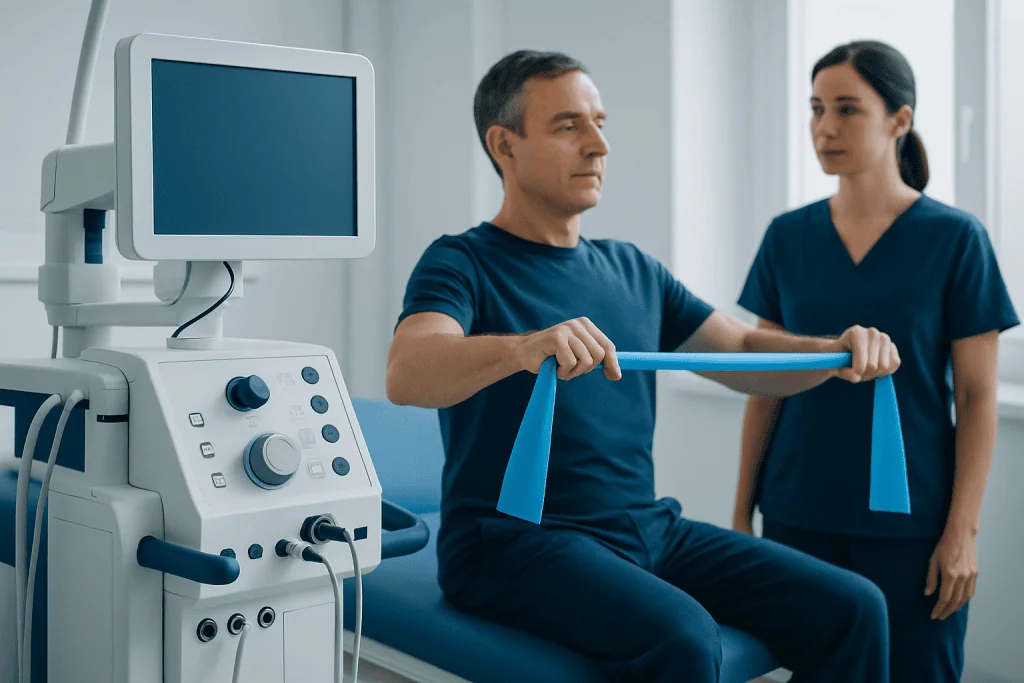
The back depends on several muscle groups working together, including the latissimus dorsi, rhomboids, trapezius, erector spinae, and the deeper stabilizing muscles around the spine and trunk. Resistance bands create tension through a movement arc, which can encourage these muscles to work in a coordinated way. This makes bands especially useful for teaching scapular control, postural endurance, and balanced pulling patterns.
Research on therapeutic exercise consistently supports strengthening and physical activity for many common musculoskeletal complaints, including non-specific back pain and deconditioning. While evidence does not show that bands are uniquely superior to all other tools, they are practical, adaptable, and accessible. They can provide enough resistance for meaningful training while allowing easier adjustments in grip, angle, and range of motion.
Bands may also help people who are rebuilding confidence after a flare-up or long period of inactivity. Because tension can be reduced quickly and many exercises can be done seated or standing, they are often easier to tolerate than movements that require lying on the floor or lifting heavy equipment. When back pain is persistent or linked to another condition, a clinician may recommend evaluation for issues such as a herniated disc or other spine-related causes before starting a home routine.
Best-supported exercise patterns, not fitness myths

Medical evidence supports exercise principles rather than internet myths. A common myth is that back training must include intense soreness or aggressive stretching to be effective. In reality, muscles can become stronger through moderate resistance and consistent practice, and pain during exercise is not a requirement for progress. Mild effort and temporary muscle fatigue can be normal, but sharp or escalating pain is a sign to modify the movement.
Another myth is that the lower back should be trained in isolation only. In most people, back health depends on the entire chain working together, including the upper back, shoulders, core, and hips. Exercises that teach the shoulder blades to move well and the trunk to stay stable can be just as important as direct lumbar strengthening.
Useful resistance band back exercises often include:
- Seated or standing row: helps train the middle back and shoulder-blade retraction.
- Band pull-apart: supports upper-back endurance and postural muscles.
- Lat pull-down variation with a band: targets the lats and helps coordinate shoulder movement.
- Face-pull pattern: may improve rear shoulder and upper-back control when done gently.
- Pallof press or anti-rotation hold: builds trunk stability that can indirectly support the back.
- Supported hip hinge with band assistance: teaches safer bending mechanics.
These movements are not one-size-fits-all. For some people, the best first step is supervised physical therapy and rehabilitation to learn form, pacing, and symptom-guided progression.
How to perform resistance band back exercises safely
Good form usually starts with a neutral, comfortable spine rather than a rigidly arched posture. During rows or pull-aparts, the chest can stay gently lifted while the shoulders remain relaxed and away from the ears. The movement should come from the shoulders and shoulder blades, not by jerking the neck backward or overarching the lower back.
Breathing matters more than many people realize. Exhaling during the effort phase and avoiding breath-holding can reduce unnecessary strain. Slow, controlled repetitions are often preferable to quick, snapping motions, which can make it harder to control the band and may irritate sensitive tissues.
Band setup is another safety issue. The band should be anchored securely if an anchor is used, and worn or cracked bands should be replaced. Starting with light resistance is usually appropriate, especially for beginners, older adults, and people returning after pain or inactivity. Progressing too quickly may overload the shoulders, neck, or lower back before technique has improved.
As a general rule, exercise discomfort should stay mild and short-lived. If pain becomes sharper, travels into the arm or leg, causes tingling, or lingers well after the session, the routine may need to be changed. In people with significant stiffness, prior spine surgery, or persistent symptoms, individualized guidance can help prevent setbacks.
Who may benefit most, and who should be cautious
Resistance band back exercises can be helpful for office workers with postural fatigue, older adults trying to maintain strength, recreational exercisers who want a home-based routine, and people in recovery from mild deconditioning. They are also commonly used to support shoulder health, because the upper back and shoulder blade muscles contribute to more efficient arm movement.
People with non-specific back discomfort may also benefit when exercise is introduced gradually and paired with walking, flexibility work, and healthy movement habits. In many cases, movement is more helpful than prolonged rest. However, the program should fit the person’s symptoms rather than follow a generic online challenge.
Caution is important for those with recent trauma, known spinal instability, severe osteoporosis, fever with back pain, unexplained weight loss, cancer history, or progressive weakness. Anyone with severe pain radiating down the leg, numbness, or loss of balance may need prompt evaluation. If symptoms suggest significant structural or nerve-related spinal disease, doctors may consider assessment and, in selected cases, spine surgery as part of a broader treatment pathway.
Building a practical routine: progression, recovery, and self-care
A useful beginner routine often includes two to four band exercises performed two or three times per week on nonconsecutive days. The goal is not to exhaust the back but to build tolerance and control. Starting with a small number of repetitions and one or two sets can make the program easier to sustain, especially for people who are new to exercise.
Progression should be gradual. This can mean increasing repetitions first, then adding another set, and only later moving to a stronger band. If one exercise consistently causes discomfort, replacing it is usually wiser than pushing through. For example, a person who finds pull-aparts irritating may do better with a supported row or anti-rotation exercise.
Recovery and daily habits also affect results. Short walking breaks, ergonomic workstation adjustments, regular position changes, and adequate sleep may improve how the back feels between sessions. Gentle mobility work for the chest, hips, and thoracic spine can complement strengthening by reducing stiffness that may otherwise shift extra strain onto the back.
For persistent or recurring pain, a broader rehabilitation approach may be needed. Some patients benefit from pain management alongside exercise, particularly when sensitivity, muscle guarding, or repeated flare-ups limit progress.
When to seek medical care
Resistance band back exercises are not a substitute for medical evaluation when warning signs are present. A person should seek medical care if back pain follows a fall or accident, if it is severe and unrelenting, or if it is accompanied by numbness, tingling, weakness, fever, bowel or bladder changes, or unexplained weight loss. These symptoms may need prompt assessment rather than home exercise alone.
Medical advice is also important when pain lasts for several weeks, repeatedly returns, or limits work, sleep, or normal activity despite a careful exercise program. A clinician can help identify whether the problem is likely muscular, joint-related, disc-related, or referred from another area. In some cases, imaging or specialist referral may be recommended.
People who are unsure whether band exercises are appropriate after surgery, during pregnancy, or with chronic conditions should ask a qualified healthcare professional before starting. Near the end of a treatment journey, ongoing exercise is often part of long-term self-care, but the plan should reflect the individual diagnosis and stage of recovery. Acibadem International’s multidisciplinary specialists at JCI-accredited hospitals diagnose and treat spine and musculoskeletal conditions for international patients when further evaluation is needed.
Frequently asked questions
Are resistance band back exercises effective?
Yes, resistance band back exercises can be effective for improving back and shoulder-blade strength, posture, and movement control. They are especially useful because resistance can be adjusted easily, but results depend on correct form, consistency, and choosing exercises that match the person’s needs.
Can resistance band back exercises help with back pain?
They may help some people with mild or non-specific back pain by improving strength and confidence with movement. However, they are not suitable for every cause of pain, so persistent, severe, or radiating symptoms should be evaluated by a doctor or physical therapist.
Which resistance band back exercises are usually best for beginners?
Rows, gentle pull-aparts, lat-focused pulls, and anti-rotation exercises are often good beginner options because they can be controlled more easily. It is usually best to begin with light resistance and a short routine rather than trying many exercises at once.
How often should a person do resistance band back exercises?
For many healthy adults, two or three sessions per week is a reasonable starting point. Rest days between sessions allow recovery, and progression should be based on tolerance rather than a fixed schedule.
Should resistance band back exercises cause soreness or pain?
Mild muscle fatigue or light soreness can happen, especially at the beginning, but sharp pain is not a goal and should not be ignored. If pain increases during the movement or lasts after the session, the exercise should be modified or stopped and medical advice may be needed.
Who should speak with a doctor before starting these exercises?
People with recent injury, prior spine surgery, osteoporosis, nerve symptoms, severe pain, or major medical conditions should ask a healthcare professional before starting. This helps ensure the exercise plan is safe and appropriate for the underlying issue.
References
- World Health Organization
- National Institute for Health and Care Excellence
- American Academy of Orthopaedic Surgeons
- American Physical Therapy Association
- National Institutes of Health
This article is for general information only and is not a substitute for professional medical advice. Please consult a qualified doctor about your individual situation.
Joint and spine care in Turkey — expert assessment & treatment
JCI-accredited · board-certified surgeons · reply within 24h