All on 4 dental implants vs All on 6 dental implants: Which Is Right for You?

All on 4 uses four implants to support a full-arch fixed bridge, while All on 6 uses six implants. All on 6 may provide additional support and load distribution when sufficient bone is available.
Key Takeaways
- All on 4 uses four implants to support a full-arch fixed bridge, while All on 6 uses six implants.
- All on 6 may provide additional support and load distribution when sufficient bone is available.
- All on 4 can be suitable when bone loss limits ideal implant placement and may reduce the need for grafting in selected cases.
- A detailed examination, 3D imaging and bite assessment are needed to choose the safest, most durable plan.
- Good cleaning routines, regular dental reviews and avoiding tobacco are important for long-term implant health.
All on 4 dental implants vs All on 6 dental implants is not a matter of one option being universally better. Both can support a fixed full-arch bridge; the right choice depends on bone quality and volume, bite forces, oral health, medical history and the prosthetic plan developed by an implant dentist.
Overview: All on 4 Dental Implants vs All on 6 Dental Implants
All on 4 dental implants vs All on 6 dental implants refers to two approaches for replacing all teeth in the upper jaw, lower jaw or both with a fixed implant-supported bridge. In either approach, dental implants are placed in the jawbone and connected to a custom bridge that restores chewing ability, speech and appearance. The bridge is secured by a dental professional and is not removed at home like a conventional denture.
The main difference is the number and distribution of implants. An All on 4 plan uses four implants, commonly including angled implants toward the back of the jaw to make use of available bone. An All on 6 plan uses six implants, often with a more even spread across the arch. More implants can offer additional support, but six implants are not automatically necessary or preferable for every person.
The decision should be individualized. A clinician considers the amount and quality of jawbone, gum health, jaw anatomy, tooth loss pattern, bite force, teeth grinding, general health and the type of final bridge planned. For a detailed introduction to the four-implant approach, see All on 4 dental implants.
How the Two Approaches Work
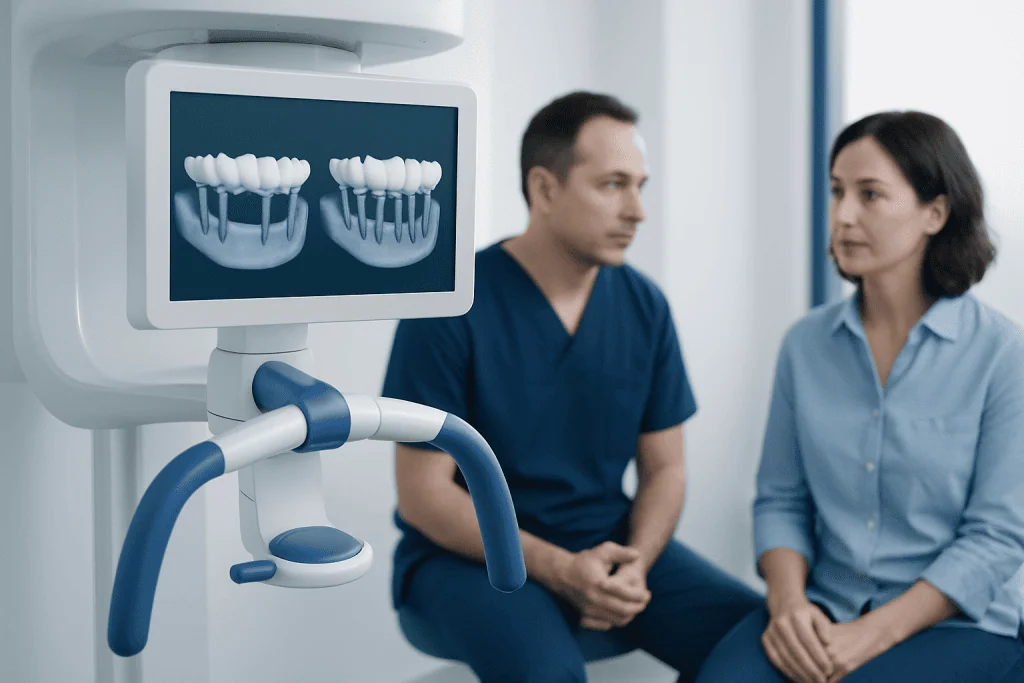
Dental implants are small biocompatible posts, usually made of titanium, placed into the jawbone to act as artificial tooth roots. During healing, bone grows closely around the implant in a process called osseointegration. Once the implants are stable, they support a full-arch prosthesis through connecting components called abutments.
With All on 4, two implants are generally placed nearer the front of the jaw and two toward the back. The back implants may be angled to avoid anatomical structures and to use denser or more available bone. This design can be particularly helpful in selected people with bone loss in the back of the jaw.
With All on 6, six implants are placed across the arch where anatomy permits. The additional implants may distribute chewing loads over more support points and can be considered when there is adequate bone and a clinical reason for extra support. An All on 6 dental implant treatment plan may also be appropriate for people with stronger bite forces or a prosthesis design that benefits from wider support.
- All on 4: four implants support one full-arch bridge.
- All on 6: six implants support one full-arch bridge.
- Both: require careful planning, surgery, a provisional or final bridge, and lifelong maintenance.
Who May Be a Candidate?

These treatments may be considered for adults who have lost most or all teeth in an arch, have teeth that cannot be predictably restored, or struggle with loose dentures. Candidates should be able to maintain daily oral hygiene and attend follow-up appointments. A full clinical assessment is essential because the goal is a stable, healthy result that can be maintained over time.
Jawbone volume is important, but bone loss does not always rule out treatment. The angulated posterior implants used in All on 4 can sometimes make use of remaining bone and reduce the need for bone grafting. In other situations, bone grafting, sinus-related procedures in the upper jaw, or another restorative option may be advised to support safe implant placement.
All on 6 may be considered when the jaw has enough suitable bone to place six implants in well-positioned locations. It can be useful where clinicians want broader support for the bridge, although the final decision is based on the individual anatomy and bite rather than implant number alone. People who clench or grind their teeth may need a carefully designed restoration and, in some cases, a protective night guard.
Uncontrolled gum disease, untreated oral infection, poorly controlled diabetes, heavy tobacco use and certain medicines or medical conditions can affect healing. These factors do not always prevent implant treatment, but they should be assessed and managed with the patient’s dentist and relevant medical specialists before proceeding.
Assessment and Step-by-Step Procedure
Planning starts with a dental examination, review of medical and dental history, gum assessment and images of the jaws. Cone-beam computed tomography, or CBCT, is often used to create a three-dimensional view of bone, nerves, sinus spaces and other important structures. Digital impressions, photographs and bite records help the team plan the bridge and position implants according to the desired final teeth.
If failing teeth remain, they may be removed at the same appointment as implant placement or during a separate stage. The procedure is performed with local anesthesia, and sedation may be available when appropriate. The clinician prepares the implant sites, places four or six implants in the planned positions and attaches components that connect to the restoration.
Some patients can receive a fixed temporary bridge on the day of surgery or shortly afterward. This depends on implant stability, bone quality, bite conditions and the treatment plan. Others may need a removable temporary appliance or a longer healing phase before a fixed bridge is fitted. A temporary bridge is designed to protect healing tissues and should not be treated as the final restoration.
After healing and confirmation that implants are integrating well, detailed impressions or digital scans are used to make the final bridge. The definitive restoration is adjusted to support comfortable speech, appearance, bite balance and cleansability. Appointments after delivery remain important because small bite adjustments may protect the implants and bridge.
Benefits, Limitations and Possible Risks
Both approaches can provide a fixed alternative to removable full dentures. Potential benefits include improved stability during eating and speaking, a more natural sense of tooth replacement, and preservation of jawbone around functioning implants. A well-designed fixed bridge can also restore facial support that may be reduced after extensive tooth loss.
All on 4 may offer an efficient solution for selected patients, particularly when posterior bone is limited. All on 6 may offer additional implant support and load distribution where anatomy allows. However, no fixed implant bridge feels exactly the same as natural teeth, and each design has trade-offs related to anatomy, materials, hygiene access and future maintenance.
As with any oral surgery, possible risks include bleeding, swelling, discomfort, bruising, infection, delayed healing and temporary changes in sensation. Less common but important risks include injury to nearby nerves or sinus spaces, implant failure to integrate, loosening or fracture of prosthetic components, and inflammation or bone loss around implants. Careful imaging, surgical planning and follow-up help reduce these risks but cannot eliminate them entirely.
Long-term success also depends on controlling plaque around implants. Implant-supported teeth cannot develop cavities, but the gums and bone around implants can develop inflammatory disease. Regular professional maintenance helps identify early problems before they become more difficult to manage.
Recovery Timeline and Daily Care
Swelling, tenderness and mild bleeding or bruising are common in the first few days after surgery. The dental team may recommend pain relief, antiseptic rinses where appropriate, a temporary diet and individualized cleaning instructions. During early healing, patients usually need to avoid biting hard foods with the new restoration and follow the diet progression advised by their clinician.
Initial soft-tissue healing often occurs over the first one to two weeks, while bone integration takes longer and varies between individuals. Follow-up visits allow the clinician to monitor healing, remove sutures if needed and assess the temporary bridge. The timing of the final bridge depends on the stability of the implants and the overall treatment plan.
Daily home care is essential for both All on 4 and All on 6. Patients are typically taught to brush the bridge and gumline thoroughly, clean beneath the bridge using tools such as interdental brushes or water flossers when recommended, and attend scheduled hygiene visits. A dental professional can show the safest cleaning method for the specific restoration.
Smoking or nicotine use can impair healing and increase the risk of implant complications. Limiting alcohol while healing, keeping chronic health conditions well controlled and using a night guard if prescribed can also support the longevity of the implants and bridge.
When to Seek Medical Care
Before implant surgery, patients should seek dental assessment for persistent tooth pain, swelling, bleeding gums, loose teeth, recurrent dental infections or difficulty wearing dentures. These symptoms may indicate conditions that need treatment before a full-arch implant plan can be safely considered. A dentist can also discuss whether remaining teeth are restorable or whether replacement options should be explored.
After surgery, the dental team should be contacted promptly for increasing rather than improving pain or swelling, persistent bleeding, fever, pus-like discharge, a loose temporary bridge, difficulty swallowing or breathing, or new numbness that does not improve as expected. Emergency services should be used for severe bleeding, significant breathing difficulty or rapidly spreading swelling.
Anyone with a fixed implant bridge should arrange a review if there is bleeding around implants, bad taste, gum swelling, discomfort while biting, movement of the bridge or damage to the restoration. Early assessment may help protect the surrounding bone and tissues. Acibadem International’s multidisciplinary specialists and JCI-accredited hospitals diagnose and treat dental implant needs for international patients.
Frequently asked questions
Is All on 6 better than All on 4?
All on 6 is not automatically better than All on 4. Six implants may provide additional support when adequate bone is available, while four implants can be a well-established option for appropriately selected patients. The best choice depends on anatomy, bite forces, oral health and the planned restoration.
Can All on 4 work if there is jawbone loss?
It may be possible in some cases because posterior implants can be angled to use available bone. However, the degree and location of bone loss must be assessed with clinical examination and 3D imaging. Some people may still need grafting or a different treatment plan.
Are All on 4 and All on 6 permanent?
Implants and the bridge are intended as long-term restorations, but they require lifelong care and periodic professional reviews. Components may wear, loosen or need repair over time. Gum and bone inflammation around implants can also affect their long-term health if not treated.
Will a fixed implant bridge be placed on the same day as surgery?
Some patients are suitable for an immediate fixed temporary bridge, but this is not appropriate for everyone. It depends on implant stability, bone quality, bite conditions and the surgical plan. The final bridge is commonly fitted after healing and additional assessment.
How long is recovery after full-arch dental implant surgery?
Most early swelling and tenderness improve during the first days to weeks, but complete implant integration takes longer. The timeline for the final bridge varies between patients and may depend on healing, bone quality and whether additional procedures were required. The dentist provides personalized diet and activity instructions.
Can a person eat normally with All on 4 or All on 6?
After healing and fitting of the final bridge, many people can eat a broad range of foods more comfortably than with loose dentures. Hard or very sticky foods may still place high stress on the bridge and implants. Patients should follow the dental team’s dietary advice, especially during healing.
References
- American Dental Association
- American Academy of Periodontology
- International Team for Implantology
- National Institute of Dental and Craniofacial Research
This article is for general information only and is not a substitute for professional medical advice. Please consult a qualified doctor about your individual situation.
Dental Implants in Turkey — costs, top hospitals & a free quote
JCI-accredited · board-certified surgeons · reply within 24h