Dental Implants
Dental implants replace missing tooth roots with biocompatible posts that support crowns, bridges, or dentures. They help restore chewing function, appearance, and jawbone support after tooth loss.
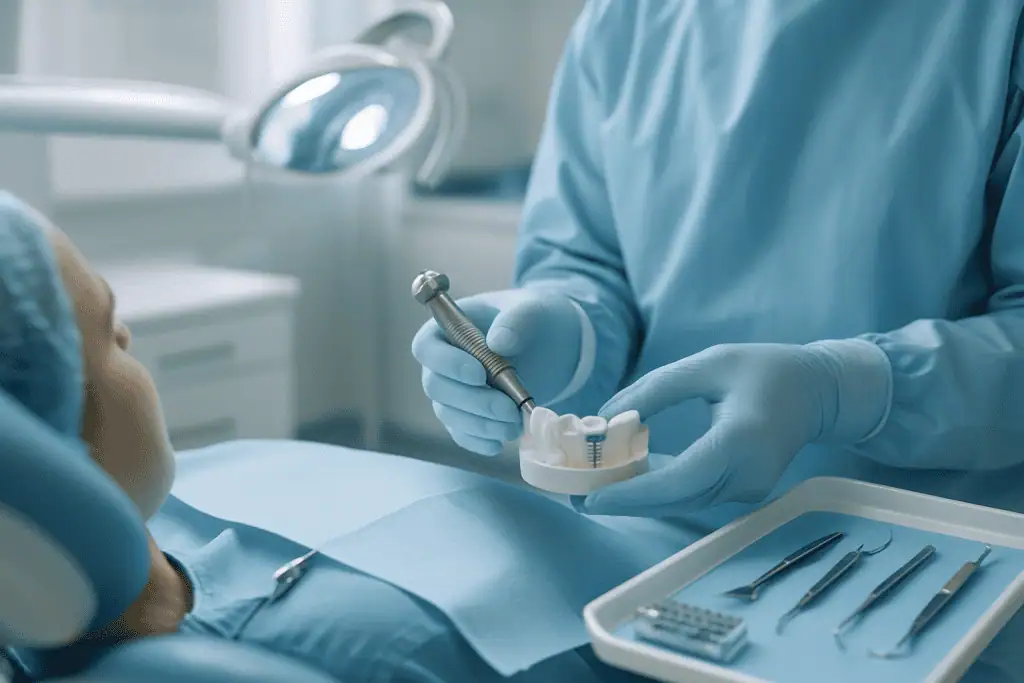
Quick answer
A dental implant is a small biocompatible post, usually titanium, placed in the jawbone to replace the root of a missing tooth. Once the bone has bonded to the implant, it supports a crown, bridge or full-arch restoration. Treatment involves assessment and imaging, surgical placement under local anaesthesia, a healing period of several months, and the fitting of the final teeth.
What Are Dental Implants?
Dental implants are biocompatible posts placed into the jawbone to replace the roots of missing teeth. Once the bone has bonded to an implant — a process called osseointegration — it can support a crown, a bridge or a full-arch prosthesis, giving you fixed teeth that do not rely on suction, adhesive or neighbouring teeth in the way dentures and conventional bridges do. Dental implants are suitable for adults who have lost one tooth, several teeth or all of their teeth, provided the gums, bone and general health allow it. They are among the most widely researched treatments in modern dentistry, and dental implants in Turkey are a common reason international patients travel for planned dental care.
Most dental implants are made from medical-grade titanium, a material used across surgical medicine precisely because bone bonds to it reliably. In selected cases, ceramic implant materials may be considered instead. Whatever the material, the implant itself sits below the gum. What you see and chew with is the restoration built on top of it.
You may also come across the phrases tooth implant, teeth implants or implant-supported teeth. These all describe the same treatment: the terminology shifts with the number of teeth being replaced, not the technology. If you have been searching for what are dental implants and finding conflicting answers, the simplest accurate description is this — an artificial root, an artificial tooth built on that root, and a healing process in between that makes the whole structure stable.
How does a dental implant work?
A dental implant works by transferring chewing force into the jawbone, the way a natural tooth root does. Implant treatment has three main components. The implant post is placed in the bone and acts as the root. An abutment connects the implant to the visible restoration. The final restoration — a single crown, a multi-tooth bridge or a full-arch prosthesis — is the part you see and use. It is designed to match your mouth in shape, colour, bite relationship and smile line.
Because the implant is anchored in bone rather than resting on the gum, an implant-supported restoration behaves differently from a removable denture. It does not shift when you chew or speak. And unlike a traditional bridge, which usually requires grinding down the teeth on either side of a gap, a single tooth implant replaces the missing tooth independently when the surrounding teeth are healthy. That distinction matters: it means healthy enamel stays untouched.
How do teeth implants differ from bridges and dentures?
Teeth implants replace the root as well as the crown of a missing tooth, which is the core difference from every other replacement option. A conventional bridge replaces only the visible tooth and borrows support from its neighbours. A removable denture replaces visible teeth and rests on the gum, which is why dentures can rub, move and make eating harder over time. When multiple teeth are missing, implants can often support a bridge between them, so you do not necessarily need one implant for every missing tooth. For complete tooth loss, implants can carry a fixed full-arch restoration or stabilise a removable overdenture — both markedly more stable than a conventional denture.
No single option is right for everyone. A short-span bridge, a removable prosthesis or orthodontic treatment may be the better choice in some mouths. The purpose of an implant consultation is to compare the reasonable options against your oral health, expectations, schedule and willingness to maintain the result — not to assume an implant is always the answer.
Why Replacing a Missing Tooth Matters
Losing a tooth affects more than your smile. You may find yourself chewing on one side, avoiding certain foods, speaking more carefully, or feeling less confident in photographs. If several teeth are missing, the bite can feel unstable, the face may look less supported, and removable dentures may rub, move or make eating a chore. For many patients the real question is not simply how to fill a gap, but how to restore comfort, function and confidence in a way that holds up over years.
There is also a biological side. When a tooth is lost, the bone in that area no longer receives stimulation from chewing forces, and it gradually shrinks in height and width. Neighbouring teeth drift into the space. Opposing teeth over-erupt. Chewing forces redistribute onto the remaining teeth, sometimes overloading them. These changes are slow, but they are real, and they can make later treatment more complex than earlier treatment would have been.
It is normal to have concerns before committing. Patients frequently ask whether implant treatment hurts, how many visits are needed, whether bone grafting will be necessary, how long healing takes, and how natural the final teeth will look. Some have been told they do not have enough bone. Others have gum disease, medical conditions or previous dental work that complicates the picture. All of these questions have honest answers, and most of them depend on a careful individual assessment rather than a general rule. Successful implant treatment is never just about placing a post — it depends on diagnosis, planning, surgical precision, gum and bone health, prosthetic design and long-term maintenance, in that order.
Types of Dental Implants and Implant Restorations
Types of dental implants are usually described by what they support and how they are used, rather than by dramatic differences in the post itself. Most implants placed today are root-form titanium posts of varying lengths and widths, chosen to match the bone available at each site. The meaningful choice for you as a patient is the restoration built on top and the surgical approach used to get there.
- Single-tooth implant with crown: one implant, one crown, replacing one missing tooth without touching the neighbours.
- Implant-supported bridge: two or more implants carrying a fixed bridge across a span of missing teeth.
- Implant-supported overdenture: a removable denture that clips onto implants, gaining stability while remaining removable for cleaning.
- Fixed full-arch restoration: multiple implants supporting a complete arch of fixed teeth for patients with total tooth loss in one or both jaws.
- Narrow-diameter (mini) implants: smaller posts sometimes used in confined spaces or to stabilise dentures in selected cases.
- Zygomatic implants: longer implants anchored in the cheekbone, considered for patients with severe upper-jaw bone loss where conventional implants cannot be placed.
Implant surfaces, connection designs and materials vary between manufacturers, and your clinician should be able to tell you which system is being used and why. Ask. A reputable team will answer plainly, and you will need that information for any future maintenance at home.
Full mouth dental implants
Full mouth dental implants replace all the teeth in one or both jaws using a set of implants that carry fixed bridges or full-arch prostheses. This is the most demanding form of implant treatment, because it involves not just individual teeth but the whole bite: jaw relationship, speech, hygiene access, facial support and material selection all have to be planned together. Patients with failing teeth across the mouth, long-standing denture problems or advanced gum disease are the typical candidates. Full-arch treatment is often planned as part of a broader full mouth reconstruction, where extractions, grafting, implant placement and prosthetic design are sequenced as one coordinated plan rather than a series of separate procedures. The number of implants per arch varies with bone quality, bite forces and the type of prosthesis chosen — there is no single correct formula, and a plan that fits one patient may be wrong for another.
Who May Need Dental Implants
Dental implants may be appropriate for adults who have lost one or more teeth and want a fixed or more stable replacement. Tooth loss has many causes: decay, gum disease, trauma, infection, failed root canal treatment, congenital absence of teeth, or fracture of a tooth that cannot be restored. Some patients seek implants shortly after an extraction; others have lived with gaps for years and are now feeling the functional or aesthetic consequences. The timing between extraction and implant placement is itself a planning decision — our guide to dental implants after tooth extraction explains the options in detail.
Common reasons patients pursue implants include difficulty chewing, discomfort with removable dentures, gaps that affect speech or appearance, shifting teeth, bite imbalance, or lost confidence when smiling. Implants are also considered when a dental bridge has failed, when a tooth is too damaged to save, or when a removable partial denture no longer feels acceptable.
The assessment begins with a detailed dental examination. The dentist evaluates your teeth, gums, bite, jaw relationship, smile line, oral hygiene and any signs of infection or inflammation. Digital imaging examines the jawbone and surrounding structures. Three-dimensional imaging, when indicated, shows bone height, width and density and maps the position of nerves and sinus cavities. This determines implant size, position and angle, and whether additional procedures such as bone grafting or a sinus lift are needed.
Your medical history is reviewed with equal care. Uncontrolled diabetes, active gum disease, heavy smoking, immune suppression, certain bone metabolism disorders and previous radiation therapy to the jaw can all affect healing and planning. Many patients with medical conditions are still candidates — the plan is adjusted, not abandoned. Any medication you take, including blood thinners or drugs that affect bone turnover, should be discussed with your treating doctor before surgery; decisions about medication always belong to the doctor who prescribes it.
Am I too old — or too young — for dental implants?
Age alone rarely decides candidacy for dental implants. Implants are generally placed only after jaw growth is complete, so they are not usually appropriate for children or young adolescents. At the other end of life, chronological age matters far less than bone health, general health, oral hygiene and what you actually need your teeth to do. Older adults with healthy tissues are routinely treated. What the assessment weighs is biology and maintenance capacity, not the date on your passport.
Conditions and Situations Dental Implants Can Address
Implants are used across a wide range of clinical situations, from a single gap to complete tooth loss. The plan depends on how many teeth are missing, the quality and volume of bone, gum health, bite forces, aesthetic demands, and whether teeth need to be extracted first.
- Single missing tooth: one implant supports an individual crown, without using adjacent teeth as bridge supports.
- Several missing teeth: two or more implants support a fixed bridge, restoring a section of the mouth without a removable appliance.
- Full-arch tooth loss: multiple implants support a fixed full-arch restoration or stabilise a removable overdenture.
- Loose or uncomfortable dentures: implant support improves retention, chewing comfort and confidence during speech.
- Failing teeth: teeth with severe periodontal disease, fracture or advanced decay may be extracted and replaced with implants when appropriate.
- Bone loss after tooth loss: implants combined with bone grafting can help rebuild support for future restorations in some patients.
- Congenitally missing teeth: patients born without certain permanent teeth may be candidates once growth is complete and orthodontic or restorative planning is finalised.
- Traumatic tooth loss: implants may be used after injury when the surrounding bone and soft tissues are suitable or can be reconstructed.
Not every missing tooth must be replaced with an implant. Molars at the very back of the mouth, for instance, are sometimes left unreplaced when the bite works without them. The consultation exists to compare realistic options honestly, including the option of doing less.
How Dental Implant Treatment Is Performed
Implant care starts well before the day of surgery. A precise plan reduces uncertainty, flags risks early, and guides both the surgical and restorative stages. Modern planning is prosthetically driven: the team decides where the final teeth need to be first, then works backwards to where the implants must go to support them. An implant placed in the wrong position can make a natural-looking, cleanable tooth impossible to build — which is why planning gets as much attention as surgery.
- Consultation and records. A comprehensive examination, medical history review, photographs, impressions or digital scans, and imaging. Complex cases are discussed across specialties — periodontology, oral surgery, prosthodontics, orthodontics, radiology, anaesthesiology — where relevant.
- Imaging and digital planning. Digital radiographs and, where indicated, three-dimensional imaging map bone volume, nerves, sinus spaces and adjacent roots. Planning software can position implants virtually in relation to the future teeth. A surgical guide may be manufactured from this plan.
- Preparing the mouth. Active gum disease, untreated decay and oral infections are managed first. If a damaged tooth must go, extraction happens before implant placement or, in selected situations, at the same appointment — the choice depends on infection, bone condition, gum shape and aesthetics.
- Grafting where needed. Some patients need bone grafting to increase volume, especially if a tooth has been missing for years or infection has damaged the bone. In the upper back jaw, a sinus lift may be required when the sinus cavity sits close to the implant site.
- Implant placement. Under local anaesthesia — with sedation options for anxious patients or longer procedures — the clinician prepares the site and places the implant according to the plan. The gum is shaped around the implant or closed over it, depending on the healing strategy. A temporary tooth may be fitted in visible areas, usually designed for appearance rather than full chewing load.
- Healing and integration. The bone bonds to the implant over several months. Timing varies with bone quality, implant location, grafting, medical factors and whether the implant is loaded immediately or later. The team monitors stability throughout.
- Final restoration. The abutment is placed or exposed, the implant position is captured digitally or with conventional impressions, and the laboratory builds the crown, bridge or denture. It is then adjusted for bite, comfort, speech, shape and appearance.
- Maintenance. Regular professional cleaning, home care and review visits protect the implant, the gums, the restoration and your remaining teeth for the long term.
Does getting a dental implant hurt?
Implant placement is performed under local anaesthesia, so the area is numb during surgery, and sedation can be discussed for anxious patients or complex procedures. Afterwards, some discomfort is normal and expected — mild swelling, bruising, tenderness or minor bleeding in the first days, particularly after grafting or multiple implants. This is typically managed with medication your clinician prescribes or recommends. Most patients describe the recovery as easier than they feared, but every mouth heals at its own pace, and honest teams say so rather than promising comfort they cannot deliver.
How long does dental implant treatment take?
From first consultation to final teeth, implant treatment commonly spans several months, because bone integration cannot be rushed. A straightforward single implant may need one short surgical appointment followed by a healing period and then one or two restorative visits. Multiple implants, extractions, grafting or full-arch work extend both surgery time and healing time. Some patients are suitable for immediate loading, where a temporary restoration is fitted at or soon after placement; others are not, and forcing the timeline is a false economy. The right schedule is set by biology and prosthetic quality, not by convenience.
Why Acting Early Matters
The longer a gap is left, the more the surrounding anatomy changes. Bone shrinks without stimulation. Neighbouring teeth drift; opposing teeth over-erupt; the bite loses balance. Each of these changes can make future implant treatment more complex — sometimes requiring grafting, orthodontic correction or more extensive restorative work than would have been needed earlier.
Delay also strains what remains. Chewing on one side can cause muscle discomfort and uneven wear. Gaps trap food and make cleaning harder. If your tooth loss was caused by gum disease, untreated inflammation continues damaging bone around the other teeth, narrowing your future options.
Early evaluation does not mean immediate implant placement. Sometimes the right first step is monitoring, gum treatment, a temporary restoration or staged bone preservation at the extraction site. But timely assessment lets the team protect the bone you still have, plan extraction sites properly and avoid preventable complications. For patients who know they will travel for treatment, early review of digital records also makes international scheduling considerably more efficient.
Potential Benefits of Dental Implant Treatment
What you gain from implants depends on your starting condition, oral health and treatment plan, but these are the outcomes patients most commonly seek — and the reasons implants are chosen over alternatives.
| Benefit | What It Means for You |
|---|---|
| Improved chewing function | Implant-supported teeth can provide stronger, more stable biting support than many removable options, helping you eat a wider range of foods. |
| Natural-looking restoration | Crowns and bridges can be designed to match nearby teeth in colour, shape and proportion, supporting a balanced smile. |
| Support for jawbone health | Because implants transfer chewing forces into the jawbone, they can help maintain bone in the treated area compared with leaving a gap untreated. |
| Protection of adjacent teeth | A single implant replaces a missing tooth without reshaping healthy neighbouring teeth for a conventional bridge. |
| Greater denture stability | For patients with loose dentures, implant support reduces movement during eating and speaking. |
| Long-term restorative option | With sound planning, healthy tissues and consistent maintenance, implants can be a durable part of oral rehabilitation. |
Dental Implant Recovery Timeline
Recovery varies with procedure complexity, implant location, grafting and individual healing, but most patients follow a pattern close to the one below.
| Time Period | What to Expect |
|---|---|
| Day 1 | Numbness wears off gradually. Mild bleeding, tenderness and swelling can occur. Rest, use medications as directed by your clinician, and eat soft, cool or lukewarm foods. |
| First week | Swelling and soreness typically improve. Continue careful oral hygiene, avoid hard foods near the implant site, and attend your checkup if one is scheduled. |
| First month | The gum tissue continues to heal. Daily life usually feels normal, but the implant is still integrating with the bone and should not be overloaded unless immediate loading was specifically planned. |
| Several months | Osseointegration progresses. The dentist checks implant stability and tissue health before moving to the final restoration stage. |
| Longer term | Regular professional cleaning, home care, bite monitoring and maintenance visits protect the implant, gums, restoration and remaining teeth. |
Two practical points deserve emphasis. First, diet: a soft diet is usually advised initially, and you should avoid chewing directly on the surgical site until your dentist clears it — our day-by-day diet guide after implant surgery covers what works at each stage. Second, smoking: it interferes with healing around implants and is strongly discouraged throughout treatment. If you smoke, read about the risks of smoking after dental implants before your surgery date, not after it.
What Influences Dental Implant Outcomes
Dental implants have a long record of clinical use and integrate well in the great majority of properly planned cases. But a successful implant is not just one that stays in the bone. It must also support a restoration that is comfortable, functional, cleanable and appropriate to your face. Several factors shape that result, and being frank about them is part of good care.
Bone quantity and quality. Adequate bone volume gives the implant stability. Where bone is limited, grafting can rebuild the foundation, but it lengthens treatment and demands careful healing. In severe upper-jaw bone loss, alternatives such as zygomatic implants may be considered instead of extensive grafting.
Gum tissue. Healthy, stable soft tissue around the implant protects the underlying bone and shapes a natural appearance — especially in the smile zone, where millimetres of gum contour are visible every time you speak.
Oral hygiene. Plaque and inflammation around implants can cause peri-implant mucositis or peri-implantitis — conditions comparable to gum disease around natural teeth. Left unmanaged, they lead to bleeding, pocket formation, bone loss and implant complications. Patients who lost teeth to periodontal disease usually need ongoing periodontal maintenance before and after implant placement. An implant does not get decay, but it is not immune to neglect.
Smoking and general health. Smoking impairs healing and raises the risk of implant complications; cessation strategies are worth discussing with your care team before surgery. Poorly controlled diabetes can also affect healing and infection risk, while well-controlled medical conditions rarely rule treatment out — coordination with your physician may simply be part of the plan. Your medication history matters too, particularly drugs that influence bone metabolism or bleeding, and any changes are decisions for your treating doctor alone.
Bite forces. If you clench or grind, you may need a night guard or a specific prosthetic design to protect implants and crowns from overload. The number, size and position of implants must match the forces they will carry — full-arch cases most of all.
Follow-up. Even after the final crown or bridge is fitted, implants need professional monitoring: bite, gum tissue, bone levels, hygiene, restoration fit, and early signs of inflammation or wear. If you travel for treatment, plan how maintenance will work once you are home — through a local dentist, periodic return visits, or both.
How long do dental implants last?
Many dental implants remain in function for decades, but no clinician can promise a fixed lifespan, and you should be wary of anyone who does. The implant post and the restoration age differently: the post can stay integrated for a very long time, while crowns, bridges and full-arch prostheses are subject to wear and may need repair or replacement over the years, much as heavily used natural teeth need work. What most reliably extends implant life is unglamorous — daily cleaning, professional maintenance, control of gum inflammation, protection from grinding, and not smoking. What most reliably shortens it is skipping those things.
How Much Do Dental Implants Cost?
There is no single answer to how much dental implants cost, because the treatment is not a single item — it is a sequence of diagnostics, surgery, materials, laboratory work and follow-up, and each element varies from patient to patient. Rather than quoting a number that would be meaningless without an examination, it is more useful to understand what actually drives the cost of a treatment plan:
- Number of implants and teeth replaced: a single tooth, a bridge span and a full arch are entirely different undertakings.
- Preparatory procedures: extractions, bone grafting, sinus lifts and gum treatment add stages and materials.
- Implant system and restoration materials: manufacturer, abutment type, and whether the final teeth are made from ceramic, zirconia or other materials.
- Imaging and guided planning: three-dimensional scans and surgical guides, where used.
- Anaesthesia and sedation: local anaesthesia is standard; sedation, where chosen, is an additional service.
- Temporary restorations and follow-up visits during the healing period.
When you compare quotes from any provider, in any country, ask what each quote includes across that whole list. A figure that covers only the implant post tells you very little about the cost of finished, functioning teeth.
Does dental insurance cover implants?
Coverage for dental implants varies widely by insurer, policy and country, and many plans treat implants differently from other dental work. Some policies exclude implants entirely, some cover parts of the treatment — the extraction, the crown, or diagnostics — while excluding the implant post itself, and some classify implants as major restorative care with annual limits and waiting periods. National health systems in many countries cover implants only in narrow clinical circumstances. Before committing to treatment anywhere, read your policy documents, ask your insurer specifically which stages of implant treatment are covered, and request an itemised treatment plan you can submit for pre-approval. If you are travelling abroad for care, also confirm whether your policy covers treatment performed outside your home country.
Coming to Turkey for Dental Implants
International patients who choose Turkey for implant treatment usually do so as a planned, staged process, and it works best when the staging is honest from the start. Because implants need months of bone integration, most treatment plans involve either two visits — placement on the first trip, final restoration on a later trip after healing — or, for suitable cases, a more condensed schedule with immediate temporary teeth and finals fitted later. Which pathway fits you is a clinical decision, not a travel decision, and a trustworthy team will tell you if your case cannot safely be compressed. Our detailed dental implants in Turkey treatment guide walks through the full journey step by step.
A typical care pathway looks like this. Before you travel, the clinical team reviews your dental images, photographs, medical history and goals to prepare a provisional plan and estimate the number and length of visits. On arrival, the plan is confirmed with an in-person examination and up-to-date imaging — a provisional plan can change once the team sees your mouth directly, and it should be allowed to. Surgery, any grafting and temporary restorations follow, with written aftercare instructions in a language you understand. Between visits, you heal at home; on your return visit, integration is checked and the final restoration is fitted and adjusted.
Plan the practical details around healing, not the other way round. Allow enough days in Turkey after surgery for an initial healing check before you fly, and know that cabin pressure and travel fatigue are worth factoring in when you book your return flight — your clinical team will advise how long to wait before flying based on the procedure you had. Bring your medical records, current medication list and any previous dental imaging with you. Before you leave, make sure you receive documentation of the implant system used, the restoration materials, and the maintenance schedule — your dentist at home will need all of it, and good records are what make care across two countries work as one continuous treatment rather than two disconnected ones.
How Acibadem Approaches Dental Implant Treatment
At Acibadem, dental implant care is treated as a personalised treatment plan rather than a single procedure. The aim is to understand why you lost the tooth in the first place, assess the condition of your jawbone and gums, identify risks, and design a restoration that fits your bite, facial features, oral health and expectations — then to sequence the work so each stage supports the next.
Implant patients often benefit from a multidisciplinary setting, particularly when the case is more complex than a single missing tooth. You may need periodontal care to control gum disease, oral surgery for extraction or grafting, prosthodontic planning for full-mouth rehabilitation, orthodontic input on tooth positioning, or medical consultation for systemic conditions. In a hospital-based environment, that coordination happens within one system rather than across separate practices, which matters most in cases involving significant bone loss, multiple missing teeth, aesthetic-zone reconstruction or medical risk factors. The wider services of the Dental & Oral Health unit support this collaborative approach.
The diagnostic pathway commonly includes digital imaging and planning tools that let clinicians evaluate bone anatomy and position implants in relation to the intended final restoration. Digital scans, three-dimensional imaging, guided planning and close laboratory collaboration improve communication between the surgical and restorative phases. These technologies do not replace clinical judgement — they sharpen it, helping the team anticipate anatomical limits and design teeth that match your bite and appearance.
Part of good implant dentistry is knowing when not to proceed. If infection, uncontrolled gum disease, inadequate bone, an unstable bite or medical concerns are present, the first step may be stabilisation rather than placement: extractions, bone preservation, periodontal treatment, grafting, temporary restorations or staged rehabilitation. For international patients, this careful sequencing is what makes an efficient plan possible without compromising clinical priorities. International patient services support the practical side — communication before arrival, interpretation, appointment coordination and planning of follow-up stages — so the clinical plan and the travel plan stay aligned.
Making a Sound Decision About Implant Treatment
Dental implants can be an effective way to replace missing teeth, restore chewing function, support facial aesthetics and rebuild confidence in daily life. The best results come from the least glamorous ingredients: careful diagnosis, healthy gums and bone, precise planning, sound surgical technique, well-made restorations and consistent maintenance. For some patients the process is straightforward. For others — especially those with bone loss, gum disease, full-mouth tooth loss or previous dental complications — it takes staged care and several specialties working from one plan.
Wherever you are treated, you should be able to get clear answers to a short list of questions before anything is placed in your jaw: how many visits the plan involves, how long healing will take, whether you will have temporary teeth and what they can and cannot do, which implant system and restoration materials are being used, how the result should be cleaned and maintained, and what happens if something needs adjustment after you return home. A team that answers those questions plainly — including the answers you would rather not hear — is giving you the most reliable signal there is about the quality of the treatment to follow.
Preparation
- A dental examination, panoramic X-ray or 3D imaging may be used to assess bone volume and plan implant placement. Your dentist reviews medical history, medications, gum health, and the need for bone grafting. Smoking cessation and good oral hygiene are usually recommended before treatment.
Aftercare
- Mild swelling, tenderness, or minor bleeding can occur for a few days and is managed with prescribed medication and cold compresses. Patients should follow soft-food guidance, avoid smoking, and keep the implant area clean. Follow-up visits are needed to monitor healing and place the final restoration after integration.
Turkey vs UK, Germany & USA
Dental implant costs and treatment experience vary according to clinical needs, materials, the dental team, and the destination. The comparison below highlights common factors international patients consider when planning implant treatment.
Dental implant treatment can involve consultation, imaging, surgery, healing, and the final prosthetic restoration, so cost and timing may differ between countries.
| Factor | Turkey | UK | Germany | USA |
|---|---|---|---|---|
| Price drivers | Often offered through package-based international patient pathways; cost depends on implant brand, grafting needs, crown material, and sedation. | Costs vary between private clinics and hospital settings; specialist fees, imaging, laboratory work, and restoration choice are key drivers. | Highly structured dental care market; implant system, prosthetic laboratory standards, and specialist involvement influence cost. | Wide variation by state, clinic type, insurance status, implant system, and whether additional procedures are needed. |
| Hospital and surgeon factors | Experience of the implant dentist or oral surgeon, digital planning, in-house imaging, and multidisciplinary support may affect the plan. | Care may be provided by general dentists with implant training or specialists; referral pathways can affect timing. | Specialist qualifications, clinic infrastructure, and prosthodontic collaboration are important considerations. | Provider credentials, surgical facility type, and access to restorative and surgical specialists can influence cost and experience. |
| Accreditation and quality | International hospitals may follow global quality systems, including JCI-accredited environments where applicable. | Quality is regulated through national professional and healthcare standards; private dental clinics follow local governance requirements. | Dental care is regulated through professional chambers and healthcare standards; quality processes vary by clinic. | Quality oversight depends on state regulation, professional licensing, facility accreditation, and clinic policies. |
| Typical waiting times | International patient teams may coordinate consultation, imaging, and surgery within a planned travel schedule, subject to clinical suitability. | Private treatment may be arranged more flexibly than public pathways; specialist availability can affect scheduling. | Appointments are usually planned in stages; specialist and laboratory availability may influence timing. | Scheduling can be prompt in private clinics, but timelines vary with provider availability and insurance processes. |
| Travel and language logistics | International patient departments commonly assist with transfers, appointment coordination, and interpretation support. | Convenient for local patients; international patients arrange travel and accommodation depending on clinic support. | International patients may need language support and careful planning around staged visits. | Travel distances, accommodation, and insurance administration can be significant considerations for international patients. |
| What a package typically includes | May include consultation coordination, imaging, implant surgery, temporary restoration planning, interpretation, and follow-up guidance; inclusions vary. | Usually itemised by consultation, imaging, surgery, implant components, laboratory work, and final restoration. | Often itemised across diagnostic, surgical, and prosthetic phases with detailed treatment planning. | Commonly itemised; insurance coverage, deductibles, and exclusions may affect out-of-pocket responsibility. |
What affects your final cost:
- Number and location of missing teeth, without stating that this alone determines treatment.
- Need for bone grafting, sinus lift, extraction, gum treatment, or other preparatory care.
- Implant brand, abutment type, crown or bridge material, and laboratory work.
- Use of digital planning, surgical guides, sedation, or general anaesthesia.
- Complexity of the case, clinician expertise, hospital setting, and follow-up requirements.
- Travel, accommodation, translation, transfers, and whether services are bundled or itemised.
Compare your options
Dental implant treatment is personalised after examination, imaging, and assessment of oral and general health. Suitability for any option is decided by a specialist.
| Option | What it is | Typical use | Key considerations |
|---|---|---|---|
| Single dental implant with crown | A biocompatible implant post supports an individual crown. | Replacing one missing tooth when surrounding teeth are healthy. | Requires adequate bone support and healthy gums; final aesthetics depend on implant position, gum contour, and crown material. |
| Implant-supported bridge | Several missing teeth are replaced by a bridge supported by implants rather than natural teeth. | Replacing a gap involving multiple adjacent teeth. | May reduce the need to prepare healthy neighbouring teeth; planning depends on bite forces, bone volume, and prosthetic design. |
| Implant-supported removable denture | A denture attaches to implants for improved stability while remaining removable for cleaning. | Patients seeking more retention than a conventional denture. | Can improve chewing comfort and confidence; maintenance of attachments and hygiene is important. |
| Full-arch fixed implant restoration | A fixed bridge is supported by strategically placed implants to restore an entire arch. | Patients missing most or all teeth in an arch, or those with failing dentition. | Requires detailed surgical and prosthetic planning; temporary and final restorations may be delivered in separate stages. |
| Bone grafting or sinus lift with implants | Additional procedures build or preserve bone before or during implant placement. | When natural bone volume is not sufficient for stable implant placement. | May extend the treatment timeline and affect healing; suitability depends on imaging and specialist evaluation. |
| Immediate implant placement or immediate temporary tooth | An implant or temporary restoration may be placed soon after extraction when conditions are favourable. | Selected cases with adequate bone, stable bite, and low infection risk. | Not suitable for every patient; careful case selection is essential to protect long-term outcomes. |
General information only — not medical or financial advice. Final costs depend on the factors above and your individual case; request a free, personalised quote.
Frequently Asked Questions
What affects the cost of dental implants?
The main factors are the number of teeth to be replaced, bone and gum condition, implant brand, crown or bridge material, need for grafting or sinus lift, sedation, imaging, clinician expertise, and follow-up requirements.
How can I get a personalised quote?
A personalised quote usually requires dental photographs, recent imaging if available, medical history, and a specialist assessment. You can request a free consultation so the clinical team can review your needs and explain the proposed plan.
Are implant packages always all-inclusive?
Not always. Some packages include consultation coordination, imaging, surgery, temporary planning, interpretation, and transfers, while others itemise each stage. It is important to ask what is included, what may be billed separately, and what happens if additional treatment is needed.
Why might I need more than one visit for dental implants?
Implant treatment often includes a surgical phase, healing period, and final prosthetic restoration. If bone grafting, gum treatment, or complex bite planning is needed, the specialist may recommend staged visits for safety and predictability.
Does the cheapest option mean the best value?
Not necessarily. Value depends on diagnosis, implant system, prosthetic quality, surgical planning, infection control, follow-up care, and the experience of the team. Patients should compare inclusions and clinical standards, not only the headline cost.
Is travelling to Turkey for dental implants suitable for everyone?
Suitability depends on oral health, bone condition, general medical status, time available for treatment, and ability to attend follow-up. A specialist consultation is needed to confirm whether travel-based implant care is appropriate.
Medically reviewed by the Acıbadem International Medical Board — September 1, 2026
See our medical review board →
Update history
- PublishedJune 8, 2026
- Medical review approvedSeptember 1, 2026
- Last content updateSeptember 1, 2026
References1
- Dental Implants — my.clevelandclinic.org
Trusted care for international patients
Compare options, costs and recovery
Dental implant costs — ledger-based guide ranges, or browse the full Turkey Medical Price Index.
Doctors Performing This Treatment

Assoc. Prof. Dr. Ferit Bayram
Oral & Dental Health
Dr. Ezgi Gülüm
Oral Dental & Maxillofacial Surgery
Dr. Emre Çengelli
Oral Dental & Maxillofacial Surgery
Dr. Arzu Morçiçek
Oral & Dental HealthDr. Deniz Turgut
Oral & Dental Health
Dr. Ceyda Sabancı
Oral & Dental Health
Dr. Çağla Su Doğangün Ayduk
Oral & Dental Health
Dr. Begüm Öykü Kesim
Oral & Dental Health
Dr. Eylül Türsen
Oral & Dental Health
Dr. Zeynep Ezgi Akan
Oral & Dental Health
Dr. Metin Kınacı
Oral & Dental Health
Dr. Duygu Yavuzer Karadeniz
PeriodontolgyDr. Ali Riza Özdurmuş
Oral & Dental Health
Dr. Bedii Ender Topçu
Oral & Dental Health
Dr. Sebiha Nihal Yılmaz
Oral Dental & Maxillofacial SurgeryDr. Seda Saygılı Özaydın
Oral & Dental Health
Dr. Zeynep Ekin Kılınç
Oral & Dental Health
Dr. Uğur Önder
Oral & Dental Health
Dr. Helin Kuşsever Topçu
Oral & Dental Health
Dr. Pelin Açık
Oral & Dental Health
Dr. İpek Saygılı
Oral & Dental Health
Dr. Halime Bayram
Oral & Dental Health
Dr. Havva Gölalan
Oral & Dental Health
Dr. Merve Ağartıoğlu
Oral & Dental HealthMedical Units
Available at These Hospitals