

Flying After Dental Surgery and Dental Implants: How Long to Wait

After straightforward dental work, many people fly within 24–48 hours once bleeding has stopped and anaesthetic effects have worn off. After dental implant placement, 48–72 hours is a common minimum. Sinus lifts and other sinus-related procedures often mean waiting 7–14 days. Treat these as planning figures only: the treating surgeon's individual clearance always takes priority.
You have a treatment date, and now you are looking at flight schedules wondering how many nights to book. It is a fair question, and the honest answer is that it depends on what happens in the chair. Flying after dental surgery and dental implants is usually a matter of days, not weeks, but the right number of days varies with the procedure, and the final word always belongs to the surgeon who treated you.
As a planning guide: simple dental treatment often means waiting 24–48 hours before flying, if your dentist agrees. Dental implant placement commonly means at least 48–72 hours, and longer for complex cases. Surgical extractions usually mean 48–72 hours, depending on healing. A sinus lift or any surgery involving the sinus area often means 7–14 days, or whatever your surgeon specifies.
Two reassurances before the detail. First, cabin pressure does not usually harm a well-placed implant. Second, dental implants do not normally trigger airport security alarms. The real questions are about bleeding, swelling, pain control and access to follow-up, and this guide works through each of them.
At a glance
- Simple dental treatment: often 24–48 hours before flying, with your dentist’s agreement
- Dental implant placement: commonly at least 48–72 hours; longer for multiple implants or grafting
- Extraction or oral surgery: usually 48–72 hours, depending on healing and symptoms
- Sinus lift or sinus-related surgery: often 7–14 days, or as directed by your surgeon
- Airport security: dental implants do not usually set off alarms and need no special card
- The rule that outranks the rest: your own surgeon’s discharge advice takes priority over any general timeline
Flying after dental surgery and dental implants: the short answer
Most people can fly after straightforward dental work once three things are true: bleeding has stopped, anaesthetic or sedation effects have fully worn off, and the treating clinician has looked at the surgical site and is satisfied with it. For uncomplicated procedures, that point often arrives 24 to 72 hours after treatment. For more extensive surgery, several implants, bone grafting, a full-arch procedure, or anything involving the sinus: the sensible wait is longer.
It helps to understand what the wait is actually for. Pressure changes in a modern aircraft cabin are modest and rarely the main risk to a healing mouth. The genuine concerns are more ordinary: swelling that peaks a day or two after surgery, bleeding that can restart, the risk of dry socket after an extraction, early infection, dehydration in dry cabin air, and the simple difficulty of managing an unexpected problem at 11,000 metres or in an unfamiliar airport. The first 48 to 72 hours are when most early complications declare themselves, which is why so many surgeons ask you to stay within reach for that window.
Every timeline on this page is a planning tool, not a clearance. Your surgeon knows the extent of your procedure, whether grafting or sedation was involved, how the site looked at the end, and any medical factors that affect your healing. Their advice replaces anything written here. If you want to see how dental timelines compare with other operations, our guide to flying after surgery, procedure by procedure sets them side by side.
Typical timeline: when can you fly after dental treatment?
The table below is a general framework. A procedure that sounds simple can still need a longer wait if the tooth was difficult to remove, if there was infection, extensive grafting, heavy swelling or ongoing bleeding, or if a medical condition slows your healing. Recovery is individual, and the ranges here describe common practice rather than a rule.
| Timing after treatment | What may be appropriate | What clinicians consider |
|---|---|---|
| Same day | Flying is usually avoided after surgical treatment, sedation or general anaesthesia. | Bleeding, dizziness, residual numbness, sedation effects and no access to prompt review. |
| 24–48 hours | Some patients fly after minor non-surgical work or a simple extraction, if cleared. | Whether bleeding has fully stopped and pain is settling rather than building. |
| 48–72 hours | A commonly used minimum after uncomplicated implant placement or oral surgery. | Wound stability, pain control, the medication plan and any planned check-up. |
| Days 4–7 | Often preferable after multiple extractions, several implants or more involved surgery. | Signs of infection, dry socket pain, facial swelling, and whether eating and drinking are comfortable. |
| 7–14 days | Often advised after a sinus lift, sinus perforation repair or surgery near the sinus floor. | Pressure-related discomfort, nasal symptoms and surgeon-specific restrictions. |
A time range is not automatic permission to fly. Before finalising a return date, it is worth knowing whether an in-person review is planned, when any sutures need checking or removing, and how follow-up will be handled once you are home. Those details often shape the departure date more than the surgery itself.
How soon after dental implant surgery can I fly?
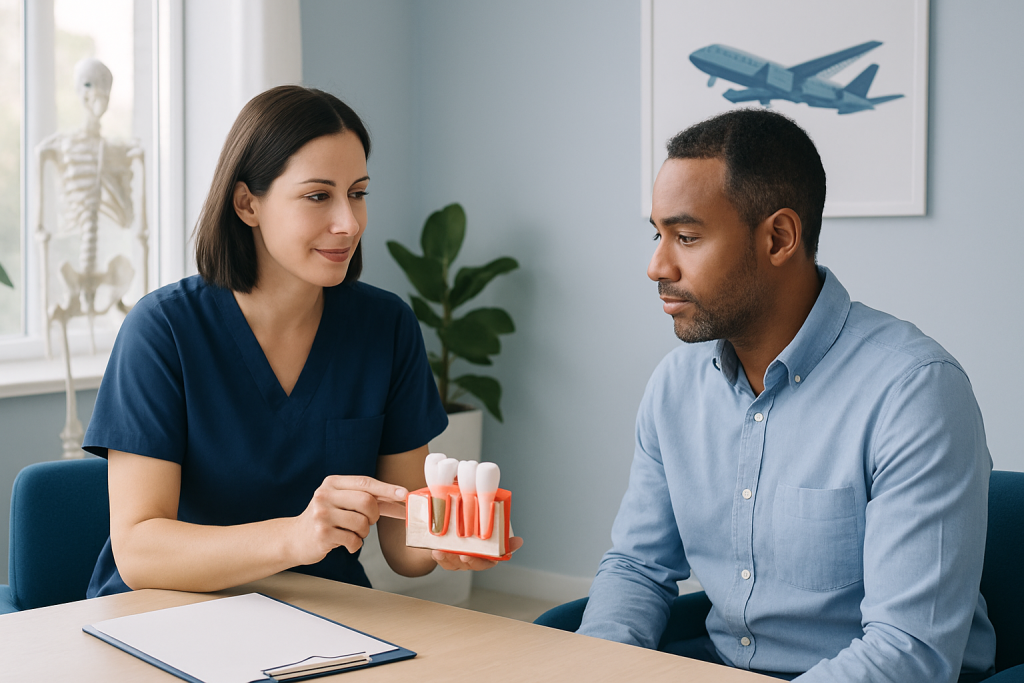
After uncomplicated implant placement, many surgeons prefer a wait of at least 48 to 72 hours. This lets the initial bleeding and swelling phase pass, shows how you respond to any prescribed pain relief or antibiotics, and leaves room for a post-operative check before departure. Patients who receive several implants in one sitting, a full-arch restoration or bone grafting are often advised to stay longer, because more surgery means more swelling and a longer window in which early problems can appear.
The important exception is the sinus. If your implant plan included a sinus lift, or the implants sit close to the sinus floor in the upper jaw, the recommended delay before flying is often around 7 to 14 days and sometimes more. Healing sinus tissue is sensitive to pressure changes, and surgeons frequently add specific instructions about avoiding nose blowing, forceful sneezing with a closed mouth, and straining. Those instructions matter even when you feel entirely well, because the membrane repairs itself quietly and gives little feedback while it does.
It also helps to remember what an implant timeline really looks like. The bone integrates with the implant over a period of months, long after any flight home. Nothing about a normal cabin environment interferes with that process, but smoking, poor nutrition and inadequate rest can. Our guide on healing faster after dental implant surgery covers the habits that genuinely influence the outcome, smoking above all.
How long after dental surgery is it safe to fly?
Surgeons generally consider a patient ready to fly when the surgical site is stable, bleeding has stopped and stayed stopped, pain is controlled with the planned medication, fluids are going down comfortably and the overall picture is one of steady improvement. For uncomplicated procedures this frequently means 24 to 72 hours. More extensive oral surgery can mean several days or longer before travel makes sense.
The reverse picture is equally instructive. Clinicians typically withhold travel clearance when pain is worsening rather than easing, when bleeding recurs, when swelling is still increasing after the expected peak, or when there is fever, discharge or difficulty swallowing. These patterns suggest the site needs assessment rather than an aeroplane seat, and a flight is the one place where assessment is hardest to arrange. This is why experienced surgeons treat the return date as provisional until the final check.
Long-haul travel adds its own layer. Cabin air is dry, so regular water matters more than usual. Meals on board rarely match a post-surgical diet, so it pays to carry suitable soft options: our list of soft foods after dental implant surgery travels well. Alcohol and smoking both interfere with early healing, which is why most aftercare plans exclude them for a period; the reasoning is explained in our guide to alcohol after dental implant surgery. And anyone who received sedation should not travel alone until fully alert and in line with the clinic’s escort instructions.
What dental procedure can you not fly after?
No single dental procedure carries a fixed, universal flying ban. What exists instead is a group of procedures where immediate air travel is generally a poor idea because the risks of bleeding, swelling, pressure-related discomfort or early complications are higher. These include complex wisdom tooth removal, multiple surgical extractions, extensive implant placement, bone grafting, full-arch surgery, jaw surgery and anything involving the sinus cavity.
The sinus deserves the strongest caution. The upper back teeth sit directly beneath the maxillary sinus, and procedures in that area, a sinus lift above all, leave tissue that reacts to pressure change while it heals. A wait of 7 to 14 days or more is common. Separately, surgeons often prefer patients not to fly with a heavy cold, sinus infection or significant nasal congestion in the early recovery period, because pressure equalisation becomes harder and more uncomfortable when the sinuses are blocked.
Anaesthesia is the other broad category. After general anaesthesia or deep sedation, the recommended recovery and observation period comes first, whatever the dental procedure was. And regardless of the operation’s size, an actively bleeding site, an untreated infection or pain that is not controlled is a reason to hold the departure date, not to test it.
Will dental implants trigger airport security?
Dental implants do not usually trigger airport security alarms. They are small, fixed inside the jawbone, and typically made from titanium or similar materials. Screening systems are designed around travellers with all kinds of medical and dental hardware, and the overwhelming majority of people with dental implants walk through security without any interaction at all.
You do not normally need an implant card or a special letter for a dental implant. If an alarm sounds for any reason, follow the officer’s instructions and, if asked, simply say that you have dental implants; screening staff have routine procedures for this. There is no need, and no point, in trying to show anyone the surgical site.
The paperwork that actually earns its place in your hand luggage is different: your discharge summary, your medication list and your clinic’s contact details. Those documents help any dentist or doctor who sees you later understand exactly what was done, which is far more useful than anything security might ask for. This applies to dental work just as it does to larger devices, see our guide on flying home with medical implants or prostheses for the wider picture.
Preparing for your flight home after dental treatment
Before leaving the clinic, make sure you hold written aftercare instructions in a language you read comfortably. The useful questions are practical ones: when to take each medicine, which symptoms are expected and which are not, whether a cold compress is appropriate, which foods suit each stage, and whether any sinus or activity restrictions apply. Written answers beat remembered ones, especially across time zones.
For the journey itself, keep prescribed medicines in their original labelled containers in your hand luggage, never in checked baggage. Add a water bottle to fill after security, soft snacks that match your dietary stage, and a copy of your treatment records. Give yourself generous time at the airport so the first days of recovery do not include sprinting between gates or hauling heavy bags. If you are travelling long-haul soon after any surgery, the general precautions in our guide to lowering DVT risk on long-haul trips are worth reading before you book a seat.
Finally, arrange follow-up before you travel rather than after. That might be a review with the treating team before departure, a planned virtual check-in, or an appointment with your dentist at home. Whoever provides that follow-up should receive your treatment records, so continuity does not depend on your memory of what was done.
Step by step
- Discuss your return date before treatment. Tell your dentist or oral surgeon exactly when you hope to fly, including connections and long-haul legs. They can say whether the planned procedure fits that window or whether extra days are needed.
- Get procedure-specific travel advice. Ask whether your surgery involves grafting, the sinus area, multiple implants, extractions, sedation or general anaesthesia. Each of these can change the recommended wait substantially.
- Stay for the recommended observation period. Do not leave simply because a minimum timeframe has passed. The point of the wait is to confirm that bleeding is controlled, pain is manageable and healing is on track.
- Attend any planned post-operative check. A review before departure catches swelling, wound concerns or medication side effects while they are easy to deal with. Ask whether sutures need checking or removal later, and by whom.
- Pack hand luggage for recovery. Medicines in original packaging, written instructions, treatment summary and clinic contact details all stay with you in the cabin. Do not rely on airport shops for suitable food or supplies.
- Make the flight itself easier. Drink water regularly, rest, choose soft foods where your plan requires them, and skip alcohol and cigarettes. Follow any specific advice about nasal pressure and nose blowing if the sinus was involved.
- Treat the return date as provisional. Symptoms that worsen rather than improve are the classic reason a surgeon withholds travel clearance. Keep at least one flexible day in your itinerary so a short delay is an inconvenience, not a crisis.
Your checklist
- Confirm your surgeon’s specific clearance to fly before booking the return leg.
- Allow extra days in Turkey in case recovery is slower than expected.
- Attend any recommended post-operative review before departure.
- Carry prescribed medicines in original packaging in hand luggage.
- Keep your discharge summary, treatment records and clinic contact details with you.
- Bring suitable soft snacks and plan to stay hydrated throughout the flight.
- Avoid smoking and alcohol for the healing period your clinician advises.
- Arrange follow-up with your home dentist and share your records with them.
- Know which patterns delay clearance, recurrent bleeding, fever, worsening pain or growing swelling, and build slack into your plans accordingly.
Key takeaways
- Flying after dental surgery and dental implants is usually possible within 24–72 hours for uncomplicated cases, but individual clearance matters more than any range.
- After implant placement, 48–72 hours is a practical minimum; multiple implants, grafting and full-arch work often mean longer.
- Sinus lifts and other sinus-related procedures commonly need 7–14 days, or whatever the surgeon specifies.
- Dental implants rarely set off airport security and need no special documentation; your discharge summary is the paperwork that counts.
- Book flexible travel, keep records and medicines in the cabin with you, and treat the return date as provisional until the final check.
Frequently asked questions
Can cabin pressure cause a dental implant to fail?
Cabin pressure changes do not usually harm a properly placed dental implant. The implant sits fixed in bone and gradually integrates over months, and a normal flight does not interfere with that process. The early concerns after surgery are the ordinary ones, swelling, bleeding and comfort, with sinus-related procedures the main exception, because healing sinus tissue is more sensitive to pressure change.
Can I fly the day after a tooth extraction?
Some people fly the day after a simple extraction if bleeding has fully stopped and the treating dentist agrees. Many clinicians prefer a 24–48 hour buffer or longer, particularly after a difficult extraction, wisdom tooth surgery, multiple extractions or sedation. Dry socket, where the protective clot is lost from the socket, typically develops in the first few days, which is one reason the buffer exists.
Can I fly after a root canal treatment?
Root canal treatment is usually less restrictive than oral surgery, and many people fly soon afterwards feeling well. Severe pain, active swelling, an unresolved infection or a temporary restoration that still needs attention can all change that picture, so the timing question is best settled with the dentist who did the work before the ticket is fixed.
Do dental implants set off airport metal detectors?
Very rarely. Dental implants are small and are typically made of titanium, and airport screening is built to accommodate travellers with medical and dental hardware. No implant card or letter is normally needed. If an alarm sounds for any reason, standard screening procedures apply, and stating that you have dental implants is all the explanation required.
Should I take pain medicine before my flight?
Use medicines exactly as your treating clinician prescribed or recommended, no more, no differently. If you expect discomfort during the journey, the timing of doses around boarding is a sensible thing to agree with your clinician before departure, along with any interactions with your other medicines. Avoid alcohol alongside pain medication, and never add extra doses on your own initiative.
How many days should I plan to stay after dental implant surgery abroad?
For uncomplicated single or few-implant placement, plans often allow two to three nights after the procedure before flying. Multiple implants, grafting or full-arch treatment usually justify more, and sinus-related work can mean one to two weeks. The most reliable approach is to ask the surgeon for a recommended stay before booking flights, then add at least one flexible day.
Does travel insurance cover dental treatment abroad?
Cover varies widely. Some policies exclude planned treatment abroad or complications arising from it, while others handle flight changes and extended stays differently again. The only dependable answer sits in the policy wording, read before travelling. Clinics can supply treatment records for a claim, but they cannot determine what an insurer will pay.
What is dry socket and why does it matter for flight timing?
Dry socket happens when the blood clot protecting an extraction site is lost or fails to form, exposing bone and nerve endings. It typically appears within the first few days after an extraction and causes significant pain that needs dental attention to settle. Because that window overlaps with the earliest possible flights home, many dentists build a deliberate buffer of two to three days into travel plans after surgical extractions.
Add us as a Preferred Source to see more of our trusted health content across Google Search, AI Overviews and Discover.

Update history
- PublishedAugust 20, 2026
- Medical review approvedSeptember 2, 2026
- Last content updateSeptember 2, 2026
References2
- Dry socket (alveolar osteitis): MedlinePlus Medical Encyclopedia medlineplus.gov
- Wisdom tooth removal: NHS nhs.uk
More Patient Guides

Septoplasty Recovery: Week by Week
Learn what to expect after deviated septum surgery: a week-by-week septoplasty recovery timeline, when it is usually safe to fly home, and…

Gallbladder Surgery Recovery: Week by Week
Learn what to expect after gallbladder surgery: a week-by-week recovery timeline, pain, diet, wound care, when it is safe to fly home…
Robotic Hysterectomy Recovery: Week by Week
Recovery from robotic hysterectomy week by week: pain, lifting, wounds, driving, flying home safely, warning signs and questions to ask before you…

Breast Reconstruction Recovery: Week by Week
DIEP flap recovery week by week: hospital stay, drains, pain, walking, showering, driving, when it is usually safe to fly home, and…