Shoulder Dislocation: Emergency Care, Recurrence Risk, and Stabilization

A suspected shoulder dislocation should be treated as an urgent medical problem; a person should not try to push the joint back in at home. Emergency care usually includes pain control, X-rays, a safe reduction by trained clinicians, and assessment of nerves, blood flow, and associated injuries.
Key Takeaways
- A suspected shoulder dislocation should be treated as an urgent medical problem; a person should not try to push the joint back in at home.
- Emergency care usually includes pain control, X-rays, a safe reduction by trained clinicians, and assessment of nerves, blood flow, and associated injuries.
- Recurrence risk is highest in younger patients, athletes in contact or overhead sports, and people with labral, ligament, or bone injuries.
- Rehabilitation is essential after the shoulder is put back in place and focuses on restoring motion, strength, and shoulder control.
- Surgical stabilization may be recommended for repeated dislocations, high-risk athletes, significant labral tears, or bone loss around the socket or humeral head.
Medically reviewed by the Acıbadem International Medical Board — June 20, 2026
A shoulder dislocation happens when the upper arm bone comes out of the shoulder socket, often after a fall, collision, or sudden twisting injury. Prompt emergency care, careful follow-up, and the right rehabilitation or stabilization plan can reduce pain, protect nerves and blood vessels, and lower the chance of recurrence.
Overview
Shoulder dislocation occurs when the head of the upper arm bone, called the humeral head, moves out of the shoulder socket. The shoulder is the body’s most mobile joint, which allows the arm to reach overhead, rotate, and move in many directions. This mobility also means the joint relies heavily on soft tissues such as the labrum, capsule, ligaments, and rotator cuff muscles for stability.
Most shoulder dislocations are anterior, meaning the humeral head moves forward out of the socket. This commonly happens when the arm is forced away from the body and rotated outward, such as during a fall, sports collision, or sudden traction injury. Less commonly, the shoulder may dislocate backward or downward, and these patterns can be associated with seizures, electrical injury, or higher-energy trauma.
A dislocated shoulder is painful and usually causes an obvious inability to move the arm normally. Although the joint can often be put back into place without surgery, the first dislocation may stretch or tear stabilizing tissues. For this reason, care does not end when the shoulder is reduced; follow-up is important to assess recurrence risk and plan safe recovery.
Symptoms and Emergency Warning Signs
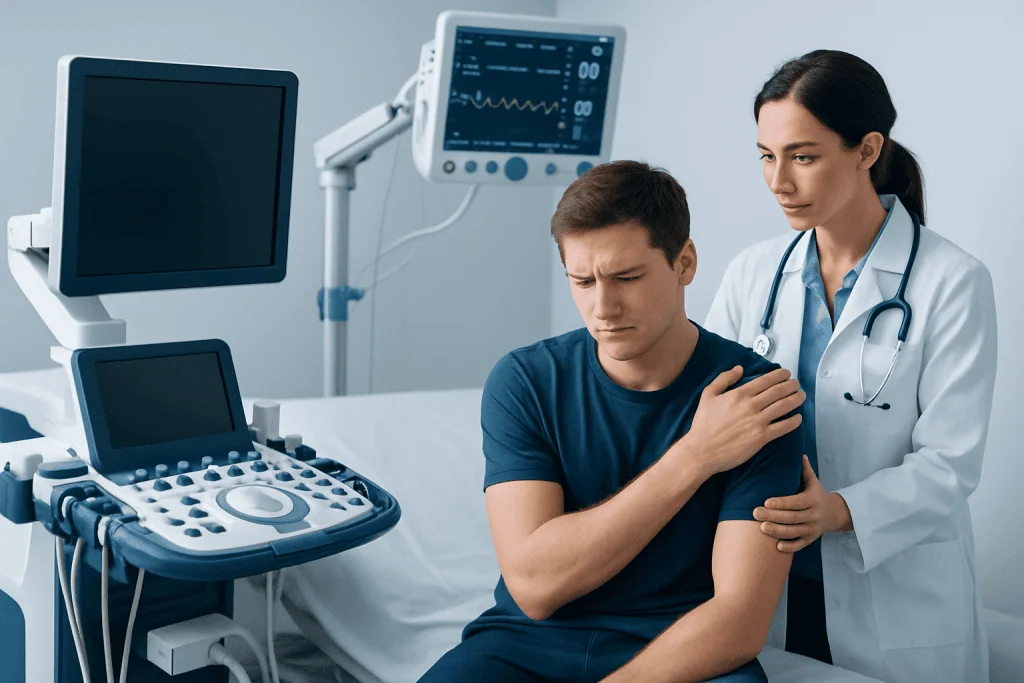
The main symptoms of a shoulder dislocation are sudden severe shoulder pain, a feeling that the joint has come out of place, and difficulty moving the arm. The shoulder may look squared off, flattened, or visibly deformed. Many people hold the injured arm close to the body and avoid any movement because even small motions can be painful.
Some symptoms suggest that nerves or blood vessels may be affected. A person may notice numbness or tingling over the outer shoulder, down the arm, or into the hand. Weakness, a cold or pale hand, or a reduced pulse in the wrist should be assessed urgently. These findings do not always mean permanent damage, but they require prompt medical evaluation.
Emergency assessment is also important when the injury follows a major fall, motor vehicle collision, seizure, or direct blow. Fractures can occur with dislocation, especially in older adults or high-energy injuries. A safe medical evaluation helps confirm the direction of dislocation, identify associated injuries, and guide the correct method of treatment.
What to Do Immediately

A suspected shoulder dislocation should be treated as an urgent injury. The person should stop activity, keep the arm as still as possible, and seek emergency medical care. A sling, towel, or soft support can help hold the arm in a comfortable position while waiting for medical help.
It is not recommended to try to push or pull the shoulder back into place at home, on the field, or in a non-medical setting. Incorrect attempts can worsen pain, cause fractures, or injure nerves and blood vessels. Trained clinicians use examination findings, imaging when needed, pain control, and controlled techniques to reduce the joint as safely as possible.
Simple first-aid steps can be helpful while traveling to care:
- Remove rings, watches, or tight clothing from the injured arm if swelling is expected and it can be done without moving the shoulder too much.
- Apply a cold pack wrapped in cloth for short intervals to help reduce pain and swelling.
- Avoid eating or drinking until assessed, because sedation or a procedure may be needed.
- Tell the medical team about numbness, weakness, previous dislocations, medications, allergies, and any major medical conditions.
Causes and Recurrence Risk
Shoulder dislocations often occur during sports, falls, or trauma. Contact sports such as rugby, football, martial arts, and wrestling carry risk because of collisions and forced arm positions. Overhead and high-demand sports may also place repeated stress on the shoulder, especially if a person already has looseness or a previous injury.
The risk of recurrence depends on several factors. Younger patients, especially teenagers and young adults, are more likely to develop repeated instability after a first traumatic dislocation. Athletes returning to contact or overhead sports, people with generalized joint laxity, and those whose work requires heavy lifting or overhead activity may also have a higher risk.
Structural injuries influence recurrence. A Bankart lesion is a tear of the labrum and capsule at the front of the socket, commonly seen after anterior dislocation. A Hill-Sachs lesion is an indentation injury on the humeral head caused by contact with the socket rim during dislocation. Bone loss from the glenoid socket or a large humeral head defect can make the joint less stable and may affect treatment choices.
In older adults, recurrence may be less common than in younger athletes, but rotator cuff tears and nerve irritation may be more important concerns. This is why follow-up care is individualized. The same dislocation pattern can have different implications depending on age, activity level, tissue quality, and imaging findings.
Diagnosis
Diagnosis begins with a careful history and physical examination. The clinician asks how the injury happened, whether the shoulder has dislocated before, and whether there is numbness, tingling, or weakness. The shoulder, elbow, wrist, and hand are examined, and blood flow and nerve function are checked before and after the joint is reduced.
X-rays are commonly used to confirm the dislocation, identify its direction, and look for fractures. In many cases, an X-ray is taken before reduction and again afterward to confirm that the joint is back in place. If a fracture is suspected or the injury pattern is complex, additional imaging may be needed.
Magnetic resonance imaging, or MRI, can show injuries to the labrum, capsule, rotator cuff, and other soft tissues. In some cases, MR arthrography, where contrast is placed in the joint, may help define labral tears. Computed tomography, or CT, is useful for assessing bone loss or complex fractures, especially when surgery is being considered.
Treatment Options: Reduction, Rehabilitation, and Stabilization
The first treatment goal is to reduce the shoulder, meaning to guide the humeral head back into the socket. This is usually performed in an emergency department or clinical setting using pain relief, muscle relaxation, and carefully controlled maneuvers. Some people require sedation, while others can be treated with local or regional pain control depending on the situation and medical assessment.
After reduction, the arm is often placed in a sling for comfort for a limited period. The exact duration depends on age, injury details, pain level, and the treating doctor’s plan. Prolonged immobilization can lead to stiffness, particularly in older adults, so rehabilitation is usually started in stages once it is safe.
Physiotherapy focuses on restoring range of motion, strengthening the rotator cuff and shoulder blade muscles, and improving coordination of the shoulder joint. A return to sports or heavy activity should be gradual and guided by pain, strength, motion, and stability rather than by time alone. Returning too early may increase the risk of another dislocation.
Surgical stabilization may be considered when the shoulder remains unstable, dislocates repeatedly, or has high-risk features. Arthroscopic Bankart repair reattaches the torn labrum and tightens the capsule in selected patients. Other procedures, such as remplissage or the Latarjet procedure, may be recommended when there is significant bone loss or an engaging Hill-Sachs lesion. The choice of procedure is individualized based on imaging, activity goals, recurrence risk, and surgeon assessment.
Prevention, Self-care, and Safe Return to Activity
Not every shoulder dislocation can be prevented, especially those caused by falls or collisions. However, good shoulder conditioning can improve joint control and may reduce the risk of future instability. Strengthening the rotator cuff, shoulder blade stabilizers, and core muscles helps the shoulder move with better support during sports and daily activities.
Self-care after medical treatment should follow the plan provided by the healthcare team. This may include using the sling as advised, applying ice in the early phase, taking prescribed or recommended pain medicines safely, and attending physiotherapy. Exercises should be progressed gradually; forcing overhead motion or returning to contact activity too soon can irritate healing tissues.
People with a history of shoulder dislocation should discuss sport-specific prevention with a qualified clinician or physiotherapist. Protective techniques, conditioning programs, and safe landing or tackling mechanics may be helpful. In some athletes, bracing or taping may provide short-term support, but it does not replace rehabilitation or correct structural instability.
When to See a Doctor
Immediate medical care is needed for any suspected first-time shoulder dislocation, a shoulder that looks deformed, severe pain after injury, or inability to move the arm. Urgent evaluation is also needed if there is numbness, weakness, a cold or pale hand, or a reduced pulse. A person should also seek care if the shoulder appears to go back into place on its own, because associated injuries can still be present.
Follow-up with an orthopedic specialist is important after the emergency visit, especially for young athletes, people with recurrent instability, and anyone whose work or sport places high demands on the shoulder. Persistent pain, clicking, apprehension in certain arm positions, or repeated slipping sensations may indicate labral injury or ongoing instability.
International patients who need evaluation for shoulder instability can seek care from qualified orthopedic and rehabilitation teams. Acibadem International’s multidisciplinary specialists and JCI-accredited hospitals diagnose and treat shoulder dislocation and related instability conditions for international patients, including imaging, rehabilitation planning, and surgical stabilization when appropriate.
Frequently asked questions
Is a shoulder dislocation always an emergency?
A suspected shoulder dislocation should be assessed urgently, especially if it is a first episode or the shoulder looks deformed. Medical care is needed to confirm the diagnosis, reduce the joint safely, and check nerves, blood vessels, and possible fractures.
Can someone put a dislocated shoulder back in place by themselves?
Self-reduction is not recommended. Pulling or pushing the shoulder without proper assessment can worsen an associated fracture or injure nerves and blood vessels. Reduction should be performed by trained healthcare professionals using appropriate pain control and technique.
Will the shoulder dislocate again after the first time?
Some people never have another dislocation, while others develop recurrent instability. The risk is higher in younger patients, contact athletes, people with labral tears or bone loss, and those who return to high-risk activity before adequate recovery. An orthopedic follow-up helps estimate individual risk.
How long does recovery take after a shoulder dislocation?
Recovery varies depending on age, injury severity, associated tears or fractures, and the physical demands of work or sport. Many people progress from sling use to guided exercises and then strengthening over several weeks. Return to contact sports or heavy overhead activity should be cleared by a clinician.
When is surgery needed for shoulder dislocation?
Surgery may be recommended for repeated dislocations, persistent instability, significant labral tears, or bone loss around the shoulder socket or humeral head. It may also be considered after a first dislocation in selected high-risk athletes. The decision depends on imaging findings, activity level, age, and personal goals.
What is a Bankart repair?
A Bankart repair is a stabilization procedure that repairs the torn labrum and capsule at the front of the shoulder socket. It is commonly performed arthroscopically for selected cases of anterior shoulder instability. The aim is to restore soft-tissue stability and reduce the chance of future dislocation.
Can physiotherapy prevent surgery?
Physiotherapy can be very effective for restoring motion, strength, and shoulder control, and many patients recover without surgery. However, rehabilitation cannot always correct major labral injury, repeated instability, or significant bone loss. If instability continues despite good rehabilitation, an orthopedic specialist may discuss surgical options.
References
- American Academy of Orthopaedic Surgeons
- British Orthopaedic Association
- Mayo Clinic
- National Institute for Health and Care Excellence
- American Orthopaedic Society for Sports Medicine
This article is for general information only and is not a substitute for professional medical advice. Please consult a qualified doctor about your individual situation.
Shoulder Dislocation in Turkey — costs, top hospitals & a free quote
JCI-accredited · board-certified surgeons · reply within 24h

More from the Health Library



Related Specialists

Dt. Şerife Karaarslan
Dentistry
Assoc. Prof. Dr. Arzu Yurci
Gynecology & Obstetrics
Assoc. Prof. Dr. Bahattin Tanrıkulu
Neurosurgery
Dr. Abdurrahman Şaban
Pulmonology