

Eye Twitching: What Causes It and When It’s Worth a Doctor’s Visit
Key Takeaways
- Most eyelid twitches are myokymia — spontaneous misfiring in a small patch of the orbicularis oculi muscle — and resolve on their own within days to a couple of weeks.
- Six everyday triggers explain the vast majority of twitches: stress, sleep loss, caffeine, eye strain, dry eyes, and alcohol.
- A twitch in only one eye is the normal pattern, not a warning sign; benign myokymia is almost always one-sided, usually in the lower lid.
- Caffeine's half-life of five to six hours means a 4 p.m. coffee still disrupts sleep at 10 p.m., giving your twitch two triggers from one cup.
- Evidence that magnesium supplements stop ordinary eyelid twitching is thin — fixing sleep and cutting caffeine is far more likely to work.
- See a doctor if a twitch lasts beyond a few weeks, forces the eyelid fully shut, involves both eyes, spreads to the cheek or mouth, or comes with drooping, redness, or vision changes.
Eye twitching is usually myokymia, a harmless involuntary flutter of the eyelid muscle most often triggered by stress, fatigue, caffeine, eye strain, dry eyes, or alcohol. It typically fades on its own within days once triggers ease. See a doctor if a twitch lasts more than a few weeks, forces the eyelid closed, spreads to other parts of the face, or comes with redness, swelling, or drooping.
It always seems to start during the third video call of the day: a tiny flutter under your lower eyelid, like a moth trapped beneath the skin. You glance at your own face on screen, certain everyone can see it. Nobody can. That’s the strange thing about an eyelid twitch — it feels enormous from the inside and is nearly invisible from the outside.
Eyelid twitching sits high on the list of symptoms people quietly Google and rarely mention to a clinician. The internet obliges with everything from folklore about incoming good luck to alarming lists of neurological diseases. The medical reality lives somewhere far more boring, and far more reassuring, than either.
Here’s the honest version: what’s actually firing in that muscle, which everyday habits are the real culprits, why the supplement aisle probably can’t help you, and the short, specific list of signs that genuinely deserve a doctor’s attention.
Why does my eye keep twitching?
The medical name for the common eyelid twitch is myokymia, and the mechanism is refreshingly simple. A thin sheet of muscle called the orbicularis oculi wraps around each eye and handles blinking. When the nerve fibers feeding a small patch of that muscle start firing spontaneously — misfiring, really — a few tiny bundles of muscle contract in rapid ripples. You feel a flutter. In a mirror, you’ll usually see almost nothing.
Two details separate ordinary myokymia from anything worth worrying about. First, it’s small: the twitch involves a section of one eyelid, most often the lower lid, and never pulls the eye itself. Second, it’s self-limited. Episodes last seconds to minutes, come and go over a few days, then quietly disappear — often the moment you stop paying attention to them.
According to MedlinePlus, this kind of eyelid twitch is common, generally painless, and harmless. It is not a muscle problem so much as a nerve-excitability problem: something has temporarily lowered the threshold at which those nerve fibers fire on their own. Most of the usual suspects — too little sleep, too much caffeine, a stretch of high stress — do exactly that. Which means the fix is rarely medical at all. It’s a matter of finding which dial in your daily routine got turned up too far, and turning it back down.
What does it mean when only one eye keeps twitching?
Medically, almost nothing — and that’s the answer worth holding onto. Myokymia is nearly always one-sided. The misfiring happens in a small patch of nerve fibers, and those fibers serve one eyelid, not both. A twitch confined to your left lower lid this week and your right upper lid next month is entirely typical of the benign version.
Folklore has had opinions about this for centuries. In parts of India and China, a twitching left or right eye supposedly signals fortune or misfortune depending on your gender; in some African traditions, it means a visitor is coming. These stories are charming and carry exactly zero predictive value. Your eyelid is not forecasting anything except, possibly, last night’s short sleep.
There is one pattern where sidedness matters, and it’s about spread rather than side. If twitching starts around one eye and then, over months, begins pulling at the cheek or the corner of the mouth on the same side of the face, that’s a different condition called hemifacial spasm — covered later in this article — and it warrants a medical exam. The same is true if one-sided twitching comes with facial weakness or drooping.
But a solitary, fluttering lower lid on one side, with a face that otherwise behaves normally? That’s the textbook presentation of the harmless kind.
What can trigger eye twitching?
The Mayo Clinic and the NHS list a remarkably consistent set of everyday triggers. Six of them account for the vast majority of twitches, and each works by making the nerves around the eyelid more excitable or the eye surface more irritated.
| Trigger | How it likely sets off the twitch | First move that helps |
|---|---|---|
| Stress | Stress hormones heighten nerve excitability | Identify the stressor; build in real breaks |
| Fatigue and poor sleep | Sleep loss lowers the firing threshold of motor nerves | Protect 7–9 hours for several nights running |
| Caffeine | Blocks adenosine, a natural calming signal for nerves | Halve intake; stop by early afternoon |
| Eye strain | Prolonged focusing fatigues the muscles around the eye | The 20-20-20 rule; check whether glasses are current |
| Dry or irritated eyes | Surface irritation feeds reflex signals to the blink circuit | Blink deliberately; ask a pharmacist about lubricating drops |
| Alcohol | Disrupts sleep quality and nerve signaling | Skip it for a week and watch what happens |
Mayo Clinic adds a few supporting players: bright light, wind, air pollution, and smoking. Notice what unites the whole list — none of it is exotic, and most of it is adjustable within a single week. That’s genuinely good news, because it means the average twitch responds to a habits audit rather than a prescription pad.
Is caffeine really to blame for my twitchy eye?
Often enough that it should be your first suspect. Caffeine works by blocking adenosine, a molecule your nervous system uses as a natural brake. With the brake disabled, nerves throughout the body — including the small motor nerves serving your eyelids — become easier to trip into spontaneous firing. For someone already running on stress and short sleep, an extra cup can be the nudge that starts the flutter.
The dose people actually consume tends to surprise them. A standard 8-ounce brewed coffee carries roughly 95 milligrams of caffeine, but a large coffeehouse pour can exceed 300. Energy drinks range from about 80 to 300 milligrams per can. Black tea contributes around 47 milligrams a cup, and even dark chocolate adds a little. Tally an honest day and many people land at double what they’d have guessed.
Timing matters as much as quantity. Caffeine’s half-life runs about five to six hours in most adults, so a 4 p.m. latte still has half its caffeine circulating at 9 or 10 p.m. — quietly shaving the deep sleep that would otherwise calm an irritable nerve. The twitch gets two hits from one cup.
Sensitivity varies widely between people, so there’s no universal cutoff. The practical experiment: cut your intake by half, move your last dose to before noon, and give it five to seven days. If the flutter fades, you have your answer without a single test.
How stress and lost sleep set off a twitch
Ask an optometrist when twitch complaints spike and you’ll hear a pattern: exam season, tax season, the weeks after a new baby arrives. That’s not coincidence. Stress and sleep deprivation are the two triggers cited most consistently by the NHS, and they tend to travel together.
The stress side works through arousal chemistry. When your body runs in a heightened state, circulating stress hormones keep the nervous system primed — useful for dodging traffic, less useful for the small motor nerves around your eye, which become more likely to fire without being asked. Sleep loss compounds the problem by depriving those nerves of the nightly recalibration that normally keeps spontaneous firing in check.
Honesty about the evidence: much of what we know here is observational. Nobody has run a randomized trial depriving volunteers of sleep to count their eyelid twitches. But the association shows up so consistently across clinical experience and major medical references that it sits firmly in mainstream consensus — and the natural experiment repeats itself in real life, where twitches routinely vanish after a restful week.
The actionable version is unglamorous. Aim for seven to nine hours of sleep for several consecutive nights, not one heroic lie-in. For stress, specificity beats vague relaxation advice: name the pressure point — the deadline, the conflict, the doom-scrolling hour — and change one concrete thing about it. Eyelids, it turns out, are honest reporters of how a week is really going.
Can screens and dry eyes cause eyelid twitching?
They can, and the two problems feed each other. When you concentrate on a screen, your blink rate drops sharply — from a typical 15 to 20 blinks per minute to as few as 5. Fewer blinks means the tear film coating your eye evaporates faster than it’s refreshed, leaving the surface dry and irritated. That irritation sends a steady stream of signals through the reflex circuit that controls blinking, and an over-stimulated circuit is fertile ground for a twitch.
Meanwhile, hours of sustained near focus fatigue the muscles in and around the eye. The Cleveland Clinic lists both eye strain and dry eye among the common culprits behind eyelid twitching — and for many desk workers, they arrive as a package deal by mid-afternoon.
A few countermeasures earn their keep:
- The 20-20-20 rule: every 20 minutes, look at something roughly 20 feet away for 20 seconds. It relaxes the focusing muscles and restores normal blinking.
- Blink on purpose. A few slow, complete blinks re-spread the tear film better than dozens of half-blinks.
- Consider lubricating eye drops if dryness is a daily companion — a pharmacist can point you to preservative-free options.
- Check your prescription. Squinting through outdated glasses is a quiet, constant source of strain.
If your twitch reliably shows up at your desk and disappears on weekends, you’ve likely just diagnosed it yourself.
Is my eye twitching from a vitamin or mineral deficiency?
Here’s where the internet gets ahead of the evidence. Magnesium is the nutrient most often blamed for eyelid twitching, and there’s a kernel of biological truth in the claim: magnesium helps regulate nerve and muscle function, and a genuine deficiency can cause muscle twitching and cramps throughout the body, as the NIH Office of Dietary Supplements notes.
But follow the logic carefully. True magnesium deficiency in otherwise healthy people is uncommon, and when it does cause twitching, the eyelids are rarely the only muscle complaining — cramps, weakness, and fatigue usually come along. More to the point, no rigorous clinical trial has shown that magnesium supplements stop the ordinary eyelid twitch in people who aren’t deficient. The evidence for that specific claim is thin, whatever the wellness feeds suggest.
An evidence-first approach looks like this. Eat magnesium-rich foods as a matter of course — leafy greens, nuts, seeds, beans, and whole grains — because they’re worthwhile regardless of your eyelid. Most adults need roughly 310 to 420 milligrams of magnesium daily, and food is the safest way to get there. If you suspect an actual deficiency, perhaps because of a digestive condition or a restricted diet, that’s a conversation for your doctor and possibly a blood test, not a guess at the supplement shelf.
The blunt ranking: sleep and caffeine are far more likely to be your twitch’s cause than anything missing from your plate.
How do I get rid of a twitchy eye?
There’s no off switch, and anyone selling one is overpromising. What works is removing whatever lowered your nerves’ firing threshold in the first place — and then giving it a little time. Most twitches resolve on their own within days once the trigger eases.
The one-week protocol most eye-care professionals would recognize:
- Sleep first. Seven to nine hours for at least five consecutive nights. This single change resolves more twitches than everything else combined.
- Taper caffeine. Cut your total roughly in half and finish your last cup before noon. Taper rather than quit cold to dodge the withdrawal headache.
- Ease the eye strain. Apply the 20-20-20 rule and take genuine screen breaks, not just app-switching breaks.
- Treat dryness. Deliberate blinking, a humidifier in dry rooms, lubricating drops if needed.
- Skip alcohol for the week. It fragments sleep even when it feels relaxing.
- Try a warm compress. A clean washcloth soaked in warm water, held over the closed eye for five to ten minutes, relaxes the muscle and soothes the surface. The evidence here is more practical than trial-based — clinicians suggest it because it’s low-risk and often feels good — and it’s honest to say so.
One thing not to do: press or rub the eyelid aggressively. It won’t stop the misfiring nerve and can irritate the eye surface, which is one of the triggers you’re trying to eliminate. Patience, in this case, is a legitimate treatment.
How long should an eye twitch last?
Shorter than it feels. A typical episode of myokymia lasts a few seconds to a few minutes, then recurs in bursts over the course of a day. The whole affair usually plays out within a few days to a couple of weeks, especially once you’ve addressed sleep, caffeine, and screen habits.
Some people experience a more stubborn version — a twitch that fades for a few days, then returns during the next stressful stretch, waxing and waning for weeks. That pattern can still be entirely benign. The nerve patch involved seems to stay a little irritable in some individuals, flaring whenever the usual triggers stack up. Annoying, yes; dangerous, no.
The clock that actually matters runs at the few-week mark. MedlinePlus advises seeing a provider if a twitch persists beyond about a week despite trigger management, and most major references agree that anything continuing for several weeks — particularly if it’s getting stronger rather than weaker — deserves an in-person exam. Not because persistence proves something is wrong, but because it moves you out of the territory where “wait and rest” is the whole answer.
A useful habit while you wait: jot down when the twitch appears and what preceded it. A simple note on your phone — coffee count, hours slept, screen time — often reveals the pattern faster than any test would.
What is blepharospasm — and how is it different from a normal twitch?
Benign essential blepharospasm is what people usually fear when they search their symptoms, and it’s worth understanding precisely so you can recognize how different it is from a common twitch. Blepharospasm is a focal dystonia — a movement disorder in which the brain’s control of the eyelid muscles goes awry — rather than a tired nerve misfiring.
The distinctions are hard to miss in practice. Blepharospasm affects both eyes. The contractions are forceful, squeezing the eyelids fully shut, sometimes for seconds at a time, rather than producing a faint flutter. It tends to worsen gradually over months, flares in bright light and under stress, and in advanced cases can make driving or reading genuinely difficult because the eyes keep clamping closed. Curiously, many patients discover “sensory tricks” — touching the temple, humming, chewing gum — that briefly quiet the spasms, a hallmark of dystonia.
It’s also rare. Estimates cited by Johns Hopkins Medicine and other academic centers put the number of affected Americans in the tens of thousands — against millions who experience ordinary myokymia every year. It typically begins between the 50s and 60s and affects women roughly twice as often as men.
The encouraging part: blepharospasm is treatable. Ophthalmologists commonly manage it with targeted injections that temporarily relax the overactive muscles, repeated every few months, and most patients get meaningful relief. If your twitching is two-sided, forceful, and progressive, that’s the appointment to book — promptly, but without panic.
What is hemifacial spasm?
Hemifacial spasm is the other named condition that occasionally hides behind an ordinary-looking twitch. It’s one-sided by definition — hemi meaning half — and it typically begins innocently, with intermittent twitching around one eye. The tell is what happens next: over months to years, the spasms spread down the same side of the face, tugging at the cheek, the corner of the mouth, sometimes the muscles of the neck. In many patients the twitching continues even during sleep, something benign myokymia essentially never does.
The usual cause is mechanical rather than mysterious. In most cases, a small blood vessel lies against the facial nerve where it exits the brainstem, and the vessel’s pulsations irritate the nerve over time — like a garden hose resting on an electrical cable. According to the National Institute of Neurological Disorders and Stroke, the condition affects both sexes but is somewhat more common in middle-aged and older women. It remains rare, on the order of roughly 10 in every 100,000 people.
Diagnosis usually involves a neurological exam and often an MRI to look at the nerve and nearby vessels. Treatment exists and works: options range from injections that quiet the overactive muscles to a surgical procedure that cushions the nerve from the offending vessel.
The takeaway for a worried reader: spread is the signal. Twitching that stays confined to one eyelid is almost certainly myokymia. Twitching that recruits the cheek or mouth on the same side has earned a neurologist’s opinion.
Can eye twitching be a sign of something serious?
Almost never on its own — and that phrasing is chosen carefully. Major references including the Mayo Clinic note that eyelid twitching can very rarely appear in the context of brain and nervous system disorders, among them multiple sclerosis, Parkinson’s disease, and Tourette syndrome, or as a lingering effect after Bell’s palsy. Certain prescription medicines can also cause twitching as a side effect, which is one reason a medication review belongs in any evaluation.
Here’s the context those lists usually lack: in essentially all of these conditions, twitching is a minor supporting character, not the opening scene. When a neurological disorder is involved, other symptoms come with it — facial weakness or drooping, changes in vision, trouble with balance or coordination, numbness, tremor elsewhere in the body. A fluttering eyelid in an otherwise fully functioning face and body simply does not fit the pattern of serious neurological disease.
It’s also worth naming a common fear directly: an isolated eyelid twitch is not a recognized warning sign of stroke. Stroke symptoms arrive suddenly and involve function — facial drooping, arm weakness, slurred speech, vision loss — not a subtle flicker of one lid.
So the honest risk summary reads like this. The odds overwhelmingly favor a benign, trigger-driven twitch. The rare exceptions announce themselves through company they keep: spread, weakness, persistence, and other neurological changes. Watch for the company, not the twitch.
When should I see a doctor about eye twitching?
Most twitches never need an appointment. But a specific, short list of features changes that calculation, and it’s worth committing to memory rather than re-Googling at midnight.
Make an appointment with your doctor or an eye-care professional if:
- The twitch persists beyond a few weeks despite better sleep and less caffeine — MedlinePlus suggests checking in even after one stubborn week.
- The eyelid closes completely with each spasm, or you’re having trouble keeping the eye open.
- Twitching involves both eyes with forceful squeezing — the pattern of blepharospasm.
- The spasms spread to the cheek, mouth, or other parts of the face on the same side.
- Other facial changes appear: drooping, weakness, or asymmetry.
- The eye itself looks unwell: redness, swelling, discharge, or pain, which point toward infection or another surface problem needing treatment.
- Vision changes accompany the twitching in any way.
Seek prompt medical attention — same day — if a twitch comes with sudden facial drooping, weakness in an arm or leg, slurred speech, or vision loss. Those symptoms need evaluation regardless of what the eyelid is doing.
One more scenario deserves mention: if you’ve recently started a new prescription medicine and twitching followed, mention it to the prescriber rather than stopping anything on your own. Side effects are a conversation, not a self-service decision.
Everything outside this list falls under watchful waiting — with a real bedtime and a smaller coffee.
What will the doctor actually do about a twitching eye?
Less than you might fear, and more usefully than you might expect. The visit typically starts with history, because history solves most of these cases: how long the twitch has lasted, which lid, whether it spreads, what your sleep and caffeine look like, what medicines and supplements you take, and how much screen time fills your day. Arriving with a week of notes — a simple twitch diary logging episodes alongside coffee, sleep hours, and stress — can shortcut the whole process.
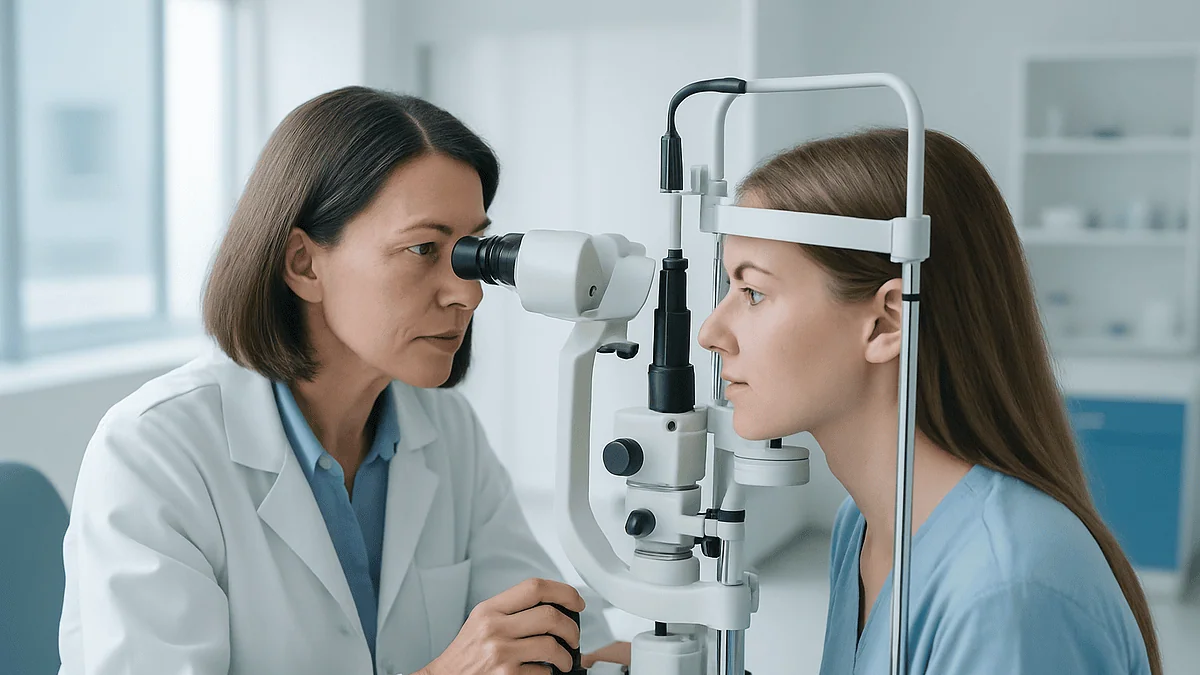
An eye-care professional will usually examine the surface of the eye, often with a slit lamp, looking for dryness, inflammation, an ingrown lash, or other irritation quietly feeding the blink reflex. Treating a dry or irritated surface resolves a surprising share of persistent twitches.
If the pattern suggests blepharospasm or hemifacial spasm — bilateral squeezing, or spread beyond the eyelid — expect a referral to a neurologist or an ophthalmologist who specializes in these conditions, possibly with imaging to look at the facial nerve. For confirmed blepharospasm or hemifacial spasm, targeted injections that temporarily relax the overactive muscle are the mainstay of care, typically repeated every few months, and the evidence for their effectiveness is solid.
For garden-variety myokymia, though, the most common prescription is validation plus a plan: your eye is healthy, your nerves are tired, and the treatment lives in your calendar and your coffee cup. Sometimes the most valuable thing a doctor provides is permission to stop worrying.
Frequently asked questions
What does it mean when only one eye keeps twitching?
One-sided twitching is the normal pattern for benign eyelid myokymia, not a warning sign. The misfiring happens in a small patch of nerve fibers serving a single eyelid, most often the lower lid. Cultural superstitions about left versus right eyes have no medical basis. The only one-sided pattern that needs evaluation is twitching that spreads over time from the eye to the cheek or mouth on the same side, which can indicate hemifacial spasm.
How do I get rid of a twitchy eye?
Remove the triggers and give it a few days. Sleep seven to nine hours for several consecutive nights, cut caffeine roughly in half and finish it before noon, take regular screen breaks using the 20-20-20 rule, skip alcohol for a week, and try a warm compress over the closed eye for five to ten minutes. Most twitches fade within days once nerve excitability settles. There is no instant off switch, and rubbing the lid won’t help.
Should I be concerned if my eye twitches?
Usually not. The overwhelming majority of eyelid twitches are harmless myokymia driven by stress, fatigue, caffeine, or eye strain, and they resolve on their own. Concern is warranted only for specific features: a twitch lasting more than a few weeks, spasms that force the eyelid completely shut, twitching in both eyes, spread to other facial muscles, or accompanying drooping, redness, swelling, or vision changes. Any of those signs deserves a medical exam.
Can dehydration cause eye twitching?
Possibly, though the evidence is indirect. Significant dehydration disturbs the electrolyte balance that nerves and muscles rely on, which can promote muscle twitching in general. However, mild everyday dehydration is rarely the main driver of an eyelid twitch — sleep loss, caffeine, and stress are far more commonly implicated by major medical references. Staying normally hydrated is sensible, but if your twitch persists, look hardest at your sleep and coffee habits.
Is eye twitching a sign of a stroke or brain tumor?
An isolated eyelid twitch is not a recognized sign of either. Stroke symptoms arrive suddenly and involve lost function — facial drooping, arm weakness, slurred speech, vision loss — and need emergency care regardless of any twitch. Neurological conditions that occasionally involve twitching, such as multiple sclerosis or Parkinson’s disease, essentially always come with other symptoms like weakness, tremor, or coordination problems. A flutter in an otherwise normal face fits the benign pattern.
Why does my eye twitch when I'm tired?
Sleep deprivation lowers the threshold at which motor nerves fire spontaneously, making the small nerves serving your eyelid more likely to misfire without instruction. Fatigue also tends to travel with its accomplices — extra caffeine to compensate and higher stress — which independently heighten nerve excitability. That’s why twitches cluster during exam weeks, deadline crunches, and new-parent months, and why several consecutive nights of adequate sleep is the single most effective remedy.
Does magnesium help eye twitching?
The evidence is weak for ordinary eyelid twitches. True magnesium deficiency can cause muscle twitching throughout the body, but it’s uncommon in healthy people and rarely limited to the eyelids. No rigorous trial has shown magnesium supplements stop eyelid myokymia in people who aren’t deficient. Eating magnesium-rich foods — leafy greens, nuts, beans, whole grains — is worthwhile for general health, but if you suspect an actual deficiency, discuss testing with your doctor rather than guessing.
How long can an eye twitch last?
Individual episodes last seconds to minutes, recurring in bursts over a day. The whole spell typically resolves within a few days to two weeks, especially after improving sleep and cutting caffeine. Some people have a waxing-and-waning version that flares during stressful stretches for weeks and is still benign. A twitch persisting beyond a few weeks despite trigger management — or one that’s growing stronger — should be evaluated by a doctor or eye-care professional.
Can too much screen time cause eye twitching?
Yes, through two routes. Concentrating on screens drops your blink rate from roughly 15–20 blinks per minute to as few as 5, drying and irritating the eye surface, which feeds excess signals into the blink reflex. Prolonged near focus also fatigues the muscles around the eye. Both effects are listed among common twitch triggers by major medical centers. The 20-20-20 rule, deliberate blinking, and lubricating drops for dryness usually help within days.
What's the difference between a normal eye twitch and blepharospasm?
Scale, sides, and trajectory. A normal twitch (myokymia) is a faint flutter in part of one eyelid that fades within days. Blepharospasm is a rare movement disorder affecting both eyes, with forceful spasms that squeeze the lids fully shut, worsen over months, and flare in bright light. It typically begins after age 50 and affects women about twice as often. Blepharospasm is treatable — ophthalmologists commonly use targeted muscle-relaxing injections — so persistent bilateral squeezing warrants an appointment.
References
This article is for general information only and is not a substitute for professional medical advice. Please consult a qualified doctor about your individual situation.