

Hip Flexor Stretch: Undo the Sitting Your Hips Remember

Key Takeaways
- The psoas attaches directly to your lumbar vertebrae, which is why letting your low back arch during a hip flexor stretch cancels most of the lengthening — tuck the pelvis first.
- Evidence-based dosing is simple: hold each stretch about 30 seconds, repeat two to four times per side, at least most days of the week, with noticeable gains typically arriving in two to six weeks.
- Walking helps but has a ceiling — a normal stride uses only about 10 to 15 degrees of hip extension, far short of the range a deliberate static stretch reaches.
- Muscles that feel chronically tight are often also weak; if stretching alone keeps failing, seated knee lifts and standing marches address the strength side of the problem.
- Hip osteoarthritis, labral tears, inguinal hernias, and referred lumbar nerve pain can all masquerade as tight hip flexors — sharp, catching, radiating, or worsening pain deserves a clinician, not a deeper lunge.
- You cannot meaningfully foam-roll the psoas from the front of your abdomen — it lies too deep behind the abdominal contents — so spend those minutes stretching instead.
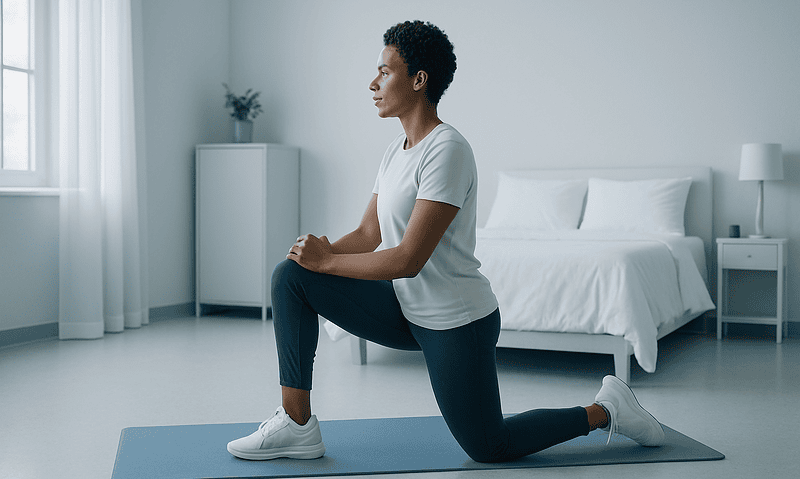
A hip flexor stretch lengthens the muscles that lift your thigh toward your chest — mainly the iliopsoas and rectus femoris — which often feel tight after long stretches of sitting. The most reliable version is a half-kneeling lunge: tuck the pelvis under, gently squeeze the back-leg glute, and hold about 30 seconds, two to four times per side, most days of the week.
It happens at the end of a long meeting. You stand up, and for two or three steps your body walks like it’s still sitting — hips slightly folded, stride short, low back doing work it never signed up for. Then things loosen, you forget about it, and eight hours later the whole scene repeats.
That folded feeling has a home address: the front of your hips, where a small team of muscles spends every seated hour in a shortened position. They don’t complain loudly. They just get grumpy about being asked to lengthen again, and that grumpiness shows up as stiffness, an achy groin, or a back that protests when you stand tall.
The fix is neither exotic nor expensive. But it is specific — and most people do the classic stretch in a way that quietly cancels its own benefit. Here’s what actually works, what the evidence supports, and what tight hips can disguise.
What are hip flexors, exactly — and why do they hold a grudge?
Your hip flexors are the muscles that fold your body at the hip: they lift your thigh when you climb stairs, swing your leg forward when you walk, and hold your trunk upright when you sit. The headliner is the iliopsoas, actually two muscles — the psoas major, which runs from your lumbar spine through the pelvis to the inner thigh bone, and the iliacus, which lines the inside of the pelvic bowl. Supporting cast: the rectus femoris (the only quadriceps muscle that crosses both the hip and the knee), plus the sartorius and tensor fasciae latae.
The psoas is the interesting one, because its top end attaches directly to the vertebrae of your lower back. That anatomy explains a pattern many people notice: the front of the hip feels short and cranky, and the low back feels the consequences. When the psoas is held in a shortened position for hours, standing up asks it to lengthen quickly — and if it resists, the pelvis can tip forward and the lumbar spine arches to compensate.
Sitting itself isn’t a moral failing, and these muscles aren’t villains. They’re doing exactly what muscles do: adapting to the position you give them most often. An office worker who sits eight to ten hours a day gives the hip flexors roughly 500 shortened hours a month. The stretch is simply the counter-vote — a few minutes of lengthening to remind the tissue, and the nervous system that governs it, that the other end of the range still exists.
What are the symptoms of tight hip flexors?
Tight hip flexors rarely announce themselves with a single sharp pain. They speak in patterns, and the pattern usually looks like some mix of the following:
- A pulling or pinching sensation at the front of the hip or deep in the groin, especially when you stand up after sitting or take long strides.
- Low back stiffness or ache when standing tall, lying flat on your back, or walking downhill — positions that demand full hip extension.
- A shortened walking stride, or the feeling that your back leg won’t fully open behind you when you run.
- An exaggerated arch in the lower back with the pelvis tipped forward (often called anterior pelvic tilt), sometimes visible in a side-view photo.
- Discomfort during exercises that extend the hip — lunges, bridges, or the back leg in a split squat.
A quick self-check clinicians use is the Thomas test position. Lie on your back on a firm bed or table with your legs hanging off the edge, then hug one knee to your chest. Watch the other thigh: if it lifts off the surface or drifts out to the side, the hip flexors on that side are likely limiting extension.
One honest caveat: the feeling of tightness doesn’t always equal a physically short muscle. Research on chronic sitters shows the sensation can come from a nervous system guarding a rarely used range of motion rather than from actual tissue shortening. Either way, regular stretching addresses both — it improves measurable range of motion and reduces the guarding.
Does sitting really shorten your hip flexors? The honest answer
The popular story goes like this: sit all day, and your hip flexors physically shrink like a sweater in a hot dryer. The evidence tells a subtler tale, and it’s worth knowing because it changes how you fix the problem.
What’s well supported: people who sit for long periods often show reduced hip extension range and report front-of-hip tightness, and prolonged immobilization in a shortened position can lead to genuine adaptive changes in muscle. What’s less certain: whether typical desk sitting — where you shift, stand, walk to the printer — produces true structural shortening in most people. Some of that tight feeling appears to be neurological: your brain reduces tolerance for a range of motion you rarely visit, the way a rarely opened door starts to feel stuck even when the hinges are fine.
Here’s why the distinction is good news. If tightness were purely structural, you’d need months of aggressive lengthening to change it. But because much of it is the nervous system’s stiffness setting, people often feel meaningfully looser within two to four weeks of consistent, gentle stretching — and studies on static stretching consistently show measurable range-of-motion gains on that timeline when it’s done most days of the week.
The practical takeaway: you don’t need to torture the muscle. You need to visit the lengthened position regularly, calmly, and often enough that your body stops treating hip extension as foreign territory. Frequency beats intensity, by a wide margin.
How do you release a tight hip flexor?
Three levers, used together, work better than any single one: stretch the muscle, strengthen the muscles around it, and interrupt the sitting that created the problem. Think of it as undoing, rebalancing, and preventing.
Stretch. Static stretching — moving into a gentle pull and holding it — remains the best-studied way to improve hip extension range. Mayo Clinic’s guidance for major muscle groups is a hold of about 30 seconds, repeated two to four times per side, without bouncing. The half-kneeling lunge (details in the next section) is the workhorse because it isolates hip extension while letting you control the intensity precisely.
Strengthen the other side. Your glutes are the hip flexors’ opposing team. When they’re active and strong, they pull the pelvis toward neutral and take extension work off the low back. Glute bridges and split squats pair beautifully with stretching — one lengthens the front while the other powers the back.
Interrupt the pattern. A stretch held for two minutes can’t fully outvote nine seated hours, so break the sitting itself: stand during phone calls, walk after lunch, set a reminder to rise every 30 to 60 minutes. None of these are dramatic. All of them add hip-extension minutes to your day.
What about foam rolling and massage guns on the front of the hip? They can feel pleasant and may temporarily reduce the sensation of tightness, but the psoas lies deep behind the abdominal contents — you can’t meaningfully press on it from the front, despite what some videos claim. Spend those minutes stretching instead.
The half-kneeling hip flexor stretch, done right
This is the stretch worth mastering before any other, because every fancier variation is built on it. Grab a folded towel or cushion for your knee.
- Set up. Kneel on your right knee with your left foot planted in front, both knees bent near 90 degrees — a proposal position. Keep your torso tall, ribs stacked over hips.
- The step everyone skips: tuck your pelvis. Before you move anywhere, gently tilt your pelvis under, as if tucking a tail between your legs, and lightly squeeze the right glute. You may feel the stretch begin already — that’s the psoas lengthening.
- Shift, don’t lunge. Ease your hips forward an inch or two while keeping the tuck. Small movement, big sensation. You should feel a clear pull at the front of the right hip and thigh — not pinching in the front of the left hip, and not compression in your low back.
- Hold and breathe. Stay about 30 seconds, breathing slowly. Exhaling tends to let the muscle release a little further. Then switch sides and repeat two to four times each.
To add the rectus femoris — the quad muscle that also crosses the hip — bend the back knee and rest that foot on a couch or low bench behind you (the so-called couch stretch). The intensity jumps noticeably, so keep the pelvic tuck and shrink the forward shift.
Intensity guide: aim for a 4 or 5 out of 10 pull. A stretch that makes you grimace makes your nervous system guard harder, which is the opposite of the goal.
Four more hip flexor stretches worth your two minutes
Variety isn’t just for boredom control — different positions bias different muscles in the hip flexor group, and some suit stiff knees or office clothes better than kneeling on carpet. Rotate through these across the week.
| Stretch | How to do it | Best for | Hold |
|---|---|---|---|
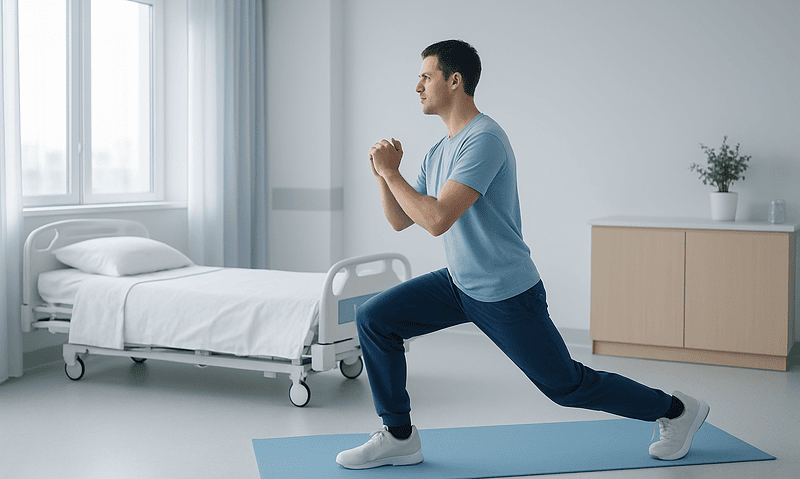
| Standing lunge stretch | Stagger your stance, back leg straight, tuck the pelvis and shift hips forward. Hands on a desk for balance. | Office breaks; no kneeling required | 30 sec × 2–4 per side |
| Couch stretch | Half-kneeling with the back foot elevated on a couch or bench behind you; keep the pelvic tuck. | Adding the rectus femoris; runners | 20–30 sec × 2–3 per side |
| Low lunge with reach | From the half-kneeling stretch, raise the same-side arm overhead and lean slightly away. | Reaching the higher psoas fibers | 30 sec × 2 per side |
| Bridge with reach-over | Lie on your back, knees bent; lift hips into a bridge and hold. An active option that pairs glute work with hip extension. | People whose backs dislike deep lunges | 15–20 sec × 3–5 |
Two sequencing notes. First, save long static holds for after exercise or as their own session — Harvard Health and others note that muscles stretch more comfortably when warm, so even two minutes of walking beforehand helps. Second, if one side feels dramatically tighter, give it an extra repetition rather than stretching the loose side harder. Symmetry of effort matters less than symmetry of outcome.
Total time cost for a full session: roughly five minutes. That’s shorter than the meeting that stiffened you up in the first place.
The one mistake that cancels the stretch
Watch ten people do a hip flexor stretch and eight of them will make the same error: they lunge forward, arch the lower back, and feel a satisfying sensation somewhere — while the hip flexors barely lengthen at all.
Here’s the mechanics of the failure. The psoas attaches to the lumbar spine. When you let your low back arch and your pelvis tip forward, you move the muscle’s two ends closer together at the top even as you push the hip forward at the bottom. Net lengthening: close to zero. Worse, that arched position compresses the lumbar joints, which is why some people finish a “hip stretch” with a sore back and conclude stretching doesn’t work for them.
The countermeasure is the posterior pelvic tilt — the tail-tuck described earlier — held throughout the stretch. It fixes the top end of the psoas in place so the forward shift actually lengthens the muscle. The strange consequence: done correctly, the stretch looks smaller. You shift forward one or two inches instead of six, yet the sensation at the front of the hip is stronger and cleaner.
A few other errors worth avoiding:
- Bouncing. Ballistic bouncing can trigger a protective contraction and, per Mayo Clinic guidance, offers no advantage over a steady hold for general flexibility.
- Holding your breath. Breath-holding raises overall muscle tension. Slow exhales do the opposite.
- Chasing pain. A stretch should register as a firm pull, never sharp, burning, or radiating. Sharp front-of-hip pinching during the stretch is a reason to shrink the range or check with a clinician, not push through.
How long, how often, and how soon will you feel a difference?
Stretching research is refreshingly consistent on dosage, which makes planning simple. Mayo Clinic recommends holding each stretch about 30 seconds and repeating two to four times per muscle group; longer holds add little for most healthy adults. Frequency is where the real gains hide: studies show flexibility improves most reliably when a muscle is stretched at least two to three days a week, and daily practice works even better for a stubborn area like the hip flexors.
So a sensible baseline looks like this: 30-second holds, two to four per side, five or more days a week. Total commitment, four to six minutes a day. That’s roughly the length of two songs.
Expect a two-stage payoff. Immediately after a session, range of motion improves for a short window — minutes to a few hours — mostly because your nervous system temporarily raises its tolerance for the lengthened position. Lasting change accumulates over two to six weeks of consistency, at which point most people notice a longer stride, easier standing after sitting, and less of that folded-forward feeling in the morning.
Two honest caveats. Progress isn’t linear; a stressful week, poor sleep, or a long car trip can temporarily re-tighten things without meaning you’ve lost ground. And stretching maintains itself only as long as you keep visiting the range — flexibility gains fade over several weeks of stopping. That’s not a flaw in the method. It’s the same use-it-or-lose-it rule that governs every other physical capacity you own.
Does walking loosen tight hip flexors?
Partly — and the details matter. Every walking stride takes your hip into extension as the leg travels behind you, so walking gives the hip flexors thousands of brief, gentle lengthenings that sitting never provides. For someone rising from a desk, a ten-minute walk genuinely reduces that stiff, folded sensation, and regular walkers tend to preserve hip extension better than sedentary peers. The CDC’s activity guidelines — at least 150 minutes of moderate activity weekly — are worth hitting for a dozen reasons, and hip health is quietly one of them.
But walking has a ceiling. The average walking stride uses only about 10 to 15 degrees of hip extension, and a body that’s tight will simply steal that motion from somewhere else — usually by tipping the pelvis forward or shortening the stride — without the hip flexors ever reaching a real stretch. You can log 10,000 steps a day and still fail the Thomas test, because you never actually visited the end of the range.
The two tools do different jobs. Walking is maintenance and circulation: it keeps the hips moving through a moderate range, warms the tissue, and interrupts sitting. Static stretching is range expansion: it deliberately visits the territory walking never reaches. Use both.
One upgrade worth trying: on part of your walk, consciously lengthen your stride slightly and let the back leg extend fully, pushing off through the big toe. Uphill walking helps too, since it demands more hip extension per step. Small tweaks, but they turn an errand into light rehab.
Tight or weak? Why your hip flexors might need strengthening too
Here’s a plot twist the internet rarely mentions: muscles that feel tight are often also weak. A hip flexor held short and idle for years doesn’t become powerful — it becomes deconditioned, and deconditioned muscles frequently register as tight because the nervous system stiffens what it can’t confidently control. If you stretch daily for a month and the tightness keeps boomeranging back, weakness is the prime suspect.
The test is simple. Sit tall in a chair and lift one knee a few inches above hip height without leaning back or slumping. Hold five seconds. If the leg trembles, cramps at the hip crease, or you can’t keep your trunk still, your hip flexors are asking for strength, not just length.
Two starter exercises, no equipment required:
- Seated knee lifts. Exactly the test above, done as a set: lift, hold three to five seconds, lower slowly. Eight to ten per side, once daily. Progress by holding longer or adding a light resistance band around the thighs.
- Standing marches. Stand tall and slowly march in place, driving each knee to hip height with control, pausing briefly at the top. Twenty total, keeping the pelvis level throughout.
And don’t forget the opposing team. Glute bridges — lying on your back, knees bent, lifting the hips until they align with knees and shoulders — strengthen hip extension and encourage the pelvis toward neutral. Two or three sets of ten, a few times a week, complements the stretching program the way a matching bookend steadies a shelf. Strength plus length is the combination that lasts; either one alone tends to be a temporary fix.
What can be mistaken for tight hip flexors?
Front-of-hip discomfort is a busy neighborhood, and several conditions rent space there. This matters because stretching helps genuine muscle tightness but can aggravate some of its impostors. Patterns that suggest something other than simple tightness:
- Hip flexor strain. An actual tear in the muscle fibers, usually from a sudden sprint, kick, or slip. The clue is a specific moment of injury, sharp pain with lifting the knee, and sometimes bruising. Strains need relative rest first; aggressive stretching early on delays healing.
- Hip osteoarthritis. Groin pain that deepens with weight-bearing, morning stiffness that eases with movement, and a gradually shrinking range of motion — especially rotating the hip inward. More common after 50, and worth an evaluation rather than a stretching program alone.
- Femoroacetabular impingement or a labral tear. A sharp pinch deep in the groin during deep squats, prolonged sitting, or pivoting, sometimes with clicking or catching. Forcing deep hip flexion or aggressive stretching often makes this crankier.
- Inguinal hernia. An ache or bulge near the groin crease that worsens with coughing, lifting, or straining. Muscle stretches won’t touch it, and a visible bulge deserves prompt medical attention.
- Referred pain from the lumbar spine. Irritated upper lumbar nerves can project pain to the front of the hip and thigh, occasionally with numbness or tingling. The hip itself may be innocent.
- Bursitis or tendon irritation. Inflammation of the small cushioning sacs or the psoas tendon can mimic tightness, sometimes with an audible snap at the hip crease.
A rough rule of thumb: tightness feels like a pull that eases with gentle movement and warmth. Sharp, catching, radiating, or steadily worsening pain is a different conversation — one to have with a clinician, as covered below.
Outsmarting the chair: small habits that keep hips honest
No stretch, however well executed, fully offsets nine unbroken seated hours. The math is simply lopsided: two minutes of lengthening against 540 minutes of shortening. The winning strategy attacks the denominator.
Break up the sitting. Set a quiet timer and stand every 30 to 60 minutes, even for 60 seconds. The point isn’t calorie burn; it’s giving the hip flexors regular visits to their full length so they never fully settle into the short position. A standing stretch at the desk — back leg straight, pelvis tucked, hips shifted an inch forward — takes 30 seconds and no floor space.
Vary the seated position. Perch at the front edge of the chair for a while with hips slightly higher than knees, which reduces the depth of hip flexion. If you use a sit-stand desk, alternate rather than standing all day; the variety is the benefit, not the standing itself.
Attach movement to existing anchors. Habit research is clear that new behaviors stick best when tied to things you already do. Stretch while the coffee brews. Take phone calls on your feet. Walk the long way to the restroom. March in place during the kettle’s two minutes.
Bookend the day. A morning session tells your hips the day involves extension; an evening session undoes the ledger before sleep. People who anchor stretching to brushing their teeth — same trigger, twice daily — tend to still be doing it six months later, which is the only timeline that matters.
None of this requires equipment, willpower heroics, or a wardrobe change. It requires remembering that your hips keep a running tally of positions, and you get to vote all day long.
Hip flexors and low back pain: what the evidence actually shows
Scroll through fitness content and you’ll find the psoas blamed for nearly every aching back in the developed world. The real evidence is more modest — and more useful.
The plausible mechanism is genuine: because the psoas attaches to the lumbar vertebrae, a short or guarded psoas can pull the pelvis into a forward tilt and increase the lumbar arch, and some studies do find reduced hip extension range in people with certain types of low back pain. Clinicians frequently observe that improving hip mobility makes standing and walking more comfortable for these patients.
But correlation isn’t a verdict. Other studies find no consistent difference in hip flexor length between people with and without back pain, and low back pain itself is famously multifactorial — sleep, stress, general fitness, load tolerance, and plain bad luck all contribute. Anyone promising that one stretch will “fix” your back is selling a story the research doesn’t support.
The defensible position: if your back aches after prolonged sitting, feels worse when you stand fully upright, and eases when you sit or lean forward — and your hips fail the Thomas test — hip flexor stretching is a low-cost, low-risk experiment with a reasonable mechanism behind it. Give it three or four weeks alongside general activity and glute strengthening, and judge by results.
What stretching should never replace: medical evaluation for back pain that radiates below the knee, comes with numbness or weakness, follows an injury, or arrives with fever, unexplained weight loss, or changes in bladder or bowel control. Those features move the conversation from wellness to medicine, promptly.
When should you see a doctor about hip tightness or pain?
Most sitting-related hip tightness improves with a few weeks of the stretching, strengthening, and movement habits above. Some situations shouldn’t wait on a home program. Seek prompt medical care if you notice:
- Hip pain following a fall, collision, or other injury — especially if you can’t bear weight, the leg looks rotated or shortened, or the joint seems deformed.
- Sudden inability to move the hip or leg, or a hip that gives way underneath you.
- Fever, chills, or a hip that is red, hot, and swollen — possible signs of infection that need urgent evaluation.
- A new bulge in the groin, particularly one that hurts more with coughing or lifting.
- Numbness, tingling, or weakness spreading down the leg, or any change in bladder or bowel control alongside back or hip symptoms.
Book a routine appointment — no emergency, but don’t shrug it off — if pain has persisted beyond two to four weeks despite sensible self-care, wakes you at night, is gradually worsening, causes a limp, or comes with clicking, catching, or locking in the joint. Per NHS guidance, hip pain that isn’t improving after two weeks of home treatment warrants a professional look.
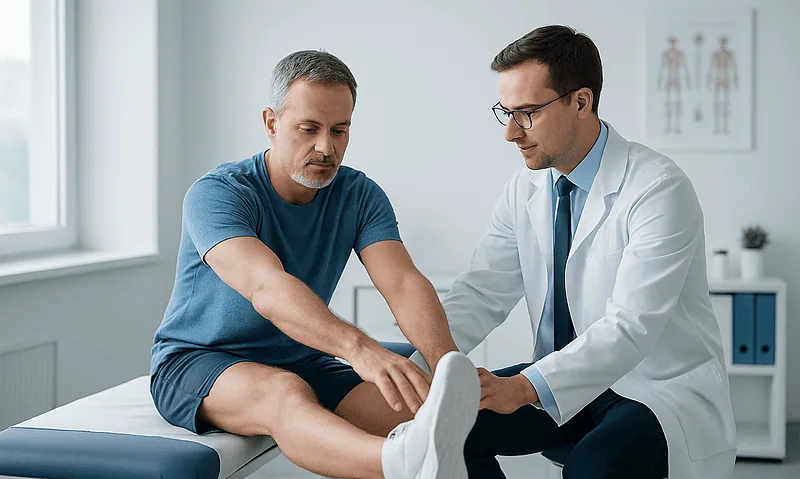
Expect a physical exam that checks your range of motion, strength, and gait, possibly followed by imaging if the exam raises questions. A physical therapist can be an excellent first stop for movement-related hip problems: a tailored program beats generic internet stretches when the situation is more complicated than simple tightness — and figuring out which situation you’re in is precisely the point of getting checked.
A simple two-week starting plan
Knowledge without a schedule tends to evaporate by Thursday, so here’s a concrete opening fortnight. It asks for about six minutes a day.
Days 1–3: learn the positions. Practice the half-kneeling stretch with the pelvic tuck until the sensation lands cleanly at the front of the hip, not the low back. Two 30-second holds per side, once daily. Add the seated knee-lift test on day 1 and note what you find — you’ll retest later.
Days 4–7: build the habit. Move to two sessions daily, anchored to existing routines (after morning coffee, after brushing teeth at night). Each session: half-kneeling stretch, two holds per side, plus ten slow glute bridges. During workdays, add one standing desk stretch mid-afternoon.
Week 2: expand and load. Keep both daily sessions. Swap one half-kneeling hold for the couch stretch if your knees tolerate it, and add ten seated knee lifts per side to the morning session. Take at least one ten-minute walk daily with a deliberately fuller back-leg push-off.
Day 14: retest. Repeat the Thomas test and the seated knee lift. Most people find the thigh sits noticeably closer to the table and the knee lift feels steadier. If nothing has budged and discomfort persists — or anything has worsened — that’s useful information pointing toward a professional evaluation rather than more of the same.
After two weeks, the maintenance dose is smaller than the building dose: one daily session, five days a week, keeps the range you’ve earned. Your hips remember what you do most often. Make sure some of it is this.
Frequently asked questions
How do you release a tight hip flexor?
Combine three things: static stretching, opposing-muscle strengthening, and less unbroken sitting. Hold a half-kneeling lunge stretch — pelvis tucked, back-leg glute lightly squeezed — for about 30 seconds, two to four times per side, most days. Add glute bridges to pull the pelvis toward neutral, and stand up from your chair every 30 to 60 minutes. Most people feel meaningful improvement within two to four weeks of this routine.
What are the symptoms of tight hip flexors?
Common signs include a pulling or aching sensation at the front of the hip or groin after sitting, low back stiffness when standing fully upright or lying flat, a shortened walking stride, and an exaggerated lumbar arch with the pelvis tipped forward. A self-check: lie on your back with legs off a table edge and hug one knee to your chest — if the opposite thigh rises off the surface, that hip’s flexors are likely restricting extension.
Does walking loosen tight hip flexors?
Partially. Each stride extends the hip and interrupts the shortened sitting position, so regular walking genuinely reduces stiffness. But normal walking uses only about 10 to 15 degrees of hip extension — well short of the muscle’s full range — so it can’t substitute for deliberate stretching. Use both: walk to maintain motion and break up sitting, and stretch to expand the range walking never reaches. Slightly lengthening your stride or walking uphill adds extra hip extension per step.
What can be mistaken for tight hip flexors?
Several conditions mimic hip flexor tightness: a hip flexor strain (an actual muscle tear from a sudden movement), hip osteoarthritis, a labral tear or hip impingement, an inguinal hernia, bursitis, and pain referred from irritated lumbar nerves. Red flags pointing away from simple tightness include a specific injury moment, sharp catching or clicking, a groin bulge, numbness or tingling down the leg, and pain that worsens rather than eases with gentle movement.
How long does it take to loosen tight hip flexors?
With consistent daily stretching — roughly 30-second holds, two to four per side — most people notice easier standing and a longer stride within two to four weeks, with continued gains over six weeks or more. You’ll feel temporarily looser immediately after each session, but lasting range-of-motion change accumulates gradually. Gains fade over several weeks if you stop entirely, so a smaller maintenance dose of five sessions per week is worth keeping long term.
Should I stretch my hip flexors every day?
Daily gentle stretching is safe for most healthy adults and speeds progress on a stubborn area like the hip flexors, though research shows meaningful gains from as few as two to three sessions weekly. The key is moderate intensity — a firm pull around 4 or 5 out of 10, never sharp pain. If a stretch causes pinching in the groin, radiating symptoms, or next-day soreness at the joint, reduce the range or get evaluated before continuing.
Why does my lower back hurt when I stretch my hip flexors?
Almost always because the pelvis tips forward and the lumbar spine arches during the stretch, compressing the low back while barely lengthening the psoas. Fix it by tucking your pelvis under — like curling a tail between your legs — and squeezing the back-leg glute before shifting forward, then moving only an inch or two. Done correctly, the stretch looks smaller but lands precisely at the front of the hip. Back pain that persists despite good form merits a professional check.
Can tight hip flexors cause knee pain?
Indirectly, sometimes. The rectus femoris crosses both the hip and knee, so restriction there can alter kneecap mechanics, and a shortened stride or forward-tipped pelvis changes how load travels through the leg. That said, knee pain has many causes, and the evidence linking hip flexor tightness directly to knee problems is limited. Treat hip stretching as one sensible piece of a broader approach, and see a clinician for knee pain that is sharp, swelling, or persistent.
Is it better to stretch hip flexors before or after a workout?
After, for long static holds. Muscles stretch more comfortably and safely when warm, and prolonged static stretching immediately before explosive activity may slightly and temporarily reduce power output. Before exercise, use dynamic movements instead — leg swings, walking lunges, marching — to prepare the hips. Save the 30-second half-kneeling and couch stretches for post-workout, evenings, or standalone sessions after a brief warm-up like two minutes of walking.
Can foam rolling release the psoas?
Not directly. The psoas sits deep in the back of the abdomen, behind the intestines and major blood vessels, so pressing on your front with a roller or ball cannot meaningfully reach it — claims otherwise aren’t anatomically sound. You can roll the more superficial rectus femoris on the front of the thigh, which may temporarily ease the sensation of tightness. For the deep hip flexors, positional stretching and strengthening remain the tools with evidence behind them.
References
- NHS — Hip pain in adults
- MedlinePlus — Hip Injuries and Disorders
- CDC — Physical Activity Guidelines for Adults
This article is for general information only and is not a substitute for professional medical advice. Please consult a qualified doctor about your individual situation.

More from the Blog

Piriformis Stretch: The Small Muscle Behind Big Sciatic Pain
A piriformis stretch lengthens a small, pear-shaped muscle deep in the buttock that lies close to the sciatic nerve. The best-known version is the…

Cold Plunge: What Ice-Cold Water Actually Does to Your Body
Ice-cold water triggers a rapid stress response: heart rate and blood pressure jump, norepinephrine surges, blood vessels constrict, and breathing quickens. Evidence supports modest…
Best Exercises for Upper Body: A Balanced Plan Beyond Push-Ups
A balanced upper-body routine pairs pushing moves (push-ups, presses) with an equal amount of pulling (rows, pull-downs), plus overhead and arm work, trained two…
Glute Bridge: The Underrated Exercise Your Back Will Thank You For
A glute bridge is a floor exercise in which you lie on your back with knees bent and lift your hips by squeezing your…

Sciatica Stretches: Evidence-Based Relief for the Nerve That Runs Deep
Gentle stretching can ease sciatica pain for many people by reducing pressure and irritation around the sciatic nerve, though it does not cure the…
How to Stretch Hamstrings: Releasing the Tightest Muscles You Own
To stretch hamstrings safely, warm up first, then hinge at the hips with a straight back — lying on your back with a strap,…