

Metacarpal Bones: The Hand Fractures Surgeons See Most
Key Takeaways
- The hand contains 27 bones, and the five metacarpals form the palm's framework between the eight carpal bones of the wrist and the fourteen finger phalanges.
- Metacarpal fractures make up roughly 30 to 40 percent of all hand fractures, and the fifth metacarpal — behind the little finger — breaks most often.
- A boxer's fracture is a break at the fifth metacarpal neck, usually from punching a hard object, and it accounts for about one in five hand fractures.
- Being able to move your fingers does not rule out a fracture, because the tendons that move the fingers run alongside the metacarpals, not through them.
- Rotation — a broken finger crossing its neighbor in a fist — is a stronger reason for surgery than pain or the angle seen on an X-ray.
- Most uncomplicated metacarpal fractures unite in three to six weeks, but grip strength commonly takes two to four months to fully return.
Metacarpals are the five long bones of the palm, linking the wrist to the fingers, and they account for roughly a third of all hand fractures. The most common is the boxer's fracture at the neck of the fifth metacarpal, usually from a punch. Most metacarpal fractures heal in three to six weeks with splinting, though rotated, badly angled, or open breaks may need surgery.
Ask any emergency doctor what walks in after midnight on a Saturday, and somewhere near the top of the list is a young man cradling one hand in the other, knuckle swollen, story vague. A wall was involved. Or a door. Occasionally, another person’s jaw. The bone that gave way is almost always the same one: the fifth metacarpal, the slender strut in the palm behind the little finger.
The metacarpals rarely get a moment of attention until one of them snaps. Yet these five bones do quiet, constant work — every grip, every keystroke, every jar lid loosened runs its force through them. They are the scaffolding of the palm, engineered with elegant compromises that make the hand both strong and dexterous.
Those same compromises are why hand surgeons see metacarpal fractures more often than almost any other break in the hand. Here is what these bones actually do, why they fail, and what honest evidence says about getting them to heal well.
What Are the Metacarpal Bones, Exactly?
Open your hand and look at the back of it. The subtle ridges fanning out from your wrist to your knuckles are your metacarpals — five miniature long bones, one for each digit, numbered from the thumb (first metacarpal) to the little finger (fifth). Each one is a scaled-down version of a thigh bone: a broad base that meets the wrist, a slim shaft, a narrowed neck, and a rounded head that forms the knuckle you see when you make a fist.
That anatomy matters clinically, because fractures behave differently depending on which part gives way. Neck fractures — the classic punching injury — tend to tip forward into the palm. Shaft fractures can shorten or rotate the whole finger. Base fractures sit close to the wrist joint, where even small misalignments can matter more.
The metacarpal heads also anchor the metacarpophalangeal joints, the hinges that let your fingers curl. Small intrinsic hand muscles attach along the shafts, which is one reason a broken metacarpal makes the entire hand feel weak, not just one finger. In children, each metacarpal still has a growth plate, so the same injury can look different on an X-ray at age 12 than at age 30 — one of several reasons pediatric hand injuries deserve their own careful look.
Carpal vs. Metacarpal: What's the Difference?
The names trip people up constantly, and the confusion is understandable — they differ by four letters. The distinction is simple geography. The carpals are the eight small, pebble-like bones packed into your wrist, arranged in two rows. The metacarpals sit just beyond them; the prefix meta comes from Greek, meaning roughly ‘after’ or ‘beyond.’ So metacarpal literally means ‘beyond the wrist.’
Functionally, they could hardly be more different. Carpals are compact and glide against each other in small increments, giving the wrist its remarkable range of bend and tilt. Metacarpals are rigid levers that transmit force from the wrist out to the fingers.
One frequent mix-up worth clearing: carpal tunnel syndrome has nothing to do with the metacarpals. It is a compression of the median nerve as it passes through a tight passage in the wrist, framed by carpal bones and a ligament. Aching in the palm can come from either territory, which is why clinicians examine the whole hand rather than guessing from the location of pain alone.
- Carpals: 8 wrist bones, two rows, small gliding movements
- Metacarpals: 5 palm bones, long and rigid, form the knuckles
- Most-fractured carpal: the scaphoid, usually from a fall on an outstretched hand
- Most-fractured metacarpal: the fifth, usually from a punch
Hand Anatomy in 60 Seconds: Where the Metacarpals Fit
The human hand contains 27 bones: 8 carpals, 5 metacarpals, and 14 phalanges (the finger bones — three per finger, two for the thumb). The metacarpals are the middle tier of this architecture, and their joints with the wrist — the carpometacarpal joints — are where hand anatomy gets genuinely clever.
The thumb’s carpometacarpal joint is a saddle joint with sweeping mobility, which is why you can touch your thumb to every fingertip. The joints behind the index and middle fingers are nearly rigid, forming a stable central pillar. The ring and little finger joints allow a modest amount of motion — enough to let the palm cup around a ball or a hammer handle.
This mobility gradient explains injury patterns better than any diagram. The rigid second and third metacarpals absorb high-energy blows without giving way at the joint, so when they break it is often from crush injuries or serious trauma. The mobile fifth metacarpal, by contrast, is the border bone — first to meet a wall, last to be protected — and its flexible base lets its neck take the brunt of a punch. The metacarpals also form the hand’s transverse arch, the gentle curve you can feel across your palm, which lets the hand mold around objects rather than meeting them flat.
Why Are Metacarpal Fractures So Common?
Blame reflexes. When we trip, we throw our hands out. When we are angry, some of us throw them at drywall. The hand is the body’s bumper, and the metacarpals sit exactly where impact energy lands.
Published orthopedic literature consistently puts metacarpal fractures at roughly 30 to 40 percent of all hand fractures, and hand fractures themselves are among the most common injuries treated in emergency departments. Cleveland Clinic notes that boxer’s fractures alone account for around one in five hand fractures — a remarkable share for a single injury at a single spot on a single bone.
The demographics are lopsided. These fractures cluster heavily in adolescent boys and men in their teens through thirties, and punching a hard object is the signature mechanism. But the full cast of causes is broader:
- Falls onto a closed fist or the edge of the hand
- Direct blows — a ball, a bat, a car door
- Crush injuries at work or home
- Contact sports and cycling spills
- Twisting injuries when a finger catches in equipment or clothing
In older adults, thinner bone means less force is needed; a simple fall can do what a punch does in a younger hand. That is worth remembering, because older patients sometimes dismiss a swollen hand as a bruise when it is actually a fracture.
What Is a Boxer's Fracture?
A boxer’s fracture is a break at the neck of the fifth metacarpal — the narrow zone just behind the little-finger knuckle. The name is a small medical joke, because trained boxers rarely get it. Fighters who are taught to strike with the stable index and middle knuckles tend to break the second or third metacarpal when things go wrong. The fifth metacarpal snaps when an untrained fist meets something unforgiving at a slightly rolled angle. Some surgeons privately call it the ‘brawler’s fracture,’ which is closer to the truth.
Mechanically, the injury is predictable. The punch drives the metacarpal head forward into the palm, and the neck — the thinnest section — buckles. The head tips downward, which produces the injury’s telltale sign: the little-finger knuckle looks sunken or vanishes entirely when the person makes a fist. Swelling and bruising bloom across the outside edge of the hand within hours.
Here is what the evidence actually shows about severity: the fifth metacarpal tolerates forward angulation surprisingly well, because its mobile base compensates. Studies and clinical guidelines accept considerably more angulation here than they would in the index metacarpal before recommending surgery, though the exact threshold remains debated among hand specialists. What no amount of angulation tolerance forgives is rotation — a twisted fragment that makes the little finger cross over its neighbor. That, more than the X-ray angle, is what pushes a boxer’s fracture toward the operating room.
Which Metacarpal Breaks Where? A Bone-by-Bone Look
Each metacarpal has its own personality — its own typical fracture site and its own typical story. Surgeons can often guess the mechanism before the patient says a word.
| Metacarpal | Where it tends to break | Typical story |
|---|---|---|
| 1st (thumb) | Base, often into the joint | Fall or blow along the thumb’s axis; skiing and ball sports; base fractures near the joint often need surgical fixation |
| 2nd (index) | Shaft or base | Higher-energy trauma or crush; its rigid base tolerates little malalignment, so treatment is less forgiving |
| 3rd (middle) | Shaft | Direct blows and crush injuries; forms the hand’s central pillar |
| 4th (ring) | Neck or shaft | Often breaks alongside the fifth in punching injuries |
| 5th (little) | Neck — the boxer’s fracture | Punching a hard object; the single most common hand fracture pattern |
The thumb deserves special respect. Because its metacarpal base is a working joint that moves in nearly every plane, fractures that enter that joint can lead to painful arthritis if the surface heals unevenly. This is why thumb base fractures are referred to hand specialists far more readily than a comparable break in the little finger, and why an injured, swollen thumb base after a fall should never be waved off as a sprain without an X-ray.
How Serious Is a Broken Metacarpal?
Most metacarpal fractures are genuinely good-news injuries: stable, well-aligned, and destined to heal with a few weeks in a splint. The palm has a rich blood supply, and the surrounding metacarpals act as natural internal splints for the injured one. Mayo Clinic and other mainstream sources describe uncomplicated hand fractures as injuries with a strong track record of full recovery.
But ‘usually fine’ is not ‘always fine,’ and a handful of features change the calculus:
- Rotation. If the broken finger crosses or splays away from its neighbors when you make a fist, the bone has twisted. Rotational malunion permanently interferes with grip and rarely corrects itself.
- Significant angulation or shortening, especially in the index and middle metacarpals, which tolerate far less deformity than the fifth.
- Multiple metacarpal fractures, which remove the internal-splint effect and destabilize the whole hand.
- Open fractures, where bone has broken the skin — an infection risk that needs prompt treatment.
- The ‘fight bite.’ A small cut over a knuckle after punching someone in the mouth can inoculate the joint with oral bacteria. It looks trivial and can become a serious joint infection within days. Medical sources are unanimous: this wound needs same-day care.
The honest bottom line: the fracture itself is rarely the danger. Missed rotation, ignored infection, and prolonged stiffness are what turn a six-week problem into a permanent one.
Boxer's Fracture Symptoms and Signs You Shouldn't Ignore
A broken metacarpal announces itself quickly, but not always dramatically. Within minutes to hours of the injury, most people notice:
- Pain concentrated in the palm or the back of the hand, sharpest when gripping or pressing on one spot
- Swelling across the back of the hand, sometimes impressive by the next morning
- Bruising that may drift toward the fingers or wrist over a day or two
- A knuckle that looks flattened, sunken, or simply missing when making a fist
- A finger that looks subtly shortened or angled compared with the other hand
- Weak, painful grip — dropping keys, struggling with a doorknob
Now the myth that needs retiring: ‘I can move my fingers, so it can’t be broken.’ This is false, and it delays care constantly. The tendons that move your fingers run alongside the metacarpals, not through them, so many people with a confirmed fracture can wiggle every finger. Movement rules out nothing. What matters more is focal tenderness — pain when you press directly on one spot of one bone — and any change in how the fingers line up.
The single most useful home check is the fist test. Curl your fingers slowly into a loose fist and look at your fingernails from above. They should all point in roughly the same direction, mirroring your other hand. A finger that dives under or climbs over its neighbor is called scissoring, and it is the sign hand surgeons care about most.
When to See a Doctor About a Suspected Metacarpal Fracture
Some hand injuries can wait a day; others cannot. Knowing the difference protects you from both overreacting and under-reacting.
Seek care the same day if you have:
- An obvious deformity — a sunken knuckle, a crooked or rotated finger, or fingers that cross when you make a fist
- Any break in the skin near the injury, especially a cut over a knuckle after a punch, however small
- Numbness, tingling, or fingers that look pale, dusky, or feel cold — possible nerve or blood-vessel involvement, which is urgent
- A crush injury, or pain and swelling severe enough that you cannot use the hand at all
- An injury in a child, since growth plates complicate the picture
Book an appointment within a few days if: pain and swelling from a hand injury have not clearly improved after about 48 hours, gripping remains painful, or one spot stays exquisitely tender to direct pressure. The NHS specifically advises against waiting out a suspected broken bone at home, and for good reason — a fracture that heals crooked is far harder to fix later than a fresh one is to set now.
What you should not do is the classic ‘walk it off’ routine: buddy-taping it yourself, icing for a week, and hoping. Ice and elevation are sensible first aid on the way to care, not a substitute for an X-ray. In my years of writing about hand injuries, delay — not the fracture — is the most consistent villain in the bad-outcome stories.
How Doctors Diagnose a Metacarpal Fracture
Diagnosis starts with hands on hands. A clinician will press along each metacarpal to find point tenderness, check the skin for wounds, and test sensation and circulation in the fingertips. Then comes the examination patients rarely expect: you will be asked to make a fist, slowly, while the clinician watches your fingernails from the end of the hand. This is the rotation check — the bedside test that catches scissoring an X-ray can miss, because rotation shows up in how the fingers travel, not just in how the bone looks on film.
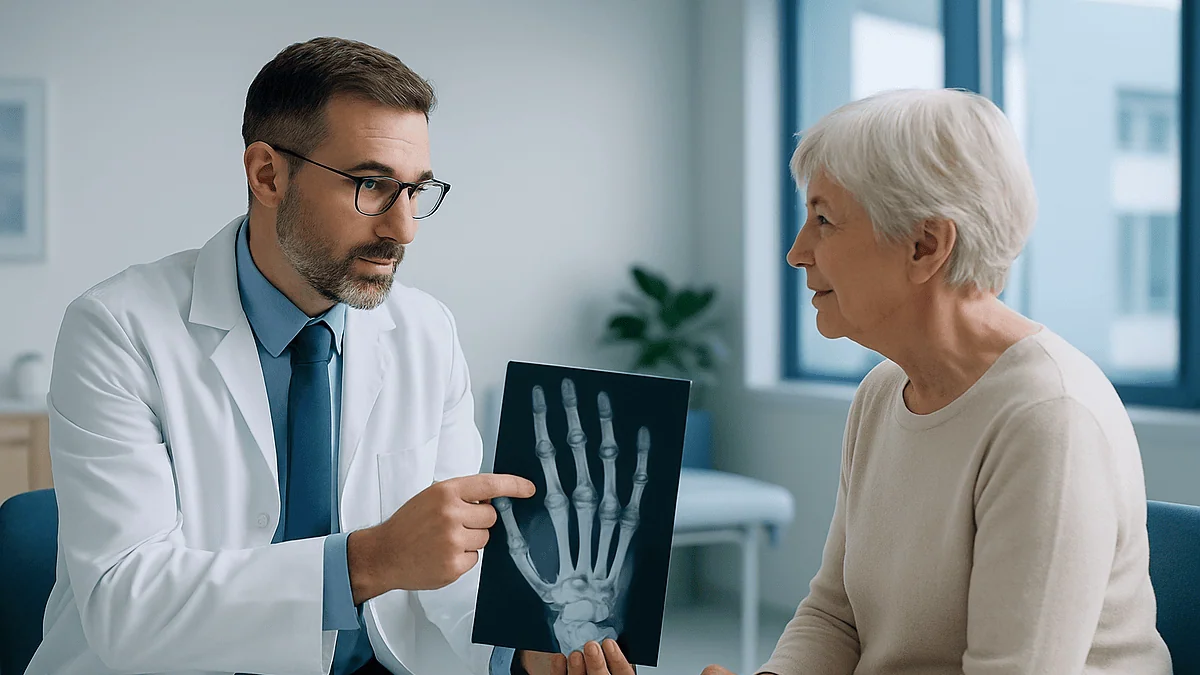
Plain X-rays confirm the diagnosis. The standard set is three views — straight-on, oblique, and lateral — because metacarpals overlap each other on film, and a fracture invisible in one view can be obvious in another. For most metacarpal injuries, this is the only imaging needed.
A CT scan enters the picture mainly for fractures at the base of the thumb or the base of the fourth and fifth metacarpals, where small joint fragments and subtle dislocations hide in the crowded architecture near the wrist. MRI is reserved for unusual cases, such as suspected stress injuries with normal X-rays.
One reassurance worth stating plainly: there is no blood test for a fracture, no lengthy workup, and usually no waiting game. Most people leave their first visit with a diagnosis, a splint, and a plan — the entire process commonly fits inside a single appointment.
Metacarpal Fracture Treatment: Splint, Cast, or Surgery?
The great majority of metacarpal fractures never see an operating room. Standard care for a stable, well-aligned break is immobilization — a splint or cast that typically holds the hand in a specific ‘position of safety,’ with the knuckles bent, for roughly three to four weeks. That bent-knuckle position is not arbitrary: it keeps the ligaments around the knuckles at full length so they do not contract and stiffen while the bone knits. Some minor fractures need only buddy-taping to a neighboring finger and early movement.
If the bone has shifted, clinicians may first perform a reduction — realigning the fragments by manipulation, usually under local anesthesia — and then splint the corrected position, with follow-up X-rays to confirm the bone stays put.
Surgery is reserved for the problem fractures: rotation that makes fingers scissor, angulation or shortening beyond what that particular metacarpal tolerates, fractures into a joint surface, multiple broken metacarpals, and open fractures. Fixation options include thin metal pins placed through the skin, or small plates and screws for fractures that need rigid, precise reconstruction. Hardware is often removable later, though much of it stays in without causing trouble.
Where does the evidence land on borderline cases — say, a moderately angled boxer’s fracture? Genuinely in the middle. Comparative studies suggest many of these do well without surgery, and acceptable-angle thresholds vary between guidelines. A candid surgeon will tell you the decision often hinges on rotation, your hand-use demands, and honest discussion — not on a single magic number from the X-ray.
How Long Does a Broken Metacarpal Take to Heal?
The short answer: the bone usually knits in three to six weeks, but the hand takes longer to feel like yours again. It helps to think of recovery in three overlapping phases.
Weeks 0–4: union. The fracture site bridges with early bone. Splints typically come off in this window, guided by fading tenderness and follow-up X-rays. Children often heal faster; adults over 60 may run slower.
Weeks 4–8: mobility. The bone is stable but the hand is stiff, the grip weak, and the back of the hand may still swell by evening. Gentle, progressive movement — often guided by a hand therapist — matters more in this phase than anything else.
Months 2–4: strength. Grip strength returns gradually. Most people are back to desk work within days of injury (in a splint), manual work in six to eight weeks, and contact sports somewhere around eight to twelve weeks, depending on the fracture and the surgeon’s judgment. Mild aching with weather changes or heavy use can linger for months and generally fades.
Several factors reliably slow the timeline, and the evidence here is consistent: smoking impairs bone healing measurably, poorly controlled diabetes delays it, and re-injuring the hand before union restarts the clock. Surgical fractures sometimes allow earlier motion because hardware holds the bone rigidly — one of the counterintuitive trade-offs surgeons weigh when choosing between a cast and a plate.
What Causes Metacarpal Pain Without a Fracture?
Plenty of aching hands have perfectly intact metacarpals. If your palm or the back of your hand hurts without a memorable injury, several culprits are far more likely than a break.
- Thumb base arthritis. Wear in the joint where the first metacarpal meets the wrist is one of the most common forms of hand osteoarthritis, particularly in women over 50. The signature is aching at the fleshy base of the thumb with pinching, gripping, and jar-opening.
- Tendon irritation. The tendons crossing the back of the hand can become inflamed with repetitive use — typing marathons, gardening, new gym routines — producing soreness that tracks along a line rather than sitting on one bone.
- Carpal boss. A firm, bony bump where the second or third metacarpal meets the wrist. It is usually harmless, often mistaken for a ganglion cyst, and only occasionally aches.
- Stress reactions. Rare but real, seen in rowers, boxers, and gymnasts whose training loads the metacarpals repetitively. Early X-rays can look normal, which is where MRI earns its keep.
- Bone bruises and sprains of the knuckle ligaments, which can hurt convincingly for weeks after a blow that broke nothing.
The pattern of pain is the clue. Fracture pain is focal and worse with direct pressure on one spot. Arthritis pain lives at a joint and warms up with use. Tendon pain travels. Persistent hand pain lasting more than two weeks, whatever its character, deserves an examination rather than a guess.
Rehab and Recovery: Getting Your Grip Back
Here is an unpopular truth from the hand-surgery world: for most metacarpal fractures, stiffness is a bigger long-term threat than the fracture itself. Bone heals reliably. Joints and tendons that sit motionless for weeks in a swollen hand do not forgive so easily.
That is why modern rehabilitation starts earlier than most patients expect — often while the splint is still on. Fingers left free of the splint are meant to move from day one. Once the splint comes off, the priorities are straightforward:
- Swelling control. Elevation above heart level, especially in the first two weeks, does more than most people believe. A chronically swollen hand becomes a stiff hand.
- Tendon gliding. Simple sequences — straight fingers, hook fist, full fist, repeated — keep the tendons sliding freely over the healing bone instead of scarring to it.
- Progressive gripping. Soft objects first (a sponge, a stress ball), then graded resistance, before returning to tools, weights, or sport.
- Scar care after surgery, since a tethered scar on the back of the hand can restrict tendon motion out of proportion to its size.
A referral to a hand therapist — an occupational or physical therapist specializing in the hand — is common after surgical fractures and worthwhile after stubborn nonsurgical ones. The evidence on structured hand therapy is pragmatic rather than dramatic: it does not speed bone healing, but it consistently helps people recover motion and function, particularly when stiffness has already set in.
Can You Prevent Metacarpal Fractures?
Not entirely — hands go where accidents happen. But the biggest single category of metacarpal fractures is nearly 100 percent preventable, because it involves choosing to punch something rigid. Walls, doors, lockers, and steering wheels win these contests every time. If frustration management sounds like soft advice, consider it hard biomechanics: drywall over a stud does not yield, and the fifth metacarpal neck does.
For the injuries that are not about temper, prevention is about equipment, environment, and bone itself:
- In sport: proper hand wraps and gloves in boxing and martial arts distribute impact across the whole fist; coaching on punch technique protects the border metacarpals. Gloves matter in cycling, lacrosse, and hockey too.
- At work: crush injuries from machinery, tailgates, and heavy loads are a steady source of metacarpal fractures — appropriate gloves and two-person lifts are unglamorous but effective.
- At home: fall prevention protects hands as much as hips. Clear walkways, secure rugs, adequate lighting, and handrails reduce the outstretched-hand landings that break metacarpals and carpals alike, especially after 65.
- In the bone: adequate calcium and vitamin D intake, regular weight-bearing and resistance exercise, and not smoking all support bone density. The NIH Office of Dietary Supplements and the CDC both treat these as foundations of fracture prevention across the skeleton — metacarpals included.
None of this makes hands invincible. It simply shifts the odds, which is the most any honest prevention advice can promise.
The Bottom Line on Metacarpal Bones and Fractures
The metacarpals are a study in trade-offs: rigid enough to drive a hammer, arranged flexibly enough to cradle an egg. That design serves us beautifully until impact finds the thinnest point — usually the neck of the fifth metacarpal — and produces the fracture hand surgeons know better than any other.
If one message deserves to outlast this article, it is this: a broken metacarpal is almost never a catastrophe, but it is also never a ‘wait and see’ injury. The fractures that end badly are not the dramatic ones — those get treated. They are the quiet ones: the sunken knuckle explained away as swelling, the small cut over a fist that met teeth, the finger that rotates a few degrees and heals that way, crossing its neighbor for the rest of a lifetime.
An X-ray is quick. A splint is a few weeks. A rotational malunion is forever, short of another operation. The arithmetic favors early care every single time.
And if your hand aches without any injury at all, the metacarpals are probably innocent — arthritis at the thumb base, an irritated tendon, or a harmless bony bump are all likelier suspects. Either way, hands are worth examining rather than guessing about. Few body parts do more for you before breakfast.
Frequently asked questions
How serious is a broken metacarpal?
Most metacarpal fractures are not serious and heal well with three to four weeks of splinting. The concerning features are rotation (a finger crossing its neighbor when you make a fist), significant angulation or shortening, fractures into a joint, open wounds, and any cut over a knuckle from a punch to the mouth, which carries infection risk. With prompt evaluation and proper alignment, full recovery is the expected outcome for the large majority of these fractures.
What is the difference between a carpal and a metacarpal?
Carpals are the eight small bones packed into your wrist; metacarpals are the five long bones of your palm that sit just beyond them and form your knuckles. The prefix ‘meta’ means ‘beyond,’ so metacarpal literally means beyond the wrist. Carpals allow the wrist’s gliding motion, while metacarpals act as rigid levers transmitting grip force. Carpal tunnel syndrome, despite the similar name, is a wrist nerve problem unrelated to the metacarpal bones.
How long does it take to heal a broken metacarpal?
The bone typically unites in three to six weeks, with splints usually removed around the three-to-four-week mark. Full function takes longer: stiffness and weakness commonly persist for another month or two, and grip strength may take two to four months to return completely. Children often heal faster, while smoking, poorly controlled diabetes, and re-injury slow the process. Return to contact sports is usually around eight to twelve weeks, depending on the fracture and clinical judgment.
What causes metacarpal pain?
Without an injury, common causes include osteoarthritis at the base of the thumb, irritated tendons on the back of the hand from repetitive use, a harmless bony bump called a carpal boss, and rare stress reactions in athletes like rowers and boxers. After an impact, a fracture or bone bruise is the leading suspect. Fracture pain is typically focal and worse with direct pressure on one spot; pain lasting more than two weeks warrants a medical examination.
Can you still move your fingers with a broken metacarpal?
Yes, very often. The tendons that bend and straighten your fingers run alongside the metacarpal bones rather than through them, so many people with confirmed fractures can move every finger, painfully but fully. Movement therefore rules out nothing. Better clues are focal tenderness when pressing on one spot of one bone, a sunken or missing knuckle, and fingers that cross or splay abnormally when you slowly make a fist.
Does a boxer's fracture need surgery?
Usually not. The fifth metacarpal neck tolerates forward angulation well because of its mobile base, and comparative studies show many boxer’s fractures do fine with splinting alone. Surgery becomes likely when the fragment is rotated so the little finger crosses its neighbor, when angulation is severe, when the fracture is open, or when multiple metacarpals are broken. Exact angle thresholds vary between guidelines, so the decision is individualized rather than dictated by one number.
Can a metacarpal fracture heal on its own without treatment?
The bone will usually knit on its own, but that is precisely the risk: it heals in whatever position it sits, including rotated or angled positions that permanently impair grip. A malunion that makes fingers cross is far harder to correct later than a fresh fracture is to align now. Even fractures that end up needing only a splint benefit from an X-ray to confirm alignment, so a suspected break should always be evaluated.
Why is my knuckle sunken after punching something?
A sunken or missing knuckle after a punch is the classic sign of a boxer’s fracture. The blow drives the head of the fifth metacarpal forward into the palm, so the knuckle no longer stands up when you make a fist. Swelling and bruising along the outside edge of the hand typically follow. This finding warrants same-day medical evaluation and an X-ray, both to confirm the fracture and to check for rotation, which changes the treatment plan.
How many metacarpal bones are in each hand?
Five — one for each digit, numbered from the thumb (first metacarpal) to the little finger (fifth). Each has a base that meets the wrist, a shaft, a neck, and a rounded head that forms the visible knuckle. Together with the eight carpal bones of the wrist and the fourteen phalanges of the fingers, they bring the hand’s total to 27 bones, making the hands among the most bone-dense regions of the body.
Is it okay to wait a few days before getting a hand X-ray?
A short delay will not usually change how the bone heals, but waiting is riskier than it feels. Untreated fractures can shift, rotated fragments can begin setting crooked, and a small wound over a knuckle can develop a serious infection within days. Seek same-day care for deformity, scissoring fingers, open skin, numbness, or pale, cold fingers. Otherwise, if pain and swelling have not clearly improved within about 48 hours, get the hand examined.
References
This article is for general information only and is not a substitute for professional medical advice. Please consult a qualified doctor about your individual situation.