

Knee Replacement Recovery: Week by Week
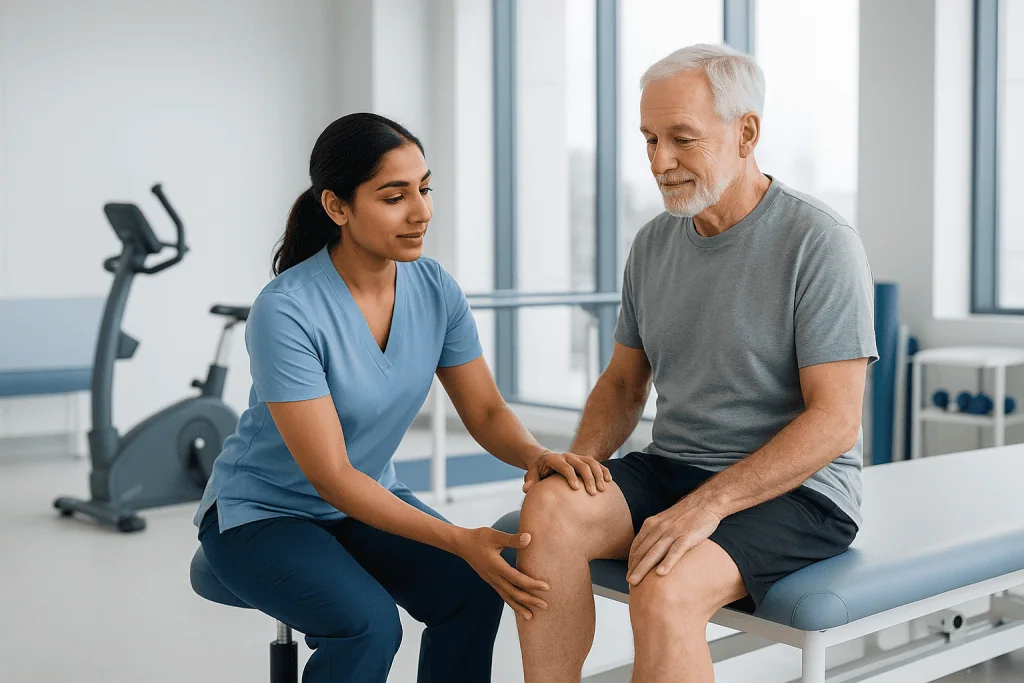
Knee replacement usually means a 1 to 2 hour operation under regional anaesthesia and a hospital stay of 2 to 4 nights. Most people walk with support within a day, eat normally within a day or two and shower once the dressing allows. Flights home are typically cleared in the second week after surgery. Everyday recovery takes 6 to 12 weeks, with strength improving for months.
Key Takeaways
- Knee replacement usually takes 1 to 2 hours under regional anaesthesia, with a 2 to 4 night hospital stay.
- Most people walk with support within a day and are discharged walking with crutches or a frame.
- Stitches or staples usually come out at 10 to 14 days; showering is possible once the dressing allows.
- Most international patients are cleared to fly in the second week, after a fitness-to-fly assessment.
- Everyday activities usually return within 6 to 12 weeks; strength keeps improving for up to a year.
- Fever, spreading redness, wound discharge, calf pain or breathlessness need immediate contact with the team.
What recovery from knee replacement actually involves
Knee arthroplasty replaces the worn surfaces of an arthritic knee joint with metal and medical-grade plastic implants. It is most often performed for advanced osteoarthritis when non-surgical treatment no longer controls pain. The operation itself usually takes 1 to 2 hours under regional anaesthesia, and the hospital stay is typically 2 to 4 nights. You can read how the operation is planned and performed on the knee arthroplasty treatment page.
Planning the operation itself? Read our full guide: Knee Replacement in Turkey: Recovery Timeline and Aftercare.
Clinical guide: Robotic-Assisted Knee Replacement — how the procedure is performed, who it suits and the risks to weigh.
Recovery has two overlapping parts. The first is healing of the wound and the tissues around the new joint, which mostly happens in the first 6 to 12 weeks. The second is rehabilitation: physiotherapy to restore knee movement, strength and walking ability, which continues for several months after the wound has healed. Most people walk with support within a day of surgery, return to everyday activities within 6 to 12 weeks and keep improving well beyond that. The stages below describe what usually happens. Your surgeon’s instructions always take precedence over any general timeline.
Recovery timeline
The first 48 hours
- Pain: Pain is expected and is controlled with a planned combination of medicines started in hospital. Regional anaesthesia usually keeps the leg numb for the first hours, so pain often becomes more noticeable on the first day.
- Movement: Early mobilisation begins in hospital. Most people stand and take their first steps with a walking frame or crutches and a physiotherapist within the first day. Do not lift anything heavier than a light bag.
- Wound: The knee is covered with a dressing and often a bandage; some staining is normal. The nursing team checks and changes it.
- Eating and drinking: Most people drink and eat light meals within hours of surgery once the anaesthesia team allows. Drinking well helps recovery.
- Washing: Bed or chair washing with help. Showering usually waits until the dressing is confirmed waterproof or has been changed.
- Sleeping: On your back with the leg straight, not propped under the knee, unless told otherwise.
- Driving, work and sport: Not applicable at this stage.
Week 1
- Pain: Usually still significant but improving each day. Regular oral pain relief and ice or cooling packs are typical. Take medicines on schedule rather than waiting for pain to build.
- Movement: Discharge usually happens between the second and fourth night. Most people walk short distances indoors with crutches or a frame, practise a few stairs with supervision and do bending and straightening exercises several times a day. Avoid twisting on the knee and carrying heavy items.
- Wound: Stitches or staples usually stay in for about 10 to 14 days; some surgeons use dissolving stitches or skin glue. Keep the dressing clean and dry and follow the wound-care instructions given at discharge.
- Eating and drinking: Normal diet. Constipation is common with pain medicines, so fibre and fluids help. Alcohol is usually avoided while taking strong pain relief or blood thinners.
- Washing: Showering is usually possible once the team confirms the dressing is waterproof, without soaking the knee. Baths and swimming wait until the wound is healed.
- Sleeping: On the back, or on the non-operated side with a pillow between the knees, is usually most comfortable.
- Driving: Not yet.
Week 2
- Pain: Usually easing; many people begin reducing stronger medicines under guidance. Swelling and warmth around the knee are still normal, and night stiffness is common.
- Movement: Most people walk longer distances, often moving from two crutches to one crutch or a stick indoors. Physiotherapy continues, aiming for a little more bend and a straighter knee each week. Light household tasks are usually fine; avoid lifting more than a few kilograms.
- Wound: Stitches or staples are usually removed around this time and the wound is checked at a follow-up visit. Once healed and dry it usually no longer needs a dressing.
- Eating, drinking and washing: Normal. Showering is usually straightforward once the wound is sealed.
- Sleeping: As before; resting with the leg straight helps the knee straighten fully.
- Flying: This is the window in which many international patients have their fitness-to-fly assessment and travel home (see below).
Weeks 3 to 6
- Pain: Usually mild to moderate and mainly linked to exercises and activity; simple pain relief is typically enough. Swelling may persist for months and is not a concern on its own if it is gradually improving.
- Movement: Most people walk outdoors, manage stairs and become independent with a stick or without support. Physiotherapy shifts towards strengthening and balance. Avoid kneeling, high-impact activity and twisting.
- Wound: Should be closed. Scar massage may be advised by the physiotherapist once fully healed.
- Driving: Many people are able to drive around 4 to 6 weeks after surgery, once they have stopped strong pain medicine, can bend the knee comfortably and can perform an emergency stop. This is usually later for a right knee and for manual cars. Confirm with the surgeon and check insurance rules.
- Work: Desk-based work is often possible from around 4 to 6 weeks; physically demanding work usually waits longer.
Months 2 to 3
- Pain: Usually occasional and activity-related. Clicking sensations from the implant are common and usually harmless.
- Movement: The published recovery time of 6 to 12 weeks covers a return to most everyday activities. Walking distance, stair climbing and knee bend continue to improve with exercise. Low-impact activities such as a stationary bike or swimming are often introduced once the wound is fully healed and the physiotherapist agrees.
- Work: Most people with manual jobs return in this period, often with adjusted duties at first.
- Sleeping and washing: Normal for most people.
Months 6 to 12
- Pain and swelling: Usually minimal. Mild warmth or swelling after a long day can persist for up to a year.
- Movement and sport: Strength and confidence typically keep improving through the first year. Low-impact sport such as walking, cycling, swimming and golf is commonly resumed. High-impact and contact sport is generally discouraged to protect the implant. Continue to follow the implant precautions given by the surgeon.
- Follow-up: A review, often with an X-ray, is typical at around one year; longer-term reviews are set by the surgeon.
When it is safe to fly home
Most international patients are cleared to fly home in the second week after knee replacement, usually around 7 to 14 days after surgery, once the wound is checked and a fitness-to-fly assessment has been completed as part of discharge. Some surgeons prefer a slightly longer wait for very long flights or for patients with other health conditions. The operating team gives the final clearance; no airline rule or general guide replaces that decision.
The timing matters for three reasons. The knee is still swollen, and reduced cabin pressure and hours of sitting can increase swelling and discomfort. Surgery on the leg, immobility and long-haul travel each raise the risk of a blood clot in the calf, so most people are still taking a blood thinner and should keep moving during the flight. Finally, if a wound problem or infection develops, it is far better to be near the operating team than at altitude.
- The fitness-to-fly check usually covers: wound healing, calf examination, mobility and stair ability, pain control on oral medicines, oxygen levels and general health, plus confirmation of the blood-thinner plan for the journey.
- Seat and mobility: Request an aisle seat with room to straighten the leg, and choose the side that lets the operated knee extend into the aisle. Stand and walk every 1 to 2 hours, do ankle pumps while seated, wear compression stockings if advised and drink water rather than alcohol. Ask for wheelchair assistance through the airport.
- Hand luggage: all medicines including the blood thinner and pain relief, a copy of the discharge summary and medication list, spare dressings, the physiotherapy exercise sheet, an implant card or letter for airport security, and your surgeon’s contact details.
Warning signs: when to contact your care team immediately
- Fever or chills, especially with a hot, painful knee.
- Redness spreading away from the wound.
- Wound drainage, new bleeding, or a wound that opens or smells.
- Increasing swelling of the knee or the whole leg rather than gradual improvement.
- Pain, tenderness or swelling in the calf.
- Sudden breathlessness, chest pain or coughing up blood, which need emergency care.
- Pain that is not controlled by the prescribed medicines.
- A sudden loss of movement, a feeling of the knee giving way, or a new inability to bear weight.
- Numbness, coldness or colour change in the foot.
Recovering in Türkiye and then at home
Most international patients stay 2 to 4 nights in hospital and then several more nights in accommodation near the hospital so that the wound, walking and exercise programme can be checked before travel. The international patient team coordinates prior reports and imaging before you arrive, arranges appointments, organises the hospital visit and, if needed, an interpreter. Choose accommodation with a lift, a walk-in shower where possible and space to do exercises; step-free access matters more than distance in the first fortnight.
Before discharge you will have a follow-up appointment with the operating team at which the wound is inspected, stitches or staples are removed or a plan for removal is made, the physiotherapy programme is reviewed and the fitness-to-fly assessment is completed. After you return home, follow-up is done remotely with the operating team, usually with photographs of the wound and a video or telephone review; local physiotherapy continues in person.
- Records to take home: the operation note, discharge summary, implant details, X-rays or imaging on disc or by secure link, blood test results, the medication list and the physiotherapy plan.
- Ask that these are provided in English, or in the language your home doctor uses, so that local care can continue without gaps. The Orthopedics & Joint Center teams at Acibadem hospitals in İstanbul and Ankara prepare this documentation as a standard part of discharge.
Questions to ask your surgeon before you fly out
- How many nights do you expect me to stay in hospital, and how long should I remain nearby before flying?
- What is the earliest date you would clear me to fly, and does the length of my flight change that?
- Which blood thinner will I take, for how long, and what should I do on the flight itself?
- How will the wound be closed, and who removes the stitches or staples if I am home by then?
- What movements or activities should I avoid, and for how long, to protect the implant?
- Which physiotherapy exercises should I do daily, and how do I find a suitable physiotherapist at home?
- When can I expect to drive, return to work and resume the activities that matter to me?
- How will remote follow-up work, and what should I photograph or report?
- Which symptoms mean I should go to an emergency department at home rather than wait for a remote review?
Add us as a Preferred Source to see more of our trusted health content across Google Search, AI Overviews and Discover.

Update history
- PublishedSeptember 9, 2026
- Medical review approvedSeptember 12, 2026
- Last content updateSeptember 12, 2026
More Patient Guides

Septoplasty Recovery: Week by Week
Learn what to expect after deviated septum surgery: a week-by-week septoplasty recovery timeline, when it is usually safe to fly home, and…

Gallbladder Surgery Recovery: Week by Week
Learn what to expect after gallbladder surgery: a week-by-week recovery timeline, pain, diet, wound care, when it is safe to fly home…
Robotic Hysterectomy Recovery: Week by Week
Recovery from robotic hysterectomy week by week: pain, lifting, wounds, driving, flying home safely, warning signs and questions to ask before you…

Breast Reconstruction Recovery: Week by Week
DIEP flap recovery week by week: hospital stay, drains, pain, walking, showering, driving, when it is usually safe to fly home, and…