

Seed Oils: Are They Actually Bad for You? What the Evidence Says About Omega-6 and Inflammation

Key Takeaways
- A 2012 review of 15 randomized trials found that feeding adults extra omega-6 linoleic acid, even at several times typical intake, did not raise C-reactive protein or other inflammatory markers.
- The 2020 Cochrane review of roughly 59,000 trial participants found that replacing saturated fat mostly with polyunsaturated vegetable oils cut cardiovascular events by about 17 percent.
- Canola oil is about 63 percent monounsaturated fat and only 19 percent linoleic acid, a profile closer to olive oil than to corn or sunflower oil.
- The 2025 JAMA Internal Medicine cohort of 221,000 adults linked the highest plant-oil intake to about 16 percent lower mortality and the highest butter intake to about 15 percent higher mortality.
- Beef tallow and coconut oil, the fats most often promoted as seed-oil replacements, contain seven to twelve times the saturated fat of canola oil.
- Repeatedly reused commercial fryer oil, not fresh home cooking oil, is where polyunsaturated fats accumulate the aldehydes and polar compounds that raise legitimate safety questions.
Seed oils such as canola, soybean, sunflower and corn oil are not shown to be harmful in the best available evidence. Randomized trials find their main fat, omega-6 linoleic acid, does not raise inflammatory markers, and replacing saturated fat with these oils modestly lowers heart-disease risk. The real concerns are repeatedly reheated fryer oil and the ultra-processed foods that often contain seed oils, not the oils themselves.
The sticker on the tortilla-chip bag reads “seed oil free” in the same proud font once reserved for “gluten free” and “no added sugar.” A few aisles over, a bottle of canola oil sits untouched while a jar of beef tallow, a product most shoppers had not thought about in decades, is sold out. As of late 2025, seed oils have become the most argued-over ingredient in American kitchens, and the argument has landed everywhere from restaurant menus to school lunch debates.
The trigger was a collision of two things. Short videos claiming that seed oils are “toxic sludge” driving obesity and chronic disease racked up hundreds of millions of views. At almost the same moment, a March 2025 analysis of more than 221,000 adults followed for over three decades, published in JAMA Internal Medicine, reported that people who ate the most plant-based oils, soybean, canola and olive among them, had lower death rates than those who ate the most butter.
Both messages cannot be fully right. What follows is an attempt to sort the physiology from the folklore, grade the evidence honestly, and answer the question people are actually typing: is any of this worth changing your grocery list over?
What are seed oils, and which oils are considered seed oils?
A seed oil is simply a cooking fat pressed or extracted from the seed of a plant rather than from its fruit or flesh. That distinction matters more than it sounds. Olive oil comes from the fruit of the olive, avocado oil from the fruit of the avocado, and coconut oil from the meat of the coconut, so none of them are seed oils in the everyday sense, even though botanists might quibble.
The list that circulates online, sometimes called the “hateful eight,” covers canola (also called rapeseed), corn, cottonseed, soybean, sunflower, safflower, grapeseed and rice bran oil. Sesame, flaxseed, pumpkin seed and peanut oil are technically seed oils too, although they rarely appear on the villain lists, partly because they carry a health halo and partly because they are used in far smaller quantities.
Two facts explain why these oils dominate the American food supply. First, they are cheap to grow at scale: the United States produces roughly 4 billion bushels of soybeans a year, and soybean oil alone accounts for more than half of all vegetable oil consumed domestically. Second, most of them have a neutral flavor and a high smoke point, which makes them the default choice for frying, baking and salad dressings in restaurants and packaged foods alike.
Chemically, what unites the group is a high share of polyunsaturated fat, and specifically of linoleic acid, an omega-6 fatty acid. A polyunsaturated fat is one whose carbon chain contains two or more double bonds, which keeps it liquid at room temperature but also makes it more reactive to heat and oxygen than a saturated fat. Canola is the outlier: it is mostly monounsaturated fat, closer in profile to olive oil than to corn oil, which is one reason lumping all seed oils together is the first place the argument goes wrong.
What changed recently: the 2025 studies behind the seed oil headlines
Nothing about the chemistry of linoleic acid changed this year. What changed was the volume of new data and the volume of the conversation around it.

The headline event was the JAMA Internal Medicine study published in March 2025. Researchers pooled three long-running cohorts, the Nurses’ Health Study, Nurses’ Health Study II and the Health Professionals Follow-Up Study, with 33 years of dietary records. Adults with the highest intake of plant-based oils had a total mortality rate about 16 percent lower than those with the lowest intake, while the highest butter consumers had a rate about 15 percent higher. The authors estimated that swapping roughly two teaspoons of butter a day for plant oils was associated with 17 percent fewer deaths overall and from cancer. Because this was observational, it shows association, not proof of cause, but the direction runs opposite to the viral claims.
A second signal came in June 2025, when a biomarker analysis of nearly 1,900 adults was presented at the American Society for Nutrition’s annual meeting. Higher blood levels of linoleic acid tracked with lower C-reactive protein (a blood marker of inflammation), lower blood sugar and lower insulin. Conference data have not yet gone through full peer review, so it belongs in the “promising, not settled” column.
Meanwhile, the Johns Hopkins Bloomberg School of Public Health published a plain-language review of the evidence in 2025, and Cleveland Clinic and Harvard Health both refreshed their guidance. Every one of these mainstream sources reached a version of the same conclusion: the case against seed oils rests on mechanisms and rodent studies rather than on human trials, and the human trials point the other way.
The freshest development is cultural rather than scientific. Restaurant chains have begun advertising a switch to beef tallow, and grocery shelves are filling with “seed oil free” labels. That is a marketing shift, and it has run well ahead of the evidence.
Why do people say seed oils are bad for you? The three main arguments
The case against seed oils is not random. It is built on three plausible-sounding pillars, and each deserves a fair hearing before it is tested against the data.
The first is the inflammation argument. Linoleic acid can be converted in the body to arachidonic acid, and arachidonic acid is the raw material for a family of signaling molecules called eicosanoids, some of which promote inflammation. Follow the arrow, the argument goes, and more seed oil means more inflammation, and chronic inflammation sits underneath heart disease, diabetes and arthritis.
The second is the historical argument. Americans ate almost no soybean oil in 1900. By 2000, linoleic acid had climbed from roughly 3 percent of calories to about 7 percent, and obesity and type 2 diabetes rose over a similar period. Correlations across a century of profound change in sugar intake, portion sizes, car ownership and screen time are weak evidence, but the timeline is real and it is persuasive in a 60-second video.
The third is the processing argument. Most supermarket seed oils are extracted with a solvent called hexane, then refined, bleached and deodorized at high heat. Critics say this strips nutrients, leaves chemical residues and creates oxidized fats and trans fats before the bottle is even opened. Add a deep fryer that runs for 12 hours, and the oil, they argue, becomes a chemistry experiment.
Each of these arguments contains a kernel of true biochemistry. Where they fail is the leap from “this can happen in a test tube or a rat” to “this does happen in a person eating a normal diet.” The next sections take them one at a time, and the honest answer turns out to be more interesting than either camp usually allows: the inflammation claim collapses under trial data, the processing claim is mostly a non-issue at home but partly valid for commercial fryers, and the historical claim points to a real problem that has little to do with the oil itself.
What is omega-6 linoleic acid, and does it really cause inflammation?
Linoleic acid is an essential fatty acid, which means the human body cannot make it and must get it from food. Without any, skin becomes scaly and wounds heal poorly. So the debate was never about whether to eat omega-6; it is about how much.
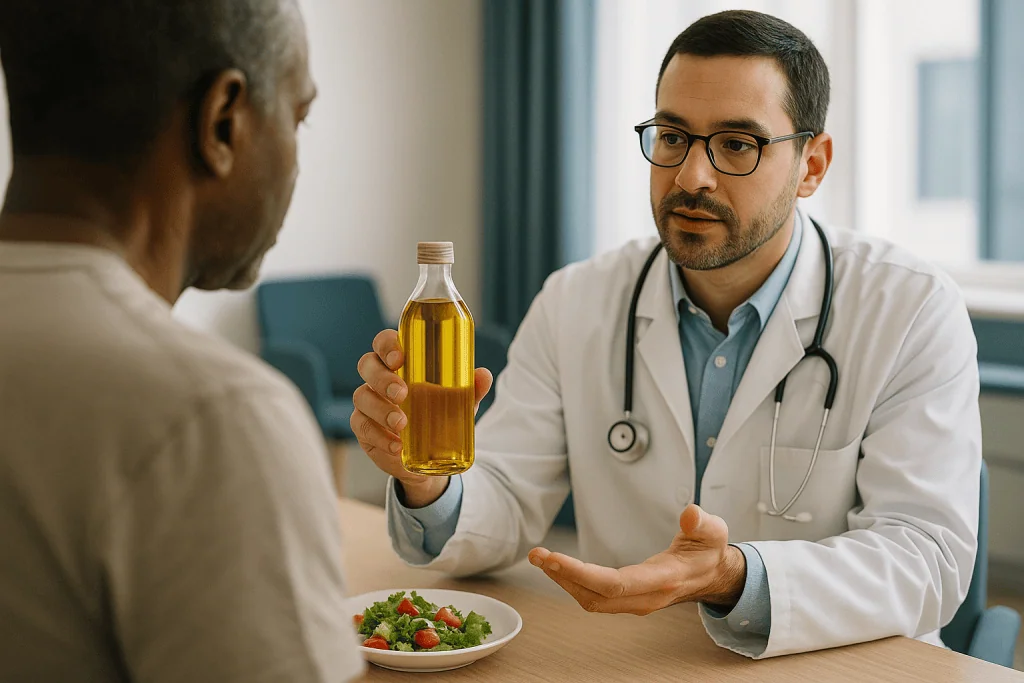
The inflammation theory hinges on conversion. Yes, an enzyme pathway can turn linoleic acid into arachidonic acid. But that pathway is tightly rate-limited. When researchers have fed people diets ranging from low to very high in linoleic acid and then measured arachidonic acid in blood cells and tissues, the levels barely move. A 2011 review of these feeding studies found that even a six-fold change in linoleic intake produced no meaningful change in tissue arachidonic acid. The body, in effect, has a thermostat.
The more decisive test is to measure inflammation itself. A 2012 systematic review pulled together 15 randomized controlled trials in which healthy adults were given extra linoleic acid, in some cases several times the typical intake, and then had blood markers checked: C-reactive protein, interleukin-6, tumor necrosis factor and others. Not one marker rose consistently. Randomized trials sit at the top of the evidence pyramid because randomization strips out the lifestyle differences that confound observational studies, so this is a strong finding, not a footnote.
There is a further wrinkle that rarely makes it into the videos. Arachidonic acid also gives rise to molecules called lipoxins that actively resolve inflammation, and linoleic acid itself is the precursor of compounds involved in skin barrier function. Labeling omega-6 as “pro-inflammatory” describes one branch of a tree while ignoring the rest.
What about the omega-6 to omega-3 ratio, the idea that a 20:1 modern ratio versus a 1:1 ancestral one is the real culprit? The ratio is a tidy concept, but the American Heart Association’s 2009 science advisory, and most nutrition scientists since, concluded that the evidence does not support cutting omega-6 to fix it. Lowering the ratio by eating less linoleic acid has never been shown to improve outcomes; raising omega-3 intake from fish has better, though still mixed, support. The practical message is to add fish, not to fear the sunflower.
What the evidence actually says, graded by strength
Nutrition science comes in tiers, and the seed oil question is a good place to see why the tier matters. Here is the evidence sorted from strongest to weakest.
Randomized controlled trials (strongest). The 2020 Cochrane review, the most rigorous type of summary in medicine, pooled 15 trials with roughly 59,000 participants and found that cutting saturated fat, mostly by replacing it with polyunsaturated fat from vegetable oils, lowered combined cardiovascular events by about 17 percent over an average of four years. Effects on total mortality were not statistically clear, which is typical for trials of that length. Separately, the 15-trial review of inflammatory markers described above found no rise in inflammation with high linoleic intake. On the inflammation and heart-event questions, the trial evidence favors seed oils or is neutral. It does not favor avoiding them.
Biomarker cohort studies (moderate). Measuring linoleic acid in blood or fat tissue sidesteps the unreliability of food questionnaires. A 2019 analysis in Circulation pooled 30 cohorts from 13 countries, about 68,000 people, and found that those with the highest linoleic acid levels had modestly lower rates of cardiovascular disease and death than those with the lowest. Observational, but consistent across continents.
Dietary cohort studies (moderate to weaker). The 2025 JAMA Internal Medicine analysis belongs here. Large, long and carefully adjusted, it still cannot rule out that people who choose plant oils differ in other ways.
Mechanistic and animal studies (weakest for human decisions). Rodents fed very high soybean oil diets develop fatty liver and metabolic changes. Mice are not small humans; their fat metabolism, their typical diets and the extreme doses used all limit translation. These studies generate hypotheses. They should not generate grocery lists.
Expert opinion. The American Heart Association, the WHO and the NHS all recommend replacing saturated fat with unsaturated fats, including those from seeds. No major medical body recommends avoiding seed oils.
Weighed together, the strength of evidence that seed oils are safe in ordinary amounts is moderate to high. The strength of evidence that they are harmful is low, resting on mechanisms and animals rather than people.
The two old trials that keep the seed oil debate alive
Anyone who reads seed oil critiques closely will meet two names again and again: the Sydney Diet Heart Study and the Minnesota Coronary Experiment. Both were randomized trials, both replaced saturated fat with omega-6 oils, and both, on reanalysis, failed to show benefit. Honesty requires taking them seriously, and context requires explaining why they do not overturn the rest of the evidence.
The Sydney study ran from 1966 to 1973 in 458 men who had recently had a heart attack. The intervention group swapped animal fat for safflower oil and a safflower-based margarine. When the raw data were recovered and reanalyzed in 2013, the intervention group had higher death rates from heart disease. That sounds damning until you look at the margarine. Margarines of that era were made with partially hydrogenated oil, which is loaded with industrial trans fat, the one fat now removed from the US food supply because it so reliably raises heart risk. The trial could not separate the safflower oil from the trans fat it came packaged with.
The Minnesota Coronary Experiment, conducted from 1968 to 1973 in about 9,000 residents of state hospitals and nursing homes, replaced saturated fat with corn oil. A 2016 reanalysis found that cholesterol fell as expected but deaths did not, and in older participants a larger cholesterol drop tracked with higher mortality. Here the problems are different: the average participant stayed in the study for roughly a year, three-quarters left early, and the population was elderly and institutionalized. A year is too short to change heart-disease deaths in almost any trial, and cholesterol falling fastest in frail people who are losing weight because they are dying is a well-known statistical trap called reverse causation.
Neither trial is worthless. Both are reminders that swapping fats is not automatically protective and that the details of what you swap in matter enormously. But two flawed trials from the 1960s do not outweigh a Cochrane review of 15 trials, 30 biomarker cohorts and the modern consensus. They are the exceptions that the critics have, understandably, mistaken for the rule.
How seed oils are made: does processing make them toxic?
Watch a video of an industrial oil plant and it is easy to feel uneasy. Seeds are crushed, washed in a petroleum-derived solvent called hexane to pull out the last of the oil, then heated, treated with an acid or base to remove free fatty acids, bleached with clay to strip color, and deodorized with steam at temperatures around 450 degrees Fahrenheit. The word “chemical” appears at every step.
Here is what the steps actually do. Hexane evaporates at about 156 degrees Fahrenheit, so essentially all of it is boiled off and recaptured during processing. Regulators in the US and Europe set limits on residual hexane in food oils measured in parts per million, and testing consistently finds levels far below the thresholds at which any toxicity has been observed in humans. The exposure most Americans get from pumping gasoline exceeds what they get from a bottle of canola oil.
Refining does remove some nutrients and flavor compounds, which is why cold-pressed, unrefined oils taste like the plant they came from and why extra virgin olive oil carries polyphenols that refined olive oil lacks. That is a genuine trade-off, but losing a modest amount of vitamin E is not the same as gaining a toxin.
The trans fat question is the one with the most substance. High-heat deodorization does create small amounts of trans fat, typically well under 2 percent of the oil and often under 1 percent. For comparison, the partially hydrogenated oils used in old-style margarines and shortenings were 25 to 45 percent trans fat, and those were removed from the US food supply after a 2015 federal determination that they were no longer generally recognized as safe. The trace amounts in modern refined oil are in the same range as the naturally occurring trans fats in butter and beef.
Oxidation before purchase is minimal because refined oils are stored in sealed, often nitrogen-flushed containers, and their peroxide values, a laboratory measure of rancidity, are checked before bottling. Processing, in short, is unappetizing to watch and not a demonstrated health hazard to eat.
Frying, reheating and oxidation: when seed oil genuinely changes
If there is a place where the critics deserve partial credit, it is the deep fryer. Polyunsaturated fats are chemically less stable than saturated or monounsaturated fats because each double bond is a spot where oxygen can attack. Heat speeds the reaction. Over hours of frying, especially when the same oil is reused across shifts and days, oils break down into compounds called aldehydes and polar compounds, some of which are irritating or toxic in laboratory studies.
Numbers help here. Fresh oil has a polar-compound level of a few percent. Many European countries require fryer oil to be discarded once polar compounds pass 24 to 27 percent, a threshold typically reached after roughly 20 to 40 hours of commercial frying depending on the oil and the food. Sunflower and soybean oils, being high in linoleic acid, reach that point faster than high-oleic sunflower or peanut oil. This is why some restaurant chains have shifted to high-oleic blends, which is a sensible change that has nothing to do with seed oils being inherently bad.
At home, the picture is different in scale. Pan-frying a piece of fish for eight minutes at 350 degrees Fahrenheit does not come close to generating restaurant-fryer levels of breakdown products. Smoke point, the temperature at which an oil starts visibly smoking, is a rough guide to stability: refined canola sits around 400 degrees Fahrenheit, refined sunflower and soybean near 450, extra virgin olive oil around 375 and butter near 350. If the pan is smoking, the oil is degrading, whatever plant it came from.
Practical steps follow naturally. Match the oil to the heat, do not reuse home frying oil more than once or twice, and if it smells sharp or looks dark, discard it. Store oil in a cool cupboard away from the stove, since light and warmth accelerate oxidation even in a sealed bottle. Rancid oil smells like old crayons or putty; that smell is the nose detecting aldehydes, and it is the one warning worth trusting.
The takeaway is that heavily reused commercial fryer oil is a legitimate concern, that it applies to any polyunsaturated oil rather than seed oils specifically, and that a bottle of canola in a home kitchen is not the same thing at all.
Seed oils and ultra-processed food: the confounder in the room
Pick up almost any packaged snack and the ingredient list will include soybean, canola or sunflower oil. This is the strongest observation the critics have, and it is also the one that most clearly points away from the oil.
Ultra-processed foods are industrial formulations made mostly from refined ingredients and additives, with little intact food left in them. They are engineered to be calorie-dense and hard to stop eating. In one tightly controlled 2019 NIH inpatient trial, adults offered ultra-processed meals ate about 500 more calories a day than the same adults offered minimally processed meals matched for fat, sugar, salt and fiber, and they gained roughly two pounds in two weeks. That is a large effect from a small trial, and it was driven by the whole food matrix, not by one ingredient.
Seed oils ride along in these products because they are cheap, stable and neutral. So when observational studies link “vegetable oil intake” to poor outcomes, the oil is often standing in for chips, pastries, fried fast food and refined-carbohydrate snacks. Statisticians call this confounding: two things travel together, and the innocent one takes the blame.
The way to untangle it is to look at studies where oil intake is measured directly and the rest of the diet is accounted for, which is exactly what the biomarker cohorts and the 2025 JAMA Internal Medicine analysis did. When the oil is separated from the package, the association flips from harmful to mildly protective.
There is a useful test for any seed-oil-free product on the shelf. If the oil has been swapped for beef tallow or coconut oil but the product is still a fried, salted, refined-flour snack, nothing about its effect on appetite, blood sugar or waistline has changed, and its saturated fat content has gone up. The label has solved a problem the food did not have while leaving the problem it does have untouched.
Reducing ultra-processed food is one of the best-supported dietary moves a person can make. Doing it by hunting for a single ingredient is the least efficient route there.
How common cooking oils and fats compare
Fat percentages vary by crop, variety and refining, so the figures below are typical rather than exact. They come from standard nutrient databases and are rounded to the nearest whole number. Linoleic acid is the omega-6 fat at the center of the debate; oleic acid is the monounsaturated fat that dominates olive oil.
| Oil or fat | Saturated (%) | Monounsaturated (%) | Polyunsaturated (%) | Of which linoleic acid (%) | Typical smoke point (°F) |
|---|---|---|---|---|---|
| Canola (rapeseed) | 7 | 63 | 28 | 19 | 400 |
| Soybean | 15 | 23 | 58 | 51 | 450 |
| Corn | 13 | 28 | 55 | 54 | 450 |
| Sunflower (standard) | 10 | 20 | 66 | 65 | 440 |
| Sunflower (high-oleic) | 9 | 82 | 9 | 8 | 450 |
| Grapeseed | 10 | 16 | 70 | 69 | 420 |
| Extra virgin olive | 14 | 73 | 11 | 10 | 375 |
| Avocado (refined) | 12 | 71 | 13 | 12 | 500 |
| Butter | 63 | 26 | 4 | 3 | 350 |
| Beef tallow | 50 | 42 | 4 | 3 | 400 |
| Coconut | 87 | 6 | 2 | 2 | 350 |
Three things jump out. Canola sits far closer to olive oil than to corn oil; treating it as a high-omega-6 villain is a category error. High-oleic sunflower and safflower, now widely used by food manufacturers, contain roughly one-eighth the linoleic acid of their standard cousins, which means the omega-6 content of the food supply is already drifting downward without anyone noticing. And the fats being promoted as replacements, tallow and coconut oil, carry seven to twelve times the saturated fat of canola. Saturated fat’s link to LDL cholesterol and heart risk is among the most replicated findings in nutrition, which is why the trade is unlikely to be an upgrade.
Which is the healthiest oil to use?
Ask three dietitians and you will get one answer with three accents: extra virgin olive oil for most things, and a neutral high-heat oil for the rest. The evidence supports that ranking more firmly than it supports almost any other food recommendation.
Olive oil earns the top spot for a reason that has nothing to do with seed oils being bad. It is the fat with the largest body of randomized trial data behind it. The PREDIMED trial in Spain assigned about 7,400 adults at high cardiovascular risk to a Mediterranean diet supplemented with extra virgin olive oil, the same diet with nuts, or a low-fat control; the olive oil group had roughly 30 percent fewer major cardiovascular events over about five years. Olive oil also brings polyphenols, plant compounds with antioxidant activity, that refined oils lack. Its moderate smoke point is fine for sautéing, roasting and most home cooking, and the myth that it cannot be heated does not survive contact with a Mediterranean kitchen.
For deep-frying, very high-heat searing or recipes where olive flavor would intrude, canola, high-oleic sunflower, avocado or peanut oil are all reasonable. Canola in particular has a favorable profile: low saturated fat, mostly monounsaturated, and a meaningful dose of alpha-linolenic acid, a plant omega-3. The American Heart Association lists canola, corn, safflower, sesame, soybean and sunflower oils alongside olive and avocado among healthy cooking choices, and the NHS gives similar advice under the heading of choosing unsaturated fats.
Variety is underrated. Rotating among two or three oils covers different fatty acids and micronutrients and reduces dependence on any single crop’s processing chain. The worst choice, on the evidence, is not any seed oil; it is substituting large amounts of saturated fat for unsaturated fat because a label told you to.
One caveat matters for everyone. All oils deliver about 120 calories per tablespoon. A drizzle is a health decision; a pour is a calorie decision. The healthiest oil poured in large amounts over an otherwise poor diet is still a large amount of oil.
What seed oils should I stay away from? An honest answer
The search query implies a list of culprits. The evidence does not supply one. There is no seed oil that, consumed in ordinary cooking amounts as part of a reasonable diet, has been shown in human studies to cause harm. That is an uncomfortable answer for anyone who wants a clean enemy, so it is worth being precise about the situations that do warrant caution, none of which are about a particular plant.
Stay away from oil that has been reused many times. Commercial fryer oil that has cooked for dozens of hours accumulates polar compounds and aldehydes regardless of its source. If deep-fried food is a frequent habit, cutting back is more useful than switching which oil the restaurant uses.
Stay away from rancid oil. An oil that smells sharp, waxy or like old paint has oxidized on the shelf. This happens faster with high-polyunsaturated oils such as grapeseed, flaxseed and walnut oil, which is why those belong in the refrigerator once opened and should be used within a few months.
Stay away from any oil for cooking that you use above its smoke point. Flaxseed oil, for instance, has a smoke point near 225 degrees Fahrenheit and is a dressing oil, not a frying oil.
Be thoughtful about foods where oil is the vehicle for ultra-processing. The problem with a bag of fried, salted, refined-flour snacks is the bag, not which oil sits fourth on the ingredient list.
For a small number of people there is one more consideration: allergy. Highly refined peanut, soybean and sunflower oils have had most of their protein removed and are tolerated by the majority of people with those allergies, but cold-pressed or unrefined versions retain protein and can trigger reactions. Anyone with a diagnosed food allergy should follow the advice of their allergist rather than a general article.
That is the full list, and it is not a list of seed oils. Cottonseed, canola, soybean and sunflower oil are not in a different risk category from one another or from olive oil once they are used fresh, at sensible temperatures, in sensible amounts.
Common myths about seed oils, corrected
Viral claims travel faster than corrections. Here are the ones that appear most often, with what mainstream evidence actually shows.
“Seed oils are toxic.” Toxicity is a matter of dose and mechanism, and no human trial has identified a toxic effect from dietary linoleic acid at intakes several times the average. Randomized trials feeding high amounts of omega-6 have not raised inflammatory markers. The word “toxic” here is rhetoric, not toxicology.
“Seed oils cause inflammation.” The 15-trial review found no rise in C-reactive protein, interleukin-6 or other markers with high linoleic intake, and 2025 biomarker data suggest the relationship may run the other way. This claim has been tested directly and has not held up.
“Canola oil is industrial lubricant.” Rapeseed oil once contained high levels of erucic acid and was used industrially. Canola is a variety bred in Canada in the 1970s to contain less than 2 percent erucic acid, and modern canola oil is a food product regulated as such. The name distinguishes the edible variety from its industrial ancestor.
“Beef tallow and butter are healthier because they are natural.” Both are roughly 50 to 65 percent saturated fat. Replacing saturated fat with unsaturated fat lowers LDL cholesterol in trials and cardiovascular events in the Cochrane pooled analysis. Naturalness is not a nutrient.
“Our ancestors did not eat seed oils, so we should not.” Our ancestors also did not eat refrigerated food, fortified grains or year-round vegetables, and they died younger. The relevant question is what modern evidence shows about modern intakes, and that evidence is reassuring.
“A 20:1 omega-6 to omega-3 ratio is the root of chronic disease.” The ratio is a hypothesis without trial support. Adding omega-3 from fish has better evidence than cutting omega-6, and the American Heart Association explicitly advised against reducing omega-6 to change the ratio.
“Cooking with seed oils creates trans fat.” Home cooking generates negligible trans fat. Refining leaves traces under 2 percent, comparable to the natural trans fats in dairy. The industrial trans fats that mattered came from partial hydrogenation, which has been removed from the US food supply.
Each of these began as a half-truth about chemistry and became a whole falsehood about health. That is the usual life cycle of a nutrition myth.
When to see a doctor about fats, cholesterol or a reaction to an oil
Seed oils are food, not medicine, and for most people no medical conversation is needed before choosing between canola and olive oil. There are, however, several situations where the question of dietary fat genuinely belongs in a clinic rather than a comment section.
See a doctor if you have never had a cholesterol test as an adult, or have not had one in five years. The choice between fats is far less important than knowing your LDL, HDL and triglyceride numbers, which quietly track cardiovascular risk long before symptoms appear. The CDC recommends most adults check cholesterol every four to six years, more often if risk factors are present.
See a doctor before making a large shift in dietary fat if you take a blood thinner such as warfarin. Soybean and canola oils contain meaningful amounts of vitamin K, which interacts with that medicine. Consistency matters more than avoidance, and only the prescribing clinician can advise on whether a change is appropriate. Never adjust a prescribed medicine because of something you read about oils.
See a doctor if you have chest pain, pressure or tightness, shortness of breath, pain radiating to the arm or jaw, or sudden weakness or trouble speaking. These are emergency warning signs of heart attack or stroke, and no dietary detail should delay a call to emergency services.
Seek urgent care for symptoms of an allergic reaction after eating food cooked in any oil: hives, swelling of the lips or tongue, wheezing, throat tightness or dizziness. Anaphylaxis can progress within minutes and needs emergency treatment. People with known peanut, soy, sesame or sunflower allergies should discuss with an allergist which oils, refined or unrefined, are safe for them.
Talk to a doctor or registered dietitian if you have gallbladder disease, pancreatitis, fatty liver disease or a digestive condition that makes fat hard to tolerate, since the amount of any oil may matter more than the type. The same applies to anyone with diabetes or established heart disease who is planning a major dietary overhaul.
Finally, if persistent joint pain, fatigue or digestive symptoms have led you to suspect “inflammation from seed oils,” a clinician can look for the actual causes, which are far more likely to be found in a proper evaluation than in a pantry purge. The decision about any diet change alongside medical treatment always rests with the treating clinician.
Frequently asked questions
Which oils are considered seed oils?
The oils most often called seed oils are canola (rapeseed), soybean, corn, sunflower, safflower, cottonseed, grapeseed and rice bran oil. All are extracted from plant seeds and are high in polyunsaturated fat, except canola, which is mostly monounsaturated. Sesame, peanut, flaxseed and pumpkin seed oil are also seed oils technically. Olive, avocado and coconut oil come from fruit or flesh and are not seed oils.
Are seed oils bad for you?
No, not according to the strongest available evidence. Randomized trials show that their main fat, omega-6 linoleic acid, does not raise inflammatory markers, and replacing saturated fat with polyunsaturated oils lowers cardiovascular events. Large cohort studies link higher plant-oil intake with lower mortality. The genuine concerns are heavily reused fryer oil and the ultra-processed foods that contain seed oils, not the oils themselves in ordinary home cooking.
Does omega-6 cause inflammation?
Human trials say no. Although linoleic acid can theoretically convert to arachidonic acid, feeding studies show tissue arachidonic acid barely changes with intake, and a 15-trial review found no rise in C-reactive protein, interleukin-6 or other markers when people ate more omega-6. Preliminary 2025 biomarker data even suggest higher blood linoleic acid tracks with lower inflammation, though that finding awaits full peer review.
Is canola oil healthy or should I avoid it?
Canola oil is a reasonable everyday cooking oil. It is about 7 percent saturated fat, 63 percent monounsaturated fat and contains alpha-linolenic acid, a plant omega-3. The American Heart Association lists it among healthy cooking oils. Its ancestor, rapeseed oil, contained high erucic acid and had industrial uses, but canola was bred in the 1970s to remove that, and modern canola oil is regulated as food.
Which is the healthiest oil to use for cooking?
Extra virgin olive oil has the most randomized-trial support, including a roughly 30 percent reduction in major cardiovascular events in the PREDIMED trial when used within a Mediterranean diet. For high-heat frying or neutral flavor, canola, high-oleic sunflower, avocado or peanut oil are sound choices. The evidence favors unsaturated oils over butter, tallow or coconut oil, which are 50 to 87 percent saturated fat.
Are seed oil free products healthier?
Usually not. A snack that swaps soybean oil for beef tallow or coconut oil remains a fried, salted, refined-flour product with the same effect on appetite and blood sugar, but now with far more saturated fat. Ultra-processed food is worth reducing, and the best-supported way to do that is to eat more minimally processed food, not to hunt for a single ingredient on the label.
Does cooking with seed oils create trans fats or toxins?
Ordinary home cooking creates negligible trans fat. Refining leaves traces of under 2 percent, similar to the natural trans fats in butter. Toxic breakdown products such as aldehydes become a concern mainly in commercial fryers where the same oil is heated for dozens of hours. At home, cooking below the smoke point and not reusing frying oil more than once or twice keeps breakdown products low.
Should I take omega-3 supplements to balance omega-6?
The omega-6 to omega-3 ratio is a hypothesis without strong trial support, and the American Heart Association advises against cutting omega-6 to change it. Eating fish twice a week has better evidence than either restricting seed oils or taking supplements. Whether a fish-oil supplement makes sense for you depends on your heart history and other medicines, so that decision belongs with your doctor.
What seed oils should I stay away from?
No specific seed oil has been shown to harm people in ordinary cooking amounts. What is worth avoiding is oil that has been reused many times, oil that smells rancid, and oils used above their smoke points, such as flaxseed oil for frying. People with peanut, soy or sunflower allergies should ask an allergist about unrefined versions of those oils, which retain allergenic protein.
Why did older trials like the Sydney Diet Heart Study show harm from seed oils?
The Sydney trial in the 1960s gave heart-attack survivors safflower oil alongside a safflower margarine made with partially hydrogenated oil, which was high in industrial trans fat, so the harm cannot be pinned on the oil. The Minnesota Coronary Experiment lasted about a year per participant with most dropping out, far too short to measure heart deaths. Later, larger and cleaner trials point the other way.
This article is for general information only and is not a substitute for professional medical advice. Please consult a qualified doctor about your individual situation.

More from the Blog

Can You Take Paracetamol with Antibiotics?
For most adults, paracetamol (called acetaminophen in the United States) can be taken alongside a prescribed antibiotic. The two work in different ways and…

The Largest Organ in the Body: You Are Wearing It
The largest organ in the body is the skin. In an average adult it covers roughly 1.5 to 2 square meters—about 22 square feet—and…

Mewing: What Orthodontists Say About Tongue Posture, Jawlines and the Evidence
Mewing is the practice of holding the tongue flat against the roof of the mouth for hours a day in the hope of reshaping…

Creatine Gummies vs Powder: Do They Actually Contain What the Label Says?
Creatine gummies can work, but only if they contain the amount of creatine printed on the label, and independent laboratory tests have found that…

How Often Should You Wash Your Sheets? The Microbiology Answer
Wash your sheets about once a week, and no less often than every two weeks. Weekly washing limits the buildup of shed skin cells,…

Contrast Therapy: Hot-Cold Cycling for Recovery, Reviewed
Contrast therapy — alternating deliberate heat and cold exposure — has modest evidence behind it: pooled trials suggest it eases post-exercise muscle soreness slightly…