

A Daily Routine That Supports Atopic Dermatitis Treatment: Bathing, Moisturizing and Nail Care
Key Takeaways
- Mayo Clinic advises keeping a daily bath or shower to about 10 minutes in warm rather than hot water, because longer, hotter washing dissolves the skin's surface fats and provokes itch.
- Emollient should go on while the skin is still slightly damp after bathing, so that water pulled into the outer layer is trapped rather than lost to evaporation.
- The NHS recommends applying emollient at least twice a day, over the whole body and not only visible patches, and continuing when the skin looks clear.
- Ointments trap more moisture than creams, and creams more than lotions, which is why many people use a heavier product at night and a lighter one by day.
- Keeping nails trimmed and filed smooth, with cotton gloves at night, limits the skin damage and bacterial entry caused by scratching that cannot be fully prevented.
- Weeping, yellow crusts or pus-filled spots suggest infection, and sudden clusters of painful blisters may signal eczema herpeticum, which the NHS classes as an emergency.
A supportive atopic dermatitis daily routine rests on three anchors: a short, lukewarm bath or shower with a gentle, fragrance-free cleanser; a generous layer of emollient applied within minutes of patting dry and repeated at least twice a day; and short, smooth nails to limit scratch damage. Prescribed treatments fit into this rhythm as the care team directs, and skin that weeps, crusts or spreads quickly needs medical review.
It is a quarter past ten and the house is finally quiet, except for the sound a parent learns to dread: the rasp of fingernails on a sheet. A six-year-old is scratching the backs of her knees in her sleep, and by morning there will be fresh scabs and a tired, irritable child. Her mother has a prescription tube in the bathroom cabinet and a drawer full of half-used moisturizers, yet nobody has ever walked her through how an atopic dermatitis daily routine is supposed to fit together.
That gap is common. Clinic appointments are short, the creams are many, and the advice online contradicts itself: bathe daily, never bathe daily; this oil, that oil. What follows is the unglamorous, evidence-backed version, the one that treats bathing, moisturizing and nail care as the foundation that prescribed medicines stand on, rather than an afterthought.
None of it replaces a plan from a treating clinician. All of it makes that plan work better.
What an atopic dermatitis daily routine actually does for your skin
Atopic dermatitis, the most common form of eczema, is a long-term inflammatory skin condition that leaves skin dry, itchy and prone to flares. The NHS notes it affects around 1 in 5 children, and many carry it into adult life. To understand why a routine matters, picture the outermost layer of skin as a brick wall: flattened skin cells are the bricks, and a mortar of fats and proteins holds them together while trapping water inside.
In atopic dermatitis that mortar is thin. The NIH points out that many people with the condition have variants in the gene for filaggrin, a protein that helps skin cells hold onto moisture. The result is a leaky wall. Water escapes, so skin dries and cracks; irritants, allergens and bacteria slip in, so the immune system overreacts; the reaction produces itch; scratching tears more mortar out. Clinicians call this the itch-scratch cycle, and every element of a daily routine is aimed at one of its links.
Bathing removes sweat, allergens, loose crust and surface bacteria while adding water to the outer layer. Moisturizing with an emollient, a product that softens skin and seals water in, rebuilds the mortar from the outside. Nail care blunts the damage when scratching happens anyway, because it always does. Prescribed anti-inflammatory treatments calm the immune reaction underneath, but they work on a surface that is being cared for; a steroid cream rubbed into untreated, parched skin is fighting uphill.
So the routine is not a soft alternative to medicine. Mainstream guidance from the NHS, Mayo Clinic and NIH places emollients and gentle washing at the center of management for every severity, from an infant’s cheeks to an adult’s cracked hands.
Is daily bathing good or bad for eczema? The eczema bathing routine explained
A generation of parents was told to bathe eczematous children as rarely as possible. Current guidance has moved. Mayo Clinic advises a daily bath or shower, and the NHS describes washing with emollient-based products as part of everyday care. The reason is simple once the brick-wall picture is in mind: water is not the enemy. Water that evaporates from unsealed skin is.
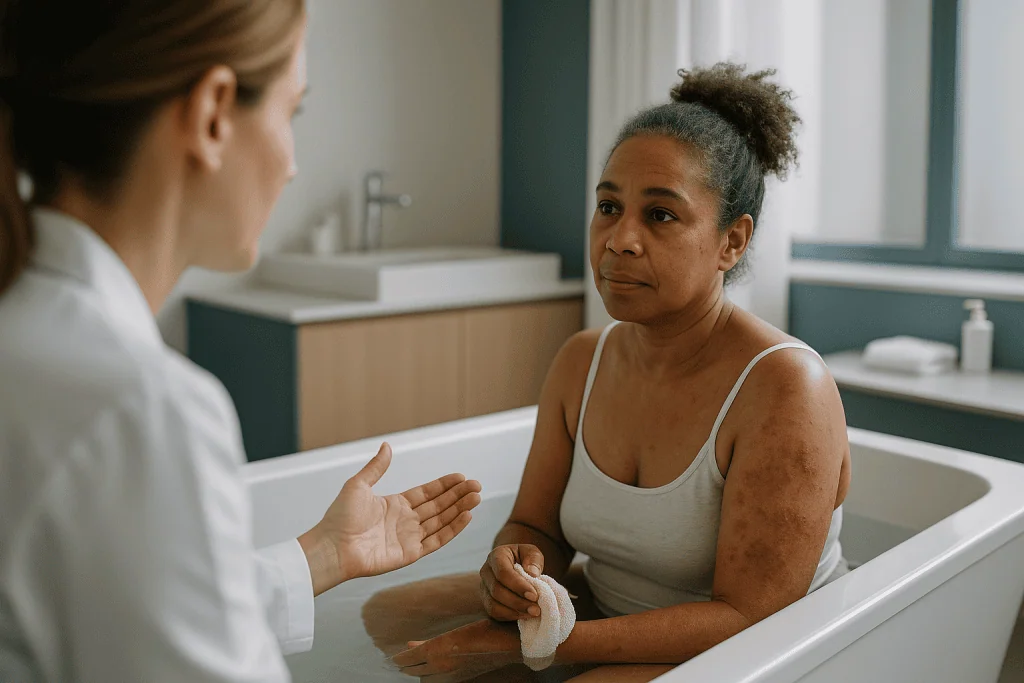
A short soak hydrates the outer layer, loosens crust so it lifts off without scratching, rinses away pollen, sweat and the bacteria that colonize eczema-prone skin, and leaves the surface soft enough for moisturizer to spread thinly and evenly. The harm comes afterward, in the minutes when a towel-dried body stands in a cool bathroom and the water pulled into the skin flashes off, taking some of the skin’s own moisture with it. That is why the bath and the moisturizer are best thought of as one act in two parts, not two chores.
An eczema bathing routine looks like this: fill the tub or run the shower lukewarm, not hot; use a fragrance-free, soap-free cleanser only on the parts that need it, such as armpits, groin, feet and visibly dirty skin; let water do the rest; skip bubble bath, scented bath bombs and anything that foams dramatically; pat dry with a soft towel rather than rubbing; then move straight to the emollient.
For children, a bath can be play rather than treatment, which helps with cooperation. Keep toys that hold stagnant water out of the tub, because they harbor mold and bacteria, and keep the whole thing brief. For adults who prefer showers, the same principles apply, with the added caution that a hot, long shower after a cold commute feels wonderful and reliably provokes itch an hour later.
Water temperature, time and cleansers: what the evidence says
Lukewarm means water that feels neutral on the inside of the wrist, neither cold nor comforting. Heat matters for two reasons: hot water dissolves the skin’s surface fats more efficiently, and warmth itself is an itch trigger, which is why many people notice that their skin prickles the moment they step out of a hot shower. Mayo Clinic advises limiting a bath or shower to about 10 minutes; longer soaks waterlog the outer layer and leave it more fragile, not less.
Cleansers deserve a closer look than most people give them. Ordinary soap is alkaline, and healthy skin sits on the acidic side. Pushing the surface toward alkaline weakens the mortar and favors bacterial growth. A soap substitute or a cleanser labeled fragrance-free and formulated for sensitive skin avoids that shift. Fragrance-free is not the same as unscented, which can mean a masking scent has been added. Washcloths, loofahs and exfoliating gloves add friction to skin that cannot afford it; hands are enough.
Shampoo runs down the body, so wash hair last or lean forward so the rinse water misses the trunk. Hard water is often blamed for eczema, and the evidence is genuinely mixed; trials of water softeners have not shown clear benefit, so it is reasonable to treat this as unproven rather than a priority.
Some clinicians recommend a diluted bleach bath, which uses a small amount of household bleach in a full tub to reduce bacteria on the skin. Mayo Clinic lists it as an option for some people with recurrent infections. The dilution, frequency and whether it suits a particular person are decisions for the treating team, and it is never used on broken or weeping skin without their say-so. After a chlorinated pool, a quick rinse and a prompt layer of emollient undo most of the chlorine’s drying effect.
The soak and seal method: moisturizing in the minutes after a bath
The soak and seal method is the name clinicians give to pairing a bath with immediate moisturizing. Soak describes the brief lukewarm bath that hydrates the outer skin; seal describes applying emollient while the skin is still slightly damp so that water is trapped rather than lost. Mayo Clinic advises moisturizing while the skin is still damp, and the NHS places emollient use straight after washing at the heart of daily care.
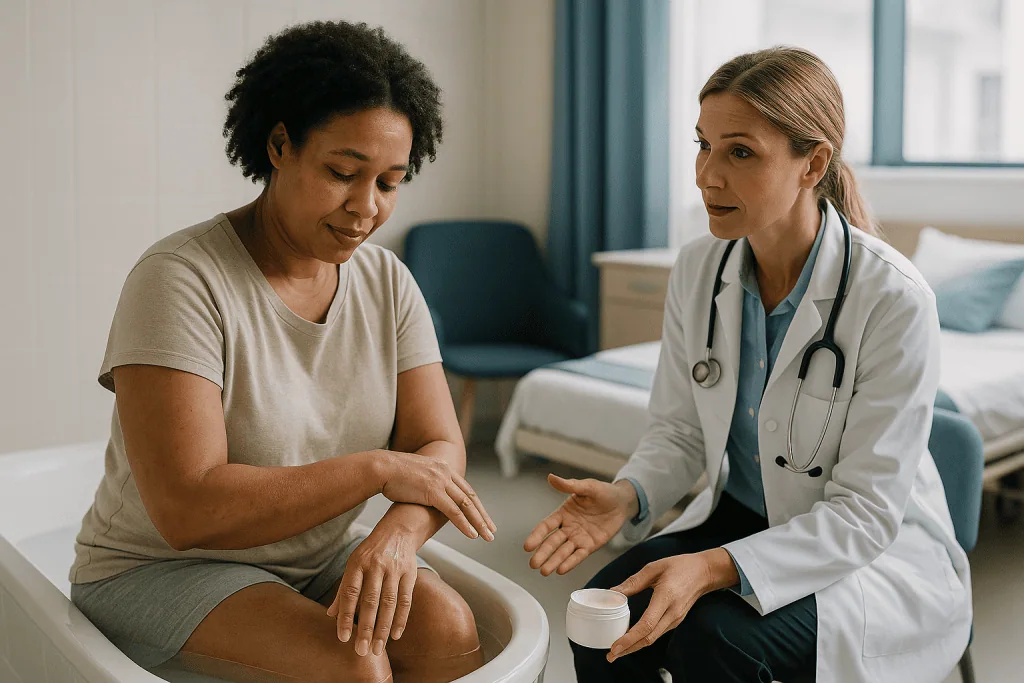
The technique is small but specific. Pat, do not rub, and stop before the skin feels fully dry. Take a generous amount of emollient, enough that it sits visibly on the skin before spreading, and stroke it on in the direction of hair growth, downward on arms and legs. Rubbing in circles against the grain can inflame hair follicles and produce a crop of itchy bumps that gets mistaken for a flare. Leave a thin, glistening film rather than massaging it until it disappears; the skin will absorb what it needs over the following minutes.
Hygiene matters when a tub of ointment is shared or used daily for months. Scooping with fingers introduces bacteria from the hands into the pot. A clean spoon or a pump dispenser avoids that, and tubs should be kept closed and away from the steam of the bathroom when possible.
People who also use a prescribed cream often ask which goes on first. Practices vary, and the right answer depends on the product and the area, so it belongs in a conversation with the prescriber. The NHS suggests leaving a gap of around 30 minutes between emollient and a topical corticosteroid so that one does not dilute or spread the other. Whatever order the team recommends, the emollient covers the whole body; the medicine goes only where it has been prescribed.
How often to moisturize eczema-prone skin, and how much is enough
The honest answer to how often to moisturize eczema is: more than feels natural. The NHS advises using an emollient at least twice a day, and more often when skin is very dry. Mayo Clinic gives the same minimum. The after-bath application is one of those two; the other most often falls before bed or first thing in the morning, with top-ups after hand washing, swimming, sport or any time the skin feels tight.
Quantity surprises people more than frequency. A proper whole-body application for an adult uses far more than a pea-sized dab per limb, and the NHS warns that people with eczema will get through large amounts. If a tub lasts for months, it is almost certainly being under-used. The goal is a continuous film over every area that is prone to dryness, including skin that currently looks fine, because clear skin in atopic dermatitis is still barrier-compromised skin.
Habit beats willpower here. Anchoring applications to things that already happen, such as brushing teeth or settling a child for a bedtime story, makes the routine survive busy weeks. Small containers at the kitchen sink, in a school bag and on an office desk remove the excuse that the big tub is upstairs. For hand eczema, the rule of thumb is one application after every wash.
Two safety points are worth stating plainly. Emollients, especially paraffin-based ointments, soak into clothing and bedding and make fabric more flammable; the NHS advises keeping away from open flames and smoking while fabric is contaminated, and washing bedding at a hot temperature regularly. Some creams contain preservatives that sting on cracked skin; a sting that fades in a minute is tolerable, but persistent burning or a new rash where a product was applied is a reason to stop that product and tell the care team.
Ointment, cream or lotion: which moisturizer suits an eczema routine?
The word moisturizer covers products that behave very differently on skin. The more oil a product contains relative to water, the better it traps moisture and the heavier it feels. Mayo Clinic notes that ointments and creams generally hold moisture better than lotions, and many people end up using more than one type depending on the hour and the season.
| Type | What it is | Where it tends to suit | Trade-offs |
|---|---|---|---|
| Ointment | Mostly oil, little or no water, few preservatives | Very dry or cracked skin, night-time, winter, hands and feet | Greasy feel, can trap heat and sweat in hot weather, marks clothing |
| Cream | Balanced oil and water mixture | Daytime, face, children who dislike grease | Contains preservatives that may sting or sensitize; less long-lasting |
| Lotion | Mostly water, thin and spreadable | Hairy areas, hot climates, very mild dryness | Evaporates quickly, least effective for truly dry skin |
| Gel or spray | Light, often alcohol- or water-based | Scalp, cosmetic acceptability | May sting; limited barrier repair |
Ingredient labels help more than marketing. Humectants such as glycerin and urea draw water into the outer layer; occlusives such as white soft paraffin and dimethicone sit on top and stop it leaving. A product that combines both covers more ground. What to avoid is clearer: fragrance, essential oils and botanical extracts are among the commonest causes of contact allergy on already inflamed skin, and the word natural on a label is not a safety claim.
Trying a new product on a small patch for a few days before using it everywhere catches most problems early. Beyond that, the best emollient is the one a person will actually apply twice a day, which is why it is worth asking the care team for more than one option.
Where prescribed treatments fit around the daily routine
Emollients and gentle washing manage dryness. They do not switch off inflammation, and most people with atopic dermatitis will at some point need treatment that does. Understanding what each class is doing makes it easier to see where it slots into the day; what to use, how much and for how long are decisions for the prescribing clinician.
Topical corticosteroids are anti-inflammatory creams and ointments that damp down the immune reaction in the skin. The NHS describes them as the usual treatment for flares, applied to affected areas for a short period until the flare settles, with the strength matched to the body site and severity. They sit alongside emollients, not instead of them.
Topical calcineurin inhibitors, such as tacrolimus and pimecrolimus, block a signaling protein that activates immune cells in the skin. Mayo Clinic notes they are often chosen for delicate sites such as the face and skin folds, where long-term steroid use is less desirable. A topical PDE4 inhibitor, crisaborole, works on a different enzyme pathway and is another non-steroid option in some settings.
For moderate to severe disease that does not settle, options widen. Phototherapy exposes skin to controlled ultraviolet light in a clinic. Biologic injections such as dupilumab block specific interleukin messengers that drive the allergic type of inflammation. Oral JAK inhibitors interrupt signaling inside immune cells. Each carries its own monitoring requirements and risks, which the care team will weigh against alternatives.
Two practical points bind all of this to the daily routine. First, emollient continues throughout, including during flares and when skin is clear. Second, nobody should start, stop or change a prescribed treatment based on something they read, including this article; the right move when a plan is not working is a conversation with the team that wrote it.
Nail care and scratch control: the overlooked third pillar
Nobody with atopic dermatitis stops scratching entirely, and pretending otherwise sets families up for shame rather than progress. The realistic aim is damage limitation. A fingernail is a hard, curved blade that carries bacteria under its tip, and the NIH notes that eczematous skin is especially vulnerable to infection with Staphylococcus aureus, the bacterium behind most skin infections in this condition. Short, smooth nails turn a cut into a scuff.
Trim nails weekly and file the edges with an emery board until they feel rounded against the back of a hand. For babies and young children, the easiest moment is straight after the bath, when nails are soft and the child is relaxed; a parent’s own fingertip run along the edge is the test. Clean under the nails during the bath. Nail polish and acrylics are best avoided on hands that touch inflamed skin, since the chemicals involved are common contact allergens.
Night is when most damage is done, because itch intensifies in the evening and the sleeping brain does not stop a hand. Mayo Clinic suggests cotton gloves at night, and loose cotton mittens serve the same purpose for infants. Many parents also sew the ends of sleep-suit sleeves closed for a few weeks during a bad patch.
During the day, substitute behaviors work better than prohibition. Pressing firmly on an itchy spot, pinching the skin beside it, or holding a cool pack wrapped in a cloth for a minute all interrupt the itch signal without breaking skin. Keeping hands busy with a fidget object helps children in classrooms. Scolding does not; itch is a sensory event, not a discipline problem, and children who are shamed for scratching tend to scratch in secret where nobody can treat what they find.
Night-time: sleep, itch and the bedroom
Ask anyone with eczema when it bothers them most and the answer is bedtime. Skin temperature rises in the evening, the body’s own anti-inflammatory hormone output dips overnight, and the distractions of the day fall away, leaving nothing between a person and the itch. Cleveland Clinic lists sleep disturbance among the most burdensome effects of the condition, and tired, scratched children become irritable, tired parents become discouraged, and the whole routine starts to slip.
The bedroom can be arranged against this. A cool room, light cotton bedding and loose cotton nightwear reduce the heat that provokes itch. The evening bath followed by a heavier ointment-type emollient makes sense because the greasy film works undisturbed for hours and nobody has to look presentable. Labels and seams on pajamas can be cut out or turned to the outside. Pets in the bed add dander and warmth; keeping them out is a reasonable trial.
Wet wraps are sometimes recommended for a severe flare. A layer of emollient, with or without a prescribed medicine, is covered by damp cotton bandages or garments and then a dry layer on top, and worn overnight. Mayo Clinic describes wet dressings as an intensive treatment that may be done in a hospital setting or taught for home use. The cooling and extra hydration can calm skin quickly, but the method is not for infected skin and belongs under clinical supervision.
Sedating antihistamines are occasionally offered for a short period to help a person sleep through a flare. The NHS notes that non-sedating antihistamines have little effect on eczema itch, because the itch is not mainly histamine-driven, and that the sedating type is used for sleep rather than for the rash itself. Whether either is appropriate is a prescriber’s call.
Who this routine is usually for, and when the care team may ask you to wait
Bathing, moisturizing and nail care suit almost everyone with atopic dermatitis, at every age and severity. Infants with early eczema benefit from the same lukewarm baths and generous emollient, with the wash kept very short and the room warm. Adults with hand eczema from wet work, teenagers with flexural flares and older adults whose skin has thinned with age all use the same framework, adjusted in texture and timing by their clinicians.
There are moments when the team may ask for part of the routine to pause or change. Skin that is weeping, crusted yellow or studded with small pus-filled spots is likely infected, and treatments such as bleach baths or wet wraps are held until the infection has been assessed and treated. Deep cracks that burn with cream are often switched to a bland ointment until they close. A new emollient or cleanser is best not introduced in the middle of a bad flare, because a reaction to the product becomes impossible to separate from the flare itself.
Eczema herpeticum, a spreading infection of eczematous skin with the cold-sore virus, is a special case. The NHS describes it as a medical emergency; routines stop and the person is seen the same day. Children with active chickenpox and adults undergoing certain systemic treatments may also receive tailored instructions about bathing and contact.
People with a known contact allergy, confirmed by patch testing, need their emollient ingredients checked against the allergen list, and those with very fragile skin may be asked to use spoons rather than fingers and to avoid rubbing entirely. In each of these situations, the question is not whether to care for the skin but how, and the answer comes from the treating team rather than from a general article.
What the first weeks of an atopic dermatitis daily routine usually look like
The first few days are mostly logistics. The bathroom fills with new tubs, the family argues about who finds the ointment too greasy, and a cracked knuckle stings when cream touches it. The skin itself rarely changes much in that window, and this is where many people quietly give up, convinced the routine is not working. It is working; the barrier simply rebuilds slowly, and the outer skin layer renews over weeks, not days.
Through the first week or two, the practical gains tend to come before the visible ones: less tightness after a bath, fewer nighttime wakings, scabs that heal rather than reopen. Dry, rough patches that have been scaly for months begin to feel smoother to the touch before they look different in the mirror. Short nails and night gloves show their value here, because the skin finally gets a stretch of uninterrupted healing.
Atopic dermatitis is relapsing by nature. A flare in week three is not evidence that the routine failed; it is the condition doing what it does, often in response to a cold, a stressful week, a change in weather or an unknown trigger. The NHS notes that symptoms can be well controlled with treatment but that flares still occur. The useful response is to keep the baseline routine going, use the flare treatment the team has prescribed, and make a brief note of anything that preceded the flare.
Seasons change the recipe. Many people need a heavier ointment in winter when indoor heating dries the air, and a lighter cream in humid summers when grease traps sweat. A review with the care team after a few weeks of consistent effort is the normal point to adjust textures, check that prescribed treatment is being used as intended and discuss anything that is not settling.
What people often get wrong about an eczema skin care routine
The most stubborn myth is that water dries out eczema and baths should be rare. Guidance from the NHS and Mayo Clinic supports daily, brief, lukewarm bathing followed by prompt moisturizing; it is unsealed evaporation that dries skin, not the bath. Close behind is the belief that squeaky clean is good. Lathering the whole body with fragranced soap strips the skin’s own fats and nudges its surface toward alkaline, which is the opposite of what a leaky barrier needs.
Natural does not mean gentle. Essential oils, botanical extracts and food-based preparations are among the commonest triggers of contact allergy on inflamed skin, and some kitchen oils have been shown in small studies to weaken rather than strengthen the barrier. The safest label is a boring one.
Stopping emollient when skin looks clear is another frequent error. Clear eczema-prone skin is still filaggrin-poor skin; the routine is maintenance, like brushing teeth that currently have no cavities. Fear of steroid creams causes a different kind of under-treatment. The NHS states that side effects such as skin thinning are uncommon when topical corticosteroids are used as directed, and that under-using a prescribed flare treatment often prolongs the flare. The place to raise worries about any medicine is with the prescriber, not by halving the recommended use quietly at home.
Food restriction deserves a careful word. Some children with eczema also have food allergy, but the NHS advises against cutting foods out without medical advice, because unsupervised elimination diets carry nutritional risk and rarely clear eczema on their own. Scratching with a hairbrush, a fork or a towel edge is not safer than fingernails; it is more damaging. Finally, eczema is not contagious, cannot be caught at a swimming pool or passed by sharing a towel, and children with it do not need to be kept apart from their classmates.
Questions to ask your care team
Appointments go faster when the questions are written down in advance, and the answers to these shape how the daily routine runs at home. None of them has a universal answer, which is exactly why they are worth asking.
- Which emollient texture do you suggest for daytime, and which for night, and can I have more than one option to try?
- In what order should I apply emollient and the prescribed cream, and how long should I leave between them?
- Which areas is the prescribed treatment for, how will I know the flare has settled, and what should I do when it starts to come back?
- How short and how lukewarm should the bath be for a child of this age, and is a soap substitute needed at all?
- Would a diluted bleach bath or wet wraps be appropriate here, and if so, who will show us how to do them safely?
- What does an infected patch look like on this skin tone, and how quickly should we be seen if it appears?
- Are there signs that would mean allergy testing or a referral to a specialist?
- Is there a written plan I can give to school, nursery or a workplace so that moisturizing and hand care can happen during the day?
- How many weeks of consistent routine should pass before we review, and what would prompt an earlier appointment?
- If sleep is still badly disrupted, what options exist, and what are their trade-offs?
A useful closing question is the simplest: what, in your view, is the single most important thing for us to get right between now and the next visit? Clinicians often have a clear answer, and it anchors a crowded routine around what matters most.
When to call your doctor
A good daily routine makes eczema quieter, and it also makes changes easier to notice. Some of those changes need prompt attention rather than another layer of cream.
Contact the care team the same day if patches start to weep clear or yellow fluid, develop golden crusts, show small pus-filled spots, or if redness spreads quickly, feels hot and painful or is accompanied by fever or a child who is unusually drowsy or off their food. These are signs of bacterial infection, which the NHS notes is common in eczema and usually needs treatment before the skin can settle.
Seek urgent care, which may mean the emergency department, for clusters of small, painful blisters or punched-out sores that appear suddenly, especially around the face or eyes, together with feeling unwell or feverish. The NHS describes this pattern, eczema herpeticum, as an emergency because the cold-sore virus can spread rapidly across damaged skin. Eye pain, light sensitivity or blurred vision in someone with facial eczema also warrant same-day assessment. Sudden swelling of the lips, tongue or face, wheeze or difficulty breathing after a food or product is a possible severe allergic reaction and needs emergency services immediately.
Less dramatic but equally valid reasons to call include a flare that does not begin to settle with the prescribed plan, sleep lost most nights for more than a week or two, a new rash where a product has been applied, skin that is cracking and bleeding despite consistent emollient use, or simply the sense that the condition is driving mood, confidence or family life in a direction nobody wants. Mayo Clinic lists interference with sleep and daily activities among the reasons to seek review. Whatever the trigger for the call, the next step, whether a change of treatment, a test or reassurance, is for the treating team to decide.
Frequently asked questions
Should a child with atopic dermatitis have a bath every day?
Daily bathing is supported by current guidance, provided it is short, lukewarm and followed straight away by emollient. Mayo Clinic recommends a daily bath or shower limited to about 10 minutes in warm rather than hot water. The bath hydrates skin and removes allergens and bacteria; the moisturizer applied afterward seals that water in. A child’s clinician may adjust frequency during infections or severe flares.
How often to moisturize eczema skin if it already looks clear?
At least twice a day, according to the NHS, even when the skin looks normal. Eczema-prone skin remains barrier-deficient between flares, and regular emollient use is maintenance rather than treatment of a visible problem. Most people pair one application with the bath or shower and the other with bedtime or waking, adding extra layers after hand washing, swimming or whenever the skin feels tight.
What is the soak and seal method for eczema?
Soak and seal describes a brief lukewarm bath or shower followed immediately by a generous layer of emollient applied to skin that is still slightly damp. The soak adds water to the outer skin layer; the seal traps it before it evaporates. Patting rather than rubbing dry and stroking emollient on in the direction of hair growth completes the technique. Prescribed creams are applied as the care team directs.
Is it better to use an ointment or a cream for eczema?
Ointments generally hold moisture better because they contain more oil and fewer preservatives, which makes them suited to very dry skin and overnight use. Creams feel lighter and are often preferred by day and on the face, but their preservatives can sting cracked skin. Many people use both. The right choice depends on body site, season and what a person will reliably apply, so it is worth discussing options with the care team.
Does hot water make eczema worse?
Hot water tends to aggravate eczema in two ways: it strips the skin’s surface fats more efficiently than lukewarm water, and warmth itself triggers itch, which is why skin often prickles after a hot shower. Guidance from Mayo Clinic favors warm rather than hot water and short washing times. Lukewarm means water that feels neutral on the inside of the wrist.
How do I stop my child scratching eczema at night?
Complete prevention is unrealistic, so the aim is to reduce damage. Short, filed nails and cotton gloves or mittens at night, as Mayo Clinic suggests, blunt the harm. A cool bedroom, cotton bedding, an evening bath and a heavier emollient before sleep lower itch intensity. If sleep remains badly disrupted, the clinician may discuss other options, including short-term sedating antihistamines or wet wraps, which are their decision to make.
Should emollient go on before or after steroid cream?
Practices vary, and the prescriber’s instruction should be followed. The NHS suggests leaving a gap of around 30 minutes between applying emollient and a topical corticosteroid so that one product does not dilute or spread the other. Emollient covers the whole body; the prescribed cream goes only on the areas it was prescribed for. If the order has never been explained, it is a reasonable question for the next appointment.
Can I use natural oils like coconut or olive oil instead of an emollient?
Natural oils are not automatically safer, and some have been associated in small studies with weakening rather than strengthening the skin barrier. Botanical extracts and essential oils are also common causes of contact allergy on inflamed skin. Fragrance-free emollients formulated for dry, sensitive skin remain the mainstream recommendation. Anyone wanting to try an alternative should raise it with the care team first and test it on a small area.
How do I know if eczema is infected?
Infected eczema typically weeps clear or yellow fluid, forms golden crusts, develops small pus-filled spots, or becomes hot, painful and rapidly spreading, sometimes with fever. The NHS advises seeing a doctor for these signs. Sudden clusters of painful blisters or punched-out sores, especially near the face or eyes, may indicate eczema herpeticum, which needs urgent same-day care. Bathing additions such as bleach baths are paused until infection has been assessed.
Do special laundry detergents help an eczema skin care routine?
Fragrance-free detergent and an extra rinse cycle are reasonable, low-risk measures, and many people with eczema find clothes feel more comfortable as a result. The evidence that specific detergents change the course of the condition is limited, so this is a sensible precaution rather than a treatment. Avoiding fabric softeners and scented dryer sheets follows the same logic of reducing fragrance contact with vulnerable skin.
References
- NHS: Atopic eczema, treatment
- NIH NIAMS: Atopic dermatitis
- MedlinePlus: Atopic dermatitis
- Cleveland Clinic: Eczema
This article is for general information only and is not a substitute for professional medical advice. Please consult a qualified doctor about your individual situation.

More from the Blog
Is Coconut Oil Good for Your Hair? The One Oil That Penetrates
Coconut oil can genuinely help hair, and the reason is unusual: its main fatty acid, lauric acid, is small enough to penetrate the hair…
Peptides in Skincare: What Signal Peptides Do and What the Studies Show
Peptides in skincare are short chains of amino acids applied topically to signal skin cells, most often to encourage collagen production or soften expression…
How to Get Clear Skin: What Actually Works, According to Dermatology Trials
Dermatology trials show that clear skin comes mainly from treating acne consistently: a gentle cleanser, benzoyl peroxide, an adapalene retinoid, daily sunscreen, and patience…

Why Is Cellulitis Not Improving? Spreading Redness, Fever and When to Contact Your Care Team
Cellulitis usually begins to improve within about 48 hours of starting antibiotics, although redness can spread slightly at first. When it keeps worsening after…

Why Does Shingles Appear Years After Chickenpox? How Herpes Zoster Is Diagnosed and Treated
Shingles appears years after chickenpox because the varicella-zoster virus never leaves the body. After the childhood infection clears, it lies dormant in nerve-root clusters…

Cellulitis When You Have Diabetes or Lymphedema: Why Care Is Monitored More Closely
Cellulitis with diabetes or lymphedema is monitored more closely because high blood sugar weakens the immune response, nerve damage can hide early pain, reduced…