

Aesthetic Genital Surgery Recovery: Hygiene, Swelling and the Activities to Pause for Weeks

Key Takeaways
- Swelling after genital surgery peaks around day two to three and usually steps down over the first two weeks, but the NHS notes full healing can take several months.
- The six-week pause on sex, tampons, cycling and heavy exercise quoted by the NHS and Cleveland Clinic exists because skin closes in weeks while deeper tissue strength builds for months.
- Plain lukewarm water, patting dry and loose cotton underwear protect the incision better than antiseptics, scented washes or hot baths, which damage new cells or trap moisture.
- Cold packs wrapped in cloth for about 20 minutes at a time in the first 48 to 72 hours reduce fluid leak; after that, elevation and avoiding friction do more than cold.
- Short walks from day one lower the risk of a leg clot, which Mayo Clinic links to post-surgical immobility, while gym-level exertion typically waits four to six weeks.
- Uneven swelling in the first two months is normal and is why surgeons usually decline to judge symmetry or discuss revision before three to six months.
Aesthetic genital surgery recovery usually means several days of marked swelling and bruising, a week or two away from work, and around six weeks before sex, tampons, cycling and heavy exercise are typically resumed, with full settling taking several months. Gentle rinsing with water, careful drying, loose clothing and avoiding friction protect the healing tissue; your surgical team sets the exact timeline for you.
The first shower after surgery is when it becomes real. Standing awkwardly, one hand braced on the tiled wall, trying to work out whether water is allowed to touch the area, whether soap is a friend or an enemy, and why the swelling looks nothing like the calm result on the consent form. Most people who have had a labiaplasty, a monsplasty or a scrotal or penile aesthetic procedure describe a version of this moment, usually within the first two days.
Aesthetic genital surgery recovery is unusual among cosmetic procedures because the wound sits in the one place the body cannot keep still, dry or unpressured. You sit on it, walk with it, urinate past it and sleep against it. The tissue is also among the most swelling-prone in the body.
That combination, not the surgery itself, is what shapes the weeks ahead. This explainer walks through what actually happens to the tissue, how hygiene and swelling are managed, and which activities are usually paused, with the timelines tied to mainstream clinical sources rather than forum lore.
What does aesthetic genital surgery recovery actually involve?
“Aesthetic genital surgery” is an umbrella phrase for elective procedures that change the appearance of the external genitals rather than treat disease. The most common is labiaplasty, an operation that reduces or reshapes the labia minora, the inner folds of the vulva. Related procedures include clitoral hood reduction (trimming excess skin over the clitoris), monsplasty (removing fat or loose skin from the mound above the pubic bone), scrotal lift or scrotoplasty (tightening loose scrotal skin) and penile skin or fat-pad procedures. Cleveland Clinic and the NHS both describe labiaplasty as a same-day operation, usually under local anesthetic with sedation or under general anesthetic, taking roughly one to two hours.
Whatever the variation, the tissue goes through the same biological sequence. In the first days, blood vessels leak fluid into the loose connective tissue, which is why the area balloons. Over the following two to three weeks, new cells creep across the incision line, a process called epithelialization, meaning the skin surface knits closed. Beneath that, collagen fibers are laid down and then remodeled for months, which is why scars and asymmetry keep changing long after the stitches have gone.
Most surgeons use dissolvable sutures. These soften and fall away over one to several weeks; you may notice small threads on toilet paper, which is normal unless the wound edges pull apart.
The recovery task, then, is less about “healing faster” and more about not interrupting a process that already knows what to do. Friction, moisture trapped against the wound, pressure and early stretching are the four things that most often interrupt it. Nearly every instruction that follows is a strategy against one of those four.
Who is this surgery usually for, and who is usually asked to wait?
People seek these procedures for mixed reasons: chafing or catching of the labia during exercise or intercourse, discomfort in fitted clothing, changes after childbirth or weight loss, or dissatisfaction with appearance. The NHS notes that labia vary enormously in size, shape and color, and that asymmetry is normal; it describes the procedure as a choice rather than a medical need in most cases.

Surgeons commonly ask certain people to postpone. Anyone under 18 is generally asked to wait, because the genitals are still developing; the NHS states labiaplasty is not usually recommended for girls under 18. People who are pregnant, recently postpartum or breastfeeding are often asked to wait until hormone levels and tissue have settled, since estrogen changes affect vulvar swelling and healing. Active vulvar skin conditions such as lichen sclerosus, untreated infections, or poorly controlled diabetes usually need attention first, because they slow wound healing and raise infection risk (CDC lists diabetes and smoking among surgical site infection risk factors).
Smoking matters more here than many people expect. Nicotine narrows small blood vessels, and the wound edges of the labia depend on a thin network of exactly those vessels. Many teams ask for a smoke-free window before and after surgery, with the exact timing set by the surgeon.
A frank conversation about expectations is also part of the screening. Surgeons and mental health professionals look out for body dysmorphic disorder, a condition in which a person is preoccupied with a perceived flaw that others barely notice, because surgery rarely relieves that distress. The NHS advises speaking with a GP first if you feel very anxious about the appearance of your genitals. None of this is gatekeeping for its own sake; it is the difference between a straightforward recovery and a prolonged one.
What the first 72 hours usually look like
Expect the area to look worse on day two or three than on the day of surgery. Swelling and bruising peak in this window, and it is common for the labia or scrotum to appear two or three times their eventual size. Cleveland Clinic describes swelling, bruising and soreness as expected after labiaplasty, easing over the first week or two.
Bleeding is usually light: spotting on a pad rather than a flow. A pad or soft gauze inside loose underwear catches ooze and keeps clothing from rubbing. Small amounts of clear or pale yellow fluid are part of healing; bright red bleeding that soaks a pad is not.
Pain is typically described as stinging or throbbing, worse when sitting upright, walking or passing urine. Most teams recommend rest with the hips slightly elevated on a pillow, which uses gravity to drain fluid away from the lowest point of the body, and cold packs wrapped in cloth for about 20 minutes at a time (Cleveland Clinic), never ice directly on skin, which can burn tissue that is already numb from swelling.
Short walks around the home from the first day matter for two reasons. They keep blood moving in the calf veins, lowering the risk of a clot, and they prevent the stiffness that makes the next day harder. Long walks, stairs in quantity and bending to lift are best left for later.
The first bowel movement and the first shower are the milestones people dread most and remember least. Both are covered below. In these early days, the most useful mindset is simple: protect, cool, rest, and resist the urge to inspect the area with a mirror every hour, because it will not look like the final result for months.
Why does swelling after labiaplasty and other genital procedures last so long?
Two features of genital tissue explain the stubborn swelling. First, the labia, scrotum and penile skin are made of very loose connective tissue with a rich blood supply and almost no firm structure to hold fluid back. When surgery disturbs the small vessels, fluid pours into that loose space the way water spreads through a sponge. Second, the area is the lowest point of the trunk whenever you sit or stand, so gravity keeps pulling fluid down into it for as long as you are upright.
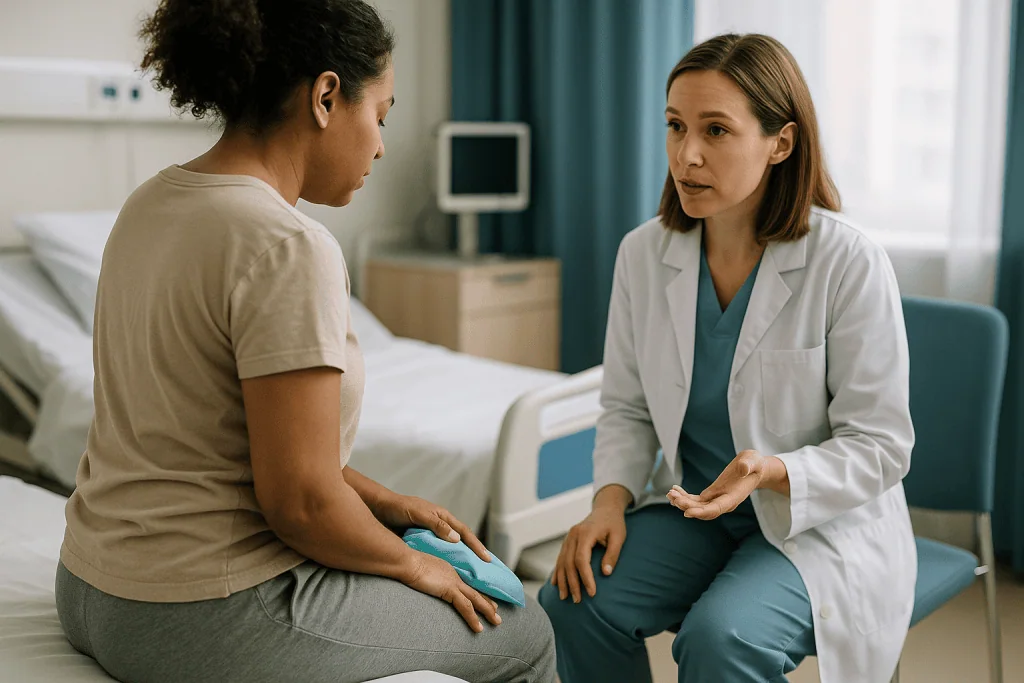
Lymphatic vessels, the drainage system that carries excess fluid back into circulation, are also cut during surgery and take weeks to reconnect. Until they do, drainage is slow.
The pattern most people notice: dramatic swelling in the first three days, a clear step down over the first one to two weeks, then a slower tail. The NHS states it can take several months for the area to fully heal; Cleveland Clinic gives most people a return to normal appearance within about six to eight weeks, with residual swelling possible beyond that. Swelling is also often uneven, one side more than the other, because tissue handling and bleeding differ side to side.
Evening swelling that improves overnight is typical and reflects gravity rather than a problem. Swelling that is increasing after day three, is hard and tense on one side, or is accompanied by purple discoloration spreading rapidly can indicate a hematoma, a collection of blood under the skin, and needs a same-day call to the team.
The honest message: swelling is not a sign that something went wrong, and its speed of resolution is mostly outside your control. What you can control is not adding to it through heat, friction, prolonged sitting or early exertion.
How is swelling managed at home, and what does not work?
Cold, elevation and stillness are the evidence-supported trio, and none of them requires a product.
Cold packs narrow blood vessels and reduce fluid leak in the first 48 to 72 hours, when most of the swelling forms. A gel pack or a bag of frozen peas wrapped in a clean cloth, applied for about 20 minutes with at least 20 minutes off in between, is the pattern Cleveland Clinic describes for labiaplasty. After the first few days, cold offers comfort more than reduction.
Elevation means lying on your back with a pillow under the hips, or lying on your side, rather than sitting upright in a chair with the wound as the lowest point. Reclining between short walks is more helpful than either bed rest alone or being on your feet all day.
Loose clothing is part of swelling control, not just comfort. Anything that compresses or rubs the area traps heat and fluid and irritates the incision; the NHS advises loose clothing and underwear during recovery.
What tends not to help, or can harm: hot baths and heating pads early on, which widen vessels and increase fluid leak; over-the-counter “anti-swelling” creams or herbal gels applied to the wound, for which there is no reliable evidence and which can introduce irritants; and compression garments, which have a role after abdominal contouring but are not routinely used on the vulva or scrotum unless a surgeon specifically prescribes them for a monsplasty. Arnica and bromelain supplements are widely marketed for surgical bruising; NIH’s Office of Dietary Supplements lists limited, low-quality evidence for such uses, and they should not be taken without the surgical team’s knowledge because some supplements affect bleeding.
How to clean after labiaplasty and other genital surgery
Hygiene after genital surgery is a balance: the area must be kept clean because urine, sweat and discharge sit against the wound, but it must not be scrubbed, soaked or dosed with products that strip the fragile new skin.
Water is the main tool. Most teams allow a gentle shower from the first or second day; the NHS notes that showering is usually fine once your surgeon says so, while soaking in a bath is delayed. Let lukewarm water run over the area rather than directing a jet at it. Plain water or a very mild, unscented wash on the surrounding skin, not on the incision itself, is generally acceptable. Antiseptic washes, douches, wipes and anything scented are best avoided; MedlinePlus wound-care guidance advises against hydrogen peroxide, iodine and alcohol on healing incisions because they damage new tissue.
After urinating, many people find a squeeze bottle of lukewarm water, sprayed front to back while still seated, both cleans and soothes. It also dilutes urine so the sting is less. Pat dry with a clean soft towel or let the area air dry; never rub. A cool setting on a hair dryer, held well away, is a trick some teams suggest for drying without touching.
Wiping technique matters. Dab front to back with soft, unscented toilet paper, or use the water bottle and pat dry. Bowel movements should be kept soft with fluids and fiber so that straining does not pull on the incision; your team may discuss a stool softener, with the decision left to them.
Change pads or gauze at least a few times a day and whenever damp. Damp dressings breed bacteria, and CDC lists a moist, contaminated wound environment among the conditions that favor surgical site infection. Wash your hands before and after each change; that single habit does more for infection prevention than any cream.
What should I wear, and how should I sit?
Clothing choices in the first weeks are a matter of physics. Anything that presses on or rubs the incision creates friction and heat, both of which slow epithelialization and increase swelling.
Loose cotton underwear, or none at home, is the usual advice. Cotton wicks moisture; synthetic fabrics trap it. Skirts, loose dresses, soft wide-leg trousers and pajama bottoms are more comfortable than jeans, leggings or anything with a firm seam through the crotch. The NHS specifically advises loose clothing and underwear to reduce friction after labiaplasty. Thongs, shapewear and tight sportswear are typically off the list until the team clears them, often around the six-week mark when other friction-heavy activities are also reintroduced.
Sitting is the hidden challenge of this recovery. Upright sitting on a hard surface puts direct pressure on the labia or perineum and makes the area the lowest point for fluid to pool. Reclining with the hips supported is easier in the first week. A soft cushion or a ring cushion (a doughnut-shaped pillow that keeps weight on the thighs rather than the center) helps when sitting is unavoidable, such as car journeys. Shift position often; prolonged sitting also raises clot risk in the calves.
Sleeping on your back or side with a pillow between or under the knees reduces pull on the wound. Some people wake to find swelling worse on the side they slept on; that is gravity again and settles once upright.
Pads without adhesive wings pressed against the skin, or soft gauze, are less irritating than tampons or pads with plastic surfaces. Tampons and menstrual cups sit inside the vagina and are avoided until healing is confirmed, typically around six weeks (Cleveland Clinic).
Which activities are paused, and for how long?
The pause list is the part of recovery people most want to negotiate, so it helps to understand the reasoning behind each item. Every activity below is restricted because it stretches, rubs, heats, soaks or pressurizes the wound. The ranges are typical figures quoted by the NHS and Cleveland Clinic for labiaplasty; scrotal and penile procedures follow similar logic, and your own surgeon’s timeline overrides any table.
| Activity | Typical pause | Why it waits |
|---|---|---|
| Work (desk based) | About 1–2 weeks (NHS) | Sitting pressure, fatigue, swelling |
| Light walking | Encouraged from day 1 | Clot prevention; no friction if unhurried |
| Sexual activity, including oral and manual | Around 6 weeks (NHS, Cleveland Clinic) | Stretching, friction, infection risk before the incision is sealed |
| Tampons, menstrual cups | Around 6 weeks (Cleveland Clinic) | Internal pressure on healing edges; infection risk |
| Bathing, swimming, hot tubs | Until incisions fully closed, often several weeks (MedlinePlus wound care) | Soaking softens new skin and introduces bacteria |
| Cycling, horse riding, spinning | Around 6 weeks or longer | Direct saddle pressure and heat |
| Gym, running, heavy lifting | Around 4–6 weeks | Raised blood pressure increases bleeding and swelling; sweat and friction |
| Waxing or shaving the area | Until scars have matured, several weeks | Skin trauma on fragile tissue |
Sex is the restriction most often broken early, usually around week three when things look and feel better. The tissue at that stage has a thin surface layer but little tensile strength; friction can split the incision line, a complication called wound dehiscence, which lengthens healing and can affect the final appearance. Waiting the full period the surgeon sets is one of the few recovery decisions with a direct effect on outcome.
When can I exercise after labiaplasty or a scrotal procedure?
Movement and exercise are different things in this recovery, and separating them avoids two opposite mistakes: lying completely still for weeks, or hitting the gym at day ten.
Gentle walking is welcome from the first day. It keeps calf muscles pumping blood back toward the heart, which is the body’s main defense against deep vein thrombosis, a clot in a deep leg vein. Mayo Clinic lists recent surgery and prolonged inactivity among DVT risk factors. Short, frequent walks around the home, gradually lengthened, are the pattern most teams describe. The measure of “too much” is straightforward: if swelling or throbbing is clearly worse an hour later, the walk was longer than the tissue wanted.
Exertion that raises heart rate and blood pressure, such as running, HIIT, heavy lifting or vigorous yoga, is typically paused for about four to six weeks. Higher pressure in the small vessels of the wound increases oozing and swelling, and sweat pooled against an incision softens new skin and feeds bacteria. Straining during lifting also bears down on the pelvic floor and stretches the perineum.
Cycling, spinning and horse riding carry a specific problem: the saddle sits exactly on the surgical site. Many surgeons keep these on hold for at least six weeks and sometimes longer, depending on how the scars feel to pressure.
Swimming waits until the incision is fully sealed, because pool and open water soak and contaminate the wound. Return to exercise is usually stepped: walking, then low-impact movement without friction such as an upright stationary bike with a wide padded seat only once cleared, then running, then contact or saddle sports. If an activity produces sharp pain, spotting or a sudden increase in swelling, stop and let the team know before trying again.
Aesthetic genital surgery recovery week by week: what the following weeks usually look like
Timelines vary with the procedure, the individual and the surgeon’s technique, so the following is a typical arc drawn from NHS and Cleveland Clinic descriptions of labiaplasty recovery rather than a schedule.
Days 1 to 3. Peak swelling and bruising, light spotting, stinging on urination. Rest with hips elevated, cold packs, short walks, water-bottle rinsing. This is the phase where the area looks most alarming and least like a result.
Days 4 to 7. Swelling begins to recede; bruising turns yellow-green. Many people move about the house comfortably and shower without anxiety. Sitting still requires a cushion. Dissolvable stitches may start to loosen.
Week 2. The NHS suggests many people return to desk work around one to two weeks. Bruising largely gone; swelling noticeably reduced but still present, often more on one side. Stitches continue to dissolve; small threads on paper are normal. Itching along the incision is a common and reassuring sign of healing skin.
Weeks 3 to 4. The surface has usually closed. Discomfort is mostly a pulling sensation with movement. Loose sportswear becomes tolerable. This is the danger window for premature sex or exercise, because things look better than they are structurally.
Weeks 6 to 8. Cleveland Clinic describes most people resuming sexual activity, tampons and full exercise around six weeks, once the surgeon confirms healing. Appearance is closer to the final result but still swollen in places.
Months 3 to 6. Scars soften and fade; numbness or oversensitivity along the incision usually settles; residual asymmetry from uneven swelling resolves. The NHS states full healing can take several months, which is why revision decisions are not made early.
What about pain relief and medicines during recovery?
Pain after aesthetic genital surgery is usually moderate and short-lived, described more often as burning, stinging and pressure than as severe pain. Most teams manage it with over-the-counter or short-course prescribed analgesics, chosen and scheduled by the surgeon or prescribing clinician. This section explains what the common classes do so that the instructions make sense; it is not a guide to taking them.
Simple analgesics such as acetaminophen (paracetamol) act centrally to dampen pain signals and are often the first-line choice because they do not affect bleeding. Non-steroidal anti-inflammatory drugs (NSAIDs) reduce both pain and inflammatory swelling by blocking prostaglandin production, but they also reduce platelet function slightly, so some surgeons prefer to delay them for the first day or two or avoid them in people with kidney, stomach or bleeding concerns. Whether and when you use either is a decision for the prescribing clinician, who knows your history.
Local anesthetic infiltrated during surgery typically wears off within several hours, which is why the first evening often feels worse than the recovery room. Topical anesthetic gels are sometimes prescribed for stinging on urination; they are used only where and how the team directs.
Antibiotics are not routinely required for clean elective procedures in healthy people, according to general surgical infection guidance from the CDC, though some surgeons give a single dose around the time of surgery. Taking leftover antibiotics “just in case” at home is not recommended.
If you take blood thinners, hormonal medicines or supplements, tell the team before surgery and do not stop or restart anything on your own; the timing is theirs to set. Pain that escalates rather than fades after the third day, or that is not touched by the prescribed regimen, is a reason to call rather than to increase what you are taking.
Scars, numbness and asymmetry: what settles and what may not
The final appearance is a moving target for months, and knowing what usually settles on its own prevents needless worry and premature requests for revision.
Scars on the labia, scrotum and penile skin generally fade well because the tissue is thin, mobile and well supplied with blood, and because the incision often sits in a natural fold or along an edge. Early scars look red, raised or slightly puckered; the NHS notes that scarring is a potential result of labiaplasty and that healing takes several months. Firmness along the line usually softens over three to six months as collagen remodels. Scars that stay thick, wide or painful are less common and should be assessed by the team.
Numbness or altered sensation is expected early. Small nerve endings are cut and take weeks to months to regrow; some people describe tingling or oversensitivity as they do. The NHS lists reduced sensitivity as a recognized risk, and a small proportion of people report lasting change. Clitoral hood reduction requires particular care because of the density of nerve endings nearby, which is a reasonable topic to raise with the surgeon beforehand.
Asymmetry in the first two months is more often swelling than surgery. One side may drain more slowly, sit differently when you sleep, or have bruised more. Surgeons generally wait at least three to six months before judging symmetry or discussing revision, precisely because so much resolves in that window.
Wound dehiscence, when incision edges separate, usually at a corner or where tension is highest, is the complication most linked to early activity. Small separations often heal with cleaning and time; larger ones may need re-suturing. Either way, it is a call to the team, not a wait-and-see.
What people often get wrong about aesthetic genital surgery recovery
“If it looks healed, it is healed.” Surface skin closes in two to three weeks, but strength in the deeper layers builds for months. This gap is why the six-week restriction on sex, tampons and cycling exists (NHS, Cleveland Clinic) even when everything looks fine at week three.
“Antiseptic keeps it cleaner.” Antiseptic solutions, hydrogen peroxide and scented washes damage new cells and disrupt the vulvar or scrotal skin barrier. MedlinePlus wound-care guidance is explicit that plain water and mild soap on surrounding skin are preferred. Clean means rinsed and dry, not sterilized.
“A hot bath will soothe it.” Heat widens blood vessels and increases swelling in the first days, and soaking softens the incision and lets bacteria in. Showers yes; baths, pools and hot tubs wait until closure is confirmed.
“Swelling on one side means it was done unevenly.” Uneven swelling is the norm, not evidence of error. Surgeons generally decline to judge symmetry before about three to six months for this reason.
“Resting means staying in bed.” Bed rest without walking raises the risk of a leg clot (Mayo Clinic lists immobility after surgery as a DVT risk factor). Rest means reclining between short, regular walks.
“Supplements speed healing.” Arnica, bromelain and vitamin megadoses are heavily marketed for post-surgical recovery. Evidence is limited and low quality, and some supplements affect clotting. Nothing replaces adequate protein, hydration, sleep and not smoking.
“Numbness means nerve damage.” Temporary altered sensation is expected as small nerves regrow. Persistent change beyond several months is uncommon but recognized, and is the honest reason this surgery deserves a careful pre-operative conversation rather than reassurance.
Questions to ask your care team
A recovery plan works best when it is specific to your procedure, your body and your life. These questions help turn general guidance into a personal one; write down the answers, because the post-anesthetic memory is unreliable.
- Which exact procedure am I having, and where will the incisions sit? Ask to see a diagram so you know what a normal-looking wound is for your surgery.
- What type of stitches will you use, and when should I expect them to dissolve or be removed?
- How should I clean the area in the first week, and which products, if any, are acceptable on the surrounding skin?
- When can I shower, and when can I soak in a bath or swim?
- What does normal bleeding and discharge look like for this procedure, and what amount should prompt a call?
- How should I manage pain, and are there medicines or supplements I take now that need to change beforehand or afterward?
- What is your specific timeline for returning to work, exercise, cycling, tampons and sex, and what will you check before clearing each one?
- How will swelling behave, and at what point would you want to see me if it is not improving?
- What sensation changes are possible with this procedure, and how often do you see them persist?
- When are my follow-up visits, and who do I contact out of hours if something worries me?
- At what point after surgery would you assess the final result, and how do you handle asymmetry or revision if it is needed?
- If I menstruate, how should I manage a period during recovery?
The last question is frequently forgotten and frequently relevant. Pads without plastic top sheets are usually acceptable; tampons and cups wait. If you are unsure whether something is normal, the team would rather hear from you early than manage a complication late.
When to call your doctor
Most aesthetic genital surgery recoveries are uneventful, but the site is warm, moist and close to bacteria, and it swells readily, so a few signs deserve prompt attention rather than watchful waiting. Contact your surgical team the same day, or seek urgent care if you cannot reach them, for any of the following.
- Bleeding that soaks a pad within an hour, or that does not slow with gentle pressure and rest.
- Swelling that is increasing after the third day, is tense and hard on one side, or is spreading with purple discoloration, which can signal a hematoma needing drainage.
- Pain that escalates rather than eases after day three, or pain out of proportion to what you were told to expect.
- Signs the CDC lists for surgical site infection: redness spreading from the incision, increasing warmth, thick or foul-smelling discharge, or a fever.
- Wound edges pulling apart, or a stitch that has come loose with an open gap.
- Inability to pass urine, or urine that becomes cloudy, strong smelling or painful beyond the first days’ stinging, which may point to a urinary infection.
- Calf pain, swelling or warmth in one leg, or sudden breathlessness or chest pain, which Mayo Clinic identifies as possible signs of a deep vein thrombosis or pulmonary embolism; these need emergency care.
- Any allergic reaction to dressings or medicines: widespread rash, facial swelling or difficulty breathing.
Less urgent but still worth a call at the next opportunity: numbness that is not changing after two to three months, a scar that is thickening or painful, persistent asymmetry beyond the swelling phase, or distress about how the area looks that is affecting your daily life. Your treating team is the right place for every one of these decisions; no article, forum or product can assess a wound it cannot see.
Frequently asked questions
What is the typical labiaplasty recovery time?
Most people return to desk work within about one to two weeks, resume sex, tampons and full exercise around six weeks once the surgeon confirms healing, and see the area settle fully over several months, according to the NHS and Cleveland Clinic. Swelling and bruising are heaviest in the first three days. These are typical ranges rather than promises, and your own surgeon’s timeline takes priority.
How long does swelling after labiaplasty last?
Swelling usually peaks around day two or three, improves noticeably over the first one to two weeks, and then fades slowly, with Cleveland Clinic describing most people looking close to their final appearance around six to eight weeks and the NHS noting full healing can take several months. Uneven swelling side to side is common and typically resolves without treatment.
How do I clean after labiaplasty without hurting the wound?
Let lukewarm shower water run over the area rather than scrubbing, use a squeeze bottle of water after urinating, and pat dry with a soft clean towel or let it air dry. Avoid antiseptics, hydrogen peroxide, scented washes, wipes and douches, which MedlinePlus wound-care guidance notes damage healing tissue. Change pads whenever damp and wash your hands before and after.
When can I exercise after labiaplasty or scrotal surgery?
Gentle walking is encouraged from the first day to keep blood moving and lower clot risk. Running, heavy lifting and gym sessions are typically paused for about four to six weeks, and saddle-based activities such as cycling and horse riding often wait six weeks or longer because the seat presses directly on the incision. Your surgeon clears each step based on how the wound looks.
Can I shower or take a bath after aesthetic genital surgery?
Showering is usually permitted within the first day or two once your surgeon agrees, with water allowed to run gently over the area. Soaking in a bath, pool or hot tub waits until the incision has fully sealed, often several weeks, because soaking softens new skin and introduces bacteria. Confirm the exact timing with your team.
Why does one side look more swollen than the other?
Uneven swelling is the norm after genital surgery, not a sign of an uneven result. One side may have bruised more, drained more slowly or borne more pressure during sleep. Surgeons generally wait three to six months before assessing symmetry for this reason. Swelling that is tense, hard and rapidly enlarging on one side is different and should be reported the same day.
Is it normal for stitches to fall out on their own?
Yes, most surgeons use dissolvable sutures that soften and fall away over one to several weeks, and finding small threads on toilet paper is expected. What is not normal is the wound edges pulling apart, a visible gap, or bleeding where a stitch has come away. In that case, contact your surgical team rather than waiting for the next appointment.
What can I wear during recovery?
Loose cotton underwear or none at home, plus skirts, dresses or soft wide-leg trousers, keep friction and trapped moisture off the incision. The NHS specifically advises loose clothing and underwear after labiaplasty. Thongs, shapewear, jeans, leggings and tight sportswear are typically avoided until the team clears friction-heavy activities, often around six weeks.
Can I have sex before six weeks if it looks healed?
Surgeons generally advise against it. Surface skin closes in about two to three weeks, but the deeper tissue lacks strength for longer, and friction can split the incision, a complication called dehiscence that prolongs healing and can affect the final appearance. The NHS and Cleveland Clinic both cite around six weeks; your surgeon confirms the point at follow-up.
Will I lose sensation after labiaplasty or clitoral hood reduction?
Temporary numbness, tingling or oversensitivity along the incision is expected as small nerves regrow over weeks to months. The NHS lists reduced sensitivity as a recognized risk, and a small proportion of people report lasting change. Procedures near the clitoris carry particular considerations, so ask your surgeon about their approach and what they see in their own patients before deciding.
References
- NHS: Labiaplasty (vulval surgery)
- MedlinePlus: Surgical wound care – open
- CDC: Surgical Site Infection Basics
This article is for general information only and is not a substitute for professional medical advice. Please consult a qualified doctor about your individual situation.

More from the Blog
What Are the Risks of Lipedema Surgery? Clots, Seroma and Honest Expectations
Lipedema surgery, usually a specialized form of liposuction, carries the general risks of any liposuction: bleeding, infection, blood clots, fluid collections called seromas, prolonged…
Fat Transfer vs Implants for Breast Augmentation: Volume, Feel and Long-Term Follow-Up
Fat transfer uses your own liposuctioned fat to add a modest, natural-feeling amount of breast volume, but part of the graft is reabsorbed and…
How Classic Liposuction Is Performed: Small Incisions, Thin Cannulas and Suction Explained
Classic liposuction, also called suction-assisted liposuction, removes fat through a few incisions roughly the size of a pencil eraser. The surgeon first infuses a…
Pectoral Augmentation With Implants or Fat Grafting? Feel, Longevity and Recovery Compared
Pectoral implants are solid silicone shapes placed under the chest muscle to add firm, defined volume that does not shrink over time, while fat…
Tummy Tuck Recovery Time: A Week-by-Week Plan From Drains to Full Activity
Most people need about two weeks off desk work after a tummy tuck, with drains typically removed within one to two weeks. Light walking…

Stage 2 Faja: When to Switch Compression Garments and Why the Stages Exist
Most surgeons move patients from a stage 1 to a stage 2 faja roughly two to four weeks after liposuction or a tummy tuck,…