

Are Mini Implants an Option for a Loose Lower Denture? What Bone Width and Gum Health Decide

Key Takeaways
- A lower denture lacks the palate suction an upper denture uses, and a resorbed ridge with muscles attaching near its crest is why it lifts during speech and chewing.
- Mini implants are generally defined as posts under about three millimeters wide, made in one piece with a ball head, which lets them fit a narrow ridge that would not hold a standard-width implant.
- Bone height and density matter as much as width for a slim post, because a mini relies on its length for anchorage; the dentist measures all three on a cone-beam CT.
- Snap-in attachments improve retention and stability, but chewing support still comes mostly from the gum ridge, so relines remain part of life with a snap-in denture.
- The distinct downsides of narrow posts are fracture under sideways load, faster wear of the rubber O-rings, fewer options for later conversion to fixed teeth, and a shorter published evidence base.
- Uncontrolled diabetes, smoking, antiresorptive bone medicines and prior jaw radiotherapy are the main reasons a team asks someone to wait, and any medicine decision stays with the prescriber.
Mini implants can be an option for a loose lower denture when the jaw ridge is too narrow for standard-width implants but still tall and dense enough to anchor several slim posts, and when the gums are free of active disease. A dentist decides using a 3D scan and a gum examination; people with uncontrolled diabetes, heavy smoking, or certain bone medicines are often asked to wait or to consider other approaches.
She had started ordering soup. Not because she liked soup, but because a lower denture that lifts every time the tongue moves makes a steak feel like a public performance. At family dinners she pressed the plate down with her tongue between bites, laughed a little less, and quietly wondered whether the dentist who mentioned mini implants for loose dentures was describing a real fix or a smaller, cheaper-sounding version of one.
That doubt is reasonable. The lower jaw is the hardest place in the mouth to hold a denture, and it is also the place where the bone has often shrunk most. Slim implants exist precisely because wide ones will not always fit. Whether they are the right tool for a particular jaw comes down to two things a dentist can measure: how much bone is left across the ridge, and how healthy the gum tissue is that will surround each post.
This explainer walks through both, plus what placement involves, what the evidence does and does not show, and the questions worth bringing to the chair.
Why does a lower denture come loose in the first place?
An upper denture has an unfair advantage. It covers the roof of the mouth, and that broad, still surface lets a thin film of saliva create suction. A lower denture gets a horseshoe of gum instead, with the tongue in the middle of it and the floor of the mouth rising and falling every time you swallow or speak. There is very little for it to grip.
Then the ridge itself changes. Once teeth are gone, the bone that once held their roots no longer receives the chewing signals that keep it dense, and it slowly remodels away. The National Institute of Dental and Craniofacial Research notes that complete tooth loss becomes more common with age, and the longer a jaw has been without teeth, the flatter and narrower the ridge tends to be. A denture made for a taller ridge ends up resting on a lower, rounder one, and the gap between plate and gum fills with movement instead of contact.
Muscles finish the job. The cheek and tongue muscles attach close to the crest of a resorbed lower ridge, so ordinary talking can lift the plate. Add a dry mouth from medicines, which reduces the saliva that helps a denture seat, and the plate that fit beautifully at delivery starts to rock a few years later.
Cleveland Clinic points out that dentures need periodic adjustment or relining because the mouth keeps changing under them. Looseness, in other words, is usually not a sign that something was done badly. It is the predictable result of a denture sitting on a moving target, which is exactly the problem implants were designed to solve.
What are mini implants for loose dentures, exactly?
A dental implant is a small titanium post placed into the jawbone to act as an artificial root. Mini implants are the narrow-diameter version of that idea. Most definitions put them at less than three millimeters across, roughly the width of a thick pencil lead, compared with the wider posts used for conventional implants.

Beyond the slimmer shaft, there are two structural differences worth knowing. A mini is usually a single piece: the part that sits in bone and the small ball or stud that pokes above the gum are one continuous unit. A standard implant is typically two pieces, a buried post plus a separate connector screwed on later. One-piece design is part of why minis can be placed with a smaller incision, or sometimes with no incision at all, and why the denture can occasionally be attached to them on the same day.
The word mini describes a size category, not a brand. Many manufacturers make narrow-diameter posts, and the clinical logic is the same regardless of who made them. The Mayo Clinic describes implant surgery as a series of steps that depend heavily on the condition of the jawbone; minis are the option that becomes relevant when that bone is thin from side to side.
What minis are not is a shortcut past the need for healthy bone and gum. A slim post needs bone around it just as a wide one does, only less of it in the horizontal direction. And because a mini relies on its length for grip, a ridge that is short as well as narrow may not suit it either. That is why the assessment matters more than the label.
How does a snap in lower denture actually work?
Picture the metal snaps on a winter coat. Each mini implant ends in a small rounded head above the gum. Inside the denture, the dentist fits matching metal housings, each lined with a rubbery ring called an O-ring. Press the plate down and the rings pop over the heads; lift it with a firm pull and they release. The denture still comes out at night for cleaning, which is why this arrangement is called a removable implant overdenture, a denture that sits over implants rather than being permanently fixed to them.
It helps to separate three jobs a denture has to do. Retention is resisting being pulled away, the thing that fails when the plate lifts mid-sentence. Stability is resisting side-to-side rocking. Support is carrying chewing force. Snap-in attachments greatly improve retention and stability. Support, however, still comes mostly from the gum ridge underneath, because a handful of slim posts is not designed to take the full load of chewing. That distinction explains why people with snap-in dentures often report far more confidence talking and eating, yet the plate still needs a good fit against the gum.
Placement is usually in the front of the lower jaw, between the two mental foramina, the small openings where the nerve that supplies feeling to the lower lip exits the bone. The bone there tends to be dense and the nerve is safely behind the working area. Several posts spread across that arc give the denture something to snap onto at multiple points, which reduces the pivoting that a single anchor would allow.
The O-rings wear with daily snapping and are swapped as a routine maintenance item, the way a coat snap eventually loosens and gets replaced.
Bone width: the measurement that decides most
Run a tongue along a lower gum ridge that has been without teeth for years and you will often feel a narrow crest, sometimes sharp enough that dentists call it knife-edged. That crest is the reason mini implants exist. A standard implant needs bone on both sides of its wider shaft; place one in a thin ridge and the outer wall either cracks during placement or thins away afterward. A slimmer post fits where a wider one cannot.
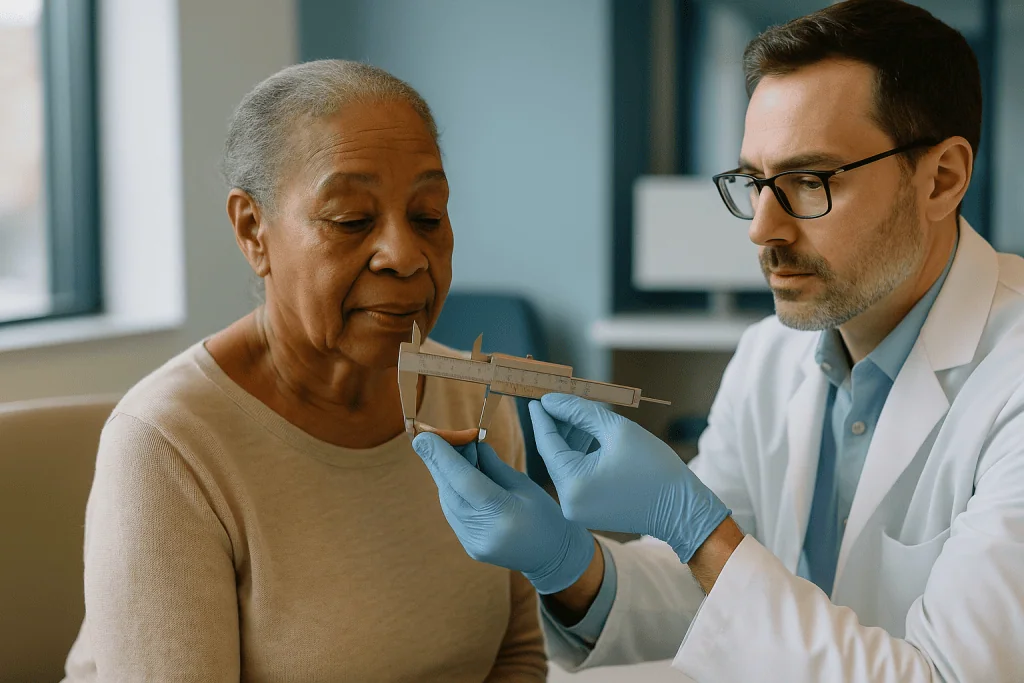
Width is measured on a cone-beam CT, a low-dose 3D dental scan that shows the ridge in cross-section like a slice of bread. The dentist looks at three things at once. First, how wide the bone is at the level where the post will sit, not just at the crest but a few millimeters down, because ridges often widen toward the base. Second, how tall the bone is above the nerve canal and the lower border of the jaw, since a mini leans on its length for anchorage. Third, how dense it appears, because slim posts hold better in firm bone, and the front of the lower jaw is usually the firmest bone in the mouth.
There is a lower limit. A ridge so thin that even a slim post would leave paper-thin bone on either side is a candidate for grafting, meaning bone added surgically and left to heal before any implant, or for a different plan altogether. The Mayo Clinic describes bone grafting as a step that can add months to the overall timeline because the graft must mature before it can bear an implant.
Bone width, then, is not a pass-or-fail gate so much as the dial that sets which implant, how many, and whether grafting comes first.
Gum health: why the tissue around each post matters as much as the bone
A mini implant spends its working life poking through the gum, and the gum is what keeps bacteria from reaching the bone. Two features of that tissue matter to the dentist assessing you.
The first is the type of gum. Keratinized tissue is the firm, pale pink band that hugs natural teeth and resists rubbing; the darker, looser lining of the cheek and floor of the mouth is not designed to seal around a post. A resorbed lower ridge often has very little of the firm kind left, and a denture rubbing on loose tissue around an implant head can lead to soreness and inflammation.
The second is history. Periodontitis, the gum disease that destroys the bone and fibers holding teeth, is the reason many people lost their teeth in the first place. The National Institute of Dental and Craniofacial Research explains that it is driven by bacterial plaque and worsened by smoking and poorly controlled diabetes. Those same drivers do not disappear once the teeth are gone. Implants can develop a parallel condition called peri-implantitis, inflammation and bone loss around a post, and a mouth that struggled with gum disease before tends to be at higher risk afterward.
Before any post is placed, the dentist also looks for problems that an ill-fitting denture leaves behind: red, sore patches under the plate, a fungal irritation known as denture stomatitis, and folds of overgrown tissue where a loose edge has rubbed for years. These are usually treated first, because implants placed into inflamed tissue heal less predictably.
Finally there is the practical question of cleaning. A snap-in denture means brushing around several small posts every day, and stiff fingers or poor eyesight change the calculation. Gum health after placement is largely a hygiene story.
Who is usually a candidate for mini implants for loose dentures, and who is asked to wait
The typical candidate is someone who already wears a complete lower denture, wants to keep a removable plate rather than move to fixed teeth, has a ridge that is narrow but reasonably tall and dense, and is in stable general health. People who cannot face, or do not want, the grafting that standard implants would require in a thin ridge are often in this group.
Several situations usually lead to a pause rather than a no. Active gum inflammation or sore spots under the denture are treated first. Diabetes that is not well controlled slows healing and raises infection risk, and the dentist may ask for the treating physician to confirm control before scheduling. Heavy smoking impairs blood flow to bone and gum; the Mayo Clinic lists smoking among the factors that can contribute to implant complications, and many teams ask about reducing or stopping, always in coordination with the person’s own doctor.
Medicines that slow bone turnover deserve their own conversation. Antiresorptive drugs used for osteoporosis or for cancer that has spread to bone, including the bisphosphonate class and certain injectable antibodies, are associated with a rare but serious condition in which jawbone fails to heal after dental surgery. This is not a reason to stop such a medicine on your own; it is a reason for the dentist and the prescriber to weigh timing and alternatives together. Previous radiotherapy to the jaw raises similar healing concerns. Blood-thinning medicines rarely rule out placement but do require planning.
Habitual clenching or grinding puts repeated sideways load on slim posts, which can be a reason to prefer a different design. And because the jaw must have finished growing, implants of any kind are not placed in adolescents. Every one of these calls belongs to the treating team, who can see the scan and the medical history together.
Mini implants vs standard implants for denture stabilization: a side-by-side comparison
The choice is rarely about which is better in the abstract. It is about which one the jaw in front of the dentist can safely hold. The table sets the two approaches beside each other for a lower overdenture.
| Feature | Mini (narrow-diameter) implants | Standard-diameter implants |
|---|---|---|
| Post width | Under about three millimeters | Wider, typically several millimeters across |
| Design | Usually one piece with a built-in ball or stud head | Usually two pieces: buried post plus connector added later |
| Bone needed | Narrow ridge acceptable; still needs height and density | Wider ridge required, or grafting first |
| Surgical approach | Often small or no incision | Usually a gum flap, sometimes staged surgeries |
| When the denture attaches | Sometimes the same day if the posts are firm; otherwise after healing | Usually after a healing period of several months (Mayo Clinic) |
| Attachment options | Mainly ball-and-O-ring snaps | Snaps, bars, or conversion to fixed teeth later |
| Length of published follow-up | Shorter; the research base is newer | Longer; studied over decades |
| Distinct risks | Post fracture, faster O-ring wear | Larger surgery, need for grafting in thin ridges |
Two rows deserve emphasis. Attachment options matter if you think you might want fixed teeth someday: standard implants can often be repurposed, while minis are generally committed to a removable snap-in plate. And the follow-up row is an honest statement of where the science sits, not a verdict on quality. Narrow posts have been used for a shorter time and in fewer large studies, so anyone who tells you exactly how they will behave over a lifetime is guessing.
What actually happens on the day the posts are placed
The appointment is usually shorter than people expect, and quieter. Placement is done under local anesthetic, the same numbing used for a filling, with sedation available for those who want it. The dentist marks positions using the scan and often a guide made from your existing denture, so the heads will line up with where the housings can sit inside the plate.
Because a mini is slim and one-piece, many are placed without lifting a flap of gum. A small pilot drill makes a starting channel, and the post is then turned into the bone with a hand wrench or a slow driver, cutting its own path as it advances. The dentist feels for firmness as it seats; that resistance is the practical measure of whether the post can carry a denture right away or should be left undisturbed while bone knits around it. An x-ray confirms position and depth relative to the nerve canal.
If the posts are firm enough, the denture may be hollowed slightly and the metal housings fixed into it during the same visit, so you leave with a plate that already snaps. If not, the denture is relieved so it does not press on the heads, and the snaps are added later. The Mayo Clinic describes the general principle: bone must grow onto the implant surface, a process called osseointegration, and loading a post before that process is secure raises the chance it will loosen.
You will be given written instructions on rinsing, eating and cleaning, and a plan for any pain relief. What to take and how much is a decision for the dentist who knows your medical history; the mechanism is simply keeping ordinary post-surgical soreness manageable while tissues settle.
What the following days and weeks usually look like
The first two or three days are the sore ones. The Mayo Clinic lists the ordinary aftermath of implant surgery as swelling of the gums and face, bruising of the skin and gums, pain at the site and minor bleeding, all of which should be settling rather than growing. Cold compresses, soft food and gentle salt-water rinses are the usual advice, with any pain medicine directed by the treating team.
Eating changes for a while. Even if the denture was snapped on the same day, most dentists ask for softer textures and smaller bites at first, because every hard chew transfers force through the posts into bone that is still healing. Chewing on both sides at once helps stop the plate from tipping on its snaps.
Expect adjustments. A denture that now has metal housings inside it sits a little differently, and sore spots often appear on the ridge where the plate presses harder than before. These are relieved with small trims at follow-up visits, which are typically scheduled within the first couple of weeks and again after the bone has had time to mature, a period the Mayo Clinic describes as several months.
Nightly removal begins on the first evening unless told otherwise. The posts are brushed with a soft brush, the housings in the denture are rinsed and inspected, and the plate spends the night out of the mouth so the gum underneath can recover. Cleveland Clinic advises keeping dentures moist when they are out, since drying can warp them.
Over the following months, the O-rings will begin to loosen their grip and are replaced at routine visits. That first replacement is not a failure; it is the maintenance schedule announcing itself.
Mini dental implants downsides: the honest list
Marketing for slim implants leans on words like fast and simple. The trade-offs are real and worth stating plainly.
The post can break. A shaft under three millimeters wide has far less metal in it than a standard implant, and repeated sideways force from clenching, a poorly balanced denture, or a single hard bite on one side can fatigue it. A fractured mini often has to be removed, sometimes leaving a defect that needs grafting before anything else can go in.
The attachments wear quickly. O-rings are consumables, and a plate snapped on and off twice a day loosens them faster than most people expect. Metal heads also wear over years, and because the head is part of the post, a worn head means the whole implant is worn.
The options narrow. Standard implants can often be converted from a snap-in plate to a bar or to fixed teeth if circumstances change. Minis are, in most designs, committed to a removable ball-and-ring denture.
The evidence is thinner. Narrow posts have shorter published follow-up and fewer large trials than conventional implants. That does not make them worse; it makes their long-term behavior less certain, which is a different kind of downside and one that matters when planning for decades.
The jaw still shrinks. A snap-in plate rests mostly on gum, so the ridge continues to remodel and the denture will still need relining over time. Implants improve retention; they do not freeze the anatomy.
And the usual surgical risks apply in miniature: infection, bleeding, and, rarely, injury to the nerve that gives feeling to the lower lip if a post strays toward the canal. Careful scanning makes this uncommon, not impossible.
How long do mini implants last? What the evidence actually shows
This is the question people most want a number for, and the honest answer is that no responsible number exists for an individual. The Mayo Clinic frames implant longevity in terms of conditions rather than guarantees: the bone must heal onto the post, the surrounding gum must stay healthy, and habits such as smoking and poor cleaning shorten the life of any implant. Those conditions apply doubly to a slim post carrying a denture.
Conventional implants have been followed in studies for decades, which is why dentists speak about them with more confidence. Narrow-diameter implants entered wide use later and most published series follow patients for years rather than decades. Systematic reviews exist and generally describe them as a viable option for lower overdentures in selected patients, but with more variation between studies and a greater share of early losses in softer bone or when loaded immediately. That is the state of the literature, not a promise in either direction.
Three factors tend to separate the posts that stay from the ones that do not. Bone density at placement is the first; the front of the lower jaw is favorable, the upper jaw much less so. Distribution of load is the second, meaning enough posts spread wide enough that no single one takes the brunt, with the denture itself balanced so it does not rock. Daily hygiene is the third, because the same bacterial process that loosens teeth loosens implants.
It also helps to separate the post from the parts around it. The rubber rings are expected to be replaced repeatedly, the denture itself will need relining and eventually remaking, and none of that counts as the implants failing. When people ask how long minis last, they are usually asking how long the whole system stays comfortable, and that depends on maintenance as much as on titanium.
What else helps a loose lower denture? Alternatives worth understanding
Implants are not the only answer to a plate that lifts, and a good consultation lays out the ladder rather than jumping to the top rung.
The simplest step is a reline, in which the dentist adds new material to the fitting surface so the denture matches the ridge as it is now. Cleveland Clinic describes relining and rebasing as routine because the gum and bone under a denture keep changing. A soft reline uses a cushioned lining that can help tender ridges; a hard reline restores a firm fit. Neither adds mechanical grip, but both restore contact, which is often all an older denture needs.
A new denture follows when the old one is worn, cracked or built for a ridge that no longer exists. Modern impression techniques and careful attention to where the muscles attach can produce a lower plate that behaves far better than one made years ago.
Denture adhesives are a legitimate tool. MedlinePlus lists them among ordinary denture care measures, and used thinly on a well-fitting plate they can bridge small gaps. They are not a substitute for a reline when the fit is poor, and heavy use to hold a badly fitting denture tends to trap irritants against the gum.
On the implant side, a lower overdenture on two standard-width posts is a long-established approach and remains the design most studies have examined. A bar joining several implants gives a different kind of retention. At the far end sit fixed replacement teeth that do not come out at all, which require more implants, more bone or grafting, and more surgery.
The right rung depends on the ridge, the gums, health, dexterity and what the person actually wants from eating and speaking. The treating team can map those factors onto the ladder.
What people often get wrong about mini implants for a loose denture
Mini means minor. The surgery is smaller, but a titanium post is still being placed into living bone, and the same healing biology, infection risk and hygiene demands apply. Treating it as a cosmetic tweak rather than a surgical procedure is how aftercare gets skipped.
Same-day snapping means same-day healing. A denture attached on the day of placement is a convenience made possible by firm initial grip. The bone has not yet grown onto the post. The Mayo Clinic describes osseointegration as taking months, and the soft-food advice during that time exists because the post is being held mechanically, not biologically.
Implants stop bone loss under the denture. Posts preserve the bone immediately around them, but a snap-in plate still rests on the ridge, which continues to remodel. Relines remain part of life.
Once fitted, it is finished. O-rings wear, housings loosen, ridges change. A snap-in denture is a maintenance relationship with a dentist, not a one-time purchase.
Using adhesive means the dentist failed. Thin adhesive on a well-fitting plate is ordinary care. Needing thick layers to keep a plate in is a sign the fit should be checked, not a personal shortcoming.
Implants cannot get gum disease. They can, and the condition, peri-implantitis, behaves much like the periodontitis that costs people their teeth. The National Institute of Dental and Craniofacial Research identifies plaque, smoking and uncontrolled diabetes as the main drivers of gum disease, and every one of them threatens implants too.
Minis are a temporary fix. Some narrow posts are used as short-term anchors during other treatment, but the ones placed for denture retention are intended to stay. Their durability depends on selection and care, not on being inherently provisional.
Questions to ask your care team before deciding
A consultation goes better when the questions are specific. These are the ones that tend to surface the information that actually shapes the decision.
- On my scan, how wide and how tall is the bone where you would place the posts, and how close is the nerve canal?
- Why are you suggesting narrow-diameter implants for me rather than standard ones, and what would have to be different about my jaw for you to recommend the opposite?
- How many posts do you plan, and what happens to the denture if one of them fails or fractures later?
- Would you attach my denture on the same day, or wait, and what determines that?
- How much firm gum tissue is around the planned sites, and is any gum or bone grafting part of the plan?
- Do any of my medicines, especially anything for bone density or cancer, change the risks, and will you coordinate with the doctor who prescribes them?
- What does the maintenance schedule look like: how often are the rubber rings replaced, and how often will the denture need relining?
- If I later want fixed teeth instead of a removable plate, do these posts keep that door open?
- What signs after surgery should make me call you the same day?
- Who do I contact after hours if something goes wrong?
Notice that none of these ask for a promise about outcome. They ask for the reasoning, which is what a careful clinician will be glad to share. If a proposal includes a strong recommendation to stop or change a medicine, the answer should always route back through whoever prescribed it. Two-minute answers to these questions are worth more than any brochure.
When to call your doctor
Ordinary healing after implant placement is a story that improves each day: soreness that fades, swelling that peaks and recedes, a little oozing that stops. Anything moving in the other direction deserves a call to the dentist or the person covering for them, and some signs deserve urgent care.
Call the same day if swelling in the face or under the jaw is growing after the second day rather than shrinking; if pain is worsening rather than easing despite the plan you were given; if the gum around a post becomes red, shiny, or discharges pus; if you notice a bad taste that will not rinse away; if a post feels loose or moves when you touch it; or if you have a fever. Bleeding that does not slow with firm pressure on a clean gauze pad for a sustained period is also a reason to call rather than wait.
Numbness needs particular attention. The anesthetic wears off within hours. Numbness, tingling or altered feeling in the lower lip or chin that persists into the next day may mean the nerve in the lower jaw has been disturbed, and the sooner the dentist knows, the more options there are.
Go to an emergency department, or call emergency services, if swelling spreads toward the throat or floor of the mouth, if swallowing becomes difficult, if breathing feels restricted, or if you cannot open your mouth. These are signs of a spreading infection that cannot wait for a routine appointment.
Weeks or months later, new bleeding when brushing around a post, a denture that suddenly snaps far less firmly, or a post that seems to have changed angle are reasons for a prompt check. The general rule holds at every stage: the treating team would rather hear about something small than discover something large.
Frequently asked questions
What is best for loose dentures: a reline, adhesive or mini implants?
There is no single best option; it depends on why the denture is loose. A denture that no longer matches the ridge usually needs a reline or a remake first, and thin adhesive on a well-fitting plate is ordinary care. Implants, whether mini or standard, add mechanical grip that no reline can, and become the conversation when a well-made denture still lifts because the ridge is too flat to hold it.
How long do mini implants stay in?
They are intended to stay permanently, but no individual lifespan can be promised. Conventional implants have been studied for decades; narrow posts have shorter published follow-up, and the Mayo Clinic ties implant longevity to healthy bone integration, good hygiene and avoiding smoking rather than to a fixed number of years. The rubber rings and the denture itself are expected to be replaced or relined along the way.
What is the downside of mini dental implants?
The main downsides are a higher chance of the slim post fracturing under sideways force, faster wear of the O-ring attachments, fewer options if you later want fixed teeth, and a thinner long-term evidence base than standard implants. They also do not stop the ridge under the denture from shrinking, so relines continue, and the usual small risks of any implant surgery, infection and rare nerve irritation, still apply.
How much do mini implants for dentures cost?
This article does not quote prices, because fees vary widely with the number of posts, whether a new denture is needed, any grafting, imaging and follow-up maintenance. The useful step is to ask the treating team for a written, itemized plan that also lists the expected schedule for replacing attachments and relining, since ongoing maintenance is part of the real picture rather than an afterthought.
How narrow can the jawbone be and still take a mini implant?
There is no universal number, because the dentist weighs width against height and density together on a cone-beam CT. A ridge can be narrow at the crest yet widen enough a few millimeters down to hold a slim post safely, while a ridge that is both thin and short may need grafting or a different plan. The scan, not a rule of thumb, decides.
Can I have mini implants if I have gum disease?
Active gum inflammation is normally treated first, because implants placed into infected or inflamed tissue heal less predictably. A history of periodontitis does not rule implants out, but it does raise the risk of a similar condition around posts, so the National Institute of Dental and Craniofacial Research advice on controlling plaque, smoking and diabetes applies with extra weight. Your dentist will assess the tissue before proposing a plan.
Do denture stabilization implants stop the jawbone from shrinking?
Only around the posts themselves. A snap-in denture still rests on the gum ridge, and that ridge keeps remodeling over time, so the plate will still need periodic relining as Cleveland Clinic describes for any denture. Implants dramatically improve grip and confidence; they do not freeze the anatomy underneath, which is one of the most common misunderstandings people bring to a consultation.
Can a snap in lower denture be attached the same day the implants go in?
Sometimes. If the posts feel firm in dense bone at placement, many dentists fit the housings into the denture the same day. The bone has not yet grown onto the posts, a process the Mayo Clinic describes as taking months, so soft foods and careful chewing are asked for during that time. If the posts are less firm, the dentist waits before adding the snaps.
Will I still take a snap-in denture out at night?
Yes. A snap-in overdenture is removable by design, and nightly removal lets the gum recover and lets you brush around each post and rinse the housings. Cleveland Clinic advises keeping dentures moist while they are out so they do not warp. Skipping removal traps plaque against the posts, which is the main route to inflammation and bone loss around implants.
Do osteoporosis medicines rule out mini implants?
Not automatically, but they change the conversation. Antiresorptive medicines used for osteoporosis and for cancer in bone are associated with a rare condition in which jawbone fails to heal after dental surgery. Never stop such a medicine on your own; the dentist and the prescribing doctor should jointly weigh timing, duration of treatment and alternatives, and that shared decision determines whether and when placement is reasonable.
References
- Cleveland Clinic – Dental implants
- Cleveland Clinic – Dentures: types, care and adjustment
- MedlinePlus – Dentures
- NIH National Institute of Dental and Craniofacial Research – Periodontal (gum) disease
This article is for general information only and is not a substitute for professional medical advice. Please consult a qualified doctor about your individual situation.

More from the Blog
The Dental Implant Process: Every Stage From First Scan to Final Crown
The dental implant process typically unfolds over three to nine months. It begins with a 3D scan and treatment planning, followed by any needed…

Why an ENT Check May Come Before a Sinus Lift When You Have Chronic Sinusitis or Allergies
An ENT (ear, nose and throat) check often comes before a sinus lift because the graft is placed directly beneath the maxillary sinus lining,…

Sinus Lift Healing Timeline: From Graft Placement to the Day Your Implants Can Be Planned
A sinus lift usually needs several months to heal before implants can be planned. Cleveland Clinic and Mayo Clinic describe bone graft maturation as…
Who Needs Full Mouth Reconstruction? Worn, Eroded and Missing Teeth That Add Up to a Rebuild
Full mouth reconstruction is usually considered when several problems overlap in one mouth: teeth worn flat by grinding, enamel dissolved by acid, multiple missing…

Full Mouth Reconstruction Stages: Bite Stabilization, Tooth Rebuilding and the Final Fit
Full mouth reconstruction usually moves through three stages. First, the bite is stabilized and gum disease, decay, grinding and jaw-joint problems are treated. Second,…

How to Clean Around Zygomatic Implants and a Fixed Bridge: Water Flossers and Recall Visits
Cleaning zygomatic implants and the fixed bridge they support means brushing twice daily with a soft brush, cleaning under the bridge with interdental brushes,…