

ARTAS Robotic Hair Transplant: What the Robot Does Better, and What It Cannot
Key Takeaways
- ARTAS automates only the harvesting (and sometimes site-drilling) step of FUE, hairline design, graft handling, and placement remain human work, and they drive the final result.
- Published series show robotic transection rates comparable to skilled manual FUE, not better; the robot's proven edge is consistency across a multi-hour session, where human precision drifts.
- The system's cameras favor straight, darker hair with good scalp contrast, tightly curled or very light hair may require dyeing or rule out the robot entirely.
- A 3,000-graft session typically costs $12,000–$30,000 in the US, and clinics recouping a machine reported to cost several hundred thousand dollars often charge a per-graft premium for it.
- Transplanted hairs shed between weeks two and eight, regrow from months three to four, and don't fully mature for 12–18 months: a biological timeline no technology shortens.
- A typical scalp holds a lifetime FUE donor supply of roughly 4,000–7,000 grafts, so every large session spends a finite budget that progressive hair loss may make you wish you'd rationed.
ARTAS is a physician-supervised robot that performs the harvesting step of follicular unit extraction (FUE) hair transplants, using cameras and algorithms to select and remove grafts with steady precision. Published evidence suggests it roughly matches skilled manual FUE for graft quality while eliminating human fatigue, but it cannot design a hairline, works best on straight, darker hair, and does nothing to stop ongoing hair loss.
The room is quieter than you’d expect. A man lies face-down, the back of his head shaved and gridded like graph paper, while a white robotic arm hovers a few millimeters above his scalp, pausing, tilting, then punching, hundreds of times an hour, each move recalculated by cameras faster than any human eye could manage.
That scene is the entire sales pitch for robotic hair restoration, and clinics lean on it hard. The word “robot” carries a promise: precision without fatigue, results without human error. Some of that promise holds up. Some of it quietly doesn’t.
Before anyone spends fifteen or twenty thousand dollars on a procedure, the honest question isn’t whether the machine is impressive: it clearly is. The question is which parts of a hair transplant a robot can actually improve, which parts it can’t touch, and whether that difference is worth what you’ll pay for it.
What does the ARTAS robot actually do during a hair transplant?
Every modern hair transplant is a relocation project: healthy follicles are moved from the back and sides of the scalp, where hair is genetically resistant to pattern balding, to thinning areas up front. In follicular unit extraction (FUE), each graft is removed individually with a tiny circular punch, typically under a millimeter across, according to Cleveland Clinic’s overview of the procedure.
ARTAS automates that harvesting step. Stereoscopic cameras photograph the shaved donor area many times per second, and software maps each follicular unit: its position, exit angle, and how many hairs it contains. An algorithm then selects grafts, spacing extractions so no single patch gets visibly thinned, and a two-stage punch scores the skin and dissects the follicle free. A physician supervises throughout, adjusting parameters and overriding selections.
Newer versions can also assist with recipient-site creation, drilling the tiny channels where grafts will sit, following a plan the surgeon programs in advance. What the robot still does not do in most practices is the final, most delicate act: a human team lifts each graft, keeps it chilled and hydrated, and places it by hand.
So the accurate framing is narrower than the marketing: this is robot-assisted FUE, not a robotic transplant. Roughly one-third to one-half of the procedure runs through the machine. The rest, the planning, the artistry, the graft handling that largely determines survival, remains stubbornly, importantly human.
What the robot genuinely does better than human hands
Fatigue is the robot’s real advantage. A large FUE session means a surgeon or technician repeating a sub-millimeter punch motion 2,000 to 3,000 times over several hours. Humans drift. Hands tire, attention dips, and the transection rate, the percentage of follicles accidentally cut and killed during extraction, tends to creep upward late in a long case. A machine’s 2,000th punch is executed exactly like its first.
Three specific strengths hold up under scrutiny:
- Consistency at scale. The imaging system re-measures each follicle’s angle before every punch, which matters because follicles exit the scalp at angles that vary across the head, and misjudging that angle is the main cause of transection.
- Disciplined donor spacing. The algorithm distributes extractions evenly, reducing the risk of the patchy, over-harvested look that shows up when tired humans keep pulling from the easiest spot.
- Speed on straightforward anatomy. On ideal hair, straight, dark, good contrast with the scalp, the arm can harvest hundreds of grafts per hour without quality drop-off.
Published case series report robotic transection rates in the mid-single digits, broadly comparable to experienced manual operators. Read that carefully: comparable, not superior. The evidence supports the robot matching an excellent human on a good day, every hour, for the whole session. That’s a real benefit. It is not the same as producing better hair.
What ARTAS cannot do, and no marketing page will tell you
Start with the part patients care about most: the hairline. Whether a transplant looks natural depends on decisions no algorithm makes, where the hairline sits for your face and age, how single-hair grafts feather the front edge, which direction each graft points so hair falls the way yours always has. That is aesthetic judgment, and it belongs entirely to the surgeon planning your case.
The machine also has hard physical limits:
- Hair type. The vision system was built around straight, dark hair against lighter skin. Tightly curled follicles bend beneath the surface where cameras can’t see, raising transection risk, and low contrast, gray or blond hair on fair skin, or dark hair on deeply pigmented skin, can confuse detection. Some candidates are asked to dye their donor hair before surgery; others are simply better served by manual FUE.
- Donor territory. ARTAS harvests from the shaved back and sides of the scalp, full stop. Beard or body hair, sometimes used manually when scalp donor supply runs thin, is off the table.
- The shave. The donor zone must be clipped to about a millimeter for the cameras to work: a dealbreaker for some patients, especially women.
And the biggest limitation isn’t mechanical at all. Moving follicles does nothing to slow the pattern hair loss that created the problem, a point Mayo Clinic makes plainly: transplanted hair fills in, while the surrounding native hair keeps miniaturizing on its own genetic schedule.
ARTAS vs. manual FUE vs. FUT: how the three approaches compare
Robotic harvesting is one of three mainstream ways to move hair, and each trades something for something else. FUT: the older “strip” method, removes a band of scalp from the donor area and dissects it into grafts under microscopes; it yields large graft numbers efficiently but leaves a linear scar. Manual FUE trades the strip scar for thousands of dot scars and heavy operator dependence. The robot standardizes manual FUE’s weakest variable.
| ARTAS (robotic FUE) | Manual FUE | FUT (strip) | |
|---|---|---|---|
| Scarring | Tiny dispersed dots | Tiny dispersed dots | Linear scar at back of head |
| Best hair types | Straight, good contrast | All types, incl. curly | All types |
| Donor shave required | Yes, to ~1 mm | Often, sometimes partial | No full shave needed |
| Consistency over long sessions | Machine-steady | Depends on operator stamina | Lab-team dependent |
| Typical relative cost | Highest per graft | High | Usually lowest |
Notice what the table doesn’t show: a column for “better final results.” That’s deliberate. No rigorous head-to-head trial has demonstrated that grafts harvested by robot grow better than grafts harvested by a skilled human. The method matters far less than the person planning the case and the team handling the grafts once they leave the scalp.
Is an ARTAS hair transplant good? What the evidence actually shows
Good is doing a lot of work in that question, so let’s split it. Is robotic FUE a legitimate, established technique? Yes: the system is FDA-cleared, has been in clinical use since 2011, and appears in peer-reviewed case series with graft survival and transection rates comparable to manual extraction.
Is it proven better than a skilled human? No. The published literature is mostly single-center series and manufacturer-supported studies, not large randomized comparisons. What those papers consistently show is equivalence on the metrics that matter: the percentage of grafts harvested intact and the percentage that grow. What they do not show is superiority in the final cosmetic result.
That tracks with the biology. A transplanted follicle’s survival depends on three things: being extracted without damage, spending minimal time outside the body in proper holding solution, and being implanted into a well-made site with gentle handling. The robot influences only the first. Cleveland Clinic notes that most transplanted hair sheds within weeks and regrows over months: a timeline set by follicle biology, not by whatever tool did the harvesting.
Here’s the honest bottom line, and it’s an opinion the evidence supports: the robot is a quality-control device, not a quality-upgrade device. In the hands of an excellent surgical team, it removes a source of human variability. In the hands of a mediocre team, it will very consistently harvest grafts for a poorly planned, poorly executed result. Choose the team. The robot is a footnote.
Who is a good candidate for robotic FUE, and who should think twice
The ideal ARTAS patient is almost a portrait: a man with established male-pattern baldness, straight brown or black hair, decent contrast between hair and scalp, a dense donor zone at the back of the head, and a stable pattern of loss, meaning the thinning has settled into a predictable shape rather than actively expanding.
Several groups should pause before booking:
- Men in their early twenties. Pattern loss usually keeps progressing; a hairline transplanted at 23 can look stranded by 33 as native hair recedes behind it. Most conservative surgeons prefer to wait until the pattern declares itself.
- People with tightly curled or very light hair. The robot’s cameras struggle here; manual FUE or FUT in experienced hands is often the smarter route.
- Anyone without a diagnosis. Not all hair loss is pattern baldness. The NHS lists causes from thyroid disease and iron deficiency to stress-related shedding and autoimmune alopecia, and several of these either resolve on their own or make surgery actively harmful. Scarring alopecias, for instance, can destroy transplanted grafts just as they destroyed the originals.
- People with thin donor reserves. Diffuse thinning that includes the back of the head means there’s nowhere safe to harvest from.
A trustworthy consultation spends more time examining your donor area and asking about your family’s hair-loss history than describing the machine. If the conversation is mostly about the robot, that tells you what’s being sold.
How much does the ARTAS machine cost, and why that shows up on your bill
You’re not buying the robot, but you are helping pay for it. Industry reporting has put the purchase price of an ARTAS system in the range of several hundred thousand dollars, figures around $250,000 to $400,000 are commonly cited, though the manufacturer doesn’t publish list prices and leasing arrangements vary. On top of that, clinics buy single-use procedure kits, sterile punches and cartridges, for each patient, adding a recurring per-case cost.
That capital expense has to come back from somewhere, and it comes back from per-graft pricing. Robotic FUE typically runs one to a few dollars more per graft than manual FUE at the same practice, which sounds trivial until you multiply by 2,500 grafts.
Why does this matter to you beyond the invoice? Incentives. A clinic that has financed an expensive machine has a strong motivation to route patients toward it, including patients whose hair type or donor anatomy would be better served manually. That’s not an accusation of bad faith; it’s how equipment economics work in every field of medicine.
A practical defense: ask the practice directly whether they also perform manual FUE, and what would make them choose one method over the other for someone with your hair. A good answer is specific to your scalp. A vague answer that circles back to the robot’s features is a red flag worth heeding.
How much do 3,000 grafts of hair cost?
In the United States, FUE pricing generally lands between $4 and $10 per graft, with robotic procedures clustering toward the upper half of that range and sometimes beyond it in major metro areas. Run the arithmetic on a 3,000-graft session and you get roughly $12,000 to $30,000, before anesthesia fees, follow-up visits, or a second session if coverage falls short.
Three caveats belong next to any price quote:
- Insurance almost never applies. Pattern hair loss is classified as cosmetic, so this is out-of-pocket money, a point MedlinePlus and other mainstream sources make about hair-loss treatment generally.
- Cheaper isn’t automatically worse, or safer. Clinics abroad quote a fraction of US prices, sometimes with excellent results. The variables to scrutinize are the same everywhere: who actually performs the surgery (a physician or delegated technicians), how grafts are handled, and what happens if you need revision care from 5,000 miles away.
- 3,000 may be the wrong number for you. A typical scalp offers a finite lifetime donor supply, often estimated around 4,000 to 7,000 FUE grafts total, depending on density and head size. A 3,000-graft session spends most of that budget in one sitting. If your hair loss keeps advancing, and untreated pattern loss usually does, you’ll want reserves left for the future.
The most expensive transplant is the one that has to be repaired. Price per graft is worth comparing; it’s the least important number in the decision.
What the procedure day actually looks like
Plan on giving up most of a day. Large robotic sessions commonly run four to eight hours, and almost all of it happens under local anesthetic while you’re awake, listening to podcasts, dozing, occasionally chatting with the team.
The sequence goes roughly like this. The donor area is clipped to about a millimeter and photographed, and the surgeon finalizes the harvest plan. You lie prone while a skin tensioner, a small frame that stretches and stabilizes a patch of scalp, is placed, giving the robot’s cameras a flat, fixed field to work in. The arm then harvests grid by grid, the tensioner moving to a fresh patch every several minutes. Numbing injections at the start are the most uncomfortable part; the punches themselves you mostly hear rather than feel.
While harvesting proceeds, technicians collect the freed grafts, sort them under magnification by hair count, and hold them in chilled solution: the quiet, unglamorous work on which graft survival heavily depends. Then comes site creation, either robot-assisted or by the surgeon’s hand, followed by hours of manual placement: each graft seated at the depth, angle, and orientation the plan calls for.
You’ll leave with a bandaged donor area, aftercare instructions that treat the grafts like wet tissue paper for the first several days, and, this surprises people, no visible new hair. What’s been planted is roots. The hair itself is months away.
Recovery and the honest results timeline
The first ten days are about protection. Tiny scabs form at every graft site and flake off within a week to ten days; most people are back at desk work in two to five days, though the donor area can feel tender and the forehead may swell briefly. Gentle washing resumes on your surgeon’s schedule, and strenuous exercise typically waits about two weeks.
Then comes the part nobody’s before-and-after gallery dwells on: the shed. Between roughly week two and week eight, most of the transplanted hairs fall out. This is expected: the follicles are alive under the skin, but the shafts they arrived with are jettisoned as the follicles cycle into a resting phase. Cleveland Clinic describes this shed-then-regrow pattern as a normal part of the process, and knowing it in advance spares you a genuinely alarming few weeks.
New growth surfaces around months three to four, thin and fine at first, then progressively thicker. Six months in, you’ll see a clear difference; the commonly quoted milestone is that meaningful results appear within eight to twelve months. Full maturation, final density, final texture, can take twelve to eighteen months.
None of this timeline changes because a robot did the harvesting. Follicle biology sets the calendar, and no technology has moved it. Anyone promising visible hair by summer from a spring procedure is either misinformed or counting on you not to check.
Risks and side effects worth knowing before you book
Hair transplantation is low-risk as surgeries go, but low-risk is not no-risk, and the robot removes none of the following from the list.
- Common and temporary: swelling of the forehead, itching as sites heal, numbness or altered sensation in the donor area that can linger for weeks to a few months, and folliculitis, inflamed, pimple-like bumps around new grafts.
- Less common: infection (uncommon with proper aftercare), bleeding, and shock loss, temporary shedding of native hair around the transplanted zone, stressed by the surgery itself. Mayo Clinic notes most surgical hair-restoration side effects are minor and resolve within weeks.
- The ones that actually cause regret: poor growth, where a meaningful fraction of grafts simply fail to thrive; an unnatural-looking hairline from aggressive or poorly angled placement; and a visibly thinned donor area from over-harvesting: a permanent problem, since donor hair doesn’t replenish.
Notice that the serious risks are judgment failures, not machine failures. A robot spacing extractions correctly helps with over-harvesting; nothing about it prevents an overambitious hairline or sloppy graft handling.
Ask any prospective surgeon two blunt questions: what percentage of their patients need revision work, and can you see healed donor areas, not just hairlines, from previous patients at the one-year mark. The donor photos are the tell. Anyone proud of their work has them.
What did Matthew McConaughey do to regrow his hair?
By his own account, repeated in interviews and his memoir, the actor never had a transplant. He has said that around 1999, when his hairline was visibly receding, he began applying a topical product to his scalp daily and simply never stopped, crediting years of that routine for the regrowth visible in his later films.
What should you make of that? A few evidence-grounded points:
- One person’s account is an anecdote, not data. There’s no way to verify what was used, whether anything else was done, or whether his follicles were simply less miniaturized than they appeared. Celebrity hair stories are unfalsifiable by design.
- Topical regrowth is real but modest. Mainstream medicine does recognize nonsurgical options: the NHS and Mayo Clinic both describe a widely available topical treatment and a prescription oral medication for pattern loss. Both can slow loss and partially regrow hair in many users, and both stop working when you stop using them, which is consistent with a use-it-daily-forever story.
- Timing matters enormously. Medical treatments work best on miniaturized follicles that are shrinking but alive. Once a follicle is gone, no topical revives it, at that point, relocation surgery is the only way to put hair back.
The transferable lesson isn’t the specific product. It’s that intervening early, and staying consistent for years, is where nonsurgical treatment succeeds. A dermatologist can tell you whether your follicles are still in the salvageable window.
A transplant moves hair: it doesn't stop you from losing it
This is the single most misunderstood fact in hair restoration, so it deserves its own space. Transplanted follicles come from a zone genetically resistant to pattern balding, which is why they generally persist in their new location. Everything around them, though, is still your original, genetically susceptible hair, and pattern loss is progressive.
Picture it in ten-year increments. You transplant the hairline at 35. The grafts hold. Meanwhile the native hair behind them keeps miniaturizing, and by 45 a gap can open between the transplanted frontal band and the retreating hair behind it: an island effect that looks stranger than the original thinning did. This is why surgeons who think in decades design conservatively, hold grafts in reserve, and talk about medical maintenance in the same breath as surgery.
Maintenance means the evidence-backed medications for pattern hair loss: the topical and oral prescription options described by sources like the NHS and Mayo Clinic, used to slow the loss of your remaining native hair. Many surgeons consider a patient’s willingness to maintain medically a factor in whether surgery makes sense at all, particularly for younger patients with a lot of loss still ahead of them.
A useful mental model: surgery is a one-time relocation of a fixed asset; medication is the ongoing effort to protect what hasn’t moved. The people happiest with their transplants at the ten-year mark are usually the ones who treated it as both.
When to see a doctor about hair loss
Before any consultation with a transplant clinic, hair loss deserves a medical look, because the assumption that it’s ordinary pattern baldness is sometimes wrong, and the exceptions matter.
See a doctor promptly if you notice any of the following, which MedlinePlus, Mayo Clinic, and the NHS flag as reasons for evaluation:
- Sudden or rapid sheddinghandfuls in the shower over weeks rather than gradual thinning over years, which can signal telogen effluvium triggered by illness, major stress, or medication changes, and often resolves once the trigger does.
- Patchy, coin-shaped bald spots, which suggest alopecia areata, an autoimmune condition with entirely different treatment.
- Itching, burning, scaling, or redness in thinning areas, possible signs of a scarring alopecia, where early treatment can preserve follicles and where transplant surgery is often contraindicated.
- Hair loss alongside other symptomsfatigue, weight change, irregular periods, which can point to thyroid disease, iron deficiency, or hormonal conditions worth testing for.
- Hair loss in women or children, where pattern baldness is a less safe default assumption and workup is standard.
A primary care doctor or dermatologist can usually sort this out with an exam, a history, and sometimes basic blood tests. It’s an unglamorous step, and it’s the one that protects you from spending transplant money on a problem surgery can’t fix, or one a pill for a thyroid condition might.
Frequently asked questions
Is an ARTAS hair transplant good?
It’s a legitimate, FDA-cleared technique with published results comparable to skilled manual FUE, but not proven superior to it. The robot’s real value is consistency: it harvests the 2,000th graft as precisely as the first, removing fatigue from long sessions. The final cosmetic result still depends on the surgeon’s hairline design and the team’s graft handling, so the quality of the practice matters far more than the presence of the machine.
How much does the ARTAS hair transplant machine cost?
Industry reporting commonly places the system in the range of $250,000 to $400,000, though the manufacturer doesn’t publish list prices and leasing terms vary. Clinics also buy single-use sterile kits for every procedure. Patients pay for this indirectly: robotic FUE usually costs one to a few dollars more per graft than manual FUE, which adds up quickly across a 2,500–3,000 graft session.
How much do 3,000 grafts of hair cost?
Roughly $12,000 to $30,000 in the United States, based on typical FUE pricing of $4 to $10 per graft, with robotic procedures trending toward the upper half. Insurance almost never covers it, since pattern hair loss is classified as cosmetic. Also worth questioning is whether 3,000 grafts is right for you: that’s a large share of the average scalp’s finite lifetime donor supply.
What did Matthew McConaughey do to regrow his hair?
By his own account he never had a transplant; he says he began applying a topical product daily around 1999 and never stopped. That’s an unverifiable anecdote, not evidence. What mainstream medicine does support: a widely available topical treatment and a prescription oral medication can slow pattern loss and partially regrow hair for many people, provided they’re started while follicles are still alive and used consistently.
Is ARTAS better than manual FUE?
Not in any way the evidence has demonstrated. Published comparisons show similar transection rates and graft quality. The robot excels at maintaining precision over long sessions and spacing donor extractions evenly; a skilled human excels at adapting to unusual anatomy, curly hair, and low-contrast coloring. For an ideal candidate, results should be equivalent, which means the deciding factors are the surgical team’s skill and their honesty about which method suits your hair.
Does ARTAS work on curly or gray hair?
Poorly, in many cases. The robot’s cameras track each follicle’s exit angle, but tightly curled follicles bend beneath the skin where cameras can’t see, raising the risk of cutting grafts. Low contrast, gray or blond hair on fair skin, can also confuse detection. Some clinics have patients dye their donor hair before surgery; for many people with curly or light hair, manual FUE or FUT in experienced hands is the better choice.
Is a robotic hair transplant painful?
The procedure itself is done under local anesthetic, and the numbing injections at the start are typically the most uncomfortable part. During harvesting and placement, most patients feel pressure and hear the punches rather than feel them. Afterward, expect donor-area tenderness, tightness, and sometimes numbness for days to weeks, manageable with your surgeon’s aftercare plan. Most people return to desk work within two to five days.
How long until I see results from an ARTAS transplant?
Eight to twelve months for meaningful results, with full maturation at twelve to eighteen. First, expect a counterintuitive setback: most transplanted hairs shed between weeks two and eight as follicles enter a resting phase: this is normal. New growth surfaces around months three to four, fine at first, then thickening steadily. The robot changes none of this; follicle biology sets the timeline regardless of how grafts were harvested.
Will I need medication after a hair transplant?
Very likely yes, if you want the result to hold up over decades. A transplant relocates resistant follicles but does nothing to stop pattern loss in your remaining native hair, which keeps thinning on its own schedule. Most surgeons recommend the evidence-backed prescription options for pattern hair loss as ongoing maintenance, and many weigh a patient’s willingness to maintain when deciding whether surgery makes sense, especially for younger patients.
Does insurance cover ARTAS hair transplants?
Almost never. Pattern hair loss is classified as a cosmetic concern, so transplant surgery, robotic or otherwise, is an out-of-pocket expense in nearly all cases. Rare exceptions can apply when hair loss results from burns, trauma, or certain medical conditions, where reconstruction may be considered differently; that’s a conversation for your insurer and physician. Budget for the full cost, including possible follow-up sessions, before committing.
References
This article is for general information only and is not a substitute for professional medical advice. Please consult a qualified doctor about your individual situation.

More from the Blog
Why Hair Transplant Repair Is Often Staged: Sequencing Graft Removal, Redesign and Regrafting
Hair transplant repair is usually staged because each step changes the conditions for the next. Misplaced grafts are typically removed first, the scalp is…
DHI Explained: What Direct Hair Implantation Changes in Practice
DHI (direct hair implantation) is a variation of the FUE hair transplant in which extracted follicles are loaded into a spring-driven implanter pen and…
Preparing for an Eyebrow Transplant: Brow Design Consultation, What to Pause and the Day Before
Eyebrow transplant preparation usually involves a brow design consultation where the surgeon maps shape, hair direction and donor area; a medical review of medicines…

DHI Hair Transplant Risks Explained Honestly: Swelling, Folliculitis and Uneven Growth
DHI hair transplant risks are largely the same as for any follicular unit extraction procedure: temporary forehead and eyelid swelling, folliculitis around new grafts,…
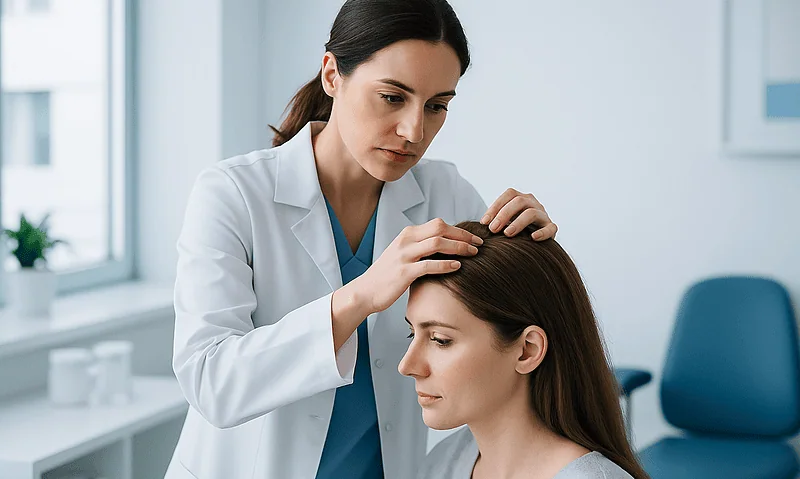
The Best Age for a Hair Transplant: Why Surgeons Say No to Most 20-Somethings
There is no single best age for a hair transplant, but most surgeons prefer patients roughly between their late 20s and mid-40s, once the…
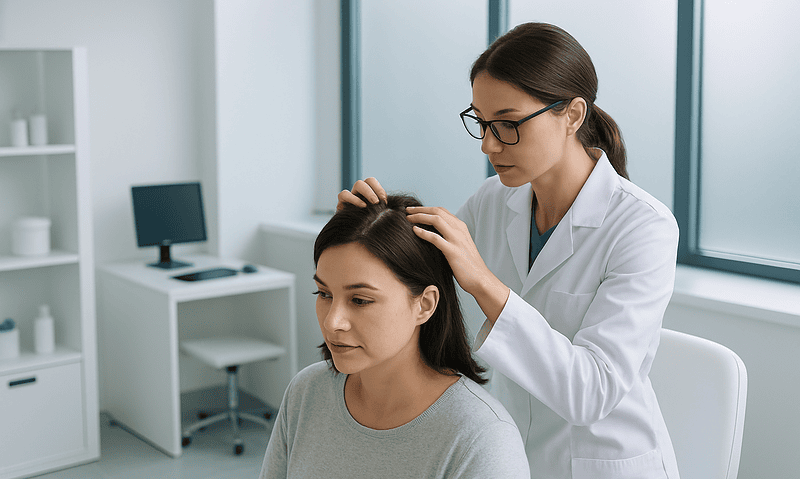
Stem Cell Hair Transplants: Where the Science Really Stands Today
No proven, standardized stem cell hair transplant exists yet. Procedures sold under that name are usually conventional follicle transplants combined with experimental cell injections.…