

Arthroscopic Surgery for Shoulder Impingement: What Subacromial Decompression Involves

Key Takeaways
- Subacromial decompression removes inflamed bursa and shaves bone from the underside of the acromion through two or three keyhole incisions, and most people go home the same day.
- The CSAW trial of 313 adults found decompression no more effective at six or twelve months than a placebo operation in which the surgeon only looked inside the joint.
- A Cochrane review of eight trials concluded, with high-certainty evidence, that decompression offers no clinically important benefit over placebo surgery at one year.
- The NHS advises that impingement usually improves over weeks to months with exercise, and that surgery is considered only after several months of non-surgical treatment have not helped.
- MedlinePlus puts recovery from shoulder arthroscopy at one to six months, with a sling usually worn for about the first week mainly for comfort.
- Pain is typically worst on the first night as the nerve block wears off, which is why teams advise starting prescribed pain relief before the numbness fully fades, on the prescriber's schedule.
Shoulder impingement surgery, usually arthroscopic subacromial decompression, is a keyhole operation that removes inflamed bursa and shaves a few millimeters of bone from the underside of the acromion to make more room for the rotator cuff tendons. It is generally considered only after several months of exercise-based treatment, and large placebo-controlled trials show it offers no clear advantage over sham surgery or structured physiotherapy for most people.
Picture a plasterer in her forties who has spent the summer with her arms above her head. Reaching for a seatbelt now sends a hot line of pain across the top of her shoulder, and lying on that side wakes her at two in the morning. Six months of exercises and one injection have helped, but not enough, and a surgeon has just said the words arthroscopic subacromial decompression. She has a week to think about it.
That is the moment this article is written for. Shoulder impingement surgery is one of the most frequently performed keyhole operations on the shoulder, and also one of the most closely scrutinized, because large trials have asked whether it does more than a placebo. Both of those facts belong in the same conversation.
What follows explains what the operation involves, what the evidence really says, what the weeks afterward look like, and which questions are worth taking back to the treating team before anyone signs a consent form.
What is shoulder impingement surgery actually treating?
The shoulder is a shallow ball-and-socket joint with a bony roof. That roof is the acromion, the outer edge of the shoulder blade you can feel as the hard point at the top of your shoulder. Beneath it runs a narrow gap called the subacromial space, and through that gap pass the tendons of the rotator cuff, the group of four muscles that steady the ball in its socket and lift the arm. A thin, fluid-filled cushion called the bursa sits between tendon and bone so they glide rather than grate.
Impingement describes what happens when that gap becomes crowded. Lifting the arm to the side or overhead pinches tendon and bursa against the roof. The bursa thickens, the tendon becomes irritated, and a painful arc appears, typically around shoulder height and just above it. Reaching into a back pocket or fastening a strap behind the back often stings more than a straight lift.
Why the space narrows is debated, and this matters for the surgery. An older theory blamed a hooked or spurred acromion pressing down from above. The more current view, reflected in NHS guidance, is that most cases begin in the soft tissue: overuse, age-related tendon change, weakness of the muscles that hold the shoulder blade in position, or posture that lets the ball ride upward. In that model the bone is a bystander.
Subacromial decompression sets out to enlarge the gap by removing inflamed bursa and shaving a few millimeters of bone from the underside of the acromion. Whether making more room reliably relieves pain that started in the tendon is the question this article keeps returning to.
How arthroscopic subacromial decompression works, step by step
Arthroscopy means operating through small cuts using a pencil-thin camera, so the surgeon watches the inside of the joint on a screen rather than opening it. For a decompression, the camera and instruments enter through two or three incisions around the shoulder, each typically shorter than a centimeter, as MedlinePlus describes.
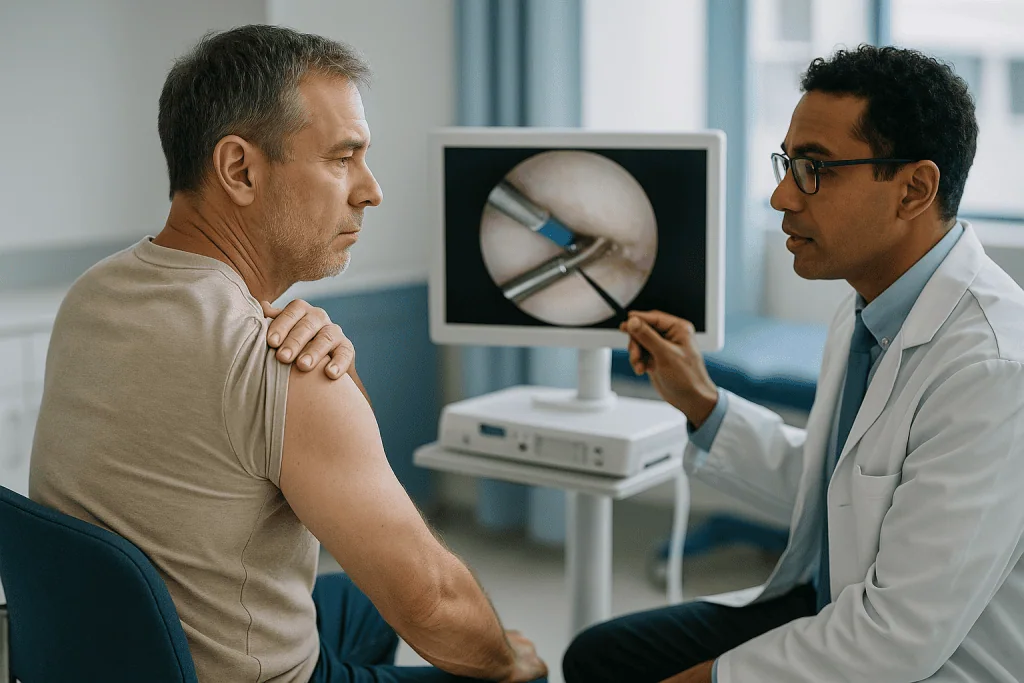
Fluid is pumped through the joint throughout. It inflates the space so the surgeon can see, rinses away debris and slows bleeding. Some of it soaks into surrounding tissue, which is why the shoulder often looks puffy for a day or two and why dressings can be damp on the first night.
The operation follows a predictable sequence. First comes a diagnostic look inside the ball-and-socket joint itself: cartilage, the biceps tendon anchor and the underside of the rotator cuff are inspected, and any unexpected tear is noted. The camera then moves above the cuff into the subacromial space. A motorized shaver removes the thickened bursa, a step called bursectomy. A small burr trims bone from the front and underside of the acromion, the step called acromioplasty, and any spur that has formed along the ligament at the front of the shoulder is smoothed. Where a partial rotator cuff tear is found, the surgeon may tidy frayed fibers or, if the tear is significant, repair it with anchors, which changes both the operation and the recovery considerably.
Incisions are closed with a stitch or skin glue and covered with waterproof dressings. Most people go home the same day. Time on the operating table is usually short, though the total stay is longer once anesthesia, positioning and recovery are included; the surgeon’s own estimate for your case is the one to rely on.
Who is shoulder impingement surgery usually for, and who is asked to wait?
Almost nobody is offered a decompression as a first step, and that is deliberate. The NHS advises that impingement often settles over weeks to months with activity modification and a structured exercise program, and that surgery is considered only when symptoms have not improved after several months of non-surgical treatment.
Those most often put forward share a pattern: persistent pain in the painful arc, night pain that disrupts sleep, a completed course of physiotherapy of reasonable length and quality, at least one corticosteroid injection that gave temporary but not lasting relief, and imaging (ultrasound or MRI) showing bursal thickening or tendon irritation without a large cuff tear. A test injection that abolishes the pain for a few hours is sometimes read as evidence that the subacromial space really is the source.
Others are usually asked to wait, or steered elsewhere. Someone whose pain began weeks rather than months ago has not yet given the tendon time to settle. Someone who has done a handful of sessions but not a consistent program is often sent back to physiotherapy with a clearer plan, because the exercises are the treatment, not a formality before surgery. A stiff shoulder with pain in every direction may be frozen shoulder, a different condition that decompression does not address. Pain radiating below the elbow with tingling in the fingers points toward the neck. A full-thickness rotator cuff tear on imaging changes the operation to a repair. Heavy smokers and people with poorly controlled diabetes are frequently asked to address those first, since both slow healing.
Age alone is not a barrier, but the reason for surgery has to hold up. The decision belongs to the surgeon and the person in the chair, weighed together.
Is shoulder impingement surgery worth it? What the trials found
Honest answer: less clearly than most people assume, and the evidence has shifted within the working life of most surgeons.

The landmark study is the CSAW trial, published in The Lancet and indexed on PubMed. Researchers randomized 313 adults with impingement-type pain who had already failed non-surgical care to one of three groups: arthroscopic decompression, a placebo operation consisting of arthroscopy alone with no bone or bursa removed, or no treatment beyond routine follow-up. At six months and again at one year, people who had the decompression reported pain and function scores that were not meaningfully better than those who had the placebo operation. Both surgical groups did somewhat better than the no-treatment group, but the gap was small, and the authors noted it could reflect the placebo effect of having surgery, extra physiotherapy contact, or simply time.
A Cochrane systematic review that followed pooled eight trials with more than a thousand participants. It concluded, with high-certainty evidence, that subacromial decompression offers no clinically important improvement in pain, function or quality of life at one year compared with placebo surgery, and probably no important advantage over exercise therapy alone.
None of this says that people who have the operation stay in pain. Most improve substantially. The question is whether the bone removal is what helped, and on current evidence that is difficult to show.
Guidance in several countries has responded by advising that decompression should not be routinely offered for uncomplicated impingement, while leaving room for individual cases, particularly where a spur is clearly abrading the tendon or a cuff tear needs repair at the same time. If your surgeon recommends it, asking how your case differs from the trial populations is a fair and useful question.
My shoulder impingement isn't getting better. What should I do?
Start by checking the diagnosis and the program, in that order. Shoulder pain that has resisted months of effort is sometimes not impingement at all, and impingement that has resisted months of effort has sometimes not been treated as intensively as it looked on paper.
A good physiotherapy program does specific things. It quiets the irritated tendon early by trimming the overhead work that provokes it, without stopping movement altogether. It then loads the rotator cuff progressively, because tendons adapt to graded load and weaken with rest. It retrains the muscles that anchor the shoulder blade so the roof of the joint tilts out of the way as the arm rises. And it runs for months, not weeks; the NHS advises persisting with prescribed exercises even when improvement is slow. Two sessions plus a printed sheet left in a drawer is not a completed course.
Medicines play a supporting role. Anti-inflammatories, a class known as NSAIDs, damp the chemical signals driving bursal swelling and are usually suggested in short bursts around flare-ups; whether they suit you depends on your stomach, kidneys, heart and other prescriptions, so a pharmacist or doctor decides. A corticosteroid injection places a potent anti-inflammatory directly into the bursa. Relief typically arrives within days and often fades over weeks to a few months, and repeated injections are limited because steroids can weaken tendon tissue.
If none of that has moved the needle, ask for a review rather than a referral. Fresh imaging may reveal a partial tear, a calcium deposit or early frozen shoulder. A second opinion from a shoulder specialist or a sports physiotherapist is reasonable. Surgery sits at the end of that path, not in the middle of it.
Treatment options for shoulder impingement compared
Seeing the options side by side makes the sequence clearer. Each row below is a step, not a rival; most people move down the table only if the row above has been given a fair trial. Timelines are typical ranges drawn from the NHS and MedlinePlus patient guidance, never promises, and your treating team will adapt them to you.
| Option | What it does | Typical timeline | What the evidence shows |
|---|---|---|---|
| Activity modification plus structured exercise | Reduces provoking load, then rebuilds cuff and shoulder-blade control | Improvement over weeks to months (NHS) | First-line; most cases settle without surgery |
| Short courses of NSAIDs | Reduce inflammatory chemicals in the bursa | Used around flare-ups, as directed | Symptom relief; do not change the underlying mechanics |
| Corticosteroid injection | Delivers anti-inflammatory directly to the bursa | Relief in days, often fading over weeks to months | Useful bridge to exercise; repeated use limited |
| Arthroscopic subacromial decompression | Removes bursa, shaves underside of acromion | Recovery 1–6 months (MedlinePlus) | No clinically important benefit over placebo surgery at one year (CSAW, Cochrane) |
| Rotator cuff repair, when a tear is found | Reattaches torn tendon to bone with anchors | Longer recovery than decompression alone | A different operation with its own indications |
Two patterns stand out. The exercise row is the only one that addresses why the space became crowded, which is why it appears before, alongside and after every other option. And the decompression row is the only one where the best available trials compared it against a convincing placebo, which is precisely why its evidence looks weaker than the others: it has been tested harder.
What happens on the day of surgery
You will usually be asked to fast for a set number of hours, to shower with the arm exposed rather than bandaged, and to arrive with someone who can take you home, since driving is not permitted after sedation or a general anesthetic. A nurse marks the correct shoulder with a pen, and the surgeon and anesthetist confirm it with you before anything else happens.
Most decompressions are done under a general anesthetic combined with a nerve block. The block is an injection of local anesthetic, guided by ultrasound, around the bundle of nerves in the side of the neck that supplies the shoulder and arm. It works by temporarily stopping those nerves from carrying pain signals, so less anesthetic is needed during the operation and the shoulder is numb when you wake. The numbness also makes the whole arm feel heavy and floppy afterward, a strange sensation the anesthesia team will warn you about; it fades as the block wears off, usually later that day or overnight.
In the operating room you are positioned either sitting up, in what surgeons call the beach-chair position, or lying on your side with the arm held in gentle traction to open the joint. The skin is cleaned, the incisions are made, and the sequence described earlier follows.
Afterward you wake in recovery with the arm in a sling, bulky waterproof dressings and often a little leaking fluid, which is irrigation solution rather than blood. Once you have eaten, passed urine and had your pain plan explained, most people leave the same day, according to MedlinePlus. Written instructions on dressing care, exercises and whom to call go home with you; keep them somewhere visible, because the first night is when they are needed.
Subacromial decompression recovery time: what the weeks usually look like
MedlinePlus notes that people commonly wear a sling for about the first week after a straightforward shoulder arthroscopy, mainly for comfort, and that full recovery ranges from one to six months depending on what was done inside. After a decompression without a repair, the sling protects nothing structural, so surgeons usually encourage taking the arm out several times a day to move the elbow, wrist and fingers.
The first days are about basics. Ice wrapped in a cloth over the dressing for short periods limits swelling. Pendulum exercises, where you bend forward and let the arm hang and swing gently like a clock weight, are often started within a day or two to keep the joint gliding. Bruising can track toward the elbow as fluid drains under gravity; it looks alarming and is usually harmless. A wound review in the early weeks, timed by your team, checks the incisions and removes any non-dissolvable stitches.
Physiotherapy then takes over. Programs move from assisted lifting to active lifting, then elastic-band resistance, then overhead control, with deliberate retraining of the shoulder blade muscles, because they decide whether the roof of the joint tilts out of the way as the arm rises. Strengthening the cuff without that retraining tends to recreate the original problem.
Driving is a practical question. There is no universal rule, and insurers may have their own wording, but surgeons generally want no sling, full two-handed control of the wheel and no sedating pain medicine; the timing varies and your surgeon confirms it. Work returns in order of demand: typing before lifting, lifting before overhead work. Sport follows the same logic, with walking and stationary cycling early, swimming and racket sports later, throwing and heavy pressing last.
Two things surprise people. Pain often improves before strength, so a shoulder that feels fine can still tire quickly overhead for months. And the operation does not change how the tendon is used day to day; the habits that crowded the space still need adjusting.
When is pain the worst after shoulder surgery?
Ask people who have been through it and the answer is consistent: the first night and the few days that follow. The reason is mechanical. The nerve block that kept the shoulder numb in recovery wears off, often in the small hours, and the full sensation of a joint that has been shaved and irrigated arrives all at once. People who felt reassuringly comfortable at discharge can be caught out, which is why anesthesia teams usually advise starting prescribed pain relief before the block has completely faded, on the schedule the prescriber gives, rather than waiting for pain to appear.
After that first peak the pattern is a slow decline with bumps. Daytime pain typically eases faster than night pain. Lying flat lets the arm drift backward and stretches the front of the shoulder, so aching at night is common for weeks and is not a sign that something has gone wrong. Physiotherapy sessions can produce a temporary flare the following day, particularly when new ranges of movement are being reclaimed.
What is prescribed varies, and the prescribing clinician tailors it. The classes involved are usually a simple analgesic such as acetaminophen, which acts centrally on pain perception; an NSAID, which reduces the inflammatory chemicals produced by operated tissue; and, for some people and for a short period, an opioid, which acts on receptors in the brain and spinal cord and carries sedation, constipation and dependence risks that make short, supervised use the norm. Ice is the fourth tool and the least appreciated. Nothing in that plan should be adjusted without checking with the team who prescribed it.
Pain that climbs rather than falls after the first few days, or that arrives with fever or a hot, red wound, is covered in the section on when to call.
Sleeping after shoulder surgery: what is the best position?
Nobody sleeps well in the first week after shoulder surgery, so the aim is better rather than perfect. Three positions work for most people. The first is semi-upright in a recliner or propped on a wedge of pillows, which stops the arm rolling back and keeps the joint above heart level to limit swelling. The second is flat on your back with a pillow under the operated elbow and forearm, so the arm rests slightly forward of the body, and a second pillow tucked along the outside to stop it sliding off during the night. The third, once the team allows side-lying, is on the non-operated side with the operated arm hugging a pillow across the chest.
Lying on the operated shoulder is off the table for several weeks; the surgeon says when. Whether to keep the sling on overnight varies: many surgeons advise it early to prevent unconscious reaching, others prefer the arm free and supported. Follow yours.
Routine helps more than gadgets. Cooling the shoulder before bed, doing the prescribed gentle movements in the evening rather than skipping them, and timing prescribed pain relief so it is working at bedtime, exactly as the prescriber has scheduled it, all reduce wake-ups. Keep water, phone and pain relief on the non-operated side so you are not tempted to reach across. A small night light avoids a stumble on a sleepy trip to the bathroom with one arm out of action.
People who snore heavily or have sleep apnea should tell the anesthesia team beforehand; sedating pain medicine and a semi-upright position interact with breathing in ways the team will want to plan for. And if a night is lost, a daytime rest is not cheating. Sleep is when tissue does most of its repair work.
What are the risks of subacromial decompression?
MedlinePlus lists the general risks of shoulder arthroscopy as infection, bleeding, blood clots, damage to nerves or blood vessels and stiffness, plus the risks of anesthesia itself. Each deserves a plain explanation. Infection is uncommon after keyhole surgery because the incisions are tiny and the joint is continuously washed, but it can occur, announcing itself as spreading redness, warmth, discharge or fever in the days afterward. Bleeding is usually minor; the pinkish fluid on dressings the first night is irrigation solution. Clots in the deep veins are rarer after arm surgery than after hip or knee operations, but immobility, dehydration, smoking, hormonal contraception and a personal or family history all raise the odds, which is why early walking and drinking well are encouraged.
The nerve block carries its own short-lived effects. Because the nerves it targets sit close to the nerve that drives one side of the diaphragm, some people feel mildly breathless for a few hours; hoarseness and a temporarily droopy eyelid on that side also occur. These resolve as the local anesthetic clears. Permanent nerve injury is rare.
Two risks are specific to the shoulder. Stiffness, sometimes progressing to frozen shoulder, is the one physiotherapists most want to prevent, hence the insistence on early movement. And persistent pain: given the trial evidence discussed earlier, a meaningful number of people find their symptoms not much different a year on. That is not a complication in the usual sense, but it is the outcome most worth discussing beforehand.
Occasionally the surgeon finds more than expected, such as a cuff tear needing repair, and both the operation and the recovery change. Ask in advance what you are consenting to if that happens, so the decision is yours rather than made while you are asleep.
What people often get wrong about shoulder impingement surgery
The bone spur has to come off. Spurs on the acromion appear on scans of many people with no shoulder pain at all, and the CSAW trial found that removing bone made no clinically important difference compared with a look-inside operation that left it alone. A spur is often a consequence of a tendon that has been rubbing, not the cause.
Keyhole means minor. The incisions are small; the work inside is not. Bone is shaved, tissue is removed, and the shoulder is sore for weeks. Treating the recovery as a few days off tends to end in stiffness.
If the injection worked, surgery will. A steroid injection that gave short-lived relief confirms the pain comes from the subacromial space. It does not predict that permanently enlarging the space will help, because the tendon’s own irritation is a separate driver.
Rest until it stops hurting. Complete rest weakens the rotator cuff and stiffens the joint, both of which crowd the space further. Guided, graded loading is the treatment, before and after any operation.
Pain during exercises means damage. Mild discomfort that settles within a day is expected when reclaiming range. Sharp pain, pain that lingers or pain that escalates session to session is a signal to adjust the program, not to abandon it.
Surgery is the end of physiotherapy. For most people it is the start of the most important stretch of it. The Cochrane review found decompression probably offers no important advantage over exercise alone, which is another way of saying the exercise does the heavy lifting either way.
Impingement means the tendon is torn. Irritation and partial fraying are not the same as a full tear, and imaging can distinguish them. The two conditions call for different operations and different recoveries.
Questions to ask your care team
A consultation goes better with a short written list, and these questions have earned their place.
What exactly did my scan show, and does it explain my pain? Bursal thickening, a partial tear, a calcium deposit and a spur each point in a slightly different direction, and the answer shapes everything that follows.
How does my case differ from the people in the decompression trials? You are entitled to hear why the surgeon expects the operation to help you when the trials did not show a benefit over placebo surgery on average.
Have I completed a genuinely adequate course of physiotherapy? If the answer is uncertain, ask what an adequate course would look like and whether a referral to a specialist shoulder physiotherapist makes sense first.
If you find a rotator cuff tear inside, will you repair it, and how does that change my recovery and my time in a sling? Consent should cover this before, not after.
Which anesthetic and block do you plan, and what will the first night at home feel like? When will I see the physiotherapist afterward, and who arranges it?
When can I drive, shower normally, type, lift and return to my sport or job, in your estimate for me rather than in general terms?
What would make you want to hear from me urgently in the first two weeks?
If I choose not to have surgery, what is likely to happen to my shoulder over the next year, and does the option stay open?
Write the answers down during the appointment, or ask permission to record them. People routinely retain only a fraction of what is said in a consultation, and the details of sling time and exercise timing matter most later, when the surgeon is not in the room.
When to call your doctor
Most recoveries are uneventful, and the routine review catches small problems. A few signs should prompt a same-day call to the surgical team or, out of hours, an urgent care assessment, rather than waiting for the next appointment.
Call promptly for fever, chills, or a wound that becomes increasingly red, hot or swollen, or that leaks cloudy or foul-smelling fluid; these can indicate infection, which is uncommon after arthroscopy but needs early treatment. Pain that escalates after the first few days instead of easing, or that is out of proportion to what you were told to expect, warrants a conversation. Numbness, tingling or weakness in the hand that persists beyond the expected life of the nerve block, or a new inability to move the fingers, needs assessment. A calf that becomes painful, swollen or warm, or an arm that swells and darkens below the shoulder, raises the possibility of a clot.
Some signs need emergency services rather than a phone call: sudden shortness of breath, chest pain, coughing up blood, a racing heartbeat with lightheadedness, or collapse. These can signal a clot that has traveled to the lung, which is rare after shoulder surgery but life-threatening.
Beyond the immediate recovery, contact your team if the shoulder is becoming progressively stiffer week by week despite exercises, if night pain has not shifted by the point your team expected, or if you develop clicking with a sense of the joint giving way. Before any surgery, seek prompt medical review for shoulder pain that follows a fall or injury, pain with visible deformity, an arm you cannot lift at all, or shoulder pain accompanied by chest pressure, breathlessness or sweating, which can be a heart symptom rather than a joint one.
Every one of these is a reason to ask, not a reason to panic. The treating team would far rather hear about a false alarm than miss a real one.
Frequently asked questions
Is shoulder impingement surgery worth it?
For uncomplicated impingement, the best available trials do not show that decompression beats placebo surgery or structured exercise at one year, so it is not routinely recommended. Most people who have it do improve, but the same is true of those who have sham surgery or physiotherapy alone. It may still be reasonable in specific cases, such as a spur clearly abrading the tendon or a tear needing repair, which your surgeon should explain.
Shoulder impingement not getting better after physio: what next?
Ask for a review of the diagnosis and the program before asking for surgery. Fresh imaging can uncover a partial tear, a calcium deposit or early frozen shoulder that behaves differently. Check whether the exercises were truly progressive and continued for months rather than weeks. A corticosteroid injection may calm the bursa enough to make exercise possible. Surgery is discussed only once those steps have been exhausted.
When is pain the worst after shoulder surgery?
Usually the first night and the few days that follow, because the nerve block that numbed the shoulder wears off and full sensation returns at once. Pain then declines gradually, with night aching and post-physiotherapy flares lingering for weeks. Pain that rises after the first few days, or arrives with fever or a hot, red wound, should be reported to the surgical team the same day.
What is the best way to sleep after shoulder surgery?
Semi-upright in a recliner or on a wedge of pillows suits most people early on, since it stops the arm rolling backward and limits swelling. Lying on your back with a pillow under the operated elbow is the next option. Side-lying on the non-operated side, hugging a pillow, comes later when the team allows. Avoid the operated side for several weeks, and follow your surgeon’s advice on wearing the sling overnight.
What is the typical subacromial decompression recovery time?
MedlinePlus gives a range of one to six months for recovery after shoulder arthroscopy, with a sling commonly worn for about the first week. Where you fall in that range depends on whether a rotator cuff repair was added, how much stiffness develops, and how consistently the exercises are done. Desk work generally returns before manual work, and overhead sport comes last.
How long does subacromial decompression surgery take?
The procedure itself is usually brief, often well under an hour on the operating table, but the total time in hospital is considerably longer once anesthesia, the nerve block, positioning and recovery are included. Most people arrive in the morning and leave later the same day. Your surgeon and anesthetist will give you an estimate specific to your case, which matters more than any general figure.
Do I need a sling after shoulder impingement surgery?
Usually yes, but briefly and mainly for comfort. MedlinePlus notes a sling is commonly worn for about the first week after a straightforward arthroscopy. After a decompression alone, nothing structural needs protecting, so surgeons typically encourage removing it several times a day to move the elbow, wrist and fingers. If a rotator cuff repair was performed, sling time is longer and stricter.
When can I drive after subacromial decompression?
There is no fixed rule, and your surgeon decides. Most want three conditions met: no sling, full two-handed control of the wheel including emergency maneuvers, and no sedating pain medicine. Your insurer may also have specific wording worth checking. Driving too early risks both your shoulder and your policy, so ask for a clear go-ahead at your follow-up appointment.
Can shoulder impingement come back after surgery?
Symptoms can persist or return, because the operation changes the shape of the space but not the way the shoulder is used. Weak shoulder blade muscles, overhead work habits and age-related tendon change are unaffected by bone removal. Continuing the strengthening and posture work after surgery is the main way to manage that risk, which is why physiotherapy is central to recovery.
Is subacromial decompression the same as a rotator cuff repair?
No. Decompression removes bursa and trims bone to create space; a repair reattaches a torn tendon to bone using anchors. They are sometimes done in the same operation if a tear is found, but a repair carries a longer, stricter recovery with more sling time. Ask your surgeon before the operation what they will do if they find a tear, so you consent to both possibilities.
This article is for general information only and is not a substitute for professional medical advice. Please consult a qualified doctor about your individual situation.

More from the Blog

When Is Arthroscopy Enough and When Is Open Surgery Needed? How Surgeons Decide
Arthroscopy is usually enough when the problem is inside the joint, limited in size, and reachable with a thin camera and small instruments, such…

The First Two Weeks After ACL Surgery: Crutches, Bracing, Ice and Bending the Knee
The first two weeks after ACL surgery usually focus on four jobs: walking safely with crutches, wearing any brace the surgeon has prescribed, controlling…

Rotator Cuff Surgery Cost: Pricing the Repair, Honestly
In our August 2026 guide, rotator cuff repair for international patients typically runs EUR 4,700–11,050, compared with roughly GBP 4,400–8,500 for private surgery in…

How Tenosynovitis Starts: Why a Tendon Sheath Swells and How Care Is Planned
Tenosynovitis usually starts when the thin, fluid-lined sheath around a tendon becomes irritated, most often from repeated gripping, twisting or lifting, and less often…

Running and Squatting After Meniscus Surgery: How Return to Sport Is Cleared Stage by Stage
Running after meniscus surgery is cleared in stages rather than on a fixed date. Surgeons and physical therapists typically look for a knee that…
Arthroscopy Complications Explained: Portal Infections, Swelling, Clots and When to Call
Arthroscopy complications are uncommon but real. Most people have some bruising, swelling and soreness for one to two weeks, which is expected. Warning signs…