

Asbestosis Treatment: What Care Can and Cannot Do for Scarred Lungs

Key Takeaways
- Asbestos fibers lodge permanently in the air sacs and trigger scarring that no current medicine can reverse, so all treatment works around the scar rather than through it.
- Symptoms typically appear 10 to 40 years after first exposure, which is why a diagnosis often arrives decades after the last day in a dusty workplace.
- Supplemental oxygen is prescribed to correct documented low blood oxygen, not breathlessness itself, and does little for people whose saturation is already normal.
- Pulmonary rehabilitation improves exercise tolerance and confidence without changing lung capacity on tests, by retraining muscles to do more with the oxygen available.
- Smoking and asbestos exposure together raise lung cancer risk far more than either alone, making smoking cessation the single most valuable step at any stage of the disease.
- Antifibrotic medicines have been studied mainly in other scarring lung diseases, and evidence for their benefit in asbestosis specifically remains limited and unproven.
Asbestosis treatment options cannot remove or reverse lung scarring, but they can ease breathlessness and protect what lung function remains. Standard care includes pulmonary rehabilitation, supplemental oxygen when blood oxygen runs low, stopping smoking, vaccinations against flu and pneumonia, avoiding further asbestos exposure, and regular monitoring with lung function tests and imaging. Lung transplant is considered only in selected severe cases.
The letter arrives decades after the last day on the job. A retired pipefitter, a shipyard electrician, a woman who spent one summer stripping insulation from a boiler room: the story is remarkably consistent. A cough that will not settle, stairs that feel steeper than they used to, and then a radiologist’s report with a word they may never have heard spoken aloud.
The first question is almost always the same. Can this be fixed? The honest answer is more layered than a yes or a no, and it deserves to be laid out plainly rather than softened. Asbestosis treatment options are real, evidence-based, and worth pursuing, yet none of them undo the damage that asbestos fibers have already done.
This explainer walks through what those options actually involve, who is usually offered which one, what the evidence shows, and, just as importantly, where the limits lie.
How does asbestosis damage the lungs?
Asbestos is a group of naturally occurring minerals that split into fibers thin enough to ride the air deep into the lungs. Once inhaled, the smallest of these fibers lodge in the alveoli, the tiny air sacs where oxygen crosses into the blood. The body’s cleanup cells try to swallow them and fail, because the fibers are too long and too durable to break down.
That failure sets off a slow, smoldering inflammation. Over years, the inflamed tissue thickens and stiffens into scar, a process doctors call fibrosis. In asbestosis the scarring builds up in the interstitium, the delicate framework between air sacs and blood vessels, which is why the condition belongs to the family known as interstitial lung disease. A scarred lung does two things poorly: it cannot stretch as far with each breath, and oxygen struggles to pass through the thickened wall into the bloodstream.
The damage is dose-related and delayed. The Centers for Disease Control and Prevention notes that risk climbs with the intensity and duration of exposure, which is why the condition concentrated among trades such as insulation work, shipbuilding, construction, and brake repair. Mayo Clinic puts the usual gap between first exposure and first symptoms at roughly 10 to 40 years, and the NHS describes symptoms typically emerging 20 to 30 years later. The lungs, in other words, may be quietly scarring for a generation before anyone notices.
Two features distinguish asbestosis from other fibrotic lung diseases. It tends to start at the bases of the lungs and creep upward, and it frequently keeps company with pleural plaques, patches of thickening on the lung’s outer lining that are a marker of exposure rather than a disease in themselves. Understanding this mechanism matters, because it explains why every treatment described below works around the scar rather than through it.
Can lungs heal from asbestos? Why can asbestosis not be reversed?
People asking whether lungs can heal from asbestos usually have two different processes in mind, and it helps to separate them. Inflammation can settle. Scar cannot dissolve.
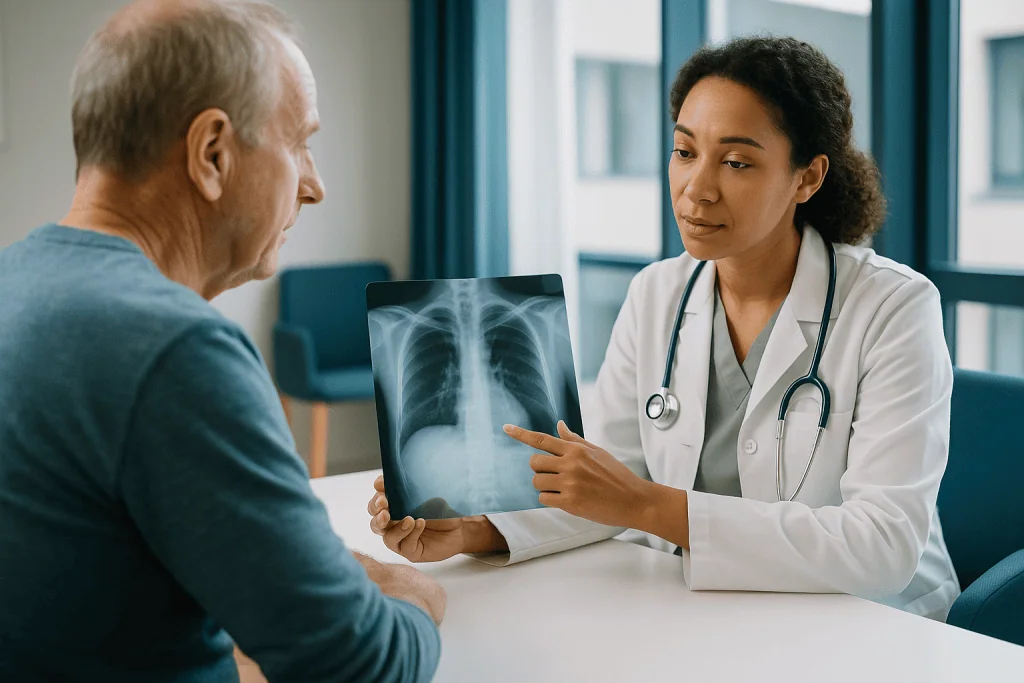
Healthy lung tissue does have some capacity to repair itself after infection or minor injury. Fibrosis is different. Once the body has laid down dense collagen where elastic air-sac walls used to be, that collagen behaves like scar tissue anywhere else on the body: it is permanent, it does not stretch, and no medicine currently available can take it back out. Mayo Clinic, the NHS, and MedlinePlus all describe asbestosis as a condition whose damage cannot be reversed, which is why treatment focuses on symptoms and on preventing further harm.
Nor do the fibers themselves leave. Asbestos is prized industrially precisely because it resists heat, acid, and wear, and those same properties mean it resists the body’s efforts to clear it. Fibers recovered from lung tissue decades after exposure look much as they did on the day they were inhaled. There is no proven way to flush them out, and claims about “asbestos detox” have no support in mainstream medical evidence.
What can change is the trajectory. Continued exposure adds new fiber burden and new inflammation, so stopping exposure is the single most important protective step. Smoking accelerates decline in lung function and multiplies the cancer risk that already accompanies asbestos, so quitting genuinely alters the road ahead. Infections can tip a stiff, compromised lung into a crisis, so preventing them preserves function.
Doctors sometimes frame this as the difference between healing and protecting. The scarred portion of the lung is not coming back. The unscarred portion, often the larger share, is worth defending with every tool available, and that defense is what the remainder of this article describes.
What are the asbestosis treatment options today?
Asbestosis treatment options fall into a handful of categories, each doing a specific job. None is glamorous, and that is rather the point: the evidence supports steady, supportive care rather than a dramatic intervention.
| Option | What it does | Who is usually considered | What it cannot do |
|---|---|---|---|
| Stopping further exposure | Prevents new fiber burden and new inflammation | Everyone with the diagnosis | Remove fibers already present |
| Smoking cessation | Slows lung function decline; lowers cancer risk | Every current smoker | Reverse existing scar |
| Pulmonary rehabilitation | Improves exercise tolerance, breathing technique, confidence | People limited by breathlessness | Improve lung capacity on tests |
| Supplemental oxygen | Raises blood oxygen when it falls too low | Those with documented low oxygen at rest, on exertion, or during sleep | Help breathlessness when oxygen is already normal |
| Vaccinations | Reduces risk of flu, pneumococcal pneumonia, and related complications | Everyone, unless a doctor advises otherwise | Treat the fibrosis itself |
| Monitoring | Tracks lung function and screens for complications | Everyone, typically at intervals set by the care team | Change the disease directly |
| Lung transplant | Replaces severely scarred lungs | A small, carefully selected group with advanced disease | Suit most patients; carries major risks |
Mayo Clinic and the NHS list these same pillars, with the NHS adding that an inhaler may be offered when breathlessness is mild, and both mentioning that fluid around the lung, when it collects, can be drained. Notice what is absent: there is no antifibrotic drug with established evidence in asbestosis specifically, and corticosteroids, which help some other inflammatory lung conditions, have not been shown to help here. The sections that follow take each option in turn.
How is asbestosis diagnosed before treatment begins?
Treatment planning starts with certainty about the diagnosis, and asbestosis is a diagnosis built from three legs: a credible exposure history, characteristic changes on imaging, and a matching pattern on lung function tests.
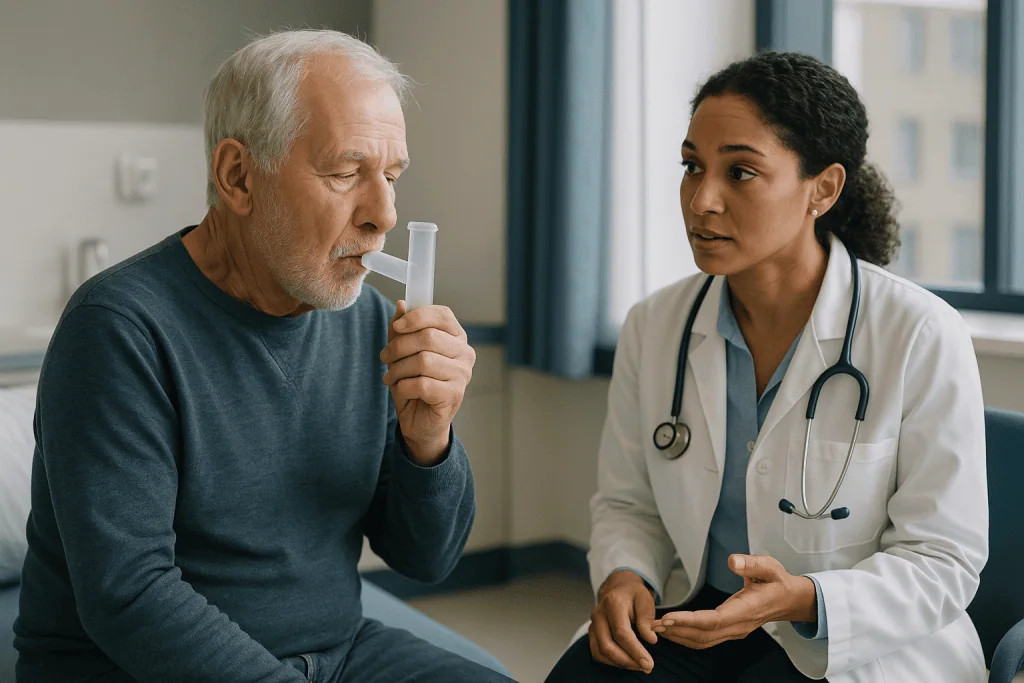
The history comes first and often takes the longest. A clinician will ask about every job, including short-term and summer work, military service, home renovation, and whether anyone in the household worked with asbestos and brought dust home on clothing. Because the latency can stretch to decades, people frequently need to reach back to their twenties.
Imaging usually begins with a chest X-ray, but Mayo Clinic notes that high-resolution computed tomography, a CT scan that takes very thin slices of the lung, shows early scarring far more clearly. Radiologists look for fine lines and honeycomb-like changes at the lung bases, often alongside pleural plaques.
Lung function tests then measure how the scarring affects breathing. Spirometry, in which you blow forcefully into a tube, typically shows a restrictive pattern: the lungs hold less air than expected. A diffusing capacity test, often abbreviated DLCO, measures how easily gas crosses from the air sacs into the blood, and it is frequently the earliest test to fall. Pulse oximetry, a clip on the finger, checks oxygen saturation at rest, and a walking test can reveal drops that only appear on exertion.
A stethoscope still earns its place. Fine crackles at the lung bases, sometimes compared to the sound of hook-and-loop fastener being pulled apart, are a classic finding. Lung biopsy is rarely needed and is reserved for cases where the picture is unclear.
Doctors also use this stage to rule out look-alikes, since other interstitial lung diseases can produce similar scans and may have different treatments. Getting this right shapes everything that follows, which is why the treating team may take several visits before settling on a plan.
Pulmonary rehabilitation for asbestosis: what actually happens?
Pulmonary rehabilitation is a structured, supervised program of exercise, education, and breathing training designed for people whose lung disease limits daily life. Both the NHS and Mayo Clinic list it as a core part of asbestosis care, and for many people it is the treatment that makes the most tangible difference to how a week feels.
The paradox is that it does not change the lungs at all. Scarred tissue after rehabilitation looks exactly as it did before. What changes is everything downstream. Breathlessness leads people to move less; muscles weaken; weaker muscles demand more oxygen for the same task; the next flight of stairs feels harder still. Rehabilitation breaks that spiral by retraining the muscles of the legs, arms, and chest wall to do more with the oxygen available.
A typical session pairs monitored aerobic exercise, often walking or cycling, with resistance work, while staff track oxygen saturation and heart rate. Between sessions, therapists teach techniques such as pursed-lip breathing, which slows the out-breath and can ease the sensation of air hunger, and pacing strategies for tasks like showering or carrying groceries. Education covers medicines, oxygen use if prescribed, nutrition, and recognizing early signs of infection.
Programs run for a set number of weeks with a fixed schedule of group sessions, and most include a home exercise plan intended to continue indefinitely. The gains, in exercise tolerance and confidence, tend to fade if the exercise stops, so the program is best understood as a launch rather than a course of treatment with an end date.
Referral usually comes from the respiratory team once the diagnosis is settled and any needed oxygen has been arranged. People sometimes worry they are too breathless to take part. In practice, programs are built around individual limits, and it is the more breathless participants who often report the most noticeable change. Ask about it directly if it has not been offered.
Oxygen therapy for asbestosis: who needs it and when?
Supplemental oxygen is the treatment most people picture when they imagine lung disease, and it is also the one most surrounded by misunderstanding. Oxygen is prescribed to correct low blood oxygen, not to relieve breathlessness as such. Those two things overlap less than intuition suggests.
In asbestosis, thickened air-sac walls slow the passage of oxygen into the blood. Early on, the body compensates, and saturation stays normal at rest. As scarring progresses, oxygen may dip first during exertion or sleep, when demand rises or breathing shallows, and later at rest. The care team establishes this with pulse oximetry, a walking test, sometimes an overnight recording, and often an arterial blood gas, a small sample drawn from an artery in the wrist that measures oxygen and carbon dioxide directly.
When levels fall below the thresholds set in national guidance, oxygen is prescribed to protect the heart and other organs from the strain of chronic low oxygen. Persistently low levels can, over time, raise pressure in the lung’s blood vessels and strain the right side of the heart, a complication called cor pulmonale. Correcting the deficit is aimed squarely at preventing that.
Oxygen may be prescribed for use during activity only, overnight only, or for much of the day, depending on when the drops occur. Equipment ranges from concentrators that extract oxygen from room air to portable cylinders for leaving the house. The prescribing team sets the flow rate and hours, and those settings should not be adjusted without them, because too much oxygen can be a problem for some people just as too little is for others.
People whose saturation is normal will generally not be offered oxygen even if they feel very short of breath, and that is an evidence-based decision rather than a rationing one. For them, pulmonary rehabilitation and breathing techniques do more than an oxygen tank would.
Is there a new treatment for asbestosis? Medicines, evidence, and honest limits
Search engines are full of hope on this question, so precision matters. There is no medicine approved specifically to treat asbestosis, and no drug has been shown in high-quality trials to stop or reverse its scarring.
The most common misunderstanding concerns antifibrotic medicines, a class developed to slow the rate of lung function decline in idiopathic pulmonary fibrosis, a scarring disease of unknown cause. Later research extended one such agent to a broader group labeled progressive fibrosing interstitial lung diseases, and asbestosis can technically fall under that umbrella when it is clearly worsening. The catch is that people with asbestosis made up only a very small fraction of the participants in those studies, so the evidence that these medicines help in asbestosis specifically is thin. Some specialists will consider them for a patient whose scarring is demonstrably progressing despite everything else; many will not. Either position is defensible, and the decision belongs with the respiratory team, weighing side effects against an uncertain benefit.
Corticosteroids, anti-inflammatory steroids that help conditions like sarcoidosis, have not been shown to help asbestosis, and their long-term side effects make routine use hard to justify. Inhalers, the mainstay of asthma and COPD care, may be tried when breathlessness is mild or when a person also has airway disease, as the NHS notes, but they work on airway muscle rather than on scar and should not be expected to change the underlying condition.
Research continues into medicines that target the fibrosis pathway itself, but none has reached routine practice for asbestosis. When someone encounters a clinic or product promising to clear asbestos from the body or regrow lung tissue, the mainstream evidence base offers no support for either claim. The most powerful interventions remain the unglamorous ones: exposure avoidance, smoking cessation, rehabilitation, oxygen where indicated, and vigilance for complications.
Who is offered which treatment, and who is usually asked to wait?
Not everyone with asbestosis needs every option, and matching the intervention to the stage is much of what the respiratory team does.
People with pleural plaques alone, without scarring in the lung tissue, are generally told they do not have asbestosis and do not need treatment. Plaques mark exposure, and they justify monitoring and the same lifestyle protection, but they do not in themselves impair breathing.
Someone with early scarring, normal oxygen saturation, and little or no breathlessness will usually be offered the foundations: absolute avoidance of further exposure, help with quitting smoking, vaccinations, and a schedule of follow-up lung function tests and imaging. Rehabilitation and oxygen are held in reserve, not because they are being withheld but because the evidence does not show benefit before symptoms or low oxygen appear. Being asked to wait is common at this stage and reflects appropriate care.
Moderate disease, with breathlessness that limits daily activity, typically triggers referral to pulmonary rehabilitation and formal oxygen assessment. If saturation drops on exertion or overnight, oxygen is prescribed for those situations; if it is low at rest, longer daily use is considered.
Advanced disease, where breathlessness is severe and oxygen levels are low despite full supportive care, is where the conversation may broaden to include assessment for antifibrotic therapy, depending on the specialist’s view of the evidence, and, for a small number of people, consideration of lung transplant.
Age, other health conditions, heart function, and personal priorities all shape these decisions. Two people with identical scans may reasonably receive different plans. What should not vary is the presence of a plan at all: everyone with asbestosis warrants a named clinician, a follow-up schedule, and clear instructions on what changes should prompt an earlier call.
Why do stopping smoking and vaccinations matter so much?
If a single intervention had the power to change the future of a person with asbestosis, quitting smoking would be it. Mayo Clinic and MedlinePlus both single it out, and the reasoning rests on two separate threats.
The first is lung function. Smoking damages airways and air sacs through a different route from asbestos, and in a lung already stiffened by scar, the extra loss of reserve is felt sooner and harder. Stopping does not restore what is gone, but the rate of decline slows toward that of a non-smoker.
The second is cancer. Asbestos exposure raises the risk of lung cancer on its own. Smoking raises it on its own. Together, the two do not simply add; Mayo Clinic describes the combined risk as greatly increased beyond either alone. For a person with asbestosis who still smokes, quitting is the most effective cancer-prevention step available, more so than any scan or test.
Help with quitting is a legitimate part of asbestosis treatment, and the care team can arrange counseling and discuss medicines that ease withdrawal. Which approach suits which person is a conversation for the prescribing clinician; the point here is that it deserves a place in the treatment plan rather than a passing mention.
Vaccination protects against the other great destabilizer: infection. A chest infection that a healthy person shrugs off can push a scarred lung into a period of low oxygen and, sometimes, hospital admission. Both Mayo Clinic and the NHS recommend annual influenza vaccination and pneumococcal vaccination for people with asbestosis, and the care team may advise others based on age and circumstance. These are not treatments for the scar. They are insurance against the events most likely to accelerate its consequences.
Smaller measures follow the same logic: washing hands during winter viral seasons, treating chest infections promptly, and staying away from dusty environments that would irritate compromised airways.
When does lung transplant enter the conversation?
Lung transplant is the only treatment that replaces scarred tissue rather than working around it, and Mayo Clinic lists it as an option in severe asbestosis. It is also the option relevant to the fewest people, and it is worth being clear-eyed about why.
Transplant is major surgery followed by lifelong immunosuppression, medicines that dampen the immune system to prevent it from attacking the new organ. Those medicines raise the risk of infection and certain cancers and require close, permanent monitoring. Donor organs are scarce, and transplant centers use strict criteria, considering age, heart and kidney function, body weight, other illnesses, and the person’s ability to manage a demanding aftercare regimen. Someone whose asbestosis has progressed to the point of severe breathlessness and low oxygen despite full supportive care, and who is otherwise in reasonable health, may be referred for assessment. Assessment is not a promise of listing, and listing is not a promise of an organ.
Asbestos exposure adds a specific consideration. Because it raises the risk of lung cancer and mesothelioma, a cancer of the lung lining, transplant teams look carefully for any sign of malignancy before proceeding, since immunosuppression can allow a hidden cancer to grow.
For the majority of people with asbestosis, transplant will never be on the table, and that is not a failure of care. The disease frequently progresses slowly enough that supportive treatment carries a person through many years, and many people live with asbestosis into older age when transplant is no longer appropriate on grounds unrelated to the lungs.
Where it is raised, the respiratory team will typically introduce the idea well before it becomes urgent, so that assessment can proceed without pressure. Asking directly whether transplant is a realistic possibility, and at what point it would be revisited, is a reasonable question at any stage.
What do the first weeks after an asbestosis diagnosis usually look like?
There is no operation to recover from and no course of treatment with a final dose, so the timeline after diagnosis is about building a structure rather than healing from an event.
The first appointment or two are usually about confirmation and baseline. Expect the respiratory team to complete any imaging or lung function tests not already done, to document oxygen saturation at rest and on walking, and to take a thorough exposure and smoking history. That baseline becomes the yardstick against which every future test is measured.
Next comes the practical layer. Referral to pulmonary rehabilitation, if breathlessness limits activity, may take some weeks to translate into a start date. Oxygen assessment, if saturation dipped, may involve a separate visit for an arterial blood gas or an overnight recording before equipment is arranged. Vaccinations can often be given at a routine appointment. Smoking cessation support can begin immediately.
The team will also explain follow-up. Mayo Clinic describes regular monitoring with lung function tests and imaging to track change and to watch for complications, and the interval is set individually, often somewhere between six months and a year for stable disease, sooner if there is concern. The care team will state the plan explicitly; if they do not, ask.
Many people also use this period to document their exposure history in writing while memory is fresh. In several countries, including the United Kingdom, where the NHS points people toward industrial injury benefits, and the United States, workplace-exposure compensation schemes exist for asbestos-related disease. A clinician cannot pursue these on a patient’s behalf, but a clear medical record of diagnosis and exposure is the foundation for anyone who chooses to.
Emotionally, these weeks are often heavier than the medical schedule suggests. A diagnosis rooted in decades-old work can bring anger and grief alongside worry. Respiratory teams commonly include nurses or counselors who can help, and asking for that support is part of good care, not a departure from it.
Asbestosis life expectancy: how many years can you live with it?
This is the question people most want answered and the one that responsible sources answer least precisely, because the honest range is enormous.
Asbestosis progresses at very different speeds in different people. Some individuals with mild scarring diagnosed in their sixties remain stable for many years, with lung function tests barely shifting from one visit to the next. Others, particularly those with heavy or prolonged exposure, experience steadier decline in breathing capacity and oxygen levels. The NHS describes asbestosis as a condition that can slowly worsen over time, and neither the NHS nor Mayo Clinic attaches a life-expectancy figure to it, for good reason: a number that applies to a population says almost nothing about the individual sitting in the clinic.
What the evidence does support is a set of factors that shift the outlook. Cumulative exposure is the largest; heavier exposure generally means more scarring and faster progression. Smoking status is next, both for its effect on lung function and for the cancer risk it compounds. Baseline lung function and oxygen levels at diagnosis, age, and heart health all matter.
The complications, rather than the fibrosis itself, often determine the outcome. Asbestos exposure raises the risk of lung cancer and of mesothelioma, and the World Health Organization notes that all forms of asbestos are carcinogenic. Chest infections and heart strain from chronic low oxygen are the other major threats. Every pillar of treatment described above exists to reduce one of these risks, which is why the plan matters even when the scarring cannot be changed.
The most useful way to approach the question with the care team is to ask how your own tests are trending. Two lung function tests a year apart, compared side by side, tell more about your particular future than any statistic. Clinicians can and should share that trajectory frankly, while acknowledging that it may change.
What people often get wrong about asbestosis treatment
“Asbestosis is a type of cancer.” It is not. Asbestosis is scarring of the lung tissue. Asbestos exposure also raises the risk of two cancers, lung cancer and mesothelioma, and people with asbestosis are monitored for them, but the fibrosis itself is a separate, non-cancerous disease.
“If I feel fine, the scan must be wrong.” Early scarring commonly produces no symptoms, and diffusing capacity can fall before anyone notices a change on the stairs. A confident diagnosis in someone who feels well is not a contradiction; it is an opportunity to protect lung function before it is lost.
“Oxygen will fix my breathlessness.” Oxygen corrects low blood oxygen. When saturation is normal, breathlessness comes from stiff lungs working harder, and extra oxygen does little for it. Pulmonary rehabilitation and breathing techniques address that sensation more directly.
“Steroids or an inhaler will treat the scarring.” Neither acts on fibrosis. Inhalers may help if there is coexisting airway disease; steroids have not been shown to help asbestosis and carry real long-term side effects.
“There’s a detox that removes asbestos.” There is no evidence for any supplement, diet, or procedure that clears asbestos fibers from lung tissue. Products making that claim are not supported by mainstream medicine.
“Quitting smoking now is pointless; the damage is done.” The opposite is true. Smoking cessation slows further loss of lung function and lowers a cancer risk that asbestos has already raised. It remains the single most valuable step at any stage.
“Pleural plaques mean I have asbestosis.” Plaques are thickened patches on the lung lining that mark exposure. They do not impair breathing on their own and do not equal asbestosis, although they warrant the same monitoring and protection.
“Nothing can be done, so follow-up is a waste.” Monitoring catches the complications that actually determine outcomes, adjusts oxygen as needs change, and keeps the door open to options like rehabilitation or, for a few, transplant assessment at the right moment.
Questions to ask your care team about asbestosis treatment options
Appointments are short and the subject is heavy, so it helps to arrive with questions written down. The following are the ones respiratory clinicians most often wish patients had asked.
- How certain is the diagnosis, and have other interstitial lung diseases with different treatments been excluded?
- What do my lung function tests show now, and which numbers will you track over time to judge whether the scarring is progressing?
- Was my oxygen saturation checked at rest, on walking, and overnight, and do the results indicate a need for supplemental oxygen in any of those settings?
- Am I a candidate for pulmonary rehabilitation now, and if not, what would prompt a referral?
- Which vaccinations do you recommend for me, and how often?
- Do I have pleural plaques, fluid around the lung, or any finding that needs separate attention?
- How often will I be seen, what tests will each visit include, and who do I contact between visits if something changes?
- Given my exposure and smoking history, how are you monitoring for lung cancer and mesothelioma, and what symptoms should make me call sooner?
- Is antifibrotic medicine something you would consider for me, and what does the evidence show for asbestosis specifically?
- Is lung transplant a realistic possibility in my case, and at what point would it be discussed?
- What support is available for stopping smoking, and can it start today?
- Are there activities, environments, or travel considerations I should avoid or plan around?
- Can you help me document my exposure history for my records and for any workplace compensation process I may choose to pursue?
- Who on the team can I speak with about the emotional side of this diagnosis?
Bring a companion if possible; a second set of ears catches what worry drowns out. Ask for a written summary of the plan at the end of the visit, including the follow-up interval and a named contact. Any answer that leaves you unsure deserves a follow-up question, and a good team will welcome it.
When to call your doctor
Asbestosis usually changes slowly, which makes sudden shifts meaningful. The care team will give you individualized guidance; the following are the changes that should prompt a call the same day or emergency care, depending on severity.
Seek emergency help immediately if you experience severe or rapidly worsening shortness of breath, chest pain that is new or crushing, blue or gray lips or fingertips, confusion or unusual drowsiness, or coughing up more than a streak of blood. Sudden sharp chest pain with breathlessness can signal a collapsed lung or a blood clot, both of which need urgent assessment.
Call your doctor promptly, within a day, if you notice a fever with a productive cough or a change in the color or amount of sputum, since chest infections can destabilize scarred lungs quickly; breathlessness that has stepped up noticeably over days or a couple of weeks rather than months; oxygen saturation readings on a home monitor that are lower than your usual range, if the team has given you one and a target; new swelling of the ankles or legs, which can indicate strain on the heart; a cough that has changed character or persisted for several weeks; unexplained weight loss, night sweats, or persistent chest wall pain, which warrant evaluation given the cancer risk that accompanies asbestos exposure; or a hoarse voice or difficulty swallowing that does not settle.
Also contact the team if prescribed oxygen equipment is not working, if you are struggling to use it as directed, or if you have been unable to attend rehabilitation or follow-up and need help rescheduling.
Keep the clinic’s number and the out-of-hours contact somewhere visible. Calling about a change that turns out to be minor is never a mistake; waiting through a change that turns out to matter can be. The treating team knows your baseline and is the right judge of what a new symptom means.
Frequently asked questions
How many years can you live with asbestosis?
There is no reliable single figure, because asbestosis progresses at very different rates in different people. Some remain stable for many years with mild scarring, while heavier exposure tends to bring faster decline. Cumulative exposure, smoking status, baseline lung function, age, heart health, and whether complications such as infection or cancer develop all shift the outlook. Your own lung function trend over time is a far better guide than any population statistic.
What is the new treatment for asbestosis?
No new medicine has been proven to treat asbestosis specifically. Antifibrotic drugs developed for idiopathic pulmonary fibrosis have been extended to some progressive scarring lung diseases, but people with asbestosis formed only a small part of those trials, so evidence in this condition is limited. Some specialists consider them when scarring is clearly worsening; others do not. That judgment belongs with the respiratory team, weighing side effects against an uncertain benefit.
Can lungs heal from asbestos, and can asbestosis be reversed?
Scarring from asbestos cannot be reversed. Inflammation can settle, but fibrosis, the dense scar tissue that replaces stretchy air-sac walls, is permanent, and asbestos fibers themselves resist the body’s efforts to clear them. What can change is the trajectory: avoiding further exposure, quitting smoking, preventing infections, and monitoring for complications all protect the unscarred lung tissue that remains. Treatment aims at protection and symptom relief, not repair.
What are the first signs of asbestosis, and what early symptoms should prompt a check?
The earliest changes often show on tests before anyone feels them, particularly a fall in the lung’s diffusing capacity. When symptoms do appear, Mayo Clinic lists shortness of breath on exertion, a persistent dry cough, chest tightness, and fine crackling sounds a doctor hears at the lung bases; fingertip clubbing can appear in more advanced disease. Anyone with a history of asbestos exposure and new breathlessness should ask a doctor for assessment rather than self-diagnose.
Does oxygen therapy help asbestosis?
Oxygen helps when blood oxygen is documented as low, whether at rest, during exertion, or overnight, and its purpose is to protect the heart and other organs from chronic low oxygen. It is not a treatment for breathlessness in people whose saturation is normal, and it does not affect the scarring. The prescribing team sets flow and hours based on testing, and those settings should not be changed without them.
Does pulmonary rehabilitation for asbestosis actually work if the lungs cannot improve?
Yes, in the ways that matter to daily life. Rehabilitation does not change the scar or the numbers on a lung function test. It retrains leg, arm, and chest muscles to work more efficiently, teaches breathing techniques such as pursed-lip breathing, and rebuilds confidence in activity. The NHS and Mayo Clinic both list it as core care. Gains fade if exercise stops, so the home program afterward is essential.
Do steroids or inhalers treat asbestosis?
Neither treats the fibrosis. Corticosteroids help some inflammatory lung conditions but have not been shown to benefit asbestosis, and long-term use carries significant side effects. Inhalers act on airway muscle and may be offered when breathlessness is mild or when airway disease such as COPD coexists, as the NHS notes. They should not be expected to slow scarring. Any decision about these medicines rests with the prescribing clinician.
Is asbestosis the same as mesothelioma or lung cancer?
No. Asbestosis is non-cancerous scarring of lung tissue. Mesothelioma is a cancer of the lining around the lung, and lung cancer arises in the airways or lung tissue; asbestos exposure raises the risk of both, and the World Health Organization classifies all forms of asbestos as carcinogenic. People with asbestosis are monitored for these cancers, and smoking multiplies the lung cancer risk, which is why quitting is emphasized so strongly.
How often will I need check-ups for asbestosis?
Follow-up is individualized, but Mayo Clinic describes regular monitoring with lung function tests and imaging to track change and to watch for complications. For stable disease the interval is often somewhere between six months and a year, with earlier review if symptoms shift or oxygen levels fall. The care team should state the schedule explicitly and give you a contact for changes between visits; ask if either is unclear.
Will a lung transplant be an option for my asbestosis?
For most people, no. Mayo Clinic lists transplant as an option in severe asbestosis, but it is major surgery requiring lifelong immunosuppression, and centers apply strict criteria covering age, heart and kidney function, other illnesses, and absence of cancer. It is considered only when breathlessness and low oxygen persist despite full supportive care in someone otherwise well enough to undergo it. Ask your respiratory team whether and when it would be discussed.
References
- NHS – Asbestosis
- MedlinePlus – Asbestosis
- CDC/NIOSH – Asbestos
- WHO – Asbestos: elimination of asbestos-related diseases
This article is for general information only and is not a substitute for professional medical advice. Please consult a qualified doctor about your individual situation.

More from the Blog
Bronchiectasis on a CT Scan: What the Images Show and Why Sputum Cultures Matter
Bronchiectasis is diagnosed on a high-resolution CT scan of the chest, which shows airways that are permanently widened, typically wider than the artery running…

Does Every Pneumothorax Need a Chest Drain? When Observation and Oxygen Are Enough
No. A pneumothorax does not always need a chest tube. A small, first-time spontaneous pneumothorax in a person who is breathing comfortably is often…

Questions to Ask Your Pulmonologist Before Starting Long-Term Pulmonary Disease Treatment
Before starting long-term lung treatment, ask your pulmonologist what your breathing tests and scans actually show, what the treatment is meant to change, how…

Pneumonia Treatment in Older Adults and People With Heart Disease: What Changes
Pneumonia treatment in older adults and people with heart disease follows the same core steps as for anyone, antibiotics for bacterial infection, oxygen if…

What to Expect While a Collapsed Lung Re-Expands: Monitoring, X-Rays and Follow-Up
While a collapsed lung re-expands, the air trapped around it is slowly reabsorbed into the bloodstream, usually over days to a few weeks depending…

When Does a Bronchitis Cough Need a Doctor? Signals That Call for a Medical Evaluation
A bronchitis cough usually needs a doctor when it lasts longer than about three weeks, comes with a fever that persists for more than…