

Benzoyl Peroxide: How It Works, the Concentration Question and the Bleaching Problem

Key Takeaways
- Benzoyl peroxide kills acne bacteria by releasing oxygen into the pore, and because that is a physical rather than targeted attack, no meaningful bacterial resistance has developed in more than fifty years of use.
- Randomized trials dating back to the 1980s found lower, medium and higher concentrations reduced acne lesions by similar amounts, with the strongest products mainly adding peeling and redness.
- The ingredient permanently bleaches fabric dyes and can gradually lighten hair near the hairline because the same oxidation that kills bacteria breaks the chemical bonds that create color.
- Regulators' 2025 testing of more than ninety products found most had no detectable benzene or levels under the interim limit, and their advice was to store products at room temperature away from heat.
- A 2025 observational analysis of several hundred thousand users found no increase in cancer diagnoses among people using benzoyl peroxide compared with non-users.
- Guidelines state topical antibiotics should not be used for acne without benzoyl peroxide alongside them, and adapalene is the retinoid that stays chemically stable when paired with it.
Benzoyl peroxide is an over-the-counter acne treatment that releases oxygen into the pore, killing acne bacteria without breeding resistance and loosening the plugs that form blackheads and pimples. Randomized trials show lower strengths clear acne about as well as the strongest ones, with less irritation. It permanently bleaches fabric and hair, and can dry skin, so use follows the product label or a clinician's advice.
The white washcloth was the first casualty. Then a pillowcase, then the collar of a favorite navy T-shirt, each one blooming with pale orange patches nobody could explain until a dermatologist asked a single question: are you using benzoyl peroxide? Anyone who has lived with acne has a version of that story. What is new is how many people are asking about this seventy-year-old molecule at once.
As of March 2026, benzoyl peroxide sits near the top of skin-care searches for three reasons that landed close together. An independent laboratory report in 2024 raised questions about benzene forming in some products stored in heat, which US regulators followed with their own testing and a limited number of lot recalls in 2025. Around the same time, a large observational study found no link between benzoyl peroxide use and cancer, and updated US acne guidelines re-confirmed the ingredient as a first-line treatment.
Three headlines, one cabinet staple, and a lot of confusion. Here is what the evidence actually supports, how strong that evidence is, and why the bleaching is chemistry rather than a defect.
What changed recently with benzoyl peroxide
Three dated events explain the current spike in attention, and none of them changes the basic advice that appears on MedlinePlus, the NHS or Mayo Clinic.
In March 2024, an independent testing laboratory reported that some benzoyl peroxide products, when incubated at high temperatures far above room storage, produced benzene, a solvent classified as a human carcinogen. Benzoyl peroxide is a reactive molecule by design, and under heat stress it can break down into benzene as one byproduct. The report tested products under conditions meant to simulate a hot car or a steamy bathroom rather than ordinary shelf storage.
In March 2025, the US Food and Drug Administration published the results of its own testing of more than ninety acne products. The large majority showed either no detectable benzene or levels below the agency’s interim limit. A small number of lots were voluntarily recalled at the retail level, and the agency described the risk from the low levels found as low. Its practical guidance was unglamorous: store products at room temperature, away from heat, and follow the label.
Also in 2025, a database analysis of several hundred thousand people found no increase in cancer diagnoses among benzoyl peroxide users compared with non-users. This is observational data, which cannot prove absence of risk, but it is reassuring in scale and direction.
The quieter change came from the 2024 update of the American Academy of Dermatology acne guideline, which kept benzoyl peroxide as a strongly recommended first-line option, alone or combined with a topical retinoid or antibiotic. In other words, the science that made this ingredient a mainstay is unchanged; what shifted is how people store it and how carefully manufacturers now test it.
How does benzoyl peroxide work on acne?
Picture a clogged pore as a small, sealed room. Inside it, a bacterium called Cutibacterium acnes (formerly Propionibacterium acnes) thrives precisely because oxygen is scarce. Benzoyl peroxide is lipophilic, meaning it dissolves in oil, so it slides down the sebum-filled pore and breaks apart into benzoic acid and reactive oxygen. Reactive oxygen species are unstable molecules that damage bacterial proteins and cell membranes on contact. To an oxygen-hating bacterium, that is like flooding the room.
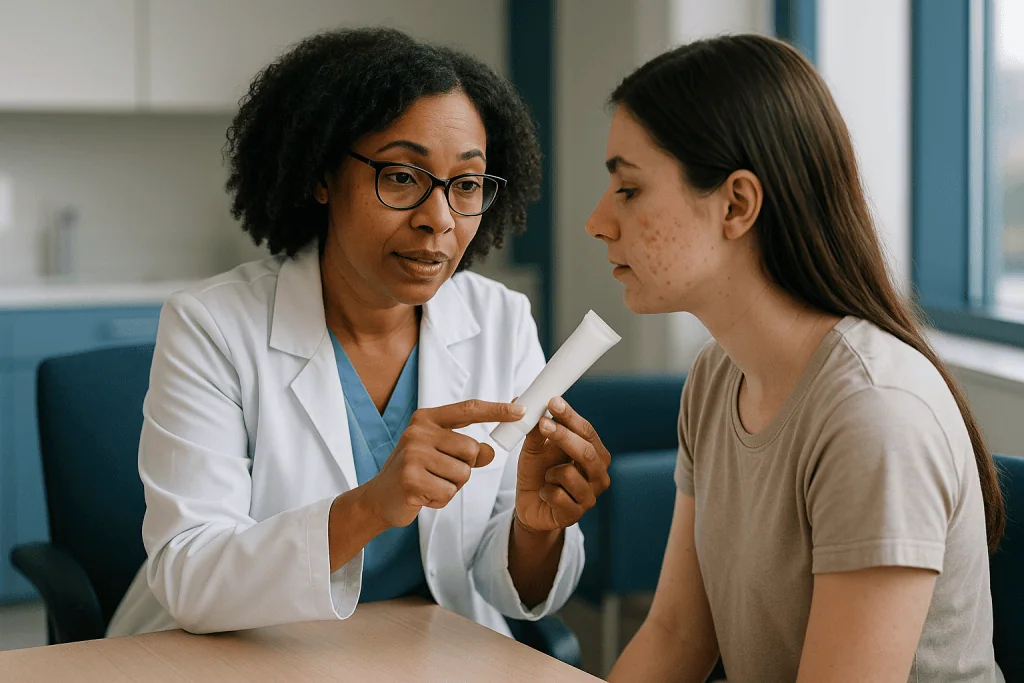
This is a physical assault rather than a chemical lock-and-key attack, which is why bacteria have never developed meaningful resistance to it in the decades it has been sold. Antibiotics such as clindamycin or erythromycin block a specific bacterial process, and bacteria can mutate around that. There is no simple mutation that protects a cell from being oxidized.
The molecule does two more things. It is mildly keratolytic, a term for loosening the dead skin cells that pile up and plug the pore, which helps comedones (the medical name for blackheads and whiteheads) drain. And it modestly reduces inflammation by cutting the bacterial load that triggers the immune response responsible for red, tender pimples.
StatPearls, the NIH-hosted clinical reference, describes onset of benefit within several weeks, with fuller results taking longer because a pore that is already plugged needs time to clear. That timeline matters. Many people abandon a product after ten days because nothing visible has happened, when the bacterial count underneath is already falling.
What benzoyl peroxide does not do is regulate oil production or hormones, so it is rarely a stand-alone answer for deep, cystic acne. It is the reliable workhorse for mild to moderate inflammatory acne and a resistance-blocking partner when antibiotics are prescribed.
The concentration question: does a higher percentage work better?
Store shelves offer benzoyl peroxide in roughly a fourfold range of strengths, and instinct says the strongest number wins. The evidence disagrees.
The often-cited trial dates from the 1980s, when researchers randomized people with acne to gels at low, medium and high concentrations and counted lesions over several weeks. All three groups improved by a similar amount. The difference was tolerability: the highest strength produced markedly more peeling, redness and stinging, and more people stopped using it. Later comparisons and the guideline reviews that draw on them reached the same conclusion, which is why the NHS and Mayo Clinic both note that lower-strength products are usually tried first.
Why would a stronger product not kill more bacteria? Because the bottleneck is not the amount of oxidant available but how much reaches the pore before it degrades on the surface of the skin. Beyond a certain point, the extra molecules mostly oxidize the outer skin layer, which is what causes irritation, rather than doing additional work below.
Vehicle matters as much as number. A gel tends to be drying and penetrates well; a cream or lotion is gentler; a wash spends only seconds on the skin before rinsing, so it delivers less to the pore but also bleaches less. Newer microencapsulated formulations wrap the active ingredient in silica shells so it releases slowly, an approach designed to keep efficacy while reducing irritation. Randomized trials of one such cream in rosacea showed meaningful improvement over vehicle, which led to a US approval in 2022 for that indication.
The honest summary: concentration is a tolerability dial more than an efficacy dial. Which strength and which vehicle suits a particular face is a conversation for the label first and a pharmacist or clinician second.
Benzoyl peroxide vs salicylic acid and other acne treatments compared
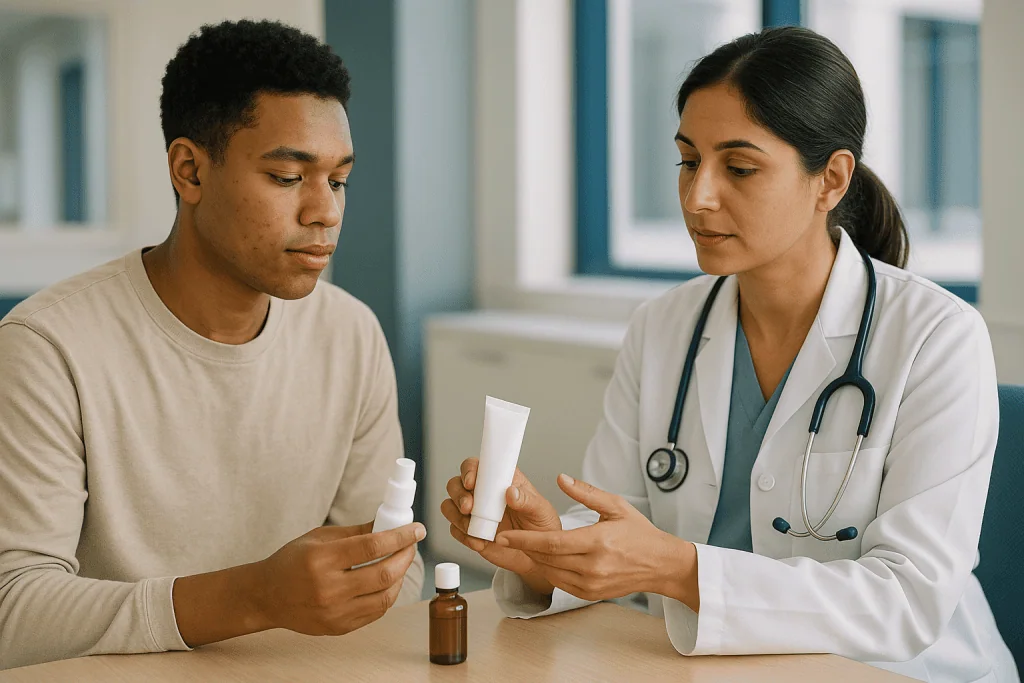
People rarely choose benzoyl peroxide in a vacuum; they weigh it against the other names on the shelf. The table below summarizes what each does and how solid the evidence is, drawing on the NIH StatPearls review, Mayo Clinic and Cleveland Clinic acne resources.
| Treatment | Main action | Best evidence for | Evidence strength | Common trade-off |
|---|---|---|---|---|
| Benzoyl peroxide | Kills acne bacteria via oxygen; loosens pore plugs | Mild to moderate inflammatory acne; preventing antibiotic resistance | Multiple randomized trials; guideline first-line | Dryness, irritation, bleaching |
| Salicylic acid | Oil-soluble exfoliant that dissolves pore plugs | Blackheads and whiteheads; oily skin | Smaller trials; guideline notes limited data | Weaker against inflamed pimples |
| Adapalene (topical retinoid) | Normalizes skin-cell turnover; anti-inflammatory | Comedonal and inflammatory acne; maintenance | Large randomized trials; guideline first-line | Initial irritation; sun sensitivity |
| Topical antibiotics | Block bacterial protein synthesis | Inflammatory acne, only combined with benzoyl peroxide | Randomized trials; not recommended alone | Resistance if used solo |
| Azelaic acid | Antibacterial and lightens post-acne marks | Acne with dark spots; pregnancy-friendly option | Randomized trials, moderate | Slow onset |
The pairing that appears again and again in guidelines is benzoyl peroxide plus a topical retinoid. One dissolves the plug and calms inflammation; the other keeps bacteria in check. Salicylic acid is the gentler cousin for people whose problem is mostly clogged pores rather than angry red bumps, and it does not bleach towels, which is a real quality-of-life point for some.
None of these is a race with a single winner. Acne is several overlapping problems, and the combination that matches a person’s pattern tends to beat any lone ingredient.
Benzoyl peroxide for back acne and other body breakouts
Back and chest acne behave differently from facial acne, and benzoyl peroxide happens to suit those differences. The skin there is thicker, the pores are larger and more oil-rich, and the area is hard to reach, so a leave-on gel applied by hand is impractical for many people. Washes and foams were designed for exactly this.
A benzoyl peroxide wash works in a short window. The active ingredient contacts the skin for the time it takes to lather and rinse, which limits how much reaches the pore. Clinicians often counsel leaving the lather on the skin for a minute or two before rinsing to give it working time; the specific approach belongs to the label and the person’s own tolerance. Because the product rinses off, dryness and bleaching are both reduced compared with leave-on formulas, though not eliminated. White towels are still at risk.
Body acne also carries a diagnostic caveat. Uniform, itchy, small bumps across the chest and back that do not respond to acne treatment can be pityrosporum folliculitis/">folliculitis, a yeast overgrowth in hair follicles that needs an antifungal rather than an antibacterial. Benzoyl peroxide will not help it and may irritate it. Sweat-trapping fabrics, backpack straps and post-workout delay before showering all worsen mechanical acne, and no wash compensates for a shirt that stays damp for hours.
Randomized-trial evidence specific to truncal acne is thinner than for the face; most guidance extrapolates from facial studies plus expert opinion. That is an honest gap. What the evidence does support is that the mechanism does not change with location, so an ingredient that clears facial bacteria is expected to work on the back when it can reach the pores.
Does benzoyl peroxide bleach clothes, towels and hair?
Yes, and it does so permanently. This is the same oxidizing action that kills bacteria, pointed at a different target.
Most fabric dyes are large colored molecules whose color comes from a specific arrangement of chemical bonds. Oxidizers break those bonds, and once the arrangement is destroyed the color cannot return. That is why a bleached patch on a navy shirt turns orange or pinkish rather than fading evenly: the dye’s blue and black components oxidize first, leaving the warmer pigments behind. Laundry bleach uses a different oxidizer to do the same thing on purpose.
The damage often happens invisibly. Residue on fingertips transfers to a towel; a pillowcase absorbs product from a treated cheek overnight; a damp bath mat picks it up from bare feet after a body wash. Heat from the dryer completes the reaction, which is why the stain frequently appears after laundering rather than before, leading people to blame the detergent.
Hair is a protein, not a dye, but its color comes from melanin pigments that are also vulnerable to oxidation. People who apply benzoyl peroxide near the hairline, eyebrows or beard sometimes notice lightening over weeks. The effect is gradual and usually subtle, but it is real and documented in product labeling.
The bleaching has nothing to do with quality or concentration in a linear way; even lower-strength products will mark fabric given time and contact. Dark towels are simply a lost cause if they touch a treated face while it is still damp. The next section covers the practical workarounds that actually hold up.
Living with the bleaching problem without giving up the treatment
Dermatology nurses tend to give the same handful of tips, and they work because they respect the chemistry rather than fight it.
The single most effective move is time. Benzoyl peroxide continues to oxidize as long as it is wet and in contact with a surface. Letting a leave-on product dry fully before dressing, lying down or pulling a shirt over the head removes most of the transfer. Washing hands thoroughly after applying removes the fingertip reservoir that otherwise migrates to door handles, phone cases and hand towels.
Color choice comes next. White pillowcases, white towels and white washcloths cannot lose what they do not have. Many people keep a dedicated set for the acne-treatment months. If white feels clinical, pale neutral shades show bleaching far less than saturated blues, blacks and reds.
Timing helps too. Applying a leave-on product in the morning, after dressing, and washing it off before bed shifts the bleaching risk away from bedding entirely. Whether that timing fits a particular regimen depends on what else is being used and on the label’s directions.
Hairline discipline matters for anyone who colors their hair or has dark brows. Keeping application a finger’s width away from the hairline and brows prevents the slow lightening described earlier. A rinse-off wash used in the shower carries less risk than a gel left overnight.
One thing that does not work is trying to reverse a bleach mark. The dye is gone. Fabric dye pens or re-dyeing are the only options, and most people simply retire the garment. Framing the stain as a known cost of a treatment that works, rather than a mystery, tends to make it easier to accept.
What side effects does benzoyl peroxide cause, and which are rare?
Nearly everyone who uses benzoyl peroxide experiences some dryness, and a large share notice mild redness or flaking in the first weeks. These are predictable consequences of oxidizing the outer skin layer, and MedlinePlus and the NHS list them as the expected adjustment period. They usually ease as the skin adapts, and a plain, fragrance-free moisturizer applied at a different time of day is the standard companion.
Stinging on application, a feeling of tightness and mild peeling fall in the same common bucket. Sun sensitivity is modest compared with retinoids but real enough that daily sunscreen is routinely advised, and benzoyl peroxide can also degrade some sunscreen filters, another reason to separate them in time.
Allergic contact dermatitis is the uncommon but important reaction to recognize. Estimates from patch-testing studies put true allergy at roughly one to two percent of users. Unlike ordinary irritation, which is confined to where product was applied and fades with rest, an allergic reaction produces intense itching, swelling, weeping or blistering, sometimes spreading beyond the application area. It does not settle with continued use and requires stopping the product and medical assessment.
Severe reactions are rare. Product labeling in the US carries a warning about the possibility of serious allergic reactions including throat tightness, facial swelling or difficulty breathing, because a small number of such cases were reported to regulators. They are emergencies.
Benzoyl peroxide is not absorbed into the bloodstream in meaningful amounts; what penetrates the skin is converted to benzoic acid and excreted. That pharmacology underpins the long safety record and explains why systemic side effects are essentially absent in the literature.
Combining benzoyl peroxide with retinoids and antibiotics
The evidence for combining benzoyl peroxide with other topicals is stronger than the evidence for using it alone, and the combinations are where prescribing decisions live.
With topical antibiotics, the case is settled. Randomized trials of clindamycin plus benzoyl peroxide consistently outperform either ingredient by itself, and guidelines now state plainly that topical antibiotics should not be used without a benzoyl peroxide partner. The reason is resistance: C. acnes strains resistant to clindamycin and erythromycin have become common worldwide, and benzoyl peroxide kills resistant and susceptible strains alike, protecting the antibiotic’s usefulness. Fixed-dose combination products exist by prescription; whether one is appropriate is the prescriber’s call.
With retinoids, chemistry dictates the pairing. Tretinoin, the older retinoid, is oxidized and inactivated by benzoyl peroxide when the two sit together on the skin, so clinicians traditionally separate them, one in the morning and one at night. Adapalene, a newer retinoid, is chemically stable alongside benzoyl peroxide, and a fixed combination gel of the two has strong randomized-trial support and a US approval, including for adolescents. The top-ranking clinical literature on this combination reflects how central it has become to moderate acne treatment.
Layering with over-the-counter exfoliants such as salicylic acid or glycolic acid is not dangerous but compounds irritation, and most dermatologists advise against stacking several drying actives at once. Vitamin C serums are partly oxidized by benzoyl peroxide, making them less effective if applied together.
Every combination in this section is a treatment plan, not a shopping list. Which partner, in which order, at which time of day is a decision that belongs with the clinician who knows the person’s skin and history, and the label of each product should be read before any pairing.
The benzene question, explained calmly
Because this issue drove much of the recent search traffic, it deserves its own plain-language treatment, free of alarm and free of dismissal.
Benzene is a chemical used in industry and present in gasoline fumes, cigarette smoke and urban air. Long-term, high-level occupational exposure is linked to blood cancers, which is why it is classified as a human carcinogen. Benzoyl peroxide is a reactive molecule, and one of its degradation pathways under heat produces benzene. Note the distinction: benzoyl peroxide is not benzene, and the two are chemically different despite the shared syllable.
The 2024 laboratory report that started the discussion incubated products at temperatures well above normal storage and found benzene forming, more so in some formulations than others. Regulators responded with independent testing of more than ninety products in 2025. Most showed no detectable benzene or levels below the interim acceptable limit; a few lots exceeded it and were recalled from store shelves. The agency assessed the risk from the low levels found as low and did not advise people to stop using benzoyl peroxide.
The 2025 observational cancer study adds context from the other direction: among hundreds of thousands of users followed in health records, cancer diagnoses were not more common than among non-users. Observational data cannot rule out small risks, but it can rule out large ones, and it did.
Where does that leave a person with a tube in the bathroom? With three modest actions supported by the regulator’s own guidance: store the product at room temperature away from heat and sunlight, do not leave it in a car, and discard products past their expiration date. Anyone who remains uneasy can raise it with a pharmacist or clinician, and alternatives exist. This is a manufacturing and storage question, not a reason to fear the molecule itself.
Common myths about benzoyl peroxide
Viral skin-care content has attached several claims to benzoyl peroxide that the evidence does not support. Here are the ones that surface most often.
Myth: the strongest percentage clears acne fastest. Randomized trials since the 1980s show comparable lesion reduction across strengths, with higher concentrations mainly adding irritation. Stronger is not faster; it is drier.
Myth: it causes cancer. Benzoyl peroxide itself has been studied for decades without evidence of carcinogenicity in humans, and a 2025 analysis of several hundred thousand users found no increase in cancer. The 2024–2025 concern was about benzene forming in some improperly stored products, which regulators addressed through testing and limited recalls. That is a storage and quality-control issue, not a property of the medicine when used as labeled.
Myth: bacteria become resistant to it. Because it works by oxidation rather than blocking a single bacterial pathway, no meaningful resistance has emerged in over fifty years of use. Guidelines recommend it specifically to prevent resistance to topical antibiotics.
Myth: if skin burns and peels, it is working. Irritation is a side effect, not a marker of efficacy. Excessive dryness damages the skin barrier and can worsen inflammation. Comfortable use over weeks beats aggressive use over days.
Myth: it lightens dark spots. It bleaches fabric and hair, but it does not reliably fade post-acne hyperpigmentation, the dark marks left after pimples heal. Azelaic acid, retinoids and sun protection have better evidence there.
Myth: it is only for teenagers. Adult acne is common, particularly in women, and the mechanism does not care about age. The NHS and Mayo Clinic describe it as appropriate for adults and adolescents alike, with children’s use guided by a clinician.
What the evidence actually says, graded
Medical claims come in tiers of certainty, and benzoyl peroxide gives a useful example of how those tiers stack up.
Strong evidence, multiple randomized controlled trials: benzoyl peroxide reduces inflammatory and non-inflammatory acne lesions compared with vehicle; combining it with adapalene or with clindamycin outperforms either ingredient alone; lower and higher concentrations produce similar lesion reductions with different irritation profiles. These findings underpin its first-line status in the 2024 US guideline and in NHS guidance.
Moderate evidence, randomized trials in a specific population: a microencapsulated formulation improves papulopustular rosacea versus vehicle, supporting its 2022 approval for that use. Data on maintenance therapy after acne clears, using benzoyl peroxide to keep it away, come from smaller trials and are encouraging rather than definitive.
Observational evidence, large but not randomized: no association between benzoyl peroxide use and cancer in a 2025 health-records analysis of several hundred thousand people. Observational studies can be confounded by who chooses to use a product, so this is reassuring but not proof.
Laboratory and regulatory evidence: benzene can form when products are heated far above room temperature; most products tested by regulators in 2025 were within limits. This tells us about storage and manufacturing, not about clinical outcomes.
Expert opinion and extrapolation: specific advice about back acne, hairline avoidance, timing relative to other actives, and letting product dry before dressing. Sensible, mechanistically grounded, and not tested in trials.
Notice what is absent: any high-quality evidence that benzoyl peroxide treats hormonal cystic acne on its own, fades dark spots, or works meaningfully better at higher strengths. When an influencer’s claim falls outside the first two tiers, it deserves skepticism proportionate to how far outside it sits.
Is benzoyl peroxide safe in pregnancy, for children and for rosacea?
These three questions arrive constantly in clinic, and each has a slightly different answer.
Pregnancy and breastfeeding. Because so little benzoyl peroxide is absorbed and what does penetrate becomes benzoic acid, a compound already present in many foods, it is generally regarded as low risk during pregnancy. Randomized trials in pregnant people do not exist for ethical reasons, so this rests on pharmacology and long observational experience rather than trial data. The NHS notes it can usually be used in pregnancy but recommends discussing it with a midwife, pharmacist or doctor first. Nursing parents are advised to avoid applying it anywhere a baby’s skin or mouth will touch.
Children and adolescents. Acne treatment typically begins in adolescence, and benzoyl peroxide has been studied in that age group extensively, including in combination products approved for children as young as nine in the US. Use in younger children is a clinician’s decision, since acne before puberty can signal an underlying hormonal issue that needs evaluation.
Rosacea. Traditional benzoyl peroxide products are often too irritating for rosacea-prone skin, and their use for rosacea is off-label. The microencapsulated cream approved in 2022 is a different story: it carries a specific US approval for inflammatory rosacea lesions, based on randomized trials showing clearer skin than vehicle. Whether a given person’s redness is acne, rosacea or both is a distinction that benefits from a clinical eye, and treating rosacea with an ordinary acne gel can make flushing worse.
People with eczema, very dry skin or a known sensitivity to benzoic acid derivatives fall into a fourth group who should raise the question before starting, since barrier-damaged skin tolerates oxidizers poorly.
When to see a doctor about benzoyl peroxide or your acne
Most people can trial an over-the-counter benzoyl peroxide product according to its label without a clinic visit. Certain signs, though, mean the plan should change hands.
Red-flag signs that need urgent care: swelling of the face, lips, tongue or throat; difficulty breathing or a feeling of throat tightness; widespread hives; or blistering and peeling that extends well beyond where the product was applied. These suggest a serious allergic reaction. Stop the product and seek emergency care.
Signs to book a prompt appointment: intense itching, weeping, crusting or swelling at the application site that does not settle within a day or two of stopping, which points to contact allergy rather than ordinary irritation; skin that cracks, bleeds or becomes painful; or eyes that are red and irritated after accidental exposure.
Reasons to consult even without a reaction: acne that has not improved after roughly two to three months of consistent labeled use; deep, painful nodules or cysts, which rarely respond to topical treatment alone and carry scarring risk; acne that is leaving scars or dark marks; acne appearing in a child before puberty; sudden severe acne in an adult, particularly alongside irregular periods, excess hair growth or hair thinning, which can indicate a hormonal cause; or a rash on the trunk that looks uniform and itchy, which may be a yeast folliculitis rather than acne.
A clinician can confirm the diagnosis, choose a concentration and vehicle to match the skin, decide whether a retinoid or antibiotic partner is warranted, and set expectations about time. Anyone already using a prescribed acne regimen should not stop or add products without checking, since stopping the benzoyl peroxide component of an antibiotic combination removes the safeguard against resistance. The prescribing clinician owns those decisions; this article is meant to make the conversation better informed, not to replace it.
Frequently asked questions
How long does benzoyl peroxide take to work on acne?
Most people notice fewer new pimples within about four weeks, with fuller improvement taking two to three months. The bacterial count falls quickly, but pores already plugged need time to clear, so early weeks can look unchanged. Clinical references describe this delay as normal. If there is no improvement after roughly three months of consistent labeled use, a clinician can reassess the diagnosis and plan.
Does benzoyl peroxide bleach clothes permanently?
Yes. It oxidizes fabric dyes, destroying the chemical bonds that create color, so bleached patches cannot be restored by washing. Marks typically appear as orange or pink spots on dark fabric, often after the dryer completes the reaction. Letting product dry fully before dressing, washing hands after applying and using white towels and pillowcases are the reliable ways to prevent it.
Is a benzoyl peroxide wash as effective as a leave-on gel?
A wash delivers less active ingredient because it stays on the skin only briefly before rinsing, so leave-on gels generally have stronger trial evidence for facial acne. Washes are practical for the back and chest and cause less dryness and bleaching. Trial data specific to washes are thinner, and the choice between formats is usually guided by location, skin sensitivity and a clinician’s advice.
Benzoyl peroxide vs salicylic acid: which is better for acne?
Benzoyl peroxide has stronger randomized-trial evidence, particularly for red, inflamed pimples, because it kills the bacteria driving inflammation. Salicylic acid dissolves oil and loosens pore plugs, making it a gentler choice for blackheads and whiteheads, and it does not bleach fabric. Guidelines note salicylic acid’s evidence base is more limited. Many people with mixed acne end up using both at different times of day.
Can benzoyl peroxide cause cancer?
Current evidence does not show that it does. The molecule itself has been used for decades without evidence of causing cancer in humans, and a 2025 observational study of several hundred thousand users found no increase in cancer diagnoses. The recent concern involved benzene forming in some products exposed to high heat, which regulators addressed through testing and limited recalls while advising room-temperature storage.
Why does benzoyl peroxide make my skin dry and peel?
It oxidizes the outermost skin cells as well as bacteria, which strips some of the lipids that hold moisture in and loosens dead cells so they flake. This is expected in the first weeks and usually eases as the skin adjusts. A fragrance-free moisturizer applied at a different time of day helps. Peeling is a side effect, not a sign of effectiveness, and severe cracking or bleeding should prompt a clinician visit.
Can I use benzoyl peroxide with tretinoin or adapalene?
Adapalene is chemically stable alongside benzoyl peroxide, and a fixed combination of the two has strong trial support and a US approval. Tretinoin is oxidized and weakened when applied at the same time, so clinicians usually separate them, one in the morning and one at night. Any combination of prescription topicals should follow the prescribing clinician’s plan rather than be assembled independently.
Does benzoyl peroxide work for back acne?
Its mechanism is the same on any skin with pores, so it is expected to help back and chest acne when it can reach them. Washes and foams suit these hard-to-reach areas. Direct trial evidence for truncal acne is thinner than for the face and relies partly on extrapolation and expert opinion. Uniform itchy bumps that do not respond may be yeast folliculitis, which needs a different treatment.
Is benzoyl peroxide safe to use during pregnancy?
It is generally considered low risk because very little is absorbed through the skin and what does penetrate becomes benzoic acid, a compound common in foods. No randomized trials exist in pregnancy, so this rests on pharmacology and long experience. The NHS advises that it can usually be used but recommends checking with a midwife, pharmacist or doctor before starting or continuing it while pregnant or breastfeeding.
What is an allergic reaction to benzoyl peroxide like compared with normal irritation?
Ordinary irritation is dryness, mild redness and stinging confined to where product was applied, easing with rest. True contact allergy, estimated in roughly one to two percent of users, brings intense itching, swelling, weeping or blistering that may spread beyond the application area and does not settle with continued use. Swelling of the face or throat or trouble breathing is an emergency requiring immediate care.
References
- Benzoyl Peroxide – StatPearls, NIH National Library of Medicine
- Benzoyl Peroxide Topical – MedlinePlus Drug Information
- Benzoyl peroxide – NHS Medicines A to Z
- Acne: Causes, Types, Treatment and Prevention – Cleveland Clinic
This article is for general information only and is not a substitute for professional medical advice. Please consult a qualified doctor about your individual situation.

More from the Blog
Sun Protection With Vitiligo: Why Depigmented Skin Burns Faster and How to Care for It Daily
People with vitiligo sunburn faster because depigmented patches have lost melanocytes, the cells that make melanin, the pigment that absorbs ultraviolet light before it…
Does Seborrheic Dermatitis Cause Hair Loss?
Seborrheic dermatitis does not usually destroy hair follicles, so it is not a classic cause of permanent hair loss. It can, however, trigger temporary…

Why Dandruff Treatment Takes Time to Work and Why Stopping Early Brings the Flakes Back
Dandruff treatment usually takes several weeks to show a clear difference, because medicated shampoos slow the yeast and skin-cell buildup that create flakes rather…

When Hives Come With Lip, Tongue or Throat Swelling: Why It Is Treated as Urgent
Hives with lip swelling mean the reaction has moved from the skin surface into deeper tissue, a process called angioedema. Most episodes settle on…
Is Laser Hair Removal Permanent? What Permanent Reduction Really Means
Laser hair removal is not fully permanent for most people. It delivers long-term hair reduction: after a full course, typically four to six sessions,…
Acne Care During Pregnancy and Breastfeeding: How Dermatologists Adjust the Plan Safely
Acne treatment during pregnancy is usually adjusted rather than abandoned. Dermatologists typically pause oral isotretinoin, topical retinoids, tetracycline antibiotics and hormonal or antiandrogen medicines,…