

Best Exercises for Mobility: A Realistic Routine for Stiff Bodies
Key Takeaways
- Mobility is active, controlled range of motion: you can be passively flexible and still functionally stiff, which is why moving through range beats only holding stretches.
- Ten minutes of mobility work most days outperforms one long weekly session, with measurable range-of-motion gains typically appearing after four to eight weeks.
- Hip internal rotation is often the first range prolonged sitting erases, and the 90/90 hip switch trains it directly without equipment.
- In the knee-to-wall test, touching your knee to a wall with toes about 10 cm away (heel down) is a common benchmark for adequate ankle dorsiflexion.
- Morning joint stiffness lasting longer than about 30 minutes, especially symmetric, in hands or feet, is a recognized inflammatory arthritis feature worth a medical evaluation.
- If you can't walk or stand for long, seated marches, ankle pumps, torso rotations, and overhead reaches preserve joint range from a chair or wheelchair.
The best mobility exercises pair gentle movement with control: cat-cow for the spine, 90/90 hip switches, a half-kneeling hip flexor stretch, open-book thoracic rotations, and ankle rocks. Practiced for about ten minutes most days, they take the major joints through their full range. Evidence suggests noticeable improvements in range of motion typically appear after four to eight weeks of consistent practice.
You know the moment. You drop your keys, bend to grab them, and something in your hips files a formal complaint. Or you twist to check a blind spot and your neck turns maybe two-thirds of the way, so your shoulders finish the job. Nobody warned you that stiffness would arrive quietly, one skipped stretch at a time.
Here is the good news the fitness internet keeps burying under 35-move listicles: your joints respond to movement at almost any age, and the routine that actually works is short, unglamorous, and repeatable. Connective tissue adapts to what you ask of it, and most of us have been asking it to hold a chair shape for eight hours a day.
This is a routine for real bodies with real schedules. No contortion, no equipment, no promises of a ‘bulletproof’ anything. Just what the evidence supports, and what you can honestly do on a Tuesday.
What does 'mobility' actually mean, and how is it different from flexibility?
Flexibility is how far a joint can go when something else moves it, gravity, your hands, a strap. Mobility is how far you can take it yourself, with control. The distinction sounds academic until you try it: lie on your back and pull your straight leg toward your chest with your hands. Now let go and hold it there using only your leg muscles. That gap, between what you can be stretched into and what you can actively do, is where most everyday stiffness lives.
Daily life rarely asks for passive flexibility. It asks you to squat to a low cabinet, reach a high shelf, look over your shoulder while merging, get up off the floor after playing with a grandchild. Every one of those is active range of motion under your own power.
This is why mobility training looks different from classic hold-and-breathe stretching. It involves moving joints deliberately through their range, sometimes pausing at the end and gently contracting the muscles there. Harvard Health notes that stretching keeps muscles long and pliable so joints can move through their full range, but the ‘moving through’ part is the piece many routines skip.
The practical upshot: if your routine consists only of passive holds, you’re training half the equation. The exercises in this article ask your body to earn its range, not just visit it.
Why do bodies get stiff in the first place?
Stiffness is rarely a malfunction. Mostly, it’s an adaptation: your tissues becoming very good at the shapes you put them in.
A few mechanisms drive it. Muscles and the connective tissue around them adjust their resting length to habitual positions; sit for eight hours and your hip flexors spend eight hours shortened. Joints rely on movement to circulate synovial fluid, the lubricant inside the joint capsule, so long stillness genuinely does make the first movement feel creaky. And with age, tissues gradually hold less water and lose some elastic quality, which is why a 55-year-old’s hamstrings feel different from a 25-year-old’s even at identical activity levels.
Then there’s the nervous system, the underrated player. Your brain limits range it doesn’t trust. If you haven’t been into a deep squat in five years, your nervous system treats that position as unfamiliar territory and puts on the brakes early. Regular, gentle exposure teaches it the position is safe, and range often returns faster than tissue change alone would explain.
None of this is a life sentence. The same adaptability that made you stiff works in reverse. Tissue remodels in response to consistent demand, slowly, over weeks, which is why the honest answer to ‘how long until I’m less stiff?’ is measured in weeks of regular practice, not days of heroic effort.
What are five good exercises for mobility?
If you only learn five moves, learn these. Together they cover the spine, hips, and ankles: the three areas where stiffness causes the most daily friction.
- Cat-cow. On hands and knees, alternate between rounding your back toward the ceiling and letting your belly sink while your chest lifts. Move slowly, one vertebra at a time, matching movement to breath. Eight to ten slow cycles.
- 90/90 hip switch. Sit on the floor with one leg bent 90 degrees in front, the other bent 90 degrees to the side. Rotate both knees to the opposite side without using your hands, then back. This trains hip internal and external rotation: the ranges sitting erases first.
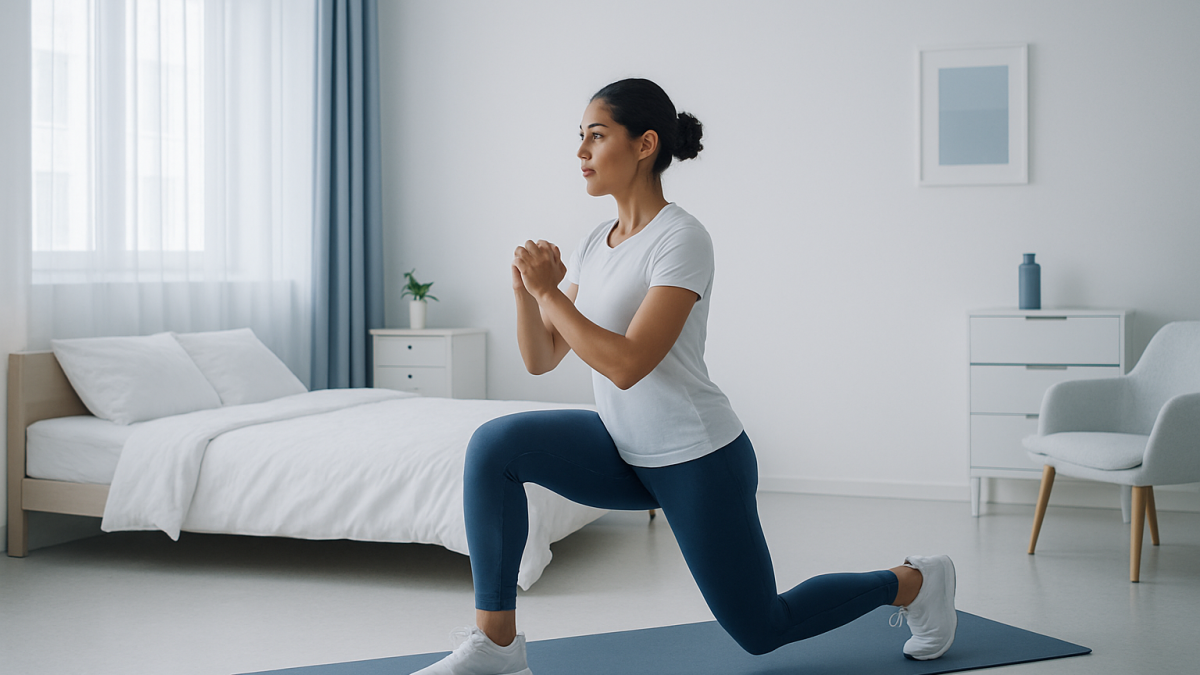
- Half-kneeling hip flexor stretch with reach. In a lunge position with the back knee down, tuck your pelvis slightly, shift forward until you feel the front of the back hip, and reach the same-side arm overhead. Hold 30 to 45 seconds per side.
- Open-book rotation. Lie on your side, knees bent and stacked, arms extended together in front. Sweep the top arm across your body like opening a book, letting your chest rotate while your knees stay down. Six to eight per side.
- Ankle rocks. In a half-kneeling position, drive the front knee forward past your toes, heel down, then rock back. Ten slow reps per side.
Every move should feel like firm stretch or mild effort, never sharp pain. Range comes from repetition, not force.
The realistic 10-minute routine, start to finish
Here is the whole thing, in the order that makes sense: spine first to wake things up, then ankles and hips, finishing with the positions that demand the most range. No equipment beyond a bit of floor and, optionally, something soft under your knees.
| Move | Main target | Time or reps |
|---|---|---|
| Cat-cow | Spine, segment by segment | 10 slow cycles (~1 min) |
| Ankle rocks | Ankle dorsiflexion, calves | 10 per side (~1.5 min) |
| 90/90 hip switches | Hip rotation, both directions | 8 per side (~1.5 min) |
| Half-kneeling hip flexor stretch + reach | Front of hip, side body | 40 sec per side (~1.5 min) |
| Open-book rotation | Mid-back rotation, chest | 6 per side (~1.5 min) |
| Wall slides | Shoulders, upper back | 10 reps (~1 min) |
| Supported deep squat hold | Everything at once | 30–60 sec (~1 min) |
For the squat hold, sink as low as comfortable while holding a doorframe or heavy furniture for balance. Can’t get low yet? Sit on a low step instead and lean gently side to side. The squat is a destination, not an entry requirement.
Frequency matters more than duration. The NHS recommends flexibility work at least twice a week as a floor; most people stiff enough to be reading this will do better with five short sessions a week than one long one. Ten minutes, most days, wins.
Hips: where most modern stiffness lives
If chairs had a lobbying group, hips would be their biggest victory. Prolonged sitting parks the hip flexors in a shortened position and asks nothing of the rotational muscles, and hip internal rotation, the ability to turn your thigh inward, is often the first range to quietly disappear. You notice it later as an awkward pivot, a wider turning circle when you change direction, a hip that ‘catches’ getting out of the car.
The 90/90 switch earns its place because it trains both rotation directions in one move, actively. Start easy: if sitting upright in the position is hard, lean back on your hands. Progress by sitting taller, then by lifting the hands off the floor entirely.
Two additions round out the hips when you have a few extra minutes:
- Glute bridge. Lie on your back, knees bent, and lift your hips until your body forms a line from knees to shoulders. Squeeze at the top for two seconds. Ten to fifteen reps. This builds strength in hip extension: the exact range the hip flexor stretch opens up. Range without strength tends not to stick.
- Standing hip circles. Holding a counter, lift one knee and draw the biggest slow circle you can with it, five in each direction. It looks silly and works well.
A note on soreness: the front-of-hip stretch can feel intense for chronic sitters. Firm pulling is fine. Pinching in the joint itself is your cue to reduce depth.
Spine: your mid-back is stealing range from your neck and lower back
The thoracic spine, the twelve vertebrae attached to your ribs, is built for rotation. When it stiffens, the rotation still has to come from somewhere, so the neck and lower back pick up the slack. That’s often the hidden story behind a cranky neck at the end of a driving day: it isn’t the neck’s fault; it’s doing overtime for a mid-back that clocked out.
Cat-cow addresses this segmentally. The common mistake is hinging entirely from the lower back and shoulders while the mid-back stays flat as a plank. Slow down until you can feel individual sections of your spine participating. If that awareness isn’t there yet, it will come: this is nervous-system learning as much as tissue work.
The open-book rotation targets rotation directly, and breath is the cheat code: exhale slowly as you rotate, and you’ll usually find another few degrees as your ribcage softens. Keep both knees anchored so the movement comes from your torso, not your hips rolling along for the ride.
When you want a third option, try thread-the-needle: from hands and knees, slide one arm underneath your body along the floor, letting your shoulder and ear lower toward the ground, then sweep it back and up toward the ceiling. Five slow reps per side. It combines rotation with the reaching motion daily life actually uses, grabbing a seatbelt, reaching across a table, pulling something from the back seat.
Shoulders: reaching overhead shouldn't require a plan
Shoulder mobility fades politely. You don’t notice the loss until the overhead bin, the top shelf, or the moment you reach back to grab a sweater from the back seat and something objects.
The shoulder is the most mobile joint in the body, which also makes it the most dependent on the structures around it, especially the shoulder blade, which glides along the ribcage and contributes a large share of overhead reach. Train the whole system, not just the ball-and-socket:
- Wall slides. Stand with your back near a wall, forearms against it in a goalpost shape. Slide your arms upward as far as you can while keeping forearms and hands in contact, then draw them back down. Ten slow reps. If the wall version is frustrating, do it lying on your back first, gravity becomes your assistant instead of your opponent.
- Slow shoulder circles. Stand tall, one arm at your side. Trace the largest, slowest circle you can with your whole arm, keeping the elbow straight, five in each direction. The slowness is the point: you’re mapping your full available range under control.
- Doorway chest opening. Forearm on a doorframe, elbow at shoulder height, step gently through until you feel the front of your chest. Hold 30 seconds per side. Desk work shortens this region relentlessly.
One caution worth taking seriously: shoulders are less forgiving of forced range than hips. Work strictly within pain-free territory, and if reaching overhead produces sharp pain rather than stretch, that’s a question for a clinician, not a stretching app.
Ankles: the joint everyone skips (and shouldn't)
Nobody brags about ankle mobility, but it quietly governs how everything above it moves. Descending stairs, squatting to the floor, walking downhill, even standing up from a low chair, all of it depends on dorsiflexion, the shin traveling forward over the foot. When ankles won’t bend, knees and hips improvise, and their improvisations are rarely elegant.
Want a quick self-check? Kneel facing a wall with your toes about 10 centimeters (roughly four inches) away. Keeping your heel firmly down, try to touch your knee to the wall. Reaching that distance comfortably is a commonly used benchmark in the knee-to-wall test; falling well short suggests your ankles deserve a spot in the rotation.
The fix is refreshingly simple:
- Knee-to-wall rocks. Same setup as the test, but as an exercise: drive the knee toward the wall, hold two seconds, return. Ten slow reps per side, heel glued down throughout.
- Full-range calf raises. Stand with the balls of your feet on a step, heels hanging off. Lower slowly until you feel a deep calf stretch, then rise as high as you can. Ten reps. This builds strength across the entire range, lowering and lifting both count.
- Ankle circles. Seated or standing on one leg, trace slow circles with your foot, five each way. Modest but useful, especially first thing in the morning.
Stiff ankles also matter for balance. The small, constant corrections that keep you upright on uneven ground happen largely at the ankle, one more reason this unglamorous joint deserves ninety seconds of your day.
What is the best exercise if you can't walk?
Mobility work doesn’t require standing, let alone walking. If you use a wheelchair, are recovering from surgery or illness, or simply can’t be on your feet for long, the principle is identical: move each available joint through its comfortable range, regularly. The NHS publishes a full program of sitting exercises for exactly this reason.
From a sturdy chair (or your wheelchair, brakes on), a solid seated routine looks like this:
- Seated marches. Lift one knee, lower it, alternate. Ten per side. Keeps hips moving and circulation going.
- Ankle pumps and circles. Point and flex each foot ten times, then circle. Small movement, real payoff for stiff ankles and lower-leg blood flow.
- Seated torso rotations. Arms crossed over your chest, rotate slowly to one side as far as comfortable, return, switch. Five per side.
- Overhead and side reaches. Reach one arm toward the ceiling, then gently over toward the opposite side, feeling the stretch along your ribs. Three per side, held a few breaths.
- Seated cat-cow. Hands on knees, alternate rounding and gently arching your back. Eight cycles.
Water-based exercise deserves special mention where it’s accessible: buoyancy supports body weight while water resistance provides gentle load, which is why aquatic programs are so often recommended for people with joint pain or limited standing tolerance.
If a specific condition limits your movement, a physical therapist can build a program around your actual capabilities, genuinely worth the appointment, because the biggest risk in this situation isn’t the wrong exercise. It’s stopping altogether.
How to fix poor mobility: the honest version
The internet sells mobility fixes the way it sells everything: fast, dramatic, before-and-after. The evidence tells a slower, kinder story.
First, consistency beats intensity, decisively. Tissue adapts to repeated, regular signals, not occasional heroic ones. Mayo Clinic’s guidance on flexibility is blunt about the timeline: results take weeks of regular practice, and stopping means the gains gradually reverse. Plan on four to eight weeks before range changes feel obvious, and expect the very first sessions to feel almost pointless. They aren’t. They’re deposits.
Second, pair range with strength. New range that you never load is range your nervous system doesn’t trust, and untrusted range gets taken back. This is why glute bridges follow the hip flexor stretch and calf raises follow ankle rocks in this routine. You open a door, then you walk through it.
Third, reduce the hours working against you. No ten-minute routine fully offsets ten motionless hours. Breaking up sitting every 30 to 60 minutes, stand, roll your shoulders, walk to the window, keeps synovial fluid circulating and muscles out of their shortened parking spots. Think of the routine as training and the movement breaks as maintenance; you need both.
Finally, calibrate expectations to your starting point. A 60-year-old desk worker will not move like a 25-year-old gymnast in eight weeks, and doesn’t need to. The meaningful wins are functional: tying shoes without a strategy session, checking a blind spot with your neck instead of your whole torso, getting off the floor without a countdown.
Are there really 'only 5 exercises you'll ever need'?
No, and it’s worth understanding why, because the myth shapes how people train.
The ‘only five exercises’ framing sells because it promises certainty and simplicity. But bodies differ in joint structure, injury history, activity demands, and where stiffness has settled. A retired carpenter with cranky shoulders, a new parent with a locked-up mid-back, and a marathoner with concrete calves do not share one optimal list. Anyone claiming a universal five is describing their favorite five.
What is nearly universal is the principle: take your major joints, ankles, hips, spine, shoulders, through their full comfortable range, actively, most days, and add gentle strength at the ends of that range. The five moves earlier in this article are a strong default precisely because they express that principle across the joints where modern life extracts the highest toll. They’re a starting lineup, not a sacred text.
There’s also a case for variety over time. Joints benefit from being challenged at different angles and speeds, and your brain refines control of a range faster when it encounters that range in more than one context. After a month of the core routine, swapping the open-book for thread-the-needle, or the 90/90 for standing hip circles, isn’t abandoning the program: it’s the program working as intended.
So keep the healthy skepticism. Any mobility content promising that one short list will fix everything forever is marketing. The five moves here will genuinely help most stiff bodies; they just won’t be the last five moves you ever learn, and that’s a feature.
Common mistakes that keep stiff bodies stiff
Most mobility failures aren’t effort problems. They’re strategy problems, and a handful account for nearly all of them.
- Bouncing into stretches cold. Ballistic bouncing on unwarmed tissue can trigger a protective tightening reflex and raises strain risk. Ease in gradually; the first two reps of any move should be exploratory, not maximal.
- Only doing passive holds. Draping yourself over a stretch and scrolling your phone builds passive flexibility, not usable mobility. Active movement and end-range control are what transfer to daily life.
- Confusing pain with progress. Firm stretch and mild muscular effort are productive. Sharp, pinching, or electric sensations are stop signs, not milestones. ‘No pain, no gain’ has aged badly, and the evidence never supported it for flexibility work anyway.
- Going too big too fast. The deepest expression of a stretch on day one isn’t ambition; it’s a setup for soreness that costs you the next three sessions. Range compounds like interest, small, regular, boring.
- Treating mobility as pre-workout garnish. Ninety rushed seconds before exercise is better than nothing, but the adaptations come from dedicated, unhurried practice. Give it its own ten minutes.
- Measuring against social media. The person doing full splits on your feed has been training that position for years, often since childhood, and their hip sockets may literally be shaped differently from yours. Your benchmark is your own body last month.
One quiet habit fixes half of these: slow down. Nearly every mobility exercise improves when performed at half the speed you instinctively choose.
When should you see a doctor about stiffness?
Ordinary stiffness: the kind that loosens with movement, a warm shower, or a few minutes of the routine above, is a maintenance issue. Some stiffness is a message, and it deserves a clinician rather than a stretching program. Make an appointment if you notice any of the following:
- Morning joint stiffness lasting longer than about 30 minutes, especially in the hands or feet on both sides. Prolonged morning stiffness is a recognized feature of inflammatory arthritis, which benefits from early evaluation.
- A joint that is swollen, warm, or red, or stiffness accompanied by fever. These suggest inflammation or infection, not tightness.
- Sudden loss of range after a fall, twist, or injuryparticularly if the joint locks, gives way, or won’t bear weight.
- Numbness, tingling, or weakness alongside stiffness, which can point to nerve involvement rather than muscle.
- Pain that wakes you at night or doesn’t change with position and movement.
- Unexplained weight loss or fatigue arriving together with new joint symptoms.
- Steadily worsening stiffness despite six to eight weeks of consistent, sensible mobility work. A plateau is normal; steady decline is not.
None of these automatically mean something serious. They mean the cause should be identified before you keep stretching at it, because stretching an inflamed or injured joint can delay the care that would actually help.
And if you’re simply unsure whether an exercise is appropriate for an existing condition, a hip replacement, osteoporosis, recent surgery, ask your doctor or a physical therapist first. Adapted versions exist for nearly everything; guessing is the only bad option.
Frequently asked questions
What are five good exercises for mobility?
Cat-cow for the spine, 90/90 hip switches for hip rotation, a half-kneeling hip flexor stretch with an overhead reach, open-book rotations for the mid-back, and ankle rocks for dorsiflexion. Together they cover the joints where modern sitting habits cause the most stiffness. Perform each slowly, within a firm-stretch-but-no-pain range, for a total of about ten minutes most days of the week.
How do you fix poor mobility?
With consistency rather than intensity: about ten minutes of active range-of-motion work most days, paired with light strengthening at the ends of your new range so the gains stick. Break up long sitting every 30 to 60 minutes. Expect noticeable change after four to eight weeks: Mayo Clinic notes flexibility results take weeks and reverse if you stop. If stiffness worsens despite consistent effort, see a clinician.
Are there really only 5 exercises you'll ever need?
No. That framing is marketing, not evidence. Bodies differ in joint structure, injury history, and daily demands, so no universal five exists. What is nearly universal is the principle: take ankles, hips, spine, and shoulders through their full comfortable range actively, most days, and add gentle strength at end range. A well-chosen five moves, like those in this article, is an excellent start, not a lifetime prescription.
What is the best exercise if you can't walk?
Seated joint-by-joint movement: seated marches, ankle pumps and circles, torso rotations, overhead and side reaches, and seated cat-cow, done daily from a sturdy chair or wheelchair. The NHS publishes a full sitting-exercise program built on exactly these moves. Water-based exercise is another strong option where accessible, since buoyancy supports body weight. For condition-specific limits, a physical therapist can tailor a safe program.
How long does it take to improve mobility?
Plan on four to eight weeks of consistent practice before range-of-motion changes feel obvious, though many people notice easier daily movement, like putting on socks or checking blind spots, sooner. Early sessions often feel unproductive; the adaptation is happening anyway. Gains reverse gradually if you stop, so mobility works best as a permanent ten-minute habit rather than a temporary fix.
Should mobility exercises hurt?
No. Productive mobility work feels like firm stretching or mild muscular effort, roughly a four or five out of ten in intensity. Sharp, pinching, burning, or electric sensations are signals to reduce depth or stop the movement entirely. Pain is not a marker of progress in flexibility training, and pushing through it commonly costs you subsequent sessions to soreness or injury.
Is mobility training the same as stretching?
They overlap but aren’t identical. Traditional stretching is largely passive, holding a position while gravity or your hands create the stretch. Mobility training emphasizes moving joints through their range under your own muscular control, sometimes contracting gently at the end of the range. Passive stretching improves flexibility; mobility work makes that range usable in daily life. Good routines include both, with the emphasis on active movement.
How often should I do mobility exercises?
Most days is ideal: the routine here takes about ten minutes, making daily practice realistic. The NHS recommends flexibility work at least twice weekly as a minimum, and frequency matters more than session length because tissue responds to regular, repeated signals. Even three sessions a week produces progress; five or more accelerates it. Missing a day is irrelevant; missing a month is a restart.
Can older adults still improve mobility?
Yes, meaningfully, at essentially any age. Tissues adapt to consistent movement throughout life, even though age-related changes make progress somewhat slower than at 25. CDC activity guidance for adults 65 and older specifically includes balance and multicomponent movement work alongside aerobic and strengthening activity. Start gently, use supported versions of exercises where needed, and expect functional wins, easier stairs, steadier balance, simpler floor transfers, within weeks.
Should I do mobility work before or after a workout?
Either works, but the jobs differ. Before exercise, use active, movement-based drills, leg swings, cat-cow, ankle rocks, to prepare joints, and save long passive holds for afterward when tissues are warm. For building lasting range, the most effective option is a dedicated session on its own, unhurried, most days. Ninety rushed pre-workout seconds is better than nothing but won’t drive much adaptation by itself.
References
This article is for general information only and is not a substitute for professional medical advice. Please consult a qualified doctor about your individual situation.

More from the Blog
Kegel Exercises for Men: The Pelvic Floor Is Not Just a Women’s Topic
Kegel exercises for men strengthen the pelvic floor muscles that support the bladder, bowel, and erectile function. Tighten the muscles you would use to…

Elliptical vs Treadmill vs Bike: Which Cardio Machine Suits Your Joints and Goals
No single cardio machine is best for everyone. Treadmills burn the most calories per minute and build bone through impact, ellipticals deliver similar heart…

The 12-3-30 Workout: What the Viral Treadmill Routine Does, and Who Should Modify It
The 12-3-30 workout is a treadmill routine: walk at a 12 percent incline, at 3 miles per hour, for 30 minutes. It provides moderate-to-vigorous…

Strength Training for Women: Why Lifting Heavy Does Not Make You Bulky, and What It Does for Bone
Strength training for women does not cause bulky muscle because women produce far less testosterone than men, and visible size requires years of deliberate…

Morning Stretches: A 10-Minute Routine Built From Physiology, Not Instagram
Gentle morning stretching is safe for most people and helps ease overnight stiffness, which comes from cooled muscles, thickened joint fluid, and fluid absorbed…

Muscle Memory Is Real: The Cell Biology Behind Getting Strong Again Faster
Muscle memory is real, and it works on two levels. In the brain, practiced movements are stored as procedural memory, so skills like a…