

Blood Pressure, Alcohol and Caffeine: What Each Drink Does to Your Readings

Key Takeaways
- A 2023 pooled analysis of 19,548 adults found systolic blood pressure rose with alcohol at every intake level, about 1.25 mm Hg at one daily drink and 4.9 mm Hg at four.
- Alcohol lowers blood pressure for the first few hours after drinking and raises it after roughly 12 hours, so the next-morning reading reveals the true cost.
- Heavy drinkers who roughly halve their intake lower systolic pressure by about 5.5 mm Hg in trials, similar to the effect of a single blood pressure medicine.
- Caffeine can raise readings by 5 to 10 mm Hg within 30 to 120 minutes in occasional users, but tolerance develops within days and habitual coffee drinking shows no long-term hypertension link.
- Stopping heavy daily drinking abruptly can trigger withdrawal with raised blood pressure, a racing heart and, in severe cases, seizures, so it should be planned with a clinician.
- Standard measurement protocol means no caffeine, exercise or smoking for 30 minutes before a reading, with alcohol noted in the log because it skews readings in both directions.
Alcohol raises blood pressure in a dose-dependent way: more than about three drinks in one sitting lifts readings temporarily, and regular drinking above moderate limits raises them long term, while cutting back can lower systolic pressure by around 5 mm Hg in heavy drinkers. Caffeine causes a short rise of up to 10 mm Hg, mostly in occasional users, with little lasting effect in habitual coffee drinkers.
Every January the same scene plays out in clinic waiting rooms: someone who swore off wine for the month taps a home monitor app and asks, half proud and half worried, whether the lower number is real or a fluke. As of January 2026 that question is louder than usual. Dry January posts keep resurfacing a 2023 pooled analysis showing that even one daily drink nudges readings upward, a 2025 federal advisory on alcohol and cancer sharpened the national mood, and the updated US hypertension guideline leaned further toward “less is better.” Search interest in blood pressure and alcohol has climbed accordingly, and caffeine has been dragged into the same argument.
The trouble is that most of what circulates online flattens a nuanced body of research into slogans. One drink is either harmless or poison; coffee either spikes your pressure or protects your heart. Neither version survives contact with the studies.
This explainer walks through what actually happens in your arteries, hour by hour and year by year, and grades how sure anyone can be.
Why blood pressure and alcohol are trending: what changed recently
Three dated events explain the current wave of searches.
On July 31, 2023, the American Heart Association journal Hypertension published a dose-response meta-analysis, a study that pools several earlier studies to look for a pattern across them. Researchers combined seven cohort studies from the United States, Korea and Japan covering 19,548 adults followed for about five years. Systolic blood pressure, the top number that reflects pressure when the heart contracts, rose by roughly 1.25 mm Hg in people averaging 12 grams of alcohol a day (just under one US standard drink) and by about 4.9 mm Hg in those averaging 48 grams a day, compared with nondrinkers. The headline that traveled across social media was simple: no safe threshold was found. The fine print mattered too: the diastolic rise, the bottom number reflecting pressure between beats, appeared in men but not in women.
In January 2025 the US Surgeon General issued an advisory linking alcohol to seven cancers and calling for updated warning labels. Blood pressure was not its subject, but the advisory shifted public conversation from “how much is fine” toward “why drink at all,” and the CDC’s alcohol pages now state plainly that less drinking is better for health at every level.
Then, in August 2025, the American Heart Association and American College of Cardiology released an updated high blood pressure guideline. The alcohol limits did not change, still no more than two drinks a day for men and one for women, but the framing moved toward ideally avoiding alcohol for people managing hypertension.
Caffeine rode along on this trend for a different reason: millions of people now own validated home cuffs, and a reading taken 20 minutes after a latte looks alarming. The Mayo Clinic’s guidance on caffeine and blood pressure has become one of the most shared pages on the topic for exactly that reason.
How alcohol raises blood pressure: the mechanism in plain terms
Picture a garden hose. Pressure inside it depends on how hard the tap pushes, how wide the hose is, and how much water is in the system. Alcohol touches all three.

First, the tap. Alcohol activates the sympathetic nervous system, the body’s fight-or-flight wiring, which quickens the heart and tightens the small arteries that set resistance to blood flow. Heart rate rises measurably after even a single drink and stays elevated for hours, a pattern seen consistently in randomized crossover trials where the same volunteers are tested with and without alcohol.
Second, the width of the hose. In the first few hours, alcohol widens blood vessels, which is why your cheeks flush and your readings may actually dip. As the alcohol clears, the balance tips the other way. Alcohol disrupts the baroreceptors, pressure sensors in the neck and chest that normally tell the brain to ease off when pressure climbs, so the usual braking system becomes less responsive. Over months and years of regular drinking, the lining of the arteries becomes less able to release nitric oxide, a molecule that keeps vessels relaxed, and the vessels stiffen.
Third, the volume. Alcohol stimulates the renin-angiotensin-aldosterone system, a hormone chain that tells the kidneys to hold on to sodium and water. More fluid in a stiffer hose means higher pressure. Cortisol, the stress hormone, also runs higher in heavy drinkers, and it nudges the same levers.
Weight gain adds a slow background push. Alcohol carries 7 calories per gram, nearly as dense as fat, and those calories rarely replace food. Each additional kilogram of body weight is associated with a small but real rise in blood pressure, so the glass of wine that feels calorie-free is quietly contributing on a second front.
None of these effects require a drinking problem. They are the ordinary physiology of a drug that happens to be legal and social.
What one drink does to your readings over the next 12 hours
The honest answer is that alcohol has a two-phase effect, and the timing of your cuff decides which phase you catch.
Within the first hour or two after a drink, blood vessels widen and readings often fall slightly. Pooled data from randomized crossover trials, the strongest design for a short-term question like this, show that a moderate amount of alcohol (roughly two standard drinks) lowers systolic pressure modestly for up to about six hours, while heart rate climbs by several beats per minute and stays up. A larger amount, three or more drinks, produces a bigger early dip.
Then the curve bends. Somewhere past the 12-hour mark, as the liver finishes clearing alcohol at its steady pace of roughly one standard drink per hour, the sympathetic nervous system is still revved and the vessels have tightened. Readings rise above where they started. This is why the Mayo Clinic notes that more than three drinks in one sitting temporarily raises blood pressure, and why the morning-after reading is usually the worst of the cycle.
For a single occasional drink in someone with normal pressure, this rise is small, typically a few mm Hg, and it fades within a day. The problem is repetition. Someone who drinks most evenings never spends time in the recovered state. The “temporary” rise becomes the baseline, and the cohort studies in the 2023 Hypertension analysis show that baseline creeping upward year by year in proportion to intake.
A useful mental model: a drink borrows a little calm from the next morning and pays it back with interest. One loan is manageable; a loan every night compounds.
If you track at home, note that this pattern means a reading taken after dinner with wine may look reassuring while the one before breakfast tells the truer story. Both are real; they simply describe different moments in the same cycle.
Does the type of drink matter? Red wine, beer and spirits compared
Red wine has enjoyed decades of flattering press, so it is worth being direct: for blood pressure, the active ingredient is ethanol, and ethanol is identical in a pinot noir, a pilsner and a vodka soda.
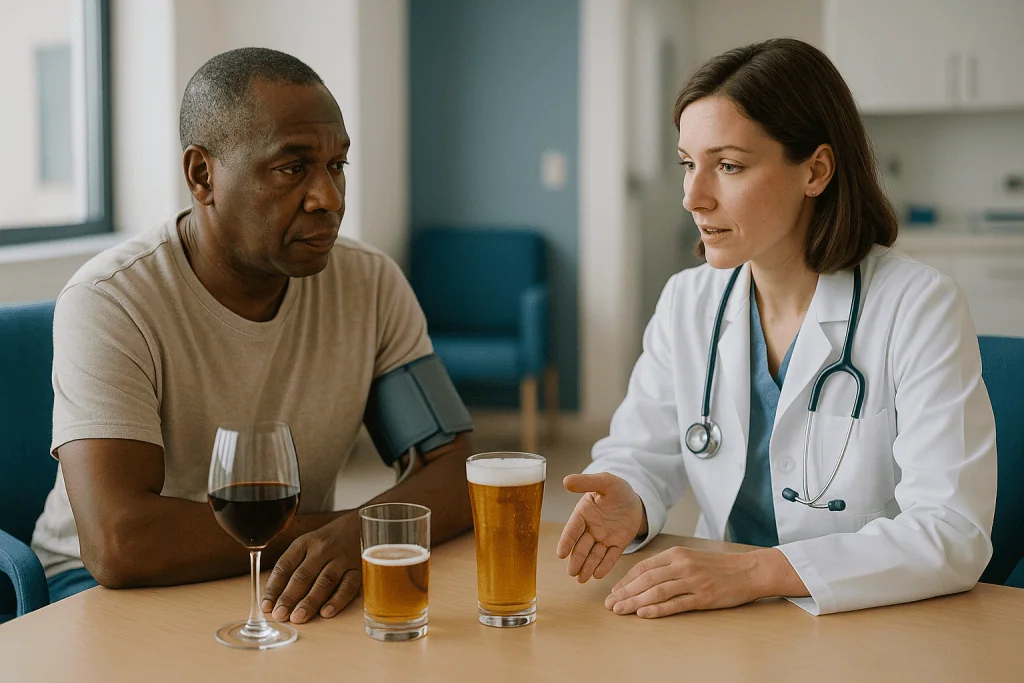
What differs is how much ethanol each serving carries, which is where the idea of a standard drink earns its keep. In the United States a standard drink contains about 14 grams of pure alcohol: a 12-ounce regular beer at 5 percent, a 5-ounce glass of wine at about 12 percent, or 1.5 ounces of distilled spirits at 40 percent. The NHS uses a smaller unit of 8 grams and advises staying under 14 units a week spread over at least three days; a large 250 ml glass of wine is roughly three units on its own.
That arithmetic is the real reason drink type seems to matter. A restaurant pour of wine is often closer to 1.5 standard drinks than one. A craft IPA at 8 percent is nearly two standard drinks in a single pint. Cocktails stack spirits so that a single glass can equal three. People who believe wine is gentler on the heart may simply be underestimating how much they drink.
What about the polyphenols in red wine, the plant compounds credited with protecting arteries? The evidence comes mainly from laboratory studies and observational data, where wine drinkers also tend to have higher incomes, better diets and more access to healthcare. When researchers have tested de-alcoholized red wine in small trials, any blood pressure benefit appeared to come from the grape, not the alcohol. The same compounds are available in grapes, berries and tea without the ethanol penalty.
Mixers add another layer. Sugary sodas and energy drinks bring calories and caffeine; salted rims and bar snacks bring sodium, which raises blood pressure by its own well-established route. A drink is rarely just the alcohol.
Blood pressure and caffeine: what coffee, tea and energy drinks really do
The relationship between blood pressure and caffeine is almost the mirror image of alcohol: sharp in the short term, surprisingly mild over the long term.
Caffeine can cause a short but dramatic rise, up to 10 mm Hg systolic in people who rarely consume it, within 30 to 120 minutes. The mechanism is not fully settled. The leading explanation is that caffeine blocks adenosine, a molecule that helps keep arteries relaxed, and may also prompt the adrenal glands to release more adrenaline. Either way, the effect is real and measurable, which is why standard measurement protocols ask you to avoid caffeine for 30 minutes before checking your pressure.
Regular drinkers tell a different story. Tolerance develops within days. Someone who has two cups every morning typically shows little or no caffeine-related rise, and large cohort studies have not found that habitual moderate coffee drinking raises the risk of developing hypertension. Several, in fact, suggest a neutral or slightly favorable association, though observational data cannot prove protection, and coffee drinkers differ from non-drinkers in many ways.
The practical limit most health authorities cite for healthy adults is the amount in about four regular cups of brewed coffee a day. Above that, the risk of palpitations, jitteriness and poor sleep climbs, and poor sleep raises blood pressure through its own pathway.
Energy drinks deserve separate mention. They combine high caffeine with sugar and other stimulants such as taurine and guarana, and small trials in healthy young adults have shown larger and longer blood pressure rises than coffee delivering the same caffeine. Combining them with alcohol, a common pattern, masks how drunk a person feels without reducing how drunk they are.
Tea sits at the gentle end. A cup of black tea has roughly half the caffeine of coffee, green tea less still, and both carry polyphenols associated in trials with small reductions in blood pressure, on the order of 1 to 2 mm Hg.
Drink by drink: a comparison of short-term and long-term effects
Numbers scattered across a dozen studies are hard to hold in your head. The table below summarizes what mainstream evidence supports for a typical adult. Ranges are approximate; individual responses vary with genetics, body size, sleep and medicines.
| Drink | First 1–6 hours | 12–24 hours later | Regular daily use | Evidence strength |
|---|---|---|---|---|
| One standard alcoholic drink | Slight dip in systolic; heart rate up | Small rise, a few mm Hg, then fades | About 1 mm Hg higher systolic over years per daily drink | Cohort data; small trials |
| Three or more drinks in one sitting | Larger dip; marked heart rate rise | Rise above baseline; worst on waking | Sustained hypertension; roughly 5 mm Hg higher at four daily drinks | Randomized crossover trials; cohorts |
| Brewed coffee, occasional user | Rise of 5–10 mm Hg within 30–120 minutes | Back to baseline | Tolerance develops; no clear long-term rise | Small trials; large cohorts |
| Brewed coffee, daily user | Little or no rise | None | Neutral or slightly favorable association | Observational data |
| Energy drink | Rise larger and longer than equivalent coffee | Usually back to baseline | Limited data; concern in people with heart conditions | Small trials in young adults |
| Black or green tea | Mild rise in caffeine-naive people | None | Small reduction of 1–2 mm Hg in trials | Small randomized trials |
Two patterns stand out. Alcohol’s harm lives in the second and third columns, the delayed rebound and the cumulative drift. Caffeine’s effect lives almost entirely in the first column, and even that disappears with habit.
A third pattern is easy to miss: evidence strength differs by row. The alcohol rows rest on tens of thousands of people followed for years plus controlled trials; the energy drink row rests on a handful of small studies. Confidence should follow the data, not the headline.
What the evidence actually says, graded by strength
Good medicine sorts claims by the quality of the studies behind them. Here is how the main statements about blood pressure and alcohol hold up.
Strong evidence (randomized trials plus consistent cohorts): Heavy drinking raises blood pressure, and cutting back lowers it. A 2017 systematic review in The Lancet Public Health pooled 36 trials in which people who drank were randomly assigned to reduce intake or continue. Those drinking six or more drinks a day who cut roughly in half lowered systolic pressure by about 5.5 mm Hg and diastolic by about 4 mm Hg. That size of change is comparable to what a single blood pressure medicine achieves, and the Mayo Clinic cites the same figures. Randomized crossover trials also firmly establish the two-phase pattern: an early dip and a later rise.
Moderate evidence (large cohorts, consistent direction, but observational): Even light daily drinking is associated with a small upward drift in blood pressure over years. The 2023 Hypertension meta-analysis found no threshold below which the association disappeared. Observational studies cannot prove cause, but the dose-response shape and the known biology make causation plausible.
Moderate evidence: Habitual coffee drinking does not raise long-term hypertension risk. Multiple large cohorts agree, but they are observational and coffee drinkers differ from abstainers in other ways.
Weak or contested evidence: That moderate drinking protects the heart. Older observational studies suggested a J-shaped curve, with light drinkers faring better than abstainers. Newer analyses that separate lifelong abstainers from people who quit because of illness, and genetic studies that use inherited alcohol-metabolism variants as a natural experiment, have largely erased that apparent benefit. Mainstream guidance no longer recommends starting to drink for heart health.
Expert opinion: Specific drink-type advantages, such as red wine being better than beer. No randomized trial has tested this for blood pressure.
The through-line is simple. The more rigorous the study, the less flattering alcohol looks.
Cutting back on alcohol for lower blood pressure: how much drop to expect
Expectation management matters here, because people who cut back and see no change in a week sometimes conclude the advice was wrong.
The size of the drop depends on where you start. Trials show the clearest gains in people drinking heavily. Those at six or more drinks a day who halved their intake gained about 5.5 mm Hg systolic. Those drinking two drinks a day or fewer saw little measurable change when they cut back, probably because there was less alcohol-driven pressure to remove. Somewhere between, at three to five daily drinks, reductions of 2 to 4 mm Hg are typical.
Timing follows the physiology. Because the rebound rise lasts a day or so, the first week of cutting back can look unimpressive or even worse if you are catching mild withdrawal. Most trials measured outcomes at four to eight weeks, and that is the realistic window for judging whether a change has worked. Stiffened arteries and extra body weight take longer to reverse, so improvements can continue for months.
A few mm Hg sounds trivial until you translate it. Across populations, a 5 mm Hg lower systolic pressure is associated with roughly a 10 percent lower risk of major cardiovascular events over the following years. For someone sitting at 138/88, the border of stage 1 hypertension in the US system (130/80 or higher), a 5-point drop may be the difference between a medicine conversation and a lifestyle plan.
Cutting back also quietly improves the other levers: better sleep, fewer late-night calories, lower sodium from bar food, and more energy for exercise, each of which has its own blood pressure effect.
What this section does not say is that anyone should stop or change a prescribed medicine because their readings improved. Blood pressure medicines are adjusted by the prescribing clinician on the basis of several readings over time, and a good run of home numbers is exactly the information to bring to that appointment, not a reason to act alone.
Alcohol withdrawal and blood pressure: the rebound effect
There is a reason searches for “alcohol withdrawal blood pressure” spike every January. Stopping abruptly after regular heavy drinking does not simply remove the alcohol effect; it can briefly produce the opposite problem.
Withdrawal is the body’s over-correction. Chronic alcohol exposure suppresses certain brain signaling, and the nervous system compensates by turning up its own excitatory volume. Remove the alcohol and that volume is suddenly unopposed. According to MedlinePlus, symptoms can begin within about eight hours of the last drink, peak around 24 to 72 hours, and in mild cases include anxiety, shakiness, sweating, headache, nausea, a racing heart and raised blood pressure.
For most people who drink moderately, none of this happens; they stop and feel better within days. For people who have been drinking heavily and daily for months or years, the picture is different and potentially dangerous. Severe withdrawal, including a state called delirium tremens, can involve confusion, hallucinations, fever, seizures, very high blood pressure and a dangerously fast heart rate. It is a medical emergency that can be fatal without treatment.
This is the single most important practical point in this article: anyone who drinks heavily every day should not stop suddenly on their own. A clinician can assess risk, and in many cases supervised reduction or medically supported withdrawal is the safe route. The decision about how, where and how fast belongs to the treating clinician.
A milder version of the rebound also explains why home readings may look worse in the first days of a dry month. That early bump is temporary. Trials measuring blood pressure after cutting back show the real benefit emerging over the following weeks once the nervous system recalibrates.
Caffeine withdrawal, for comparison, is far gentler: headache and fatigue for a few days, with no meaningful blood pressure danger.
What are the symptoms of drinking alcohol every day?
Daily drinking rarely announces itself. The signs accumulate quietly and are easy to attribute to work, age or stress. Blood pressure is one of the earliest measurable markers, which is why clinicians often ask about alcohol when readings creep up in someone who is otherwise well.
In the first weeks and months, the common signs are sleep that feels unrefreshing even after eight hours, because alcohol fragments the second half of the night; morning readings that run higher than evening ones; a resting heart rate that has edged up; and a lower tolerance for stress or anxiety, since alcohol’s sedative effect is followed by a rebound in nervous system activity.
Over months to years, more systemic changes appear. Weight tends to settle around the abdomen. Blood tests may show raised liver enzymes and elevated triglycerides. Blood pressure may reach the hypertension range, and the proportion of hypertension attributable to alcohol in heavy drinkers is substantial. Some people notice they need more alcohol to feel the same effect, the definition of tolerance, or feel edgy on days they do not drink.
The CDC frames the thresholds in two ways. Heavy drinking is 15 or more drinks a week for men and 8 or more for women. Binge drinking is 5 or more drinks for men or 4 or more for women within about two hours. Daily drinking can fall below the heavy threshold and still raise blood pressure, as the 2023 cohort data show.
A useful self-check, not a diagnosis, is to look at the pattern rather than the quantity: whether drinking has become automatic, whether days without it feel uncomfortable, and whether anyone close to you has commented. These questions deserve a conversation with a clinician rather than a verdict from a web page. Many people are surprised to learn that a short, structured discussion with a primary care provider is one of the most effective tools for reducing drinking, with evidence from randomized trials behind it.
Can alcohol be a coping mechanism for depression? What the evidence shows
People search this question honestly, often late at night, and it deserves an honest answer: alcohol feels like it helps in the first hour and the evidence is consistent that it makes depression worse over any longer horizon.
Alcohol is a central nervous system depressant. The initial loosening and warmth come from suppressing inhibitory brain circuits, but as it clears, the same circuits rebound, producing the low mood and anxiety many people feel the next day. Sleep architecture is disrupted, with less restorative deep sleep and more awakenings after 3 a.m., and poor sleep is one of the strongest predictors of worsening depressive symptoms. Over weeks, the cycle of relief and rebound trains the brain to reach for the same solution more often.
Large cohort studies find that depression and alcohol use disorder occur together far more often than chance would predict, and each raises the risk of the other. Observational data cannot settle which comes first for any individual, but treatment studies show that reducing alcohol tends to improve mood and that treating depression tends to reduce drinking, which points to a two-way street.
Blood pressure sits in the middle of this loop. Depression, chronic stress and poor sleep raise sympathetic activity and cortisol; alcohol adds its own push; the combination is associated with higher readings and worse cardiovascular outcomes than either alone.
None of this is a judgment. Reaching for something that works in the moment is a human response to pain. The point is that better tools exist. Psychological therapies and, where a clinician recommends them, antidepressant medicines have randomized-trial evidence for depression that alcohol does not have. Exercise has moderate-quality evidence for mild to moderate depression and lowers blood pressure as a bonus.
If low mood has lasted more than two weeks, or if drinking has become the main way of getting through the day, that is the moment to talk to a primary care provider or mental health professional. In the United States, calling or texting 988 reaches a confidential crisis line at any hour.
How to help your body recover after heavy drinking (and whether to fast)
The morning after a binge, the body is doing three jobs at once: clearing acetaldehyde, the toxic intermediate the liver produces from alcohol; restoring fluid and electrolytes lost through alcohol’s effect on the kidneys; and recalibrating a nervous system that has been first sedated and then over-stimulated. Blood pressure and heart rate are usually at their highest in this window.
What genuinely helps is unglamorous. Water or an oral rehydration drink restores volume. A meal with carbohydrate and protein steadies blood sugar, which alcohol can push low, especially in people who drank without eating. Sleep, even a nap, allows the sympathetic rebound to settle. Avoiding further alcohol is the single most effective step; “hair of the dog” delays the rebound rather than preventing it. Light movement such as a walk is fine; intense exercise while dehydrated is not.
Should you fast after a binge? There is no evidence that fasting speeds alcohol clearance or repairs anything. The liver metabolizes alcohol at a fixed rate regardless of food intake, and going without food after heavy drinking can prolong low blood sugar, worsen shakiness and make the day feel worse. For people with diabetes, particularly those using insulin or certain glucose-lowering medicines, fasting after alcohol carries a real risk of dangerous hypoglycemia, and that combination should be discussed with the prescribing clinician. Intermittent fasting as a general pattern is a separate question with its own evidence; starting a fast the morning after a binge is not a recovery strategy.
Painkillers are a common question. Combining some over-the-counter pain relievers with alcohol raises the risk of liver or stomach harm, so a pharmacist’s advice is worth 30 seconds before taking anything.
Over the following week, readings typically return to the person’s usual baseline. If they do not, or if heavy nights are happening regularly, the recovery question becomes a prevention question, and the sections above on cutting back apply.
How to take an honest home reading around coffee and alcohol
Home monitoring is one of the best tools in blood pressure care, and it is also where most alcohol and caffeine confusion begins. A reading is a snapshot; the goal is a reliable series.
The standard protocol used by the American Heart Association and NHS is straightforward. Sit quietly for five minutes in a chair with back support, feet flat, arm resting at heart level, cuff on bare skin. Avoid caffeine, exercise and smoking for 30 minutes beforehand, and empty your bladder. Take two readings a minute apart, morning and evening, for about a week, and average them. Use an upper-arm cuff that has been validated for accuracy; wrist and finger devices are less reliable.
Caffeine’s role in this protocol is specific: it can inflate a reading by 5 to 10 mm Hg in someone who does not drink it daily. If you want to know whether you are caffeine-sensitive, the Mayo Clinic suggests a simple test with your clinician’s blessing: take a reading before a cup of coffee and again 30 to 120 minutes after. A rise of 5 to 10 points suggests sensitivity. Habitual drinkers often see nothing.
Alcohol complicates the series differently. Readings taken within a few hours of drinking may run low; readings the next morning may run high. Neither is wrong, but a week that includes a heavy Saturday will have a skewed Sunday morning. Note drinks in the log next to the readings. Clinicians find that annotation genuinely useful, and it often reveals a pattern the patient had not noticed.
The threshold figures differ slightly by country. In the US, 130/80 or higher on repeated readings is stage 1 hypertension; in the UK, the clinic threshold is 140/90, with home readings of 135/85 treated as equivalent. Decisions about what any series means, and what to do about it, belong to the clinician who knows your full history.
Common myths about blood pressure and alcohol (and caffeine)
Viral claims tend to be half-true, which is what makes them stick. Here are the ones that circulate most, with the evidence beside them.
“A glass of red wine a day is good for your heart.” The apparent benefit came from observational studies that lumped sick ex-drinkers in with abstainers. Genetic studies and better-designed cohorts have largely removed it, and no health authority recommends starting to drink. For blood pressure specifically, the 2023 pooled data show a rise at every intake level.
“Alcohol lowers blood pressure, I checked after dinner.” It does, for a few hours, and then it raises it. The after-dinner reading is the dip; the next-morning reading is the rebound. Both are the same drink.
“Coffee causes high blood pressure.” Coffee causes a short-term rise in people unaccustomed to it. Long-term cohort data do not show that habitual moderate coffee drinking raises hypertension risk. The measurement protocol asks you to skip caffeine for 30 minutes so the snapshot is clean, not because coffee is dangerous.
“Beer is safer than spirits.” A pint of 5 percent beer and a shot of 40 percent spirits contain roughly the same alcohol. What differs is how fast people drink them and how many they count as “one.”
“If I quit, my blood pressure will drop in a week.” The early days can include a rebound rise. Trials show the benefit at four to eight weeks, with further gains over months.
“Energy drinks are just strong coffee.” Small trials show larger and longer blood pressure rises than caffeine-matched coffee, likely because of the sugar load and other stimulants.
“Sweating it out at the gym clears alcohol faster.” The liver sets the pace at roughly one standard drink per hour, and exercise does not change it. Exercising while dehydrated the morning after can raise readings further and increase the risk of fainting.
Each of these myths survives because it contains a true observation attached to the wrong conclusion. The physiology, read in full, resolves all of them.
When to see a doctor: red-flag signs
Most of what this article describes is gradual and manageable, but a few situations call for prompt medical attention, and a few others call for an ordinary appointment sooner rather than later.
Seek emergency care immediately if you or someone else has any of the following, particularly after stopping or sharply reducing heavy drinking:
- A home reading of 180/120 or higher together with chest pain, shortness of breath, severe headache, confusion, vision changes, weakness on one side, or difficulty speaking.
- Seizures, hallucinations, severe confusion or agitation, a very fast or irregular heartbeat, or fever in the days after the last drink; these can signal severe withdrawal.
- Vomiting blood, black stools, or yellowing of the skin or eyes.
- Chest pain or palpitations after energy drinks, especially combined with alcohol or in anyone with a known heart condition.
Book a routine appointment if:
- Home readings average 130/80 or higher over a week (135/85 in the UK home system), whether or not you drink.
- You drink daily and want to cut back or stop; a clinician can assess withdrawal risk and plan a safe approach.
- You notice sleep problems, morning anxiety, shakiness, or that you drink to feel normal.
- Low mood has persisted for more than two weeks or drinking has become your main way of coping.
- You take blood pressure medicines and your readings have changed, up or down, after altering your drinking.
Bring your log, including drinks and caffeine, to that visit. Every decision about starting, adjusting or stopping a medicine, about how fast to reduce alcohol, and about what your numbers mean for you specifically belongs to the prescribing clinician. Online guidance, including this article, can prepare you for that conversation; it cannot replace it.
If you are worried about someone else’s drinking, the same clinicians can advise on how to raise the subject and what support exists.
Frequently asked questions
How long after drinking alcohol does blood pressure go back to normal?
For an occasional drinker, readings usually return to baseline within about 24 hours of a single drinking session. The rise peaks the morning after, as the sedative dip gives way to a rebound in nervous system activity. In people who drink heavily most days, there is no true return because the next drink arrives before recovery; trials show readings settling over four to eight weeks once intake falls.
Does blood pressure and caffeine sensitivity differ between occasional and daily coffee drinkers?
Yes, substantially. Occasional users can see a rise of up to 10 mm Hg within 30 to 120 minutes of a cup. Daily drinkers develop tolerance within days and often show little or no change. Large observational studies have not linked habitual moderate coffee intake to developing hypertension, although these cannot prove safety for every individual. A clinician can suggest a simple before-and-after reading to check personal sensitivity.
Is one drink a day bad for blood pressure?
The best current cohort data, pooled in a 2023 analysis, found a small upward drift in systolic pressure of roughly 1 mm Hg over several years at about one standard drink a day, with no intake level showing zero association. The effect at one drink is modest, far smaller than at four, but mainstream guidance now describes less drinking as better rather than endorsing a daily glass for heart health.
Why is my blood pressure higher after I stopped drinking?
A short-term rise after quitting is a withdrawal effect. Regular alcohol dampens the nervous system, which compensates by turning up its own activity; remove the alcohol and that activity is briefly unopposed, raising heart rate and blood pressure for a few days. In light drinkers this is minor. In heavy daily drinkers it can be dangerous, which is why stopping should be planned with a clinician rather than done abruptly alone.
Does red wine lower blood pressure?
No reliable evidence shows that red wine lowers blood pressure. The alcohol in wine raises readings just as beer or spirits do. Small trials of de-alcoholized red wine suggest any modest benefit comes from grape polyphenols, which are also found in grapes, berries and tea. The older idea that moderate wine protects the heart has largely dissolved under better-designed studies, and no health authority recommends drinking for cardiovascular benefit.
What are the symptoms of drinking alcohol every day?
Early signs include unrefreshing sleep with 3 a.m. awakenings, higher morning than evening blood pressure, a faster resting heart rate, and more anxiety or irritability on days without alcohol. Over months, abdominal weight gain, raised liver enzymes and sustained hypertension become more likely, and some people need more alcohol for the same effect. These patterns are worth discussing with a primary care provider, who can assess them in context.
Can alcohol be used as a coping mechanism for depression?
Alcohol can feel helpful for an hour and consistently worsens depression over any longer period. It fragments sleep, produces a rebound in anxiety as it clears, and raises the risk of developing alcohol use disorder, which itself deepens low mood. Psychological therapies and clinician-recommended treatments have randomized-trial evidence that alcohol lacks. Anyone relying on drinking to get through the day should speak with a clinician or, in the US, contact 988 for confidential support.
Can I fast after an alcohol binge?
Fasting does not speed alcohol clearance or help recovery, and it can make the day after worse by prolonging low blood sugar, shakiness and dehydration. The liver processes alcohol at a fixed rate regardless of food. A meal with carbohydrate and protein, plenty of fluids and sleep are the evidence-based steps. People with diabetes, especially those using insulin, face a real hypoglycemia risk from fasting after alcohol and should ask their clinician.
How to heal body after heavy drinking?
The body recovers on its own timetable, and the helpful steps are simple: rehydrate with water or an oral rehydration drink, eat a balanced meal, rest, avoid further alcohol, and keep exercise light until fully hydrated. Blood pressure and heart rate are usually highest the morning after and settle within a day or two. If heavy nights happen regularly, the lasting recovery step is reducing frequency, ideally with a clinician’s input.
Should I skip coffee before a blood pressure check?
Yes, for at least 30 minutes beforehand, along with exercise and smoking. Standard measurement guidance from the American Heart Association and NHS includes this step because caffeine can temporarily inflate a reading by 5 to 10 mm Hg in some people, producing a misleading snapshot. Skipping coffee before the cuff is about accuracy, not a signal that coffee is dangerous; habitual moderate coffee drinking has not been linked to long-term hypertension.
References
This article is for general information only and is not a substitute for professional medical advice. Please consult a qualified doctor about your individual situation.

More from the Blog

Does Peripheral Vascular Disease Always Need Surgery? The Stepwise Path From Walking to Bypass
No. Most people with peripheral artery disease are treated first with supervised walking, medicines that protect the arteries, and control of smoking, blood pressure,…

Blood Thinners and Heart Valve Treatment: What Your Cardiologist Reviews at Each Stage
Before valve surgery, most patients are asked to pause blood thinners for a short, planned window so the heart can be operated on safely,…
Preparing a Child for the Fontan Procedure: Tests, a Dental Check and the Hospital Stay
Preparing a child for Fontan surgery usually involves a run of tests: an echocardiogram, often a cardiac catheterization or MRI, blood work and…

How Cardiorenal Syndrome Is Diagnosed: Kidney Tests, Echocardiography and Fluid Assessment
Cardiorenal syndrome is diagnosed by showing that heart dysfunction and kidney dysfunction are occurring together and influencing each other, rather than by any single…
Deep Vein Thrombosis Recovery Timeline: Swelling, Walking and the Months on Blood Thinners
A typical DVT recovery timeline runs in phases: anticoagulant medicine works within hours to stop the clot growing, leg pain and swelling usually ease…

When Does Hypertension Need Medication? How Doctors Weigh Readings, Risk and Lifestyle
High blood pressure usually needs medication when confirmed readings stay at or above 140/90 mm Hg, or at 130/80 mm Hg or higher in…