

Clubfoot Treatment Timeline: Weekly Casts, the Tendon Release and the Bracing Years

Key Takeaways
- Clubfoot affects about 1 in 1,000 babies according to the NHS, roughly half of them in both feet, and in most cases no cause is ever identified.
- Mayo Clinic describes Ponseti casting usually starting in the first one to two weeks of life, with the NHS putting the weekly casting phase at about five to eight weeks.
- The NHS reports that about four in five babies need a minor Achilles tendon release through a small skin puncture after the final cast, followed by roughly three weeks in a holding cast.
- The brace is worn about 23 hours a day for around three months, then at night and nap time until roughly age three to five depending on the service, which makes bracing more than ten times longer than casting.
- Mayo Clinic identifies smoking during pregnancy and family history as risk factors and notes clubfoot is about twice as common in boys, while alcohol is not listed as an established cause of isolated clubfoot.
- Relapse is most closely linked to incomplete brace wear and is usually treated with a short return to casting, so a slipping heel or inward-turning step after walking begins is worth an early review.
The clubfoot treatment timeline usually begins in the first one to two weeks of life with the Ponseti method: gentle weekly manipulation and plaster casts for roughly five to eight weeks, then a minor tendon release under local anesthetic in most babies, followed by a boots-and-bar brace worn nearly full-time for about three months and then at night and nap time until roughly age three to five, depending on the treating team.
The ultrasound technician pauses, angles the probe, and says something about the baby’s foot. That sentence, or the moment a midwife turns a newborn’s foot gently inward to show a parent what she sees, is where the clubfoot treatment timeline begins for most families. The foot points down and turns in, the sole facing toward the other leg, and the first question is almost always the same: how long is this going to take?
The honest answer is longer than most people expect and less dramatic than most people fear. Correction happens fast, over a few weeks of casts that a baby will outgrow before the first real smile. Holding that correction is the slow part, measured in years of a small brace worn at bedtime.
This explainer walks through each stage in order: what happens at the weekly cast changes, why a tiny tendon release is part of the plan for most babies, and why the bracing years decide the outcome more than any single appointment.
What is clubfoot, and why does the timeline matter so much?
Clubfoot, known medically as congenital talipes equinovarus, is a foot that is present at birth pointing downward and twisted inward so the sole faces sideways or up. It is not a positional quirk that a baby can wiggle out of. The bones of the foot sit in an abnormal alignment, and the tendons and ligaments on the inside and back of the foot are shorter and tighter than they should be.
It is common as birth differences go. The NHS puts the figure at about 1 in every 1,000 babies, and roughly half of those babies have both feet affected. In most cases no cause is found, which doctors describe as idiopathic clubfoot. Less often it appears alongside another condition, such as spina bifida or a neuromuscular disorder, and those feet can behave differently under treatment.
Timing matters because of what newborn tissue is like. In the first weeks after birth, a baby’s ligaments, joint capsules and tendons are unusually pliable, still rich in the loose connective tissue that allowed the foot to fold inside the womb. That pliability fades as the months pass. The Ponseti method, the standard nonsurgical approach used across pediatric orthopedic services, was designed around this window: stretch the foot a little, hold it in plaster for a week while the tissues adapt, then stretch a little more.
Waiting does not close the door. Feet in older infants and toddlers can still be corrected, sometimes with more casts. But the earlier the start, the more the timeline tends to follow the textbook pattern of a handful of casts, a short tendon release and a smooth move into bracing. Understanding that pattern, and where it can bend, is the point of the sections that follow.
How soon should clubfoot be treated?
Most pediatric orthopedic teams aim to start casting within the first one to two weeks after birth, which is the timing Mayo Clinic describes for the Ponseti method. There is a practical reason for not rushing to day one: the baby needs to be feeding well, the family needs a moment to breathe, and any associated conditions need to be looked for. There is also no evidence that a start on day three beats a start on day ten.

A diagnosis made during pregnancy changes the emotional timeline more than the medical one. Clubfoot is often spotted on the routine anatomy ultrasound around 20 weeks, according to the NHS. That gives parents time to meet the team, see a brace, hold a demonstration cast and ask questions before the baby arrives. Treatment itself still begins after birth, once the foot can be examined by hand. Ultrasound can suggest clubfoot but cannot grade its stiffness, and it occasionally flags a foot that turns out to be positional and loosens on its own.
Positional clubfoot is a term you may hear. It describes a foot that looks similar at a glance but can be gently moved into a normal position because the bones are aligned and only the soft tissues are cramped from the baby’s position in the womb. That foot usually needs stretching or nothing at all. The examining doctor distinguishes the two by feel, testing whether the heel and midfoot can be brought around.
If a baby is diagnosed later, at the newborn check or even in the first months, the same method applies. The clubfoot treatment timeline simply starts from that point, and the team may plan for a few more casts than usual. Parents sometimes carry guilt about a late diagnosis; the evidence gives no reason for it.
How the Ponseti method for clubfoot actually works, cast by cast
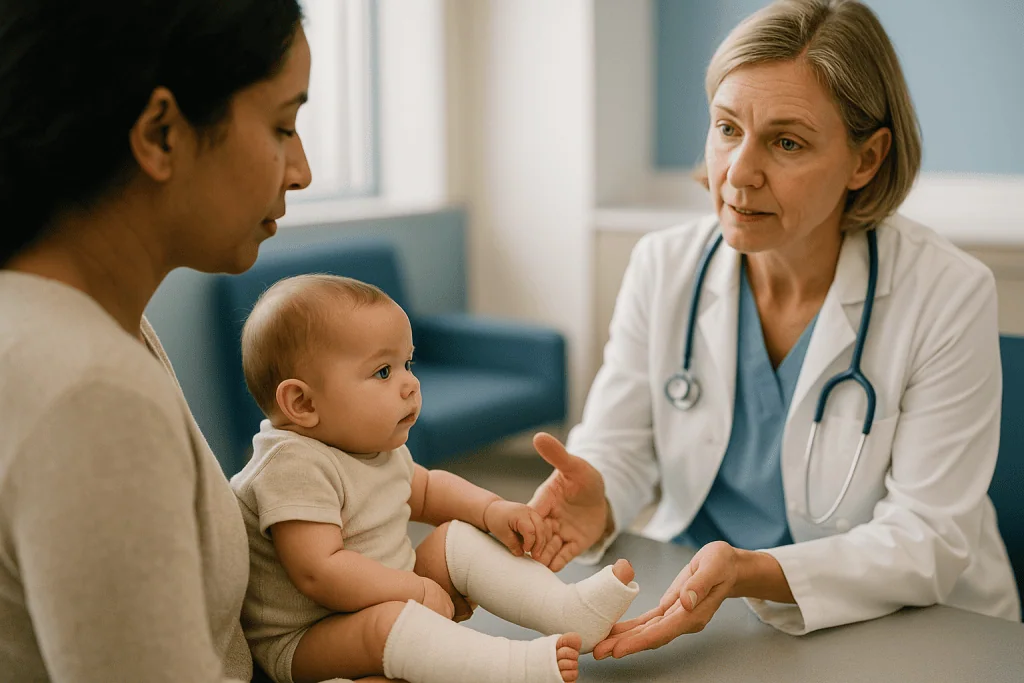
Each visit follows the same choreography. The old cast comes off, usually soaked and unwound or split with a small oscillating saw that vibrates rather than cuts skin. The baby’s leg is checked, the skin inspected, and the doctor spends a minute or two manipulating the foot: cradling the heel, feeling for the head of the talus (the ankle bone that sits out of place in clubfoot) and gently rotating the front of the foot outward around it. Then a fresh plaster cast is applied from the toes to the upper thigh with the knee bent, holding the foot in its new, slightly improved position.
The long cast is deliberate. A cast that stopped below the knee would let the leg rotate inside it and lose the correction. Bending the knee also relaxes the calf muscle so the foot is not fighting against it for the week.
The order of correction is fixed and counterintuitive. The first cast addresses the cavus, the high arch, by lifting the first toe rather than pushing it down. Subsequent casts turn the whole foot outward under the talus, a movement called abduction, which brings the heel around from the inside without ever twisting it directly. The downward-pointing ankle, the equinus, is corrected last, because trying to force the foot up too early risks a rocker-bottom deformity in which the middle of the foot bends instead of the ankle.
Casts are changed roughly weekly. The NHS describes the casting phase as lasting about five to eight weeks in most babies; Mayo Clinic describes it as several weeks. Babies tolerate this far better than parents expect. The cast is not painful once on, and most are back to feeding and sleeping normally within an hour of the appointment.
Clubfoot treatment timeline at a glance
The table below sets out the typical pathway for an idiopathic clubfoot treated from the newborn period. Every range is a pattern drawn from NHS and Mayo Clinic descriptions, not a schedule your child must meet. Stiffer feet, later starts and feet linked to other conditions all shift the numbers.
| Stage | What happens | Typical timing |
|---|---|---|
| Diagnosis | Pregnancy ultrasound around 20 weeks, or examination at birth | Before or at birth |
| First cast | Manipulation and toe-to-thigh plaster cast | Usually first one to two weeks of life |
| Weekly casting | Cast changed and foot turned further outward each visit | About five to eight casts over five to eight weeks |
| Tendon release | Minor Achilles tenotomy under local anesthetic in most babies | After the final abduction cast |
| Post-tenotomy cast | Final cast holds the corrected, upturned foot while the tendon heals | About three weeks |
| Full-time bracing | Boots-and-bar worn nearly all day and night | About three months |
| Night and nap bracing | Brace worn during sleep only | Until roughly age three to five, per team protocol |
| Follow-up | Regular checks for relapse, then less frequent reviews | Through childhood |
Two features of this table deserve emphasis. First, the active correction phase, from the first cast to the end of the post-tenotomy cast, is over in about two to three months. A baby is often out of plaster for good before the four-month vaccination visit. Second, the bracing phase is more than ten times longer than the casting phase. Families who understand this proportion from the start tend to find the later years easier, because the brace is not a surprise extension but the plan itself.
The tendon release: what a tenotomy involves
After the last abduction cast, the front of the foot has been turned outward but the ankle is usually still pointing down, held there by a tight Achilles tendon. This is the thick cord at the back of the heel connecting the calf muscle to the heel bone. In a small number of babies the tendon has stretched enough during casting that the foot can be brought up without help. In the majority it has not. The NHS reports that about four in five babies treated with the Ponseti method need a minor operation to release the tendon.
The procedure is called a percutaneous Achilles tenotomy. Percutaneous means through the skin without an open incision: a very fine blade is passed through a puncture a few millimeters wide and the tendon is divided. The gap allows the foot to move up into a corrected position. A newborn’s Achilles tendon heals remarkably quickly, regrowing across the gap in a lengthened form over the following weeks.
Where and how it is done varies by service. Many teams perform it in the clinic under local anesthetic, with the baby comforted by a feed or a sugar solution; others use a brief general anesthetic in an operating room, particularly for older infants or both feet at once. Neither approach is the right one for every child, and the choice sits with the treating team based on the baby’s age, the stiffness of the foot and the setting available.
A final cast goes on immediately, holding the foot in its fully corrected position with the toes pointing up. This cast stays on for about three weeks, according to the NHS, while the tendon heals. When it comes off, the family sees for the first time a foot that looks and moves like the other one, and the brace goes on the same day.
The first weeks after the last cast: starting the brace
The transition from plaster to brace is the point in the clubfoot treatment timeline where families most often struggle, and it helps to know that in advance. For two to three months the baby’s legs have been fixed in casts, and they have grown used to it. Suddenly the legs are free but strapped into a pair of small boots attached to a metal or plastic bar that holds the feet turned outward and tipped up, mirroring the corrected position. The bar means the legs move together, and babies do not like that for the first few nights.
The Ponseti protocol, as described by the NHS and Mayo Clinic, calls for the brace to be worn about 23 hours a day for roughly three months. The one hour out is for bathing, skin checks and stretching. Most babies settle into the brace within a week or two. Kicking both legs together, in a way that looks like a small swimmer, is a sign of adaptation rather than distress.
Skin is the main thing to watch in these weeks. The corrected foot has spent weeks in plaster and the skin is soft. Red marks that fade within about 20 minutes of removing the brace are normal pressure marks. Marks that do not fade, blisters, or broken skin mean the fit needs checking, and teams generally want to see the child rather than have parents adjust things at home.
The heel must sit fully down in the boot. Most designs include a window or a strap arrangement that lets a parent confirm this by eye or by feel. A heel that rides up means the foot is slipping toward its old position inside the boot, and the correction is not being held.
The bracing years: how long the clubfoot brace is worn and why it matters more than anything
After the full-time phase, the brace moves to nights and naps. This is the long tail of the timeline. The NHS describes night-time bracing continuing until the child is about four or five years old; Mayo Clinic describes it as lasting up to about three years. Individual services set their own end point within that range, and a stiff foot or an early relapse may push it later.
The reason for such a long commitment is the nature of the tissues involved. The tendons and ligaments on the inside of the foot were corrected by stretching, but they retain a tendency to tighten as the child grows, particularly during periods of rapid growth in the second and third years. Sleep is the period when a foot held in a brace is not being used, and holding it there through those hours counters the pull back toward the original position.
The evidence linking brace wear to outcome is consistent and it is the reason clinicians can sound uncompromising about it. Mayo Clinic notes that clubfoot tends to recur when the brace is not worn as prescribed. Relapse does not mean the family failed, and it does not mean the foot is beyond help, but it does usually mean a return to casting.
Practical wisdom from families and teams tends to converge on a few points. Make the brace part of the bedtime routine from the first night, the way a sleep sack or a favorite book is. Keep it in the same place. Expect that a toddler who has learned to say no will say it about the brace, and treat that like any other non-negotiable such as a car seat. Mattress-length bars, soft socks pulled smooth, and a toy that both feet can kick together help more than negotiation.
Who the Ponseti pathway is usually for, and who may be asked to wait or take a different route
The standard timeline described here applies to the typical case: an otherwise healthy baby with idiopathic clubfoot in one or both feet, starting treatment in the first weeks or months of life. That is most children with the condition. For them, the Ponseti method is the first-line approach described by the NHS, Mayo Clinic and Cleveland Clinic, and open surgery on the foot is no longer the starting point.
Some babies are asked to wait, briefly. A baby born early or with feeding or breathing difficulties may need to be stable before weekly clinic visits and full-leg casts are sensible. Because the tissues remain pliable for many months, a delay of a few weeks does not change the plan. A baby with another significant medical condition may have clubfoot placed further down the priority list while more urgent issues are managed.
Clubfoot that occurs alongside neuromuscular or genetic conditions, sometimes called syndromic or non-idiopathic clubfoot, follows the same casting steps but often behaves differently. These feet can be stiffer, need more casts, relapse more readily and are more likely to need surgery later. Teams generally set expectations accordingly rather than promising the textbook pattern.
Older children present a different picture. A toddler or older child whose foot was never treated, or whose correction was lost, can still be treated with modified casting, but the bones have started to change shape under abnormal load and more extensive surgery may be discussed. The decision about which pathway fits a particular child rests with the treating orthopedic team after examining the foot’s stiffness, the child’s overall health and any associated conditions. No online explainer can grade a foot; that takes hands.
Is clubfoot caused by alcohol, and is it more common in boys or girls?
Parents search this question at two in the morning, and the answer deserves to be plain. Mainstream sources do not list alcohol as an established cause of isolated clubfoot. Mayo Clinic identifies smoking during pregnancy as a factor that raises risk, particularly when combined with a family history, and it notes that the underlying cause in most cases is unknown. Heavy alcohol exposure in pregnancy is associated with a range of other harms, which is why avoiding alcohol is standard pregnancy advice, but a single glass of wine before a positive test is not a recognized explanation for a clubfoot.
Genetics does play a role. The NHS notes that clubfoot runs in some families, and Mayo Clinic describes a higher risk when a parent or sibling has had it. The pattern is not simple inheritance; most babies with clubfoot have no affected relative, and most children of an affected parent are born with normal feet. Researchers think many genes each contribute a little, interacting with the position and space available in the womb.
On sex, the evidence is consistent: clubfoot is more common in boys. Mayo Clinic states it is about twice as likely to occur in boys as in girls, and the NHS describes the same male predominance. Why is unclear. Girls who do have clubfoot are not treated differently and do not follow a different timeline.
Other factors mentioned in the literature include low amniotic fluid during pregnancy and certain conditions affecting the nervous system or connective tissue. None of these are within a parent’s control. The most useful thing a family can do with the cause question is set it down and pick up the brace routine, which is the part of the story they can influence.
Do babies with clubfoot take longer to walk?
The clubfoot treatment timeline is built so that correction is complete well before a child would normally begin to walk. Casting ends around three to four months of age in a baby treated from birth, and by the time pulling to stand begins, usually somewhere between eight and twelve months, the child has been in a night-time brace for months and is free of it during the day. The brace does not interfere with crawling, cruising or the first steps, because it is off during waking hours by then.
The NHS states that most children treated with the Ponseti method are able to walk, run and play in the normal way. Cleveland Clinic and Mayo Clinic describe the same expectation: a child who was treated in infancy typically wears ordinary shoes and takes part in ordinary activities. No mainstream source reports a systematic walking delay in children whose clubfoot was corrected on the usual timeline.
Some differences do persist and it is fairer to name them than to gloss over them. The treated foot is often slightly shorter and narrower than the other, sometimes by about half a shoe size, and the calf on that side tends to be thinner because the muscle has always been smaller. Neither affects walking. The ankle may have a little less upward flexibility than the untreated side, which most children never notice.
Where walking is delayed, the cause is usually something other than the foot: an associated neuromuscular condition, prolonged casting in a late-treated child, or simply the ordinary variation in when children walk, which spans several months even among children with no foot differences at all. A child who is not walking by around 18 months should be reviewed regardless of clubfoot history, which is standard developmental advice.
What relapse looks like, and how the timeline changes if it happens
Relapse means the foot begins drifting back toward its original position after correction. It is the main thing follow-up appointments look for, and it is the reason bracing continues for years. Mayo Clinic notes that recurrence is more likely when the brace is not worn as recommended, and that relapses are treated with a return to casting, sometimes followed by surgery.
Early signs are subtle and are more often noticed by the treating team than by parents. The foot may lose some of its upward flexibility. The heel may start to tuck inward again. Once the child is walking, a relapsing foot tends to turn in with each step, and wear appears on the outer edge of the shoe sole. A child who complains that the brace suddenly hurts or will not go on properly, after months of tolerating it, may have a foot that no longer fits the corrected shape.
The response depends on age and on what has tightened. In an infant or young toddler, a short course of two to four weekly casts often restores the position, and bracing resumes. In a child over about two and a half to three years who keeps relapsing despite good brace wear, teams may discuss a tendon transfer: the tendon of the muscle on the front of the shin, the tibialis anterior, is moved from the inside of the foot to the middle so that it lifts the foot straight rather than pulling it inward. This is a different, and larger, procedure than the newborn tenotomy, done under general anesthetic with a period in a cast afterward.
A relapse resets part of the clock but not all of it. Correction usually comes back faster than it did the first time, and the bracing end point may be extended. What it does not do is undo the years already invested.
Risks, alternatives and what the evidence actually shows
Every stage of the pathway carries small, well-described risks, and families should hear them in neutral terms. Casts can cause pressure sores if they slip or fit poorly, and a cast that is too tight can restrict circulation, which is why teams teach parents to check toe color and temperature. Rocker-bottom deformity, a bend through the middle of the foot, can result from forcing the ankle up too early; it is a technique error rather than a random complication. The tenotomy carries the ordinary risks of any skin puncture, including bleeding and infection, and rarely injury to nearby vessels or nerves. Braces cause skin irritation more than anything else.
The historical alternative was extensive open surgery in infancy, releasing joint capsules and lengthening multiple tendons. Long-term follow-up of adults who had those operations showed stiff, weak and often painful feet, which is the main reason mainstream practice moved to casting. The NHS, Mayo Clinic and Cleveland Clinic all describe the Ponseti method as the usual first treatment, with surgery reserved for feet that do not respond or that relapse repeatedly.
Other approaches exist. Physiotherapy-based methods involving daily stretching and taping are used in some centers, particularly in parts of Europe, and require far more frequent visits. Taping alone is not a recognized substitute for casting in a true clubfoot. Devices or exercises sold online as home treatments have no supporting evidence and can delay proper care.
What the evidence does not offer is a tidy success percentage that applies to every child. Published series vary in how they define correction and how long they follow children, and outcomes depend heavily on brace adherence and on whether the clubfoot is idiopathic. The fairest summary, echoed by the NHS, is that most children treated this way go on to walk and play normally, with a small proportion needing further procedures. Numbers for an individual child come from the treating team.
Living with the routine: comfort, sleep and skin care during casting and bracing
A newborn in two thigh-high casts is heavier and stiffer to hold than parents expect, and small adjustments make daily life easier. Casts are plaster and must stay dry, so bathing becomes a sponge affair for a couple of months. A rolled towel under the knees when the baby lies on its back takes strain off the hips. Car seats and carriers usually still fit, though a wider-based carrier is more comfortable. Nappies need to be tucked with care so the top edge of the cast stays clean; a damp or soiled cast edge softens and can rub.
Teams generally teach a daily cast check: are the toes pink and warm, can the child wiggle them, has the cast slipped so that the toes have disappeared inside it? A slipped cast is a reason to call, not to wait for the next appointment, because a cast that has ridden down loses its hold on the foot and may press on the skin.
Once the brace begins, comfort centers on skin and sleep. Thin cotton socks with no seams over the toes, pulled smooth, reduce friction. The brace should go on with the heel pushed fully down and the straps snug enough that the foot does not lift. Checking the skin at every removal takes 30 seconds and catches problems early. Some toddlers sleep better in a slightly larger sleeping bag that accommodates the bar; others prefer the bar outside the covers.
Emotional comfort matters too. A baby cannot be reasoned with, but a routine becomes familiar quickly, and most families report that the brace fades into the background within weeks. Older toddlers often do better when they are allowed to choose the sock color or a sticker for the bar, a small piece of control in a routine they did not pick.
What people often get wrong about clubfoot treatment
The first misunderstanding is that clubfoot is fixed by an operation. Most people picture a newborn going to surgery. In current practice the reverse is true: the correction comes from casting, and the only procedure most babies have is a tendon release through a puncture that leaves no meaningful scar. Extensive surgery is the exception, not the plan.
The second is that treatment is over when the casts come off. Families who absorb this idea tend to relax bracing once the foot looks normal, and this is exactly the period when relapse quietly starts. The brace is the treatment for the following years, not an accessory to it.
A third belief, common among grandparents, is that the baby is in pain. Casting is not painful once a cast is on. The manipulation before each cast is a gentle stretch, and babies who cry at appointments are usually protesting being undressed and held still, the same way they protest a nappy change. The tenotomy is done with anesthetic and babies typically settle quickly afterward.
Fourth, many people assume the child will limp or need special shoes for life. The NHS describes children treated with the Ponseti method walking, running and playing normally, in ordinary footwear. A slightly smaller foot and thinner calf on the treated side are the usual visible differences, and most people never notice them.
Fifth, parents blame themselves. Something they did or did not do in pregnancy, a sleeping position, a fall. The evidence points to genetics and womb environment, neither of which a parent chose, and does not identify a behavior that reliably causes isolated clubfoot beyond the modest link with smoking that Mayo Clinic describes.
Last, a late diagnosis is not a lost opportunity. The tissues stay workable for months, and the same method applies with a few more casts.
Questions to ask your care team
Appointments during the casting phase are brief and busy, and it helps to arrive with questions written down. These are the ones families most often wish they had asked earlier.
- Is this an idiopathic clubfoot, or is there any sign of an associated condition you want to look into?
- How stiff is the foot on your grading, and does that change the number of casts you expect?
- What should a cast look and feel like at home, and what changes would you want a call about the same day?
- Will the tendon release be done in clinic under local anesthetic or in an operating room, and how do you decide?
- How many hours a day should the brace be worn in the first phase, and how will I know when to move to nights only?
- Until roughly what age does your service continue night-time bracing, and what would make you extend it?
- How do I check that the heel is fully down in the boot, and what skin changes are normal versus concerning?
- What are the early signs of relapse you want me to watch for once my child is walking?
- Who do I contact between appointments if the brace no longer fits or my child suddenly refuses it?
- How often will follow-up visits happen after bracing ends, and for how many years?
A team that treats clubfoot regularly will have heard every one of these before and will usually have printed or online material to hand. Asking also signals that you understand the brace is the long game, which tends to open a more useful conversation about the years ahead than a visit focused only on the next cast.
When to call your doctor
Most of the clubfoot pathway is routine, but a few situations need same-day contact with the treating team or, out of hours, an urgent care service. During casting, call if the toes turn pale, blue or dusky, feel cold compared with the other side, or swell noticeably; if the baby cannot wiggle the toes or is inconsolable for more than an hour or two after a cast change; if the cast slips so that the toes disappear inside it or the cast becomes loose enough to rotate; if the plaster cracks, softens or becomes soaked; or if there is an unpleasant smell or discharge from the cast edge, which can signal a pressure sore or infection underneath.
After the tendon release, contact the team about bleeding that soaks through the cast, a fever, or increasing irritability rather than settling over the first day or two. During bracing, red marks that do not fade within about 20 minutes of removing the boots, blisters, broken skin, or a heel that will not stay down despite correct strapping all warrant a fitting review rather than home adjustment.
Once the child is walking, arrange an earlier review if the foot starts turning inward with each step, if shoe wear appears mainly on the outer edge of the sole, if the child begins refusing a brace that was previously tolerated, or if the ankle seems stiffer than before. These can be early signs of relapse, and earlier casting is simpler than later casting.
Seek urgent medical attention for any child, clubfoot or not, who develops a high fever with a limb that is hot, swollen and painful to touch, or who suddenly stops using a leg, since these can indicate infection in a bone or joint that needs prompt assessment. In every case, the treating team decides the next step.
Frequently asked questions
How long does clubfoot treatment take from start to finish?
Active correction takes about two to three months, but the full course runs for years. The NHS describes weekly casting for roughly five to eight weeks, a minor tendon release, a further three-week cast, then a brace worn full-time for about three months and at night until around age four or five. Mayo Clinic gives a similar pattern with night bracing lasting up to about three years.
How soon should clubfoot be treated after birth?
Most teams begin casting within the first one to two weeks after birth, the timing Mayo Clinic describes for the Ponseti method. Starting a few weeks later does not change the plan because a baby’s ligaments and tendons stay pliable for months. A clubfoot spotted on the pregnancy ultrasound is still treated after birth, once the foot can be examined by hand.
Is clubfoot caused by alcohol during pregnancy?
Mainstream sources do not list alcohol as an established cause of isolated clubfoot. Mayo Clinic identifies smoking during pregnancy, especially with a family history, as a factor that raises risk, and states that the cause in most cases is unknown. Avoiding alcohol in pregnancy remains standard advice for other reasons, but parents should not read a clubfoot as evidence they did something wrong.
Is clubfoot more common in boys or girls?
Boys. Mayo Clinic states clubfoot is about twice as likely in boys as in girls, and the NHS describes the same male predominance. The reason is not understood. Girls with clubfoot follow exactly the same casting and bracing timeline and have the same expected outcomes; the difference is only in how often the condition occurs.
Is clubfoot hereditary?
Partly. The NHS notes clubfoot runs in some families, and Mayo Clinic describes a higher risk when a parent or sibling was affected. It is not simple inheritance, though: most babies with clubfoot have no affected relative, and most children of an affected parent have normal feet. Many genes each seem to contribute a small amount, alongside conditions in the womb.
Do babies with clubfoot take longer to walk?
Not usually. Casting is finished by around three to four months in a baby treated from birth, and by walking age the brace is worn only at night. The NHS states most children treated with the Ponseti method walk, run and play normally. The treated foot is often slightly smaller with a thinner calf, but that does not delay walking.
Does the tendon release hurt the baby?
The percutaneous Achilles tenotomy is done with anesthetic, either local in the clinic or a brief general anesthetic in an operating room, depending on the service and the baby. It is a puncture a few millimeters wide rather than an open incision, and babies typically settle quickly afterward. A cast is applied immediately and stays on about three weeks while the tendon heals.
What happens if we miss nights of the clubfoot brace?
An occasional missed night during illness or travel is unlikely to undo the correction, but a pattern of missed nights is the main factor Mayo Clinic links to relapse. If the brace has been off for several days, put it back on and mention it at the next visit. If it no longer fits or the child suddenly refuses it, ask for an earlier review rather than waiting.
Can clubfoot come back after treatment?
Yes, and follow-up appointments exist to catch it early. Relapse shows as a foot losing upward flexibility, a heel tucking inward again, or a walking child turning the foot in and wearing the outer edge of the shoe sole. In young children it is usually treated with a short return to weekly casting; repeated relapses in older children may lead to a discussion of tendon transfer surgery.
Will my child need special shoes after clubfoot treatment?
Generally no. Once night-time bracing ends, children treated in infancy usually wear ordinary footwear, and the NHS and Cleveland Clinic describe normal activity including running and sport. The treated foot may be up to about half a size smaller than the other, so some families buy shoes to fit the larger foot. Insoles or supports are only added if the treating team identifies a specific need.
References
This article is for general information only and is not a substitute for professional medical advice. Please consult a qualified doctor about your individual situation.

More from the Blog

Preparing for Hip Replacement: Blood Tests, Imaging and the Medicine Review That Comes First
To prepare for hip replacement surgery, most people attend a pre-operative assessment a few weeks beforehand that includes blood tests (blood count, kidney function,…

Deformity Correction in Children vs Adults: Why Growth Plates Change the Surgical Plan
Deformity correction in children and adults differs mainly because children still have open growth plates, the soft cartilage zones near the ends of long…

What Results Does the Ponseti Method Usually Give? Walking, Shoes and Long-Term Foot Shape
The Ponseti method usually corrects clubfoot without major surgery. In published series, nearly all babies treated in infancy reach a flat-standing, flexible foot; walking…

Which Tests Come Before Upper Limb Surgery? Nerve Studies, Vascular Checks and Imaging
Before upper limb surgery, most people have a physical examination with orthopedic special tests, and then targeted investigations chosen for their problem: nerve conduction…

Slipped, Bulging, Herniated: The Disc Terms Explained
A bulged disc and a slipped disc are not quite the same thing, though the terms overlap in everyday speech. 'Slipped disc' is an…

Allograft vs Autograft Bone Grafting: Why Your Surgeon May Choose Donor Bone
An autograft is bone taken from your own body; an allograft is sterilized, screened bone from a deceased donor. Autograft contains living cells and…