

Cryoablation vs Surgery for Selected Prostate Tumors: How Specialists Weigh the Options
Key Takeaways
- Cryoablation freezes the prostate in place through ultrasound-guided needles passed through the perineum, while radical prostatectomy removes the gland, the seminal vesicles and often pelvic lymph nodes.
- Surgery produces a pathology report on the whole gland, margins and nodes; cryoablation provides no tissue, so staging relies on biopsy and MRI alone.
- After prostatectomy the PSA is expected to be undetectable, whereas after cryoablation a low but measurable PSA is normal and the team watches the trend rather than the single value.
- Whole-gland cryoablation commonly causes erectile dysfunction because the ice ball must reach the nerve bundles on the gland's edge, while urinary leakage is more characteristic of surgery.
- Cryoablation is most often offered to men who are poor candidates for surgery, to men whose cancer has returned after radiation, or within focal treatment programs with planned follow-up biopsy.
- The NHS describes cryotherapy as a treatment still under long-term evaluation, while prostatectomy and radiation carry decades of outcome data, which is a central reason specialists weigh them differently.
Cryoablation freezes prostate tissue through thin needles guided by ultrasound, while surgery (radical prostatectomy) removes the whole gland. Specialists usually consider cryoablation for selected localized tumors, for men who cannot safely have surgery, or when cancer returns after radiation. Surgery remains the more established option with longer-term evidence; the right choice depends on tumor features, health, priorities and the treating team's judgment.
The folder on the kitchen table has two tabs. One is labeled surgery, the other cryoablation, and the man who owns it has been flipping between them since the biopsy results came back. His urologist sketched both on a notepad: a scalpel removing the whole gland, or thin probes cold enough to freeze a tumor in place. Neither drawing answered the question he actually has, which is: how do specialists decide?
That question sits at the center of the cryoablation vs surgery prostate conversation, and it deserves a straight, evidence-based answer rather than a sales pitch for either technology. Both approaches aim to control a tumor confined to the prostate. They differ in what they remove, what they leave behind, what the recovery feels like, and how much long-term evidence stands behind them.
This explainer walks through the mechanics, the typical candidates, the side effects, the recovery arc and the myths, so the folder on the table feels less like a coin toss and more like a shared plan with your care team.
What the cryoablation vs surgery prostate decision actually involves
Start with the shared goal. Both cryoablation and surgery are local treatments: they act on the prostate itself rather than on cancer cells elsewhere in the body. That is why they are discussed mainly for tumors that imaging and biopsy suggest are still confined to the gland, or for a cancer that has come back in the prostate after radiation.
Cryoablation (sometimes called cryotherapy or cryosurgery) destroys tissue by freezing it. Radical prostatectomy is an operation that removes the entire prostate gland, the seminal vesicles that sit behind it, and in many cases nearby lymph nodes. One treatment leaves a frozen, scarred gland in place; the other leaves an empty space and a reconnected urinary tract.
The decision rarely turns on a single factor. According to the National Cancer Institute’s patient summary on prostate cancer treatment, options depend on the stage and grade of the cancer, the PSA level, a man’s age and general health, and whether the cancer is newly diagnosed or has recurred. PSA, or prostate-specific antigen, is a protein made by prostate cells and measured in a blood test to help track the disease.
Evidence maturity matters too, and this is where the two options differ most sharply. Radical prostatectomy has decades of follow-up data behind it. Cryoablation has a shorter track record, and the NHS describes it as a treatment whose long-term effectiveness is still being studied. That does not make it a poor choice for the right person; it means the conversation has to be honest about what is known and what is not.
Everything that follows expands on those three threads: how each works, who tends to be offered which, and how the trade-offs are weighed in a real consultation.
How prostate cryoablation works, step by step
Picture a row of slender metal rods, each about the width of a knitting needle, passed through the skin between the scrotum and the anus. That strip of skin is called the perineum, and it is the usual entry route for prostate cryoablation. A urologist places the probes while watching a live ultrasound image produced by a probe in the rectum, so each needle lands in a planned position inside the gland.
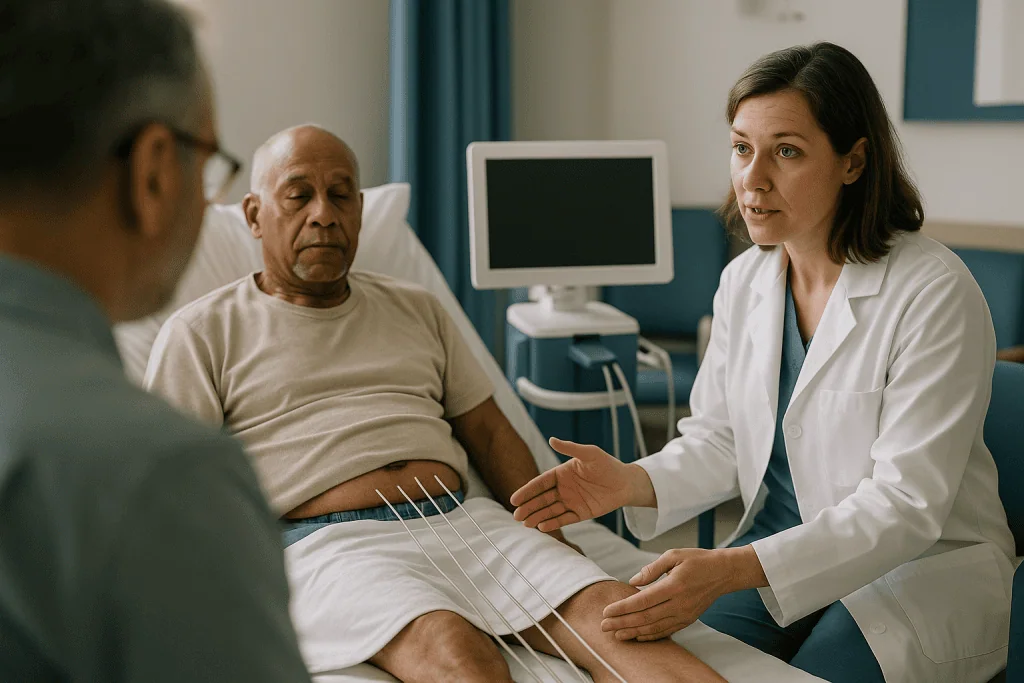
Once the probes are in place, pressurized gas (commonly argon) circulates through them and chills the tips to temperatures tens of degrees below zero. An ice ball forms around each probe and spreads outward until the targeted tissue is enclosed. Cells inside the ice ball are destroyed by ice crystals forming within them and by the collapse of the tiny blood vessels that feed them. Most protocols freeze, allow a controlled thaw, then freeze again, because the second cycle is more destructive to tissue that survived the first.
Protecting the surroundings is half the skill. A warming catheter is threaded through the urethra, the tube that carries urine out of the body, so the urethral lining stays above freezing. Temperature sensors placed near the rectal wall and the external sphincter, the muscle ring that controls urine flow, tell the team when to stop. The Mayo Clinic notes that cryoablation is typically done under general or spinal anesthesia and that many people go home the same day or after a single night.
A urinary catheter usually stays in afterward while swelling settles, for a period your team will specify. The prostate is not removed; it remains in the body as a shrunken, scarred gland that the PSA test will continue to reflect in a small way.
What happens during prostate surgery (radical prostatectomy)
Surgery takes the opposite approach: instead of destroying the gland in place, it takes it out. Radical prostatectomy removes the whole prostate along with the seminal vesicles, the small glands that contribute fluid to semen. Depending on the risk profile of the cancer, the surgeon may also remove pelvic lymph nodes so a pathologist can check them for cancer cells.
Three routes are in common use. Open surgery uses one incision in the lower abdomen. Laparoscopic surgery uses several small incisions and a camera. Robot-assisted laparoscopic surgery uses the same small incisions, with instruments controlled from a console. The Mayo Clinic describes all three as ways of performing the same operation; the choice usually reflects the surgeon’s training and the specifics of the case rather than a fundamentally different result.
Inside, the surgeon must separate the prostate from the bladder above and the urethra below, then sew the bladder neck directly to the urethra. Two bundles of nerves that run along the outside of the gland control erections. When the tumor’s position allows, the surgeon tries to preserve these nerves, a technique called nerve-sparing surgery. When the tumor sits close to them, preservation may be unsafe, and this trade-off is one of the first things a surgeon will discuss.
The operation is done under general anesthesia. A catheter is placed during surgery and, according to the Mayo Clinic’s prostatectomy overview, usually remains for one to two weeks while the new connection between bladder and urethra heals. The removed gland goes to pathology, which is one of surgery’s distinctive advantages: the team learns exactly what grade of cancer was present and whether the edges of the specimen were clear.
Who is usually considered for cryoablation, and who is usually asked to wait
Cryoablation occupies a specific niche rather than competing with surgery across the board. The National Cancer Institute’s treatment summary lists it as an option for localized prostate cancer, and clinical practice tends to concentrate on a few groups.

The first is men whose cancer is confined to the prostate but whose overall health makes a major operation risky. Serious heart or lung disease, prior pelvic surgery, or heavy scarring can tip the balance toward a needle-based procedure that avoids a long anesthetic and an abdominal incision.
The second is men whose cancer has returned in the prostate after radiation therapy. Radiated tissue is fragile, and operating on it carries a high risk of complications. Freezing the gland, often called salvage cryoablation, is one of the established ways to address a local recurrence in this setting.
The third, more recent group includes men with a single, well-defined tumor area who are candidates for focal treatment, which is discussed in its own section below.
Who is typically asked to wait, or steered elsewhere? Men with very large prostates, because the ice ball cannot reliably reach every part of the gland. Men with evidence that the cancer has spread beyond the capsule, because freezing a gland does nothing for cancer outside it. Men who have had a previous operation that removed tissue from the inside of the prostate, since the altered anatomy makes urethral protection harder. And, perhaps most often, men with very low-risk disease, for whom guidelines from the NHS and the National Cancer Institute point toward active surveillance, meaning regular monitoring with PSA tests, examinations and repeat biopsies instead of immediate treatment.
The treating team weighs all of this against the strength of the evidence for each path, and that judgment belongs to them and to you.
Cryotherapy vs prostatectomy: a side-by-side comparison
Lining the two options up in a table makes the trade-offs easier to hold in mind. None of the rows below is a verdict; each is a point your team will interpret in the light of your own scans, biopsy and health history.
| Feature | Cryoablation | Radical prostatectomy |
|---|---|---|
| What happens to the gland | Frozen and left in place as scar tissue | Removed entirely, with seminal vesicles |
| Access | Needles through the perineum, ultrasound-guided | Abdominal incision(s), open, laparoscopic or robot-assisted |
| Anesthesia | General or spinal | General |
| Typical stay | Same day or one night (Mayo Clinic) | Usually a short hospital stay; team specifies |
| Tissue for pathology | None; staging relies on biopsy and imaging | Whole gland examined, margins and nodes reported |
| Lymph nodes | Not addressed | Can be removed and checked |
| PSA afterward | Falls to a low level but rarely to zero | Expected to become undetectable |
| Long-term evidence | Shorter follow-up; still being evaluated (NHS) | Decades of outcome data |
| Repeat treatment | Can sometimes be repeated | Not repeatable; radiation is the usual next step |
| Role after radiation failure | An established salvage option | Possible but technically demanding |
Two rows deserve emphasis. The pathology row explains why surgeons value the operation beyond its ability to remove cancer: a report describing the actual grade, the margins and the lymph nodes guides every later decision. The PSA row explains a recurring source of anxiety. After surgery, any measurable PSA prompts attention because no prostate tissue should remain. After cryoablation, a low but detectable PSA is expected, and the team instead watches for a rising trend. The same number means different things after different treatments.
Focal cryoablation prostate treatment: what focal really means
Whole-gland cryoablation freezes the entire prostate. Focal cryoablation freezes only the part of the gland where the biopsy and MRI show cancer, leaving the rest untouched. The idea borrows from breast and kidney cancer care, where removing or destroying the tumor rather than the whole organ became routine once imaging was good enough to find it reliably.
The appeal is obvious. If only one side of the prostate is frozen, the nerve bundle and the urethral tissue on the other side are spared, which in principle means fewer erection and urinary problems. Many men hear the word focal and feel they have found a middle path between watching and operating.
The caution is just as important, and it comes from how prostate cancer behaves. Unlike many kidney tumors, prostate cancer is frequently multifocal, meaning several separate clusters of abnormal cells sit in different parts of the gland. Multiparametric MRI, a scan that combines several imaging sequences to map suspicious areas, has made it easier to identify the dominant lesion, but smaller clusters can escape detection. A focal treatment addresses what imaging can see.
What does the evidence say? The National Cancer Institute’s summary lists cryotherapy among localized options while noting that long-term data for newer approaches remain limited. The NHS similarly describes cryotherapy as a treatment under ongoing evaluation. In practice, focal cryoablation is most often offered within research protocols or registries, to men with a single visible lesion of intermediate risk, with a clear plan for continued monitoring and repeat biopsy.
If focal treatment is on your folder’s second tab, the right questions are about what the follow-up schedule looks like and what the team would do if cancer were found elsewhere in the gland later.
Prostate cryotherapy side effects, and how they differ from surgical ones
Every local prostate treatment can affect the three structures packed around the gland: the nerves for erections, the sphincter for continence, and the rectum. The two options affect them in different patterns.
With whole-gland cryoablation, erectile dysfunction is the most common lasting side effect. The ice ball must reach the edge of the prostate to destroy cancer there, and the nerve bundles sit on that edge, so freezing them is often unavoidable. The Mayo Clinic and the National Cancer Institute both list impotence as a frequent consequence of whole-gland freezing. Urinary leakage is generally less common after cryoablation than after surgery, although it does occur, particularly in salvage treatment of radiated tissue.
Cryoablation carries a few side effects that surgery does not. Dead tissue lining the urethra can slough off in the weeks afterward, causing a temporary blockage or the passage of debris in the urine. Pelvic pain and swelling of the penis or scrotum are common early on. A rare but serious complication is a fistula, an abnormal channel between the urethra and the rectum, which can allow urine to leak into the bowel or stool and gas to appear in the urine. Scarring can also narrow the urethra, a stricture, which may need a minor procedure to open.
After radical prostatectomy, the characteristic early problem is stress incontinence, leaking with coughing or lifting, because the sphincter must adapt to doing the job the prostate used to share. Erectile dysfunction depends heavily on whether nerves could be spared. Ejaculation stops permanently because the glands that make semen are removed; cryoablation usually causes the same result. Surgical risks also include bleeding, infection, blood clots and injury to the rectum.
Neither pattern is better in the abstract. A man who values continence above all may weigh them differently from one who prioritizes a known pathology report.
Cryoablation prostate recovery time: the first days and weeks
The recovery after cryoablation feels, to most people, surprisingly brief on the outside and oddly slow on the inside. The outside: a few small puncture marks on the perineum, soreness when sitting, and a urinary catheter. The inside: a gland that is now dying and reorganizing itself into scar, a process that takes weeks.
In the first day or two, swelling of the scrotum and the base of the penis is common and usually settles with rest and ice. Blood in the urine is expected while the catheter is in. Walking the same day is encouraged, both for comfort and to reduce the risk of a clot in the leg veins, which the Mayo Clinic lists among the general risks of any procedure requiring anesthesia and reduced mobility.
The catheter stays until the team judges that swelling has eased enough for urine to pass freely. When it comes out, the stream may be slow and interrupted for a time. Over the following weeks, small fragments of dead tissue may pass in the urine, sometimes with a brief sting; this is the sloughing described in the side effects section and is normal unless it blocks the flow.
Erectile function, if it has been affected, does not declare itself in days. Nerves that were only partly frozen can take months to recover, and the team will usually discuss supportive options once healing is well under way, with any decisions about medicines resting with the prescribing clinician.
PSA is typically rechecked after a few months, because the level needs time to settle to its new baseline. Follow-up thereafter usually combines PSA tests with examination and, where focal treatment was used, planned repeat biopsy or MRI. Your team will set those intervals; they are not fixed across all patients.
Recovery after prostate surgery: what the weeks usually look like
Surgery asks more of the body up front. The Mayo Clinic’s prostatectomy guide describes a hospital stay followed by discharge with a catheter, which usually remains for one to two weeks while the join between bladder and urethra heals. During that time, walking several times a day is encouraged, lifting is restricted, and the incisions need the ordinary care any surgical wound does.
The catheter coming out is a milestone, and often a humbling one. Many men leak at first, especially when they stand, cough or lift. Pelvic floor exercises, which strengthen the muscles that support the bladder, are usually started before surgery and continued afterward; the NHS prostate cancer treatment pages describe them as a standard part of recovery. Continence typically improves over months rather than weeks, and the pattern varies widely from person to person.
Fatigue is common for several weeks. Driving, desk work and gentle exercise come back in stages, with the surgical team setting the pace based on how the incisions and the urinary tract are healing. Heavy lifting and strenuous sport usually wait longer.
Erections are the slowest thread. Even with both nerve bundles spared, nerve recovery is gradual, and a rehabilitation plan is often discussed in follow-up. If nerves could not be preserved, the team will explain what that means and what assisted options exist; those conversations belong with them, not with a magazine.
The first PSA after surgery is a defining moment, because it is expected to be undetectable. A detectable value prompts further discussion rather than panic. The pathology report, available within a couple of weeks of the operation, tells the team whether margins were clear and whether lymph nodes were involved, and that report shapes every later step.
How specialists weigh cryoablation vs surgery prostate options for one specific tumor
Multidisciplinary tumor boards, meetings where urologists, radiation oncologists, radiologists and pathologists review a case together, tend to walk through the same sequence of questions, whatever the hospital.
Is the cancer confined to the gland? MRI, biopsy and PSA are read together. If there is a suspicion of spread beyond the capsule or into lymph nodes, a local treatment on its own is unlikely to be enough, and the discussion shifts toward combinations with radiation or hormone therapy.
How aggressive is it? The Gleason score, a grading system that rates how abnormal the cells look under the microscope, and its newer grouping into grade groups drive much of the decision. Low-grade disease often does not need treatment at all; high-grade disease usually calls for the most thoroughly proven options, which means surgery or radiation rather than cryoablation.
Can this man safely have an operation? Age alone is not the question; fitness is. Heart and lung function, prior surgeries, body habitus and anticoagulant use all count.
Has the prostate already been radiated? If so, salvage cryoablation moves up the list, because operating on radiated tissue is hazardous.
What does the man want? Some people cannot accept the chance of long-term incontinence; others cannot accept uncertainty about long-term control. The National Cancer Institute’s summary explicitly includes patient preference among the factors that determine treatment.
How strong is the evidence? For a fit man with intermediate-risk cancer and a normal-sized gland, surgery and radiation have the deepest outcome data, and most teams will say so plainly. Cryoablation is more often recommended when something specific, such as poor surgical fitness or prior radiation, tilts the scale.
The answer that emerges is not a formula. It is a weighted judgment, and it is one you are entitled to hear explained in full.
What people often get wrong about cryoablation and surgery
Myth: cryoablation is the gentle option, so it must have fewer side effects. Whole-gland freezing damages the nerve bundles in most men, and erectile dysfunction is listed by the Mayo Clinic and the National Cancer Institute as a common outcome. Cryoablation also brings risks surgery does not, such as urethral sloughing and fistula. Less invasive is not the same as fewer consequences.
Myth: surgery removes everything, so the cancer cannot come back. Prostatectomy removes the gland, but microscopic cells can already have escaped before the operation. That is why PSA is tracked for years afterward and why a detectable value triggers further evaluation rather than reassurance.
Myth: a detectable PSA after cryoablation means failure. Some prostate tissue survives freezing, particularly near the urethra where it is deliberately protected, and it continues to produce a small amount of PSA. Teams look for a rising trend over time, not the mere presence of a number.
Myth: focal treatment and whole-gland treatment are the same thing with a smaller ice ball. Focal cryoablation rests on the assumption that imaging has found the clinically important cancer. Because prostate cancer is often multifocal, follow-up with repeat imaging and biopsy is built into the plan, not an optional extra.
Myth: newer always means better. Cryoablation technology has improved considerably, but the NHS still describes it as a treatment whose long-term results are being evaluated. Surgery’s advantage is not elegance; it is decades of follow-up data.
Myth: choosing a treatment is a one-time decision. Cryoablation can sometimes be repeated, and radiation can follow surgery. Thinking of the first treatment as one step in a sequence, rather than a single bet, usually makes the choice feel less overwhelming.
The alternatives that sit beside both options
Cryoablation and surgery are two of at least five paths for localized prostate cancer, and understanding the others clarifies where each belongs.
Active surveillance comes first. For low-risk cancer, the NHS and the National Cancer Institute describe a program of regular PSA tests, examinations, MRI and periodic biopsies, with treatment held in reserve until there is a sign of change. Many men never need treatment at all, and surveillance avoids every side effect listed above. It is not doing nothing; it is structured watching.
External beam radiation therapy delivers focused X-rays over a course of sessions and has outcome data comparable in depth to surgery. Brachytherapy places small radioactive seeds inside the gland. Both carry their own patterns of bowel, bladder and sexual side effects, and both leave the gland in place, which, like cryoablation, means PSA falls rather than vanishing.
High-intensity focused ultrasound, usually shortened to HIFU, destroys tissue with heat rather than cold. The NHS groups it with cryotherapy as a newer approach still under evaluation, and the two are often discussed together as ablative options.
Hormone therapy, which lowers testosterone or blocks its effect on prostate cells, is not a local treatment and is generally used alongside radiation for higher-risk disease or for cancer that has spread. Any discussion of such medicines belongs with the prescribing clinician.
Seen in this landscape, cryoablation’s role sharpens. It is a tissue-destroying local treatment, closer in logic to radiation than to surgery, with the particular advantages of being repeatable and usable after radiation has failed, and the particular limitation of a shorter evidence base.
Questions to ask your care team
A consultation goes better with a list. The questions below are the ones that most often surface after the appointment is over, when it is too late to ask them.
- What is my grade group and stage, and how confident are you that the cancer is confined to the prostate?
- Would active surveillance be a reasonable option for me, and if not, why not?
- Why are you suggesting cryoablation rather than surgery or radiation for my case specifically? What tipped the balance?
- If cryoablation is proposed, is it whole-gland or focal, and what is the plan for follow-up imaging and biopsy?
- If surgery is proposed, do you expect to be able to spare the nerves on one or both sides?
- What does my PSA need to look like after treatment, and when will you first check it?
- What side effects are most likely for someone with my anatomy and health, and how are they usually managed?
- What would the next step be if this treatment did not control the cancer?
- How many of these procedures does your team perform, and is this treatment offered within a registry or research program?
- What support is available for continence and sexual recovery afterward?
Two habits help. Bring someone with you; a second pair of ears catches what anxiety filters out. And ask the team to say which parts of their advice rest on strong evidence and which rest on judgment. Good clinicians welcome that question, because it is the one they ask themselves.
Write the answers down, including the ones you did not expect. The folder on the kitchen table is more useful with your own notes in it than with any pamphlet.
When to call your doctor
Most recovery after either treatment is uneventful, but a few signs mean the team needs to hear from you promptly, and some mean emergency care rather than a phone call.
Seek urgent care the same day if you cannot pass urine at all after the catheter has been removed, if the catheter stops draining and your lower abdomen feels tight, or if urine turns from pink to heavy red with clots that will not clear. These can mean a blockage or bleeding that needs attention quickly.
Call for a fever with chills, shaking, or flu-like aching, especially in the first two weeks; infection of the urine or a wound is the usual cause and is treatable when caught early. Call for pain that is worsening rather than easing, or for redness, warmth or discharge at an incision or needle site.
After cryoablation specifically, report any gas or stool-like material in the urine, or urine leaking from the rectum. These can signal a fistula between the urethra and bowel, rare but serious, and need prompt assessment.
After any procedure under anesthesia, a swollen, painful calf, sudden shortness of breath, or chest pain can mean a blood clot and warrant emergency evaluation. The Mayo Clinic lists clots among the recognized risks of prostatectomy and of extended immobility.
Also call if you notice a steep change in your mood, persistent low spirits, or anxiety that interferes with sleep and daily life; emotional recovery is part of the plan, and teams can connect you with support.
Whatever the symptom, your treating team knows your case and is the right judge of what it means. This article explains the landscape; it does not replace their advice or make decisions on their behalf.
Frequently asked questions
Is cryotherapy better than surgery for prostate cancer?
Neither is better across the board. Surgery has far longer follow-up data and provides a full pathology report, so it remains the more established choice for fit men with localized disease. Cryoablation is favored in specific situations, such as poor surgical fitness or recurrence after radiation. The treating team weighs tumor grade, stage, gland size, health and your priorities before recommending either.
What is focal cryoablation of the prostate?
Focal cryoablation freezes only the region of the prostate where MRI and biopsy show cancer, leaving the rest of the gland intact to protect nerves and urinary function. Because prostate cancer is often multifocal, it is usually offered to men with a single visible intermediate-risk lesion and comes with a structured plan for repeat imaging and biopsy. Long-term evidence is still developing.
What are the most common prostate cryotherapy side effects?
Erectile dysfunction is the most common lasting side effect of whole-gland cryoablation, according to the Mayo Clinic and the National Cancer Institute. Early effects include pelvic pain, scrotal or penile swelling, blood in the urine and passage of dead tissue from the urethra. Less common problems include urethral narrowing, urinary leakage and, rarely, a fistula between the urethra and rectum.
How long is cryoablation prostate recovery time?
Many men go home the same day or after one night, per the Mayo Clinic, and return to light activity within days. A urinary catheter stays until swelling settles, on a timeline the team sets. Internal healing takes weeks, during which fragments of dead tissue may pass in the urine, and erectile recovery, where it happens, unfolds over months. PSA is usually rechecked after a few months.
How does cryotherapy vs prostatectomy affect PSA results?
After prostatectomy, no prostate tissue should remain, so PSA is expected to be undetectable and any measurable level prompts evaluation. After cryoablation, tissue near the protected urethra survives and continues to make a little PSA, so a low stable value is expected. Teams watch for a rising trend over successive tests rather than reacting to a single detectable number.
Can cryoablation be done after radiation has failed?
Yes. Salvage cryoablation is one of the recognized options when prostate cancer returns within the gland after radiation therapy. Operating on radiated tissue carries high complication risks, which is why freezing is often preferred in this setting. Side effects, including urinary leakage and fistula, are more frequent after salvage treatment than after primary treatment, so the decision is made carefully by the treating team.
Does cryoablation work for a large prostate?
Usually not well. The ice ball spreads a limited distance from each probe, and in a very large gland it may not reach every area safely without endangering the rectum or sphincter. Teams sometimes consider reducing gland size first or recommend surgery or radiation instead. Gland volume, measured on ultrasound or MRI, is one of the first factors assessed when cryoablation is being considered.
Can I have surgery if cryoablation does not control the cancer?
It is possible but technically demanding, because freezing creates scarring that makes the gland harder to separate from surrounding structures. More often, radiation therapy or a repeat cryoablation is discussed after a local recurrence. Your team would reassess with PSA trends, MRI and biopsy before advising the next step, and that sequence should be part of the conversation before the first treatment.
Will I still ejaculate after cryoablation or prostatectomy?
After prostatectomy, ejaculation stops permanently because the prostate and seminal vesicles that produce semen are removed; orgasm can still occur but is dry. After whole-gland cryoablation, the same structures are destroyed by freezing, so most men also lose ejaculation. Focal treatment may preserve some function. Fertility planning, if relevant, should be raised with the team before either procedure.
Is active surveillance an alternative to both cryoablation and surgery?
For low-risk prostate cancer, yes. The NHS and the National Cancer Institute describe active surveillance, a program of regular PSA tests, examinations, MRI and periodic biopsies, as a standard option that defers treatment until there is evidence of change. It avoids the side effects of both freezing and surgery. Whether it suits you depends on grade, stage and your own comfort with monitoring.
References
This article is for general information only and is not a substitute for professional medical advice. Please consult a qualified doctor about your individual situation.

More from the Blog

Mesotherapy Aftercare: Makeup, Saunas, Workouts and the Small Bumps That Settle in Days
Mesotherapy aftercare usually means keeping the injected skin clean and untouched for the rest of the day, skipping makeup until the tiny puncture points…

Who Is a Candidate for Cryoablation of a Kidney Tumor? What Your Team Looks At
The usual cryoablation kidney tumor candidates are adults with a small kidney mass, generally about 3 cm or less and confined to the kidney,…
How Vascular Laser Treatment Targets Hemoglobin to Close Spider Veins and Port-Wine Stains
Vascular lasers work by emitting light at wavelengths that hemoglobin, the red pigment in blood, absorbs far more strongly than the surrounding skin. The…

Masseter Botox Results: When Clenching Eases, When the Jawline Changes and What Fades First
After botulinum toxin is injected into the masseter, the main jaw-clenching muscle, the relaxing effect usually begins within a few days and is fully…

Hand Rejuvenation Results: How Long Volume and Texture Improvements Tend to Last
Hand rejuvenation results are temporary and vary by method. Hyaluronic acid fillers used to restore volume on the backs of the hands generally last…
What a Microdermabrasion Session Involves: Crystals or Diamond Tip, Suction and Timing
A microdermabrasion procedure uses either a stream of fine crystals or a diamond-coated wand, combined with gentle vacuum suction, to lift away the outermost…