

Daily Residual Limb Care During Amputee Rehabilitation: Skin Checks, Compression and Liners

Key Takeaways
- A residual limb needs a skin check at least twice a day, using a mirror for the end and back, because pressure damage and infection usually begin where you cannot easily see.
- Redness that has not faded roughly half an hour after removing a sock or prosthesis is treated by rehabilitation teams as a warning to report, not a normal part of wearing in.
- Compression shrinkers work by moving fluid upward and shaping the limb into a taper a socket can grip, which is why a rolled or over-tight top edge defeats the purpose and risks circulation.
- Liners should be turned inside out, washed with mild soap and dried completely every evening; a damp silicone liner is a warm incubator for bacteria and fungi.
- Keeping the knee or hip straight when resting, rather than propped on a pillow, prevents the contractures that can delay or prevent prosthetic fitting.
- For people whose amputation followed diabetes or vascular disease, the remaining foot carries the same risk and needs the same daily inspection from the first week.
Residual limb care during amputee rehabilitation means checking the skin of the remaining limb at least twice a day (a mirror helps for the back), washing it daily with mild soap and drying it fully, wearing a compression shrinker or bandage as your team instructs to control swelling and shape the limb, and cleaning prosthetic liners and socks every day. Report redness, open skin, unusual pain, fever or wound discharge to your care team promptly.
The first time most people really look at a residual limb is in a bathroom mirror, a few days after surgery, with a physiotherapist standing just outside the door. It rarely looks the way anyone imagined. It is swollen, oddly shaped, bruised in places, and it does not yet feel like part of the body. Then comes the question that quietly dominates the next year: how do I look after this?
Residual limb care is not glamorous. It is a routine of skin checks, careful washing, compression garments that feel too tight on the first morning, and liners that need scrubbing every single night. The evidence behind each step is practical rather than dramatic, and that is exactly why it works when it is done consistently.
This article walks through what the daily routine actually does to the tissue, who is asked to wait before compression or a prosthesis, what the following weeks usually look like, and which signs should send you back to your team rather than to a search engine.
What does residual limb mean, and why the word matters
A residual limb is the part of an arm or leg that remains after an amputation. Many people, and plenty of older leaflets, still say stump. Rehabilitation teams increasingly avoid that word, not out of squeamishness but because language shapes how patients treat their own bodies. A stump is something left behind; a residual limb is something you are going to use, load, protect and rely on for decades.
The distinction matters clinically too. The residual limb is not simply a shortened leg. Surgeons deliberately shape it: muscles are stitched over the bone end to create padding, nerves are cut back so they retract into soft tissue, and the skin flap is positioned so the scar sits away from the areas that will bear weight inside a prosthesis. According to the NHS overview of amputation, the aim is a limb that heals well, tolerates pressure and can be fitted with an artificial limb where that is appropriate.
Where the amputation happens changes the daily care. Below-knee limbs have a bony shin end and a mobile knee to protect; above-knee limbs have more soft tissue and a hip that stiffens quickly if it is left bent. Upper-limb residual limbs sweat inside sockets and are checked with the same discipline as legs. The principles in this article apply across all of them, with the leg used as the working example because it is what most people searching for this topic are living with.
One more definition, since it will come up repeatedly: rehabilitation here means the whole period from the operation through prosthetic fitting and beyond, not a single block of hospital physiotherapy. Johns Hopkins describes it as an ongoing process that adapts as the limb changes.
How residual limb care works: what the daily routine actually does
Every part of the routine addresses a specific biological problem, and it helps to know which one.
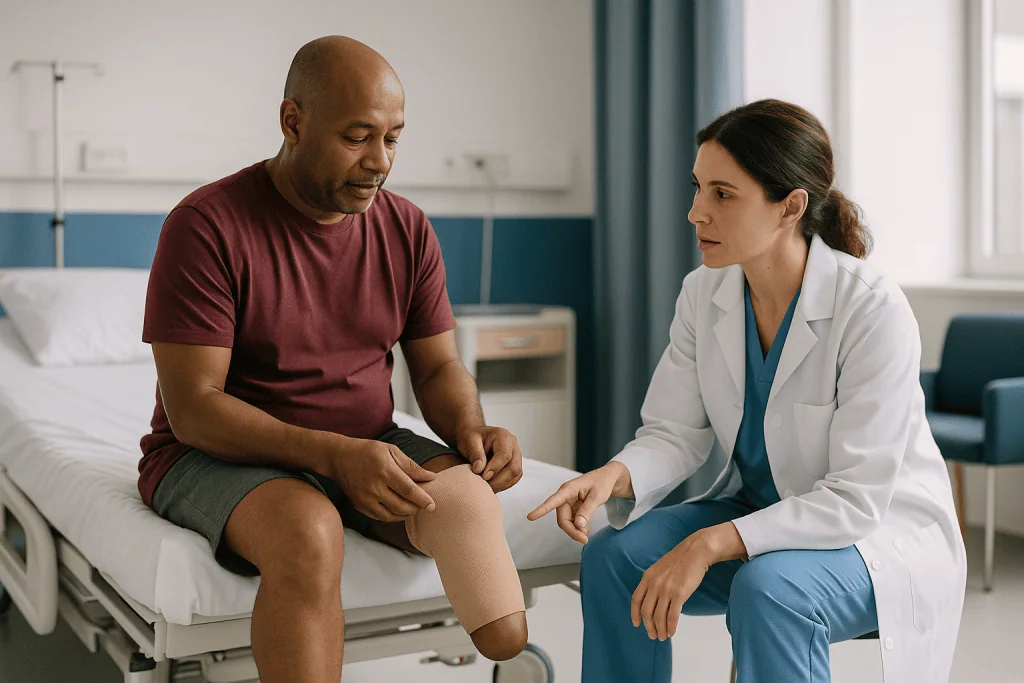
Swelling is the first. After surgery, fluid collects in the tissues because lymphatic and venous return have been disrupted and the muscles that normally pump fluid back toward the heart have been cut. Left alone, that fluid stretches the incision, slows healing and produces a bulbous, unstable shape that no socket can grip. Compression pushes fluid out of the tissue and gives the limb a taper, wider at the top and narrower toward the end, which is the shape a prosthesis can hold securely.
Skin breakdown is the second. Residual limb skin was never designed to carry body weight, sit in a warm, humid socket for hours, or rub against silicone. MedlinePlus discharge guidance for leg amputation asks patients to inspect the skin at least twice daily precisely because pressure damage starts as redness that fades, then redness that does not fade, then an open area, often within a day or two of an ill-fitting sock or a new liner.
Infection is the third. Sweat, dead skin cells and bacteria accumulate inside liners. Daily washing of both skin and liner keeps the microbial load down. This is why drying matters as much as washing: moist skin macerates, meaning it softens and breaks more easily.
Stiffness is the fourth. Joints above the amputation drift toward a bent position because the muscles that pull them straight have lost their attachments or their reason to work. Positioning and stretching preserve the range of motion that walking with a prosthesis demands.
Nothing here is a trick. The routine simply keeps four predictable problems small enough that the team can manage them at the next appointment instead of in an operating theater.
How should I care for my amputated leg? The twice-daily skin check
If you do only one thing from this article, do this. The skin check is the early-warning system for almost every complication that sends people back to hospital.
Choose two fixed moments, typically after the morning wash and before bed, because a check that floats through the day is a check that gets skipped. Sit somewhere with good light. Use a long-handled or hand mirror for the back of the limb and the end, or ask someone to look and describe what they see. The end of the limb is where most problems begin and where you can least see them yourself.
Look for changes rather than perfection. A newly healed residual limb is patchy, discolored and uneven. What matters is whether anything looks different from yesterday: a patch of redness that has not faded 20 to 30 minutes after taking a sock or prosthesis off, a blister, a crack in a fold of skin, a shiny or weeping area, a small ridge of hardened tissue where the socket edge sits, or warmth in one spot compared with the surrounding skin. MedlinePlus discharge instructions emphasize this daily inspection for exactly these signs.
Run your hand gently over the limb as well. Fingertips pick up heat and tenderness before eyes pick up color changes, and a firm lump under the skin can be an early sign of fluid collecting.
Keep a simple record. A phone photo of the limb in the same position, same light, once a week, gives your prosthetist and physiotherapist information no verbal description can match. When something changes, you will be able to say when, which turns a vague worry into a useful clinical clue.
The check takes three or four minutes. It is the cheapest, most effective tool in rehabilitation, and the one most often abandoned once life gets busy.
Residual limb skin care: washing and drying without stripping the skin
Residual limb skin lives a harder life than the rest of your skin, so it is treated more carefully, not more aggressively.
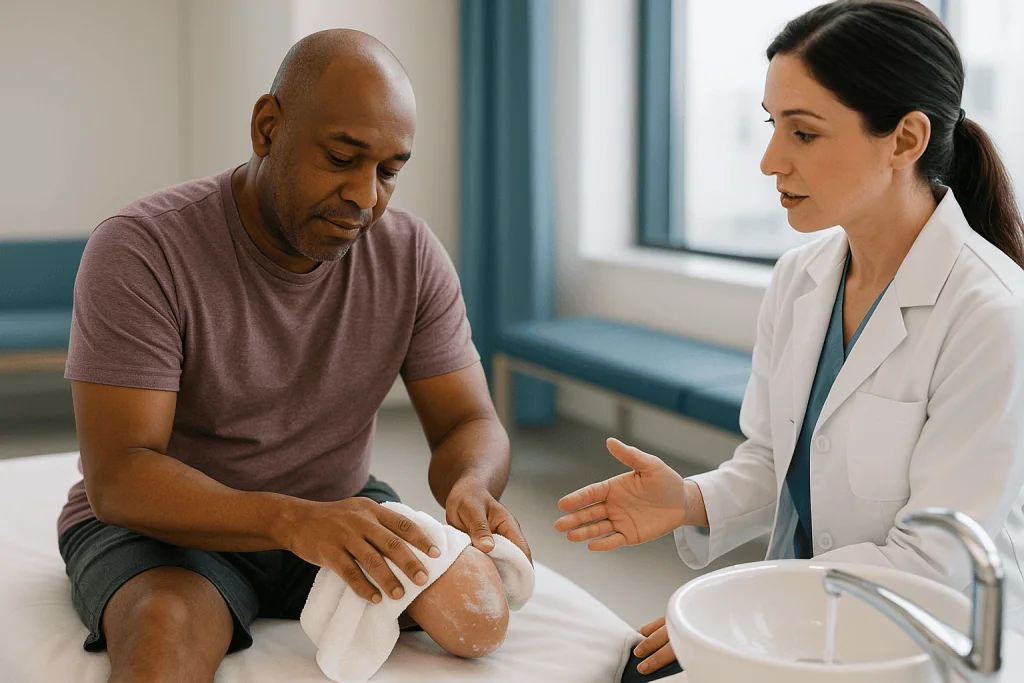
Wash once a day, usually in the evening so the skin has hours to dry fully before it goes back into a liner. MedlinePlus guidance for leg amputation recommends mild, unscented soap and warm rather than hot water. Antibacterial scrubs, alcohol-based products and exfoliating tools remove the thin lipid layer that protects skin and tend to leave it drier and more prone to cracking, which is the opposite of what a socket-bearing limb needs.
Rinse thoroughly. Soap residue trapped in a liner becomes an irritant by lunchtime.
Do not soak the limb. Long baths soften the skin and stretch the tissue with fluid, both of which make it more vulnerable when the prosthesis goes back on. A shower or a basin wash is enough.
Dry with a patting motion rather than rubbing, paying particular attention to the scar line and any skin folds. Then leave the limb uncovered for a few minutes before applying anything. Damp skin under compression is one of the most common reasons a healed limb breaks down.
Moisturizer is a genuine trade-off. Dry, flaky skin cracks; over-moisturized skin becomes slippery, sweats more inside a liner and can encourage fungal growth. Most teams suggest a plain, fragrance-free lotion applied at night, when the limb is out of the socket, and never in the morning immediately before donning. Your prosthetist will know how your particular liner material reacts.
Shaving the limb is discouraged by most rehabilitation programs. Tiny nicks and ingrown hairs under a sweaty liner turn into folliculitis, an infection of the hair follicles, remarkably quickly. If hair causes friction, raise it with your team before reaching for a razor.
Why compression matters after amputation: shaping the limb for a prosthesis
Compression is the part of residual limb care that patients most often dislike and most often underestimate.
The logic is mechanical. A freshly amputated limb swells into a rounded, club-like shape. A prosthetic socket, by contrast, needs a limb that tapers gently so that weight is distributed along the sides rather than concentrated on the bone end. Consistent, graded pressure, firmest at the end and easing toward the top, moves fluid upward and encourages the tissue to settle into that taper. Johns Hopkins and the NHS both describe this shaping and swelling control as a routine early goal of rehabilitation.
Compression also protects. A residual limb without a covering bumps into bed frames, door edges and wheelchair parts. A snug garment cushions minor knocks and, for many people, makes the limb feel less exposed and less strange.
Three methods are in common use, and teams choose between them based on the wound, the person and the setting:
- Elastic bandaging, applied in a figure-of-eight pattern by a trained clinician or carer, is adjustable but only as good as the person wrapping it.
- Shrinker socks are elasticated tubular garments made in graded sizes; they are easier to apply consistently and are the most common choice once the wound is closed.
- Rigid or semi-rigid dressings, sometimes applied in theater, protect the limb and control swelling in the first days, particularly after below-knee amputation.
Which method, when it starts and how many hours a day it is worn are decisions for the surgical and rehabilitation team, because they depend on the state of the incision and the blood supply. What is not negotiable is consistency. A shrinker worn for two days and abandoned for three simply lets the limb swell back, and the fitting date drifts further away.
How to wear a shrinker sock after amputation safely
A shrinker sock is only useful if it is on correctly, and it is only safe if it is checked.
Fit comes first. The garment should be sized by your prosthetist or physiotherapist to the measured circumference of the limb, and re-sized as the limb shrinks. A shrinker that was right in week three is often loose by week eight; a loose shrinker bunches, creates pressure ridges and does nothing useful.
Application follows a consistent sequence. Skin must be clean and completely dry. Turn the sock inside out to the toe end, place the end squarely over the tip of the limb so the seam is not sitting on the scar, then roll it up smoothly with the hands rather than pulling at the top edge, which stretches the fabric unevenly. There should be no wrinkles, no folds and no rolled edge at the top. A rolled top acts like a tourniquet, a tight band that cuts off circulation, and is the most common serious mistake.
Pressure should feel firm and even, never painful. Throbbing, numbness, pins and needles, coolness of the skin or a bluish tinge are signs the garment is too tight or has ridden up, and it should come off while you contact your team.
Wearing time varies by program. Some teams ask for the shrinker to be worn most of the day and night in the early weeks, removed only for washing and skin checks; others use it only when the prosthesis is off. MedlinePlus discharge guidance describes shrinkers as a routine part of daily care, but the schedule is set individually and should be followed rather than improvised.
Wash the garment as often as its material allows, usually daily, and have two so one is always dry. A shrinker that smells or has lost its stretch has stopped doing its job.
Prosthetic liners and socks: how they work and how to look after them
Once a prosthesis is fitted, the liner becomes the most intimate object in your day. It sits directly on skin for hours, absorbs sweat and shear, and quietly determines whether the limb is comfortable by evening.
A liner is a soft sleeve, usually of silicone, urethane or a gel-like polymer, that rolls onto the residual limb before it goes into the hard socket. Its job is to cushion, to spread pressure and to hold the limb in the socket by suction or a locking pin. Prosthetic socks, worn over or instead of a liner depending on the system, are layers of knitted fabric in different thicknesses used to adjust fit as the limb changes volume through the day and across the months.
Care is simple but must be daily. Turn the liner inside out every evening, wash the skin-facing surface with mild soap and warm water, rinse thoroughly and let it dry completely, ideally on a stand that keeps its shape. Never put it away damp. Bacteria and fungi thrive in a warm, closed silicone tube, and the smell that develops is the least of the consequences.
Inspect the liner as carefully as the skin. Cracks, thinning at the end, small tears at the edge or a loss of tackiness all change how it grips and where it presses. Report them to your prosthetist rather than living with them.
Socks are washed like fine underwear: warm water, mild detergent, air dried, and retired when they thin or lose elasticity. Keep several plies available and learn from your prosthetist how to add or remove layers as the limb changes during the day. Many people find the limb slightly larger in the morning and smaller by afternoon, so the sock count is rarely fixed.
Donning always happens on clean, dry skin with no lotion. Doffing is followed by a skin check, every time, without exception.
Who residual limb care is for, and who is usually asked to wait
Everyone with an amputation does skin checks and washing from the first days. Compression and prosthetic fitting, though, are staged, and the staging is where patients often feel impatient or confused.
Compression usually starts once the surgical team is satisfied that the incision is closed, stable and not at immediate risk of opening. An open wound, active infection, a skin graft that has not yet taken or a very fragile blood supply are common reasons to hold off, because a shrinker applied to a wound that cannot yet tolerate pressure can undo weeks of healing. The team will say when, and it is worth asking why if the answer is not yet.
Prosthetic fitting follows the same logic, only more so. The NHS notes that fitting typically begins once the wound has healed and swelling has settled enough for a socket to be shaped, and that this can take several weeks after surgery. People whose amputation resulted from poor circulation or diabetes, which the NHS identifies as the leading causes of lower-limb amputation, are more often asked to wait longer because their tissue heals more slowly and their skin tolerates pressure less well.
Some people are not prosthesis candidates at all, at least initially. Severe heart or lung disease, cognitive impairment that makes safe use difficult, uncontrolled pain, or a very short residual limb can all lead a team to prioritize wheelchair mobility and limb protection. That is not a failure of care. The residual limb still needs the same daily attention because it still bumps, sweats and scars.
Children, whose limbs are still growing, and older adults with thin skin and reduced sensation need the routine most of all, but with closer supervision. In every case, the decision about what to start and when belongs with the treating team, who can see the wound and the blood supply that a leaflet cannot.
Skin problems on a residual limb that clinicians see most often
This is not a list for diagnosing yourself. It is a description of what rehabilitation teams expect to encounter so that you recognize the moment to pick up the phone.
Pressure marks and blisters usually trace back to a change: a new liner, a sock ply too few, a limb that has shrunk since the socket was made, or simply a longer day on the leg. Redness that fades within about half an hour of doffing is generally treated as a warning; redness that persists, or any open skin, is treated as a problem that needs the prosthesis adjusted before it is worn again.
Folliculitis, infection of the hair follicles, and small boils appear where sweat and friction meet hair, often at the socket brim. Fungal infections show up as itchy, scaly or moist patches, most commonly in warm months or where a liner is not dried properly. Contact dermatitis, an itchy rash from a reaction to the liner material, a detergent or a lotion, tends to follow the exact shape of whatever touched the skin.
Verrucous hyperplasia is a warty thickening at the end of the limb caused by the socket gripping the sides while leaving the end unsupported. It is a fit problem masquerading as a skin problem, and it resolves when the prosthetist corrects the socket rather than when a cream is applied.
Wound reopening, a spreading area of heat and redness, pus, or a fever alongside any of these belongs in the red-flag category discussed later, not on tomorrow’s to-do list.
Two rules cover almost every situation. First, do not put the prosthesis back on over broken or angry skin without your team’s agreement, however inconvenient that is. Second, do not treat the skin with anything, including over-the-counter creams, without asking, because some products soften skin or degrade liner material in ways that make the next problem worse.
Contractures, positioning and desensitization: the parts people skip
Skin gets the attention because it is visible. The joint above the amputation quietly causes just as much trouble.
A contracture is a joint that has become fixed in a shortened position because the muscles and soft tissue around it have tightened. After a below-knee amputation the knee drifts into a bent position; after an above-knee amputation the hip drifts into flexion and outward rotation. Both happen because sitting and lying with the limb propped on a pillow is comfortable, and because the muscles that used to straighten the joint have lost their pull. Johns Hopkins lists preventing contracture as a core early rehabilitation aim, since a knee that will not fully straighten cannot be fitted with a standard prosthesis and a hip that will not extend makes walking exhausting.
Prevention is unglamorous. Lie flat on your stomach for periods each day if your team agrees, avoid pillows under the residual limb while resting, keep the knee straight rather than dangling over the wheelchair edge, and do the stretching program you were given even on days it feels pointless. Wheelchair residual-limb supports exist for exactly this reason.
Desensitization is the other neglected task. The end of a residual limb is often exquisitely sensitive in the early weeks, partly because cut nerves are healing and partly because the brain has not yet learned what normal touch there feels like. Rehabilitation teams typically introduce gentle, graded input: stroking with soft cloth, then rougher fabric, then light tapping and firm pressure with the hands. The aim is a limb that can tolerate a socket, and the process cannot be rushed or skipped; a limb that has never been touched will object loudly to being loaded.
Strengthening rounds out the trio. Hip and core muscles do far more work when walking with a prosthesis than they did before, and building them during the weeks of waiting for a socket is time well spent.
Phantom limb pain and residual limb pain: what the evidence actually shows
Two different pains live in the same place, and separating them matters for how they are treated.
Residual limb pain is felt in the tissue that is still there: an aching scar, a tender bone end, a neuroma, which is a tangle of regrowing nerve fibers that forms a sensitive lump under the skin, or pressure from a socket. It usually has a mechanical cause and often responds to a change in fit, positioning or wound management.
Phantom limb pain is felt in the part of the limb that has been removed. Mayo Clinic describes it as common after amputation and explains the leading theory: the brain and spinal cord retain a map of the missing limb and continue to generate sensation from it, sometimes rewiring in ways that produce pain. Phantom sensation, the non-painful feeling that the limb is still present, is more common still and is not in itself a problem.
The pattern over time is reassuring but not uniform. Mayo Clinic and Cleveland Clinic both note that for many people phantom pain becomes less frequent and less intense in the months after surgery, while for others it persists and needs ongoing management. Neither source offers a fixed percentage, and honest clinicians do not either.
Management is usually layered. Compression and consistent prosthesis use appear to reduce phantom pain for some people, possibly by giving the brain steady sensory input from the limb. Mirror therapy, in which the person watches the reflection of the intact limb moving, has evidence of benefit in some studies but not others. Medicines used include classes originally developed for nerve pain, epilepsy and depression, which act on the way nerves transmit signals; they can take weeks to show an effect, and starting, adjusting or stopping any of them is a decision for the prescribing clinician, not for a magazine article.
What matters for daily care is reporting the pain accurately: where it is, when it happens, and what the skin looked like at the time.
Diabetes, circulation and the leg you still have
Most lower-limb amputations in high-income countries are the end point of vascular disease, diabetes or both, according to the NHS. That fact changes residual limb care in two ways that are easy to miss.
First, the residual limb itself heals and tolerates pressure less well when the blood supply is compromised. Small wounds take longer to close, infections take hold more readily, and reduced sensation in the skin, called neuropathy, means pain does not reliably warn of damage. The twice-daily visual check becomes the only alarm system, because the usual one is unreliable. People with diabetes are often advised to check even more carefully and to treat any break in the skin as urgent rather than routine.
Second, and more sobering, the other leg carries the same disease. Rehabilitation teams routinely fold care of the remaining foot into the residual limb routine for exactly this reason. That means daily inspection of the sole and between the toes, washing and careful drying, moisturizing dry skin but not between the toes, well-fitting footwear worn at all times including indoors, and never walking barefoot. Nail care is best done by a podiatrist when sensation or circulation is poor. Report any blister, cut or color change on the remaining foot the same day.
Blood glucose control, blood pressure, cholesterol and stopping smoking are not separate topics from residual limb care; they are the conditions under which the limb heals or does not. Smoking in particular narrows small blood vessels and is consistently associated with slower wound healing and higher complication rates in surgical guidance. Your medical team, not the rehabilitation gym, manages these, but the rehabilitation gym is where the consequences show up first.
People whose amputation followed trauma or cancer will not share these risk factors, and their care can be less cautious about pressure and healing. The routine is the same; the margin for error is wider.
What the following weeks and months usually look like
Timelines vary with the reason for amputation, the level, general health and how well the wound behaves, so what follows is a typical shape rather than a schedule.
| Phase | What is usually happening | Where daily care focuses |
|---|---|---|
| First days after surgery | Wound is dressed; swelling and pain are at their peak; early movement and positioning begin in hospital | Protecting the incision, keeping the joint straight, first supervised looks at the limb |
| First few weeks | Incision closes; compression begins once the team clears it; strength and balance work start; wheelchair or crutch mobility | Twice-daily skin checks, daily washing, shrinker or bandage as instructed, desensitization |
| Roughly weeks to a few months | Swelling settles enough for a first socket; early prosthetic training, often with a temporary socket | Liner and sock hygiene, adjusting sock plies, checking skin after every wear |
| First year and beyond | Limb continues to shrink and change shape; sockets are adjusted or remade; activity increases | Ongoing checks, volume management, prompt reporting of fit changes |
The NHS describes prosthetic fitting as typically beginning several weeks after surgery once healing and swelling allow, and MedlinePlus notes that the residual limb keeps changing shape for many months, which is why early sockets are often temporary and why sock counts change. Some rehabilitation programs describe the first year as the period of greatest volume change.
Two things surprise people. The first is how much of the year is spent waiting: for a wound, for a socket, for an adjustment. The waiting is not idle if the daily routine is done. The second is that the routine does not end when walking becomes easy. The limb continues to change with weight, activity, seasons and age, and people many years past their amputation still check their skin every night for the same reasons they did in week one.
What people often get wrong about residual limb care
Most complications a rehabilitation team sees are not caused by ignorance. They are caused by reasonable-sounding beliefs that turn out to be wrong.
Tougher is better. Rubbing the limb with alcohol, scrubbing it with rough cloths or deliberately toughening the skin is still passed on as folk wisdom. Skin that has been stripped of its natural oils cracks more, not less. Desensitization uses graded touch, not abrasion.
A tighter shrinker shrinks faster. It does not. A shrinker that hurts, leaves deep grooves or turns the skin cool and dusky is cutting off circulation, and poor circulation slows healing. Compression should be firm and even, which is why sizing by a clinician matters.
If it does not hurt, it is fine. Reduced sensation after amputation, and especially with diabetes or neuropathy, means damage can progress without pain. The skin check exists because feeling is not a reliable guide.
The prosthesis is the finish line. Fitting is closer to the start of the second phase. Sockets need adjusting as the limb changes, and skin problems in the first months of wearing are common precisely because the limb has not finished changing.
Phantom pain means something is wrong with the surgery. Mayo Clinic and Cleveland Clinic both describe phantom pain as a recognized consequence of how the nervous system remaps after amputation, not a sign of surgical error. It should be reported and managed, but it is not evidence that the operation failed.
Propping the limb on a pillow is harmless. Comfortable, yes; harmless, no. Sustained bent positions are the main route to contractures that can delay or prevent prosthetic use.
The other foot can wait. For people whose amputation followed vascular disease or diabetes, the remaining foot shares the same risks and needs the same daily attention from the very first week.
Questions to ask your care team about how to care for a residual limb
Appointments are short and the questions that matter tend to arrive in the car afterward. Taking a written list changes that. The following are the ones rehabilitation clinicians most wish patients would ask.
- When can I start compression, and which method do you want me to use? How many hours a day, and does that include night?
- Who will check the fit of my shrinker as my limb changes, and how will I know it needs replacing?
- Exactly what should I wash the limb with, and is there anything I should never put on it?
- Which lotion, if any, and at what time of day?
- What does a normal healing scar look like at this stage, and what would make you want to see it sooner than the next appointment?
- How long after taking my sock or prosthesis off should redness fade before I should worry?
- Which positions should I avoid in bed and in the wheelchair, and can you show me the stretches you want me to do every day?
- What should I do if my phantom pain changes or gets worse, and who do I contact?
- How do I clean and store my liner, and how will I know it needs replacing?
- How do I decide how many sock plies to wear, and what does it feel like when I have too many or too few?
- If my residual limb resulted from diabetes or circulation problems, what exactly do you want me to do for my other foot each day?
- Who is the single point of contact if something looks wrong on a weekend?
Ask for answers in writing where possible, or record them on your phone with permission. The team will not mind; they would far rather explain twice than treat a wound that a clear instruction would have prevented. If two members of the team give different answers, say so, and ask them to agree a single plan. Ambiguity about wearing time or wound care is one of the most common and most avoidable reasons for setbacks.
When to call your doctor
Most residual limb problems are minor and are sorted by a prosthetist adjusting a socket or a physiotherapist correcting a technique. A small number are urgent, and the distinction is worth knowing cold.
Contact your surgical or rehabilitation team the same day, or seek urgent care if they are unavailable, for any of the following:
- The incision opens, gapes or starts to leak fluid, blood or pus.
- Redness that spreads outward from the wound or from a sore spot, or skin that is hot, hard and increasingly painful.
- Fever, chills or feeling generally unwell alongside any change in the limb.
- A foul smell from the wound or from under the dressing.
- Skin that turns cold, pale, dusky blue or dark, particularly after applying compression or a prosthesis.
- Sudden, severe or rapidly worsening pain in the residual limb that is different from your usual pain.
- New numbness or an inability to move the joint above the amputation.
- Any open area, blister or break in the skin of the remaining foot if you have diabetes or circulation problems.
Seek emergency care immediately for heavy bleeding that does not stop with firm pressure, chest pain, sudden breathlessness, or a painful, swollen calf or thigh in the remaining leg, since clots in the veins are a recognized risk after major surgery and reduced mobility.
MedlinePlus discharge guidance for leg amputation lists wound opening, spreading redness, discharge and fever among the signs that need prompt contact, and the NHS advises that any sign of infection after amputation should be reported without delay. When in doubt, call. Teams would rather hear about a false alarm than see a limb that has been quietly deteriorating for a week.
Every decision about what happens next, from a change of dressing to a return to theater, sits with the clinicians who can see and examine the limb. The routine in this article keeps that conversation early and calm.
Frequently asked questions
How do you care for a residual limb day to day?
Check the skin at least twice daily with a mirror, wash once a day with mild unscented soap and warm water, dry thoroughly, and wear a compression shrinker or bandage exactly as your team instructs. Once a prosthesis is fitted, clean the liner every evening and check the skin after every wear. Report any open skin, spreading redness, discharge or fever to your team the same day rather than waiting for the next appointment.
What does residual limb mean?
A residual limb is the part of an arm or leg that remains after amputation. Clinicians prefer the term over stump because it describes a working part of the body that will be protected, shaped and, where appropriate, fitted with a prosthesis. Surgeons deliberately pad the bone end with muscle and position the scar away from weight-bearing areas so the limb can tolerate pressure inside a socket.
How should I care for my amputated leg in the first weeks after surgery?
Follow the wound-care instructions from your surgical team, keep the knee or hip straight when resting rather than propped on pillows, begin the stretches and positioning your physiotherapist shows you, and start looking at the limb daily in good light. Compression usually begins once the incision is closed and cleared by the team. Do not soak the limb, shave it or apply creams without asking first.
When do you start wearing a shrinker sock after amputation?
Compression typically starts once the surgical team is satisfied the incision is closed and stable, which varies with the reason for amputation and how the wound heals. People with poor circulation or diabetes are often asked to wait longer because pressure on fragile tissue can reopen a wound. The shrinker should be sized by a clinician and worn for the hours your team specifies, not improvised.
How tight should compression on a residual limb feel?
Firm and even, never painful. The pressure should be greatest toward the end of the limb and ease toward the top, with no wrinkles, folds or rolled edge. Throbbing, numbness, pins and needles, cool or bluish skin mean the garment is too tight or has ridden up; remove it and contact your team. A shrinker that feels loose or bunches is no longer doing its job and needs re-sizing.
How often should I clean my prosthetic liner?
Every day, usually in the evening. Turn the liner inside out, wash the skin-facing surface with mild soap and warm water, rinse thoroughly and let it dry completely before use. Never store it damp. Inspect it for cracks, thinning or tears as you clean, and report changes to your prosthetist. Prosthetic socks are washed in warm water with mild detergent, air dried and replaced when they thin or lose stretch.
What is good residual limb skin care if my skin is dry or itchy?
Use mild, unscented soap, warm rather than hot water, and pat dry rather than rub. A plain fragrance-free lotion applied at night when the limb is out of the socket is what most teams suggest, never in the morning before donning. Persistent itching, scaling or a rash that follows the shape of the liner should be shown to your team, since fungal infection and contact dermatitis both need a diagnosis rather than a guess.
Is phantom limb pain a sign something went wrong with the surgery?
No. Mayo Clinic and Cleveland Clinic describe phantom limb pain as a recognized consequence of how the brain and spinal cord remap the missing limb, not a sign of surgical error. For many people it eases in frequency and intensity over months; for others it persists and needs ongoing management. Report it accurately, including when it occurs and what the skin looked like, so your team can separate it from pain in the remaining tissue.
How long does a residual limb keep changing shape?
For many months. MedlinePlus notes that the limb continues to shrink and change shape well after the wound heals, and many rehabilitation programs describe the first year as the period of greatest volume change. This is why early sockets are often temporary, why sock plies are adjusted through the day, and why a shrinker that fit in week three may be loose by week eight. Ongoing checks continue for life.
Why do I need to check my other foot if I have had a leg amputated?
Because most lower-limb amputations follow diabetes or vascular disease, and the remaining foot carries the same risks. Reduced sensation means damage can progress without pain. Inspect the sole and between the toes daily, wash and dry carefully, wear well-fitting shoes at all times, avoid walking barefoot, and report any blister, cut or color change the same day. Nail care is best done by a podiatrist when circulation or sensation is poor.
References
- Leg amputation – discharge (MedlinePlus Medical Encyclopedia)
- Amputation (NHS)
- Phantom Limb Pain (Cleveland Clinic)
This article is for general information only and is not a substitute for professional medical advice. Please consult a qualified doctor about your individual situation.

More from the Blog

Physical Therapy Myths: No Pain No Gain, Machines Do the Work and Other Misconceptions
Physical therapy myths often come from a kernel of truth stretched too far. Some effort and mild, short-lived soreness can be part of rehabilitation,…

Magnifiers, Lighting and Electronic Aids: How Vision Rehabilitation Training Works
Low vision aids training is a rehabilitation program that teaches people with permanent, uncorrectable vision loss to use magnifiers, task lighting, contrast changes and…

What a Brain Injury Rehabilitation Program Covers: Movement, Thinking, Speech and Daily Skills
A brain injury rehabilitation program is a coordinated course of therapy that helps a person relearn movement, thinking, communication and everyday skills after a…

Sore After Therapeutic Exercise? Normal Muscle Ache vs Pain That Means the Plan Needs Changing
Mild, symmetrical muscle ache that starts 12 to 24 hours after a rehab session, peaks within about three days and eases with gentle movement…

Amputee Rehabilitation Stages: Wound Healing, Limb Shaping, Prosthetic Fitting and Walking
Amputee rehabilitation usually moves through overlapping stages: wound healing in the first weeks, shaping the residual limb with compression, a prosthetic fitting once the…

Manual Therapy and Prehab: The Hands-On Side of Physiotherapy
Manual therapy is a set of hands-on techniques, joint mobilization, manipulation, and soft-tissue work, that physical therapists use to ease pain and improve movement,…