

How the Level of a Spinal Cord Injury Shapes the Rehabilitation Goals and Timeline

Key Takeaways
- The neurological level of injury is the lowest spinal segment with normal sensation and strength on both sides, and it can differ from the vertebra that was fractured.
- Cord injury above C3 to C5 can stop the diaphragm, which is why high cervical rehabilitation begins with breathing and ventilator weaning rather than limb movement.
- At C6, returning wrist extension creates a passive tenodesis grip that therapists train deliberately because it unlocks self-feeding and transfers.
- Sacral sparing, any preserved sensation or movement in the lowest sacral segments, is what separates an incomplete injury from a complete one on the ASIA scale.
- Mayo Clinic and NIH NINDS both describe the fastest recovery in the first six months after injury, with slower gains possible for one to two years.
- Autonomic dysreflexia, a dangerous blood pressure surge usually triggered by a full bladder or bowel, affects injuries at T6 and above and is a medical emergency.
The level of a spinal cord injury is the lowest segment where sensation and movement still work normally, and it sets the ceiling for rehabilitation goals: cervical injuries center on breathing, arm function and assisted independence, thoracic injuries on wheelchair skills and upper-body strength, and lumbar or sacral injuries often on walking and bladder control. Timelines vary widely; most measurable recovery tends to occur within the first six months, with slower gains afterward.
In a rehabilitation gym, two people can be working side by side with what sounds like the same diagnosis. One is relearning how to push a manual wheelchair up a ramp and already transfers to the mat alone. The other is practicing how to breathe out hard enough to cough, with a therapist’s hands on the ribs. Both have a spinal cord injury. The difference between them is largely a matter of inches along the spine.
That is why the first question families ask, “Will they walk again?”, is usually answered with another question: at what level, and is the injury complete or incomplete? Understanding the link between spinal cord injury level and recovery does not make the road easier, but it makes it legible. It tells you which goals are realistic for the first months, which skills come first, and why two people with “paralysis” can be working toward very different finish lines.
This explainer walks through what level means, how each region of the cord shapes rehabilitation, and what the evidence actually says about time.
What does the level of a spinal cord injury actually mean?
The spinal cord is a bundle of nerve tissue running from the base of the brain down the spinal canal, carrying signals between the brain and the body. Along the way, 31 pairs of spinal nerves branch out: 8 cervical, 12 thoracic, 5 lumbar, 5 sacral and 1 coccygeal. Each pair serves a strip of skin (a dermatome) and a set of muscles (a myotome). An injury interrupts traffic at one point, and everything served below that point is affected to some degree.
Clinicians define the neurological level of injury as the lowest segment where both sensation and strength are still normal on both sides of the body. That is a slightly different idea from the bone that was fractured. Vertebrae and cord segments do not line up perfectly, especially in the lower back, so a fracture at one vertebra can produce a neurological level a segment or two away. The neurological level is the number that matters for rehabilitation planning, because it predicts which muscles are available to retrain.
The second half of the definition is completeness. A complete injury means no sensation or voluntary movement is preserved in the lowest sacral segments, the area around the anus. An incomplete injury means some signal still gets through. Mayo Clinic notes that completeness, not just level, is one of the main factors shaping how much function returns.
Put those two pieces together, level plus completeness, and you have the shorthand that rehabilitation teams use when they set goals. A C6 incomplete injury and a C6 complete injury share a level but may lead to very different outcomes, which is why the examination is repeated as the person stabilizes and the picture becomes clearer.
Spinal cord injury levels explained: cervical, thoracic, lumbar and sacral
The simplest way to see how level shapes rehabilitation goals is to map the regions of the cord to the functions they control. The table below is a general guide, not a prediction for any individual; incomplete injuries, age, other injuries and overall health move the picture in both directions.
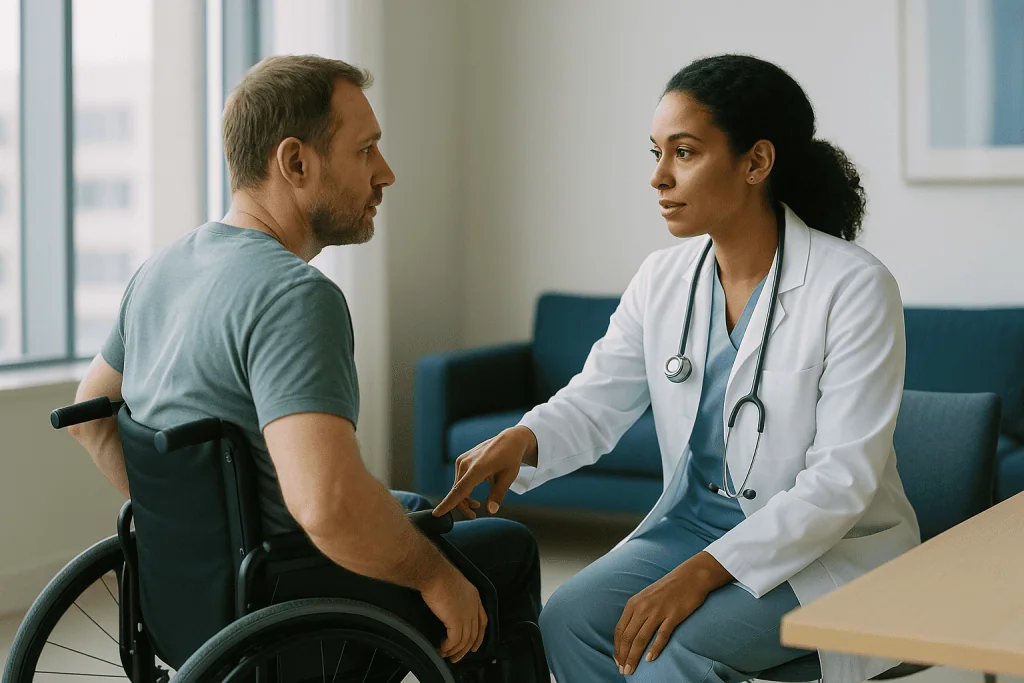
| Region | Segments | Typically affected | Common early rehabilitation focus |
|---|---|---|---|
| High cervical | C1–C4 | Breathing muscles, neck, all four limbs, trunk | Ventilator weaning where possible, secretion clearance, powered mobility with head or breath controls, caregiver training |
| Low cervical | C5–C8 | Varying arm and hand function, trunk, legs | Shoulder and elbow strengthening, adaptive grip, pressure relief, transfers with or without equipment |
| Thoracic | T1–T12 | Trunk control (improves lower down), legs, bladder, bowel | Sitting balance, manual wheelchair skills, independent transfers, bladder and bowel routines |
| Lumbar | L1–L5 | Hips, knees, ankles, bladder, bowel | Standing, gait training with braces or walking aids, continence management |
| Sacral | S1–S5 | Feet, bladder, bowel, sexual function | Walking often preserved; pelvic floor, bladder and bowel programs |
Two patterns stand out. First, the higher the injury, the more body systems are involved, so cervical rehabilitation is as much about breathing, blood pressure and skin as it is about movement. Second, trunk control is the hinge of independence. Someone with a low thoracic injury can usually sit unsupported and reach without toppling, which unlocks dressing, transfers and wheelchair propulsion in a way that a high thoracic injury does not.
Doctors use the terms tetraplegia (also called quadriplegia) for cervical injuries affecting all four limbs and the trunk, and paraplegia for injuries at T1 or below that spare the arms. MedlinePlus and Mayo Clinic both use this division, and it maps closely to the two broad rehabilitation pathways described below.
Complete or incomplete: what is an incomplete quadriplegic?
An incomplete quadriplegic is a person with a cervical spinal cord injury, affecting all four limbs to some degree, in whom some sensation or movement is still preserved below the level of injury, including the lowest sacral segments. The word “incomplete” is not a comment on severity in everyday terms; it is a precise statement that the cord is still transmitting at least some signal past the damaged zone.
Rehabilitation teams grade this using the American Spinal Injury Association (ASIA) Impairment Scale, a five-letter system from A to E. Grade A is complete. Grades B, C and D are incomplete, with B meaning sensation but no movement is preserved below the level, C meaning some movement but most key muscles are weak, and D meaning most key muscles below the level can move against gravity. Grade E means sensation and strength have returned to normal, even if other problems such as spasticity remain. Mayo Clinic describes this scale as a core part of the diagnostic workup.
The grade matters because it tracks closely with what tends to come back. Preserved sensation in the sacral area early on, even a flicker, is one of the signs clinicians watch for because it suggests the cord is not fully disconnected. People with incomplete injuries have more potential for return of movement than those with complete injuries, although the amount and speed remain highly individual.
Incomplete cervical injuries also come in recognizable patterns. Central cord syndrome, common after a fall with the neck bent backward in an older adult, often affects the arms and hands more than the legs. Brown-Séquard syndrome, after injury to one side of the cord, weakens one side of the body while numbing the other to pain and temperature. Each pattern shifts the rehabilitation plan: a person with central cord syndrome may walk early but struggle with buttons for months.
The practical takeaway is that “quadriplegic” alone tells a family very little. Level, completeness and pattern together tell the story.
What happens if you break your C1 and C2?
C1 and C2 are the top two vertebrae, the ring-shaped atlas and the peg-shaped axis that let the head nod and turn. A fracture here is not the same as a spinal cord injury here. Many C1 and C2 fractures, including the well-known “hangman’s fracture” of C2, occur without cord damage, because the canal at this level is unusually wide relative to the cord. Those fractures are treated with immobilization in a collar or halo device, or with surgery, and the rehabilitation focus is neck stability and gradual return to activity.
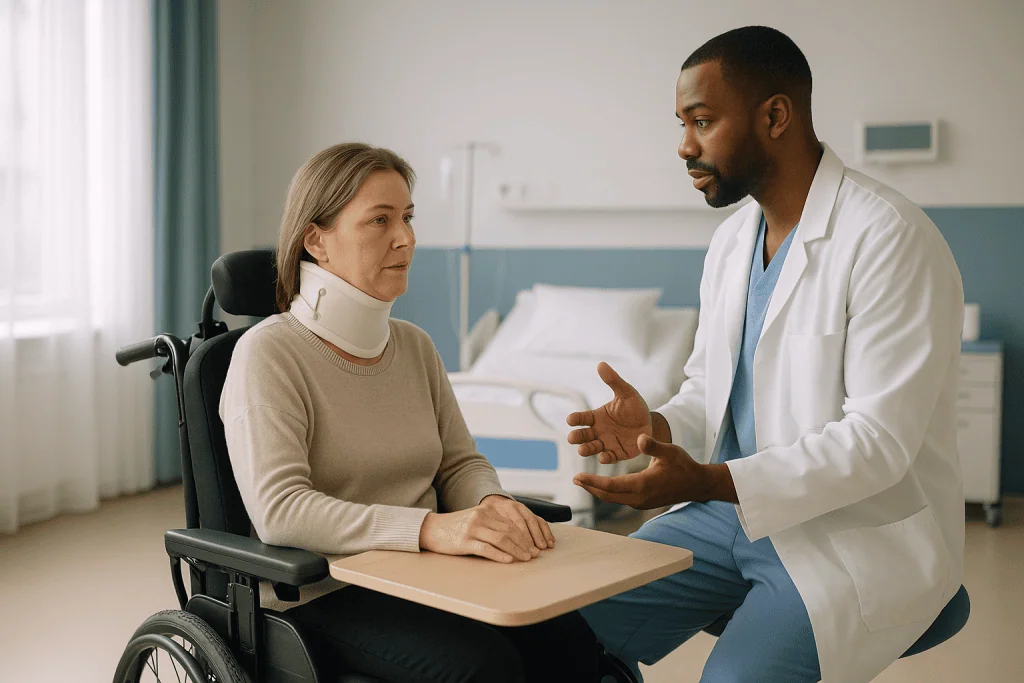
When the cord itself is injured at C1 to C3, the consequences are the most serious in the spinal column. The phrenic nerve, which drives the diaphragm, arises mainly from C3 to C5. Injury above that leaves the person unable to breathe on their own. Johns Hopkins Medicine notes that injuries to C1 through C4 can affect breathing and may require a ventilator. The neck, shoulders, arms, trunk and legs are typically paralyzed, and head movement may be limited.
Rehabilitation goals at this level look different from almost every other injury. Early work centers on the respiratory system: secretion clearance, techniques for assisted coughing, and, where the phrenic nerve is intact, evaluation for ventilator weaning or diaphragm pacing. Mobility goals turn to powered wheelchairs controlled by head movement, chin, breath (sip-and-puff) or voice. Communication, environmental controls and caregiver training become central, and the person’s own decision-making, directing care and daily routines, is a skill the team deliberately builds.
A C4 injury sits at the boundary. Some diaphragm function may be preserved, which can mean breathing without a ventilator, with shoulder shrug but little arm use. A C3 injury usually does not. That single segment is one of the clearest illustrations of how spinal cord injury level and recovery goals are tied together: the same anatomy, one level apart, with a very different first year.
How C5 to C8 injuries change the arm and hand goals
Below C4, each segment adds a layer of arm function, and rehabilitation goals climb with it. Therapists talk about these injuries almost muscle by muscle, because the difference between a working elbow and a working wrist changes what a person can do without help.
At C5, the deltoid and biceps typically work, so the person can raise the arm and bend the elbow, but there is no wrist or hand control. Goals often include eating with adapted utensils strapped to the hand, driving a powered wheelchair with a joystick, and assisting with pressure relief. Transfers usually need help or a lift.
At C6, wrist extension returns. That matters more than it sounds, because when the wrist bends back, the fingers naturally curl inward, a passive grip called tenodesis. Therapists train this grip deliberately, and it opens the door to self-feeding, grooming, writing with adaptations, and, for many, independent transfers using a sliding board and manual wheelchair propulsion on level surfaces.
At C7, the triceps allow the elbow to straighten and push. Pushing up is the mechanical key to lifting the body for transfers and pressure relief, so independence in daily tasks becomes a common goal. At C8, finger flexion gives a true grasp, and most self-care becomes achievable with practice, though fine dexterity may still lag.
Across all these levels, the trunk and legs remain affected, and the same background issues persist: bladder and bowel programs, skin checks, blood pressure regulation and respiratory care, since the abdominal and intercostal muscles that power a strong cough are still weak. Mayo Clinic and Cleveland Clinic both describe these functions as part of the rehabilitation plan rather than separate medical problems.
A tendon transfer or nerve transfer, surgical options that reroute a working muscle or nerve to restore a missing movement, may be discussed later for some people. Whether that is appropriate is a decision for the treating team after the neurological picture has stabilized.
Thoracic injuries: paraplegia, trunk control and wheelchair skills
A thoracic injury, between T1 and T12, spares the arms. Doctors call the result paraplegia: weakness or paralysis of the legs and, to a varying degree, the trunk, with bladder, bowel and sexual function also affected. Because the hands work, the rehabilitation conversation shifts from “how will I manage daily tasks” to “how do I do them fully on my own.”
Trunk control is the variable that splits this group. The intercostal muscles between the ribs and the abdominal muscles are innervated segment by segment down the thoracic cord. A T2 injury leaves little of either, so sitting balance is poor and the person relies on armrests, a higher backrest and learned techniques to stay upright while reaching. By T10 to T12, most of the abdominal wall is working, sitting balance is good, and a strong cough is possible. That difference shapes everything from the wheelchair prescription to how quickly someone can dress in bed and transfer to a car seat.
Typical goals for thoracic rehabilitation include independent transfers to bed, toilet, shower bench and vehicle; manual wheelchair skills including curbs and ramps; a reliable bladder program, often intermittent catheterization, in which a thin tube is passed into the bladder on a schedule to drain it; a bowel program; and skin management, since the person cannot feel pressure building on the buttocks. Standing frames and, in some cases, bracing or exoskeleton-assisted walking are used for exercise and bone health, but for complete thoracic injuries, wheelchair mobility is generally the functional goal and walking is not the measure of success.
The arms become the person’s legs, and overuse of the shoulders is a known long-term problem. Teaching efficient pushing technique, upper-body strengthening and smart pacing early is a legitimate rehabilitation goal, not an afterthought. The NHS and Mayo Clinic both emphasize that long-term care after paralysis is as much about preventing complications as restoring movement.
Lumbar and sacral injuries: walking, bladder and bowel goals
The spinal cord itself ends around the first or second lumbar vertebra in adults. Below that, the canal contains a bundle of nerve roots called the cauda equina, named for its horsetail appearance. Injuries in this region damage nerve roots rather than cord, and peripheral nerves have some capacity to recover that the central cord does not. That is one reason lower injuries often have a different trajectory.
With a lumbar injury, hip flexion and knee extension may be preserved while the muscles that lift the foot or push off the toes are weak. Walking is frequently a realistic goal, often with ankle-foot orthoses (lightweight braces that hold the foot up), a walker or crutches, and the rehabilitation plan is built around gait: standing balance, step training, stair practice and energy conservation, since walking with braces costs far more effort than it looks.
Sacral injuries, S1 to S5, often leave walking relatively intact but affect the functions people talk about least and worry about most. The sacral segments control the bladder, bowel and sexual function. After injury here, the bladder may fail to empty rather than empty unpredictably, and bowel movements may need a scheduled program. Rehabilitation goals center on continence management, pelvic floor work where possible, skin protection and, when the person is ready, frank discussion of sexual health and fertility.
Cauda equina syndrome deserves its own mention. It is a surgical emergency in which these roots are compressed, classically by a large disc herniation, and the NHS lists new loss of bladder or bowel control, numbness around the genitals or buttocks and weakness in both legs as reasons to seek care immediately. Rehabilitation after decompression follows the same lumbar and sacral principles described here.
Across the lower levels, the honest message is this: walking is more likely, but bladder and bowel recovery is less predictable and often slower, and it deserves the same attention in goal-setting.
How spinal cord injury rehabilitation actually works day to day
Rehabilitation after a spinal cord injury is not a single treatment. It is a coordinated program delivered by a team: a rehabilitation physician (physiatrist), physical therapists, occupational therapists, rehabilitation nurses, respiratory therapists, psychologists, dietitians and social workers. Mayo Clinic describes the goals in plain terms: prevent complications, maximize remaining function, teach new skills and adapt the environment.
The work follows a predictable logic. First, the team completes a full neurological examination to confirm level and completeness. Next, they set short-term goals measured in weeks, usually written down and reviewed with the person. A typical early goal for a C6 injury might be “tolerates sitting upright for 30 minutes without a drop in blood pressure”; for a T12 injury it might be “transfers bed to wheelchair with supervision.” Goals climb as each one is met.
A day on an inpatient rehabilitation unit usually includes several hours of therapy. Physical therapy addresses strength, range of motion, balance, transfers and mobility. Occupational therapy addresses the tasks of daily living, dressing, bathing, cooking, writing, and the equipment that makes them possible. Nursing teaches the bladder and bowel programs and skin checks that will continue for life. Respiratory therapy, for cervical and high thoracic injuries, trains breathing muscles and cough assistance.
Underneath the visible work sits neuroplasticity, the nervous system’s ability to reorganize. Repetitive, task-specific practice drives this reorganization, which is why therapy involves hundreds of repetitions of the same movement rather than a few demonstrations. Incomplete injuries benefit most, but even complete injuries gain from strengthening the muscles above the level and learning compensatory technique.
Medicines are part of the picture, mostly to manage symptoms rather than to restore function: antispasmodics for muscle stiffness, agents for nerve pain, bladder medicines, and anticoagulants (blood thinners) in the early weeks to prevent clots. The NIH National Institute of Neurological Disorders and Stroke describes current treatment as focused on supporting recovery and preventing complications; decisions about any of these medicines belong to the prescribing clinician.
Who goes to inpatient rehabilitation first, and who is asked to wait
Not everyone moves from the trauma ward to the rehabilitation gym on the same schedule. The treating team weighs medical stability, the stability of the spine itself and the person’s ability to participate before transfer.
Candidates for early intensive rehabilitation usually share a few features: the spine has been stabilized, surgically or in a brace, so the person can be moved and sat upright; breathing is stable, with or without a ventilator; blood pressure holds up when sitting; and there is no untreated infection, uncontrolled pain or unhealed wound that would make hours of therapy unsafe. For most people, that means transfer within the first few weeks after injury, although the exact timing is individual.
Some are asked to wait, and the reasons are worth understanding. A person still in spinal shock, a temporary state after injury when reflexes below the level disappear and blood pressure and heart rate may be unstable, may not be safe to sit up for long. Someone with multiple fractures, a brain injury or a chest injury from the same accident may need those treated first. Older adults with heart or lung disease may need a gentler ramp. Severe pressure injuries, deep wounds over bony points caused by sustained pressure on numb skin, can delay sitting for weeks and are one of the most common reasons therapy stalls.
Waiting is not the same as doing nothing. Bedside therapy, range-of-motion exercises, positioning, breathing exercises and early education continue, and the NHS emphasizes that preventing complications in this phase is itself a treatment goal.
There is also a distinction between inpatient rehabilitation, where the person lives on the unit, and outpatient or home-based rehabilitation, which usually follows. People with lower injuries and good family support sometimes move home sooner and continue as outpatients. People with high cervical injuries typically stay longer because the caregiver training and equipment setup take time. Who goes where is the treating team’s call, made with the person and family.
Paraplegia recovery time and the first weeks after a spinal cord injury
“How long does it take to recover from paraplegia?” is the question with no single honest number, but there is an honest shape to the answer. Recovery after a spinal cord injury front-loads. Mayo Clinic states that if some recovery is going to happen, it usually starts within a week to six months after injury, and that the fastest rate of change is seen in the first six months, with smaller gains possible for a year or two. The NIH NINDS describes the same pattern: most improvement occurs in the first months, though some people continue to gain function slowly afterward.
That shape shows up in a typical timeline.
- Days 1 to 14: emergency care, imaging, spinal stabilization and management of spinal shock. Breathing, blood pressure, bladder drainage and skin protection dominate. The first neurological examination is done, then repeated.
- Weeks 2 to 8: transfer to inpatient rehabilitation when stable. Sitting tolerance, transfers, wheelchair fitting, bladder and bowel programs, and caregiver training. Spasticity (muscle stiffness and involuntary spasms) often appears in this window as spinal shock resolves.
- Months 2 to 6: the period of greatest functional change. Goals are revised upward or adjusted as the picture clarifies. Discharge home with equipment, followed by outpatient therapy.
- Months 6 to 24: slower neurological change, but continued functional gains from strength, technique and adaptation. Return to work, driving assessment and community activity become goals.
For a complete thoracic injury, “recovery” in practice means reaching independence in a wheelchair, and many people achieve their main functional goals during the inpatient stay and the months after it. For an incomplete injury, neurological recovery and functional recovery run in parallel and the ceiling is higher but less predictable.
Early signs that clinicians watch for include return of sensation or voluntary movement in the sacral area, improving strength in muscles just below the level, and the shift from spinal shock to reflex activity. None of these is a promise, and their absence early does not close the door, which is why the examination is repeated rather than done once.
Complications that quietly reshape the rehabilitation timeline
Ask any rehabilitation nurse what delays progress and the answer is rarely “the injury.” It is the complications that follow, and most are tied directly to level.
Pressure injuries sit at the top of the list for every level. Skin that cannot feel pressure breaks down over the tailbone, hips and heels, and a deep wound can take the person off their seat for weeks. Pressure relief every 15 to 30 minutes while sitting, cushion selection and daily skin inspection are core rehabilitation skills, not extras.
Respiratory complications dominate cervical and high thoracic injuries. Weak breathing muscles and a poor cough mean pneumonia is a leading cause of illness in the first year; Johns Hopkins lists breathing difficulty as a central concern in acute cervical injury. Training in assisted cough and breathing exercises is scheduled therapy for these levels.
Autonomic dysreflexia affects people with injuries at T6 and above. A trigger below the level, most often a full bladder or bowel, sets off a sudden surge in blood pressure with a pounding headache, flushing and sweating above the injury. Mayo Clinic describes it as a medical emergency. Learning to recognize it and remove the trigger is a mandatory part of rehabilitation at these levels.
Blood clots in the legs are a risk in the early weeks at all levels because the legs are not moving; clot-prevention measures are standard in that period. Spasticity can be useful for standing but painful and disruptive when severe. Chronic nerve pain, bladder infections, bone loss and shoulder overuse all follow in the months and years after.
The WHO notes that people with spinal cord injury have a two- to threefold higher risk of early death than the general population, with secondary conditions such as infections and pressure injuries driving much of that difference, especially where services are limited. Each complication prevented is time returned to rehabilitation, which is why teams treat prevention as the first goal rather than the last.
What people often get wrong about spinal cord injury level and recovery
A few misunderstandings come up in nearly every family meeting, and clearing them early saves a lot of grief.
“The vertebra that broke is the level of injury.” Often it is not. The bone level and the neurological level can differ, particularly in the thoracolumbar region, and only the neurological examination defines the rehabilitation plan.
“Complete means nothing will ever change.” Complete means no sacral sparing on examination at that moment. Some people initially graded complete are regraded incomplete as spinal shock lifts, and even with a complete injury, muscles above the level strengthen and function improves through technique and equipment. Functional recovery and neurological recovery are different things.
“If they cannot walk, rehabilitation has failed.” For a complete thoracic injury, independent wheelchair mobility, self-care and a reliable bladder and bowel program are the goals, and reaching them is success by every clinical definition. Walking is a goal for some levels and some incomplete injuries, not the measure of all rehabilitation.
“Six months is a hard deadline.” The first six months bring the fastest change, as Mayo Clinic and NINDS describe, but slower gains can continue well beyond that. The curve flattens; it does not stop.
“Surgery fixes the cord.” Surgery stabilizes bones and removes pressure from the cord. It does not repair the nerve tissue. Experimental approaches such as stem cells and electrical stimulation are being studied, and the NIH NINDS notes that no current treatment reverses the injury; any offered outside a registered clinical trial should be treated with caution.
“Lower injuries are easy.” Lumbar and sacral injuries often permit walking, but bladder, bowel and sexual function changes are real, frequently permanent and often the hardest part to live with. They deserve the same seriousness in goal-setting as mobility.
Getting these right lets families spend their energy on the goals that actually move, rather than waiting for the one that may not.
Questions to ask your care team about level and rehabilitation goals
Rehabilitation goes better when the person and family understand the plan in the same terms the team uses. These questions tend to produce useful answers at any stage.
- What is the neurological level of injury, and is it complete or incomplete on the ASIA scale? Has it changed since the first examination?
- Which muscles below the level are working now, and which are you watching for change?
- What are the specific goals for the next two weeks, and how will we know they have been met?
- Given the level, is walking a realistic goal, a long-term possibility or not the focus? What is the mobility goal instead?
- What breathing, blood pressure or skin issues are tied to this level, and what should we be doing about them every day?
- What will the bladder and bowel program look like, and who teaches it?
- Which medicines are being used, what each one is for, and when will they be reviewed? (Decisions about starting, changing or stopping them rest with the prescribing clinician.)
- How long is the expected inpatient stay, and what has to happen before discharge?
- What equipment will be needed at home, and who assesses the home?
- What signs of autonomic dysreflexia, infection or clot should prompt an urgent call?
- What psychological support is available for the person and the family?
- When the neurological picture has stabilized, are there surgical options such as tendon or nerve transfer worth discussing?
Write the answers down. Goals change as the examination changes, and having the earlier answers on paper makes it easier to see progress that is slow enough to miss from day to day. It also keeps the family and the team working from the same sheet, which, as any therapist will tell you, is half the battle.
When to call your doctor
After a spinal cord injury, some problems are emergencies regardless of level, and knowing them is as much a part of rehabilitation as any transfer technique. Call emergency services or go to the emergency department for any of the following.
- A sudden pounding headache with flushing, sweating above the injury or a very slow pulse, especially with an injury at T6 or above: this may be autonomic dysreflexia, which Mayo Clinic describes as a medical emergency.
- New or worsening difficulty breathing, a weak cough with chest congestion, or fever with shortness of breath.
- New weakness, numbness or loss of function in any area that was previously working, or new severe neck or back pain after a fall or jolt.
- Swelling, warmth or pain in one leg, or sudden chest pain and breathlessness, which can signal a blood clot.
- A pressure sore that is deepening, draining or surrounded by redness, or any fever with a wound.
- Signs of a bladder or kidney infection: fever, chills, cloudy or foul-smelling urine, increased spasms or sweating.
- Thoughts of self-harm or a sudden change in mood; depression after spinal cord injury is common and treatable, and the care team wants to know.
For anyone who has not yet been diagnosed, the NHS advises seeking emergency care after a significant injury with severe neck or back pain, weakness or numbness in the limbs, loss of bladder or bowel control, or numbness around the buttocks and genitals. Do not move a person with a suspected spinal injury unless they are in immediate danger.
Between emergencies, keep a low threshold for contacting the rehabilitation team about anything unexpected: a new pattern of spasms, a change in bladder emptying, a skin mark that does not fade within half an hour of pressure relief. The treating team sets the plan and adjusts it; the person living with the injury is the one who notices first.
Frequently asked questions
What is an incomplete quadriplegic?
An incomplete quadriplegic has a cervical spinal cord injury affecting all four limbs, but with some sensation or movement preserved below the level, including in the lowest sacral segments. On the ASIA Impairment Scale this is grade B, C or D rather than A. Incomplete injuries generally have more potential for return of function, although how much varies widely between people.
What happens if you break your C1 and C2?
A fracture of C1 or C2 does not always injure the spinal cord, because the canal is wide at that level; many are treated with a collar, halo or surgery. When the cord is damaged there, breathing muscles are usually affected and a ventilator may be needed, with paralysis of the arms, trunk and legs. Rehabilitation focuses on respiratory care, powered mobility and caregiver training.
How long does it take to recover from paraplegia?
There is no fixed paraplegia recovery time. Mayo Clinic notes that recovery, when it occurs, usually begins within a week to six months of injury, with the fastest change in the first six months and slower gains for a year or more. For a complete thoracic injury, the practical goal is independence in a wheelchair, often achieved during and soon after inpatient rehabilitation.
What are the symptoms of a back injury that needs emergency care?
After a fall, crash or other significant injury, the NHS advises emergency care for severe back or neck pain, weakness or numbness in the arms or legs, loss of bladder or bowel control, or numbness around the buttocks and genitals. A person with a suspected spinal injury should not be moved unless in immediate danger. Only a clinical examination and imaging can confirm what has happened.
Can spinal cord injury levels explained by the bone fracture be wrong?
Yes. The vertebra that fractured and the neurological level of injury often differ, especially in the lower back where the cord ends around L1 to L2 and nerve roots continue below. Rehabilitation planning uses the neurological level, defined by examination of sensation and strength, not the bone level seen on imaging.
Does a complete injury mean no recovery is possible?
Complete means no sensation or movement is preserved in the lowest sacral segments at the time of examination. Some people are regraded incomplete as spinal shock resolves, and functional gains from strengthening, technique and equipment continue even when neurological recovery does not. The examination is repeated over time rather than treated as final on day one.
What is spinal shock and how long does it last?
Spinal shock is a temporary state after injury in which reflexes below the level disappear and blood pressure and heart rate can be unstable. It typically resolves over days to weeks, after which reflexes and often spasticity return. Its end allows a more reliable neurological examination, which is one reason level and completeness are reassessed during rehabilitation.
Will someone with a c1 c2 spinal cord injury be able to use a wheelchair?
Usually yes, with a powered wheelchair controlled by head movement, chin, breath or voice rather than hands. Rehabilitation at this level teaches the person to direct their own care and environment using these controls, alongside respiratory management and caregiver training. Independence is redefined around decision-making and technology rather than physical self-care.
Why do thoracic injuries at different levels lead to different goals?
Trunk muscles are supplied segment by segment down the thoracic cord. A high thoracic injury leaves poor sitting balance and a weak cough, while a low thoracic injury preserves most abdominal control, allowing unsupported sitting, stronger coughing and easier transfers. That difference changes wheelchair setup, dressing technique and how quickly independence is reached.
Are stem cells or electrical stimulation proven treatments for spinal cord injury?
Not yet as standard care. NIH NINDS describes these as areas of active research, and no current treatment reverses the injury itself. Some approaches are being tested in registered clinical trials. Anything offered outside a trial with promises of restored function should be discussed with the treating team before any decision is made.
References
This article is for general information only and is not a substitute for professional medical advice. Please consult a qualified doctor about your individual situation.
Add us as a Preferred Source to see more of our trusted health content across Google Search, AI Overviews and Discover.

More from the Blog

Is Pulmonary Rehabilitation Safe With Heart Disease? How Programs Monitor Oxygen and Effort
Pulmonary rehabilitation is generally considered safe for people who also have heart disease, provided the heart condition is stable and the program screens, individualizes…

Brain Injury Rehabilitation Milestones: Realistic Timelines for Movement and Memory
A brain injury recovery timeline depends mostly on injury severity. Concussion symptoms often settle within about two weeks for adults and up to four…

Long-Term Life With a Prosthesis or Orthosis: Refits, Cleaning and When Comfort Changes
Long-term care of a prosthetic leg centers on three habits: clean the residual limb and liner every day, watch the skin for redness or…

Questions to Ask Your Physical Therapist at the Start of a Rehabilitation Program
The most useful questions to ask a physical therapist at the start of rehabilitation cover five areas: what the therapist thinks is causing the…

How Family Members Can Support Neurological Rehabilitation Between Therapy Sessions
Family members can support neurological rehabilitation between sessions by helping the person practice the specific exercises and everyday tasks their therapists have prescribed, keeping…

What Happens in a Manual Therapy Session: Mobilization, Manipulation and Soft Tissue Work
A manual therapy session usually begins with a short conversation about your symptoms and a physical assessment, followed by hands-on techniques chosen for your…