

Long-Term Life With a Prosthesis or Orthosis: Refits, Cleaning and When Comfort Changes

Key Takeaways
- Residual limb volume changes with weight, activity and health, so a socket that fit well last year may need adjusting now even if nothing feels broken.
- The NHS and MedlinePlus advise washing the residual limb daily with mild unscented soap, drying thoroughly and inspecting the skin with a mirror.
- Needing many more sock plies than at your last fitting, or finding that extra socks no longer stop pistoning, is a signal for a socket refit rather than a permanent fix.
- Liners, suspension sleeves and prosthetic feet wear at different rates, so most replacements involve one component rather than the whole prosthesis.
- A limb that becomes suddenly swollen, hot and painful is a medical sign to be assessed by a doctor before anyone adjusts the socket.
- Orthoses such as ankle-foot braces rub, warp and loosen in the same ways, and people with reduced sensation need the same daily skin checks.
Long-term care of a prosthetic leg centers on three habits: clean the residual limb and liner every day, watch the skin for redness or pressure marks, and report any change in fit to your prosthetist promptly. Limb volume shifts with weight, activity and health, so sockets need periodic refits and components wear out. Your rehabilitation team decides when adjustments or replacements are appropriate.
Eleven years after his amputation, Daniel still remembers the morning the socket stopped feeling like part of him. Nothing dramatic had happened. He had walked the same route to the bus, worn the same sock ply he always did, and yet by lunchtime a hot spot was blooming on the inside of his knee. He had assumed that once you learned to walk on a prosthesis, the hard part was over.
That assumption is common, and it is mistaken. Prosthetic leg long term care is less like owning a pair of shoes and more like tending a working partnership between living tissue and engineered parts. The limb changes. The components wear. Weight, illness, a new job, even a hot summer can alter how the socket sits.
The same holds for anyone who wears an orthosis, the clinical word for a brace that supports or realigns a joint. This explainer walks through what actually shifts over the years, how cleaning and refits keep problems small, and which changes in comfort deserve a call rather than a shrug.
How a prosthetic leg actually works from day to day
A lower-limb prosthesis is a chain of parts, and comfort depends on every link. Closest to the body is the liner, a soft sleeve of silicone or gel that cushions skin and helps the limb grip the socket. Over or under it sit prosthetic socks, layered to fine-tune the fit. The socket is the rigid shell shaped to the residual limb, the clinical term for the remaining part of the leg after amputation. Below the socket, a pylon connects to a foot or a knee-and-foot unit, and a suspension system (a pin lock, a suction seal or a sleeve) keeps everything attached.
Here is the part many people are not told clearly at the start: the socket does not carry weight evenly. It is deliberately shaped to load tolerant areas, such as the shelf of tissue below the kneecap in a below-knee amputation, and to relieve bony prominences that bruise easily. That shaping only works while the limb keeps the shape the prosthetist cast or scanned.
Soft tissue is not static. Over a single day, fluid moves out of the limb as you stand and walk and returns when you rest, so most people find the socket looser by evening than at breakfast. Over months, muscle can shrink from reduced use, fat can redistribute with weight change, and swelling can rise with heart, kidney or circulation problems. The NHS notes that the residual limb changes shape particularly in the early period after surgery, which is why early prostheses are often temporary, but change never fully stops.
Understanding this mechanism reframes the whole project. Cleaning protects the skin interface. Sock management buys time between adjustments. Refits realign the load with the limb you have now, not the one you had at the last appointment.
Why does a prosthetic leg fit change over time?
Ask a prosthetist what causes most long-term complaints and the answer is rarely a broken part. It is volume. The residual limb gains or loses bulk for reasons that have little to do with the prosthesis itself.

Body weight is the obvious driver. A modest gain or loss spread across the whole body is concentrated, in socket terms, on a few square inches of contact surface, so a change you barely notice at the belt can make a socket pinch or piston. Activity matters too. Someone who takes up swimming or starts a physically demanding job may build muscle in the thigh, while a long spell of illness or a desk-bound year can let it waste. Medical conditions add another layer: fluid retention from heart or kidney disease, dialysis cycles, and the vascular disease that underlies many amputations can all swell or shrink the limb. Mayo Clinic highlights that diabetes-related circulation and nerve changes are the leading reason for lower-limb amputation in the first place, and those same processes continue to affect the remaining tissue.
Daily swings are smaller but real. Standing, heat, salt intake, hormonal cycles and even air travel can shift fluid. That is why clinicians teach sock ply management: adding a thin sock when the socket feels loose, removing one when it feels tight.
Then there is the socket’s own history. Rigid materials do not stretch, but liners compress, soft inserts pack down, and straps lose elasticity. A fit that drifts slowly is easy to adapt to without noticing, which is precisely the trap. By the time a sore appears, the mismatch may have been building for weeks. Regular self-checks are the early-warning system, and the next sections describe them.
Prosthetic leg long term care: the daily skin routine
Skin is the one component you cannot replace, so it earns the most attention. Both the NHS and MedlinePlus advise washing the residual limb every day with mild, unscented soap and warm water, rinsing thoroughly and patting dry rather than rubbing. Evening is usually the better time; washing in the morning can leave skin damp and soft just before it goes into a close-fitting socket, and damp skin blisters more readily.
Inspection follows washing. Use a hand mirror for the back and underside of the limb, and look in good light. You are checking for redness that does not fade after about twenty minutes out of the socket, shiny or thickened patches, small cracks, blisters, ingrown hairs and any area that feels warmer than its surroundings. If sensation in the limb is reduced, as it often is with diabetes, your eyes have to do the work your nerves cannot, which is why Mayo Clinic recommends daily visual checks of the feet and lower limbs for anyone with diabetic neuropathy.
A few practical points reduce trouble. Avoid shaving the limb, since stubble and nicks irritate under pressure; trimming is gentler if hair is a problem. Skip lotions in the morning unless your team has recommended a specific product, because residue changes how a liner grips. Do not soak the limb for long periods, and never use heat pads or very hot water on skin that may have reduced sensation.
Finally, give the limb time out of the socket each day. Continuous wear traps moisture and heat. The prosthesis is a tool for living, not a second skin, and both the tissue and the liner recover better with a nightly rest.
How to clean a prosthetic liner, socks and socket
The liner lives in a warm, sealed, sweat-fed environment for hours at a time, which is ideal for bacteria and yeast. Cleaning it is not fussiness; it is infection prevention.
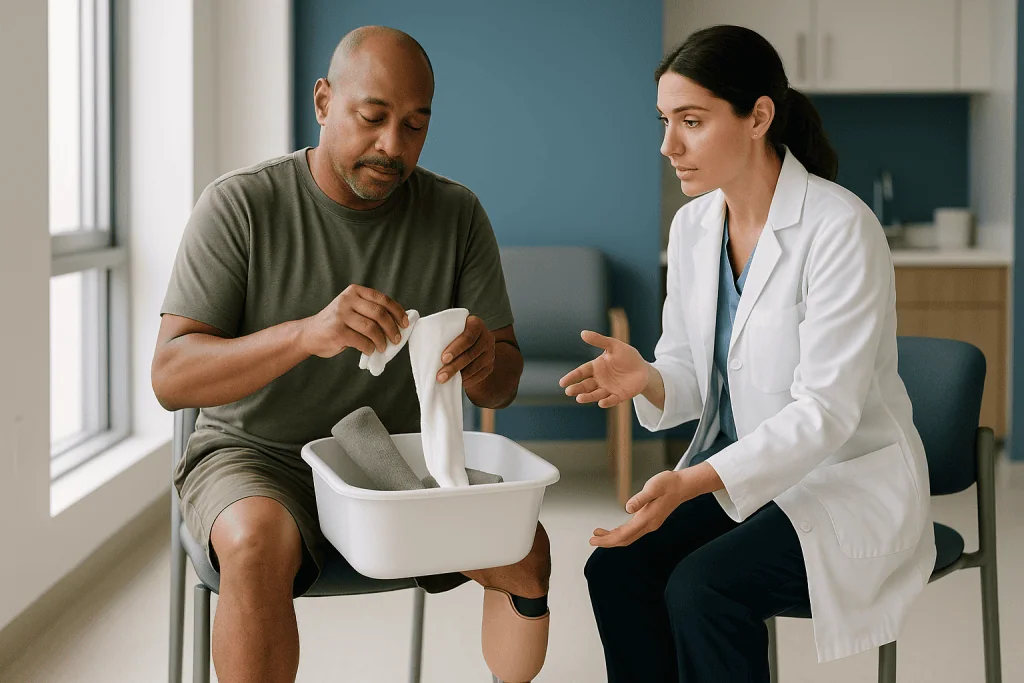
Most gel and silicone liners are washed daily. Turn the liner inside out, wash the skin-facing surface with warm water and a mild, fragrance-free soap, rinse until no slip remains, and pat with a lint-free cloth before leaving it to air dry, inside out, on a stand or upright on a clean surface. Keep it away from radiators and direct sun, which can degrade the material. Do not use alcohol, bleach or solvents unless the manufacturer’s guidance specifically allows it; harsh agents crack the surface and the cracks then harbor microbes. Your prosthetist will tell you the care instructions for your particular liner, and those instructions take priority over general advice.
Prosthetic socks are changed every day, or more often in hot weather or when a sock becomes damp. Wash them as you would delicate knitwear, in warm water with mild detergent, and dry flat. Stretched, matted or thinned socks no longer provide the ply they claim and should be replaced.
The socket itself needs a wipe-down each evening with a damp cloth and mild soap, then thorough drying, since moisture left overnight can cause odor and skin problems the next day. Check the inside for cracks, rough edges or loose padding while you clean.
Watch what goes near the skin: scented wipes, antiperspirants and essential oils are frequent causes of contact dermatitis, the medical name for an itchy rash caused by something touching the skin. If you want to try a product for sweat or odor, ask your team first.
Prosthetic leg skin problems: what causes them and what usually happens
Skin complaints are the most common long-term issue for prosthesis users, and almost all of them trace back to one of four mechanisms: pressure, shear, moisture or an allergen.
Pressure sores form where bone sits close under the skin and the socket pushes harder than the tissue can tolerate. Shear, which is skin being dragged sideways against the socket wall, causes blisters and abrasions, often when the limb has shrunk and pistons up and down with each step. Moisture softens the outer skin layer and invites folliculitis, an infection of hair follicles that looks like small pimples, as well as fungal rashes in the warm folds at the top of the socket. Allergic and irritant reactions appear as itchy, red, sometimes weeping patches that match the shape of a liner, strap or cleaning product.
What usually happens depends on catching it early. Mild redness that fades with an hour of rest and a sock adjustment often needs nothing more. A persistent hot spot generally prompts a socket adjustment, where the prosthetist relieves or pads a specific area. Broken skin typically means a period out of the prosthesis while it heals, and your team will advise on wound care. Infection, signaled by spreading redness, warmth, pus or fever, needs medical assessment, and MedlinePlus lists these as reasons to contact a provider after limb surgery.
Two points deserve emphasis. First, do not pad a sore spot with cotton wool or tape and carry on; improvised padding shifts pressure to the neighboring area and hides the problem. Second, people with diabetes or peripheral vascular disease heal more slowly and are at higher risk of serious infection, which is why Mayo Clinic treats any foot or limb wound in diabetes as a reason to seek prompt care rather than wait.
Prosthetic leg socket refit: how you know it is time
A refit is not a failure. It is scheduled maintenance for a body that keeps changing. The question is how to tell the difference between a day that needs an extra sock and a limb that needs a new socket.
The sock test is the first clue. If you routinely need many more plies than you did at your last fitting, or if adding socks no longer stops pistoning, the socket shape no longer matches the limb. Conversely, if you cannot get into the socket comfortably even with no socks, the limb has grown or swollen beyond the shell’s capacity. Other signs include pain or pressure in a new location, a feeling that the knee or hip is being pulled into an odd angle, a changed walking pattern that others notice before you do, new low-back pain from compensating, and skin problems that keep returning in the same spot despite good hygiene.
| Comfort change | Likely cause | What usually happens next |
|---|---|---|
| Loose by evening, fine in morning | Normal daily fluid shift | Sock ply management, taught by your team |
| Loose all day, many extra socks | Limb volume loss | Socket adjustment or new socket |
| Tight at the top, cannot seat fully | Limb volume gain or swelling | Medical check for swelling cause, then refit |
| New pain over a bony point | Localized pressure | Socket relief or padding |
| Sudden looseness after illness or weight change | Rapid volume change | Early review rather than waiting for the next routine visit |
The NHS advises keeping in regular contact with your prosthetic service, since sockets need adjusting or replacing as the limb changes. How often that is varies widely from person to person and is a decision for your prosthetist based on the limb in front of them, not a fixed calendar.
When to replace a prosthetic leg or its parts
People tend to think of the prosthesis as a single object with a single lifespan. In practice it is a set of components that wear at different rates, and most replacement decisions concern one part rather than the whole limb.
Liners usually go first. Gel and silicone fatigue with daily stretching and washing, developing thin spots, tears or a surface that no longer grips. Suspension sleeves and straps stretch. Prosthetic feet have internal springs or keels that lose their responsiveness and can crack, which you may feel as a flatter, harder step or hear as a new click. Knee units, whether mechanical or microprocessor-controlled, have moving parts and sometimes batteries, and they need servicing. Sockets are replaced when the limb has changed beyond what adjustment can accommodate or when the shell itself cracks.
Signs that something mechanical, rather than the fit, has changed include new noises, a foot that feels dead or lopsided, visible cracks in the shell or pylon, a knee that gives way or locks unexpectedly, and a pin lock that fails to engage reliably. Any of these warrants a visit, and a knee that buckles is a safety matter rather than a comfort one.
Activity level and goals also drive replacement. Someone who moves from a sedentary routine to regular hiking may need a different foot category, and that is a clinical prescription based on assessment, not a product choice to make alone. The reverse is also true; a person whose health has changed may do better with a simpler, more stable setup.
What this means in practice is that the “when to replace” question is answered in partnership. Keep a short log of what has changed and bring it to each review. Prosthetists make better decisions with a month of observations than with a vague sense that things feel off.
Living long term with an orthosis: braces need upkeep too
Not everyone reading this has had an amputation. Many people wear an orthosis, a brace that supports, corrects or offloads a joint, and the long-term principles overlap more than you might expect. An ankle-foot orthosis for foot drop after a stroke, a knee brace for ligament instability, a spinal brace for scoliosis, a custom insole for diabetic feet: each sits against skin, each depends on a precise fit, and each ages.
The skin rules transfer directly. Check daily for redness that outlasts a short rest, especially over the ankle bones, the shin, the heel and the top of the foot where plastic edges press. Wear the recommended sock or interface, keep it clean and dry, and never add your own padding to a sore spot. People with reduced sensation from diabetes or neurological conditions need the mirror-and-good-light habit as much as any prosthesis user, and Mayo Clinic’s advice on daily foot inspection applies to anyone whose footwear or brace could rub unnoticed.
Fit drifts for the same reasons: weight change, muscle change, swelling. A child’s orthosis is outgrown; an adult’s can loosen as swelling resolves after injury or tighten as an unrelated condition causes fluid retention. Straps lose their hook-and-loop grip, plastic creeps and cracks, hinges wear, and the shoe worn over an ankle brace changes how the whole system works.
Cleaning is simpler than for a liner but not optional. Most plastic orthoses are wiped with mild soap and water and dried fully before wear. Avoid leaving a brace in a hot car, since heat can warp thermoplastic. Bring the brace, and the shoes you actually wear with it, to every review so the orthotist can assess the system as you use it rather than in isolation.
Who is usually fitted for a prosthesis and who is asked to wait
A long-term relationship with a prosthesis starts with a decision about whether and when to fit one, and that decision belongs to the rehabilitation team.
Fitting is generally considered when the surgical wound has healed, swelling has settled enough for the limb to hold a stable shape, and the person has the strength, balance and cardiovascular reserve to use a prosthesis safely. The NHS describes an early phase of compression and shaping of the residual limb, often with a shrinker sock or bandaging, before a first prosthesis is made, and notes that early limbs may be temporary while the shape continues to change. Motivation and goals matter as well; a prosthesis is a demanding tool, and the team will talk honestly about what is realistic.
Some people are asked to wait, and some will do better without a prosthesis at all. Reasons to delay include an unhealed or infected wound, uncontrolled swelling, skin that cannot yet tolerate pressure, unstable heart or lung disease, severe pain in the limb, or contractures, which are joints stiffened in a bent position that prevent the limb from fitting a socket. Cognitive impairment or very limited mobility before surgery can mean a wheelchair offers more safe independence than walking on a prosthesis would. None of these is a judgment on the person; they are safety assessments, and several can change with treatment and time.
Later in life, the same questions recur. A long-term user whose health declines may be advised to change to a simpler device or to use the prosthesis for transfers only. Equally, someone who was once told to wait may become a candidate as their condition improves. Reassessment is part of care, not an exception to it.
What the first weeks after a refit or new socket usually look like
A new socket, even on a limb you have worn a prosthesis on for a decade, is a new relationship. The pattern of the first weeks is familiar to anyone who has been through it, and knowing the pattern makes it less unsettling.
The first few days are usually a build-up. Teams commonly suggest a wearing schedule that increases gradually, with frequent checks of the skin, so that any pressure point reveals itself as a fading red mark rather than a blister. Expect the socket to feel different rather than wrong: pressure in new places, a slightly altered sense of where the ground is, perhaps a changed walking rhythm. Fatigue is normal because you are using muscles differently.
Within the first couple of weeks most people return for a check, and small adjustments are routine. A prosthetist may relieve a spot, change alignment by a few degrees, or alter the foot position. These tweaks are expected, not evidence that the fit was poor. MedlinePlus advises following your team’s instructions on how long to wear the prosthesis as you get used to it and reporting problems rather than pushing through pain.
Over the following weeks the limb settles into the new shape. Some volume loss is common once a well-fitting socket begins to compress tissue efficiently, so you may find yourself adding a sock ply during this period. By the end of the adjustment phase, the aim is a socket you can forget about for most of the day.
Timelines vary with the amputation level, the person’s health and how different the new socket is from the old one. A different suspension system or a first microprocessor knee takes longer to learn than a like-for-like replacement. Your team sets the pace, and physiotherapy input during this window often makes the difference between tolerating a device and trusting it.
Phantom sensations and phantom pain years after amputation
Daniel still feels his missing foot when it rains. He is not unusual. Phantom sensation, the feeling that the amputated part is still present, is reported by most people after limb loss, and phantom limb pain, in which those sensations are painful, affects a large proportion according to Cleveland Clinic and Johns Hopkins Medicine. It is not imagined and it is not a sign of mental weakness; it arises from the brain and spinal cord continuing to process signals from a body map that has not fully updated.
Why mention this in an article about long-term fit? Because the two interact. A poorly fitting socket, a neuroma (a tender tangle of nerve endings that can form at the cut nerve), and skin breakdown can all trigger or worsen phantom pain. Equally, phantom pain can make people reluctant to wear the prosthesis, which allows the limb to swell or waste, which then worsens the fit. Breaking that loop often starts with the prosthetist and physiotherapist rather than with medication.
Approaches that teams commonly use include desensitization, mirror therapy (using a mirror to show the brain an image of the intact limb moving), graded activity, and treatment of any socket problem. Where medicines are used, clinicians typically draw on drug classes that act on nerve signaling, and the choice, the timeline and any adjustment sit entirely with the prescribing clinician.
A new or changing pattern of pain in a limb you have worn comfortably for years deserves a conversation, not endurance. Pain is information about the interface, and your team can only act on it if they hear about it.
Weight, health and the whole body: the hidden drivers of comfort
The socket is where comfort is felt, but comfort is decided elsewhere in the body. The long-term users who fare best tend to treat their general health as part of prosthetic care.
Weight is the clearest example. A stable weight keeps the limb volume stable, which keeps the socket fit stable. Rapid changes in either direction, including deliberate weight loss, are a reason to tell your prosthetist in advance so that refits can be planned rather than reactive. Sudden swelling, by contrast, is a medical signal rather than a prosthetic one and can point to heart, kidney or venous problems, or to a clot. A limb that becomes tight, warm and painful over a day or two should be assessed by a doctor before anyone adjusts the socket.
Vascular disease and diabetes deserve particular attention because they underlie many amputations. Mayo Clinic notes that good blood glucose control, daily foot inspection and prompt care for any wound reduce the risk of complications in the remaining foot. The intact limb carries extra load in a prosthesis user, so protecting it is as important as protecting the residual limb. Well-fitting shoes, regular podiatry where recommended and not walking barefoot are low-effort habits with high value.
Fitness feeds back too. Hip and core strength make gait more efficient and reduce the shear forces inside the socket. Smoking impairs circulation and wound healing. Sleep, hydration and managing other conditions all show up, eventually, at the skin-socket interface.
The reverse is also true: a prosthesis that fits well encourages activity, which supports weight, mood and cardiovascular health. The American Heart Association’s general physical activity guidance applies here, adapted to each person’s abilities by their rehabilitation team.
What people often get wrong about prosthetic leg long term care
Myths about living with a prosthesis tend to make people either too stoic or too anxious. A few of the most common deserve a plain correction.
“Once you are used to it, it should not hurt.” Discomfort that builds slowly is still discomfort, and it usually signals a fit change. Pain is not a toll you pay for walking.
“A bit of redness is fine.” Transient redness that fades within a short rest can be normal. Redness that persists, deepens or sits over bone is an early pressure injury and the moment to act, not to wait and see.
“Adding socks solves looseness.” Socks are a bridge, not a destination. Needing many plies is itself a sign that a refit is due.
“More expensive or high-tech parts mean better comfort.” Comfort comes from fit and alignment matched to the person’s needs. Advanced components suit some people and not others, and the decision is clinical.
“The liner only needs washing when it smells.” By the time odor is noticeable, bacterial growth is well established. Daily cleaning is the standard advised by the NHS and MedlinePlus.
“Phantom pain means something is wrong with the amputation.” It is a common nervous-system phenomenon, and it is manageable in most cases, although it is also a prompt to check the fit.
“An orthosis is just a support; it does not need checking.” Braces rub, warp and loosen like any other device, and people with reduced sensation can develop sores under them without feeling it.
“I should wait for my next scheduled appointment.” Scheduled reviews are a safety net, not a ceiling. Teams would far rather see a small problem early than a large one late.
Questions to ask your care team at a long-term review
Reviews go better with a short list. These questions are starting points; the answers will be specific to your limb, your device and your health.
- How many sock plies should I expect to use, and at what point does my sock count mean I need a socket adjustment?
- What signs on my skin should prompt me to stop wearing the prosthesis for the day, and what signs mean I should contact you immediately?
- What are the cleaning instructions for my particular liner, and which products should I avoid?
- How should I manage fit on hot days, during long periods of standing, or when traveling?
- Which components of my prosthesis wear fastest, and what does early wear look or sound like?
- If my weight, activity or health changes, how far in advance should I tell you so we can plan a refit?
- Is my current foot, knee or suspension system still the right match for how I live now?
- What should I do if the knee gives way or the pin lock fails?
- Are there exercises that would reduce shear inside the socket or improve my gait?
- How should I protect my other foot, and do I need a podiatry referral?
- If phantom pain changes, who do I contact first?
- What backup do I have if the prosthesis needs repair for several days?
Bring the prosthesis, the shoes you wear with it, your socks and liner, and a note of anything that has changed since the last visit. Photos of a skin problem on the day it appeared help a prosthetist see what you saw. The point of the review is not to pass inspection; it is to give the team enough information to keep you walking comfortably.
When to call your doctor: red-flag signs for prosthesis and orthosis users
Most long-term problems are handled by the prosthetic or orthotic service at a routine or early appointment. A smaller number need medical attention the same day, and a few need emergency care. MedlinePlus and the NHS list warning signs after limb surgery that remain relevant for years afterward.
Contact your doctor or care team promptly if you notice broken skin, a blister or an ulcer on the residual limb or under a brace that is not healing; spreading redness, warmth or swelling around a wound; pus or a foul-smelling discharge; a fever or chills alongside any limb problem; a new, persistent and worsening pain in the limb that is unlike your usual phantom sensations; or a limb that has become suddenly swollen, tight and painful without an obvious cause.
Seek urgent care if the limb or the intact leg becomes swollen, hot and painful over hours to a couple of days, particularly with calf tenderness, since this can indicate a blood clot; if any part of the skin turns dark, blue or black; if you have chest pain or sudden breathlessness; or if you have a fall or a knee unit failure that causes injury.
For people with diabetes or peripheral vascular disease, Mayo Clinic advises treating any foot or limb wound as a reason to seek care without delay, because reduced circulation and sensation allow small wounds to become serious quickly.
If in doubt, make the call. Prosthetists, orthotists and physicians would rather assess something minor than treat something that was left too long. Every decision about wound care, infection, swelling, pain management or device changes rests with your treating team, who know your limb, your history and your device.
Frequently asked questions
How often does a prosthetic leg socket refit usually happen?
There is no fixed schedule; refits are driven by changes in the limb rather than the calendar. The NHS notes that sockets need adjusting or replacing as the residual limb changes shape, which happens fastest in the first months after amputation and continues at a slower pace afterward. Weight change, illness or a new activity level can bring a refit forward. Your prosthetist assesses this at each review.
How do I clean a prosthetic liner properly?
Turn the liner inside out, wash the skin-facing surface daily with warm water and a mild fragrance-free soap, rinse fully, pat dry and leave it to air dry away from heat and sunlight. Avoid alcohol, bleach or solvents unless the manufacturer’s guidance allows them. Follow the specific instructions your prosthetist gives for your liner type, since materials differ and some tolerate certain products better than others.
What are the most common prosthetic leg skin problems?
Pressure marks and sores over bony points, blisters and abrasions from shear when the socket pistons, folliculitis and fungal rashes from trapped moisture, and contact dermatitis from liners, straps or scented products. Most trace back to fit or hygiene. Persistent redness, broken skin or spreading warmth should be reported to your team, and people with diabetes should seek care promptly for any wound.
When should a prosthetic leg be replaced rather than adjusted?
Replacement is usually considered when the socket can no longer be adjusted to match a changed limb, when the shell is cracked, or when a component such as the foot or knee has worn out or become unsafe. New noises, a dead-feeling foot, a knee that buckles or a suspension that fails to hold are reasons for a prompt review. The decision sits with your prosthetist after assessment.
Why does my prosthetic leg feel looser in the evening?
Fluid moves out of the residual limb during a day of standing and walking and returns during rest, so most people find the socket looser by evening than in the morning. This is a normal daily shift and is usually managed by adding a thin prosthetic sock as the day goes on. If the looseness is present all day or needs many plies, that points to longer-term volume loss and a possible refit.
Can I wear my prosthesis all day and overnight?
Most teams advise taking the prosthesis off for a period each day and not sleeping in it, because continuous wear traps heat and moisture against the skin and prevents the liner from drying. Evening removal also gives you the chance to wash and inspect the limb. Your prosthetist will advise on daily wear time, which is often built up gradually after a new socket.
Is phantom limb pain normal years after amputation?
Yes. Phantom sensation is reported by most people after limb loss and phantom pain by a large proportion, according to Cleveland Clinic and Johns Hopkins Medicine, and it can persist or recur years later. A change in pattern can be linked to socket fit, a neuroma or skin problems, so report new or worsening pain to your team. Treatment choices, including any medicines, are made by your clinician.
Does an ankle-foot orthosis need the same care as a prosthesis?
The principles are the same even if the device is simpler. Check the skin daily over the ankle bones, shin and heel, keep the brace clean and dry, avoid adding your own padding, and report redness that does not fade. Straps and plastic wear over time, and fit changes with weight or swelling. Bring the brace and your usual shoes to each review so the orthotist can assess the whole system.
Should I tell my prosthetist if I am planning to lose weight?
Yes, ideally before you start. Weight loss, like weight gain, changes residual limb volume and therefore socket fit, and a planned change lets your team anticipate sock adjustments and a refit rather than reacting to sores. The same applies to a new sport, a physically demanding job, pregnancy, or treatment for a medical condition that affects fluid balance.
What should I do if my prosthetic knee gives way?
Treat it as a safety problem rather than a comfort one. Stop using the prosthesis for walking if the knee buckles or locks unexpectedly, use your backup mobility aid, and contact your prosthetic service for an urgent check. If you have fallen and injured yourself, seek medical care. Do not attempt to adjust or repair knee units yourself, since settings and components are set by your team.
References
- NHS: Amputation (overview, recovery and prosthetics)
- MedlinePlus: Leg amputation – discharge
- MedlinePlus: Limb Loss
- Cleveland Clinic: Phantom Limb Pain
This article is for general information only and is not a substitute for professional medical advice. Please consult a qualified doctor about your individual situation.

More from the Blog

Questions to Ask Your Physical Therapist at the Start of a Rehabilitation Program
The most useful questions to ask a physical therapist at the start of rehabilitation cover five areas: what the therapist thinks is causing the…

How Family Members Can Support Neurological Rehabilitation Between Therapy Sessions
Family members can support neurological rehabilitation between sessions by helping the person practice the specific exercises and everyday tasks their therapists have prescribed, keeping…

What Happens in a Manual Therapy Session: Mobilization, Manipulation and Soft Tissue Work
A manual therapy session usually begins with a short conversation about your symptoms and a physical assessment, followed by hands-on techniques chosen for your…

How Long Does Vestibular Rehabilitation Take? Typical Milestones From Dizziness to Steady
Vestibular rehabilitation commonly takes about six to eight weeks of supervised sessions plus daily home exercises, though the range is wide. Positional vertigo (BPPV)…

Which Medicines Matter During Stroke Rehabilitation and Why the Team Keeps Reviewing Them
During stroke rehabilitation the medicines that matter most prevent a second stroke, such as antiplatelets or anticoagulants, statins and blood pressure medicines, and treat…

Sports Rehabilitation Phases: From Protected Movement to Return-to-Play Testing
Sports rehabilitation usually moves through five overlapping phases: protected movement while swelling and pain settle, restoring range of motion and muscle activation, rebuilding strength…