Scoliosis
Scoliosis is a sideways spinal curve. Learn about scoliosis symptoms, causes, diagnosis, treatment options and when to seek care.
Quick answer
Scoliosis is a sideways curvature of the spine that can develop in childhood or adulthood and may range from mild postural change to a more complex deformity affecting balance, pain, or breathing. At Acibadem, evaluation includes physical examination and imaging, and treatment is tailored to curve severity and age, from monitoring and physiotherapy to bracing or surgery when needed.
What is scoliosis?
Scoliosis is a condition in which the spine curves sideways instead of running in a straight line down the middle of the back. When viewed from behind, a healthy spine looks mostly straight, while a spine affected by scoliosis curves to the left or right, often in the shape of the letter “C” or “S.” The curve may also involve a rotation, or twisting, of the individual bones of the spine (vertebrae), which is why scoliosis can change the shape of the rib cage and the overall posture of the body.
Understanding what is scoliosis begins with knowing that a sideways curve is only considered scoliosis when it reaches a certain size, usually measured on an X-ray. Small, mild curves are very common and often cause no problems at all. Larger curves may become more visible, cause discomfort, and, in severe cases, affect how the lungs and heart work inside the chest.
Scoliosis most often appears during childhood or adolescence, typically around the growth spurt that comes just before puberty. This form, called adolescent idiopathic scoliosis (“idiopathic” means the cause is unknown), is the most common type. Scoliosis can also be present at birth (congenital scoliosis), develop because of a nerve or muscle condition (neuromuscular scoliosis), or appear later in life as the spine ages and wears (degenerative or adult-onset scoliosis). Both children and adults of any sex can be affected, although larger curves that need treatment are seen more often in girls during adolescence.
Symptoms
Many people with scoliosis, especially those with mild curves, have no pain and no obvious signs at all. In these cases, the condition is often discovered by chance during a school screening, a routine check-up, or an X-ray taken for another reason. When scoliosis symptoms do appear, they usually relate to visible changes in posture and body shape rather than pain, particularly in children and teenagers.
Common signs and symptoms of scoliosis include:
- Uneven shouldersone shoulder sits higher than the other, or one shoulder blade sticks out more.
- Uneven waist or hipsthe waistline looks asymmetric, or one hip appears higher or more prominent.
- A visible curve in the spinethe spine appears to bend to one side when viewed from behind.
- A rib humpone side of the rib cage appears raised, most noticeable when the person bends forward.
- Clothes fitting unevenlyhems, collars, or straps that hang unevenly can be an early clue noticed by parents.
- Leaning to one sidethe head may not appear centered over the pelvis.
- Back pain or stiffnessmore common in adults with degenerative scoliosis than in children.
Scoliosis symptoms often differ by age and type. In children and adolescents with idiopathic scoliosis, pain is uncommon, and the main signs are changes in posture and symmetry. Because these changes develop gradually, they can be easy to miss. In adults, scoliosis is more likely to cause aching back pain, stiffness, and, in some cases, leg pain, numbness, or weakness if the curved spine presses on nerves. In very large curves, regardless of age, the chest may become misshapen enough to reduce lung capacity, leading to shortness of breath during activity. This is uncommon and generally seen only with severe curves.
It is worth noting that mild scoliosis and back pain do not always go together. Many people with mild curves never develop pain, and many cases of back pain in people with scoliosis have other causes. A doctor can help sort out whether symptoms are related to the curve itself.
Causes and risk factors
In the majority of cases, doctors cannot identify a single cause. This is called idiopathic scoliosis, and it accounts for most childhood and adolescent cases. Research suggests that genetics play a role, since scoliosis often runs in families, but no single gene fully explains the condition, and it can also appear in people with no family history.
Known scoliosis causes and contributing conditions include:
- Congenital scoliosisthe vertebrae do not form properly before birth, leading to a curve that is present from infancy.
- Neuromuscular conditionsdisorders that affect the nerves or muscles supporting the spine, such as cerebral palsy or muscular dystrophy, can lead to scoliosis because the muscles cannot hold the spine straight.
- Degenerative changesin adults, wear and tear of the discs and joints of the spine over time can cause a new curve to develop or an old one to worsen.
- Injuries or infections of the spinethese are less common causes.
- Differences in leg length or other structural issuesthese can create a functional curve, meaning the spine curves to compensate rather than because of a problem within the spine itself.
Risk factors for developing a curve, or for a curve getting worse, include age (curves tend to progress during rapid growth in adolescence), sex (girls have a higher risk of curve progression that requires treatment), and family history. Importantly, everyday habits are not considered causes of scoliosis. Carrying a heavy backpack, poor posture, sports, or sleeping position do not cause structural scoliosis, although they can contribute to general back discomfort.
Diagnosis
Scoliosis diagnosis usually starts with a physical examination. A doctor will look at the back, shoulders, waist, and hips while the person stands, checking for asymmetry. A common screening step is the Adam’s forward bend test, in which the person bends forward at the waist with arms hanging down. This position makes a rib hump or uneven back contour easier to see. The doctor may also use a scoliometer, a simple handheld device that measures the angle of trunk rotation.
If the examination suggests a curve, the diagnosis is confirmed with imaging:
- Standing X-ray of the spinethis is the standard test. It allows the doctor to measure the size of the curve using the Cobb angle, which is the angle formed between the most tilted vertebrae at the top and bottom of the curve. A Cobb angle of 10 degrees or more is generally required for a diagnosis of scoliosis.
- MRI (magnetic resonance imaging)a detailed scan of the spinal cord and soft tissues, sometimes ordered if there are unusual features, such as pain, nerve symptoms, a curve pattern that is atypical, or a very young age at onset.
- CT scan (computed tomography)a detailed bone scan occasionally used to plan surgery or evaluate congenital abnormalities of the vertebrae.
In children and adolescents, the doctor will also assess skeletal maturity, how much growing is left, often by looking at growth plates on X-rays. This matters because curves are most likely to progress while a child is still growing. Follow-up X-rays taken over months or years help the care team see whether a curve is stable or worsening, which strongly influences treatment decisions.
Treatment options
Scoliosis treatment depends on the size of the curve, the type of scoliosis, the person’s age and remaining growth, and whether the curve is progressing. There is no one-size-fits-all approach, and many people with scoliosis never need any active treatment beyond monitoring. Care for scoliosis is typically coordinated by spine and orthopedic specialists; at Acibadem, this condition is managed within the Orthopedics & Joint Center.
Observation (watchful waiting)
For mild curves, generally those under about 20 to 25 degrees, doctors often recommend regular check-ups and periodic X-rays rather than immediate treatment. In growing children, visits may occur every several months to catch progression early. Many mild curves never worsen enough to need anything more.
Bracing
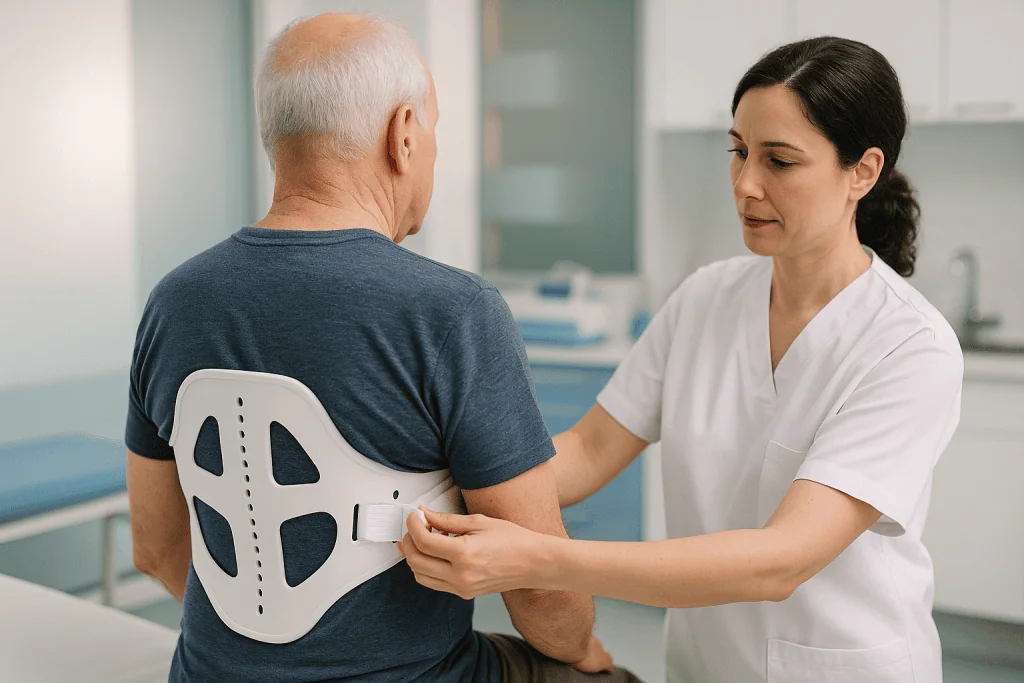
For children and adolescents who are still growing and have moderate curves, a back brace may be recommended. A brace does not straighten an existing curve; its purpose is to prevent the curve from getting worse during growth. Braces are typically worn for a prescribed number of hours per day until growth is complete. Evidence supports bracing as an effective way to reduce the chance that a curve will progress to the point of needing surgery, although results vary from person to person. Bracing is generally not used in adults, because their spines have finished growing.
Physical therapy and exercise
General exercise and core-strengthening activities are usually encouraged for overall spine health. Some structured, scoliosis-specific physical therapy programs are used in certain cases, often alongside bracing. Exercise alone is not proven to correct a structural curve, but it can help with posture, flexibility, muscle balance, and pain, particularly in adults.
Medication and pain management
There is no medication that treats the curve itself. In adults with painful degenerative scoliosis, doctors may suggest over-the-counter pain relievers, physical therapy, or, in selected cases, injections to reduce nerve-related pain. These measures address symptoms rather than the curvature.
Surgery
Surgery is generally considered for severe curves, often around 45 to 50 degrees or more, for curves that continue to progress despite other measures, or when the curve causes significant pain, nerve problems, or breathing difficulty. The most common operation is spinal fusion, in which the surgeon straightens the curve as much as safely possible using metal rods and screws, and then joins (fuses) the affected vertebrae so they heal into a single, stable segment of bone. In young children who are still growing, growth-friendly techniques, such as expandable rods, may be used to control the curve while allowing the spine and chest to keep growing. Like all major surgery, spine surgery carries risks, and the decision is made carefully after weighing the potential benefits against those risks for each individual.
Living with scoliosis and outlook
For most people, the outlook with scoliosis is good. Mild curves often remain stable, cause few or no symptoms, and do not limit daily life. Children and adolescents with scoliosis can usually participate fully in school, sports, and other activities, and doctors generally encourage them to stay active. Wearing a brace can be emotionally challenging for teenagers, and support from family, friends, and the care team can make a meaningful difference during that period.
Larger curves need closer follow-up. In adults, curves can slowly progress over decades, and degenerative changes may add pain or stiffness with age. Regular check-ups allow the care team to track any change and adjust the plan as needed. People who have had spinal fusion surgery typically return to most activities after recovery, although the fused portion of the spine loses some flexibility, and long-term follow-up is usually recommended.
It is honest to say that scoliosis usually cannot be “cured” in the sense of making the spine perfectly straight without treatment, and even surgery aims to correct and stabilize the curve rather than restore a completely normal spine. However, with appropriate monitoring and treatment when needed, most people with scoliosis lead full, active lives. No outcome can be guaranteed, and your doctor is the best source of guidance for your individual situation.
Frequently asked questions
What is scoliosis in simple terms?
Scoliosis is a sideways curve of the spine. Instead of running straight down the back, the spine bends to one side, often with some twisting of the vertebrae. It is usually diagnosed when the curve measures 10 degrees or more on an X-ray. Most cases appear during childhood or adolescence, and in most of those cases the exact cause is unknown.
Can scoliosis heal on its own?
Structural scoliosis does not usually go away on its own, because the shape of the spine itself has changed. However, many mild curves stay stable and never cause problems, particularly once growth is complete. Functional curves caused by something else, such as a leg-length difference or muscle spasm, may improve when the underlying issue is addressed. Only a doctor can determine which type of curve is present.
How serious is scoliosis?
In many cases, scoliosis is not serious. Mild curves often need only periodic monitoring. Seriousness increases with the size of the curve and how quickly it is progressing. Severe curves can cause visible deformity, pain, and, rarely, breathing problems if the chest is affected. Regular follow-up helps catch progression early, when simpler options such as bracing may still be effective in growing children.
What are the first signs of scoliosis?
Early scoliosis symptoms are usually visual rather than painful: one shoulder or hip higher than the other, a shoulder blade that sticks out, an uneven waistline, or clothing that hangs asymmetrically. A rib hump when bending forward is another common early sign. Because children rarely complain of pain, parents or school screenings often notice these changes first.
Does scoliosis always need surgery?
No. Most people with scoliosis never need surgery. Treatment is matched to the curve: mild curves are usually observed, moderate curves in growing children may be braced, and surgery is generally reserved for severe curves, often around 45 to 50 degrees or more, or curves that keep progressing or cause significant symptoms. Your doctor may recommend a period of monitoring before considering any procedure.
Can adults develop scoliosis?
Yes. Adults may have scoliosis that began in adolescence and persisted, or they may develop a new curve later in life as the discs and joints of the spine degenerate with age. Adult scoliosis is more likely to cause back pain, stiffness, or nerve-related leg symptoms than childhood scoliosis. Treatment in adults often focuses on managing pain and function, with surgery considered only in selected cases.
What is recovery like after scoliosis surgery?
Recovery varies with age, health, and the extent of the operation. Most patients spend several days in the hospital and then gradually increase activity over the following weeks and months, often with guidance from a physical therapist. Return to school or desk work typically comes earlier than return to sports or heavy physical activity, which the surgical team will guide based on healing. Long-term follow-up visits and occasional X-rays are usually part of the plan.
When to see a doctor
It is reasonable to see a doctor whenever you notice a possible spinal curve or persistent asymmetry in yourself or your child, even if there is no pain. Early evaluation matters most in growing children, because treatment such as bracing works best before a curve becomes severe. Adults with a known curve should also seek review if their symptoms change or worsen.
Seek prompt medical attention if any of the following red-flag warning signs occur:
- New or worsening weakness, numbness, or tingling in the legs or feet.
- Loss of bladder or bowel control, or new difficulty urinating: this can signal pressure on the spinal nerves and needs urgent assessment.
- Severe or rapidly worsening back pain, especially pain that wakes you at night or does not improve with rest.
- Shortness of breath or reduced ability to exercise in someone with a known large curve.
- A curve that appears to be changing quickly, such as a visibly increasing rib hump or worsening posture over weeks to months.
- Back pain in a young child, particularly when combined with fever, weight loss, or a visible spinal curve.
- Problems with balance or walking that are new or getting worse.
These signs do not necessarily mean something serious is happening, but they should be evaluated promptly by a medical professional so that the cause can be identified and treated appropriately.
Patient Guides for This Condition
Medically reviewed by the Acıbadem International Medical Board September 2, 2026
See our medical review board →
Update history
- PublishedJune 8, 2026
- Medical review approvedSeptember 2, 2026
- Last content updateSeptember 2, 2026