

Scoliosis Surgery Recovery: Week by Week
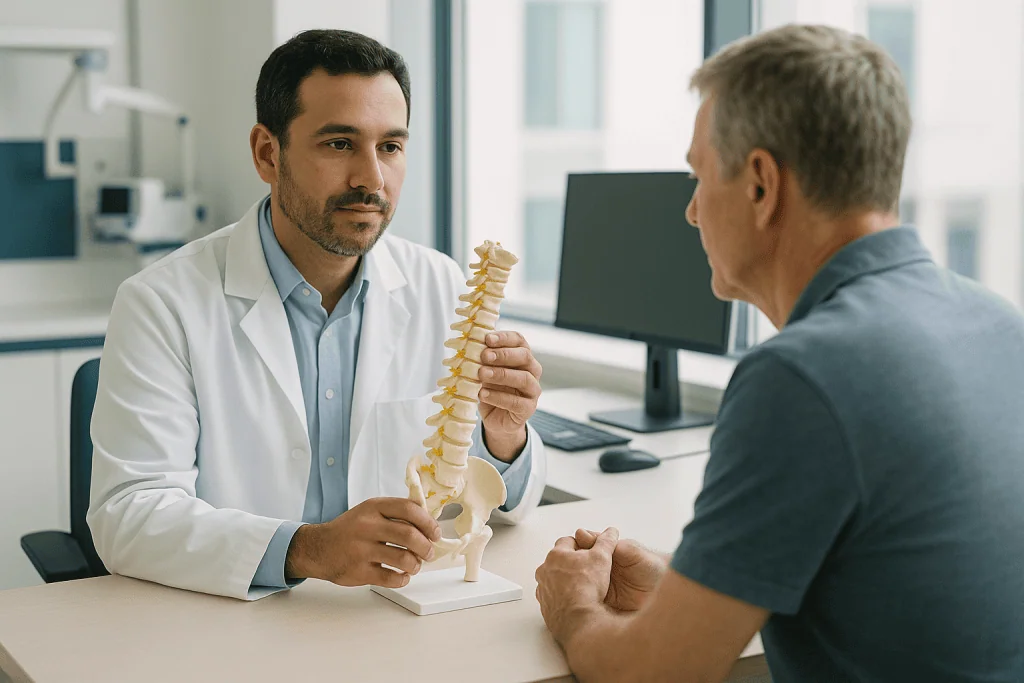
Scoliosis surgery usually means 4 to 7 nights in hospital. Most people take their first assisted steps within the first 48 hours, return to normal eating within the first few days, and shower once the wound is sealed, typically within the first two weeks. Flying home is usually cleared around one to two weeks after discharge, and full recovery typically takes 3 to 6 months.
Key Takeaways
- Hospital stay is usually 4 to 7 nights; assisted walking typically starts within the first 48 hours.
- Bending, twisting, heavy lifting and high-impact activity are avoided until the spine surgeon clears them.
- Everyday function usually returns over 3 to 6 months; bone fusion and sport clearance can take longer.
- Fitness to fly is usually assessed one to two weeks after surgery; the operating team gives final clearance.
- Fever, wound discharge, calf pain, breathlessness or new leg weakness need immediate contact with the team.
- Follow-up after returning home is done remotely with the operating team using your discharge records.
What recovery from scoliosis surgery actually involves
Scoliosis surgery corrects and stabilises a significant sideways curvature and rotation of the spine. In the most established technique, spinal fusion, the surgeon realigns selected vertebrae with screws and rods and places bone graft so the treated levels heal into one stable segment. The operation is performed under general anaesthesia and usually takes 4 to 8 hours, followed by a hospital stay of 4 to 7 nights. Because the metal implants hold the spine in position from the first day, most people are helped out of bed early, but the bone itself takes months to fuse, which is why the published recovery time is 3 to 6 months. You can read how the operation is planned and performed on the scoliosis surgery treatment page.
Recovery has two parts that run at different speeds. Pain, wound healing and everyday independence improve over days and weeks. Bone fusion and the return to unrestricted activity take months, and during that time bending, twisting, heavy lifting and high-impact activity are avoided until your spine surgeon clears them. This guide describes what most patients experience, but every spine, every curve and every operation is different. Your surgeon’s instructions always take precedence over any general timeline.
Recovery timeline, week by week
The first 48 hours
- Pain and what controls it: pain is usually strongest in the first two days and is controlled with scheduled medication set by the anaesthesia and surgical team. Tell the nurses if pain is stopping you from breathing deeply or moving, because the plan can be adjusted.
- Movement and lifting: physiotherapists and nurses usually help you sit on the edge of the bed and take the first steps within the first 48 hours. You are taught to roll and rise without twisting. No lifting at all.
- Wound and dressing: the incision along the back is covered with a dressing that the team checks and changes. A drain, if placed, is usually removed in the first days.
- Eating and drinking: most people start with fluids and light food as the anaesthetic wears off and the bowel wakes up. Nausea is common and is treated.
- Breathing exercises: deep-breathing exercises begin straight away to keep the lungs clear after a long operation lying face down.
- Washing: bed washes only; the dressing stays dry.
- Sleeping position: lying on your back or side with pillows placed by the nurses; you are taught the “log roll” to turn without twisting.
Week 1
- Pain: usually improving each day. Oral medication typically replaces intravenous pain relief before discharge, and you go home with a written plan for tapering it.
- Movement and lifting: walking on the ward several times a day, then stairs with the physiotherapist before discharge. Nothing heavier than a light bag; no bending or twisting.
- Wound: the dressing is inspected and usually renewed before discharge. Stitches or staples, if used on the skin, are removed or dissolve according to your surgeon’s timetable.
- Eating and drinking: most people eat normally by discharge. Fluids, fibre and mobility help with the constipation that strong painkillers commonly cause.
- Washing and showering: most patients are allowed to shower once the team confirms the wound is sealed, keeping the incision protected as instructed and patting it dry. No baths or soaking.
- Sleeping: a firm mattress, lying on the back or side, using the log-roll technique.
- Driving: not permitted.
- Discharge: most people leave hospital 4 to 7 nights after surgery to nearby accommodation rather than travelling straight home.
Week 2
- Pain: usually manageable with reduced oral medication; muscle stiffness across the shoulders and back is common as posture adjusts to the new alignment.
- Movement and lifting: gentle daily walks, gradually longer. Still no bending, twisting or lifting beyond very light objects. Sitting for long periods is usually uncomfortable, so alternate sitting, standing and walking.
- Wound: a follow-up wound check is usually arranged in this period. The wound should be dry, with no new redness or discharge.
- Eating and drinking: normal diet; good protein intake supports healing.
- Washing: showers are usually fine; avoid scrubbing the incision or soaking it.
- Driving: not permitted while taking strong painkillers or while trunk movement is restricted.
- Flying: this is usually the earliest point at which a fitness-to-fly assessment is considered (see below).
Weeks 3 to 6
- Pain: typically reducing to a level controlled with simple painkillers. Nerve-type sensations along the incision are common as skin nerves recover.
- Movement and lifting: walking becomes the main exercise, and physiotherapy exercises given by the team continue. Bending, twisting and lifting beyond light household items remain restricted until your surgeon says otherwise.
- Wound: the incision is usually fully closed; the scar may feel numb or tight. Protect it from direct sun.
- Washing: normal showering; baths only when the surgeon confirms the wound is fully healed.
- Sleeping: most people sleep more comfortably, still avoiding twisting positions.
- Driving: some surgeons allow short drives towards the end of this period once you are off strong medication and can turn to check mirrors without pain. Ask before you drive.
- Work and school: school-age patients and people with desk-based work often begin a phased return in this window, usually with reduced hours.
Months 2 to 3
- Pain: usually occasional and activity-related rather than constant.
- Movement and lifting: follow-up imaging typically checks alignment and early fusion. Based on this, the surgeon may progressively relax lifting limits and permit low-impact activities such as longer walks, stationary cycling or swimming.
- Wound: the scar matures and softens over the following months.
- Driving: most people who drive have resumed by now, with surgeon approval.
- Work and sport: physically demanding jobs and contact or high-impact sport are still restricted. Sedentary work is usually back to normal hours.
Months 6 to 12
- Pain: most people report little or no daily pain; some stiffness in the fused segment is expected and permanent, because those levels no longer move.
- Movement and lifting: as fusion consolidates on imaging, the surgeon usually clears heavier lifting and, later, higher-impact activity. The published recovery time of 3 to 6 months refers to everyday function; a return to demanding sport is often later and is decided case by case.
- Work and sport: manual work and sport are reintroduced in stages agreed with the surgeon.
- Follow-up: imaging at intervals set by the team monitors fusion and alignment.
When it is safe to fly home
Most international patients stay near the hospital after discharge and are usually assessed for travel around one to two weeks after surgery, once the wound is sealed, pain is controlled with oral medication and walking is steady. Some people need longer, particularly after long fusions or when there were complications. The operating team gives the final clearance; no general timeline replaces that decision.
Timing matters for three reasons. Swelling around the surgical site and the effects of a long anaesthetic take time to settle. Reduced cabin pressure and dry air can worsen dehydration and discomfort. Most importantly, prolonged immobility on a long-haul flight raises the risk of blood clots in the legs, and this risk is already higher after major spinal surgery.
A fitness-to-fly assessment is part of the discharge process. It usually covers the wound, pain control, mobility, breathing, circulation and any signs of infection or clot, plus a review of medication and a written summary for the airline or your home doctor if required. On the flight, an aisle seat with legroom makes it easier to stand and walk every hour or two. Ankle and calf exercises while seated, plenty of water, avoidance of alcohol, and compression stockings if the team recommends them all help. Carry your discharge summary, medication list, a supply of painkillers and any prescribed anticoagulant in hand luggage, together with the surgeon’s letter describing the implants, which may be needed at airport security.
Warning signs: when to contact your care team immediately
- Fever or chills, or feeling generally unwell.
- Redness spreading from the incision, increasing warmth or swelling around the wound.
- Any discharge, opening or bleeding from the wound.
- Pain, swelling or tenderness in one calf or thigh.
- Sudden breathlessness, chest pain or coughing up blood.
- Pain that is worsening rather than improving, or not controlled by the medication you were given.
- New or worsening numbness, tingling or weakness in the legs or feet.
- Difficulty passing urine, or loss of bladder or bowel control.
- A sudden change in posture, a new prominence under the skin along the spine, or a clicking sensation at the implant site.
- Severe headache when sitting or standing, or clear fluid leaking from the wound.
Recovering in Türkiye and then at home
Scoliosis surgery is performed at Acibadem hospitals in Ankara and İstanbul within the Orthopedics & Joint Center. After the 4 to 7 night hospital stay, international patients usually stay in accommodation near the hospital until the first follow-up. The international patient team coordinates prior reports and imaging, arranges appointments and organises the hospital visit and the follow-up after the patient returns home; interpreters can be arranged. A fitness-to-fly assessment before the return flight is part of the discharge process.
Before you leave, a follow-up appointment with the operating team checks the wound and mobility and confirms the travel plan and restrictions. After returning home, follow-up is done remotely with the operating team, and later imaging can be arranged locally and shared. Take home the operative report, the implant record, the discharge summary, the medication list with tapering plan, the physiotherapy programme, copies of pre- and post-operative imaging, and written instructions on activity limits and the schedule for future X-rays.
Questions to ask your surgeon before you fly out
- How many spinal levels were fused, and what does that mean for my movement long term?
- Exactly what may I lift, and when will each restriction be reviewed?
- When may I shower without protecting the wound, and when may I bathe or swim?
- Which medications do I continue, and how should I reduce them?
- What specific signs should make me seek urgent care in my home country?
- When will I be assessed for fitness to fly, and what if I am not ready?
- Do I need compression stockings or blood-thinning medication for the flight?
- How will remote follow-up work, and when should the next X-rays be taken?
- When may I drive, return to work or school, and resume sport?
Add us as a Preferred Source to see more of our trusted health content across Google Search, AI Overviews and Discover.

Update history
- PublishedSeptember 9, 2026
- Medical review approvedSeptember 10, 2026
- Last content updateSeptember 9, 2026
More Patient Guides

Septoplasty Recovery: Week by Week
Learn what to expect after deviated septum surgery: a week-by-week septoplasty recovery timeline, when it is usually safe to fly home, and…

Gallbladder Surgery Recovery: Week by Week
Learn what to expect after gallbladder surgery: a week-by-week recovery timeline, pain, diet, wound care, when it is safe to fly home…
Robotic Hysterectomy Recovery: Week by Week
Recovery from robotic hysterectomy week by week: pain, lifting, wounds, driving, flying home safely, warning signs and questions to ask before you…

Breast Reconstruction Recovery: Week by Week
DIEP flap recovery week by week: hospital stay, drains, pain, walking, showering, driving, when it is usually safe to fly home, and…